> As a comparison a Tesla Model 3 got 975km (606 miles) at 40 km/h (25 mph) [1]. I can't seem to find any range tests at a similar speed as the Nexo.
> It doesn't seem like current fuels cell have much of a energy density / range advantage even though hydrogen itself is much more energy dense, the fuel cell weight and efficiency and high pressure liquid hydrogen tanks must be accounted for.
I'm curious to know how you come to this conclusion? I don't know much about aerodynamics other than at, as a first order approximation, drag is proportional to the SQUARE of the velocity. Driving 887.5 km at an average speed of 66.9 km/h is, afaict, much more impressive than driving 975 km at 40 km/h.
What is the energy density delta between a HFCV and BEV currently?
>What is the energy density delta between a HFCV and BEV currently?
Depends on what you're counting. Mirai's fuel cell stack, composite overwrapped tank, additional underbody and rear impact crash protection, high pressure filling system, cooling and fan intake system, and lithium battery together masses well over 400kg. Also takes up a lot of cabin and cargo space necessitating a larger vehicle.
Tesla's new 4680 batteries form part of the vehicle's structure and add free torsional rigidity, and will weigh roughly the same as a fuel system for 600km range. I imagine in the compact they'll package it into the unused area under the rear seat in order to drop the floor which should help with CdA.
Hydrogen has a better gravimetric scaling than batteries - as stored energy increases, the fixed weight of the fuel cell is amortised over more energy and the weight of high pressure tanks goes up with their surface area while the energy stores goes up with volume.
So for applications where you want to store a lot of energy and are weight but not volume limited, hydrogen might make enough sense to pay the efficiency penalty required to turn electricity into hydrogen and back again.
That's why it makes more sense for big trucks than it does for passenger cars where volume limitations matter a lot more and where total energy is less.
Nope, tank mass scales with volume because bigger tanks need thicker walls: https://en.wikipedia.org/wiki/Pressure_vessel#Scaling
In particular, pressurized automotive-size hydrogen tanks aren't made from metal at all, they are typically epoxy/kevlar/carbon fiber composites.
At around 2000 wh/kg you are equivalent to diesel drivetrain energy density both size and weight based on my rough math.
Expensive large hydrogen tanks in a trailer with high pressure lines to tractor seems like it would cause safety and cost issues offsetting much of the benefit.
But I'm always amused to think that posters on HN give more credence to their back-of-the-napkin calculations over opinions of, say, folks at Toshiba, Volvo or Daimler.
You should alway try to understand the math / science and make your own judgements rather to falling for arguments from authority. This isn't always feasible but I think most people can do enough to weed out the snake oil to a much better degree than we seem to be doing as a society now.
Note this will also make you a better engineer / programmer in my experience.
For instance the Semi being announced in 2017 I said no way, but their range numbers where not outlandish, they just conveniently left off weight numbers for the tractor and cost of the battery seemed to high at the time. What I missed was how quickly battery cost are coming down and energy density going up, however they still haven't delivered a tractor yet so...
Tesla has a real tech lead, not sure if they can keep it and they are way over valued stock wise.
Nikola complete BS.
H2 offered the highest ISP, ie energy per fuel mass, and originally they wanted the Shuttle to be a single stage to orbit vehicle. But Hydrogen also added larger, much heavier tanks and engines didn’t have enough thrust for that. So they had to add large Solid Rocket Boosters to get off the pad. And all they additional dry mass meant the higher ISP of H2 was wasted.
And now the SLS is repeating those mistakes, not because engineers didn’t learn those lessons, but because politicians require them to repeat them.
Engineers recommending Hydrogen for cars are influenced by regulatory requirements and benefits, and politically by company objectives. If your CEO says Hydrogen is important to use because our government and regulators say it is, you as an engineer will find a way to make the best of a bad choice.
They also have large resources and are willing to experiment in things (especially if there are incentives around it from government, etc) - and even if it fails entirely they'll likely get useful and actionable data and results that still can help the company.
Which umm shows you never know who’s posting here.
The Emperor and the downtrodden, the Ivey League and the community college, you'll find the same mathematics wherever you go.
Some may have an advantage in innovation or inspiration, but it should he fair trivial for any sufficiently motivated individual to check the numbers.
It's also not inconceivable that if we have more base load power generation (e.g. through more nuclear) then we could generate hydrogen at night with the excess.
Liquid hydrogen at -253c that is more energy intensive to make than high pressure.
Not sure I see that being practical.
For trucks where you need bigger tanks, both autonomy and boil-off rate improve by themselves due to the square-cube-law. And you can use the boil-off to charge the batteries in your hybrid electric powertrain, run auxiliary systems etc.
The LH2 trucks currently under planning have sophisticated fuel management systems where the driver inputs where she will stop and for how long, and the truck will optimize LH2 consumption and battery SoC before arriving at the stop point.
As for LH2 versus compressed: do you actually know how energy demanding a hydrogen compression train is? Compressing a low molecular weight gas to 700 bar is just fundamentally inefficient.
At the scale required for mass adoption of hydrogen fuels, both compression and liquefaction are talking 6-8 kWh/kg. For comparison the energy content in hydrogen itself is 33 kWh/kg. So naturally there is great interest in recovering as much as possible of that work before consumption.
"To stay a liquid, hydrogen must be cooled and maintained at cryogenic temperatures of, at warmest, −253 °C (20.1 K; −423.4 °F). When not using fuel, the Hydrogen 7’s hydrogen tank starts to warm and the hydrogen starts to vaporize. Once the tank’s internal pressure reaches 87 psi, at roughly 17 hours of non-use, the tank will safely vent the building pressure. Over 10–12 days, it will completely lose the contents of the tank because of this"
At that temperature even sloshing around adds enough energy to heat and cause venting much sooner another reason its not great for mobile use.
Looks like Air Liquide made a different one that you are quoting perhaps an improvement, still high vacuum double walled, so you lose all your fuel in a month instead, thats progress.
This shows liquefaction to be about twice as energy intensive as compression (1.3 vs 3.4 kWh/kg theoretical 6 vs 13 kWh/kg actual) [2] So please point me to better info.
1. https://en.wikipedia.org/wiki/BMW_Hydrogen_7
2. https://www.hydrogen.energy.gov/pdfs/9013_energy_requirement...
Even if it offers 20% better range and some allegedly better refuel experience (H2 people keep handwaving that as "solved"), that wouldn't justify the gigantic infrastructure switchover cost.
Electric vehicles can use the grid. That's a massive advantage for infrastructure readiness and scalability, even if the current grid isn't ready for full EV consumer transportation.
EVs can use home solar as well. Easily scalable, adds redundancy and alleviates load to the grid.
H2 would need a huge buildout of hydrogen generators, transporters, refuelling. EVs are so far ahead of all of that.
By the time any significant H2 infrastructure was out there, it'd be 10 years even if they secured 100s of billions in financing yesterday.
In 10 years, the alternative energy / solar / home solar / grid / battery / storage economic proposition is likely to be 50% cheaper in real dollars, and possibly even better.
It's the same problem nuclear faces.
Sure, throw some money at places like aviation or maritime shipping.
But it's just distraction, because I think the oil industry knows that the hydrogen will come from natural gas for the foreseeable (10-40 years) with some "future switchover" to "green hydrogen".
Green hydrogen smacks of "clean coal". Granted the physics/engineering for it are a lot more realizable.
But everyone should see that for the shell game it is.
Hydrogen was always a distraction. Fuel cells have been 10 years away from practicality since the 80s, and hydrogen production was only ever non-fossil-fuel-based in theory. It's 100% a smokescreen to protect fossil fuels.
Even the greatest H2 car is always just going to be a second class EV with "weird fuel needs".
https://en.wikipedia.org/wiki/Hydrogen_internal_combustion_e...
One of the largest producers in the world (CF Industries in Louisiana) has committed to producing it using offshore wind, and renewables in general (and their terminals are located in geographic areas where there is already high penetration of renewables on the local grid).
https://www.cfindustries.com/globalassets/cf-industries/medi...
In practice, some buffering pressurization may be necessary, but the scale of pressurization needs will be a lot lower than is required to store hydrogen long term.
That doesn't sound so ... bad?
No oil spills beats a few oil spills - but these are not an Exxon Valdez sized event, and they don't really matter in the grand scheme of things.
Wow, it must have been brutal to drive 1,000km under faux heavy urban conditions.
Being low on joules is a pain when you're going to work in the morning, but it's a royal pain if you have to wait a half hour to charge.
The last time I looked at it, it turned out that hydrogen filling stations need a significant time after fueling each car to get back to transfer pressure. If you want to fill your tank right after someone else, you'll have to wait for a bit.
But overall, filling time is not that big of a deal. Most people don't really drive that much, and the car spends the majority of its time in a parking lot. In practice it turns out that just charging it at home every day is more than enough to keep a battery full.
In addition to that, commercial vehicles often have a driving time limit. As long as the recharge period is shorter than the mandatory break, you are not going to care about the recharge speed.
And both battery capacity and charging speed are quickly improving. There might be a small niche for hydrogen, but it's disappearing rapidly.
If you have a plug at home though thats much more convient at least to me when going to work.
I am not getting an EV anytime soon unfortunately.
But it is a significant project and it doesn't look like EV charging standards (plugs, power delivery) are set across all manufacturers.
The balance of effort+money vs benefit/risk means we will keep driving what we know for now.
I know the tide will turn sometime, but not anytime soon.
The Tesla numbers are correct and verifiable, actually. The problem is that the EPA "highway" test is designed to capture the "average highway mile" driven by a US vehicle (which makes sense, it was designed to inform purchasers of aggregate fuel use). Here's the driving schedule:
https://www.epa.gov/sites/production/files/2015-10/hwfetdds....
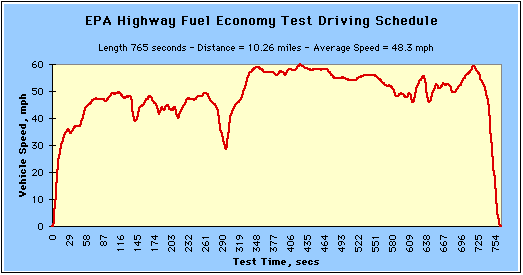
Note that it never goes above 60mph, and spends most of its time between 40 and 50. This isn't wrong, but it corresponds to an urban highway commute (again, which is pretty much the "average highway mile").
The problem is that this does NOT match what typical consumers think of as "highway driving", meaning blasting 75mph+ down an open road. So people get in their Model 3's and measure their consumption at those speeds and it doesn't match.
And it's true that other EV manufacturers (Ford, especially -- the Mach E actually does somewhat better than sticker consumption on the highway) chose not to run the full test and used other methods that put a higher number on their stickers. And in context that's probably more informative.
But nothing was "rigged". In fact Teslas in stop-and-go urban commute traffic really do get close to their sticker mileage. It's just that no one cares because one's battery doesn't run out on an urban commute before you get home to charge it. Ironically, EV owners in this case care LESS about efficiency than gas owners.
There are caveats. The lower end Model 3s hit their estimates pretty reliably. The Performance trim usually misses by a pretty big margin for most people. There are exceptions to every rule, but I owned a P3D and hung out with other P3D owners as well, and this was a commonly shared experience.
IIRC there was some youtube video a year or two back that tested a few variants on a track using what they claimed to be a replica of the EPA highway test, and the cars came out almost dead on.
There have been some independent tests and IIRC the consensus is that the standard range Model 3 was rated pretty accurately, and the Performance trim was rated something like 25-30 miles too high compared to reality.
But again, you're using the words "on the highway" to reflect what I assume to be your driving habits in rural open road conditions and not the test that was actually performed to produce the numbers in the product specs. And that was my point. It's not about advertising fidelity at all, it's about regulation and its mismatch with the expectations of a modern EV driver.
By that you must mean Tesla bothers to do the full suite of EPA tests instead of accepting a somewhat penalizing multiplier, like how other manufacturers do?
There's no rigging whatsoever and the same option is available for other manufacturers as well. If they bother to do the longer and more demanding test cycle, that is.
My old 2010 Prius was EPA-rated for 50 MPG. If I drove it with kid gloves over flat terrain, I could hit that mileage. If I drove it in a way that doesn't piss other road users off, I would get closer to 46 MPG.
If I was doing 80+ MPH over the Rockies on the Trans-Canada, I'd be getting a cool 35 MPG, because air resistance is very high at those speeds, and because most of my braking was exceeding the regenerative capacity of the car.
Model Y will blow the doors off the Nexo in performance due to much larger electric motors.
As a comparison a Tesla Model 3 got 975km (606 miles) at 40 km/h (25 mph) [1]. I can't seem to find any range tests at a similar speed as the Nexo.
I found an EPA dyno test for the Model 3 at 77 km/h (48mph) for 708 km (440 miles).
The Nexo and Model 3 have similar dimension and weight and price, while the Nexo advertises 380 miles vs 353 miles.
It doesn't seem like current fuels cell have much of a energy density / range advantage even though hydrogen itself is much more energy dense, the fuel cell weight and efficiency and high pressure liquid hydrogen tanks must be accounted for.
Also fuel cell cars seem to use a buffer battery and have lower power output than BEV's as current fuel cells can't output as much burst power and can't store power from regenerative braking with out a battery somewhere.
Pretty skeptical about hydrogen fuel cells compared to the continued advancement in battery tech.
1.https://electrek.co/2018/05/27/tesla-model-3-range-new-hyper...
Edit: very good efficiency comparison of hydrogen vs batteries by Volkswagen, which to me shows the biggest issue with using hydrogen in cars the "well to wheel" efficiency:
https://www.volkswagenag.com/en/news/stories/2019/08/hydroge...