I'd be more interested in what you think it "should" look like for an "advanced" species besides optimal?
Looking at it is disparagingly is weird to me, when the conclusion is maybe humans in aggregate are optimal with regards to finding and using resources to grow.
Not that we're growing unbounded either because that would be bad, we're in population decline across many major nations right now and are working towards a greener future in multiple industries to avoid resource collapse.
The level of doom and gloom and misanthropy is generally unwarranted if you look around at the steps we're taking to better ourselves as a species and every time I read things like this I can't help but think people revel in the supposed helplessness of our potential destruction and inability as some perverted pleasure.
In a word, sustainable. An advanced civilization should be able to develop in a coordinated and self sustaining way, rather than as a grand experiment in tragedy of the commons. Microbes don’t coordinate their growth, and therefore fall into boom-bust cycles that dominate and exhaust their local environment. Humans can reason about these issues, but we see insufficient ability to collectively coordinate in response to them.
> The near universal consensus of people who study natural systems is that we’re way, way, way behind.
What other advanced civilization is our benchmark for making such an assessment?
The second point isn't dependent on an external comparison.
If the goal/definition is concrete, then we can plan better and understand what is "enough" once we're caught up.
Alternatively, if you're simply putting out a Vision to inspire enthusiasm or incite fear, then "we're behind" is sufficient and doesn't require anything more because at best, it's the "race to the moon" and at worst, it's the "missile gap."
I mean, I guess I am, but really I'm mostly relaying my understanding of the scientific consensus. I didn't make my comment in some sort of vacuum where readers are supposed to understand the last few decades of climate science just from my comment...
In a situation where "we're behind" and "we're ahead" are both accurate statements point to a significant problem in the approach.
You choosing one of them exclusively means you're playing for "your team" instead of looking at reality of the situation which is neither useful nor honest.
To the best of my knowledge, my language (while imprecise) is completely and totally uncontroversial in the scientific community.
"And when will that be?"
"Well, not to beat around the bush, but when the cancer has metastisized and is about to kill you, we will be certain enough of the benefit of surgery now. Yes, this will likely result in your death, but to move before we have solidified all of these variables to a five-sigma measure would be allowing too much emotion into our descision making."
Press releases and pop-science articles tend to try to strike a more hopeful tone, because it's extremely tiring and depressing just hearing "we're screwed" all day. I try to stay hopeful, but my faith that enough people will care soon enough is basically gone.
Nothing I’ve said disagrees with the scientific consensus, so you could also just Google it rather than whining that someone on the internet isn’t holding your hand.
Can you prove what the scientific consensus is? What if I were claim the scientific consensus is different than what you claim it to be?
Do you think running out of oil will go smoothly? We already can't stand still for 5 minutes without blowing someone up in a resource war and basically all of our resources are plentiful for now.
Rising sea levels decreasing usable land. Rising temperatures destroying key organisms in the food chain. Mass deforestation is destroying the very things that allow us to breathe.
How much climate change affects you is a function of your wealth and your country's wealth (cost of basic resources as well as required countermeasures are growing). Anyone who's been on the low side of one or both of those variables will tell you that it's already miserable. Imagine, if you even can, what being in a poor country will be like when all the oil is gone, food can't grow the usual way (you need either hydroponics or serious genetic modification), increasingly unstable weather destroys everything you build and everyone else is out to get you to squeeze out every last drop of resources you might have?
What people with no such experience don't realize is that unlike our economic system, which funnels resources upwards, ecosystem collapse doesn't funnel them anywhere. It's just an endless pit and eventually, everyone is poor.
Example: Second world war. You might argue that it was not disaster comparable to climate change, but it did turn entire world upside down, disrupting everything aspect of life of vast majority of world's population. But it also led to incredible advancements in many areas, new discoveries in all sciences, new technologies, massive changes in societies as well.
So I don't see the situation as gloomy, we will survive, because we always do.
Taking an approach that "we will sort it out" ignores that the disaster is already unrolling, just too slow for most of us to notice. The longer we linger, the worse the situation, and the higher the human toll.
I look at the insanity in how the US responds to small movements of people now and despair at the thought of how we’ll deal with simultaneous waves of millions of climate refugees alongside the predictable handful of domestic crises.
https://climate.nasa.gov/faq/16/is-it-too-late-to-prevent-cl...
https://www.climate.gov/news-features/climate-qa/can-we-slow...
Going to need something a little stronger than xkcd here. I'm not a climate scientist but a lot of the names attached to both links seem to be and they're saying if we act decisively in the next 29 years we can avoid the worst effects, which in that second link is defined as < 1.5C change this century
Edit: I also want to make it clear just in case anyone misinterprets my skepticism over the depth of the effects as skepticism in climate change or the urgency of it in general. I agree we need to do what we can to make sure things like this don't come to pass because I happen to like our somewhat diverse ecosystem and that we continue to damage it isn't great.
Whenever you read a study saying that 'In complex system X, Y will happen in a decade' breathe easily -- we can't model what the stock market will look like in a day. We can't model what user demand for a sale will be in a week. We can't model most complex things in any large time frame, and believing any conclusions in the XX years for something as complex as climate is bizarre.
The second link says we are unlikely to keep global warming in this century below 2.7° Fahrenheit (1.5° Celsius) which has severe consequences for the environment.
I think you’re reading into their optimistic language a bit too much.
Do you watch the news? Have you seen a completely ice-free North Pole earlier in January? The ice in Norway, Russia and Iceland melting completely, permanently damaging the permafrost and releasing huge amounts of methane? Might be hard to notice from your apartment but the weather is going absolutely nuts in most of the world. Insect populations down by up to 90%. These are not “feelings”.
You missed the first part of their sentence.
On the flipside perhaps you're a little too much into doomsday scenarios?
We've quite literally transformed the entire planet and way of living inside of 30 years since personal computation technology took off. I really don't see it as particularly farfetched that we can correct for our negative consumptive habits inside of the same timeframe, considering our rate of advance and change only accelerated within that same timeframe.
I'll live out just the end of this century if I'm lucky so I'll be able to eat my words just fine if I'm wrong, but I'll bet you I'm not.
> Even if we stopped emitting greenhouse gases today, global warming would continue to happen for at least several more decades, if not centuries
or
> In the absence of major action to reduce emissions, global temperature is on track to rise by an average of 6 °C
There is not much major action going on (except for the electrification of vehicles which is being driven by commercial venture) so your hopes are just that, hope. Hope is not a strategy. It is quite far fetched to expect a correction when literally all data points are going the other way.
Your view does not reflect the common scientific consensus. We’re at a stage where changes are irreversible and all we can do is minimize and prepare for them, as seen in the article.
This is not fatalism, much to the contrary: I’m saying corrective action is much, much more urgent than you seem to believe and has to be started immediately. We don’t have another 30 years to sit on it.
You also keep saying scientific consensus and data points but considering I keep finding information to the contrary and you’ve provided nothing I really think you mean your own personal and emotion driven stance. Of which I don’t buy.
Yup climate change is a big issue, we'll probably solve it to a point humanity and the broader earth will be fine in a reasonable time. Just like every other crazy things we've pulled off during the same geological instant.
All it offers is a meaningless “it’s up to us what happens next”. Where is the information to the contrary you see?
Here is an extensive report, from the same source, on the effects of predicted global warming: https://climate.nasa.gov/news/2865/a-degree-of-concern-why-g...
Read it carefully, and note that the 1.5C scenario is extremely optimistic and assumes humanity will zero out emissions completely by 2050.
If we manage to get it started, what if another Trump gets elected and sabotage it from the top?
I don't think we are. As long as we accept unbounded population growth, nothing is sustainable.
I'm not sure if it's technically a counterexample, but it's fascinating. Society seemed to collapse due to a series of causes, more or less unexplained to this day. (We have hypotheses, but it's still something of a mystery: https://en.wikipedia.org/wiki/Sea_Peoples)
Update: Upon some brief research, the last Ice Age ended about 12,000 years ago, whereas the Bronze Age Collapse was around 1200 BCE. So totally unrelated.
Lots of things are unsustainable in the short term but sustainable in the long term. Hunter-gathering for instance. If you pick the berries off a bush, they're gone. You can't keep doing that all day every day or the plant will never reproduce and eventually stop producing berries. But if you look at the hunter-gatherer's berry picking habits over a whole year, it may well be sustainable because he's not doing it at the same rate all the time. Similarly, our unsustainable behaviors may be limited to a few centuries of rapid change taking us into a new and different sustainable future that wouldn't have been possible otherwise.
I've also taken an amateur interest in ecology and the natural sciences, and once you actually learn a bit about the species around you, the loss of habitat and biodiversity we're undergoing becomes a staggeringly obvious fact that most people are just completely oblivious to.
There's lots of nuclear power plants out there, shut down for political reasons, that'd be ready to go in weeks if you didn't have all the anti-nuclear protests, for starters.
There's also geo-engineering and such - spraying black stuff in the atmosphere to reduce the amount of incoming sunlight.
The idea that humanity couldn't deal with this situation if it spent anywhere in the ballpark of 100% of its resources on it seems to me frankly laughable.
We've just seen first-hand evidence that millions of people could be dying and some would find it politically expedient to pretend that it wasn't actually occurring.
We absolutely have the resources and capability to solve these problems. We just don't have the will or the policy.
I'm sorry, I don't follow, who do you mean? Colonialism? The Uighurs in China? People in India/Pakistan? Possible victims of global warming? The Holocaust?
>We just don't have the will or the policy.
Right, that's what I mean. The minute things get anywhere near serious, people are gonna figure something out real quick. Restarting the nuclear power plants and closing the coal plants would take weeks, be profitable in economic terms, and hugely reduce greenhouse gas emissions. The fact that nobody's done this means we aren't serious about it.
I mean, if you were really serious, you would just deregulate nuclear power totally. If the estimates of the harms of global warming are true, you could take 1 Chernobyl-scale incident per year and still come out on top. The fact that nobody's done this means we aren't serious about it.
The combination of facts that (1) we aren't serious about this and (2) there's plenty of low-hanging fruit we could reap if we were, leads me to believe this will not really be a problem, as soon as we do get serious about it.
Sure, human technology is super advanced, but we are no play for the elements.
First, we look at the numbers concerning best case scenarios and see that a few degrees of warming is basically inevitable. Then, we ask how likely it is that well make rapid corrections now - personally I see little evidence of that, but I hope I’m wrong.
Next, try to remember that nothing in the world is disconnected. There’s a long scholarship concerning resource conflict and the destabilizing effects of mass migration. We don’t have a good track record of dealing with this, and I see little reason to expect us to become better at it soon.
The geoengineering idea is especially ludicrous to me - what we’re really talking about are emergency uncontrolled experiments to stave off a worse disaster. We’ve organized our entire global economic system around carbon - any geoengineering project has to not only compete with that, but actively remove more carbon from the atmosphere, which is a problem you’re underestimating the difficulty of.
Meanwhile, we need to worry about positive feedback cycles from various sources of methane, and the rest of the related threats to our biosphere (ocean acidification, wildfire, extreme weather).
To close, what has humanity done to convince you that we’ll 100% restructure our society to collaboratively solve this crisis “once it gets bad enough”?
Good riddance. If our technological global civilization results in conditions that make technological global civilization impossible, then so be it. It wasn't fit to exist to begin with. It's a self-regulating problem.
> There’s a long scholarship concerning resource conflict and the destabilizing effects of mass migration. We don’t have a good track record of dealing with this, and I see little reason to expect us to become better at it soon.
I don't know what you mean here - are you suggesting mass migration is inevitable?
> The geoengineering idea is especially ludicrous to me - what we’re really talking about are emergency uncontrolled experiments to stave off a worse disaster. We’ve organized our entire global economic system around carbon - any geoengineering project has to not only compete with that, but actively remove more carbon from the atmosphere, which is a problem you’re underestimating the difficulty of.
No, I mean spraying dust into the atmosphere to make it darker, so less sunlight comes in.
It's not just a matter of economy - people aren't even picking the low-hanging fruit. If any country wanted to severely cut CO2 emissions, there's a simple thing they could do:
1) reopen all the closed nuclear plants 2) deregulate nuclear power plant construction, focus on mass producing cheap power plants with no regard for safety 3) shut down the coal plants 4) throw everyone who protests in prison
Obviously, this isn't done because all of these steps are politically impossible. But it just goes to show - if we were serious about this, we'd have picked the low-hanging fruit already. If we haven't even picked the low-hanging fruit yet, how can you say it's impossible?
> To close, what has humanity done to convince you that we’ll 100% restructure our society to collaboratively solve this crisis “once it gets bad enough”?
It's like people procrastinating their homework until 5 minutes before the deadline. Eventually they'll get it done.
Matter of preference I guess. I like to hope humanity will continue to learn things about and explore the broader universe rather than descent into feudal oppression (or some-such) in the ashes of our former civilization, but whatever.
> I don't know what you mean here - are you suggesting mass migration is inevitable?
At this point, that's the conclusion, yes. Climate impacts cause incredible destabilization for folks who rely more closely on their local environment (subsistence farmers and the global poor generally), and yes - disruption leads to mass migration.
> No, I mean spraying dust into the atmosphere to make it darker, so less sunlight comes in.
.... yes, an emergency uncontrolled experiment to solve some of the symptoms of a global problem. The global economy as it currently exists is geoengineering at an absolutely monumental scale.
Also, your reply is just incredibly baffling and frustrating, to the point that I half think you're not being serious. "Oh, we'll just spray some dust in the air and reflect more sunlight to solve the problem" - it's ludicrous, and nobody serious who studies geoengineering shares your attitude. I do believe we're going to have to engage in geoengineering, but it's not something to be taken lightly (and the experts who study it generally agree). Never mind the fact that even if your "solution" worked, it wouldn't solve things like ocean acidification, and would at best buy us some time... while having potentially unforeseen consequences on cancer rates, crop production, solar efficiency, etc.
> It's like people procrastinating their homework until 5 minutes before the deadline. Eventually they'll get it done.
Talk about unearned optimism. Not everything is a problem you can just go "fix".
Probably fair to say that it's not low hanging fruit then.
I think a lot of time is being spent on finding politically correct solutions, but maybe we'll come full circle back to your solution after wasting a lot of time with fancy solutions that don't have a significant enough effect.
OP I was responding to stated:
"Microbes don’t coordinate their growth, and therefore fall into boom-bust cycles that dominate and exhaust their local environment. Humans can reason about these issues, but we see insufficient ability to collectively coordinate in response to them."
Government is how we collectively coordinate. Microbes exhaust their local environment by reproduction, hence the question.
Every man* has his own temperament, value system, -- and so on -- that reason alone begets wildly different what-should-be-dones. That is, unless the achievement of a narrow aim would benefit the many---and therefore all those different reason machines come together to collectively strive towards some end---then we have all sorts of different, many times conflicting, what-should-be-dones (politics is a prime example here).
Perhaps then an authority should be appointed?; someone or some group whose sole purpose is to reason all day and all night, until they come up with a what-should-be-done that benefits their constituency (of course, this assumes they didn't ascend by force, coercion, or some other deviousness).
But now, we get into this dreadful stalemate: the more constituents there are, the more the means and the ends have to be tailored to them, and the more the whole venture becomes watered down, in order to suit some muddied "average." Or perhaps the authority decides to "draw a line in the ground," to create some abstract "core" of acceptable means and ends (as well as people to enlist), and shun out the rest---in order to maintain some semblance of identity and individualism.
Yet, now we have two very inefficient differentiations. On one hand, we have the all-inclusive reasoning-body, that is so held back by trying to please all, that it pleases none. On the other hand, we have the some-exclusive reasoning-body, that -- fortunately, or unfortunately, depending on one's own reasoning -- shuts out the "others," and does nothing to support the advancement of their ends (many times, quite the opposite).
I think it is self-evident that both are inefficient towards the coordination of all humanity. So are there any alternatives?
Perhaps we could simply do away with collective coordination -- or atleast some less rigid approach?
What about some type of individualism?; where each man* decides his own fate. Therein, each member is responsible for his own fate, and therefore---collectively---the fate of all man? Each soul going in his own direction, serving his interests foremost, and pushing the fate of humanity, in his own image, little by little -- like some plant, slowly rooting itself into the most impenetrable places, and overcoming the, otherwise apparent, impossible odds.
On a local level, humanity is ever unsustainable, "booming-and-busting," but on the world level we have survived, and will continue until we lose our survival instincts (impossible, collectively). Each member of the human race will do what he must to survive and improve his own circumstances, even if it leaves others worse off; then, those worse-offs must now improve their circumstances further, and strive for a better life. In the end, each man guarantees the survival (but not thrival) of the human race, by the virtue of his selfishness.
*Are we still doing the "man" is not synonymous with "human" fad? It's more of a stylistic choice, rather than an "only men can use reason." I.e, it flows better than "hu-man."
I think where we differ is in our approach to language. I see it as a medium of art -- like a song or a painting. "Man" is but a certain, evocative hue of brown that I believe fits best into the feelings I'm trying to elicit; and "human" is a lesser, albeit passable substitute.
I think this scientificization, making it more rigorous and "comprehensible," has done the opposite. Words have connotations, denotations, and all sorts of deeper meanings behind them. "Human" is such a sterilized, unnevocative word; and I refuse to use it.
However, certainly you've felt something from its usage -- even if that feeling was not the one I felt (compare it to: human -- which only the most scientifically-obsessed would have their hearts sing from its utterance).
"Human" is a perfectly evocative word that does make people's "hearts sing". You have the "human touch", humanitarianism, treating things humanely. It reflects our highest aspirations for ourselves, and your rejection of it reflects upon you.
"Man" connotes... well, men. It depicts a society where the real movers and shakers are men. No one really hears "man" and thinks "men and women" (or "women and men" - why should men come first?). Notably, they say they do, but this has been shown by experiment to be inaccurate. If you say "man", people can't help but picture one. Indeed I also notice you use gendered language everywhere, not just in the word "man" to mean humanity. You say "men of letters", for instance, and you take care to match the pronouns. Am I really meant to imagine women when you write that? Would "people" not do just as well?
Lastly - far from being a "fad", this debate was active in the 70s, and has been entirely resolved now; nobody uses "man" this way anymore, and it sticks out like a sore thumb when you do. It sounds archaic to the point of comical. Consider if the subtextual message you want to send with your word choices is "I stubbornly refuse to adapt to the times".
Douglas Hofstadter (you may have heard of him!) wrote a lot about this in the 80s and 90s - I challenge anyone to read what he wrote and fail to be convinced: https://leeclarke.com/courses/intro/readings/Hofstadter_Chan...
Frankly, my experience has been that men are the real moves and shakers (and women impelling them to move, shake, and writhe around). It takes a certain amount of ego, and internal and emotional drive to "shake" and "move" (which I must assume you consider to be "good" aspects of humanity) the world -- one that most women do not have, and the ones that do require external resources to maintain that "drive" (mostly food).
I don't understand why you would rally around for this point. Being someone of substance is a worthless affair, compared to being someone of culture. The first comes easily to men, and arduously for women. The last comes easily to women, and arduously for men. It's an atrocity to eschew woman's gifts, to pursue men's. That's how you destroy a nation's culture, tradition, its children, and thereby its society. There must be a duality, with a strict boundary, else you get muddied people that don't know a single thing about what it means to be human. (in this context, it fit just right)
I use man in this way. I don't care what anyone---justifying their schooling and existence---has to say about it. Progress without purpose is wasted breath. Conforming for its own sake is death. Anything Western Intellectuals have written in the past 70 years I believe to be without merit.
...
Yet, I'll admit Hofstadter got a chuckle out of me with that riddle: I thought the surgeon was the male spouse of the deceased father! I yield.
I agree with your take, after it's been shoved in my face, and forced me to self-reflect. However, I'll still use "man" as a more archaic synonym of "human," albeit with a more apt note this time.
You got me. Take your upvote, and let me live in my crotchety, curmudgeon fantasy-land.
As a stylistic choice, I also have an aversion to dressing up human decision-making in such abstract and flowery terminology. We've invented lots of cool tools for thinking and doing, but we're still simply advanced primates with lots of baggage.
Like where do you think we are? https://en.wikipedia.org/wiki/Kardashev_scale
Seems to me like you are expecting too much. Worst part is, if that kind of thinking - do not exploit nature wins out - we might not even get there. Exploitation is key for scientific advancement in capitalism.
In capitalism? You mean, compared to the sustainable and non-exploitive nature of communism, for example?
The universe doesn’t grade on a curve.
> Exploitation is key for scientific advancement in capitalism
What a weird objection. It’s our science that tells us we need to radically reform how we consume resources. I’m not worried we’re going to waste all our resources in scientific endeavors, I’m concerned that we’re destroying the environment on which we depend for frivolous short term gains.
We’re another level of the fractal of life, replicating patterns seen in bacterial biofilms, slime molds, circulatory systems, nervous systems, leaves, all manner of multicellular architectures.
It’s certainly a bad thing that we are growing in a sort of zero-sum manner against many original ecosystems though.
We need to learn to restrain our own growth (a tough one that we’re in the process of trying to beat into all of our heads it seems), and also we need to learn how to maximize the potential for biodiversity to exist within the structure of human occupied areas as well. (A good book on this last subject is “Win-win Ecology”).
I also think we shouldn’t attempt to constrain growth but instead constrain footprint upon the Earth.
The human footprint already covers nearly the entirety of the planet. Conservation of systems that are within or directly adjacent to that footprint is actually very important. Extraordinary amounts of biodiversity are contained in these areas and we need to study how to reconcile our land use with the needs of that biodiversity. We shouldn’t ignore it out of a fear that people will get the wrong idea.
Grow food in vats, and the vast majority of the planet can just be like National Parks.
But I do think we can think of smart ways to ensure biodiversity under, say, solar arrays. Solar arrays are (or can be made to be) biologically inert. If they are high enough, they can act as a sort of technological canopy over a biodiverse forest floor. And that would only be a small portion of the planet (the rest would be National Parks). We’d use solar electricity to produce food super efficiently from vats. About 2000-4000W nameplate solar per person (at least in the 30N to 30S latitude that most people live in) should be enough to provide the macronutrients for the average person. At high efficiency, that’s about 10 square meters per person at noon. That’s just 100,000 square kilometers to feed 10 billion people, compared to over 50,000,000 square kilometers used for agriculture today (which is half of the habitable land surface of ~100 million km^2). It can be over the ocean, too. That’s just 0.02% of the Earth’s surface.
Consider this image: https://www.bloomberg.com/graphics/2018-us-land-use/img/2018...

Notice that for the USA for example, not very much of the land is state or federal parks. The vast majority is used by humans in some way, and the reality is that they’re not about to turn it all into parks.
So, while pushing for the protection of as much land as possible, we should also study conservation on land that’s not already a protected area.
The book I mentioned has a number of examples where good conservation work has actually been done on such lands.
As far as actually farmed land, productivity has increased by an order of magnitude, MUCH faster than population, so we actually farm less land than in the 40s in spite of having a much larger population that eats more. We burn that corn in our cars, for goodness sake. The land area use for ethanol corn in our country is more than enough area to convert the entire nation’s electric production to solar.
Corn yields: https://extension.entm.purdue.edu/newsletters/pestandcrop/wp...
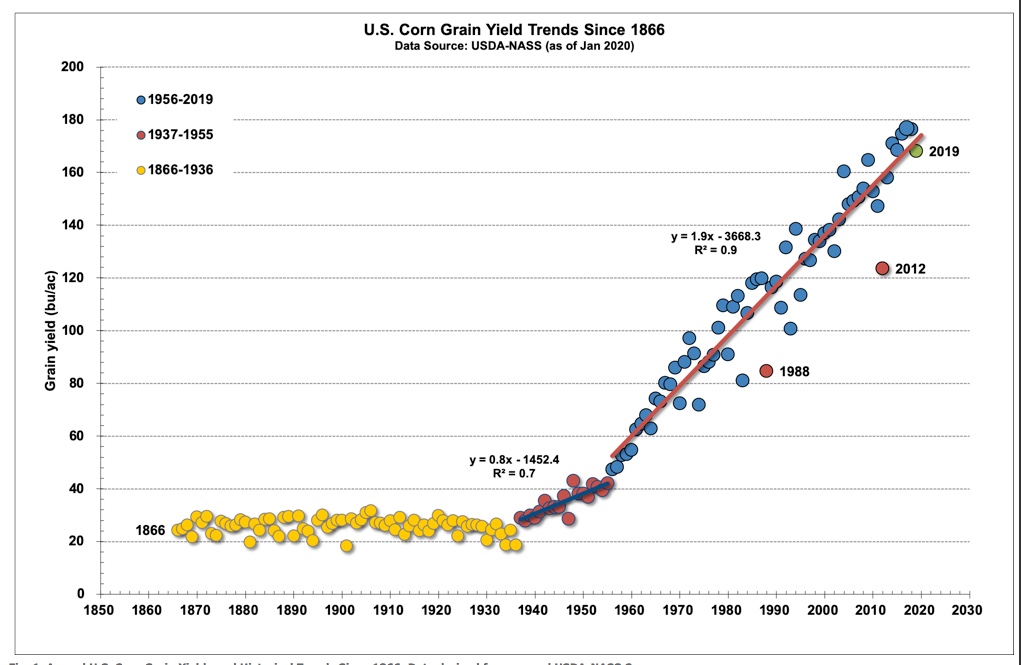
Agreed!
I would emphasize restoration and protection in almost every case.
Just that there’s also ways we can work towards conservation on land that is being utilized too.
You talked about farms but there’s also: managed forests, anywhere anything is grazing, private lands, fisheries, artificial reefs and kelp forests, any area we already use which we can also stack on an incidental conservation benefit ontop of (as you mentioned renewable energy infrastructure will be a big one, the book I mention is full of other surprising examples such as military bases), things like wildlife underpasses, suburban lawns, and so on. This adds up to a lot of land.
I hope we protect half of the land and ocean like Edward O. Wilson and other major biologists recommend, but also I think it’s smart to look at everything and not just protected areas.
I hate mowing the lawn. I actually prefer the typical "weeds" like clover and dandelion over the typical grass. Dumb that we basically mandate weird, chemical and labor-intensive grass monoculture.
I actually think about 90% of the land ought to become basically national parks and/or protected wilderness. Maybe even more. We can live in dense cities in absolute luxury and abundance (with 10,000 square foot condos... why not? multiple stories make it possible) and then those of us who like to can go camping on the weekends. Traveling by electric motorgliders to our weekend campsite. Cars only underground (but everyone has one still).
We're also causing top soil to erode and blow away in much of the corn belt [0]. That productivity has a cost and shouldn't be assumed.
[0] https://www.smithsonianmag.com/science-nature/scientists-say...
edit: I don't think we disagree, much. I'll leave the above for reference.
I would like to note though that if we start mining and settling space, our growth would in fact be essentially unbounded.
Combined with the fact that some types of stars are expected to continue radiating energy for trillions of years...
https://www.openculture.com/2015/06/isaac-asimovs-favorite-s...
It's easy to take an outside look and say "well, see, humankind fixed it", but the personal energy and misery that goes into fighting for those fixes is enormous. I wouldn't call it "misanthropy".
Humans establishing self-sufficient communities beyond Earth would prove that humans have the capability to thrive sustainably on Earth. It would silence forever any technological objections to the possibility of human sustainability on Earth.
And a firm idea that humans can never establish self-sustaining communities in space is not that far from the idea that we probably cannot do so on Earth, either.
It really is not a huge step from pessimism about human future (ie in space) to nihilism about sustainability on Earth, and I do wish people would acknowledge this more: people enthusiastic about permanent settlements in space are, in fact, more certain about the possibility of sustainable thriving on Earth than the space-pessimists are.
Once we get depressed and nihilistic and give up, the universe will be forever deprived of the colour and drama human civilization can add to all those bare rocks up there.
I never considered that the implication is we could live here sustainably, but you’re right.
These discussions tend to be heavy on Asimov-inspired scifi-think and weak on just taking a walk in a forest on a nice sunny day in late spring. All this talk about having to colonize space is just rubbish, compared to the wonders of nature that would be worth preserving.
But the audience here is strongly biased. If most of your day is spent in front of a computer and reading scifi novels in the evening, then that's where the discussion moves.
Also, are you saying that forests are nature and space isn’t? Or are you saying that there aren’t any wonders of nature to experience out there?
Setting up nice sunny walk-ready forests in space is something that’ll take centuries, but if we don’t do it we’re doomed. Incidentally, so are the forests.
(Especially part 2 starting around 10m in).
I's not misanthropy to note that we're not so different from other species and that our growth/behavior is in many respects similar to other natural phenomena involving complex systems. Our long term success is correlated with our ability to shift resources away from negative-sum behaviors so as not to exceed the carrying capacity of our environment.
An advanced species would recognize the uniqueness and importance of the natural world, and would fence off huge sections of it to protect it for future generations.
You are just projecting what you think on this hypothetical advanced species. They might find, instead, that they don't need or care for any of that and just wipe it out faster.
Yours could be one that retreats into hermetic shelters and plays Call of Duty between themselves all day long.
Your "interpretation" is just making them after your self image, thinking that that is what it means to be "advanced".
You are again just projecting what you/we need on them, like the parent comment.
The biggest threat we face as a species in the foreseeable future is the exhaustion of our natural resources. Ergo, it makes sense to reserve as much as we can for future generations to decide what to do with. Some argue that we should use them as fast as possible in order to blow past some (claimed) barrier to entirely technological reproduction (producing a self-sustaining system on the Moon, for example), but this strikes me as hasty. The difficulties of achieving this might be far more difficult than advocates imagine, and if so we're likely to hit resource exhaustion.
That's before you even deal with the values. We don't have a lot of choice over those, but it's worth pointing out that many of our personal scruples are more compatible with collaborative than combative approaches to growth. The real moral challenge is whether the new frontier of growth (wealth acquisition) hits any wall before it destroys the environment.
30 by 30.
Or, 30% of the planet’s surface as protected areas by 2030.
The Biden administration adopted it, but it’d be cool to see it as a global goal as well.
At a macro scale, both fire and life create net entropy. The difference is when you zoom in and see either created order or uniform destruction.
And let's remember that Agent Smith is itself attempting to take over the world.
In that case, it's presumed it was indeed a massive extinction (but no data to quantify any % over, due to no microbial fossils preserved).
... But for a different reason. It wasn't due to decrease in oxygen levels; contrary to that. At that time, oxygen was being first ever introduced into the atmosphere. This has left a unique geological trace we observe everywhere across the planet: the white sedimentary + red rust striped 2 Ga rocks.
The "microbes" were the first photosynthesisers. The oxygen was a toxic byproduct. Resistance to it had to be learned by evolution, and that learning took ~1e8 years. Many of life didn't manage to and went extinct.
I think this pattern of exponential growth of human beings is a curse of their intelligence. All other animals end up being controlled by these large ecosystem dynamics because they can't adapt and/or do group work sufficiently. Species with this property are easily influenced/controlled by large scale dynamics.
Maybe, a species with more intelligence than us wouldn't grow so fast and unorderly because they can see the future consequences of their own dynamics more easily. We just happen to not deal with large temporal scales very well.
Yet people breed anyway, for a multitude of selfish reasons. Everyone else is having babies so why shouldn't I, it's my right as a human to reproduce, I want to pass on my genes, I want my life to be fulfilling, I don't want to die alone, the list goes on. It is these lines of thinking that have caused our population to balloon to over 7 billion people with no end in sight.
No one is thinking of the planet.
When you zoom out, the law is the law.
Exactly the sort of comment that fits the community here. I hope that gives some clue why this is an upvoted comment.
To suggest we are somehow not different is another kind of arrogance. We absolutely are and that gives us a unique level of agency and control. That is brilliant and scary. We are able to turn down the thermostat of an entire planet (reduce co2). That kind of culturally motivated intervention is completely unprecedented and totally different to historic humans and other species.
Slime mold doesn't have the same ring as "rail network planning AI", but it seems that's what it is.
1: https://outline.com/t8hxKh (original: https://www.wired.com/2010/01/slime-mold-grows-network-just-...)
When microorganisms divide, the children "appear" in the same location. Our species growth dynamics kind of has this same property in that it's easier to build something closer to the already established region than far away.
So, in the end, looking from far away, the growth pattern is the same.
It covers how similar growth patterns can be identified, from cities, vegetation, motors and human life.
It is a long book, but recommended by none other than gates [1]
Man’s natural instinct, in fact, is never toward what is sound and true; it is toward what is specious and false. Let any great nation of modern times be confronted by two conflicting propositions, the one grounded upon the utmost probability and reasonableness and the other upon the most glaring error, and it will almost invariably embrace the latter. It is so in politics, which consists wholly of a succession of unintelligent crazes, many of them so idiotic that they exist only as battle-cries and shibboleths and are not reducible to logical statement at all. It is so in religion, which, like poetry, is simply a concerted effort to deny the most obvious realities. It is so in nearly every field of thought. The ideas that conquer the race most rapidly and arouse the wildest enthusiasm and are held most tenaciously are precisely the ideas that are most insane. This has been true since the first “advanced” gorilla put on underwear, cultivated a frown and began his first lecture tour in the first chautauqua, and it will be so until the high gods, tired of the farce at last, obliterate the race with one great, final blast of fire, mustard gas and streptococci. (Meditation on Meditation, 1922)
It's hard to believe the USA's top newspaper editor once wrote like that! Writing worth paying for. Here's some more:
[The Declaration of Independence is] "a mere string of sonorous phrases, a piece of windy flapdoodle, a rhapsody almost empty of intelligible meaning, and probably composed under the influence of ethyl alcohol. And yet, as I say, it is more powerful than a million swords. It looms larger than the massive fact of Gettysburg. It is worth more than the whole Civil War. The man who loosed it upon posterity has left it a vaster heritage than the man who invented baseball." (Smart Set, 1914)
He said of US politics:
"It was Americans who invented the curious doctrine that there is a body of doctrine in every department of thought that every good citizen is in duty bound to accept and cherish; it was Americans who invented the right-thinker. … In the face of this singular passion for conformity, this dread of novelty and originality, it is obvious that the man of vigorous mind and stout convictions is gradually shouldered out of public life. He may slide into office once or twice, but soon or late he is bound to be held up, examined and incontinently kicked out. This leaves the field to the intellectual jelly-fish and inner tubes." (Baltimore Evening Sun, 1920)
[0] e.g. "OCCIDENT: The part of the world lying west (or east) of the Orient. It is largely inhabited by Christians, a powerful subtribe of the Hypocrites, whose principal industries are murder and cheating, which they are pleased to call war and commerce. These, also, are the principal industries of the Orient."
"If Materialism Is True, the United States Is Probably Conscious" https://news.ycombinator.com/item?id=9905847
The bacteria within us certainly don't know anything about our consciousness. Yet somehow the sum total of their activity results in a conscious being. If we as humans look and act like bacteria when we zoom out, do we suffer the same myopia of our bacteria friends, unable to recognize the consciousness our collective activity creates? It's fun to think about.
Recently I've found myself too stressed to even think about it. Too many stresses in life and I can do without the planet for now.
Totally selfish I know, but I'll get back to it when other things have died down.
I think what we need is something which helps us recognise the issues. Not only that but show us what we can do to help! We have to understand at a micro-level, how we can make an impact in aggregate.
That seems like a slightly peculiar idea of what a conscious being is.
In a real sense we are a joint venture.
Why would the traditional mathematics of growth make all that less?
Now can we extrapolate? If we zoom out more do we see the same happening? Does the interaction between all the galaxies create a thought? A slow one perhaps.
Potentially, one of us could even decide to stop being a parasite and scale down, move to the forest and live naked as a result.
My personal theory is that we're nature way of extending beyond earth. Yes we're a funghi, but a clever enough one we can be the earth's tentacle to go spread beyond.
Too much/little X causes outbursts of Y.
The question is, has Earth got a few spots lurking behind the earlobes. Or is there a feature-length episode of Dr Pimple Popper taking place?
But to me the fascinating part is that we're aware of looking like bacterias. We are matter that became conscious of itself.
Isn't that the weirdest thing?
We are mostly lead by greed and not a need of growth. This is ofcourse not the case for all individuals but good enough portion.
If you don't want to be banned, you're welcome to email [email protected] and give us reason to believe that you'll follow the rules in the future. They're here: https://news.ycombinator.com/newsguidelines.html.
I sometimes think that it is a valid mental model to think of us as not much different from ants in a hive who think they possess more control and freedom than they do
I think it is the opposite. We are different from ants, and have a lot of control and freedom, so we know that if others will not make the sacrifice, why should we?
In an ant colony, I imagine the orders are being given top down and they do not think about what others are or are not sacrificing.
I'm not a biologist though and also have no experience in what it's like to be a bee or ant
Take our main coordination mechanism - the market. For all that's been said and written about it, it's still basically gradient descent. As greedy as it gets - in the technical sense. It's what's been driving the development of humanity ever since we formed societies. It's what controls the behavior of everyone.
We may think we're smart and have principles - and we do. But the reality still is, everyone is spending most of their lives trying to align themselves to exploit the local economic gradient - because that's how individuals get more of what they want, and less of what they don't want. Nobody is strong enough to single-handedly reshape the larger economic gradient. So while individually, we play complex games, at macro scale, we're not all that different from slime molds or fungal growths.
Maybe one day our economy grows so sophisticated it'll gain sentience. But that doesn't necessarily mean things will get better - much like an individual human being sentient doesn't mean their cells are happy.
Although conservation probably has more to do with reality looking different depending on your own local observations, to a Brazilian cattle rancher or Indonesian logger at the frontlines of the biodiversity crisis, things look different. For a consumer of those goods and materials, they likely don’t realize the connection.
If, on the other hand, you independently decide to stop driving your car because you know the world is getting smothered with carbon dioxide, but see people daily driving modified diesel pickups belching smoke into the sky, you're going to feel a bit like you're pissing in the wind even trying.
This Game of Life video shows what I mean perfectly: https://www.youtube.com/watch?v=xP5-iIeKXE8
Yes, there's a ton of complexity in there, but when you zoom out enough, it looks and acts very similar to the lower level.
I think human beings are just a very complicated form of bacteria.
> I'd like to share a revelation I've had during my time here. It came to me when I tried to classify your species. I realized that you're not actually mammals. Every mammal on this planet instinctively develops a natural equilibrium with their surrounding environment, but you humans do not. You move to another area, and you multiply, and you multiply, until every natural resource is consumed. The only way you can survive is to spread to another area. There is another organism on this planet that follows the same pattern. Do you know what it is? A virus. Human beings are a disease, a cancer of this planet. You are a plague, and we are the cure.
[1]https://www.reddit.com/r/factorio/comments/b6gsxp/spreading_...
i saw global warming and covid19 as part of the earth's immune system to curb human impact. however, with our technology we are too resilient.
Anyone studying mathematical biology has also probably come to the same conclusion.
We think of ourself as special, as having conquered environments, technology and more - and when zoomed out you could explain everything we've built and accomplished as the achievements of a sufficiently robust slime mold simply using available resources to continue growing.