... for now.
The thing is, 2-3 tx/sec is basically snail mail. That's such a small number of transactions that there's not even a forest to hide within.
As the analytics tools improve the de-anonymization will be faster and more automatic, and that "tens of millions" figure will dwindle down to pennies. State actors can easily combine that data with actual fiat, and you'll be in court before you know it.
The problem is you're committing a ledger of your criminal activity to the cloud forever, and CCing your attorney general, smirking that they'll never figure it out. Of course they will. Either they'll figure it out or ban it. Or both.
It bears repeating explicitly I think: you're not working against today's analysis tools, you're working against whatever analysis tools exist far into the future, since everything is recorded for eternity.
From what I've seen, success in this industry is predicated upon planning, caution, and constantly thinking of ways that people are going to screw you over.
Most people who break the law do so because they either don't consider the consequences or accept the rewards as justifying the risks. And plenty of criminals go to prison because they judged wrong. That those who are successful for long periods of time buck this trend is just survivor bias.
only as far as statute of limitations. figuring out the crime after that point is not a risk ... but it does put a target on your back
For a buyer, this isn't as big of a deal because you won't have that level of target on your back, but for anyone running a marketplace I don't think statute of limitations will protect you once they figure out who you are.
Basically, if you dont want to deal with the onchain transactions, you could sell the risk of that to someone else and only deal in internal offchain transactions. Dont know if this actually happens though.
https://www.wired.com/story/bitcoin-blockchain-fifo-dirty-co...
You might find that the mixer, rather than washing your bitcoin, unexpectedly taints them.
The threat being considered in this thread is a future crackdown on bitcoin and how the blockchain may be used against bitcoin owners. Legal threats seem very relevant.
While some will try to do everything the legal way, the the wily people who believe they are getting away on some kind of technicality sometimes find themselves charged with a different crime, or maybe just unlucky after a pre-dawn police raid or traffic stop goes south.
The idea isn't necessarily to de-anonymize the transactions here but to disincentivize people from using mixers. Either a haircut kills a portion of your value, or you lose it all, the idea is you won't do that again.
That doesn't change that legally it still kills all your money, and creates a liability on the person who put in the dirty money. If you figure out who they are it's all you, you're welcome to sue them. If not, you've learned a hard lesson.
I'm fine with either.
You're not solving the problem, you are just introducing new problems that affect other people in the hopes that the entire system becomes unworkable.
The security in the Lightning Network doesn't come from settling on-chain after a transaction happened but from signing over all your money in a Lightning Network channel to the other party should somebody catch you cheating.
They are unconfirmed transactions and there are many ways of losing your funds compared to confirmed ones. Such as having your harddrive corrupted and your node trying to propagate an old state.
You are correct that funds in a Lightning Network wallet are at higher risks than those in a cold wallet, but this applies to all "hot" crypto wallets. Most LN wallets supports "Static Channel Backups" which you only create and store once after setting up a channel. In case your phone goes up in flames, you can use it to safely close your channels and receive your balance.
It involves either buying or creating a tamper resistant device and a reputation for authenticity.
It's significantly more complicated.
its really not.
unlike cash or bearer bonds, _all_ transactions are recorded in perpetuity. That's literally the entire selling point of bitcoin, the ledger is opensource and universal.
Given that virtually all money going into and coming out of bitcoin is through establishments that have financial licenses, its perfectly trivial to trace the flow of money from its first exchange of real cash for bitcoin, to when its used for illicit purposes.
You're currently labouring under the impression that tracing cash flows in the real world is hard. its not, especially for a government. what is hard is proving that its illicit. cash is fungible, as in each unit of currency has no ID. so its much harder to prove that this $1 came from a drug sale.
with bitcoin, you have a public wallet, and a clear lineage of transactions from start to end.
This may seem nitpicky to point out that it does, but since it does, I'm not sure of your point.
"A unique combination of eleven numbers and letters appears twice on the front of the note. Each note has a unique serial number"
https://www.uscurrency.gov/denominations/bank-note-identifie...
moreover we are assuming that cash is ID at entry and exit, which its not, unless someone suspects something.
So when a cash machine gives you money, the ID of the currency not be tied to your account. When you spend that money in a shop, those notes will not be attached as having come from you as a customer.
With bitcoin, that all comes for free, we know when money left your wallet, what addresses it passed through to get to someone's else's. the whole selling point of bitcoin is that you can trace the provenance of each transaction right back to when that coin was originally mined.
For example, if I was to use bitcoin as a bank account replacement, everyone would know my employer, they would know how much money I give to my spouse each month. They would know who I invest with. They would know when I do my shopping at the super market. They would know when I'm having work done at the house. They would know if I got a bonus, and how much.
Some of those things I'm ok with, but a lot of things, I'm not
If you mean physical units of currency that is no longer the case, most notes have serial numbers. In principle quite a lot of tracing can be done.
there is lots of scope for laundering by giving the cash to third parties, before it gets to the banks.
Laundering inside bitcoin is pretty futile, because we can trace from mining to current wallet. we don't even need to trace all bitcoins.
All you have to do is pay for something illicit, and you can trace the flow of money from wallet to wallet, until its either converted into real cash, or held as a "reserve"
Outside of some exchange link keeping a name = address record, the public wallet doesn't really expose you as there's no link between an address and a person.
Also, that $1 can be charged with crime and sized directly. Good luck siezing a brainwallet etc.
Edit: like IP address and torrent lawsuits etc.
"Outside of" is doing a lot of work here.
Please... Bitcoin transactions can be traced by whoever has a laptop and internet. If you want to stay anonymous, there is nothing worse than Bitcoin. Do yourself a favour and switch to Monero and similar which offer some level of privacy. But there is nothing better than the good old bank notes. Anyway, please educate yourself https://en.wikipedia.org/wiki/Bitcoin
Of course, Monero is a better option but even with BTC it's not as trivial as you claim.
Comparing that to any other payment system (or combination of) where there is due process in collecting this information (hopefully accurate and valid) you're going to have a much easier time developing tools to detect and alert with Bitcoin.
It takes something pretty extreme to get the consensus of enough miners to matter, but the hack of Mt. Gox was that extreme.
[1] https://www.coindesk.com/623m-in-bitcoin-from-2016-bitfinex-...
This is bullshit. WHM switched to Monero, not "all of the DNMs"
DNM == Dark Net Market WHM == White House Market, a large DNM
That is completely unsubstantiated. You have no evidence for that.
Tumbling also makes some of their other figures unbelievable. For example in table 2 they report "181.82%" of all users transactions attempt to use tumbling services... I have little confidence in this paper being accurate.
Don't you eventually need fiat? Yes, so you have someone sell NFTs to those untraceable wallets and now you have a legit income stream as an artist. Pay the tax in the place you want your money to end up and you really only need like one person in your destination country to clean as much as you'd like.
Given cryptos nature of being a public ledger and there more then enough compute power available everything can probably be traced and backtracked in real-time.
So to transfer $1 million out over 3 years, you'd need to run mine ~$900 of crypto per day, ie. run 90 RTX3080s 24/7/365.
Also note that this would draw around 20kW.
[1] https://www.nicehash.com/profitability-calculator/nvidia-rtx...
The questions of number of cards and electricity usage are pretty secondary and easy enough to hide. Go off grid, setup a similar legitimate company, lots of options to hide it.
This is backed by the fact the vast majority of hash power for BTC comes from China (3). There are world wide shortages for sha asics and gpus. I'm not describing a hypothetical.
(1) https://www.nicehash.com/profitability-calculator/nvidia-rtx...
(2) https://www.globalpetrolprices.com/China/electricity_prices/
(3) https://www.statista.com/statistics/731416/market-share-of-m...
assuming you're able to buy them and have the money upfront and are able to hide the purchase.
"What this person could be doing with 90 3080, I wonder" asks the Chinese government employee that checks your bank transactions.
https://www.techradar.com/news/nvidia-rtx-3080-shortage-coul...
Its like kind of like the unequal treaties but now china can fight back and as small concession for less aggressive approach, offered a small piece of the China pie for the outsiders to fight over. Let the outsiders fight among themselves instead of letting them fight together against you.
Isn't the cap like $25k/year/person that's like top 5~10% of the global citizens that can save up like $25k per year.
Taiwan's silicon shield and western semi conductor independence are contradicting objectives, sacrificing Taiwan for a bigger piece of the Chinese market is more then worth it from a realist/Mercantilism perspective.
The US investing in the Chinese "pie" is useless because they're just feeding the CCP more. CCP will use the power to take over the world. US companies would get eaten by the Chinese companies and US gov would be taken over from within, once mainstream and social media is taken over by CCP hands.
But don't be afraid of China taking over US cyberspace, I wouldn't be surprised that the Anglo-Europeans will build their Hadrian fire wall. To keep the Eurasian troll armies out of their part of the cyber world. This might all grow out of the clean network initiative.
For most non westerns nothing will really change if the king sits in Washington or Beijing. If you think it does you have been drowned in US propaganda. Maybe the biggest historical difference is that Beijing builds, and Washington bombs cities in the global south.
TLDR: CCP doesn't answer to the people. US gov at least has open elections.
I agree that at this moment, a poor person in central africa should not care 1% between US and CCP. But for their descendants, yes they should care.
The easiest thing for China would be monitor crypto transactions and stop them from happening.
But suppose you are Chinese and have a good friend in UK who's going to report as legit income the result of your criminal activity in China (criminal as in simply hiding the money from the government, for whatever reason) on your behalf.
Why should you set this complex scheme up when you could simply fly to UK to visit your artist friend, buy one of his artwork with your yuan and you're done?
Or better yet, invite your UK friend to China and give him the money, that he can then deposit on his account.
Purchasing mining hardware or artworks with your money that can be trace back to you it's the exact same thing.
> Or better yet, invite your UK friend to China and give him the money, that he can then deposit on his account.
China has capital controls and dual currencies to prevent these common scenarios. The yuan that the Chinese resident can get from a Chinese bank is devalued outside of China, and it is forbidden to move large quantities anyway (much less than the 1M USD mentioned in the thread).
https://statrys.com/blog/cnh-vs-cny-differences-chinese-renm...
that's why you buy stuff in yuan and sell the stuff for dollars/euro or other currencies
BTW we are talking about criminal activities here (money laundering), of course there's a price to pay and that price usually is in the 20-40% range (I've checked CNY and CNH and they are being traded at very similar rates right now [1][2])
there's no need to buy hundreds of GPU to mine crypto to do what the OP intended to do
unless OP meant btc it's a cheaper and safer way to launder money, which is a good reason why people could think it's a scam
KuCoin? Binance?
You just have to take it up with the government in whatever country they're domiciled in. Like any legitimate company, they simply won't tell anyone which country that is, of course.
So I don't mind the KYC process so I don't have to jump through hoops, but I do see how nations can use lawfare to attack/monitor crypto currencies, its not that hard to see. You have a open ledger, you have wallet addresses connected to personal identities. They can probably use social media connection graphs to fill in the gaps of unknown wallet addresses. Its a real time financial monitoring tool like the current system, just packaged up as some libertarian/tech bro nirvana escape hatch. Brilliant marketing if you ask me, but I'm just using it as an inflation hedge.
XMR I don't know though.
Wouldn't be surprised if there are ways to obfuscate your bitcoins. Something like wrapped bitcoins or something.
For the time being you already have block chain analytics companies that can trace and back trace transactions. Hell maybe they can even do it cross chain.
I wouldn't be surprised if a NSA or other nat sec organization can hack something together in a weekend.
Some bold statements there. Do you have any evidence to provide?
And depending on where you live you wouldn't be able to make big purchases in cash (in France I think the maximum cash transaction allowed is about 3000€).
BTC or cash you would have to launder your money to make it look like legit and be able to buy a house etc
Of course the other problem of BTC is that transactions are stored forever (as long as the BTC network operates) so it might bite you decades later.
This has to be the worst reason a drug dealer would avoid dealing in cash ever. Inflation is literally 2% per annum. Drug dealers pay 20%-50% to launder their money. C'mon now.
Deposit money to Binance, covert to XMR, withdraw XMR is well under 0.1% total in fees.
There is no such thing as a free lunch.
Yes, there are risks involved in doing criminal business, inflation is not one of them
That thinking is quite shallow.
Think drug dealers/gangs recirculating bitcoins mined years ago. Now the tricky part of this is that it would only take knowledge of a few transactions in the networks identity, complete with purpose to start identifying everyone. I’m sure an AG is looking forward to the largest RICO case in history at that point.
I’m sure that folks looking to anonymize are aware of this and take further precautions, I’m also sure that there is someone in the network who is dumb.
If I was in law enforcement I’d make btc address collection a top priority.
Do you have a source for that number, or did you just pull it out of thin air?
Funny how in the hack space some people explained how to buy drugs with bitcoin, others showed how they can track you anyways.
I would not be surprised if there will be agencies that will bid on tracing services.
Sources?
First problem: transaction fees are currently over $10 per transaction.
Second problem: max transactions per block (2k?). Wouldn’t a single tumbling instance of 100k pieces completely fill 50 bitcoin blocks, effectively browning out the system?
Coinbase, shockingly, violated trust on both sides and is still being hyped. Doesn't take much to understand what a terrible investment that is.
Now imagine I smuggled in from Mexico to Chicago this[1] but I don't know how to take back this[2]
What kind of genius/idiot criminal would I be?
[1] https://www.gannett-cdn.com/-mm-/6d0c827943b8dc8c2c7449974d0...
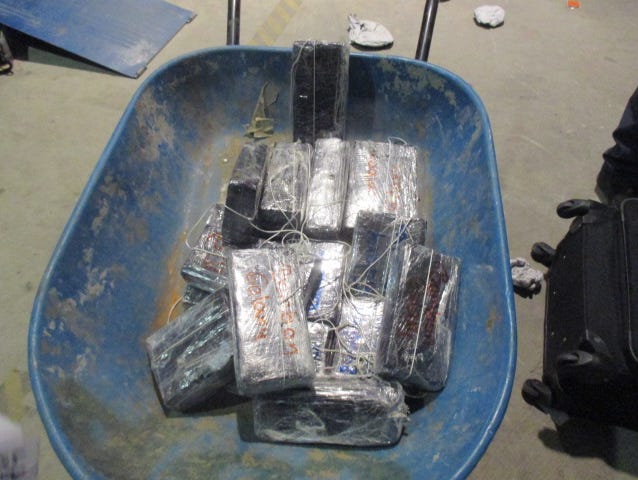
[2] https://www.cbp.gov/sites/default/files/u6097/CBP-AMO%20-%20...

are we still talking about criminals?
I don't think something that make it worth optimizing for but is intended to optimize criminals activities is really desirable.
Anyway, there's no advantage with crypto, the smuggler didn't smuggle 1 million dollar worth of cocaine from Mexico, cocaine is moved in much larger volumes, if a few pounds are lost, it's part of the business risks, criminals understand it and sometimes facilitate it, so that police can make big splash announcements and everybody is happy.
money is another thing entirely.
that million dollar worth of cocaine has been cut in hundreds of smaller doses, that are being paid mostly in cash.
so now every corner dealer has a pile of cash that use to pay the bigger dealer and so on.
first of all, you can't buy crypto with cash. You should go through another person who already owns enough to sell them to you, which means another breadcrumb that could lead back to you in case that other person is caught.
also, cash has some disadvantages over a usb pendrive, but one big advantage is that it's harder to lose a briefcase than a usb drive and they don't break as easily.
so the smaller dealers have no incentive to do it.
the average dealer has no incentive on buying crypto to pay the larger dealer, because he gets rid of the cash pretty fast and keeps his cut that invests into criminal but legal activities so that the facade is clean.
the larger dealers have now a pile of cash that need to handle anyway, they can't ignore it and make it disappear just because it takes too much space.
let's go back to the smuggler (probably a cartel man) that moved cocaine from Mexico to Chicago
they have bank accounts in Panama and don't care about moving large sum of money anonymously or through perfectly clean American front men.
The system already works, there was an article the other day on front page titled "The war against money laundering is being lost" (https://news.ycombinator.com/item?id=26786810), so why change it for an asset that has not even a stable value?
I guess they tried at one point, but there's too much attention on them now, so criminals with capital C dropped them and let only their kids play with it so they can pay for their college expenses.
I'm not defending that Bitcoin is a solution to moving money, I'm attacking what I perceived to be an argument that it's not a problem for dealers because they can just do to cash as they do to drugs.
The same applies with fiat. This is a tired argument against cryptocurrencies.
It seems that HN has been upvoting anti-bitcoin content for the past few days now.
Yes, but the difference is that for fiat this amounts to a small percentage.
What a hilarious claim. Everything else you've said just confirms you've fallen for the "BTC bad" narrative. I wonder how you feel about you-know-who printing unlimited toilet paper money for their own benefits.
It all depends what your threat model is. Bitcoin can be traced by sophisticated nation state actors at the cost of tens of millions per intercepted target. If I was Osama bin Laden or El Chapo or a guy who personally pissed off Putin, I probably wouldn't rely on it. But if I was a local drug kingpin in Baltimore, or a corrupt mid-level CCP official, or a Cypriot corporate money launderer, then Bitcoin deanonymization is probably a small risk in the scheme of things. Certainly orders of magnitude less risk than using the traditional banking system.