Politics requesting censorship is always partisan.
Let's say you have a newspaper spreading misinformation that is hurting an important social institution. What do you do? Close it down? Sue the editor for defamation, then close it down? There must have been precedent.
Later on, once ads became a major source of revenue, most newspapers realized that being completely one sided hurt ad revenue. After all, if you want to advertise your furniture store, don't you want to sell to everyone in your area regardless of their party?
Now with intelligent/micro-targeted ad systems and minimal geographic limitations, those previously "too small to matter" niches are suddenly worldwide and large enough to be a useful segment on their own.. so many organizations can say/do what they want up to the line of defamation/slander protections, if any.
The idea that the press should be politically neutral is a pretty new one -- historically there were highly partisan newspapers, alongside "impartial" ones.
But I think the lies, etc., were more likely to be litigated on charges of slander, defamation, etc., at least when they were about individuals.
Now they're all about "socialism" or whatever, and unfortunately socialism doesn't have any lawyers.
You can say that it's the Democrats who want censorship, but the other side of the coin is that Republicans want to freely spread a false narrative.
Extremely general statements are always applicable.
  1. Try this sushi, it's mostly fresh.
  2. Sure, I'll give you a ride, I'm mostly sober.
3. I know what I'm doing, I'm technically a doctor.What I've seen this last election on Facebook is partisan fact checkers hunting for that one bad grain of rice so they can use it to label the whole article as "false" or "partly false" in an effort to protect Biden/Harris. I'm having trouble finding them now because facebook isn't super searchable but I remember thinking a lot of them were really nit-picky, similar to this one from 2018[0]. It got so bad I started seeing various viral memes complaining about it[1]
[0] https://www.snopes.com/fact-check/hillary-clinton-smash-phon...
(Context: Trump tweeted that "crooked Hillary destroyed her phones with a hammer", Snopes labels his tweet as partly false because Hillary personally didn't destroy her phones with a hammer, her aide did)
And yet, you were able to read on Snopes why they flagged something as "partially true", and you were able to make an informed decision.
When someone says "Hillary Clinton is using private email servers and unauthorized phones," that's technically true, and it sounds really, very bad. But when you learn that previous officials, like Colin Powell, and current officials, like members of the Trump family, did the same thing, then it provides more context, and it makes you wonder just how egregious the original charge is.
The point is, "technically true" things are often intentionally misleading; the fact that something is "technically true" should arouse more suspicion than trust.
I hear you calling out fact checkers that provide insight into why something is flagged true or false, but I don't hear you calling out officials that make misleading "technically true" statements, or totally false statements. What's up with that? Are fact checkers really the root of this problem, or are they a symptom?
YouTube had security camera videos posted by members that showed taking mail in ballots from under the table rather than the counting bins. Stuff like that was called false or inaccurate. I cannot say if this mail in vote did the same across the USA, but it shows that the voting process is flawed that and the Dominion software flipping votes from Trump to Biden by mistake.
These workers announced that they're closing the count for the night and that everyone must leave. You can see them in the video just sitting still not doing anything until everyone leaves. Then when poll watchers leave they spring into action pull out the ballots from under the table and start counting for three more hours.
>state officials told us that the full video shows the supposed “suitcases” were actually standard containers used to secure ballots, and that the ballots in question were opened and prepared for counting earlier in the night in full view of observers.
>On Dec. 5, Frances Watson, the chief investigator for the secretary of state’s office, said in an affidavit that after reviewing the video and conducting interviews, her investigators found “that observers and media were not asked to leave” but “simply left” after they saw workers, whose job was to open the ballots, leave. She said the investigation remains open.
We investigated ourselves and found no wrong doing.
The Secretary was DIRECTLY involved in the purchase and deployment of the Dominion machines. He is refusing any signature audits. He is now being sued by GA Legislature members.
Despite what FactCheck dot org says (and how could that possibly not be trustworthy!?) I don’t think a statement from this office is going to sway anyone.
How about this, here is footage from a GA official showing just how ridiculously insecure and awful the dominion software is.
This changed my opinion on the whole mess:
https://www.youtube.com/watch?v=46CAKyyObls&feature=youtu.be
No evidence will sway someone who's accepted one side as truth before hearing all the arguments.
That's a futile affidavit. Where are affidavits from the investigators and the precinct staff members themselves, where they say that observers and media were not asked to leave.
"Covid19 is a lie!1!!" isn't an opinion. It's ignorant non-sense at best, likely malicious, indirect interest-driven misinformation. It absolutely does not deserve the same, attention, platform and range as scientific, or reasonably political debate.
Naive unconditional free speech, "attention communism", if you want lol, is an ignorant and anti-democratic idea. The only reason that hasn't hurt us like this before, was the cost of spreading information effectively, pre-www.
This whole fact obsession has gotten completely out of hand. Presiding over disputed matters of fact is pretty much the core purpose of our entire court system. You can’t just call something a fact and be done with it. What you’ve actually described is a collection of opinions, and then declared them settled facts by referencing some of the people that hold them.
I know people get terribly riled up by politics, but they’re just losing sight of any form of reasonableness. Having an unaccountable central authority decide what’s true and what’s not is literally one of the most canonical forms of dystopia that exists.
How is it still "quite clearly in dispute"?
> Having an unaccountable central authority decide what’s true and what’s not
This part of your comment is highly ironic.
I'm not at all sure why you think my comment is so ironic either, so please feel free to explain.
> Pennsylvania’s top court on Nov. 28 dismissed the challenge, saying that the lawsuit was not filed in a timely manner when the mail-in voting law was first enacted. It threw out a lower court ruling that had ordered the state not to certify the election pending a hearing.
But this is not about widespread fraud, this is about mail-in voting laws.
I don't know what's a reputable website for USA political news, feel free to tell me if I'm reading overly biased junk:
https://www.forbes.com/sites/alisondurkee/2020/12/09/nevada-...
https://www.reuters.com/article/usa-election-court-pennsylva...
https://www.freep.com/story/news/politics/elections/2020/12/...
> I'm not at all sure why you think my comment is so ironic either, so please feel free to explain.
Trump calling it a win the night of the election is, no matter how you spin it, very close to your "unaccountable central authority" deciding what’s true and what’s not. So your final point seems correct, just pointed in the wrong direction.
> Trump calling it a win the night of the election is, no matter how you spin it, very close to your "unaccountable central authority" deciding what’s true and what’s not.
Your mistake to presume that I am defending Trump really backs my point here. I have made no comments defending him or any of his court action, or public statements, or any action or statements from his allies. I have only made comments in defence of reasonableness and common sense, and against mega-corps like google using their influence to control the internet in a way that suits their political agendas. The merits of his claims will be decided by our justice system, not by Google. But if you’re ok with Google dictating to the internet which sides of a political debate are allowed to exist on the internet, then I guess you and I just have very different values. It's also a bit of a false equivalence, as the president is accountable to both the law and the electorate, opposed to Google, which is accountable to what exactly? Shareholders (theoretically)?
You're the one misrepresenting what I've said. I'm not ok with a corporation "dictating to the internet which sides of a political debate are allowed to exist" and whatever else you're accusing me of. I'm telling you, widespread fraud is not "quite clearly in dispute".
Also, criticizing somebody for something that you think other people are also guilty of isn't Irony. Even if both parties in this matter were equally despicable, that doesn't make either of them right. Your comments highlight a lot of issues we currently have with political tribalism. You're just proving that facts and misdeeds don't matter as long as they have the correct political context.
Of course it's partisan. Had Trump won, and Biden voters were publishing content like this with the same lack of evidence, do you believe that Democratic senators would still be urging YouTube to take it down in the interest of fairness to Trump? I think you know the answer to that.
The scary part of this is that elected officials, who were presumably elected by people that thought they were going to protect the freedoms granted to them by the Constitution, and who must take an oath upon taking office to "support and defend the Constitution," sat down and wrote a letter that gleefully trampled all over one of our most fundamental constitutional rights. Since they were successful in this endeavor, it will happen again, on other, more expansive, partisan issues. Down the slippery slope we go.
The simple fact of the matter is that people are entitled to their opinions, and in the United States, they have a constitutional right to express those opinions in the same way and on the same platforms as those that disagree with them. The only problem is that now we have politicians who believe that those rights should only be extended to those who are on their side. Both sides of the political aisle are acting this way, and it does not bode well for our future as a country.
You've never had a constitutional right to a particular platform for your opinions. E.g., if a magazine or newspaper published an opinion that disagreed with yours, you do not have a constitutional right to have your opinion published in that same magazine or newspaper.
While this is true, it's a distracting non-sequitur.
US senators (of any political persuasion) asking any platform to take down any information, correct or not, is chilling. That's not their role in government. That's not their job.
Also distraction: the content is false and misleading
Also distraction: the content is "political"
The important part, that I wish every American regardless of party would understand deeply in their bones, is that once it's easy for "our guys" to do this illegal, rights-trampling thing, then it becomes easier for "their guys" to do it.
This is creeping authoritarianism. Not Trump, not Obama, not Democrats, not Republicans, not this or that party engaging in skullduggery.
Someday, a group of senators will ask the platform-du-jour to take down something that you agree with and that you think is important for people to know. Perhaps about actual election fraud, on a candidate you like. Imagine it. Inhabit that idea.
American complacency in the face of "our guys can use this new awesome power for good, so it's OK" is how we have secret Presidential assassination lists (Disposition Matrix), secret courts where the accused cannot see the evidence against them (FISA courts), gag orders on civilians, and so forth
Do not applaud senators using the weight of the government to suppress speech that you do not like, even if you believe that speech is false. It's about protecting your rights.
You keep saying this over and over but you're wrong.
According to Section 230 they're allowed to "censor" all they want. It doesn't make them a publisher. That's literally the point of Section 230.
Repeating a lie doesn't make it true.
The fact that Youtube is removing content about election fraud while leaving up much more egregiously false information is a huge red flag about their bias.
Have they taken down videos that blame George W. Bush and the federal government for the 9-11 attack?
Further, one of the big problems here is that YouTube didn't do this of its own accord. Agents of the government - Democratic Senators in this case, who signed the letter in their official capacity - pressured the company into suppressing free speech that they simply didn’t like. That is a clear violation of the Constitution.
Speaking of contracts, when someone sign up for YouTube, they agree to their terms of service, which don’t say “we’re an open platform where opinions of any kind can be published”. They say “YouTube is under no obligation to host or serve Content” and “you understand and agree that there will be times when we make […] changes without notice” and “If we reasonably believe that any Content is in breach of this Agreement or may cause harm to YouTube, our users, or third parties, we may remove or take down that Content in our discretion”.
I don’t want to be pedantic about anything. The terms can say whatever they want - they write them. But regardless of what the TOS say, when you advertise yourself as an open platform for free speech, which YouTube certainly does, it opens you up to liability when you prove not to be that open platform. Further, if they go too far with moderation and begin censoring content over and above clear, previously set guidelines, they can lose their immunity to libel/slander lawsuits under the CDA (Communications Decency Act).
Section 230 (which is essentially the only surviving part of the CDA; the rest was found to be unconstitutional in 1997[0]) gives interactive computer services immunity from civil claims (not just defamation) when removing material that they find objectionable, regardless of whether or not it is constitutionally protected, so long as it is done in good faith. The law is short and unambiguous[1]. There is no provision that says providers lose immunity if they go “above clear, previously set guidelines”. That is some straight made up garbage.
If what you were saying were true (again, it is not!), the “clear, previously set guidelines” are right in YouTube’s Terms. Those Terms explicitly say that they have no obligation to host your content, might change the rules, might remove your stuff, and you’re OK with that. And, even better, the issue of whether or not a provider can lose their S230 immunities through harm due to the reliance on misrepresentation of material fact was adjudicated in Green v America Online[2] and the answer was no! In that case, AOL’s member agreement was clear and binding. YouTube’s member agreement is similarly clear and binding. YouTube cannot lose their immunity in the way you claim.
[0] https://www.lawfareblog.com/whats-name-quite-bit-if-youre-ta...
We aren’t talking about AOL. We are talking about a group of partisan senators pressuring a company that has a de facto monopoly in online video distribution into suppressing free speech for no reason other than “we don’t like it”.
Your analysis, even ignoring the fact that it has nothing to do with the present case, is also entirely incorrect as it relates to my comment. The CDA requires that the removal be “in good faith”. Removals that aren’t in line with “clear, previously set guidelines” can be ruled to not be in good faith. We essentially said the same thing, but you managed to hurl insults at me - saying that my “sources must be garbage” - while you said your version of it. Well done.
Yes, I didn’t reply to that part because I couldn’t prove that a letter from four senators “pressured the company into suppressing free speech”, whereas I could conclusively prove that the claims I did reply to were false.
If you want me to opine on the “senators sending a letter equals government censorship” angle too, fine. It was a pretty typical letter from the senate. They make some claims, they ask some questions. Senators send letters like this often. YouTube had the option to say ‘we won’t commit to that’ and explain why, but they chose not to do that, despite having a pretty bottomless pit of lawyers and PR agents to throw at the problem. They also could easily have suggested that they were making a change due to inappropriate pressure from the senate in the press release, but they did not do that either. Any suggestion to the contrary is speculative at best.
> We aren’t talking about AOL.
You were claiming that YouTube could lose their legal immunity through some estoppel claim, and I gave you the relevant case law which explicitly rejects that interpretation of the law.
> Removals that aren’t in line with “clear, previously set guidelines” can be ruled to not be in good faith.
Please show me a single case where a court has accepted this interpretation of the immunity clause of Section 230. Please show me where in the law it says anything about “clear, previously set guidelines”.
> We are talking about a group of partisan senators pressuring a company that has a de facto monopoly in online video distribution into suppressing free speech for no reason other than “we don’t like it”.
Setting aside how there are actually quite a few places where people can post their videos (Facebook, Twitter, Vimeo, Dailymotion, Periscope, their own $5 VPS, etc.), the letter[0] is actually quite clear on the senators’ concerns, which were not “we don’t like it”:
> These videos seek to undermine our democracy and cast doubt on the legitimacy of President-elect Biden’s incoming administration. Moreover, because the current president has not committed to a peaceful transition of power, misinformation and manipulated media content on your platform may fuel civil unrest.
> you managed to hurl insults at me - saying that my “sources must be garbage”
It was not my intent to insult you personally and I’m sorry if you took it that way. I didn’t say you were garbage, I said your sources were garbage.
If you can’t accept that both the law doesn’t say what you say it does, and that courts have explicitly rejected your claimed interpretation of the law, I don’t know what else I can say. Which is, of course, the problem with misinformation and the reason why removing it is sometimes an unpleasant but necessary course of action: people latch on to falsehoods which reinforce their pre-existing world view, then refuse to accept that they might be wrong.
And to be fair to that point, I could be completely full of shit too, but it’s on you to prove that by bringing facts to this discussion and not just repeating refuted claims and making it sound like I somehow proved them by giving evidence against them.
[0] https://www.menendez.senate.gov/imo/media/doc/YouTube%20Lett...
The answer that it feels like I would have is, "No"; but it only feels that way because I can't even imagine them doing that in the first place. In order to even enter your thought experiment, I must put Biden and the Democrats in the shoes of Trump and the Republicans, and imagine that they have done something I don't believe they would do; and that is where the entire thing falls apart.
> The simple fact of the matter is that people are entitled to their opinions, and in the United States, they have a constitutional right to express those opinions in the same way and on the same platforms as those that disagree with them.
False. Everyone has the right to express whatever they want, but they don't have the right to do so using someone else's platform. For example, I have the right to express my criticisms of The Bible, but I don't have the right to walk into a church, walk up to the pulpit, and start a TED talk about the lack of evidence for Noah and the great flood, Moses and Hebrew slaves in Egypt, New Testament authorship, etc.
What keeps getting called "censorship" here is really "moderation". The reason it's such a big deal is that YouTube is a huge monolithic platform, so moderation on that platform is inherently a big deal.
If we want to remove the power YouTube has over public discourse, we need to create real competitors. The same goes for Facebook, Twitter, et al.
The premise here is that both sides are just as likely to push misinformation on behalf of their team. The Democrats aren't perfect, but let's not kid ourselves into thinking that they would engage in the exact same tactics and rhetoric as the GOP if the shoe were on the other foot.
I'll flip the question around. Had Trump won, would the Democratic party be publishing content like this with the same lack of evidence? I think you know the answer to that.
Specifically, he demanded recounts of under votes, where the machine hadn’t registered any pick for President. But he did so only in counties where he had won a large majority. Theoretically, this wouldn’t help. Statistically, Bush voters should have been as likely as Gore voters to fail to completely punch a ballot. But by only requesting recounts in counties he had won solidly—I.e. the base rate in the data set heavily favored Gore—newly discerned votes would break in heavily his favor. If he had won the county 2-1, he’d get two newly discernible votes for every one that Bush got.
This was an obvious attempt at cheating. So obvious that the Florida Supreme Court smacked Gore down and ordered a statewide recount. And the Supreme Court agreed 7-2 that recount was still unconstitutional because under votes were being counted using different standards in different counties.
Imagine if Trump had demanded hand recounts of under votes in this election in Wisconsin, but only those votes that were made in person on Election Day. This would be obvious cheating, since the pool of Election Day voters went heavily for Trump to begin with, so newly discernible votes would break for him as well. Gore did the exact same thing. And it would have been a huge news story if the media understood basic Bayesian probability.
This is important, because you could get an idea of what has to be done to fix the issues and what repercussions it might have by looking at historical precedence.
Pot meet Kettle.
The current attempt to steal the election is bound to fail, but it's setting up the GOP playbook for stealing a closer, more plausibly contested presidential election.
You're making it sound like a witchhunt but it was in fact extremely fishy.
"The investigation found there were over 100 contacts between Trump campaign advisors and individuals affiliated with the Russian government, before and after the election, but the evidence was insufficient to show an illegal conspiracy."[1]
I'd encourage you to at least read through the Wikipedia articles on the Mueller report before shouting "zero evidence" so loudly.
1. https://en.wikipedia.org/wiki/Mueller_report#Russian_interfe...
Mueller himself disagreed with this summary, saying "the attorney general had inadequately portrayed their conclusions" and "the Barr letter "did not fully capture the context, nature, and substance" of the findings of the special counsel investigation that he led. "There is now public confusion about critical aspects of the results of our investigation""[1]
Causing confusion was, of course, the point. It allowed everyone in the President's orbit to say "See? No collusion", knowing that the media would amplify it. Everyone who was already inclined to believe the President would rest assured that this whole thing was a Democratic witchhunt. And when the real report came out later they would disregard it.
Of course when even the redacted report came out, it had some key differences with the summary that Barr wrote:
"The New York Times reported instances in which the Barr letter omitted information and quoted sentence fragments out of context in ways that significantly altered the findings in the report, including:
Omission of words and a full sentence that twice suggested there was knowing and complicit behavior between the Trump campaign and Russians that stopped short of direct coordination, which may constitute conspiracy."[2]
It wasn't just a politically motivated probe. Just because evidence "beyond reasonable doubt" could not be found doesn't mean the crime never happened. And it certainly doesn't mean looking into it was "pysops" or "political hysteria" or "Trump derangement syndrome".
1. https://en.wikipedia.org/wiki/Mueller_report#Mueller's_react...
2. https://en.wikipedia.org/wiki/Mueller_report#Redacted_report...
Here's Mueller lying to the world to justify a war: https://www.youtube.com/watch?v=uTDO-kuOGTQ
Dirty tricks and psyops. Fooled entire nations, they just need people to swallow it down and they maintain power.
But at the same time you linked me to an NPR article about the initial summary of Mueller report that said "No collusion", which you believed. But then the actual report came out and it said "Quite possibly collusion" and therefore Mueller's a liar? That's some pretty impressive doublethink.
It's clear no amount of evidence matters to you so I won't try any more.
What makes you so sure you aren't the one being psyops-ed by whichever media source you trust?
You hold diametrically opposing opinions simulataneously ("No collusion!" && "Mueller's a liar!") to fit your image of a charismatic leader. You believe in some amorphous "they" who are silently manipulating everyone behind the scenes. These are all classic signs of being psypops-ed.
Many outside of the US political circus viewed the whole Russiagate affair as a joke, independents who don't have strong adherence to any party can see the farce.
Even some of the most ardent journalists who pushed the collusion narrative admitted that they were not practicing real journalism, they called it 'meta-journalism' I'm not joking. They actually said that they don't have time to check facts and counter narratives need to be spun quickly to combat Trump lies... regardless of facts. (Seth Abramson)
I really don't blame people for being so twisted on this. It was 3 years of nonstop misinformation blaring from every major news outlet. The CIA/FBI officials leaking to the media as anon sources should have been a clue, but not everyone is keen to this.
"If you don't read the newspaper, you're uninformed. If you do read it, you're misinformed." - Twain
Who said anything about a typo?
> Many outside of the US political circus viewed the whole Russiagate affair as a joke
"Many" is a weasel word. Who? Why does their opinion matter? Do they have subject matter expertise?
> Even some of the most ardent journalists
More weasel words. What's an "ardent" journalist?
> Seth Abramson
I don't know who that is, so I had to look him up. He's not a journalist. Wikipedia describes him as a "political columnist". The Atlantic, that bastion of lefty liberalness, called him a "conspiracy theorist".[1]
You still haven't addressed my central point. Either the Mueller report is false. Which means saying "the Mueller report says 'No collusion'" is incorrect, but AG Barr tried to say that nonetheless. Or it's true. Which means there quite possibly was collusion and the media attention was warranted.
You seem to simultaneously believe that the Mueller report said "No collusion" and that's true (and therefore the media are idiots), but also that Mueller's a liar and can't be trusted. Which is it?
1. https://en.wikipedia.org/wiki/Seth_Abramson#Claims_about_Pre...
You said both of these things. Please explain how they can both be true.
Why would you use quotes when I never said that?
If you didn't imply "Mueller can't be trusted" what did you mean by this comment where you said "Here's Mueller lying to the world": https://news.ycombinator.com/item?id=25381931?
On the other hand, if you agree that Mueller can be trusted please refer to my comment here: https://news.ycombinator.com/item?id=25377886 I showed how Mueller disagreed in very strong terms about "no collusion" as a conclusion. And how "no collusion" was the lie (Barr's summary letter) spread widely before the truth (the actual report) could come out.
You're either a troll arguing in bad faith. In which case, I hope you find better things to do with your life. Or you can't see the logical fallacies in your own worldview, which is a sure sign of being brainwashed by your news sources. In that case, I hope you are able to see the truth one day.
> The Mueller Report did not find any evidence of collusion, but did find two main efforts by the Russians to interfere in the 2016 presidential campaign.
If you read the report, note that they found multiple cases where people were interested in colluding (e.g. the Trump Tower meeting where they wanted to get dirt from some Russian lawyers) but did not find enough evidence proving intent to bring formal charges, in part because the administration was successfully able to prevent testimony and evidence collection. That’s very different from exoneration.
Is it as bad as what Trump is doing? No. Is it as bad as what Democrats did in 2000, 2004, and 2016 put together? Well my schadenfreude meter is pretty pegged.
Democrats on the House Judiciary committee released a report claiming that claimed Republicans cheated in the Ohio recount: https://www.thenation.com/article/archive/something-rotten-o...
A fun thing about the 2004 theories is that they were based mainly on exit polls showing Kerry won. (Bush was ahead by 2 points in the actual vote.) Today we know that exit polls are probably unreliable and may well underestimate conservative votes.
Just to keep this from noodling, I'll ask directly: are you really claiming that the Democrats seriously challenged the results of the 2004 election?
Jerry Nadler is a tool.
There was Russian hacking, — as best we can tell, that’s where the Podesta emails came from. No one serious alleges that they tampered with the vote tallies, but we can credibly say they swung the election.
“Asset” is frustratingly vague word for Democrats to use, but a lot of the collusion narrative has panned out. The Mueller report revealed that the Trump campaign welcomed Russian interference, stopping just short of alleging outright collusion.
Meanwhile — basically everything Republicans allege now is laughably false, and many are outright calling for a coup.
Hillary said the election was fraudulent from day one all the way up to current election.
Or how on October 26, 2020, PBS (hardly a right-wing or conservative news agency), aired a documentary [2] on the problems with the Dominion voting machines showing how you could just copy the QR codes and they could be re-scanned and count as a legitimate vote, no major hacking needed here. Here's an excerpt: -
"J. Alex Halderman:
By analyzing the structure of the Q.R. codes, I have been able to learn that there's nothing that stops an attacker from just duplicating one, and the duplicate would count the same as the original bar code.
Miles O’Brien:
And in late September, another concern came to light. During testing, election workers found half the names of the 21 candidates for Senate intermittently disappeared from screens during the review phase.
Dominion sent out a last-minute software patch.
J. Alex Halderman:
I'm worried that the Georgia system is the technical equivalent to the 737 MAX. They have just made a last-minute software change that might well have unintended consequences and cause even more severe problems on Election Day."
For me, it's the individual states changing their own election laws via unconstitutional methods right before the election. I think that is widespread fraud without a doubt, and those votes need to be audited or discounted.
[1] https://www.forbes.com/2009/08/27/ted-kennedy-soviet-union-r...
[2] https://www.pbs.org/newshour/show/will-georgias-new-voting-m...
https://evidence2020.wordpress.com/2020/11/17/strong-evidenc...
Hillary is still going around claiming they stole the election from her.
https://thefederalist.com/2020/10/26/four-years-later-bitter...
I just listened to 4 years of CNN, MSNBC, and virtually every other media outlet claiming that the previous election was rigged, with similarly sparse evidence. So yes, not only do I believe that they would, but they have already done it, 24/7, for the last 4 straight years.
What matters is evidence. Facts. Logic. Reason.
The two simply are not equivalent. Check out what Wikipedia says about the Mueller Report:
https://en.m.wikipedia.org/wiki/Mueller_report
I'm not claiming the Democrats are perfect or that there aren't mixed motives.
But it's obvious to any thinking person not living in a poisoned media ecosystem that all of these election fraud claims are baseless and ridiculous.
The same is not true about Russian influence operations during the 2016 election and the Trump campaigns, let's say, benign support of them.
If you turn on CNN for a second or two today, you'll hear them use the phrase "no widespread voter fraud occurred". In other words, there is evidence that some fraud occurred, as it does in every election. Just not enough to have swayed the results. The same can be said about any Russian interference.
So the two things are equivalent, because both happened to some degree, and it is extremely unlikely that either had any effect on the outcome.
That being said, if anyone has an unbiased academic paper that looked in-depth at Russia's Twitter/Facebook shenanigans, please cite. I'd like to read it.
It was a well funded and coordinated effort by a nation state. Not a few thousand dollars on bad english ads.
The alleged Russian actions are by themselves criminal. It makes no difference whether they had any impact. An attempted theft is still a crime.
There is no evidence of electoral fraud or whatever nonsense is currently being claimed. It did not happen. It is, in fact, a deliberate lie.
Someone saying stuff on CNN is not reliable information. Are you really going to compare that to the Mueller report?
In fact, what is reliable right now is how courts have been deciding these ridiculous claims. And they’ve all been universally rejected because the claims have no evidence, make no sense, and are basically asking for something that’s actually illegal.
So we are talking about two completely different things. Something that really happened, based on evidence, and something that is a bunch of lies and distortions. That is my point.
And, I’d really encourage you to learn how to better judge things. Or, to stop participating in this anti-democratic bullshit.
[1] https://www.cnn.com/2016/11/22/politics/hillary-clinton-chal...
...
> Hillary Clinton dismissed President Trump as an “illegitimate president” and suggested that “he knows” that he stole the 2016 presidential election in a CBS News interview to be aired Sunday.
Is there a word for someone or something that mirrors your sins back at you, but in a grotesquely amplified manner?
Of course it's not clear if Hilary would have won if there was no such interference, but her claim is not nearly as far-fetched as all the baseless crazy batshit stuff being thrown around by republicans nowadays.
I’ll grant you that Clinton’s allegations are less “far-fetched” than Trump’s. But that shouldn’t be the standard! We shouldn’t be trying to draw distinctions over claims that are totally made up and ones that are only mostly made up.
To use a legal analogy, I don’t see political discourse as being something where there should be judges excluding unreliable or prejudicial materials. Information is fair game.
I was against impeachment (I still think it was stupid), because it was a political stunt with no hope of actually removing the president. But just morally, Trump richly deserved investigation. "Where's there's smoke, there's fire", and Trump's campaign and administration put out a burning oil well's worth of smoke. He lost his National Security Advisor to a foreign agent violation within weeks of taking over. Senior members of his campaign coordinated with Julian Assange. I don't think you can pretend like this was all fake.
(Just to calibrate: I also think Clinton should have been impeached).
There is something seriously wrong with the republican party watching the destruction of core values -- I for one will never vote for them again. But I guess folks like me who were life long republicans until Trump are just silly dems.
The fact that Trump has the party on a leash is just insane. Republicans watching idly as he actively subverts all norms of transfer of power and millions choosing to grasp at theories that would be espoused by drunkards on city corners 5 or 6 years ago is insane.
https://thefederalist.com/2020/10/26/four-years-later-bitter...
After his win in 2016 we had Russia collusion claims about election collusion that is still ongoing, it even led to the Mueller investigation that extended beyond the 2018 election, so yes absolutely the Democrats would do this.
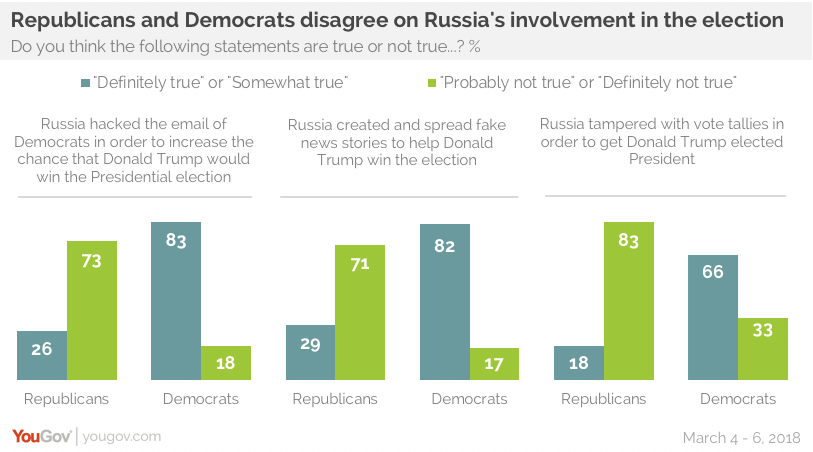
This partisan dichotomy about all this is extremely hard to credit. For two years we were subjected to Rachel Maddow dropping one “bombshell” after the other about how Trump colluded with Russia to steal the 2016 election. What was proven in the Mueller Report was a fraction of that, with scant evidence linking Trump himself to wrongdoing.
What’s worse, a story that’s 90% made up or one that’s 100% made up? The latter, obviously, but I have zero sympathy for partisans trying to make hay out of that distinction.
Look at what Democrats said just this year. Nadler asserted that if he wasn’t impeached, Trump would “rig the 2020 election.” They ran with a conspiracy theory that USPS would manipulate mail delivery to delay mail in votes. Numerous outlets ran articles on voting machine security and how easy they are to hack. You don’t think all this primed voters to believe our elections were easily manipulated? If you consistently piss in the pool, it’s fair to complain when someone takes a dump in it. Like yes, I’ll acknowledge it’s not the same. Yes, one is worse! But my sympathy is minimal.
Separate rant: As to Republicans being a “minority party”—Democrats thinking they’re the “silent majority” is a misperception that causes them to overplay their hand. They imagine that if only we had a popular vote, or higher turnout, or whatever, they’d win decisive majorities. We just had an election with mass mail-in voting with historically high turnout and Trump increased his percentage share of the vote from 2016. If you look at the data, Biden’s margin is built on (1) Republican-leaning suburbs in Phoenix, Atlanta, etc. (https://www.theatlantic.com/politics/archive/2020/11/gop-wom...). Mine went +14 for Biden, but +38 for Hogan. (2) the collapse of the third party vote from over 5% to about 2% (https://www.vox.com/21561230/libertarian-party-third-party-2...). And (3) Trump suppressing his own vote by telling his supporters not to vote by mail in an election conducted primarily by mail: https://twitter.com/JustinGrayWSB/status/1328782492913033219...
When you’re the liberal party and you have to cash in Romney Republicans and Gary Johnson voters—while running against Donald Trump of all people—how smug can you possibly be?
It’s also worth looking down ballot. Despite historic turnout and the easiest voting ever, Republicans held Democrats to a razor thin House majority. They’ll finish within a couple of points in the Congressional popular vote. They regularly win the Congressional popular vote outright (in 2016 by a point, in 2014 by 6 points, in 2010 by 8 points). If we had a parliamentary system like other countries, that would allow them to regularly form the cabinet executive branch and select the prime minister.
Also, while I’m ranting, if we had a “popular vote” like France, Clinton never would have won because it would have gone to a run-off with Perot eliminated. And Trump may still have won, in a run-off with Johnson and McMullin eliminated.
How can you possibly say this is mere paranoia in the face of an active, ongoing attempt by both the President and a huge portion of the institutional GOP to do exactly that?
There is much that is puzzling about the judges treatment of this case considering: 1) The FBI agents in charge of the Flynn case wrote a 'case closure memo' on Jan. 4, 2017, concluding he had found "no derogatory" evidence that Flynn committed a crime or posed a national security threat. FBI management then ordered the closure to be rescinded and pivoted toward trying lure Flynn into an interview. 2) In an extraordinary interview with prosecutors this fall, the FBI agent who led the Flynn case, William Barnett, admitted there was never evidence of wrongdoing by the retired general or Russian collusion by Trump, but the probe was kept open by Special Counsel Robert Mueller because his team was obsessed with punishing the president. [2]
And there are a long list of other odd facts about the case that put into question Judge Sullivans extraordinary actions by acting as a prosecutor in this case. [3]
[1] https://justthenews.com/sites/default/files/2020-04/FBIFlynn...
[2] https://justthenews.com/sites/default/files/2020-09/04518073...
[3] https://justthenews.com/accountability/russia-and-ukraine-sc...
My "favorite" example of this is Carter Page, whose name was raked over the coals for years because a FBI lawyer intentionally altered evidence (https://www.nytimes.com/2019/12/09/us/politics/fbi-ig-report...) showing that far from being a Russian asset, Page had for years briefed the CIA every time he met with suspicious Russians. (Got to love how the Times describes said altering evidence as a "serious error".) For those who want an actual Russiagate-related indictment and guilty plea by an American, Kevin Clinesmith—said FBI lawyer—is your man.
Here is the declassified note of the agents in charge of case trying to close it from Jan 4 2017. [2]
[1] https://justthenews.com/accountability/russia-and-ukraine-sc...
[2] https://justthenews.com/sites/default/files/2020-04/FBIFlynn...
What matters is evidence. Facts. Logic. Reason.
The two simply are not equivalent. Check out what Wikipedia says about the Mueller Report:
https://en.m.wikipedia.org/wiki/Mueller_report
I'm not claiming the Democrats are perfect or that there aren't mixed motives.
But it's obvious to any thinking person not living in a poisoned media ecosystem that all of these election fraud claims are baseless and ridiculous.
The same is not true about Russian influence operations during the 2016 election and the Trump campaigns, let's say, benign support of them.
If so, the facts around it should be freely discussable like the Russian collusion case was. Censoring the opposition seems fishy and anti-freedom.
And actually, when the facts are discussed in courts of law what we find every time is that there is no evidence of fraud in any meaningful way. And, that the legal arguments being made don’t make any sense and may actually be asking for something illegal.
The question of a private company choosing to censor right wing anti-democratic propaganda (I think that’s a precise description even if it’s an unpalatable one to you) at the urging of some politicians is a different and tricky question.
I think it’s important to note that there have been threats of violence against state-level civil servants and their families. Threats which YouTube videos like the ones we are discussing foment.
But to say it’s not being discussed is just another lie.
0) Biden totally won and the Trump cases are ill-founded and wrong, but
1) One can make the case that the Democratic establishment has been pushing disinformation since the first time Trump was elected, insinuating that the election was invalidated by Russian interference. The Washington Post, as late as September 21, 2020, ran the following article: "The unanswered question of our time: Is Trump an agent of Russia?"
In what manner is this new material qualitatively different? If it is a simple question of fact, to what extent is YouTube really qualified to determine facts?
2) It is eminently within reason for a human to believe that if Biden had lost, we'd be hearing cries of "voter suppression!" Hillary Clinton herself advised Biden not to concede if it came down to it, and we have other historical cases to look at, like Bush v Gore, and Stacey Abrams (D-GA) still hasn't conceded the 2018 election for governor of Georgia.
I do not ask you to litigate the matter itself, as HN is ill suited for such a dispute. I ask you instead: Is there some clear and indisputable factual evidence that would demonstrate to all comers the indicators above are not meaningful, such that it is unreasonable for your fellow man to rely on them? If not, why is the cynical position such a wrong one to take here?
Postscript: I see the score comment wobbling! Lots of fun! The -1 Insufficiently Supportive of Groupthink vote is coming through loud and clear <3
Bush won Florida in the first machine count. There was an automatic recount, and Bush won again. Gore then proceeded to create a cluster—k by demanding a hand recount of under votes only in counties he had won.
> Bush won the initial count by 1,784 votes, and he was still ahead by 327 votes after the automatic statewide machine recount. Gore then filed “protests,” demanding a hand recount of the ballots in four heavily Democratic counties, only three of which are relevant to the following discussion: Broward, Palm Beach, and Miami-Dade. Gore apparently chose these counties for one or both of two reasons. First, to the extent that errors by the counting machines were randomly distributed, Gore could expect to be a net gainer in these most heavily Democratic jurisdictions. Second, the hand recounts would be supervised by local elected officials, and the chances that such officials would be biased in Gore’s favor (or at least not biased in Bush’s favor) would be highest in the most heavily Democratic counties.
It’s a simple trick that leverages the large number of under votes (1-2% of all votes) generated by these punch machines. The machine can’t read cards that aren’t fully punched out, so there is a large pool of potentially discernible but uncounted ballots. If you only recount ballots in counties that went say 2-1 for Gore as the base rate, then when hand counters look at markings on the ballot to identify “voter intent” you’ll get 2 new Gore votes for every new Bush vote. Not only that, but there was some insane maneuvering by Gore to include partial recounts in the results. The Florida Supreme Court found this unconstitutional and ordered a statewide recount. 7 to 2, the Supreme Court found that recount unconstitutional as well. (The Court split 5-4 on what to do with the mess. But people overlook that Gore precipitated the mess, burning a ton of time before the safe harbor deadline, with his partial recount strategy.)
Voter suppression is real and has been happening for a long time. Biden winning or losing doesn't change that. So those cries wouldn't demonstrate much.
> Hillary Clinton herself advised Biden not to concede if it came down to it
She said not to concede on the night of the election, because of factors like mail-in voting. Someone that thinks she said not to concede at all, at any point, is just wrong.
“Joe Biden should not concede under any circumstances, because I think this is going to drag out, and eventually I do believe he will win if we don't give an inch, and if we are as focused and relentless as the other side is,” Clinton said in an interview with her former communications director Jennifer Palmieri for Showtime's “The Circus,” which released a clip Tuesday.
Ref: https://www.nbcnews.com/politics/2020-election/hillary-clint...
As a pragmatic matter, running any party on Not As Bad As The Other Guys™ rules will not earn you respect, at least not outside those who were already voting for you; it's impossible to send virtue signals if they don't meaningfully cost you.
"They have a couple of scenarios that they're looking toward. One is messing up absentee balloting, so that they then get maybe a narrow advantage in the electoral college, on election day."
A better argument would be to point out that a non partisan motion should gain some Republican support and it has not.
Additionally you could point out that it would be unlikely to gain support from the right due to the current incarnation of right wing politicians tending to support freedom of speech and would be opposed to this action on a partisan basis.
What if a man comes home, and says to his wife:
“Susan, you didn’t take out the trash!” he says.
“Brad, you have never taken out the trash once in your life,” she replies.
Would it be fair for him to turn, smugly clutching a copy of The Economist, and say, “Susan, this is not about me. I can’t believe you are doing whataboutism”?
... getting in before the "maybe they've only been married a couple of days and this is the first load of trash" - then how does she know he's never taken the trash out in his life?
I call shenanigans.
Because many people have been fooled by misinformation on large social websites, and it gives them a bad name, which is not in the companies' best interest. I don't really see this as a nanny state action, either. YouTube is not part of the state. From a libertarian point of view, shouldn't they have the right to censor what they want on their own platform? Yes, politicians are urging YouTube to take down the videos, but the key word there is "urging". They have no way to force them to take them down.
https://gizmodo.com/democrats-propose-section-230-changes-sa...
"Better do what we want, we're introducing legislation that will mess you up" is a pretty direct threat.
(There are also several other bills of a similar nature, that was only one example.)
They aren't saying do X or we will pass legislation about Y. They are saying do X or we will pass legislation forcing you to do X. The "widespread voter fraud" story is exactly the kind of extremist rhetoric that they are talking about writing legislation against spreading.
You haven't seen it?
Not saying anything either way about the politics of the election, but isn't this blatant government censorship?
If you think it is, then why are you asking? If you're not sure, why are you asserting it (and suggesting that a party is equivalent to a government because some of its members are part of the government)?
Perhaps you should extend your inquiry, and ask how it is that much of one party and its leader are demanding that an election be overturned or declared invalid, using a variety of extremely tenuous arguments. Please consider that these demands originate with people who have also demanded tech companies be stripped of legal immunity for content publication and regularly expresses a wish to sue media outlets out of existence, topics which seem to have earned little discussion on HN.
hartator answered this pretty well.
>If you're not sure, why are you asserting it (and suggesting that a party is equivalent to a government because some of its members are part of the government)?
Yes, active senators are in fact part of the government. The partisanship system does affect even active member's of the US government and this does seem to be a partisan issue driven solely by politics.
>Perhaps you should extend your inquiry, and ask how it is that much of one party and its leader are demanding that an election be overturned or declared invalid, using a variety of extremely tenuous arguments.
Then the other party should counter those arguments and wait for things to resolve as they will. This will happen whatever the average person believes. The election will be decided by the electoral college, or possibly the courts if any of those lawsuits end up having substance. People posting videos about anything won't change this.
>Please consider that these demands originate with people who have also demanded tech companies be stripped of legal immunity for content publication and regularly expresses a wish to sue media outlets out of existence, topics which seem to have earned little discussion on HN.
The section 230 issue seems like a separate issue being spun as a response to this issue in ways that make no logical sense. But are being pushed as a response to actions like these. I don't support the repeal of this, but I do think this kind of obvious, government urged censorship is good either.
I didn't like when trump went on about fake news and I don't like when the other side of the government goes on about misinformation. I don't believe the government, either side, should be the arbiters of what is real news or real information.
When this happens, all the average person is left with is state sponsored propaganda.
Shouldn't they?
When a murder happens, a court (which I guess is a part of a government) decides which testimony is true.
When a company makes food, FDA (or some similar department) gets to decide if their nutrition facts are correct or not.
ditto for IRS, FTC, etc.
What a government doesn't decide is if a certain opinion is right or wrong. But they usually urge public entities (e.g. media) to state the truth and suppress misinformation.
None of these are in business of deciding truthiness of arbitrary statements or opinions, and they all operate in their well-defined narrow niches and run strict fact-checking procedures, collect proofs, etc.
Unless I misinterpreted what bills were brought forward.
I don't know why you are phrasing this as a both sides issue. Misinformation is an accurate description when nearly everything about the election being stolen is an explicit lie, unless we cannot rely on their own words in court as defining what is true.
> nearly everything about the election being stolen is an explicit lie
So all of the people who swore affidavits committed perjury?
Perjury is very rarely prosecuted as it's difficult to prove the person knew they were affirming a lie. So even though there have been sworn affidavits asserting fraud which was then utterly disproven by hand recounts, there still won't be many or any prosecutions of perjury. Even though these people are most likely guilty of perjury, prosecutors won't waste scarce resources building cases and prosecuting them. Judges have mostly just dismissed these false affidavits as not credible.
A better test would be corroborating evidence or some victories for these lawsuits. In most states, election systems are designed for traceability and error detection (while some like Kentucky only have auditability in 14% of precincts). If there was fraud, there would be evidence. If there's evidence, why has Trump lost 55 of 56 of these election-related cases to date (and the one victory changed nothing, because it held that that PA had to separate out ballots that arrived after Nov 3, which the PA SoS was already doing preemptively).
Seriously, read through these filings [0]. These are clearly bad faith arguments that have no basis in reality. Trump and co have raised over $170 million from the people they are blasting with these claims that can't stand up to any scrutiny [1]. One side is objectively spewing misinformation.
[0] https://www.democracydocket.com/ [1] https://www.washingtonpost.com/politics/trump-raises-more-th...
Their star witness claimed that there was an error of 100k in the books when an error of 30k (necessary to swing the election) wasn't found during review. When challenged on that point she claimed the Republican was in on it. Whatever it is.
No claim has been made of general election malfiance. All accusations are specifically about the presidential election. How and why would you rig only a presidential election? You can't do that by merely rescanning ballots.
OP made a rethoric question.
More Senators (from both parties) should be joining the named ones about cracking down on misinformation.
I don't see the equivalence. One of those has the potential of causing very immediate panic and potential injury or death as people rush to escape a non-existant fire. The other leads to people thinking dumb things about politics.
>For example, they typically refer to things like mail-in voting as "fraud" to begin with.
Ok, so wouldn't it be the people who seek out and watch these kinds videos that would be the ones that would be too afraid to use mail in ballots? Seems like the people who think those videos are nonsense won't believe them anyway.
>All of this has a chilling effect on democracy and people exercising their lawful right to vote by post
How? From what I understand, there was a record number of mail in ballots this year, seems like it did nothing of the sort.
>More Senators (from both parties) should be joining the named ones about cracking down on misinformation.
No, the government should not be allowed to decide what is or isn't real information, that's called propaganda.
Thinking dumb things about politics is how you end up bringing your AR-15 to investigate a pizza parlor... or trying to kidnap the governor.
For those unfamiliar, telephone is a game in the US (maybe western countries) where 12 or so children sit in a circle and one whispers a phrase to another around the circle, something like “there’s a banana in the cabinet.” Then everyone has a big laugh at how ridiculous the story began and then ended up after going around the circle.
I don't understand your argument here. An astonishgly miniscule percent of the population commit crimes as a result of news stories.
Based on your argument, we also shouldn't report on police abuse because people may riot and burn down stores?
I don't think censorship is necessarily the right approach to mitigate this torrent of bullshit, but it's clearly out of control.
There is no "we".
The platform is YouTube. It is their prerogative (and indeed their right to freedom of speech) to host content as they see fit. The Senators are merely asking them to exercise their freedom to a very reasonable extent.
>Based on your argument
I was pointing out how "believing dumb things about politics" is a deliberate minimization of the effect of disinformation.
>An astonishgly miniscule percent of the population commit crimes as a result of news stories.
But an astonishingly large number of people are afraid of vaccines/black people/corona jihad/the deep state pedophile ring because they read something that isn't true. Can you think of any effects this might have had recently? Any you think of anything bad going on that isn't strictly a crime?
So in that vein, should incitements for violence against the opposing party be unfettered free speech? At what point does it go too far?
Wide scale misinformation about election fraud could result in a mini civil war. I don't see how you could be so sanguine about that.
At this point continuing to assert wide scale fraud escalates beyond "reasonable" and up to the level of "recklessness" that brings it into parity with "yelling fire".
Not to take too strong a stance until I understand your position better, but record number of mail-in ballots doesn't imply there wasn't significant voter suppression.
the implicit justification for censoring this idea is that it delegitimizes the democratic process; it is ridiculous on its face to assert that overt censorship is any less delegitimizing. this is an expression of ideological power upon an opponent.
I would assert that, collectively, we have a vested interest in determining what's knowable about the material world. We have a tradition of allowing particularly well suited people to spend the majority of their waking lives in the detailed study of difficult to understand phenomena.
We have experts, in other words.
We have a political process that encourages the cultivation of experts and even has rules allowing for personal consequences for when experts and politicians breach ethical standards.
Is it here where we disagree? Should there, indeed, be no ethical standards to which we hold out experts?
Asking honestly, bc I don't follow your argument. Maybe I'm completely off base.
We all have brains capable of thinking. The idea is to examine objective facts as best one can, this means yes overcoming personal bias, which can be difficult and assessing things from a variety of sources.
Personally, I find, if you can't find an objective source, about the best thing you can do is listen to the extreme voices and assume truth likely lies somewhere between them, whatever that truth may be.
>I would assert that, collectively, we have a vested interest in determining what's knowable about the material world. We have a tradition of allowing particularly well suited people to spend the majority of their waking lives in the detailed study of difficult to understand phenomena.
We have a vested interest in figuring out what is untrue in the world, it's the only thing we as a species are truly capable of doing and what the scientific method is based on. Silencing dissenting opinions has never worked well at that, compounding observation and evidence does.
>We have experts, in other words.
No, we have people who have spent a lot of time doing one thing, those people are often times extremely knowledgable and correct many times, but they're still human with the same fallibilities and humanness as the rest of us.
>We have a political process that encourages the cultivation of experts and even has rules allowing for personal consequences for when experts and politicians breach ethical standards.
That comes down to the same thing that plagues a lot of science reporting and other things and is a logical fallacy called an appeal to authority.
A 'so called expert' is never correct over logic and facts. This may come down to an education, knowledge issue, I dunno.
>Is it here where we disagree? Should there, indeed, be no ethical standards to which we hold out experts?
>Asking honestly, bc I don't follow your argument. Maybe I'm completely off base.
Yes, but, a person posting videos on youtube isn't a expert just because they post things on youtube.
It's fairly easy to post a video on youtube. The issue of people assuming every video posted on youtube or every word someone says on the internet, is the word of an expert is something that again I think comes down to a lack of proper education on such things as psychology, marketing, written communications other things at maybe a younger age.
We live in a world where it's possible for anyone to say anything publicly. Censorship is not the solution to the problems that arise from that.
Every person has a brain, everyone's capable of being taught critical thinking. The world seems to push subservience, acquiescencing blindly to the authority of experts and assuming the average person has the intelligence of a child instead.
https://www.msn.com/en-us/news/world/facebook-resists-handin...
I press a button on a screen when I vote. I don’t know what the hell it is actually doing and it’s shocking to me the mainstream consensus is we can’t even talk about now horrifically broken American voting is compared to sane countries like France.
You might want to look at what's going on in France right now before calling our democratic institutions sane :)
Only the swing states that Trump lost are being accused of fraud, but only in the presidential election. This is extremely disingenuous and lacks all credibility.
Now the GOP seems to be arguing in court that there wasn't even fraud, but they just don't like the outcome and want to reverse the will of the voters in swing states based on weird technicalities.
This entire thing is nonsense, and youtube should censor it because it is entirely just a scheme to subvert our democracy. That is extremely dangerous, more dangerous than yelling fire in a crowded theater.
If our democratic systems were transparent, verifiable, and understandable, it wouldn't be possible to 'subvert' our democracy in this way. The fact is that our democracy has already been 'subverted' whether or not any fraud occurred (and surely some did, just as it does in every election in American history; the only question is the scale - was it late 1800s scale or late 1900s scale - most people on HN would agree it was probably late 1900s scale, that is, minimal.) But the system is set up in such a way that we cannot actually prove anything. We just have to accept what we're told, because democracy.
The election systems in each state have their own problems. In Georgia the problems are with the tabulation, with absentee ballots, with chain of custody. I am not saying fraud did occur. I am saying that because of the problems I just mentioned, it is impossible to prove if fraud occurred or not. And things should not be that way.
At any rate, all you mean by 'subverting democracy' is 'decreasing faith in our institutions.' And I honestly don't know how anyone can look at the past few years and trust any of our institutions.
When NO fact finding court will back up any of your claims then how do you know there are "problems" with the ballots in Georgia? Your only source is partisans and the manipulated media they are releasing.
Just because trump has been working to blanket the airwaves with lies and half truths to sew doubt doesn't mean there is anything there. If there was they would be taking it to court and not losing 50+ cases.
There is no way to justify trying to overturn the vote based on technicalities while filling the airwaves with lies about fraud and that the election was stolen. If there is fraud they can prove it. If they can't prove it then they don't get to find loopholes to steal the election.
Can you actually not tell that trump is using marketing and con artist style manipulation to trick you into believing the election was stolen? There is no substance to these accusations.
Right. The faith is already gone, which is why allegations of election fraud immediately gained a large following. The cat is out of the bag, and nothing will be accomplished by censoring these videos except setting a bad precedent.
Interesting, do you have a source for this?
https://www.npr.org/2020/12/08/944230517/supreme-court-rejec...
To put it another way, regardless of the ruling I still doubt a person who walks into a the same theater every day repeatedly screaming "fire" and pulling the fire alarm with malicious intent to hurt the profits of the theater would have a 1st amendment case get very far against the theater when the theater decides to throw that person out.
Holmes' used the metaphor to equate criticism of the government during wartime to being so dangerous for society, specifically speaking against the draft during WWI, that it was akin to yelling fire in a crowded theatre.
Clearly, criticism of the government, especially regarding matters of war and public safety, are protected by the first amendment. Not only was the metaphor used to justify an unconstitutional ruling, but it also furthered gross misperceptions regarding limits on protected speech that are still referenced today.
If anything, the metaphor seems to have persisted because it's applicable in so many other scenarios, not because of that one case that rarely seems to get brought up in casual discussion.
Lies, falsehoods, misinformation and irrational statements are all protected by the first amendment. As is uttering insane and unintelligible thoughts in public.
If speech is used to further a crime or directly causes civil harm that result in damages (ex. assault or nuisance), there are existing applicable criminal and civil laws to either punish or provide a remedy.
If for example, the police were to execute a lawful warrant to search your property, it would not nullify or burden your fourth amendment protection from unreasonable searches and seizures.
Similarly, civil remedies (i.e. tort law) allowing for compensation for damages due to negligence - say from getting trampled in a crowd that was spooked by someone yelling "fire" or "shooter" - would not place limitations on your protected right of freedom to assemble.
The biggest problem with the campaign to justify censorship or moderation of misinformation/disinformation under the guise that it causes harm, is that it removes the measurable injury element of tort law and replaces it with vague and abstract notions of either mass ethereal or psychic harm (which the Supreme Court has expressing found against).
Not "fraud." Illegal votes. In fact, there is a case brought to the Supreme Court by Texas and 17 other states (36% of the United States) alleging this exact thing: that many mail-in votes were illegal, due to unconstitutional rule changes which allowed them to take place[1]. That's not ok to talk about on YouTube?
[1]If you don't know what I'm talking about, just say so and I'll point you to a non-partisan, levelheaded explanation of the argument.
Firstly, this is a false equivalence. The kind of videos I am talking about are not ones discussing some frivolous lawsuit, they are the ones by wild-eyed zealots ranting about the Constitution that end up hatching plots to kidnap the Governor of their State [1]. The sort of videos that lead to people shooting up a pizza parlor because they believe it's the center of a Satanic organization [2].
But leaving that aside for a moment, restricting what's okay to talk about on YouTube is, by definition, YouTube's problem. They can restrict videos uploaded on the platform to be exclusively people wearing pink furry suits if they want.
Senators can ask YouTube to try and stop running videos peddling conspiracy theories on their platform, because they believe YouTube (despite the large number of complaints about them) is generally speaking, a responsible and fairminded platform; and they expect that YouTube is broadly trying to do the right thing – not be political, but also crack down on unreasonable crackpot theories being peddled on its platform.
Asking this of a less fair-minded source (say the vidoes on a Stormfront website) would be pointless, which is why the Senators don't do so. You will notice that the Senators aren't asking the creators of Gab to crack down on crackpot theories on their platform either.
-----------------------------
[1] https://www.reuters.com/article/us-michigan-whitmer/militia-...
[2] https://www.npr.org/sections/thetwo-way/2017/06/22/533941689...
>Asking this of a less fair-minded source (say the vidoes on a Stormfront website) would be pointless, which is why the Senators don't do so. You will notice that the Senators aren't asking the creators of Gab to crack down on crackpot theories on their platform either.
That's an interesting theory. Someone else might argue they are targeting YouTube and Facebook because there are more swing voters on these platforms and because these platforms are far more viral than Gab or Storefront.
As a matter of great irony to folks in the tech industry, this same argument was being used in the 1990s to ban violent video games. Of course it failed, because it was a terrible idea and was based on debunked science.
No one is taking away free speech in this case, that's where I think people are talking past each other.
Isn't not allowing videos on your platform also a form of freedom of speech? The senators are simply urging YouTube to exercise their freedom of speech to run fact-checked, non-crackpot videos on their platform. Why do you want to force YouTube to carry videos of bizarre conspiracy theorists on their (private) platform?
If the Senators ordered YouTube (or indeed, Fox News) to suppress specific videos, that would indeed be taking away free speech.
This is incorrect. The other states' attorneys general, partisan elected officials that they are, filed amicus briefs. They didn't join the suit and aren't speaking for their states. The actual precedent that this case would set would be nightmarish for every state. Nobody wants this, it's a stunt.
This suit is going to be immediately rejected by the SC just like all the other frivolous lawsuits. The best way of predicting the future is to look at the past, and the past 50+ lawsuits have been dead on arrival.
I'm not saying that you're wrong. I'm saying that the media do a deplorable job of reporting accurately.
(emphasis added) An amicus brief is also known as a 'brief.'
[1] https://www.foxnews.com/politics/missouri-16-other-states-fi...
(Note that rejecting for procedural deficiencies doesn't mean that the court approves of the merits of the case, it just means that the court also doesn't want to decide the merits. Although if you piss it off hard enough, they will also go own to berate you on why your claims lack merit in addition to enumerating procedural deficiencies).
A reminder that states are sovereign and don't run their elections according to the Federal Constitution. This whole idea that states can't determine the course of their elections because it's "unconstitutional" is farcical.
> In fact, there is a case brought to the Supreme Court by Texas and 17 other states ...
How do I put this delicately?
That case is bullshit.
Texas knows it, those 17 states know it, the Supreme Court knows it, and every single lawyer in the United States knows it.
And now you know it.
The Supreme Court will probably, like it did to the Pennsylvania Republicans, issue an order consisting of a single sentence rejecting their application:
"The application for injunctive relief presented to Justice Alito and by him referred to the Court is denied."
https://www.supremecourt.gov/orders/courtorders/120820zr_bq7...
Examining what facts we have it’s very clear that the Republican Party has put forth a number of specious lawsuits with no grounds - all of which have been vehemently rejected by every court in the land - and that the goal of these lawsuits is either to overturn the legitimate election results and/or undermine people’s faith in the election.
Many or most Republican politicians know the lawsuits will fail and are on board because they know they have to keep their base riled up in Georgia to win those Senate runoff elections.
And also because Trump still has a vise-grip on the Republican base, so these politicians have made the calculation that they’d rather do what Trump wants (so they can win re-election) than reaffirm what is America’s most fundamental small-d democratic process: voting for our president, having our leader be elected by the people.
Considering how fundamental voting is to a democracy, I don’t think it’s unreasonable to call an attempt to undermine the electoral process itself seditious.
It’s not very patriotic to put the success of your own political party ahead of the good of the country. Both sides do it a lot but in this specific case it’s clearly the Republicans and it’s a pretty egregious breach of faith of our social contract. In America we expect our elected officials to respect the rules of the game, and acknowledge an electoral loss.
Do you agree that these lawsuits are un-patriotic and seditious? If not, why?
I look forward to your reasoned, cogent, and rational response so we can have a nice intellectual discussion about policy.
Please don’t share evidence or whatnot which the courts have already examined and rejected - it doesn’t seem like a very good use of time to cover old ground, unless of course you wish to disagree with the decision of the courts.
Be careful what you wish for - you just might get it! ;)
———-
My point, of course, is that not all of our political conflict is blind “tribal warfare” where blame can be equally distributed between the two sides. There really are some important issues where one side is wrong, and where it’s important to fight for what’s right.
That’s not to say all partisan conflict is good and necessary. But I do think the facts show that (and I don’t deny the many flaws of the Democratic Party) the Republican Party has embraced obstruction as a technique to achieve and maintain power and continues to inch closer to “If I can’t have it, well then nobody can.”
And that they’ve embraced a figure who is very comfortable with undermining democracy itself and would love to become an authoritarian leader.
(You'll note that the examples I cite are not states that Texas is suing, and that should give you some indication of the likelihood of success.)
[Side note: that's one of the arguments. The actual brief is kind of a legally incoherent mess, so it kind of hops around from argument to argument a bit; the other main argument, which most of the amici seem to want to focus on, is that PA's Supreme Court improperly adjudicated PA law's propriety under the PA Constitution, and therefore Texas has right to settle that dispute in front of SCOTUS, despite SCOTUS dismissing an appeal alleging exactly that just yesterday.]
It’s a bad argument. The US Congress has delegated some of its power to the Executive Branch (FDA and IRS, among others), just like I’m sure some of these states have. If a state legislature passed laws allowing the governor to change election rules, then the legislature is still choosing the electors, not directly, but by having delegated that power to the executive branch of the state.
I’m not a lawyer but this argument sounds flimsy at best.
2) You should also explain more clearly why you think it could be rational to discount the decisions of state courts which rule on the laws passed by the state legislature on the basis that they aren't the state legislature... That is like saying the Supreme Court shouldn't have a say over how Federal laws are applied. It's their entire job.
And all this is ignoring the idea that the legal system ought to represent the democratic will of the people and the institutional processes they put in place, whether it's via upholding the laws of the legislature or the vote.
They could also request (but not order) Russia Today, Fox News, One America News Network, and Stormfront to do some basic fact-checking on the videos they host; but that would be a complete waste of the Senators' time, so they don't bother with the request.
And private entities should go even further, at least to protect their brands. I will always think of Facebook as the place where the Rohingya genocide was organized and carried out, and Facebook is where violent protesters like Kyle Rittenhouse gathered before killing multiple people. I think about the platforms that allowed ISIS to radicalize people. Google doesn't want YouTube to be the video hosting site where you can watch the world burn. Reddit removed the sub where you could literally watch people die. You might see these actions as against some dearly held political beliefs but it's pretty clear to me that these are just adults trying to act with a modicum of responsibility.
And I don't think there's any reason to believe that these YouTubers don't believe their allegations.
If things are backed by evidence is a whole different story (but it is not)
"For context, electoral fraud was and is more prevalent in Corsica than in the rest of the country. The article goes on to mention that in Ajaccio (the largest city in Corsica), one list had obtained 33.5% of the physical votes but 90% of the mail-in votes in the first round, and similar figures in the second round."
Doesn't it feel familiar?
> Here also — observers generally agree on this point — mail-in voting is one of the preferred methods for fraud. The idea of removing mail-in voting and replacing it by proxy voting has therefore been generally admitted in the [parliamentary] legal commission.
Also the counting from some distant area with opaque machines and the fact not everyone is authorized to check the count is ripe for abuse.
This feel vaguely concern troll-y, but I'll engage. I am sure that there are valid security concerns, and some possibilities for fraud with mail-in voting.
However the argument about "Oh look it's bad, there are so many possibilities for fraud" would look a little more okay if the President wasn't engaging in it [1] and his party wasn't also quietly pushing for more of it in areas where it benefits them. Of course they find some flimsy excuse to justify this “well, ours is called an absentee ballot because you have to request it”.
You can't have it both ways. If mail-in voting feels crazy, the 2016 election where like 25% of eligible voters voted by mail should also be considered invalid.
What is not okay is crying "Fraud" in nebulously defined ways for only the states you lost at the moment you start losing with the existing system. This is basic kindergarten stuff, so it's kind of funny that it has to be explicitly explained in such a big national event.
------------------------------------
[1] https://www.npr.org/2020/08/19/903886567/trump-while-attacki...
[2] https://www.politico.com/news/2020/08/19/republicans-mail-in...
And those before. It's like most things are done in a way to make it possible to fudge results.
Which is not new, the exactly same happened a couple of years ago to force Social Media companies to moderate more strongly on "extremist/jihadist", "foreign interference" and "child nudity" content.
During Senate hearings Google, Facebook and Twitter were faced with the choice to either do it themselves, or be forced to do it trough regulation, those were bipartisan efforts [0].
But even back then it was pretty evident how that whole thing would end up as a slippery slope.
[0] https://www.fastcompany.com/40489793/senators-grill-facebook...
The use of the word "urge", instead of "request" or "demand", seems to imply that Google is within its rights to decide. The letter does not threaten any legal action if Google decides not to remove alleged misinformation. It does not allege that Google has broken any law. What the letter does request are answers to questions. It looks like a standard letter requesting information that we commonly see from US Senators to US tech companies.
One can make a reasonable argument that YouTube is making the decision voluntarily. And the letter is just giving them some cover for what they wanted to do, based on their own biases, anyway.
But private censorship is still censorship. And when a platform is so large that it has effectively become "the public square", well I do not go so far as to say that they cannot legally engage in censorship, but I do believe they are morally obliged not to, and should be publically called out when they do.
I hope people will begin moving to other platforms in droves so that some real competition emerges.
Google is making a strategic decision. Despite what you may hope, free speech isn't YouTube's main priority--it's profit. Right now they're trying to minimize the possibility profits may be impacted by stakeholder action. They don't care if your particular political views aren't adequately represented. Free speech isn't a mandated requirement for corporations.
Once you have started taking sides, started to take down videos you fund spreading incorrect points of view, you can consider to extend it. Videos that doubt the efficaciousness of masks. Videos that say the quarantine is a plot by world government of reptiloid aliens. Videos that promote the idea of flat Earth. Well, this is a dead end.
How about videos that Taiwan is in fact independent from China? Videos that allege that unelected bureaucrars have more power than elected officials? Videos that suggest that there is trouble with voting counting during US elections?
You can easily end up doing way, way more censorship than strictly required to keep your resource legally clean (hate speech, copyright violations, etc). If I were Google (YouTube, Alphabet, whoever is responsible), I would stay as far away as possible from this kind of censorship, purely because of the cost of doing it, and the constant getting into hot water when not censoring enough, or censoring too much. Being a neutral pipe could be plainly better for the business.
Edited: typos.
Today, we live in a society where crackpot ideas are being shared by acquaintances, but unlike 10 years ago there is no common sense and logic being applied at the value and factual nature of the information. The systems are designed and layered in such a way that a person gets a bit of information, that information is highly compounded in their world view, other ideas are not in their funnel. Even if they go and try to validate it (which they may not because everything else in the funnel on their information streams supports/compounds the view) there are whole markets of pseudo news that are entertainment channels masquerading as news supporting the same insane ideas.
These systems act as badly as a schizophrenic thought process slowly detaching the participants from reality as the information they see compounds their world view.
I think Bertrand Russel, as quoted elsewhere in the comments in https://news.ycombinator.com/item?id=25362730, explained it well.
That is, to me the solution is to help people become less religious / partisan / rooting for the in-group, and become more independent and critical. It's indeed pretty hard to do when most major information streams work in the opposite direction.
Some of my hope is in the built-in protest of teenagers and youth; some in the idea that people with a developed taste would stay away from echo chambers and outrage machines for esthetic reasons, among others.
"Our observers could not see anything"... then they could not see any fraud taking place either. It is a dumb narrative.
We also have to acknowledge the context in which this is occurring; the people claiming fraud are also threatening violence against civil servants and their children.
"Georgia officials were similarly reticent until last week, when threats online targeted a young contract worker for Dominion Voting Systems, whose voting machines were used in the state. One post on Twitter included a swinging noose.
That day, Gabriel Sterling, the Republican in charge of the voting machines, walked to a podium visibly angry and demanded that Trump “stop inspiring people to commit potential acts of violence.”
In an interview with Reuters, Sterling said that he personally had received a message calling him a him “traitor” that included his home address. Someone else wished him a happy birthday in a tweet saying it would be his last."
https://www.reuters.com/article/usa-election-threats/electio...
Just like it's difficult when and what content to censor when it comes to things like the ISIS recruiting pipeline, it's hard to know where the line is with what is basically a far-right ideology which bleeds into domestic terrorism.
Not saying it’s right. Just saying it’s happened at least once before and I bet other times.
I also think it's misleading to call it partisan, as if truth and falsehood are just two different flavors of ice cream, or two different sports teams. An informed populace is a necessary precondition for democracy to survive. Google might have the right to profit from misinformation, but I don't think they have an obligation to do so. They are allowed to support free and fair elections, just like the rest of us.
So, i'm kind of curious how it's reasonable a political party can ask for partisan censorship.
>YouTube CEO Susan Wojcicki received a letter on Tuesday from four Democratic senators expressing “deep concern” over the spread of election misinformation on Google’s video platform. In the letter, senators Robert Menendez of New Jersey, Mazie Hirono of Hawaii, Gary Peters of Michigan and Amy Klobuchar of Minnesota ask YouTube to commit to removing content with false or misleading information about the 2020 US presidential election and future political races, including the coming, pivotal Senate runoffs in Georgia.
>“We urge you to immediately remove all election outcome misinformation and take aggressive steps to implement prohibitions, as other social media companies have done, regarding outcomes in future elections,” the letter reads.
This isn't a company deciding, this is censorship urged by the government. I thought that kind of thing was illegal down there.
Not saying anything either way about the politics of the election, but isn't this blatant government censorship?