https://images.hgmsites.net/lrg/hydrogen-vs-electric--volksw...
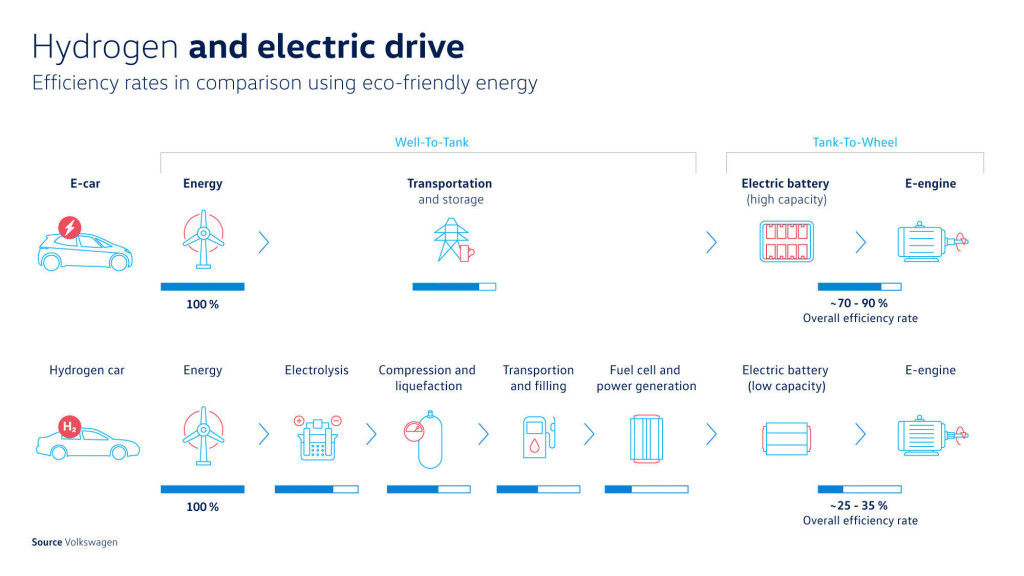
This image (don't know the source), which includes oil and coal, is also a good visualization:
https://i.imgur.com/Wuhnlvu.png

Even simpler:

In other words, if a refueling station can do solar or wind capture and electrolysis on-site, the economics are better. This would be unlikely for stations in urban or high-density areas, but for rural and suburban locations it might be a win.
Say a fueling station needs to serve (only) 100 cars per day, providing 50kWh per car. That's 200kW average generation power needed. Ballpark, a 1 m2 solar panel can generate 200kWh/year, or 23W average. (quora answer, 2018). You need .. really? 9100 m2 of area, which is .91 hectare or 2.25 US acres.
A 200kW per day (73000kWh/year) wind turbine might stand 25m tall. (uk wind energy report, 2014) Will these function in suburban to urban settings? Would they be accepted by the public? In the US, siting rules are a mess, but one example I found called for 2500 feet (760+m) distance to property line and 1.5 times turbine height to overhead utility lines. (NCSL, 2016)
Given these fairly large size requirements, unless I slipped some decimal points, it doesn't seem likely to work out.
https://www.quora.com/How-many-kWh-will-1-sq-meter-of-solar-...
https://cdn.ymaws.com/www.renewableuk.com/resource/resmgr/Do...
https://www.ncsl.org/research/energy/state-wind-energy-sitin...
The only thing that beats oil is nuclear fission. With everything else, production takes up land that could be used for something else, or isn't being used for something else because it has problems such as distance or inhospitable climate or unfriendly (steep or unstable) terrain. All of which drive up maintenance costs or make the land also unusable for energy production.
There are no good solutions apart from the one that coal companies astroturfed us into nearly banning in the 1960s.
I understand the impulse to defend nuclear power against seemingly irrational criticism, but that shouldn't distract you from the incredible advances that other technologies have been making. Nuclear has had its time, and today it's just not a competitive way of making electricity anymore.
Beside, you're never going to convince people that nuclear is perfectly safe - it just isn't. Even if you can completely rule out catastrophic failure, you still have a bunch of people who need to go to work every day and work with radioactive materials. Yes, it can be done safely, but personally I'm happy I don't have to (and I do work with other toxic crap in the lab on a regular basis ;)).
So, at the end of the day, you're going to need to make an argument that goes like "... but nuclear power is worth it because we have no better alternatives" at some point. But look at this report on levelized cost of energy (LCOE) [0]. Wind and solar are absurdly cheap! We need to focus on solving the intermittent supply issue now, and that looks to be totally doable, if expensive, with current technology. But it's only getting cheaper (see literature I've cited in a different post in this thread).
Of course, calculations might change if there's some sort of technology breakthrough in nuclear technology - as in any technology.
This is argument from extremes.
Coal plants kill a lot more people simply by operating: they release radioactivity (and toxic heavy metals, and PM2.5 particulate).
Gas extraction, processing, and transport also kill people (often the people who were occupying the land that the gas drillers want.) Ditto for oil. Wind turbine construction and maintenance also kills people. Solar panel construction involves working with toxic chemicals in far greater quantities than nuclear fission.
You expose fewer people to smaller risks with nuclear than with its alternatives.[1]
Also, wind and solar are dependent on either storage, for which we have no good grid-scale, months-long options yet, or globe-spanning petawatt transmission networks, if you're not going to accelerate climate change.
Don't get me wrong. I love solar PV - the only energy production method that relies on modern physics. I love wind, too, because it doesn't involve boiling water to make steam to drive turbines, which seems hopelessly steampunk to me these days. I'd also love to see a worldwide transmission network - that level of international co-operation would be awesome.
[1]. Gawd, I sound like a shill for nuclear. 2002 me would be horrified. But learning about climate change (and wanting industrial civilization to continue) forced me to confront my priors.
I just don't agree with this. The tech has not been there, and even as that has slowly changed, the regulatory environment has lagged and obstructed horribly. These are problems, but they can change over time.
I believe it is in fact possible, given enough resources and effort, to truly perfect nuclear power - that being, after all, the real source of all these "renewable energy" options. And when we do, we should embrace it, not dismiss it out of hand based on some outdated superstition.
I don't have anything at all against wind and solar, but it's not a 1000-year strategy. Yes, we need to take urgent action to address climate change, and these may well be - ok, fuck it, are - our best short term options. But going forward, when we then need to look at how we'll increase society's power budget by 10, 1,000, 1,000,000 - nuclear is the only way[1], and we should start working on that, and sweeping away these old stereotypes, today.
[1] also open to space-based energy harnassing techniques, but i am trying to limit my thinking to known-viable ideas
Even though not so many people live so far up north, it's a significant part of densely populated Europe.
Are the economics better than just placing that solar or wind plant on the grid and using electricity for battery-powered cars? You still have big losses in electrolysis, compression and then power generation in a fuel cell.
AKA Germany would probably be better off investing solar farms in southern Spain and connecting via long distance transmission lines. Only 1600km or so. Also consider sunset is an hour later in south west Spain.
Nuclear is not cheap compared to photovoltaics, wind and hydro. Since the former two are bursty, overcapacity in them leads to cheap excess energy at times, which needs to be stored.
Which storage method is the best depends on multiple factors, particularly on the duration of storage, capacity required and frequency of charging/discharging.
Batteries are great for relatively short term storage, but for long term, seasonal storage, hydrogen and pumped hydro are the options we have. Pumped hydro capacity is limited, and the cost of hydrogen production and storage is coming down. So that's where hydrogen makes sense: Long term, high capacity storage.
Not necessarily, at least not always. It needs to be used and this can be made possible by expanding the high voltage networks.
This would be especially effective in the east-west direction because then areas with sun could supply areas where it is dark. This reduces the need for storage while also making the system more robust.
If we add more north-south interconnects we can use some of the Scandinavian hydro plants as batteries (I agree that pumped storage can never be as extensive as one would like and is not as easily achieved as some people think) and North Africa for solar power.
What is most lacking is not new technology but political will to interconnect the electrical supply network so that energy can flow more easily from where it is produced to where it is needed.
I think many people see excess capacity as a form of waste to be reduced, but it's like thinking that gigabit fiber is a waste because it's not used to it's full capacity. The value of oversupply is that it's always available when you need it. The fact that new industries can spawn from the super cheap rates for excess electricity or data is just a bonus.
I disagree, especially at high latitudes. Try that in the UK, for example, at https://model.energy/
https://www.forbes.com/sites/christopherhelman/2020/05/21/ho...
Go play with this web site and look at the optimal solutions (for producing constant power output) under various cost assumptions, using real weather data.
Generally, the best solutions involve some overbuilding, some storage, and some combination of solar and wind. For sunny places, solar + batteries (+ a little hydrogen); for windy places, wind + hydrogen (+ a little solar and batteries).
The amount of energy storage required even to just handle the daily duck curve is staggering. To put this in perspective, the US consumed 11.5TWh of electricity daily. Global lithium ion battery production is 300GWh per year.
Until some truly groundbreaking storage mechanism gets developed, renewables have difficulty providing more than 40-50% of energy demand.
https://cleantechnica.com/files/2019/04/2019-Q1-Growth-in-Gl...

And this all this is ignoring the fact that batteries lose half their capacity after 300-500 cycles. Even if we're generous and say 1000 cycles that's still just 3 years for diurnal use (daily charge and discharge cycles).
This thread is being rate limited, reply in edit:
> I didn't miss that. Why do you think global manufacturing capacity will stop when it reaches what the US needs, and not expand to satisfy the global market? You think the manufactures are going to leave sales and profits on the table for no good reason
I can ask you the same thing: why do you think that global battery manufacturing capacity is unlimited? What makes you think that we'll have an unlimited supply of raw materials? The prevalence of metal deposits does not respond to the market. Increasing prices of lithium will make more people search for lithium deposits, but there's a finite number of said deposits.
And again, the projected increases in in battery production due to increased demand bring down the time to create enough capacity from a matter of centuries to a matter of decades. For batteries that last a few years if cycled daily.
> It also seems reasonable to expect at least one significant breakthrough in battery technology over the next 10-30 years, given how important a problem it is, and how many promising approaches there are already.
So our approach is to keep our fingers crossed and hope for a technological breakthrough. If that's the case we might as well just hope for fusion to work.
But most of us would prefer a solution that we know works rather than bet on the possibility of breakthrough. And right now the only two known means of generating most of a country's power from a carbon free energy source is through hydroelectricity and nuclear power.
The growth in production is being controlled by the growth in the market. New factories can be added at very high rate if needed. You are treating the manufacturing capacity as some exogenous constraint rather than something that can be changed along with everything else.
To respond to your response: a universal aspect of mineral depletion arguments is that estimates are too low. Demand create supply as people are encouraged to go look for more, and to develop new ways to extract materials.
Consider that natural gas used to be though of as rare and limited, so much so that its use for power production was outlawed in the US!
Where are you getting this information? Natural gas has been widely extracted for much of the last century [1], and made up substantial portion of electricity generation as early as the 1960s and 1970s [2]. Where did you read that its use for power production was banned?
It became preferable in late 20th and early 21st century for power generation because of stricter emissions standards. Burning methane is cleaner than burning coal, and technology developed to the point that building gas infrastructure was not cost prohibitive.
Natural gas is not an example of a previously rare natural resource suddenly becoming common. And even if it were, there's no guarantee that lithium is going to follow the same fate. Simply assuming that there are always more mineral reserves than is estimated is an easy way to end up with a shortage.
There are battery technologies based off of metals other than lithium. For example, the key downside of sodium batteries seems to be weight/volume, which is less of an issue for grid storage. And there's a lot of easily accessible sodium.
It also seems reasonable to expect at least one significant breakthrough in battery technology over the next 10-30 years, given how important a problem it is, and how many promising approaches there are already.
Finally, there is a lot we can do to reduce storage requirements by strategically spreading load. If we get enough generation capacity and are storage constrained, then electricity could become significantly during generation hours, which would cause people to do things like run their washing machines during the day.
> And while battery production increases, so too does electricity demand.
This is probably true on a worldwide basis. But here in the UK, electrical demand has actually been falling due to more efficient appliances.
And as you point out, generating this hydrogen is nowhere near cost efficient. To put this in perspective, energy costs in the US average about $.10-$.20 per KWh [1]. You're literally talking about a 1,000x increase in the cost of electricity for hydrogen storage even if the rumors of "cheap" $200/KWh hydrogen production turn out to be true.
1. https://www.electricchoice.com/electricity-prices-by-state/
This thread is being rate limited, reply in edit:
> You are pointing to RETAIL electricity costs. Rookie error, man.
Elaborate on what you mean by emphasizing retail energy costs. That is the cost that customers pay for the electricity that is delivered to them. Some of this is subsidized, but this subsidy is not large. The US provides $3-5 subsidy per MWh of electricity. [2] Half a cent per KWh.
Even if we ignore subsidies, hundreds of dollars per kilowatt hour of hydrogen storage is still a factor of a thousand more expensive.
2. https://spectrum.ieee.org/energywise/energy/policy/how-much-...
It's what a residential customer would pay. It's not what an industrial customer would pay, and it's certainly not the internal cost the utility to pay for their own production of hydrogen. In particular, it includes the cost of supporting the distribution network. None of the power being sent to the electrolysers will be sent over the thousands of miles of residential distribution lines.
It also doesn't take into account that the wholesale price of electricity in power markets varies with time. The residential fixed price is derived from some average of that (plus charges for all the overhead), but the electrolysers could be operated when the wholesale price is low.
> hundreds of dollars per kilowatt hour of hydrogen storage is still a factor of a thousand more expensive.
The capital cost of storing hydrogen in underground cavities is estimated to be $1 per kWh of capacity, and perhaps much less.
Current estimates place this at $1,400 per KWh per year for the average case assuming that the electricity provided is free [1]. That works out to $3.80 per day per kilowatt hour of storage. Even for the optimistic estimated provided by this study, it's still $800/KWh/year - still over $2.00 per day. And again, this is assuming that free excess wind generation is used to get generate hydrogen.
Us retail energy costs are about $.13/KWh. Industrial costs are $.07/KWh. For diurnal storage, hydrogen energy storage represents a 20x cost increase even in the best case estimates for the storage cost and assuming that excess wind generation will pick up th slack.
And for non-diurnal storage the costs are even higher per KWh because a smaller amount of delivered electricity needs to pay off the same amount of capacity cost.
Also, before you point at figure 16, know that this graph includes "capacity credits" - it's not the actual cost.
1. https://www.google.com/url?sa=t&source=web&rct=j&url=https:/...
Nowhere did I say or imply that. My argument is actually the complete opposite.
What hydrogen does is get a much lower cost per unit of energy storage capacity, at the cost of lower efficiency . The cost per energy capacity of batteries is two orders of magnitude higher than for hydrogen storage. So, hydrogen exploits that for long term storage, it's ok to waste more input energy, if you can get the capital cost down.
> Us retail energy costs are about $.13/KWh. Industrial costs are $.07/KWh.
The correct figure to look at is wholesale price, which is often below $.03/kWh in US power markets, and lower at off peak times when one would make hydrogen.
https://www.eia.gov/todayinenergy/detail.php?id=42456
> For diurnal storage, hydrogen energy storage
I explicitly wasn't talking about diurnal storage. That's not the use case for hydrogen. The use case is long term storage.
> And for non-diurnal storage the costs are even higher per KWh because a smaller amount of delivered electricity needs to pay off the same amount of capacity cost.
Hydrogen has a huge advantage in long term storage, because the per-energy capacity cost is so damned low, compared to batteries. Yes, the cost per kWh stored in long term storage is higher than the cost per kWh in short term storage. But they are different use cases and one cannot be substituted for the other.
If you optimize the problem of providing a steady output from renewables over the days and years, you will find in most places that a mix of short term and long term storage is optimal. Neither substitutes for the other.
Again, the estimates shared in the study are made with the assumption that electricity used for hydrogen production is free. This is why I am left with the impression that you think the energy used for electrolysis amounts to a large portion of the cost of hydrogen storage. Because you seem to be fixated on the cost of electricity, even though hydrogen storage is still incredibly expensive even if electricity is 100% free.
No, hydrogen does not have low cost of energy storage. Average estimates place the cost at $1,400 per KWh per year for average estimates and $800 per KWh per year for optimistic estimates. And for the third time, just to make sure that this fact gets across, these estimates are made with the assumption that the electricity supplied to generate hydrogen is at zero cost from surplus renewable generation.
This cost needs to be recovered from people drawing the stored energy. If all this energy is being drawn in one day of the year, it's going to cost $1,400 or $800 per kilowatt hour depending of whether you use the average or optimistic estimates. If you draw the energy on 10 days out of the year then it's going to cost $140 or $80 per KWh. How does this make it more suitable for long term storage? It doesn't. Even if the cost were spread out over the entirety of the year it would cost anywhere from 60 to 120 times as much as the wholesale price of $0.03 per KWh. If this energy is only going to be draw on for part of the year this cost increase is going to be even larger because the same cost of storage needs to be recuperated from a shorter period of sales.
It's the most suitable solution for long term storage by virtue of the fact that it's one of the only mechanisms we have for long term storage with our current technology. It's nowhere near cost effective. The costs are the total opposite of "so damn low".
Yes, the cost to store hydrogen for LONG TERM STORAGE is higher than the cost to store electricity in batteries for SHORT TERM STORAGE. But the cost to store hydrogen for long term storage is LOWER than the cost to store electricity in batteries for the long term.
If you are comparing batteries short term with hydrogen long term, you are comparing apples and oranges.
Your study does NOT say batteries are cheaper than hydrogen for long term storage. They could not possibly be cheaper for that, since there are too few charge/discharge cycles to amortize the batteries' very high cost per kWh of capacity.
You seem to be saying "just use short term storage!". But that's not a legitimate approach, since there are long term variations in supply and demand. Short term storage only applies to short term variations.
> Yes, the cost to store hydrogen for LONG TERM STORAGE is higher than the cost to store electricity in batteries for SHORT TERM STORAGE. But the cost to store hydrogen for long term storage is LOWER than the cost to store electricity in batteries for the long term.
> If you are comparing batteries short term with hydrogen long term, you are comparing apples and oranges.
I'm not comparing anything. I'm providing a source on the cost of hydrogen storage, to refute your unsubstantiated claim that hydrogen storage is cheap.
And as it turns out this cost is extremely expensive, regardless of whether it's used for short term or long term storage.
> Your study does NOT say batteries are cheaper than hydrogen for long term storage. They could not possibly be cheaper for that, since there are too few charge/discharge cycles to amortize the batteries' very high cost per kWh of capacity.
Correct, this study is about the cost of hydrogen not a comparison versus batteries. And for the second time, nowhere did I compare hydrogen against batteries. My reply doesn't even mention batteries once.
All I used this study for was tho find an estimate for the cost of hydrogen storage. And that cost is $1,400 per kilowatt hour per year for normal estimates and $800 per kilowatt hour per year for optimistic estimates. This is incredibly expensive, contrary to your claim that the cost of hydrogen storage is "so damn low".
> You seem to be saying "just use short term storage!". But that's not a legitimate approach, since there are long term variations in supply and demand. Short term storage only applies to short term variations.
The point is that it's extremely expensive, and not a viable solution for any type of storage. Short term or long term. The cost per kilowatt hour of storage is just way too high to be viable. $800 per kilowatt hour per year for the optimistic estimates, and $1,400 for realistic estimates is insanely expensive. And again this is assuming that the electricity provided to convert water to hydrogen is free.
In what world is $800 to $1,400 per kilowatt hour per year, "so damn cheap"? For hydrogen to achieve even just 1 day's worth of energy storage for the USA (11.5 TWh daily usage) at a cost of $800 per kilowatt hour per year would cost $9 trillion dollars per year. And remember, that's the optimistic estimate and assuming that the energy used to produce hydrogen is free.
This isn't about short term vs long term storage. Hydrogen storage is incredibly expensive, it's not "so damn cheap".
There are, of course, OTHER parts of a hydrogen storage system, whose costs scale with the input and output power, not the stored energy. And these other parts (and the lower efficiency) make hydrogen uncompetitive for diurnal load leveling.
But hydrogen is superior to batteries if the goal is to store the energy for considerably longer periods. It is TOTALLY about short vs. long term.
As for whether hydrogen is "incredibly expensive": for the things it is suitable for, it is cheaper than the alternatives. Try to optimize a CO2-free power system using just wind, solar, and batteries in Europe, vs. one that also includes hydrogen storage. The latter is cheaper! It's also cheaper than a system that includes new nuclear power plants
> In what world is $800 to $1,400 per kilowatt hour per year, "so damn cheap"?
Your units there don't even make sense. BTW, I hope you aren't taking ratio of energy capacity to power-related costs suitable for diurnal storage and applying that to a seasonal storage system. The latter charges up and discharges over months, so the ratio is very different.
Right, and this claim is totally false. It's not cheaper than batteries, let alone 200x cheaper.
Where are you getting this figure that hydrogen storage is 200 times cheaper than battery storage?
> But hydrogen is superior to batteries if the goal is to store the energy for considerably longer periods. It is TOTALLY about short vs. long term.
No, it's not. Again, are you just completely ignoring the costs presented in the study?
> As for whether hydrogen is "incredibly expensive": for the things it is suitable for, it is cheaper than the alternatives. Try to optimize a CO2-free power system using just wind, solar, and batteries in Europe, vs. one that also includes hydrogen storage. The latter is cheaper! It's also cheaper than a system that includes new nuclear power plants
No, it's not. Again, even just providing 1 day's worth of nuclear power costs over 9 trillion dollars every year using the optimistic estimates. Using the mid range estimates this figure is $16T per year.
> Your units there don't even make sense.
Cost of storage is measured in both capacity in duration. The unit answers the question, "how much does it cost to provide X amount of storage over Y duration"? Hence, kilowatt hour per year. Or $ KWh/yr as shown in the study. I'm not sure what is hard to understand about cost per kilowatt hour per year. $800 KWh/yr means it costs $800 dollars to provide 1 kilowatt hour of storage capacity for one year.
Let's look at a source of numbers, shall we?
Go to https://model.energy/ and click on "Show advanced assumption settings".
Now scroll down a bit:
Battery energy capital cost: 142 Euro/kWh
Hydrogen energy capital cost: 0.7 Euro/kWh
What's the ratio of those? About 200!
It should be really clear why these numbers are what they are, if you understand what they mean. The hydrogen energy capital cost is the cost of creating the underground storage cavern where the compressed hydrogen will be stored. It does not include electrolyzers, compressors, turbines, or generators -- those are all POWER related capital costs.
The NREL hydrogen cavern cost numbers are even lower.
What this means is that if you want to expand the energy storage capacity of your storage system, but keep the input/output power the same, hydrogen scales FAR better than batteries do (with the partial exception of flow batteries, but the energy capacity related costs of those will still be higher than that of hydrogen storage, due to the need for tanks and expensive metals like vanadium for the anolyte/catholyte). And THIS is why hydrogen is far superior to batteries for long term storage.
> Now scroll down a bit:
> Battery energy capital cost: 142 Euro/kWh Hydrogen energy capital cost: 0.7 Euro/kWh
> What's the ratio of those? About 200!
You realize that this site is a calculator, right? It's a calculator used to calculate how much energy would cost for the cost values supplied. You can put whatever you want for that field. This site isn't a study. The value for this figure comes from an external pay walled link. And it looks like that link isn't even talking about storing hydrogen, but storing methane produced from hydrogen gas (power to gas). Methane is much easier to store and is more energy dense by unit of volume, as well as makes use of existing natural gas transportation infrastructure. But power to gas needs an external source of carbon dioxide.
And this isn't the actual cost of hydrogen storage, only the capital cost of constructing a storage container. Which is kind of a ridiculous figure to provide for storing gas in a cavern: the storage container is already built for you. But this goes back to the problem of geographic limitation: you can only store hydrogen in a limited set of places. This is like saying we should just power all our energy needs with hydroelectricity and geothermal power.
> And this isn't the actual cost of hydrogen storage, only the capital cost of constructing a storage container.
Of course. If you had been reading what I wrote, you would know I know that. The total cost in the model is obtained by adding the energy related cost and the power related cost (as well as the cost of the input energy). And no, the cavern is not already built for you, it's produced by solution mining of an existing salt formation.
Follow the NREL link if you want data that's not behind a paywall. Their numbers are even lower.
But anyway, the basic point I've been making is extremely elementary, and it's remarkable and more than a little appalling that you are unable to understand it. You need to step back and stop embarrassing yourself.
This plan is to repurpose existing mines. Yes the cavern is already built for you as far as the cost estimates are concerned.
> But anyway, the basic point I've been making is extremely elementary, and it's remarkable and more than a little appalling that you are unable to understand it. You need to step back and stop embarrassing yourself.
And by resorting to insults you've demonstrated that you are not interested in participating in good faith. This is the exact opposite of what you want to do if you want to convince someone that your claims are correct.
I really wish that I was wrong instead of just semi-accurate and sloppy.
> Nuclear is not cheap compared to photovoltaics, wind and hydro.
The price of nuclear power is dominated by regulation. Running the power plant is quite cheap. The real cost is satisfying regulation and getting rid of the nuclear waste. If you use new reactor designs it promises to be really cheap. But currently regulation cost is so high that it's not happening any time soon. Similarly, nuclear fusion promises a lot. Maybe one day it will deliver.
My point is that IFF you have dirt cheap nuclear energy, it would be quite appealing to convert it to hydrogen (or Methane/Methanol) and to replace natural gas and oil with it. But since that is not happening, renewables will NOT deliver enough energy to replace gas and oil completely any time soon. We have a factor of 10-100 to scale up for that to happen.
> Since the former two are bursty, overcapacity in them leads to cheap excess energy at times, which needs to be stored.
Wind and solar currently rarely have overcapacity because in many nations mandated by regulations the other sources will have to go offline instead. The problem is that if you really manage to build up wind and hydro to satisfy electricity demand on average the Hydrogen generators will only utilize somewhat in the region of 10% of their design capacity in average. They need to be very cheap to run at a profit for that.
Also, if electricity is really cheap, we have a lot of uses for it. For example heating is ideally done using clean electricity. This substitution frees up a lot oil and gas that you can use instead of Hydrogen.
> Which storage method is the best depends on multiple factors, particularly on the duration of storage, capacity required and frequency of charging/discharging.
> Batteries are great for relatively short term storage, but for long term, seasonal storage, hydrogen and pumped hydro are the options we have. Pumped hydro capacity is limited, and the cost of hydrogen production and storage is coming down. So that's where hydrogen makes sense: Long term, high capacity storage.
True. But if you have enough production capacity, you don't really need storage. You only store it if it is cheaper than simply generating more power when you need it. Instead of generating Hydrogen and storing it you could use a natural gas peaker plant. You have natural gas and storage solutions already available and installed. Hydrogen has to be cheaper than natural gas.
You have some nice academic references while I only have anecdata that may be partially outdated by now. In my past experience Hydrogen and fuel cells have failed to deliver time after time, year after year while Lithium batteries have really taken off.
Look at that figure: https://ars.els-cdn.com/content/image/1-s2.0-S25424351183058...

Currently, Hydrogen is off the charts because it is too expensive but it is projected to come down and dominate the upper end in 30 years while Lithium batteries dominate all the rest. Lithium batteries are here today and the focus is on batteries. Natrium and other battery technologies may be ready by then and drop prices a further factor of 10.
I do not deny that some Hydrogen from electricity makes sense. Especially if you need Hydrogen for your chemical processes. Maybe even for storage of excess electricity (or just adding it to the natural gas instead of storing it). But I don't see Hydrogen for small vehicles anytime soon.
Can you tell me which nuclear stations cover all their own costs?
As far as I am aware, all nuclear power stations in the world do not bear that cost - it is always picked up by the government.
They often figure that the long term cost is worth it for energy stability - not because nuclear is cheap - but because it is more stable than relying on energy imports from another country.
The notion that cost of storing nuclear waste would make nuclear power considerably more expensive is incorrect.
1. https://www.energy.gov/ne/articles/5-fast-facts-about-spent-...
2. https://en.m.wikipedia.org/wiki/Yucca_Mountain_nuclear_waste...
I really want renewables to work but so far grid scale batteries just don't exist. The biggest lithium battery isn't even a blip, it's roughly equivalent to what the UK receives through French over production every 6 minutes.
Then how come that not a single country has yet developed a method for storing their nuclear waste safely and permanently?
From your first link:
> The fuel is either enclosed in steel-lined concrete pools of water or in steel and concrete containers, known as dry storage casks.
> For the foreseeable future, the fuel can safely stay at these facilities until a permanent disposal solution is determined by the federal government.
But from Wikipedia's page on dry cask storage, linked from your second link:
> In the 1990s, the NRC had to “take repeated actions to address defective welds on dry casks that led to cracks and quality assurance problems; helium had leaked into some casks, increasing temperatures and causing accelerated fuel corrosion”.
> With the zeroing of the budget for Yucca Mountain nuclear waste repository in Nevada, more nuclear waste is being loaded into sealed metal casks filled with inert gas. Many of these casks will be stored in coastal or lakeside regions where a salt air environment exists, and the Massachusetts Institute of Technology is studying how such dry casks perform in salt environments. Some hope that the casks can be used for 100 years, but cracking related to corrosion could occur in 30 years or less.
In other words the "safe" temporary storage is not really safe.
From your second link:
> In September 2007, it was discovered that the Bow Ridge fault line ran underneath the facility, hundreds of feet east of where it was originally thought to be located, beneath a storage pad where spent radioactive fuel canisters would be cooled before being sealed in a maze of tunnels. The discovery required several structures to be moved several hundred feet further to the east, and drew criticism from Robert R. Loux, then head of the Nevada Agency for Nuclear Projects, who argues that Yucca administrators should have known about the fault line's location years prior, and called the movement of the structures "just-in-time engineering."[80][81] In June 2008, a major nuclear equipment supplier, Holtec International, criticized the Department of Energy's safety plan for handling containers of radioactive waste before they are buried at the proposed Yucca Mountain dump. The concern is that, in an earthquake, the unanchored casks of nuclear waste material awaiting burial at Yucca Mountain could be sent into a "chaotic melee of bouncing and rolling juggernauts".[82]
How sure can we be there are no other fault lines waiting to be found? How sure can we be earthquakes won't cause problems in 100 years, or 500 or 5000 years? The Yucca Mountain repository is supposed to last 10000 years. How do we know it will?
Storing nuclear waste is a huge unsolved problem. What's going to happen is that we're going to put it somewhere out of sight and let future generations deal with it. As other posters said: the nuclear industry externalizes all its difficulties to government, society and even future generations.
They have. Finland has built a disposal site: https://en.m.wikipedia.org/wiki/Onkalo_spent_nuclear_fuel_re...
The US built the Yucca Mountain, but then Congress blocked its usage. This was done due to political posturing not technical concerns. Burying it in an area with no groundwater is a foolproof method of disposal short of hyperbolic scenarios involving societal collapse followed by a future people digging in an area with no resources for an inexplicable reason. Yucca mountain is not in a geologically active area, so the concern about earthquakes is moot.
> How sure can we be there are no other fault lines waiting to be found? How sure can we be earthquakes won't cause problems in 100 years, or 500 or 5000 years? The Yucca Mountain repository is supposed to last 10000 years. How do we know it will?
After 10,000 years the uranium is no more radioactive than it was when it was dug out of the ground. And when Yucca mountain is filled the entrances are blocked by meters of concrete - even if canisters are somehow get compromised the uranium still needs to magically get through several meters of rock and concrete to get out into the environment.
It is a solved problem, but politicians have decided not to use the solution. In the US that is, Europe has it's dig in Finland continuing as planned.
This thread is being rate limited, reply in edit:
Understand the the "controversies" section on Wikipedia includes concerns that are addressed. In fact you even quoted the explanation that tectonic deformation is not a concern.
And if it does get into the groundwater it will be detected. Do you realize that Uranium is a naturally occurring element? It's a contamination concern even where there is no waste disposal: https://www.sciencedaily.com/releases/2015/07/150716094840.h...
We're acting like uranium is some magic kryptonite, when it's 40 times as common as gold. We know how to detect uranium in water, because naturally occurring uranium gets in it.
> In 2012, a research group at the Royal Institute of Technology in Stockholm, Sweden, published research that suggests that the copper capsules of KBS-3 are not as corrosion-proof as SKB and Posiva claim. The research group led by Peter Szakálos estimated that the copper capsules would last only about 1,000 years, instead of the 100,000 years claimed by the companies. According to the research results, corrosion in pure copper advances at about one micrometre a year, whereas KBS-3 depends on a rate of corrosion that is a thousand times slower. Independent research conducted in Finland has supported the results of Szakálos's group.
I said "safely and permantently".
> Yucca mountain is not in a geologically active area
> Nevada ranks fourth in the nation for current seismic activity.[78] Earthquake databases (the Council of the National Seismic System Composite Catalogue and the Southern Great Basin Seismic Network) provide current and historical earthquake information. Analysis of the available data in 1996 indicates that, since 1976, there have been 621 seismic events of magnitude greater than 2.5 within a 50-mile (80 km) radius of Yucca Mountain.[78]
> DOE has stated that seismic and tectonic effects on the natural systems at Yucca Mountain will not significantly affect repository performance. Yucca Mountain lies in a region of ongoing tectonic deformation, but the deformation rates are too slow to significantly affect the mountain during the 10,000-year regulatory compliance period.
So there is tectonic deformation in the area, but everyone who has a stake in the projects believes it won't be a problem. To me that sounds like the believe that the Challenger's O-ring couldn't cause problems.
> After 10,000 years the uranium is no more radioactive than it was when it was dug out of the ground.
Which is why I only mentioned shorter timescales.
> And when Yucca mountain is filled the entrances are blocked by meters of concrete - even if canisters are somehow get compromised the uranium still needs to magically get through several meters of rock and concrete to get out into the environment.
> The volcanic tuff at Yucca Mountain is appreciably fractured and movement of water through an aquifer below the waste repository is primarily through fractures.[73] While the fractures are usually confined to individual layers of tuff, the faults extend from the planned storage area all the way to the water table 600 to 1,500 ft (180 to 460 m) below the surface.[74] Future water transport from the surface to waste containers is likely to be dominated by fractures. There is evidence that surface water has been transported down through the 700 ft (210 m) of overburden to the exploratory tunnel at Yucca Mountain in less than 50 years.[75][76] > The aquifer of Yucca Mountain drains to Amargosa Valley, home to over 1400 people and a number of endangered species.[2] > Some site opponents assert that, after the predicted containment failure of the waste containers, these cracks may provide a route for movement of radioactive waste that dissolves in the water flowing downward from the desert surface.[77] Officials state that the waste containers will be stored in such a way as to minimize or even nearly eliminate this possibility.
We already know the waste containers degrade much faster than originally thought. There is a significant chance of contamination of the groundwater.
> In other words the "safe" temporary storage is not really safe.
I think you misunderstood this paragraph. The waste is being stored in these temporary casks because the Yucca Mountain facility's budget was eliminated, and thus temporary storage is the only storage option.
I think people tend to be too blinded in their focus on cars here? I don’t think hydrogen cars make much sense. Batteries all the way – but that doesn’t mean that hydrogen is without merit for other applications.
And if you want to replace all greenhouse gases in industrial applications with green hydrogen you still need a shitton of hydrogen (since, yeah, it’s inefficient – but if it’s the most efficient greenhouse-neutral way to get there – what choice is there?), so that’s not something you can just improvise. You need to tackle it head-on.
That’s why I fear people being stubbornly focused on cars. Even if not a single car will ever use hydrogen ever we could still need a lot of green hydrogen for other purposes if we want to be greenhouse-neutra.
https://fuelcellsworks.com/news/a-simplified-way-to-turn-foo...
First: Energy density The primary advantage of hydrogen is energy density. Though Li Ion and other technologies have improved considerably, they are no where near the energy density of fossil fuel technologies and therefore vehicles which use these batteries will have to carry huge weight of batteries to get better range. With Hydrogen that is not a problem.
Second: Storage There has been huge advances in the safe storage of hydrogen - from the use of nanoporous carbon for storage https://www.sciencedirect.com/science/article/pii/S100200711...
to the use of LOHCs (Liquid Organic Hydrogen Carriers) that is aromatic liquids to store hydrogen instead of storing it as gas or liquid hydrogen: https://www.chemistryworld.com/features/hydrogen-storage-get...
Simply, it is by far the best of all possible aircraft fuels.
Its one major disadvantage for this, as for most uses, is its low mass density: it needs more room than diesel to store enough to be useful. The tanks need to be bigger, and either strong enough to contain high pressure, or well-enough insulated to keep it liquid.
Current aircraft store fuel in wing tanks not roomy enough for hydrogen. The most practical hydrogen-fueled aircraft would probably have a shape more like a lifting body than a submarine with skinny wings sticking out. So for best efficiency, we might need new airframes, but just using hydrogen yields major improvement. To oversimplify, the plane doesn't need to lift so much weight of fuel to cruising altitude, or carry it halfway across the world.
Tankage has improved radically in recent years with the development of aerogels, which make practical carrying liquid hydrogen that need not held be at high pressure, so can be in tanks that conform to an aerodynamically-practical shape. (Other sophisticated storage methods increase weight, so are more practical on the ground.)
Hydrogen is tricky to store for long or in large amounts, so the best way to use it is to produce it on demand where it is needed. A major airport would be a good place to produce it, as it could be piped directly into aircraft and used immediately. All the airport would need is water and power. Power can be collected by wind and solar over a wide area, delivered by transmission lines. The amount of water needed is negligible.
Producing hydrogen would also yield plenty of oxygen, which might just be vented; but by carrying liquid oxygen, aircraft could fly higher, faster, and more efficiently, or at least get to cruising altitude more quickly. As electric power continues to get cheaper, uses for it such as liquifying oxygen along with hydrogen get more attractive.
The first use will be in long-haul craft operating from a few major airports. It is possible that current large aircraft -- 747s, 777s, A380s -- could be converted, by using some of what is now cargo space for tankage, and replacing fuel pipes and pumps and, quite possibly, engines. It would be a big job, made attractive mainly by the extreme cost of qualifying new airframe designs.
The lost cargo space would be made up easily by the much larger weight capacity, as tens of tons less weight of fuel is needed. Cargo aircraft today often fly half-empty so as not to exceed their takeoff weight limit.
How is it better than generating biogas from biomaterial, something we already do at industrial scale? What’s the advantage of biohydrogen over biomethane?
Venting methane is worse, but that would be wasteful, too.
It’s not really about that, we don’t lack water or methane. The issue is rather about the energy required to produce given amount of hydrogen. Electrolysis requires 2-3 as much energy as steam methane reforming already if you just look at energy of chemical reactions, and moreover, steam reforming requires just heat, while electrolysis requires electricity, which again is more expensive than heat: we produce most of our electricity from heat, and the conversion efficiency from heat to electricity is around 20-30%, so it makes more sense to use all the heat directly instead of going through electricity production stage.
2. Huge efficiency gains are to be had, in electrolysis, via catalytic action, needing only transition from lab to production funded by sufficient demand for the hydrogen.
3. There has been great success with direct solar -> H2, needing, again, only sufficient demand for the hydrogen produced to be made industrially practical.
While duty cycle of solar is under 50%, when there is not sunshine there is very often wind. So 50% idle capacity is unlikely.
Catalytic conversion of electricity to hydrogen will probably exceed 90% efficiency in short order, and from H2 back to electric via fuel cell is already over 90%.
Liquified and pumped into aircraft, nothing comes close to H2 for efficiency. Likewise, in rockets.
When we finally get sensible carbon taxation, 6x cheaper than CH4 will be easy to achieve.
That’s because the alternative process to electrolysis of producing hydrogen, the steam reforming, uses heat, not electricity. I keep talking about heat, because electricity from solar or wind is competing not with electricity from natural gas, but with heat from natural gas. Given typical conversion efficiency of 20-30%, this means that the heat from natural gas is at the very least 3-5 times cheaper than electricity from natural gas, and in fact it’s even cheaper than that, because you don’t need expensive turbines to generate heat from natural gas, reducing your capital and maintenance costs even more. EIA doesnt expect costs of electricity from solar to go below electricity from natural gas by 2040 at all, much less 6 times.
When we finally get sensible carbon taxation, 6x cheaper than CH4 will be easy to achieve.
Yes, if you put a finger on a scale, you can achieve any result that you want.
All production issues aside, aviation makes sense to me. Planes are only filling at known stops, the weight is superior to our best batteries, and the transition from fossil fuel to hydrogen jets should be easy.
As for as long haul trucks, I can kinda see it, maybe, still a lot of storage, production, efficiency issues. Weight isn’t nearly the same concern as it is for aviation.
For cars, yea, I don’t see it.
When wouldn't it be at a loss? That's just physics. Hydrogen fuel cells aren't a source of energy in and of themselves, they're just a storage medium, like any other battery. And the act of filling them will never by 100% efficient because nothing is, so there will always be loss.
How far is that far?
HVDC only loses ten percent per 3000 km. That is it loses about ten percent transmitting almost from one end of Europe to the other.
Just connect all the national grids together properly, especially in the east-west direction so that areas with sunlight can supply areas that are dark. Also add north-south interconnects to North Africa so that hot dry areas can supply cold wet ones.
http://large.stanford.edu/courses/2010/ph240/harting1/
Appearances is that losses in transmission lines are a few percent per 1000km. Across the US is about 4000km so you'd lose a little under 20%.
Batteries don't have a rare earth metal problem, they have a normal metal problem. You need a lot of raw materials to make them, and it's plausible that this will never scale to point where everything can run on batteries.
NiMH batteries do, but who is using those?
But I mean, that has to be a limitation of current technology, right? There has to be engineering solutions that we can devise to make it as safe statistically as for example gasoline transport?
And the leaked gas, especially if in an enclosed space, is flammable or explosive over a very wide range of concentrations.
Long-term storage, transport, and use, at scale, is hugely problematic.
https://www.sciencedirect.com/topics/engineering/hydrogen-mo...
https://en.wikipedia.org/wiki/Hydrogen_embrittlement
https://www.sciencedirect.com/topics/engineering/hydrogen-ex...
So just have a small fan that constantly flows air around the container to remove all the leaked gas? They do it with heat from the batteries in EVs (which if heat up too much can explode). What is such a big deal?
I covered the topic in a series of posts based on then-new research about six years ago. That's ... not developed much further:
Primary article: https://old.reddit.com/r/dredmorbius/comments/22k71x/us_navy...
Others: https://old.reddit.com/r/dredmorbius/search?q=fischer-tropsc...
The main development since has been Foghorn, a Google (Alphabet) project attempting to develop the technology. It failed.
(for uses such as air travel)
IIRC at $150 oil these synfuels were already competitive?
I'd argue that fossil fuel oil is grossly underpriced, by an order of about 10^6, but that's a longer discussion.
Not much. Hydrogen has a tendency of assuming a form that no material can hold.
People have been working on chemical storage, but the efficiency always suffer.
I thought it was only available as a byproduct of natural gas collection.
Hydrogen fuel cells are clean where you use them. But so are batteries. Inner cities could be kept cleaner using either. Inner city traffic is mostly short range, so batteries are at an advantage.
Batteries have a rare earth problem. But so do Hydrogen fuel cells. There is work to reduce it for both technologies.
Hydrogen fuel cells have a problem with varying loads. You would use additional batteries in cars to supply peak demand when accelerating or store braking energy. For comparable weight, range, and price you could replace all hydrogen technology with more batteries. Those bigger batteries would also wear out slower because the power demand per cell is lower.
So, when would hydrogen make sense? I think only if you don't care for efficiency. When you have so much electrical power that it costs you nothing and is available at least a few hours every night. Hydrogen would do well in a combination with large scale nuclear fission/fusion. It could take decades until we get there if we ever go that route.
I see that, as batteries become less and less expensive, the niche where Hydrogen could have good advantage is getting smaller and smaller. However you twist and turn it, either oil&gas or batteries have the advantage.