Imagine how many people would be biking, riding electric scooters and walking if US cities were actually designed with these modes of transportation in mind.
I ride in LA and if you can get a bike lane at all, it's gonna be a faded strip painted 2 feet from the parked cars/along the sewer grates. There needs to be more separation from the batshit drivers here who wouldn't shrug at a hit and run too. Not very inviting, but I can bike all year at least.
Long ago, when I was working in western Tennessee, I noticed that, in that area, the painted bike lanes were almost always on arterial roads. I even found one that was on a stretch of controlled access highway. Asked a colleague who worked for TDOT about that, and it turns out that you could get extra federal money for roads with bike lanes. So of course, the counties would put the bike lanes on the roads that cost the most to maintain, not the ones that made sense for bicycles.
Outside of a few major cities, I suspect that's invariably how bike lanes are going to end up working in the US.
What you could get people on board behind, though, is traffic calming measures. Bill it as fighting back against the hordes of Waze drivers blasting through your neighborhood as a shortcut, and you might be able to get some political momentum behind it. That would then get you to roads that could support mixed traffic without half-assing it by painting cyclists into a thin ghetto full of potholes and broken glass.
And then pair it with movements to get some questions about how to share the road with bicyclists onto the written driving test, so that drivers at least know how to share the road with cyclists. Right now, nobody's telling them, so they genuinely don't know. Even here in Chicago, I've had surprisingly many water cooler conversations where I had to correct a complaining car commuter who thought that it was illegal for all these bikes to be in the road and that they're supposed to stay on the sidewalk.
That's one of the reasons why the "Share the road" sign is being phased out in favor of the "bikes may use full lane sign".
The proper way to share a lane is in serial fashion, not parallel. This is because lanes are rarely wide enough for a car or truck to pass a cyclist with sufficient distance between the two while both remain within the lane itself.
In fact, many state laws that specify that cyclists must ride as far right as practicable actually have the substandard width lane exception (described above) to that requirement.
One day when I had reduced ride height due to a tire issue, a "traffic calming" device cracked my oil pan. That was just great for the environment. I leaked carcinogenic used oil all along the way, and then had to get the oil pan replaced. The creation of that new oil pan involved industrial activity that surely was not good for the environment.
I don't like to bike because it rains 9+ months out of the year here.
I'm very pro-motorcycle but bicycles have a much lower barrier to entry.
I'll grant you that a car is more convenient for carrying cargo. But with a bike trailer, a bicycle can pretty easily handle most people's cargo requirements—anything from groceries to large appliances like refrigerators. Check out some of these bicycle trailer plans: https://bikecart.pedalpeople.coop
Which may be true, but they encourage cyclists to ride at the edge instead of the middle of the general traffic lane. A motorist not paying attention is going to notice an edge riding cyclist later than they would if they were in the center of the general traffic lane.
> People don't like to bike because it's (rightly) perceived as dangerous.
Not really. Assuming one is riding a bicycle in traffic that's not moving at more than 40 mph, it's not that dangerous at all.
> There needs to be more separation from the batshit drivers here who wouldn't shrug at a hit and run too.
That's a problem with law enforcement, not a problem with the road design. Also, separation doesn't work when there are frequent intersections. It makes more sense to build bike lanes along side arterial roads where traffic is moving in excess of 40 mph and intersections are no more frequent than once every mile or so. On city streets with traffic moving at 0 to 30 mph, it makes far more sense to ride in the center of the general traffic lane while following the rules of the road.
http://www.pdxhistory.com/html/streetcars.html
https://vintageportland.files.wordpress.com/2010/05/trolley-...
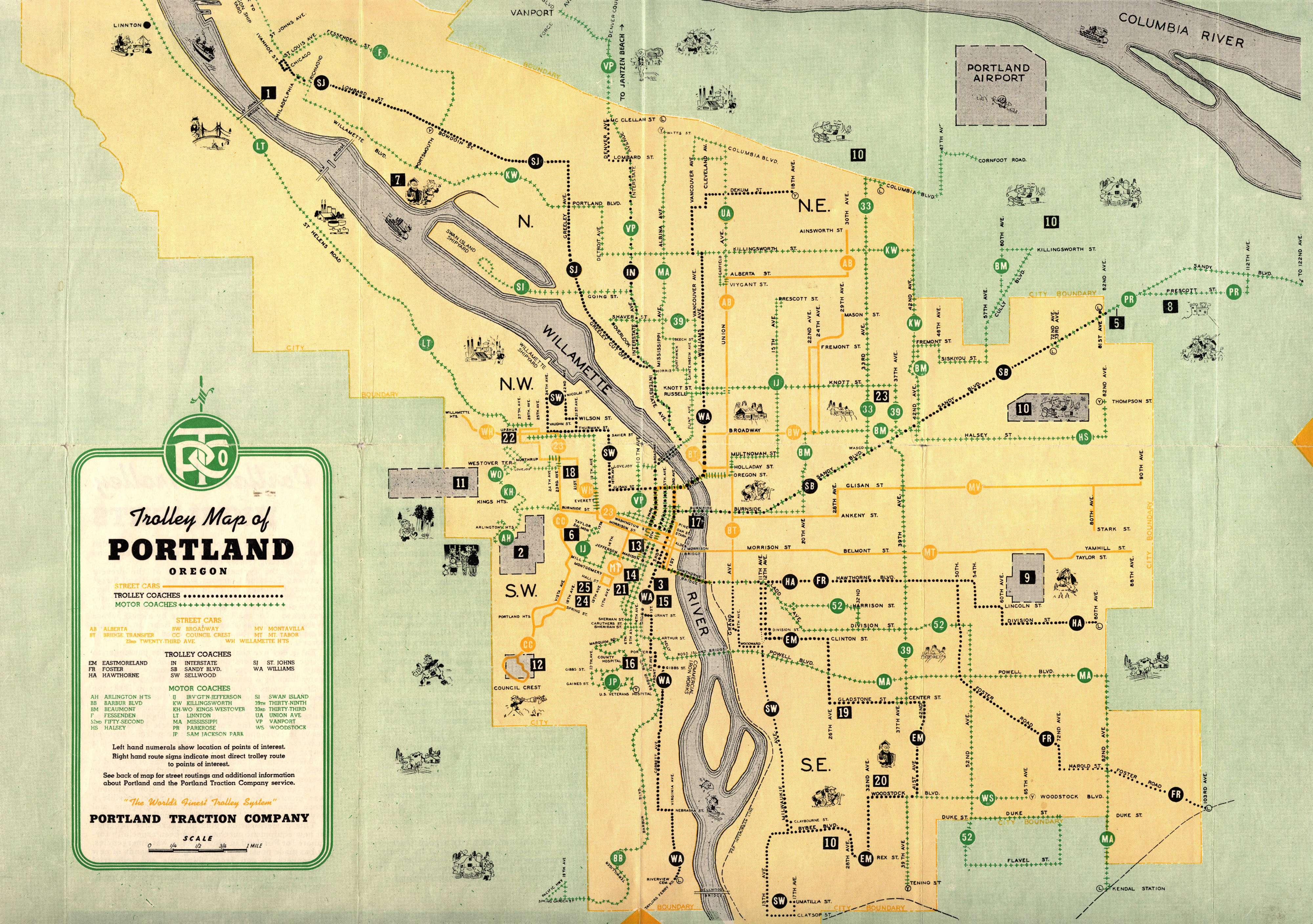
From what? Riding horses cross country?
> reconfigured from streetcars and buses and trolleys and trains in cities
That isn't to say you are wrong, just that you are changing the subject.
This is how every city in Europe works. There are only a handful of cities in the US with a well-developed rail network -- and most of those are crumbling due to half a century of under-investment.
This is how I and many other commuters use Amtrak. They even provide "last mile" bus tickets with your fare.
Denmark is a small country and the efforts are huge, yet even there people prefer the car.
The issue is that you can't just build a solid infrastructure for everyone, it's impossibly expensive the further out you get.
If you both have to go to work and pick up your kid at school or in kindergarden and go shopping or take them to practice etc.
That's where the car is convenient. I can't send my kids with public transportation before they are 12 in NY.
So yes it's ver flexible, convenient and practical with a car.
Outside of the Eastern Seaboard, has anyone ever attempted to book a rail trip? It's insane. You have to really work at it and you are losing a ton of time, have overnight "connections" and other odd problems. Furthermore, nearly all the train stations of any size are in the ghetto. The whole system has not kept up with the times. And while there is still some romantic notion of "riding the rails" it quickly gets subsumed by the price, which is also ridiculous.
There's nothing about affluence that requires single family detached homes, that's just a fantasy that's been marketed to us for the past hundred years, and at a huge cost in terms of walkability, time/money/land wasted on traffic and parking, traffic fatalities, etc.
This idea have been marketed and for a good reason, it was good way to save U.S. population from Soviet nuclear threat - in a way Coomies could neither counter, nor replicate on their side - when Commies launch their nukes, it's much better if most people find themselves in separate houses with large tracts of land and little combustible materials, and good basements to protect from fallout, and in a few days, can emerge from there and drive their cars in whichever direction civil defense points as safer.
No public infrastructure will work for that - bus drivers will quickly die of radiation sickness or just refuse to do their work, but for one, one-way trip to save your own ass it's okay.
Essentially, this is why suburbanisation come to being: war planners realized exactly the thing you are pointing out: that evacuating people in a crisis - while the Soviet bombers will be flying (it was before ICBMs) was an impractical idea, it will kill more people than it will save; but what works instead, is to evacuate people in advance: just make them live far from city centers which can be attacked. And redline the city centers: let only people you don't care about surviving, live there.
In 1950s Soviet Union, "workers and peasants" lived in villages and suburbs, these were replaceable anyway and killing them had little benefit. Difficult to replace cadres - engineers, most qualified workers, high ranking military, Party officials and such - lived in posh Stalinist apartments in city centers, and would perish inevitably. In 1950s U.S., it was already other way around. Soviet Union could do nothing about that: they simply couldn't afford an individual house, and thus inevitably, individual car, for everyone - they still can't. It was a clear win and moved a balance in the Cold War a great lot in U.S. favor.
One thing to realize here, it will best of all work if U.S. attacked first - then they choose the timing and attack in late evening in the U.S. when everyone is at home already, are warned, and don't leave their houses in the morning to avoid being caught in road panic, and have some hours to prepare for the Commie attack such as letting go of any combustibles, covering car so it doesn't suck fallout particles in, and stocking water and if possible, food.
Hurricane evacuations even a week in advance are horrible by car. Highway infrastructure simply cannot cope with large movements of people in one direction.
Mass transit is cool, but evacuating an entire modern city on busses isnt viable. (Inter-city rail connections cannot be scaled up in such times.)
In the evacuation model those buses drive out a day full, and then need to drive a day to get back before they can pick up more people. It just doesn't work. No transit system has enough buses.
That is before we point out that if you have anywhere near that many people served you probably have some rail systems that cannot operate outside their lines (third rail power or overhead electric)
Cars have the advantage of there are enough of them. Note that in most evacuation situations the cars are full. (the roads don't have the capacity, but the cars do)
See the recent evac of fort mcmurray canada. That was all cars for hundreds of miles. No hope for busses there.
So the assumption that "90% of people won't need government help" clearly failed to hold true for this relatively small evacuation of 88k people.
The fact remains, most people who are told to evacuate by car will pack their suitcases and enough spending cash so that they can live on their own once they get out. The majority will end up sleeping on the floor of friends/relatives, so once you get them out of danger you don't think about them again. All that is required is enough warning that they can pack (if you don't have this much warning nothing can work anyway), and enough fuel (accounting for gridlock!) along the way.
Government needs to deal with the small number of people who cannot care for themselves, but the vast majority of people can be self sufficient, and having their personal car makes them more self sufficient.
More 25% is not a small number. A car only helps if people can actually get out. A mass evacuation by car of LA, San Francisco, Seattle or NY would fail utterly. Any place that already has significant traffic issues during rush hour (the sorts of places where buses are needed) would face massive drops in the evacuation rate due to gridlock and the areas that they would be evacuating through would rapidly run out of supplies (as happened with Fort McMurray with only 88k people being evacuated).
We shouldn't use bus when they are available for evacuation? Why? If we can get all the bus to be used + add bus from other cities nearby, why should we prevent people from using them? This is scaling much better and people with cars are free to leave with their own cars.
"Cars have the advantage of there are enough of them." --Surely not the case in many urban cities.
New Orleans had huge numbers of school buses. They went unused and were destroyed by flooding.
You might demand that the government not be incompetent, but the reality is that government will screw up badly. Individuals with cars can screw up, but the effects are limited to the people screwing up.
I vastly prefer living in my apartment in Europe than living in a house, especially a US house.
Also, putting every family in a separate free-standing house is ridiculous: there is physically no way to achieve that.
Just the economic and yeah, transportation infrastructure we have in Europe won't support that. It's not even the population density really.
Until we invent teleportation, putting everyone in their own separate house is unsustainable.
For most people, the ideal life is having your yard and be able to drive everywhere with enough lanes on the street to be sure you never hit traffic. Except that ideal situation rarely exists, all the roads are clogged (induced demand!) and having a large house for every person means a big desirable city to work can't scale. Even LA has understood they couldn't keep building highways and needed to densify, it just doesn't scale.
Having lived in a European city I was appalled of how bad the air quality was, how noisy the streets were, how annoying trash collection at 5am was, I had to use a wet mop on the hardwood floor almost on a daily basis to and it was black every day. I had to walk a half a mile to a tiny parklet, always packed with kids as it was the only location in the play. Every morning on the packed subway and street buses. It was awful, I couldn't wait to get back home.
Back home I live in a green environment, trees everywhere, I got my lawn, there are no fences, I forget to close my garage door at night no problem, nothing is ever missing ... I use a wet mop every other week and it is never dirty.
Do you know what generates the CO2 emissions? All that useless junk we buy shipped from all corners of the world. The fix is buying less junk not blaming on someone that happens to want to live in a green environment.
I know it's hard to be criticized for your lifestyle, but please do your research, suburbans lifestyle is nowhere near sustainable. That's not anecdata, that's data.
I don't actually live in the suburbs, just a small town that looks like a suburb, and I also lived in European style cities hence I understand the attractiveness of a suburb. It is a different lifestyle and you can't "fix" the suburbs with the wrong kind of arguments - "you my friend suck for wanting to live there" Find a suburb looking place in Europe and check the prices ... now think about it, do Europeans assign value to that?
The vast majority of cities do not even remotely look like some of the elite and lucky European cities that are built on the many advantages they got from (not looking for a flamewar here) but exploiting other nations (the behavior is in the past, but the advantages remain and accumulate), all I am saying is that it cannot be a model for <insert eastern european city here>.
If anything the clean, quiet, well kept European city is non-sustainable and non-replicate-able as a global model. We need to fix the problems of the suburbs but not by imposing a model that cannot work.
The global city model is a far less livable.
That said, I suspect we overinvest in both subsidies because of romantic ideas and status quo bias.
What we really need is far more subsidies in urban and dense suburban areas. The problem is that with our bifurcated political system in the US the people who make up less than 50% of the population outside the cities will block investment in the cities because they will feel like they’re not getting equal investment.
Edit: grammar
If Amtrak want to prove it’s the freight traffic causing the slowness they should quantify how many otherwise ontime routes are delayed by freight.
"Signaling issues" usually means traffic and sometimes means under-invested infrastructure. There is no question that the slowness of Amtrak is directly related to underinvestment.
Same here. I frequently ride between Boston and New York. In New York, I've seen over 200+ people leave the train and another 200+ board the train, especially on Sunday evenings. The whole process takes < 15 minutes.
And I can't believe no one has talked about how much better the seating is than any other form of long distance travel in the US.
At the end of the return trip, I overheard a group of four other travelers saying that they got so much work done, they should just ride the train back and forth every day.
Seat and ride comfort are totally different as well. To me, it's well worth trading in some time for a much better travel experience. I've had a year where I logged close to 50k air miles in coach and over 10k train miles in coach, so I've seen the good and bad of both modes of travel (on and off the NEC for the trains).
For the long distance trains, I consider the time it takes to travel one of the benefits. In today's highly connected, highly active world, I find having 24 hours to simply look out the window and be alone with my thoughts to be incredibly rejuvenating.
What's the boarding process over there? In Europe you just .. enter the train.
I also arrive and get onto the train in ~5min. getting off in Canada is slow though
In practicality, I agree with you that freight lines abuse this without consequence.
If I were a manager I would ban driving and insist on trains (if the work would benefit from the added collaboration)
It's even worse for long-haul. I have family along the Canadian route (Toronto -> Vancouver), and taking the overnight sleeper train out there is about 4x the cost of flying.
I mean, maybe that's just the obvious path given what they're working with in terms of cost structure, but it's still annoying.
Southern California is very spread out and still organized around private automobiles.
There’s been some serious sprawl since then, yes, but at its heart Los Angeles is a city that is conducive — not contradictory — to public transit. And I think our planning decisions will only get more effective once we, as a region, realize that.
https://usp100la.weebly.com/history-of-transportation.html (scroll down for a map — and note that this doesn’t include the downtown/central LA streetcar system, which essentially covered every other block in downtown LA)
San Diegans tend to have a bit of a defeatist attitude toward transit, and there are plenty of suburban areas where transit is bad, but there are also many places where transit is a reasonable option.
https://www.sandiegouniontribune.com/news/transportation/sto...
Then again, it's basically legal to use your car to kill cyclists in the states, especially in socal, which is why I gave it up.
It took 10 hours. Could've gone to Chicago, turned around and headed home, and still had time to grab dinner. That was enough to turn me off to long-distance train travel. All these years later I'm curious again, but still very dubious.
Pretty much no one. But Chicago to St. Louis? Or Chicago to Minneapolis? Or Charlotte to Atlanta? Or Dallas to Houston? Or LA to San Francisco? Etc/etc? Lots of people. That's here high-speed rail investment helps. High-speed planes are fine, until it snows in Chicago, or thunderstorms in Atlanta, or high winds in Denver and then the whole national air system gets screwed up. Alternatives are good.
But if you add up all the people who want to travel between Chicago and St Louis in a year, and then multiply by the hour-ish that they might be able to save by catching a high speed train instead of driving, and then divide by the tens of billions that such a railway line would cost to build and maintain, then... is it really a sensible use of funds per man-hour saved?
How many hours are spent stuck in traffic? How much loss is that to society.
Perhaps people would start moving closer along the rail lines, now that frees up land from sprawl. Etc. The same rail line could carry goods (fewer trucks on the road). The rail line could be electrified, now pollution will be down and so on.
Billions of dollars is not all that expensive. The US is a rich country. First time realized this when I saw a small town with 30K population easily built a new high school for 150 million USD - compared to that, the "billions" does not sound all that big if it reconfigures the economy at that extent.
Also, you make a good high speed railway, and the demand will appear. In my coutry also nobody used the train, untill they were modernized, suddenly the word started to spread that it was nice, and now too many people ride the trains and we need more.
Regular, daily train service would revitalize and open up a lot of smaller communities.
Precisely as major cities are grappling with housing and affordability issues.
The solution to the urban housing crisis was, continues to be, and will be until its done the building of more housing. A lot more. Density, at every price. Without mandated parking, without vertical clearance limits, without per-unit size limits, without the ability for NIMBYs to stall out or shut down expansion efforts for their own personal gain. Nothing else will cure the ailment - all else is just treating the wound.
Unfortunately, for the past century the larger cities have been steadily sucking their population and talent away. Hub and spoke rail systems are an excellent way to revitalize these towns and encourage population balancing.
Because not everyone wants to live in a Singaporean econobox.
Traditionally, the limitation on this has been weakness / corruption of local government vs the major freight railroads.
Amtrak, with proper Congressional support, could play an interesting part in reopening existing rail to passenger traffic.
A 90 minute train ride connecting Texas' largest two cities? Compared to the 4hr trip a car takes or ~2hr for a plane (factoring in security)? At a (tentative) price point of ~two tanks of gas?
I'm optimistic that it won't only be a commercial success, but also that it will convince people (and politicians) that a HSR-network is in the public's best interest, even for routes that don't necessarily make sense from a commercial (private) perspective.
As population grows, train speeds increase, and road traffic worsens, we may need to rethink what we consider a "region."
Alas, that’s a pipe dream, much less bringing New Haven or Philadelphia into the reasonable commuting radius which is what I suspect you are alluding to.
But to be viable, it has to be competitive with airline travel, and that means fast trains. It currently costs more to go from SLC <-> SF than by airplane, and it takes a full day (18 hours or so, I forget exactly) to get there vs 2 hours or so by airplane and 10 hours by car. If it was 4-6 hours (120-200mph), it would be competitive with airlines if you take into account security and baggage on both ends. I know I would take Amtrak if that were the case, but for now, I'm only going to take it as a vacation in itself.
There are a lot of companies in CA that have offices in Utah now, so improving the train system between them may make sense if they can get speeds to be reasonable.
So, you're either blasting a giant gap in the Sierras, blasting a giant tunnel under the Sierras, or have some novel HSR technology that'll run over the Sierras.
For a much less useful route, it'll probably be more expensive than the actual full proposed CA HSR system.
For reference, the LA<->SFO train was last estimated about $75-100 billion to complete before it was canceled. Of course, there's almost no way anyone could build such a train tunnel in the USA for the same price as they did in Switzerland.
Also, on the side, remember that non-city dwellers get massive subsidies from city dwellers for their cost ineffective lifestyles. One can argue that this is justified to support the people working in critical agriculture and industry that can't be moved to the cities and we want low sticker prices on, but it's a much hard case to make for suburb dwellers.
I would be happy to pay that if the travel time was better, but it's almost 2x longer than driving and not much cheaper than driving (it's actually more expensive if I'm bringing kids along).
Trains were supposed to be more efficient than airlines, so why is taking Amtrak essentially the same price as flying?
Assuming you live close to a station and don’t have to carry anything with you. It’s a fools errand to expect a country the size of the US to have stations that connect everything. We also have extensive and ubiquitous air infrastructure as well for long distance travel and airplanes can be rerouted based on demand a lot more easily than fixed rail infrastructure. If there is a big event in some city or town, it’s fairly trivial to add flights, but it’s impossible to add more tracks. Airplanes can better handle seasonal traffic. For commuter traffic, rail can be more efficient, assuming point A to point B. As soon as you need a point C and point D (such as taking kids to karate practice or visiting your aunt Sally, trains become far more painful.
Cities and metro areas have plenty of taxing authority at their disposal. If they want to institute additional taxes to fund these types of things then they could.
Why should people living in rural areas have to pay for it?
doubt it. regardless, federal government revenue goes disproportionately towards funding rural services and welfare, including many services that city residents don't use at all. federal funding of a city's transport system would still not shift that balance.
regardless, you missed the point of the parent comment.
That's only because highways cover the country like a fishermans net. Capacity and connectivity are massive for roads. Locally it might back up, but average the capacity of every road in the U.S., and it can probably handle the population of earth. Imagine if that were the case for high speed trains, it would be borderline idiotic to drive.
It seems like recently transit agencies are finally working to improve options for commuters beyond the road network. Simple fixes, needing only a can of paint and a traffic cop enforcing law and order, like bike lanes and buss lanes can be done practically overnight in many urban areas.
LA metro has studies done for hundreds of transit corridors involving bus lanes, BRT, LRT, and HRT. The only barrier seems to be political will, not the engineering. I'm sure this is the case for most large cities, so if we ever get an administration that would prioritize funding transit projects on a federal level, as was done a century ago, we could see a transit explosion.
When you do that, suddenly the tables flip and driving is way behind.
Amtrak is a speck on the federal budget. It’s a worthwhile investment if only to keep the rights of way open for the future
Amtrak doesn't compete with local roads, it competes with interstates.
Personally, I think people should be paying more for using the roads. From what I can tell, most states' use related taxes (gas taxes, registration taxes, etc) account for less than half of total road funding. This makes driving artificially cheap compared to mass transit options, to the point where it's often cheaper to drive than to take a bus or train, which is absolutely ridiculous. For example, my commute is ~10 miles, and the IRS claims this costs me $5 (~$0.50/mile). I did some math and estimate that my costs are closer to $0.30/mile, probably less (insurance, registration, gas, maintenance). A bus ticket is $2.50 each way. The bus takes >40 minutes assuming I ride my bike there, >60 minutes if I walk, and driving takes ~20 minutes.
Assuming my state funds roads ~50% with income taxes, switching this over to purely use-based taxes (gas and registration taxes) would likely double my driving costs, making mass transit make sense financially, as it should. It certainly uses less resources to take the bus than drive, so it should also be cheaper. Yet it doesn't look that way according to my calculations.
Also, taking Amtrak is often more expensive than taking an airplane, even if direct routes exist, and it takes way longer. Amtrak should be way cheaper than flying, yet at best it's a wash, but usually way more expensive. We need faster, cheaper trains, and trips within 800 miles should be competitive with airlines (<6 hours, about the same price or cheaper than flights).
In terms of road maintenance, that might actually not be the case. Road destruction by traffic scales with the fourth power of axle load, for weak pavement surfaces and heavy loads with the sixth (!) power of axle load.
(Of course you are right with respect to traffic congestion, CO2 emissions, particulate pollution and noise pollution.)
With respect to the rights of way, an asset unused goes away. That is a big reason why car companies bought out streetcar lines to kill them. I live in an area (Albany, NY) which was a big transit driven place until the postwar era. The New York Central, Delaware & Hudson and various streetcar/trolley lines had all sorts of rights of way connecting various communities in a relatively small area.
That stuff is all gone, converted to roads, parks and subdivisions.
For an entity like Amtrak, the rights they have in major cities are worth billions, but in reality are priceless. Without operating service, that value would diminish to near zero very quickly.
Glad you mentioned the externalities of pollution that people are allowed to create without penalty, but are you also considering that CO2 is hardly the only thing to worry about. Air pollution is a major cause of neurological illnesses, since auto exhaust is neurotoxic, as is non-exhaust pollution from brake pads and tires.
Despite being a huge fan of public transit, I actually think the efficiency numbers would probably still come out in favor of cars, in America, in the near term. Our country has been car focused for a hundred years and the assumption of car travel is baked into the way our cities (and especially suburbs) are designed. There would need to be years of shifting urban planning before mass transit really won everywhere.
Having a cheap enough car and expensive enough transit bill to exceed it is an extreme statistical outlier. I saw this as an owner of a cheap car and an expensive commuter rail pass.
But that's part of why he excluded expenditures covered by the gas tax on the road comparison, you'd want to add that back in if you are adding in fares.
The only time your question matters is if/when the transit system is useful enough that someone can actually consider selling a car. I sold my car to ride the bus to work. However the one week my wife's car was in the shop convinced us that we won't be doing without a car anytime soon. (We often take trips that are 5 minutes by car that were 55 minutes by bus! Then there is the annoyance of the one time we missed the bus)
Trains are paid for by riders in the form of fares and taxpayers in the form of subsidies.
This has total vehicle miles at 1.4 trillion in 2017, having around 2 occupants per vehicle on average sounds about right: https://www.statista.com/statistics/193007/vehicle-miles-tra...
For some very very specific routes, train miles may be more valuable, but generally speaking they are less valuable.
Bwahahaha. _Someone_ on this thread is clearly not driving in enough rush-hour traffic. ;-)
On a side note, that would be an interesting PhD dissertation - figuring out the actual cost of America's car-centric lifestyle broken down locally, state and nationally.
The combination of the US and Canada has been producing all the oil the combination needs for a year or 2 now. Everyone in the industry says it is only a matter of time before the US will be able to produce all the oil the US needs. Whether that happens next year or 5 years from now depends on pricing and production decisions made by the OPEC producers.
I wouldn't be surprised if in 8 or 10 years the US will be in a position to guarantee a steady supply of oil to one of its strategic partners: the UK or Japan, say.
But this has thread has gotten off track because like grandparent already pointed out, Amtrak run on oil, too. I suppose your reply to that is that it is easier to convert Amtrak to renewables than to convert the highway system to renewables
There's more to it than that.
first, oil is a commodity product traded around the world, so, say, if Indonesian (offshore) oilfields go offline, china will simply buy from the saudis, which will drive up the price of Saudi oil and encourage US producers to export instead. Now rising price encourages local production, but most of it can't be switched on and off in a instant.
And in fact they already both import and export; for example tar sands "oil" from Canada is removed with a shovel, not a pipe. Refining it is very expensive (and energy demanding) so only gets mined when the price of oil is high enough to justify it. Currently the US exports about as much oil as it imports.
Lots of great stats on this topic from the Energy Information Administration (though some of the important statistics stopped being collected last year, alas). Here is the petroleum import & export page: https://www.eia.gov/energyexplained/oil-and-petroleum-produc...
But OK, let's talk about price. There's probably a 100 years worth of 'tight' oil just in Texas that can be produced for the price oil currently sells for. In other words, the cost of fracking that oil has decreased a lot. (And that oil is easier to refine than the stuff that comes from Saudi Arabia.)
It's probably the other way around. The highways (ie: cars and trucks) will gradually convert to electric in the coming decades as the vehicle fleet is replaced and old equipment is retired.
On the other hand, electrifying long-distance rail requires a lot of very expensive infrastructure investment. Battery electric technology may mean that cost comes down, however (perhaps you only need wires on intermittent sections of track).
But many of those miles were necessitated by the astoundingly large footprint cities and towns have when they're built to accommodate highways.
When the answer necessitates completely redesigning every major city in the country, I'm not sure the question is valid in the first place.
And we already redesigned every city in the country, so clearly it's an option.
What is the total spent per person-mile of travel?
The real issue is how much we’re paying in subsidies compared to how much we’re paying in subsidies for other forms of transportation, and perhaps what other people are paying in subsidies for the same kinds of transport.
Highways get about $75 billion in subsidies (what’s not covered by gas tax). A lot more than Amtrak for sure. But highways carried over 3 trillion passenger miles last year. Amtrak was just 6.3 billion. We spent 50x as much on highways as Amtrak, but got 500x as much mileage out of those highways.
(You can throw in pollution externalities, etc., but even if you use current carbon recapture methods to suck out CO2 from driving, and ignore the fact that Amtrak’s mainly east coast operations are not powered by renewables, driving still comes out ahead.)