This court ruling just allows German cities to ban diesel cars, so whatever a city decides to do, is possible as long as it isn't challenged by the public or there is a new law.
I go by bike to work every single day. It's 8.5 km one way, today morning was -9C outside and while my beard was full of ice, I biked my way to work. On the way to work, there was a sign: "Achtung, erhöhte Feinstaubbelastung!" - "Attention, high fine dust pollution!"
I don't understand why my health should be at risk for something I don't produce.
Regarding a ban of certain cars: I think German cities can still make it work. There is public transportation in most cities. It's also reasonable to allow trucks at least at certain times. It's also reasonable to allow diesel cars with 2 or more people inside or allow diesel cars at certain times.
This is a time to have a conversation about how we want to live in the future and every mayor has to think hard about what (s)he want for the citizen of her/his city.
I'm totally sympathetic to the end goal, I would just like to see a realistic approach and the GGP's call for an outright ban on vehicles in the present is not supportable.
The biggest problem I have with various 'green' parties is that for the most part their solutions are bordering on the militant and do not take in to account the various complications that will need to be dealt with in order to implement the final vision.
I cycle a lot, wear out a couple of bike tires in a year. I also drive a lot, live in a small town outside of Amsterdam. So I think I see the world from both sides and a life-long interest in green technology (windmills, solar) as well as electric vehicles has given me a pretty good ground level of knowledge about all this stuff.
There is one part of me that would very much like to see this car-free city of the future come to pass in my lifetime, I'd probably move there in a heartbeat if it were done properly. But if it were done improperly I highly doubt it would fly and it would likely end up being undone and that would cause a setback we can not afford.
So better to think really hard about how to make this work, prepare plans that are properly wrought through in such a way that they work for everybody and in ways that do not accidentally kill the thing they are aiming for.
Keep in mind that cars were not thrown into cities without reason, and that at the time they were invented the bicycles were already there as well. The car mostly displaced the horse because it was cleaner.
The time when things went wrong is roughly the 1960's (for Europe at least) when suddenly a car was within reach of everybody that wanted one and the cities were ill prepared to deal with that. By the 1970's the disaster was already complete and traffic became a mess. It's been downhill from there so we definitely will need to make changes.
In my experience to date it takes roughly as long to get out of a problematic situation as it takes to get into it. Any major changes on time-scales of less than a few years will lead to trouble, a realistic transition plan would probably run for a decade or more.
For all the faults around Europe with traffic, I think they did far better adapting to cars than the UK. Mainly by preserving some of the alternatives better.
The Netherlands has infinitely more sensibly integrated public transport, and provision for cycles than we will probably ever have. At least that's my perspective as an occasional visitor.
Postwar rebuilding here gave us internal combustion as the answer to all, leading to much, now regretted, removal of rail lines and trams. Not forgetting the many people-hostile choices like cutting communities in two (e.g. Mancunian Way) and giving residents a motorway right above the house (Birmingham, M6). Trying to undo those choices always comes with a bill in the £bns for the shortest length or rail or tram.
I'd recommend a brief history of cycling infrastructure in the Netherlands. It was actually quite poor here, too. i.e., it wasn't culture naturally shaping a cyclist-first traffic regime throughout Dutch history, it were conscious policy decisions to uproot a car-friendly traffic regime and make a decades-long effort for change. The Dutch system sucked in the 50s and 60s and it changed its policies in the 70s, which took off only in the 80s.
https://www.centreforpublicimpact.org/case-study/focusing-bi...
What is absolutely possible is to ban cars from certain areas for certain times. And the thing is, VW and the other car manufacturers are the guys at fault. I'm pretty sure they will have to pay a big price for their downplay of the scandal.
Politicians will say whatever they want to get people to vote for them regardless of whether or not their plans are actually realistic.
The electrical car is doable as a complete replacement, but not overnight. It will need a lot of work and time before this can be a reality, but step-by-step we might get there.
If you know German, there is a video on what it costs to use wind and solar energy in Germany's energy network: https://www.youtube.com/watch?v=rV_0uHP3BDY
This isn't news for the Germany's big four power grid operators: https://www.heise.de/newsticker/meldung/Stromnetz-unter-Druc...
What would happen when there are lots of e-cars in one street: https://www.heise.de/newsticker/meldung/Elektroautos-koennte...
How many Tesla PowerWalls would you need to have Munich's power covered for one week? I'm really to lazy to translate it, so I just paste it from my email:
Laut Google hat ein 4 Personen Haushalt im Jahr einen Stromverbrauch von 4.000 kWh.
Ich rechne einfach mal mit 50 Wochen im Jahr, an denen so ein Tesla-Speicher verwendet wird. Dann benoetigt die Familie im Mittel 80 kWh pro Woche (Winter ist dabei schon nicht dabei). Bei 13.5 kWh, die so eine Tesla PowerWall speichern kann, braucht diese Familie also 6 Stück davon, um eine Woche von jeder Energiezufuhr abgeschnitten sein zu können.
Jetzt hat Muenchen aktuell ca 1 430 000 Einwohner. Man braucht als ca 2145000 von diesen Tesla Walls und dann ist vermutlich der Erdvorrat an Metallen, die man darin verwenden kann, aufgebraucht. ;-)
The diesel scandal is the following: people like to drive big cars like SUVs. A car in the 90s weighed maybe 500kg. Now a new SUV weighs 3t. To drive this, you have to have a diesel engine. A diesel engine can be relatively environmental friendly if you add enough AdBlue. But AdBlue isn't cheap and the AdBlue tank takes up space in the car. So VW, Bosch, and the other German car manufacturers switched of the AdBlue as soon as the car detects it's not in a testing setup.
We were more environmental friendly in the 90s only because our cars didn't weigh as much.
So, can we replace fossil fuels in energy generators?
A lot of countries like Brazil build new nuclear reactors to generate energy. The problem is, the waste is going no where. Maybe it's possible to send the waste to the backside of the moon, but the risk of an exploding rocket seems too high for me.
Solar energy does generate only energy when the sun is shining. That's maybe 12h a day and it depends a lot on the location on earth surface. The problem of storage and transportation of energy isn't solved yet.
Wind energy is massively changing. It can generate a lot of energy in a short time period and the next week there isn't even a breeze. It's hard to switch power plants on and off as fast as the wind is changing.
I was thinking, there should be Tesla Power Walls or similar technology next to decentralized wind and solar energy generators. But I really doubt it is possible to switch of all fossil energy.
I'm not sure what to do about this. Lobbying and investing in renewable research might not be enough.. but is there anything else really?
But not everybody is that lucky and plenty of professions will require you to be in places where public transportation is not an option. An interesting reversal of intentions is happening between the cities of Almere and Amsterdam. Almere and Amsterdam are connected very well through public transport and many people will take the train into Amsterdam each day from Almere. The Amsterdam public transport system is reasonably good and services most of the areas with corporate activity. The fact that Almere has a large and skilled professional population caused some clever business people to move their operation to Almere. Initially those companies were staffed with people living almost exclusively in Almere itself. But now people from Amsterdam have started to commute to Almere in the morning causing a substantial amount of traffic the other way because the Almere industrial areas are not as well serviced with public transport as they probably should have been.
The best combination for such transportation that I've found is to take a small folding bike along on the train, this gets you within a few km of where you need to go and then it is an easy bike ride. But this option is not open to everybody, and it almost closed for me too due to a self inflicted bike accident.
Amsterdam is just about ideal for cycling, Copenhagen is the other EU city that really gets this right and Helsinki gets a lot of credit from me for being almost there. But the majority of EU cities have a very long way to go to make the bicycle the best form of transportation and even in Amsterdam bicycling is anything but safe (mostly due to scooters and taxis).
Amsterdam could probably get away now with closing off the center for traffic completely, say from Munt to central station and east to the Cruqius mill and west to Haarlemmer poort. They would have to build some more underground parking though because that would lose the main new parking garage at Oosterdok.
Maybe in a couple of years, time will tell.
A modern society requires some amount of pollution to function. This has been reduced, and we should work to continue to reduce it, but generating/storing/transporting energy (as well as many other activities) generate some pollution. Some of it we directly benefit from (powering our homes, getting food on our tables), but others are indirect (pollution to produce/transport medical equipment when we aren't the ones using it). Given this, one can think of it as a tax on your health for the benefit of society.
Of course there are issues with ensuring people pay their fair share, that people aren't over burdened with the taxation, and that the revenue is being efficiently utilized.
Some highly economically productive cities in Europe have similar bans on private vehicles in the centre, and function perfectly well.
The towns that have banned vehicles completely that I am aware of are all small and have simply set up a major parking lot right next to the access road into town. For the ones that I am aware of this was a practical thing to do because the streets in winter were already more or less useless due to the snow and the inclined roads so it was a relatively minor step.
A nice example of such a town:
https://en.wikipedia.org/wiki/Saas-Fee
Pop. < 2000, car free since the 1950's.
Taxis buses and other cars are used for transportation to remote areas of the island.
So I think that you both are right, and it is just a misunderstanding on the time-frame that this changes will happen.
Oh, sorry about that, forgive me for speaking my mind in a public forum, and out of turn at that. Would you like a position paper with references?
I claim things because I've been interested in transportation for a very long time and have read up on the subject from countless sources. There are a whole pile of reasons why you can't just overnight remove all traffic from cities. For one you're still going to have to supply the cities which means you will need to keep all road and other infrastructure in one piece but with a far smaller tax base available to pay for them, you will have numerous exceptions to your rule (due to for instance people with handicaps, emergency vehicles and so on), there is the small detail of a lack of public transport capability, the fact that public transport is not usually practically usable when you need to transport more than a small bag of stuff and so on. Another issue is that if the larger part of the alternative transportation methods will use electricity that we will need more grid infrastructure, charging points and generating capacity, all of which will not spring into being overnight.
Simplistic solutions such as 'ban all cars' from one day to the next will have serious side effects and you're not going to win this battle by making such idiotic suggestions. Society is like a super tanker, the minimum turning radius is large and if you try to exceed that limit something will break.
'Plans with regarding alternative means of transportation' require time to be implemented and require actual alternatives.
Amsterdam has been slowly but surely pushing vehicles out of the cities inner center with a combination of tax pressure, changes to infrastructure, improved public transport and so on, it's been going on for decades and the effect is very clear. If they had done this any faster there would have been too little time to adapt for all the individuals and businesses depending on mobility.
It's akin to how you change a large technological system: the agile method applied to society. Large uncontrolled swings in direction will not be manageable and will result in only one of two things: some kind of disaster or a reversal. If you don't want either of those you are going to have to be a bit more patient for a proper solution.
Let me start by summarizing the facts to get this straight. Germany does not generally ban diesel cars from cities. Some cities plan to ban diesel cars in limited areas and under certain conditions. These conditions are non-exclusively such that if door to door businesses is necessary you are still free to go with your diesel car.
You claimed that "the German economy would crash" as a response to a comment that asked for "Next: Petrol cars please.", which in turn was a comment to the article with headline "Diesel cars can be banned from German cities, court rules".
Germanies economy wouldn't just crash when german cities were able to ban petrol cars. What happens depends on when what bans are imposed and with what accompanying measures.
You don't name a single accompanying measure the cities that are planing. You don't name what exactly is banned. In the absence of knowing these facts, no conclusion can be drawn.
Also, neither I, nor the comment you responded to beforehand, nor the article of the thread mention banning all cars. Where did you get that from? Did you just made that up?
The metaphorical analogies don't convince me, because they seem to be based on intution and not on science.
I don't disagree with the other very interesting points you bring up. Surely, they need to be considered. I'm quite sure any city that plans a ban has thought about them and then some more, and has come up with solutions.
Cheers from a random person on the internet!
Edit: Plus German car industry will crash either way because most people work not in building cars, but motors, electronics, transmission etc. which are mostly redundant with electric cars.
A. No cars, clean air!
B. Don't do this, economy will crash
A. Doesn't scare me, economy will crash either way, keeping cars will not prevent a crash.
Sound reasonable and good to you? I mean you do believe in what you're saying, yes?
What's your email address so that I can mail you the contract?
Also I'm from a neighbouring (check out how I spell neighbour for a clue!) EU country so a link to a US gambling site is no use to me. ;-)
Also if you're a lawyer
"An AI just beat top lawyers at their own game" https://mashable.com/2018/02/26/ai-beats-humans-at-contracts...
AI is great but it's hilarious to think much will have changed in 5 years. Have a look at the results from the Stanford Question Answering Database if you want to see how far there is still to go.
German ambulances and firetrucks have an unbelievable siren volume! It is piercing - I have to literally cover my ears if I'm a bystander. I have never heard anything like that in other European countries or the US. So I suspect that you can already lower their volume if you German people were willing to, seeing that it works fine in other places...
The situation is now much better than when I lived there but even so Poland still has a huge smog problem.
I guess I sometimes feel this way about some things, but then pretty quickly get over it and realize that other people have different utility functions than me, and that I kinda like this whole life, liberty, and the pursuit of happiness thing.
I much rather take the approach that externalities be accounted for properly than to ban anything that produces an externality.
So it’s rather much more like; how many trees do you want me to plant to keep my car? Or more probably, enjoy the $2.50/gal I just paid your town in taxes to fill up my gas tank. Instead of, fuck off with your dirty car you’re not welcome here.
Liberty is not an absolute thing. My freedom to drive my car ends where it encroaches on other peoples freedom to have a passable living environment.
We've banned smoking in public spaces for exactly the same reasons. The current system is really the tyranny of the majority. Let's just be honest about that and not use euphemisms like "accounting for externalities".
It’s easy to gauge how many lives are lost due to the automobile. But how many lives are saved? How many lives are enriched? How many lives are even made possible because of the automobile?
You can look at only the costs of a thing, but I find the appeal to emotion, similar to gun control arguments, to be entirely unconvincing.
Furthermore, technology has steadily improved the safety of these machines, and I’m convinced we’re less than a decade away from a quantum leap in safety by automating more and more of the driving process.
As automobiles get quieter, safer, less polluting, available on demand, and less expensive, I’m afraid you’re going to see quite a bit more of them, not less.
It’s nothing less than economic warfare to ban diesel cars outright from entering a city. Ban the sale of new diesels if you want. Tax the hell out of diesel fuel if you want. Add a toll booth and set a lower speed limit. But your well meaning compatriots spent their hard earned money to buy their vehicles and if you’d just assume fuck them over for it, I’m sure they will find a way to repay the favor. Probably by not coming to your city (and spending their money there) in the first place. To which you might say, “Good riddance!” And we have an expression for that too.
Oftentimes there is an entirely valid reason to get in a car and drive somewhere. I know, this may be shocking to you. Shocking to the people talking about bicycling a couch uphill downthread too.
There are 45 million passenger cars in Germany (for 82 million people) so it seems you’re in the minority on this. Before you call for just outright banning cars, maybe consider how you could make public policy which would decrease the number of cars by 10% without increasing the cost of cars.
Me too, I can't wait for self-driving electric cars to be used inside the city. That will take care of the local pollution burden put on residents today, and hopefully put cars in a more submissive role in traffic, where they belong.
I’m sorry you can’t imagine the range of human conditions which can make cars a absolute necessary part of modern life for some people, even in dense urban environments.
The funniest example that comes to mind is you (or your wife’s) water breaks and it’s time to head to the hospital. Quick, let’s get on the bus!
You honestly think the only way people should be able to get privately and expeditiously from point A to point B (while potentially transporting hundreds of pounds of cargo) is calling emergency services?
I took a guess of $2.50 per gallon in total net externality. Turns out after a bit of Googling a study out of Harvard University [1] put the number at $2.10. So, yeah I do believe it, seriously!
By the way, those $2.50 peanuts would add up to $360 billion per year in the US.
I don’t have a problem with a gas tax that tries to fully cover the externalities of driving, as long as the money is earmarked to actually try to offset the cost.
[1] - https://sites.hks.harvard.edu/m-rcbg/heep/ee-workshop_131024...
That latter part is a very serious concern. This isn't hurting big evil corporations who are killing the planet. It's hurting regular lower/middle class Germans who bought cars that they could afford just as everyone else was... electric isn't a financial option for the vast majority of people and diesel has been sold/advertised as comparable to petrol for quite some time...
Like most bad policies it's based in good intentions with some highly questionable/harmful real-world implications.
In Germany, there's a "right to sell"?
You still own the car, it's just worth less (most probably).
It's basically statements like these "Next: Petrol cars please" that deprive the clean-air activists of any credibility.
If the outcome was better funding for public transportation, I would be all for it. With more people using public transportation, traffic would lighten up and may get more relaxed? Everybody wins!
It would be really nice if it turned out this way, but I am not overly optimistic. The car lobby has a lot of power, and the relationship people have with their cars is not very rational.
(I will freely admit that my relationship to my computers is similarly irrational, but all my computers combined gobble up far less energy than a single car with its motor running in idle. Plus, a substantial amount of the electricity that drives my computers comes from renewable sources.)
As a factual matter, i. e. "unexpected consequences", your idea might become true. But it's a risky strategy to hope that premature obsolescence of your product will result in consumers coming back for more. With the VW diesel scandal in the background, it's also possible that the industry will end up having to shoulder a major part of the monetary burdens. It's much more likely that the loss to their brands, and the very public failure of their diesel strategy, will far outweigh any gains from some turnover in cars.
Some diesel cars may also be retrofitted with cleaner technology, and others can probably be sold abroad, making the losses not quite as large as one might expect.
But I find suprising that over the last years it became obvious that electric cars are not the choice for the largest majority of any new car buyers. But all of the sudden the car manufacturer industry is having a scandal (aparently mostly in Germany) that becomes such a manficent scandal that is reaching a dimension never seen before. As a result a large number of cars is most likely going to be taken out of the market that would have never been replaced that early on.
Besides from kicking out a few employees, updating a few models and paying fines, the latter both probably covered by their insurances, the companies have no real consequences experienced. Sales and revenues seem to be stable and a few % changes in brand reputation are not going to hurt them either. Ultimately there will soon be a lot more cares purchased at a time where Tesla is still not mainstream ready.
Sometimes you have to kill the one to save the many.
There is simply no way to lay blame on him. Blame the car industry.
What about death? I mean, wouldn't this take too long to reach people and to bring them into hospital if needed?
(We already have cases were people die on the way to the hospital as things stand.)
0. http://www.cambridgema.gov/~/media/Images/CDD/Transportation...
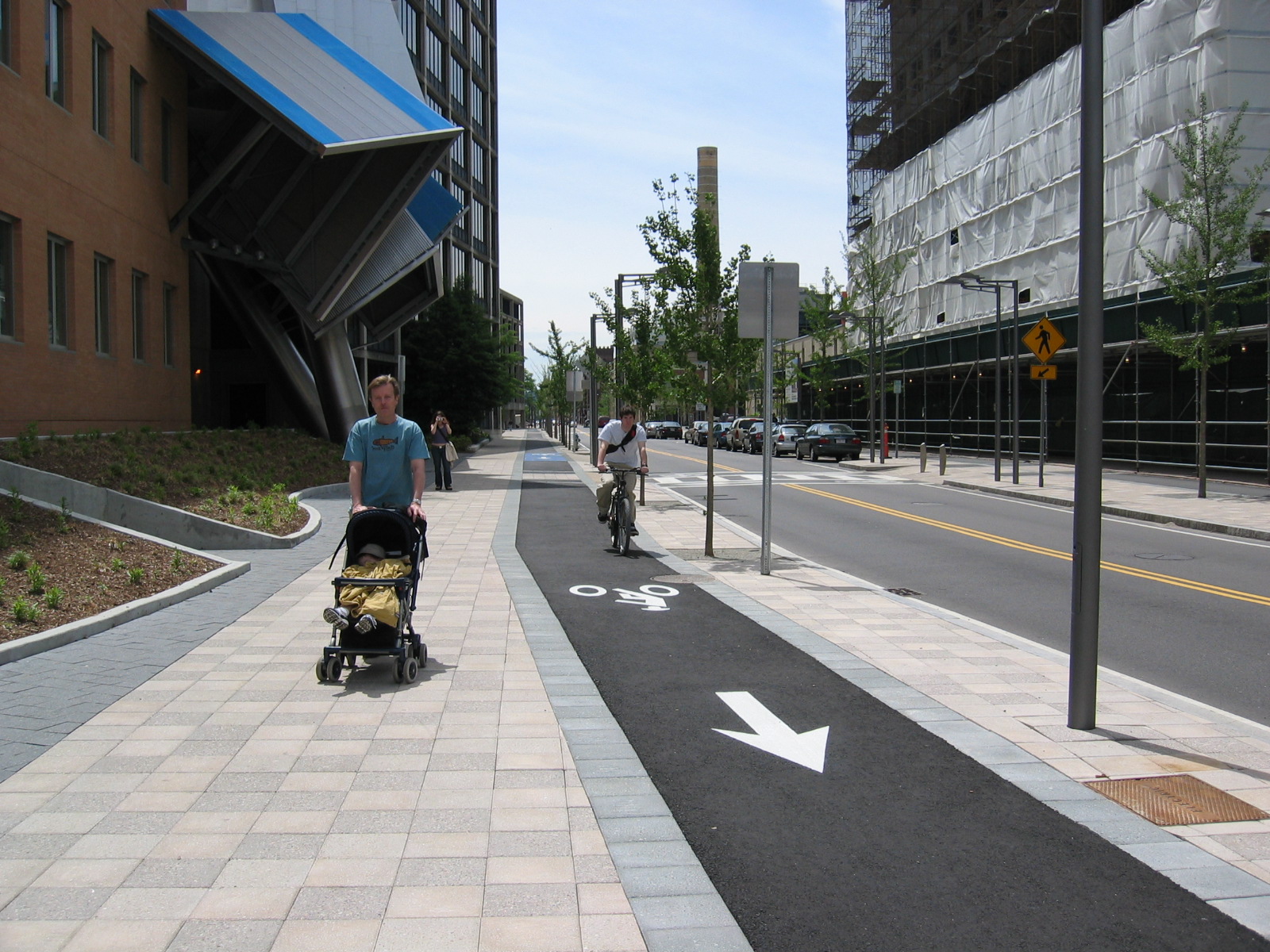
But then, this change doesn't have to happen in isolation. The Netherlands is a great example of a decades-long investment in pedestrian-first & cyclist-first infrastructure over cars. Cycles have their own dedicated lanes, increasingly not just painted on the car-lanes but separated from both the car lanes and sidewalks with elevations. And as they're ubiquitous and well-kept, cyclists have no real reason to drive on the sidewalk.
Cycling on the sidewalk just isn't a problem of any significance anymore in most places in the Netherlands. But when I went to Berlin and cycled there, I often found myself on the sidewalk by way of convenience and safety. The solution isn't to say no to bikes and have cars instead because cars have dedicated infrastructure they stick to, the solution is dedicated infrastructure for bicycles and incentives + enforcement to make them stick to it. It works very well in the Netherlands, which was actually, at one time, a country with tons of development geared towards cars.
(sorry, ony have stats in German: https://www.adac.de/_mmm/pdf/Praesentation11-13_192487.pdf)
Evidence: http://www.idahostatesman.com/news/local/article196605814.ht...
https://nacto.org/docs/usdg/relationship_between_speed_risk_...
This is a very backwards approach. Why don't we destroy our cities that have replaced the beautiful nature that used to be there instead of them?
So far, places that come to mind are central Ghent and Rothenburg ob der Tauber (sadly the latter allows cars but they're still very few in number). If I were there I would expect to work remote, or start my own gig. I'd shop locally.
There are very few places in the world where you can live near other people and escape automobiles, and I suspect there are at least a few other people like myself.
But a jerk walking is virtually certainly not going to kill me (or my kid). A jerk cycling almost certainly won't either. But a jerk driving quite possibly will - after all, where I come from there's a 9/11 on the roads every month due to drivers, and the dead are disproportionately people walking or cycling.
Of course, 100 years ago the streets were for walking (or horses, bikes, early autos, whathaveyou) and it was quite a feat that auto makers convinced people that only folks inside cars deserved to use 90% of it (all of it, in much of the US), and that it was perfectly normal to leave people walking clinging on to a shred of space at the edge.
And keep in mind, it's a lot more dangerous for a woman to walk alone than the average HN poster, especially if they need to do so at night.
“Mugging” can't happen in a car only in the sense that when it happens to people in a car, it is called “carjacking” instead of “mugging”.
When I cycle I fear being killed by a motorist; when I drive I fear killing a cyclist. It's important to clarify whether cyclists are putting you in danger or if they are stressing you out. Both suck, but one sucks a lot more.
You are quite right in terms of where the danger lies though. It's on the driver more than any other to be the most careful with their actions.
You can see the same behaviour from car drivers when the rules don't make any sense (as for example in some upcoming countries).
There is still inner city parking too (the underground garages) so Ghent is not really free of cars yet.
If you want to live without cars the best place would be a nature reservation or silence zone, there are a few of those in Europe and the few houses that are there are priced quite high as a result but I think they would come closest to your vision.
Alternately, a nature reservation shouldn't have residences in it, should it? When we get away from cities, towns, and villages, it becomes more feasible to just buy enough land to enjoy it without automobiles. A bit lonely though.
True, but the ones that have historically been there are usually grandfathered in when the area as a whole is declared a reservation. There will be strict limits on what you can do with such a place but that's a small price to pay.
There was one for sale here in NL, at least 2500 meters away from any trafficked road but - ironically - the people that live there have road access to their property making the whole thing much worse for the other users of that area such as me when I'm cycling there (the road is only about 2 meters wide).
I'd be very happy if you had bought it, that would save at least two vehicles that still use that road!
One very good way to find such houses is to look at night time satellite images and to look for places with very little light. Any houses in those regions will be in very lightly trafficked areas.
You should be thankful for cities, especially if you enjoy living in nature. Distributing city populations evenly across the land would do serious harm to that natural beauty you claim to enjoy.
(I did public transit to my assignment (working as a consultant) for five years; won't work with my current one as it's a 2 hour journey for just 60 kilometers).
It’s fine to debate the merits of the policy, but don’t pretend it wouldn’t come at an enourmous cost.
Cars are a net negative for societies (see e.g. https://tu-dresden.de/bu/verkehr/ivs/voeko/ressourcen/dateie...). Just imagine having most (80%+) of goods transported by cargo bike: lots of (local!) employment, lots of new technology needed, etc.
Great idea, but how would you feasibly transport them?
The deliveroo boxes are going to have to increase in size...

Also, realistically, do you need to transport these things on a daily basis? Can you not rent a (electric) truck whenever you need this kind of things?
I'm fairly sure most people working normal office kind of jobs could easily live without a car, especially if cities use that money to make public transport available to more "remote" regions easily.
My employer actually used this reasoning and has an office next to the train station, which makes traveling with public transport from other cities a breeze and prevents the company from having to pay massive fees for parking space.
There are certainly instances where a car is necessary, or sufficiently convenient. For example, I rent a truck when I move homes or get new furniture, and I get a taxi after surgery or a night out, and rent a car when doing something time/convenience-sensitive like hopping between locations on elaborate wedding days that involve a ceremony, food, drinks and after-party all around the city. But all in all, about 5% of my trips need to happen by personal vehicle, at most. Everything else is can be done via public transport or bicycles.
Nowadays we have ride-sharing and electric 'public transportation' mini-cars available that you can rent for 15 minutes or a few days. The costs are about twice that of a normal car, but as I only use it in 5% of my trips my total expenses are barely affected, while giving me the convenience of a car when necessary.
There's no real reason to keep a personal car myself. Actually I've never owned one, but it's become easier and more convenient over time. Borrowing a car from a friend or traveling far to a car rental, or expenses of renting aren't problems anymore.
Having kids or working very far from home changes the incentives quite a bit. But I think there's a lot of value in optimising for distance. As a species we spend way too much time on mundane travel, even to the point of inefficiency. I've seen people chase a job that pays $300 more for $250 in self-paid traveling costs per month. These are people who will pay $10 for delivery of groceries instead of spending 30 minutes to go to the store, but are willing to travel 20 hours more each month for a $50 net benefit.
i definetly agree to this, spending time on travel is pure waste. One of the best decisions for my personal health and my career was getting a job which is located 10 minutes from my home by bicycle. The amount of free time you have left because you spend a lot less time traveling should not be understated. Also, i find commuting very boring and stressfull, and living close to work has done wonders for my mental health aswell.
https://hollandbikeshop.com/fietskarren/bagage-fietskarren/
English : bicycle trailer.
There is a place for automobiles, and vans, in cities (ambulances come to mind) - just like there is a place for helicopters, but what we have now is a gross distortion that came as a result of more or less legalizing killing people with your car (as long as it was an accident) and giving people ample free asphalt and parking.
A better solution would be to restrict traffic to commercial vehicles and only at certain times.
That having been said, I think it's a silly solution to expect bicycles to take over logistics. I think we can all agree however that if the only vehicles on the roads were for logistics and public benefit (e.g. ambulance) that'd be a massive improvement already.
https://www.irishtimes.com/news/ireland/irish-news/container...
Further reading: https://en.wikipedia.org/wiki/Mechanical_advantage
Honestly trying to convince people that a full life can be lived with a bicycle feels a lot like the problem of the cave.
There's a whole world outside the parking lots, but too many people have never even seen it; just pictures of it on travel blogs about Amsterdam, and don't really think it's real.
Edit:
In addition to gears, batteries and motors are a thing.
Edit: To the people downvoting: We're talking about Europe. The US apparently works differently, but that's not how it's in the EU.
There are some differences wrt property taxes, etc. but for the most part, roads are an all you can drive buffet, if you're in a car that is, so of course people use them without regard to cost. My taxes pay for roads but I only get a sliver of them as a bike lane on some of the thoroughfares in the city. Even the motorway tolls are laughably low; a few Euro at most barring one tunnel.
As always you can find exceptions. French motorways begin to cost enough to matter. Demand-priced parking and Express lanes in California have brought something resembling sanity to space allocation where it was obviously desperately needed. But for the most part my point stands.
http://www.nytimes.com/2010/08/15/business/economy/15view.ht...
But I can't because we give roads to cars for free and that can't be questioned.
For that matter I'd love to lease some of the park and ride spots near transit so I could build an apartment on them (they're nearly free) but apparently I'm not allowed to do that. I can't even use them to park a mobile home permanently. How is that fair?
But really, if roads were not free in the first place, toll roads would basically stop being a thing and the roads themselves would become the toll.
In some cases the very act of having to pay increases the utility of the road to the user - see congestion charging. This ensures people who gain the most economic benefit from using the road are the ones using this precious resource.
Of course, your point could be applied to any government-provided service where there is a fee. The tram receives public funding but I still have to buy a ticket, after all.
That said, there are certainly things that you absolutely have to transport with some sort of automobile. But there's no problem with exempting such transports from a possible car ban.
Do we need to have personal cars just for delivery of those items? Or can we have trucks?
Next: Petrol cars please.
Costs for cities would decrease a lot [1], room for bicycles would increase, noise would drop to a level which can't believed, ambulances would be adjusted to walking persons instead of loud cars with their stereos on and air would be wonderful.
[1] https://www.amazon.de/High-Cost-Free-Parking/dp/193236496X