Citation needed for this. From a quick look from a paper: https://arxiv.org/pdf/1606.06196.pdf it seems like this statement is true at the undergraduate major level, but certainly not true at the doctoral level.
This is particularly relevant as unlike engineering/tech, where a Bachelor's (or less) suffices for the majority of work, the same is certainly not true in mathematics.
As an illustration of this, note that for many people graduate school in mathematics is spent trying to come up to speed with the current research efforts of the community, unlike engineering where one is (generally) expected to be a "producer" once one hits graduate school.
The current path of ~10 years of schooling through women's 'best' biological time to have a child is, I imagine, a reason for some of the discrepancy between male and female post undergrad.
On the other hand, my friends who had children in their early-20s had no issues.
It's convenient for both women's studies departments and tech recruiters to pretend other fields don't exist. It is taboo to talk about it, to the point that I haven't come across any serious piece of writing that dared to seriously contemplate the question of "what are the girls choosing to do instead?", but I don't think it has much to do with psychoanalytic undercurrents.
https://nsf.gov/statistics/2016/nsb20161/uploads/1/6/at03-12...
It does mention nurses, nurse practitioners, and technicians.
I find that hard to believe.
When you say "others" it's helpful to convey the distribution. Overwhelmingly, STEM has better gender parity than CS. And MechE might be the only STEM field worse than CS.
In India. Mechanical engineering sees least enrollment from women. Many times there no girls in the Mech eng class at all. Or worse, 1 or 2 who go and tell other girls not to take up Mech ever.
The issue isn't discrimination at all. You regularly have to do physically demanding work. Welding, Metal cutting work with a myriad other stuff. Of course you may argue Women do physically demanding work all the time. But the point is such women come from a background of poverty which demands such a lifestyle.
If you come from anywhere a above lower-middle class lifestyle the overall lifestyle of your family never prepares you for this.
I don't care how many lego sets you buy for your girl. Nothing prepares for you for a certain things.
However the argument that we should put our focus based on how high the gender unequal distribution is is an fascinating argument since here in Sweden we have a perfect record of every employed person profession (as part of the tax record). We can list every professions and their gender distribution, and naturally very few of the stem professions are at top or even in the top 20. Worst two professions (of each gender) had midwife and floor tile worker at both >99.4% of each representative gender.
The data for female dominated professions was midwife and dentist at 99.6% and above, with pediatric at 98%. For male dominated profession at 99%-98% it is tile worker, mechanic, thin plate worker, carpenter, concrete worker, electrician, and last plumber. With 90% of people working in a profession with less than 40% women or 40% men, IT with a distribution of 81%/19% is quite average and unremarkable on the list. molecular biology, being in that small 10%, is much more remarkable because it actually has a gender equal distribution.
Therefore, for either side to claim that the "simplest explanation is misogyny" or "simplest explanation is preferences" is seen as unconvincing to the opponent.
As per that, your use of misogyny to mean something apart from ingrained dislike or contempt for women is wrong.
You're using misogyny as if its a synonym for any expression of differing attitudes to men and women, regardless of if the outcome is good or bad, and if the participants feel happy or poorly about the situation.
That colloquial usage is utterly disqualified if you want to turn this into a formal argument.
And I agree with you in a lot of things, including that we should make workplaces more inclusive.
But being right does not entitle you to be rude, passive agressive, using various tricks to silence everyone.
Think about this: if someone else behaved like you are doing now (edit: in this whole thread) - and wasn't a celebrity or otherwise safe - they might very well have to face unpleasant consequences (edit: was something like might very well have to find a new job).
Usernames, and personalities, are very de-emphasized on HN.
I'm also uncertain what issue you have with their behaviour?
I'm very interested in looking at the raw numbers.
Thank you.
Labour market - The Swedish Occupational Register
Great resource.
Thank you!
A taste: (unfortunately I can't link to the actual report)
Gender pay-gap in IT related fields is <5% (for the same occupation and education) vs 10 to 20% for the general private sector.
Or we could stop acting as if the metric at the end is what we need to equalize, look at it only as an indicator, and then find issues to fix. If 19/81 is caused by some actual sort of discrimination, we can fix which ever issues we identify. Just as we can with the 66/33 split.
C'mon man. You're better than that.
I too have seen tptacek communicate a lot better than today.
It is a direct result of patriarchal social attitudes combined with the fact that nursing is perceived as a subordinate role to medicine, and therefore beneath men.
So it's actually a manifestation of the same broad social problem as the disparity in tech, rather than the mirror image.
The American Association of Men in Nursing: http://www.aamn.org/
The Campaign for Nursing’s Future: https://www.discovernursing.com/men-in-nursing
Minority Nurse: http://minoritynurse.com/
Oregon Center for Nursing: http://oregoncenterfornursing.org/nursing-posters/
Hint - it has to do with getting in the medical school.
Notice what was written. It was not >50%. It was better than 50%
> and some STEM fields, like molecular biology, have better than 50% representation of women.
not ">50%"
not "more than 50%"
not "higher than 50%"
but "better than 50%"
Of all the variations, only the last one has a moral value attached to it.
If you can think of a way of making things fairer for men, without making things worse for women at the same time I'm all for it.
How so? It's not even established that an unequal gender ratio is "sexism" at all.
Note that the problem it is specific only to some degrees, in general women are advancing in most western countries: http://politikon.es/wp-content/uploads/2015/02/4.png
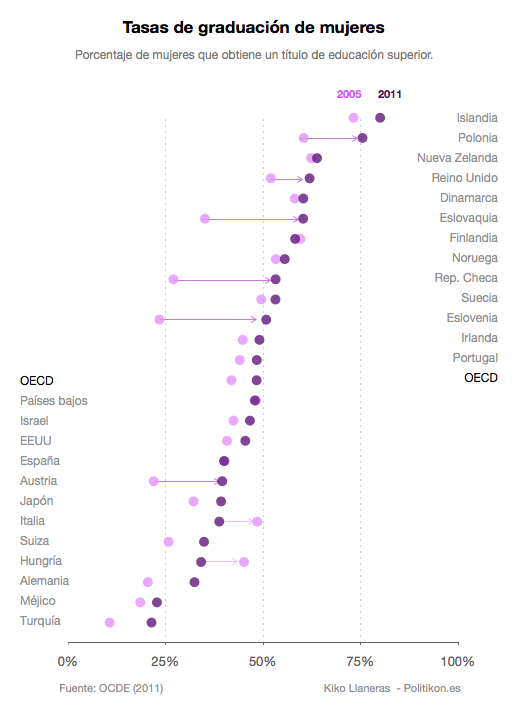
This wording reminds me of that which Obama also used with respect to gender in STEM & education:
>In fact, more women as a whole now graduate from college than men. This is a great accomplishment
-Barack Obama
Source: http://www.newsweek.com/president-obama-reflects-impact-titl...
What I mean is, there isn't anyone out there telling women that physics is cool whereas programming is not. My bet is that anyone encouraging their little girl to be a physicists would be equally enthused about electrical engineering.. but I could be wrong.
I think when people decide what a good career would be, they're going off what little knowledge they have. And programmers aren't displayed on TV as big earners - but rather scrawny stinky anti-social dorks. And sadly there's a source of truth to this..
Software just isn't cool. It's actually pretty un-cool. I don't know how to change that.
> Software just isn't cool. It's actually pretty un-cool. I don't know how to change that.
I don't see how you find this to be a conflict. If software is presented as "uncool", is that not social conditioning?
I'm currently as an exchange student in China, and every time I tell someone that I'm studying CS, they are like "Oh my god, that's so cool!".
Somehow I'm still completely surprised when I hear that reaction. I have no idea what causes this perception, I need to remember to ask next time.
The gender distribution in my classes is still 90%+ male, though. Somehow the different image of the field does not translate into more female students.
If the imbalance is due to a lack of interest in a field by one gender or another that's perhaps regrettable but not a moral issue. If the imbalance is due to obstacles or prejudices faced by one gender over another then would you agree that is a moral issue that is more important for society to rectify?
Not to mention the conflation of equality of opportunity with equality of achievement.
In our society it has become a taboo to even consider that stratification by gender and/or race of achievement could possibly be related to group wide differences in behavior or ability. This is, ironically, causing immense bias in modern culture; but it seems bias is OK when its the en vogue kind.
"A new study from Microsoft sheds some light...gender stereotypes, few female role models, peer pressure and a lack of encouragement from parents and teachers largely to blame."
So no assumptions are being made, this has been researched. This discussion is even about some of that research and it turns out girls are being discouraged by factors that are completely addressable.
> we simply ignore fields where women are over represented
Nobody's ignoring anything. My wife is a registered nurse here in the UK and encouraging men to get into nursing is definitely a thing. It turns out that men who do go into nursing have a significantly higher chance of promotion, which you'd hope would encourage them to and is it's own issue. But please, go off on a 'whataboutist' tangent as though the legitimate answer to every uncomfortable problem in the world is 'whatabout' some other problem.
If this were the case, then the participation of women currently entering the workplace would represent the baseline distribution of inclination, whereas men represent a modified distribution caused by hostile attitudes (e.g. men are classically discouraged from becoming nurses, or teachers to young children).
There's often a view that whatever condition men have is the correct one, and ought to be emulated in the female population. For somethings maybe this is true (yes, suffrage is pretty good), but for things like work-life balance and professional-inclinations, I am not so sure.
> do you seriously mean to suggest
I didn't suggest any such thing. Where are you getting this stuff? I presented what I think is a perfectly good test as to whether unequal gender representation is an issue and an example of one example of under-representation of men I'm aware of. What is it with making up opinions for me?
But fair enough. I am not all-knowing. As you're so keen to change the subject I am happy to oblige, what gender imbalances in which men are outnumbered by women are due to prejudice and are being ignored?
http://www.careersinconstruction.ca/en/why-construction/oppo...
Programs/orgs for men in nursing:
https://news.ycombinator.com/item?id=14165427
Tech is not unique, but for some of us in the industry it seems logical to focus our attention here.
No, we don't. This point has been asked, and answered, so often (even on HN) that it probably falls under this bit of the guidelines:
https://news.ycombinator.com/newsguidelines.html
> Please avoid introducing classic flamewar topics unless you have something genuinely new to say about them.
EDIT there are dozens of these:
4 years ago: https://news.ycombinator.com/item?id=5598659#5599061
3 years ago: https://news.ycombinator.com/item?id=7538789#7539557
5 years ago: https://news.ycombinator.com/item?id=3452516#3454185
The same trite point - "what about women in nursing? Are they oppressing men" ignores the fact that nursing is generally a low status job and that men in nursing get paid more and promoted faster than women, which is not what happens to women in tech.
> notice how you immediately presume that men are choosing not to go into nursing because of a lack of interest
I haven't said that. Please don't put words in my mouth.
Since you've done this it's obvious you're not interested in a good faith discussion.
These threads follow a predictable pattern.
Every single time people say "What about women in contruction?" or "what about men in teaching?", and every single time they do it in the same "AHA!" way.
But, if they'd bothered to plug it into any fucking search engine they'd have seen that considerable effort is spent in these other trades to change the gender balance.
But off you go and take a look. I'll sure you'll find something in the research you don't even seem aware exists, linked above, to complain about. At least we'll have something to discuss instead of just slinging mud around.
Also, please, point out anywhere in my posts where I asked for equality of outcome? Which of my posts are you even talking about?
No, it absolutely does not.
You suggest "overall society might affect individual choices" and then from that premise reach the conclusion "overall society definitely does not affect individual choices."
>[Women get into] tech [in Russia] because it provides a way of getting a good life. In the West, where conditions are less harsh, women don't feel the need to go into tech to get a good life.
Consider hypothetical societal differences [that may be patriarchal] that may make "a good life" to a Russian woman a totally different thing than "a good life" to an American women. Consider, even if definitions were identical, societal differences [that may be patriarchal] that may make make pursuing a good life much harder (or even downright impossible, see Saudi Arabia) in one country vs another.
I could go on.
For one example, after Title IX of the Higher Education Act was passed in 1972 female enrollment in medical school went from around 10% to over 20% in just 2 years. It's now around 50%.
But does it now? All of 'the West' isn't Silicon Valley.
I live in 'the west', Western Europe to be exact, and while I probably make more than a plumber or a shoe salesperson, I'd say someone with a medicine, law or business degree tends to make a lot more than I do, under easier conditions, and in those fields, you're not considered old at 40, and you're not on call in the weekends. IN terms of 'a good life', tech isn't the best return on investing 5 or 6 years of your life in a degree.
It's probably not a coincidence that these are the degrees women like to pursue. For a job that requires a college degree, 'tech' isn't that rewarding in terms of money or 'the good life'. It's rewarding in terms of getting to work in tech. You really need to want to work in tech to do it. This may be stupid prejudice of mine, but I get the impression guys tend to think more in terms of what they want, and girls tend to think more in terms of what would be smart of practical.
Now I can imagine that for someone in India or Romania, a degree and skills in tech means you could work for customers in the west or even move there, and make a lot more money than you would otherwise, while a business or law degree and skills don't transfer as well across borders, so the same dynamic of choosing what you want versus what would be the smart choice leads to a different decision.
What do you do, that's in worse conditions than those fields?
No it doesn't
At most it suggests that in more desperate circumstances women will be motivated to climb that hill and struggle through it
It doesn't mean there isn't a problem
It does no such thing, because there is no universally agreed upon metric by which we can rank the degree of any given form of "conditioning in nasty patriarchal socities." It could simply be the case that, in this regard / with your example, this is a dimension in which the West is more patriarchal than Iran.
I don't understand your logic here. Isn't the more natural conclusion that the desire to get a good life is stronger than the conditioning?
What does that have to do with anything? In what country do you get an engineering degree, heck a degree of any sort with a goal to be broke? Obviously, there is a financial motivation, but you can find the same motivation in the United States and women tend to avoid going down this path here.
Russian women, in general, are more into this type of thing than the American counterparts. You are trying to downplay this and make it seem like they are doing it out of desperation. They are not, thank you very much.
It's pretty ignorant and shortsighted, the educational system in Russia always favored math, engineering, and science sans gender bias.
In societies with weaker social safety nets, the motivation to go into a field with high earning potential but that you have no inherent interest in is greater. Someone from the U.S. will be less motivated by financial security than someone from Russia.
I know I did, I wanted to study sociology but that doesnt pay the bills.
This doesn't really give any evidence for or against the argument that women avoid stem because of conditioning.
... what's the social safety network like? Is there welfare? Are there government programs that will help with housing / food / healthcare for a single mom (working or not)? This absolutely influences things.
... what's the legal marital environment like? Are the laws regarding divorce more or less favorable to women in one place vs the other (property, child support, alimony, allowance of 'no-fault' divorces, burden of proof, etc)? This will also influence choices.
In both of these tangents, actual risk and perceived risk in various life choices is different based on the answer to those questions.
Yep, that one anecdotal line from an article totally destroys the idea of any sort of patriarchy or sexism happening in the US.
Sheesh, this is the top comment? Give me a break.
I came from mech eng, and the cluelessness and defensiveness techies display when their field's hostility towards women is discussed is incredibly messed up.
If you were an innocent bystander and being tarred with an overly broad brush by people with an agenda, I would imagine that you'd be annoyed and defensive too. What's actually messed up is that attempting to argue your own innocence is furthermore taken as conclusive proof that you are guilty, as alluded to in the above quote and elsewhere in this topic.
Frankly, I fall under an underrepresented category that these identity politics advocates are purportedly trying to help (more than one actually) and even _I_ don't wish to be in any way associated or represented by them because they're just that absurd and alienating to ordinary people.
Neal Stephenson in Snow Crash put it really well:
> It was, of course, nothing more than sexism,the especially virulent type espoused bymale techies who sincerely believe that they are too smart to be sexists.
It's hard to find them because they were, correctly, flagged and Algolia search doesn't return dead comments, but they do exist.
Also, you purposely expanded the scope from "women don't do STEM because.." to "any sort of patriarchy or sexism happening in the US" in order to construct a straw-man.
The reason why women in Iran, Russia, Romania etc choose STEM and woman in Sweden and the US don't is because it is deadly serious which profession they choose. The same seriousness in not in evidence in the West. In the US, people (often from rich families) are spending tens of thousands to study trivial subjects. Americans are infantilised to such a degree that they unable to recognise their infantilisation.
The same impetus is seen in all the tech people from India. Do you think they are all really interested in Richard Stallman? No, they just need to eat.
And those are not even pure fantasy: an economy that is far down the service economy road towards what would be better characterized as an ad economy offers quite a few career options far from male-dominated fields that are both "serious" enough to be considered a possible path to success (vs the make-ends-meet-until-marriage spirit of traditional female occupations, think nurse instead of doctor) and still sufficiently down-to-earth to not be considered starlet territory (like the traditional girly pipedream careers of acting, modeling, singing). Why aim for engineer if you can dream of VP for social media outreach? In an economy that is closer to industrial than to service/ad, evading male-dominated fields comes at a much bigger price in career options.
> Most of the girls we talked to from other countries had a slightly playful approach to Stem, whereas in Russia, even the very youngest were extremely focused on the fact that their future employment opportunities were more likely to be rooted in Stem subjects.
They do tech because it provides a way of getting a good life. In the West, where conditions are less harsh, women don't feel the need to go into tech to get a good life.
Similar considerations explain why female university students are more likely to do STEM subjects in Iran than in Sweden.
This, incidentally, blows out of the water the argument made by some feminists that women don't do STEM because of conditioning in nasty patriarchal societies.