Having driven a corridor with a ton of snow quite a lot (western PA to washington DC), i'm going to strongly disagree with this.
People don't "adapt". They just do it anyway because they have to. The rate of minor and major fender benders in this kind of situation is really high, it's just "acceptable".
In truth, computers that understand the physics of what is happening to the car at a given point in time based on tons of sensor data are going to be much more effective drivers in snow and ice than people (because of even simple data it can use like "this wheel has this much traction currently, so i need to correct this much"). People are really bad at figuring this out in their head and use horrible heuristics, often hitting other cars, guard rails, you name it.
You could also can get data about surrounding conditions (IE the ice the wheel will hit next or whatever) that people can't because they are not close enough/can't process fast enough (IE not just what is going on with the car, but what is the state of the ice on the road 2 inches to the right or left of the car and would it be better for the car to steer in that direction to get more traction, etc)
I remember driving home in a massive rainstorm at night about two years ago with around 2 meter visibility and was going like 20mph because I could not see shit. I had less sensory data than a computer with extra vectors of vision beyond sight would have had, and my reaction time is a ton slower.
Then a year later I'm driving in icy conditions and count five cars that either off roaded or rear ended each other in the span of 15 minutes because of the slick surfaces. I imagine self driving cars would do a much better job slowing down and budgeting for potential slippage than impatient humans.
There is nothing really magical about our eyes that give us better clarity in awful driving conditions, and we don't have radar and GPS fed into our brains to give us a clue where the roads are supposed to be - we just rely on historical context and past driving experience on the same roads.
How many hours would it take a networked fleet of self driving vehicles to outdo my historical context for driving on any of the roads I've driven on for a decade? Two? Maybe three? You just need to get the tunable parameters right though some good old genetic algorithm work like what Google is doing now with its test fleet and while it would be impossible to guarantee perfect performance in every scenario (because inevitably an earthquake is going to make a self driving car crash where nobody could have prevented it) it just has to be better than us, and that has almost certainly already happened.
Maybe not. On March 11, 2011, a magnitude 8.9 earthquake hit Japan. The first seismometer to detect it (out of 92 in the system) was on Kinkazan Island, just off the eastern coast of Japan. Each seismometer has some compute power and is constantly computing a hazard level based on the waveforms of earth movements. The Kinkazan unit did what it was supposed to, and sent an emergency shutdown signal to the Shinkansen high speed rail system. Not through the signaling system; the circuit breakers at power substations were immediately tripped and power to the trains cut. The trains treat a power cut as an emergency stop situation and apply the brakes hard. All trains stopped safely.
[1] http://www.railway-technology.com/features/feature122751/
I'm a relatively new driver (1.5 years or so since taking my license) but this happened to me twice, i.e. catching a rainstorm so big that I could barely see in front of me. In both cases I decided to stop in a refuge on the right-side of the road, waiting for the weather to improve. Sure enough, after about 20 minutes of waiting the rain eased down. What I'm saying is that under some circumstances (like close to no visibility) one should just stop and wait for the external factors to improve.
I have seen drivers barreling down a motorway at 80mph in pouring rain with visibility of under fifty metres. It made my skin crawl.
Yikes.
You do see a spike of people who don't do well to adjust to winter driving. They don't give longer gaps, make sure they have more time before crossing intersections than they do. Computers will do that much better, eventually. I can't wait to go to work or drive around the city and not have to worry about someone texting, doing makeup or making poor driving decisions. Have a nap on long trips, watch a movie, finish up some work.
I can see computers having an amazing reaction time to some kid running into the street to catch a ball. An animal running in front of you at night. It's going to take awhile though. I wouldn't trust it right now to safely take me anywhere. There are just so many variables that the engineers have to account for. Weather conditions, people conditions, car conditions and on and on. It's nuts.
It is extremely common to drive beyond your actual "in complete control" speed.
You are supposed to drive slowly enough in snow so that you can correct for unexpected patches of black ice or rocks in the snow slush. You are supposed to leave a long enough gap to be able to react and stop if the car in front of you unexpectedly fully slams on their brakes. You are supposed to drive slowly enough to stop if a kid runs out between parked cars.
Humans almost never do, because unexpected things almost never happen. Traffic flows faster and perhaps smoother, because we willingly accept driving at speeds where we can avoid most, but not all hazards.
But if we expect self-driving cars to always put safety first, then we will find them to be "tediously" slow, even if they have better sensors and faster reaction speed than us.
[1] http://www.theguardian.com/global-development/2012/may/02/tr...
I constantly need to tap the brake and back away as a car cuts into the lane. Almost no one on the highway leaves adequate space for human reaction times.
When I was taught to drive, we were told that 2 seconds of following distance was appropriate.
This just reinforces your point that the typical human driver leaves insufficient following distance.
It's a good idea; the distance is always bigger than you think.
(Although the penalty line in Germany is just this, half the speed in km/h to get meters, i.e. driving closer than 100 meters if going 200 km/h gives you a ticket for tailgating)
The difference is, in aviation, when you get this wrong you will very quickly no longer be a pilot. Or alive.
There is a slight problem. In practice, in actual measured statistics, we're utterly fantastic drivers despite all the reasoning.
We need a baseline. How about trains? Trains in the PTC and semi-PTC era don't (can't) speed and are monitored to crazy 1984 levels, usually there are two employees in the cab (not counting subway type things, I mean real Amtrak here). Trains don't have steering wheels, usually can't spin out, etc. Still the death rate is about 1/2 per billion passenger-miles. What can I say, brakes fail, drivers have heart attacks, rails crack. Its apparently impossible to put squishy humans in a sealed box and toss that box around at 90 MPH without killing about one per two billion miles. Note that's to the moon and back 4000 times, safer than even spacecraft.
The death rate for passenger cars is about 7 per billion passenger miles. A little higher for trucks/SUVs, a little lower for cars (cars are safer on the road, more stable).
That's only about 14 times worse than trains.
Anecdotally human drivers do dumb things, because there's 7 billion people and world wide networks every form of idiocy is known to all, yet simultaneously its very rare. Anecdotally a billion passenger miles isn't very far, so every year we stack bodies like cordwood, sadly. But even on the ultimate in safety, a train, we'd still have 10th the number of dead. By reasoning the ratio should be immensely larger than 14, like 1000 or 1000000. But its 14. That has to be answered...
Even crazier to consider is the death rate has dropped by a factor of 3 since the 1970s due to better engineering and regulation. We KNOW how to lower death rates using existing techniques. Yet we also know software written by humans is basically worthless. So given a choice of strategies to further lower death rates, given the track records I'd trust the MechEng and CivEng a lot more than the CS department.
A factor of 14 reduction in death rates is unfortunately far more likely to come from the MechEng/CivEng grads than the CS grads, and I say that as a CS grad.
While I agree about good measurements and need for baselines, death rate isn't it. When cars collide, you get really high number of injuries and deaths. For example there are almost 20x more injuries to pedestrians than deaths. It's nor fair to exclude them from those stats, since that can be a permanent and life changing injury.
We probably don't get any more people decapitated with the steering column. But it doesn't mean they are completely fine after the same collision.
I just wanted to note, that planes have a several times lower death rate than trains: 0.07 per billion passenger miles according to the sources I've seen. Maybe this could be a hint that safety in trains could still be improved?
Also when planes encounter bad weather or ... events of any sort (erupting volcanoes?) planes working with ATC can use three dimensions to avoid the hazard. In that way trains have it worse because they can't just tear off across farmland to avoid a tornado and they only have 1-D mobility (speed). I acknowledge its unfair for cars because of the denser road network they have 2-D mobility.
Also the security and 1984 style monitoring and monday morning quarterbacking is brought to a fine art in the aviation community, far beyond the train community.
On one hand the airplane industry is rapidly moving maintenance offshore unregulated uncontrolled facilities, which will likely impact accident rates in the future, although not so bad right now. On the other hand its hard to maintain a train or its tracks offshore, which leads to inherently higher quality, but rushed jobs due to the expense.
Its a mixed bag.
"Haven't yet attempted" isn't a "cannot."
The main rule for driving in snow is to assume everyone else is actively trying to kill you. :)
It's something I was told when getting a motorcycle at 17, and it's served me pretty well.
Specifically on snow I think we subcontract too much from brain to ABS, traction control, lovely powerful heater and what not. We don't get Scandinavian amounts of snow in the UK, so whenever we do have snow you'll see dozens of ridiculous accidents because people don't take account of stopping distances or speed, or ABS being a hinderance in snow etc.
"I don't need to go more slowly, I have 4WD!"
Cue Slip 'n' Slide. It's just enough extra performance to make people think that the road conditions don't matter.
  The main rule for all driving is to assume
  everyone else is actively trying to kill you.
In any case, you need good tires and working brakes to navigate snow effectively. Anti-lock brakes (in my opinion) are no better than a person that can properly pulse their brakes but ... if you've got even a slight warp in your rotor, you won't brake evenly enough to stop in the snow. The other problem in PA is PennDOT's "new regime". There's been far more ice packed onto the roads when it snows lately - because melting snow that's packed under tires turns to ice. I'd far rather drive on dry, crunchy snow (for traction)
/rant
Latvia does have a traffic-related death rate (per number of motor vehicles) that is twice as big (24.8) as neighbouring Estonia (11.8), or the United States (12.9), which are about on the same level, or over five times as high as Finland (4.4) somewhat further to the north.
On the other hand it's less than half of that in Russia (53.4), and one-fifth of that in India (130.1). In Ethiopia, the death rate is 200 times as big (4984).
https://en.wikipedia.org/wiki/List_of_countries_by_traffic-r...
The hard part of this we're trying to force self driving into our current infrastructure and traffic. If the bus was self driving, they would have communicated properly and merged perfectly.
This could not be less true among people driving in unfamiliar conditions. (http://legacy.wusa9.com/story/news/local/virginia/2016/01/20...)
The difference is that all self-driving cars benefit from the knowledge created by bumping into the edge cases. People can only do this in an ad-hoc manner (i.e. personal experience, taught by mentor, etc)
First snow fall in Calgary looks like what you get in a standard snow storm in a city in the south east. Its even funnier if the first snow fall is early and then there are another two months of sun and no snow and then you get a repeat during the second snow fall. People have to relearn how to drive in snow every year.
People are bad drivers in good conditions, they just happen to be able to be bad drivers in bad conditions as well.
In my experience Saskatoon fares a lot better. They don't salt as heavily because it's often cold enough that salt doesn't work as well, and because judges don't blame the municipality for not salting when there's an accident.
We defined self-driving cars: When I can pull out my phone in any of at least 5 major metropolitan areas around the world, order a driverless car, have it pick me up and deliver me to a specified location within the city in a timely fashion, with as little risk as getting in a taxi.
He is sub 20 years. I'm thinking more like 40-50 mark.
My thesis? We can solve the technical challenges, but so much physical, legal, and regulatory infrastructure needs to change to make this viable that it will be more than 2 decades until we see self-driving cars as a reality across multiple cities. Of course, I would be more than happy to lose the $100 as it would make everyone's lives better that much sooner. But I'm skeptical.
Perspective:
* 60 years ago, we didn't have highways.
* 45 years ago, seat belts weren't required.
* 40 years ago, we expected engines to last 10s of thousands of miles. We didn't really understand crumple zones. Open containers and even drinking while driving.
* 30 years, we added fuel injection, computers, and airbags.
* 20 years ago, the hybrid car, better fuel efficiency, and side airbags
Imagine what we'll know tomorrow.
Vast sums of money have been sunk into developing exceptionally reliable avionics systems since then.
Passenger carrying aircraft still all have a pilot or two.
If the cost of that automation (programmers, testing, etc) is greater than the cost of training pilots, then pilots are going to remain.
Usually, there ends up being a middle ground - you automate the low-hanging fruit, and leave the last percentage points to the humans.
EDIT: I understand that there is research going into making computers recognize "novel" situations. My comment only applies to algorithms that contain "checklists".
Sure, it can be tough to tease out the algorithm from the minds of current pilots. Luckily in aviation we already have training manuals. In other domains it'd be tougher to know when we're done extracting knowledge from humans.
b) Said human pilot was aided considerably by the airplane's autopilot system
c) I'm not sure why you think software would find this particularly challenging?
Some on-ground duty pilot sitting in a simulator who's suddenly placed in control of an aircraft that's notified an anomaly seconds before landing has absolutely zero chance of being able to make the same judgement call as a human (co)pilot who's been sitting at the controls for the last few hours. And the likelihood of human input being required is highly correlated with the possibility the aircraft has lost connectivity and/or some of the equipment that's supposed to be sending back data is malfunctioning (and yeah, you could build in more redundancy, but that still doesn't eliminate the problem and probably costs more than the pilot)
Not quite. Here's the US highway system in 1955.[1] Construction of the US Interstate Highway System started in 1956.
[1] http://www.mappery.com/map-of/Pre-Interstate-US-Highway-Syst...
[0] - http://www.historylink.org/index.cfm?DisplayPage=output.cfm&...
What?
> 30 years, we added fuel injection, computers, and airbags.
But we knew about them for a lot longer than that. Fuel injection was used in aircraft during WWII.
It could be a lot more straightforward than you suspect. The three things we have going for us:
1. Car accidents are almost always resolved by deals made between insurance companies (this will be doubly true with unpiloted cars, which will presumably not commit criminal acts)
2. The same few large companies are likely to deal in insurance of piloted and autonomous vehicles, so there's not a huge incentive to go sue-crazy
3. If autonomous vehicles cause significantly fewer accidents and companies can charge the same amount for insurance covering them, that is a huge win for some very large companies with the power to get the ball rolling.
Increased vehicle safety will be a big win for these companies in the short term, although in the long term some price discounts might be factored into the cost of autonomous vehicle insurance.
Once the first ones are available on the open market, I'd expect at least 10 years of them being very expensive rich peoples' toys while the remaining edge cases and kinks in the tech are worked out, manufacturing scales up, insurance and legal issues get sorted out, various road maintenance departments learn to deal with their needs, etc.
It's possible that such vehicles will have 5x-10x total occupancy per day of regular vehicles(which sit idle at most times). And it could imagine how the right financial incentives would shift a large share of the manufacturing capacity towards such cars. And considering the car replacement rate at probably something like 20 years - maybe 10 years is a possibility of starting to have that conversation.
I could believe that the first generation of fully automated cars might be available for purchase in ten years.
To be there I do think we need the first generation of fully automated cars available to the general public in 5 years or less, which I think we're actually close to or we wouldn't be having this very discussion...
Cars sit idle 95% of the time. That means you only need to flip 5-10% of the total fleet. Tesla could do it by themselves building 2-4 million cars/year, with the amount of cars needed per year declining the higher the utilization level you can achieve.
Disincentivize rush hour using congestion pricing.
40K people a year die in the US from vehicle accidents. Why would you not ban humans from driving if machines were objectively superior? Where do you find the "right" to drive to be? Driving is a privilege granted by the government, not a right.
If fully-automated vehicles become commercially available (which seems likely at some point, though not in the immediate future), we will likely see rapid adoption in the applications where they are very well suited, followed by a long, slow, gradual trend toward broader usage. The hardest cases will be the ones sticking around longest, and one can't simply legislate them out of existence. Just replacing a small percentage of the fleet won't come anywhere close! It's only when automated cars have become so dominant that only a small percentage of the fleet still depends on manual drivers that it will become practical to start talking about a ban on manual operation.
Self-driving, electric cars will make future taxi-equivalents affordable enough that it's considered for many instances. That makes for a massive market.
It's not as though current taxis have a sparkling reputation as drivers either. Not many will be sad to see the end of them.
Let's go with that. Say that tomorrow Google finished the development of the car. It works very well.
Than it just need to find a single city that would agree to a wide scale deployment. And I imagine there are plenty of reasons why a city might want to do that. Heck if Google cared, they could legally bribe politicians. And it doesn't even have to be a city in the west. It could be a city ruled by a dictator somewhere in africa. Or it could be a self driving car created by a chinese company, and china would be willing to take the risk to lead in this field.
So maybe the first city isn't as hard as it seems.
Now what happens after a car has proven itself in a city for a year or two ?Showing almost zero accidents, and all the other benefits of a self-driving car. How much will people everywhere would want it ? how much political support would it gather ? i imagine a lot.
Would such support and proof be enough for relatively rapid deployment of self-driving cars ?
If you're talking about _everyone_ in major economies having a driverless car, yeah, I think 40 years is realistic given the replacement rate for cars alone, nevermind the legal issues.
¹ Additional car inspection, criminal record check on the driver, etc.
https://en.wikipedia.org/wiki/Taxicabs_of_the_United_Kingdom...
Food for thought.
The problem with driving is you have to consistently do it well. You can make zero mistakes 99.99% of the time and be a terrible driver. One accident per 10,000 minutes would be ~one accident every year. Worse, a lot can happen every minute, so it's closer to not messing up for 600,000+ seconds.
The only reason people can drive is we build in very wide tolerances. ex: Car lanes are far wider than strictly necessary, you can fit ~2 cars in the average lane. Traffic lights have a significant delay where they are all red etc.
And other drivers react to minimize the problem created by another driver.
Coming from a smaller, more suburban area, I learned to recalibrate my driving to be more aggressive in larger cities (primarily NYC & DC), to hold my own against pushy taxis, etc. Most city drivers kind of bluff, and if you show you're not falling for it, they'll stay out of your way.
But city buses don't bluff. If they start pulling into your lane, even if clearly cutting you off, you better slam on those brakes, because that bus is not stopping. It's one of those unwritten rules you learn, at least in my experience driving in major East Coast cities.
I can see how it'd be hard to train AI that you have adjust the driving style depending your locale and for specific types of non-emergency vehicles.
I'm not making an argument here, really just sharing a chuckle about the crash involving a city bus.
But city buses don't bluff. If they start pulling into
your lane, even if clearly cutting you off, you better
slam on those brakes, because that bus is not stopping.
http://www.reddit.com/r/reddit.com/comments/fd667/while_ridi...
It's true that most deaths and serious accidents occur on highways, where human factors like boredom and sleepiness are probably significant. But humans also have a heck of a lot of fender benders like this incident, and a lot of the ones I have seen weren't exactly situations where "a lot of thinking" was necessary. People are texting and rear-end the person in front of them, or underestimate how much room they have to switch lanes between two cars, or other things like that. I don't see why these situations are uniquely difficult for AI to solve. In fact, they seem like very apt problems for computers to solve.
The problem is: real-life driving does not only consist of situations that even a child could easily manage. Humans are extremely good at letting their driving skills degrade gracefully when conditions get rough. AIs? They drive perfectly until they reach their limit, then they suddenly pull off epic fails - if no human driver is on standby to resolve the situation immediately.
And programmed to turn off the blinker light after merging onto the freeway...
They totally drive by night too. How do I know that? Simple: You see them with your own eyes, in Mountain View. Even if Google doesn't brag about it.
> Mastering autonomous driving on city streets -- rather than freeways, interstates or highways -- requires us to navigate complex road environments [...]. This differs from the driving undertaken by an average American driver who will spend a larger proportion of their driving miles on less complex roads such as freeways. Not surprisingly, 89 percent of our reportable disengagements have occurred in this complex street environment (see Table 6 below).
1: https://static.googleusercontent.com/media/www.google.com/en...
Statistically, Google's Self-Driving Car would've lost it's license by now, if not for human drivers keeping it in check.
PS: How often do you think the average drivers ed teacher uses there break?
A minor fender bender at low speed vs. losing control and going over a guard rail at 80 mph are both "accidents" - but have entirely different consequences.
I have a hunch that while human drivers are still better, when they do have accidents some percentage of those tend to be much more fatal.
424,331 miles, according to the report. http://www.consumerwatchdog.org/resources/cadmvdisengagerepo...
Nor are you counting all of the times the driving software handed control back to the driver. Consider each one of those equivalent to your human driver falling asleep at the wheel.
Our objective is not to minimize disengagements; rather, it is to gather, while operating safely, as much data as possible to enable us to improve our self-driving system. Therefore, we set disengagement thresholds conservatively, and each is carefully recorded.
That's a long way from falling asleep at the wheel. That's we don't want to put people at risk so we are going to hand off control if "Disengage for a recklessly behaving agent" etc.
But the report actually goes so far to points out that on at least 13 of those occasions Google believes that without human intervention a crash would have occurred. It also implies that only 3 of those situations were created by poor driving on the part of another human. That's a definite crash due to Google car error averted every ~40k miles, even though humans already take over whenever there's a software warning, a spot of rain or something else that they think might stretch its capabilities too much.
The average US driver has 1 accident per 165000 miles (which, like the unusual tendency for the Google car to get bumped when stopping at junctions, may or may not be their fault) and that's including DUI as well as people driving in slightly more difficult conditions than sunny surburban California.
The average driver doesn't do all city miles and that's why Google's cars have gotten bumped. Highway driving is much easier to automate (several cars already do this today) and makes up a large percentage of total miles driven.
That is a useful data point. Extremely optimistic bystanders think self driving cars will lower death rates to zero.
Statistically about 7 people die on the public roads per billion passenger miles. At half a million miles, assuming the miles are statistically random and indistinguishable from the entire country (sure, summer in socal is as hard driving as a winter in a blizzard at night in Montana, sure...) then 424331 death free miles means that technologies death record is no worse than 336 times worse than human drivers, at least so far. Perhaps its only 335 times more deadly than human drivers. Even drunk people aren't that dangerous.
Or in other words, the self driving car can be summarized to lots of predictions based on very little data.
Why did the bus move into an occupied lane?!?
It depends on the city, but bus drivers often don't care whatsoever about other vehicles in the way. They merge and let others avoid contact.
Because that's what busses do all the time, whether or not that is safe, legal, or desirable.
    Seventy-four per cent of road traffic deaths occur in middle-income
    countries, which account for 70% of the world’s population, but only 53%
    of the world’s registered vehicles, burdens for 74% of world's road
    deaths. In low-income countries it is even worse. Only one percent of the
    world's registered cars produce 16% of world's road traffic deaths.
The promise of an AI driver is that there will never be a second accident of the same type. The only question is how fast the learning rate can ramp up.
To me, it makes sense to make use of the brain power provided by the occupant of the vehicle. For example, if one of the main vision sensors in the car breaks, why not let the human occupant drive the car manually?
[0] http://www.amazon.co.uk/Our-Robots-Ourselves-Robotics-Autono...
[1] http://www.econtalk.org/archives/2015/11/david_mindell_o.htm...
If you have years of experience driving a car, maybe it'll work. For some time. But what if your last manual intervention was five years ago? Or twenty years ago? The rarer handoff happens, the more stress it puts on the manual operator, and the more likely things go wrong.
It's much better to have a safe default reaction (stop the car, shut down the reactor, ...) that kicks in when normal, automatic operation can't continue.
If you haven't already, I highly recommend listening to the Econ Talk podcast for much more depth from someone who has been thinking about these kind of problems for years (I can't really do it justice in a HN comment).
Which isn't really any different than any other sort of major mechanical failure.
We're already okay with the possibility that a human might drop dead in the middle of an interstate and lose control and more humans might be injured or killed as a result. As long as it is not more likely that a self-driving car will drop dead, I don't see why it's any different.
(And this isn't even getting into things like the possibility of catastrophic failure being lower and the options for recovery being much higher. You can run two robots with redundant hardware; you can't run two humans quite as easily. A human who loses vision will lose their concentration; a robot that loses vision can use its last known positions of nearby cars to attempt to pull over immediately in an orderly fashion.)
It's the same principle. You try to do the safest thing you can, but yes, at some point a car will fail and be stuck in the middle lane of an interstate because the autopilot fails, just as can happen because of mechanical failure.
1) It hands control to an out-of-car human driver, similar to how military drones and driverless trains are operated now.
2) It turns on the hazard lights and pulls to the side of the road. Another vehicle is dispatched to pick you up.
Yes, driving is actually a challenging task. But guess what, humans are BAD AT IT. And are computers going to be better? I'd be pretty damn surprised if they weren't.
Most crashes come down to distraction. Computers never get distracted. So if we can workout errors like the one in this story, then at least we can say the computer isn't going to get lazy or distracted and suddenly forget it's lessons learned.
Yes, its a challenging road ahead for these self driving cars. But I'd feel so much safer in a world of autonomous vehicles than I would with the morons behind the wheel of today.
- not using signals at all, just randomly changing lanes
- not using signals at all and on the top of that do not care about traffic in the other lanes
- driving 45 mph in the left lane because California teaches to new drivers that changing lanes are dangerous, aka "stick to your lane" (I learned that recently and I could not believe)
- driving with the exact same attitude in rain like under dry weather conditions
- do not care about people merging lanes, do not look at them, pretend they dont exist
- being on facebook on the highway driving with 65mph
- do not care about bicycles, pretending they are not legitimate traffic
I am not sure about the rest of US, but several friends told me it is specific to California. I would argue that humans are not as good drivers, at least there is a large part of drivers who aren't. Replacing drivers with software is always going to win, just like it did with airplanes or anything else repetitive task that we automated. I am pretty sure there is going to be a period while AI is not as good as humans but this is why Google is collecting to data at large scale to improve it to beat humans and make driving a safer way to commute.
It doesn't seem too hard to go in that direction. For example you can use satellties or drones or other sensing mechanism to survey a city in real time and tell the driver X minutes in advance before he would need to take control of the wheel - and of course you could adapt this recommendation according the skill of the person, his current state(being drunk) or other data.
(Source: I'm a motorcycle rider, we have a term here "SMIDSY", which stands for "Sorry mate, I didn't see you" - because it's such a common thing for drivers to say when they've just driven into you. There's a great quote from a judge a few years back in a court case over a driver excusing themselves for running into a bike "But the plaintiff was _clearly_ there to be seen.")
Have you seen the accident rate in these places? It's huge, and in many countries underreported.
Imagine how much easier it would be, for example, if roads had embedded markers (like magnets or RFID chips) that designated lanes, speed limits, and other road rules and weather conditions. AI vehicles would simply need to read this information and adjust accordingly.
But, unfortunately, this would be almost unfeasible in today's world vecause a) it depends on every car following the same rules and that's impossible if you have human drivers and b) it would require massive investment and national-level cooperation to change the infrastructure.
Speed limits can be defined as metadata on existing mapping data. Existing vehicles, such as Tesla's with their autopilot system and GPS receivers, can "define" existing lanes by refining existing mapping data using their drivers as expert system trainers [1].
You don't need national-level cooperation to change infrastructure; you just need a massively automated system for collecting data and training based on it. Google and Tesla are doing both, just in different ways.
[1] http://www.teslarati.com/tesla-building-maps-autopilot-drive...
You're talking about 13 million RFID chips that would need to be installed on 164,000 miles of roadway - just to get the interstate highways covered.
Now think about the fact that these chips are going to need to sit static and not be replaced for more than 15 years at a time. So you have to come up with a way to house them such that they will not be affected by > 150 degree heat or by < -50 degree (F) cold.
And then think about the fact that it takes ~6 months for the government wheels to spin in the right direction for a pothole to be filled in.
The project to put RFID, or any new technology on the roadways in the US will have to involve federal cooperation as well as the governments of 50 states and countless local governments. It will be 100 times more expensive than any other venture using the same technology.
Look at the Big Dig project in Boston. It took 25 years, $24 billion and several acts of congress to get it to a state where they could start working out the kinks like "why do the guardrails keep killing people".
The scale of solving this problem "the right way" is incredible. I don't disagree with you entirely. But I think any change like that is a solid 100 years out into the future.
I fully agree it's going to take a long while for everyone to adopt this, and one of the keys will be proving the AI tech - which then becomes a chicken and egg problem. Maybe Google/Tesla are laying the groundwork for that, and on second thought maybe I'm wrong about us thinking about this the backwards. Perhaps this "over-engineered" solution (for the lack of a beter word) is exactly what we need to then later optimize for "the right way".
All we really need is an idea that we can't fathom today. Google has a library of images of just about every street in the states. If they could run that same project and in the process lay out markers of some sort that would be helpful for the next generation of autonomous vehicles, then from that point forward incremental change is simply a matter of re-tooling an autonomous vehicle. Cooperation from local governments could be pushed through in a similar way that the 55 MPH speed limit happened.
Of all the "billion dollar ideas" floating around silicon valley, the person/investment group who's willing to take on an idea like this to a nationwide scale is going to be the winner.
The first round doesn't even need to be high tech. They could have a paint ball gun hanging out the side of a car spraying out a biodegradable path that a series of other cars can follow. Those cars could then train other cars.
...
Yeah, I'm flip flopping. I'm actually an idealist deep down inside. Sometimes I forget that for a little while.
We need visual processing and heuristic logic to handle a kid on the side of the road chasing a ball unlikely to intersect and catch it before he enters traffic. Given that mandatory ability, reading a speed limit sign is pretty trivial.
Given that its very unusual for an oncoming car to swerve into your lane, and a giant pothole in the oncoming lane, and the car sees three cars swerve into your lane taking turns, what are the odds of the next car hitting you head on? Compared to this puzzler, interpreting a stop sign is pretty easy.
Also the human drivers presumably will not understand the weird behavior of an enhanced self driving car, unless the human infrastructure matched the automatic infrastructure. Of course you could analyze the human data visually to predict the human behavior, but then why bother with the automatic hardware sensors?
I guess a bad automobile analogy is if you must design this pickup truck to safely haul a 8000 pound trailer, then a 300 pound trailer will not overtax it.
On the other hand, making this mandatory would also be the wet-dream of most governments. In the name of safety, they could have access to so much information... Just knowing how many passengers the car is carrying, what's the weight of each passenger, and, of course, a history of the coordinates, would open insane possibilities, not all of them good.
"Boring" versus "not boring" is too vague for this statement to really be meaningful. Examples could be drummed up on both sides. For example computers beat humans hands down in at least some criteria fitting the "not boring" description, like reaction time and seeing in multiple directions at once, and probably some others.
Self driving cars being better than the average driver is absolutely to be expected since they can only get better. They'll be consistent. They will always be focused, not get distracted, not get tired, have more sensors than a human could. It's not just about the environment but also about the mental state of the driver.
Sure it's difficult but your using one case to flip things around doesn't seem to be a very strong argument.
> Self driving cars will get there someday, but I think it's much farther away than many assume it will be.
There's no evidence to support your assertion given the tests that have been going on so far. There's no evidence to support that switching back and forth would be better than having the AI all the time either.
This gets brought up every so often, much to my chagrin. If you asked 10 people what qualifies a good driver, you will get 10 different answers.
Does it mean they have a good safety record?
Does it mean they are skilled at controlling the car?
Does it mean they can navigate traffic efficiently?
Does it mean they communicate with other drivers well enough to not negatively affect traffic?
Does it mean they have good reactions times?
What combination and weighting to you provide the above questions and what questions haven't even been asked?
Of course people respond that they are above average or good drivers since everyone is using a separate metric to define a good driver.
Let's suppose you are given a 2d field in which there are a number of rectangles, each of which have a velocity vector. So you know the location of each rectangle now, and, to a good approximation, in the near future.
How difficult is it to program a path-finding algorithm that will not crash into any of these rectangles, given that lowering speed is always a good option within a city?
I'd say this is really not all that difficult. Yes, there are a lot of special cases to consider, but still, in essence, this seems to me a quite simple problem.
So breaking down the problem is key. If you look at an autonomous vehicle as a black box, then, of course, it will seem dauntingly complicated, and difficult to trust.
hard AI problem, computer vision
> to a good approximation, in the near future.
how near is near?
> lowering speed is always a good option
can't brake if someone faster is behind you
> there are a lot of special cases [..] simple problem
simple problems by definition don't have many special cases, the "simplicity" means you can abstract them into a few cases.
in other words, talk is cheap show me the code
Also, here's ([1]) an article about a student who (single-handedly!) wrote the software for a self-driving car, which doesn't use a LIDAR system and is much cheaper.
[1] http://www.nbcnews.com/technology/students-self-driving-car-...
Large swarms on the highway, small swarms (or solitary driving) elsewhere. Best of both!
Turn one out of four one-way streets in business districts to robot only. Make a certain highway on/off-ramp robot only etc...
How about using the "self-driving AI" only as "really advanced automatic assistance". Humans will still drive the cars, but the AI will kick-in in those boring situations where the humans turn off their thinking.
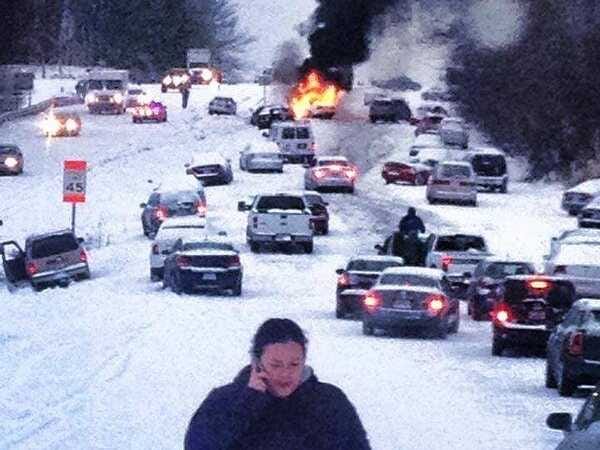
That is an awful result. Humans are awful drivers. They are too easily distracted, don't have enough information, bored, and tired.
Humans are actually great drivers when the situation requires thinking. Lot of snow and can't see the lane markers? Millions of people adapt every day to this during winter. Lots of pedestrians, bicycles, motorcycles, etc. doing somewhat unpredictable things? Again, look at any Asian mega city, people can adapt very fast. Basically, if the situation requires being alert, people are very good at driving.
When are people bad a driving? Whenever it's monotonous. Bumper to bumper traffic or a free flowing freeway. Constant repetition of red/green cycles while going down a suburban street. These boring situations make a lot of people basically turn off their alert thinking. Then they do other things like texting, talking on phone, etc.
And these boring situations are exactly where AI self driving is better at driving than people. Computers never get bored. The self driving car will be at 100% attention even during the most boring traffic. But when boring suddenly turns to not boring? The current state of AI is very very bad at this.
And unfortunately there's no easy way to use the best of both sides. If the AI is fully driving, then it will do great while the driving is boring. But by the time the AI decides, this is too much, can't handle this, it's too late to alert the human driver to take over. But if the human driver is required to always pay attention, what's the point of the self driving car?
Self driving cars will get there someday, but I think it's much farther away than many assume it will be.