I used to have some massive programs installed, a lot of digital media and video games at one point. Now Steam / GOG / Blizzard "stores" my games when not in use. Google / Apple / Pandora / Spotify "stores" my music. Amazon or Netflix "stores" my movies.
When I ran an HDD, I wanted a TB. Now that I'm running SSDs, 80 GB seems to meet all my needs (thanks to changes in internet services).
Sure, it won't be true for everyone. (Editing TIFFs for GIS anyone?) I don't run a Chromebook, but its philosophy is not completely insane for a reason...
It's like storage has differentiated into at least two separate purposes. Main system drive for consumer PCs, formerly an HDD only component, is feasibly replaced by SSDs. At the sizes needed for that, the difference in price per GB is already under a factor of two.[1]
[1] Caviar Blue 80GB @ $0.375/GB; MyDigitalSSD 64GB @ $0.578; Kingston 90GB @ $0.658/GB... https://pcpartpicker.com/parts/internal-hard-drive/#sort=a7&...
If Windows takes up 30GB, you pretty much need to wipe out everything just to play Unity on 80GB. I think 256GB to 512GB is the best bet for the standard consumer.
Your load times for a level of Call of Duty are always reflective of how long it takes to get texture data off the disk and into vram, and that is constantly being hammered. It sometimes even causes texture popping on crappy notebook hard drives.
I have 256GB SSDs in my desktop and notebook (with intents to find a nice 1TB drive next year, since we are at the tail end of SATA3) and my Steam library on my desktop is 176GB by itself.
My OS on its own (Arch) discounting pacman provided games (0ad, doom3bfg, darkplaces, doom, etc) is around 6GB, and most of that is Qt doc, Python2 site packages, 300MB of wallpapers, and 600MB of locale.
Right now, you maybe put your favorite game on the SSD, not the whole steam library - and that is what gamers often recommend themselves. FPS don't get influenced by the HDD, only loading times, and those are normally not too high. Many new games have only two loading times: loading the game and then loading the save. Afterwards, everything is streamed, and a proper HDD is fast enough for that. And that is what the people responding to your comment here miss completely.
Using a SSD is for many games a waste.
You are right, it is a pity that you are downvoted.
The downvotes and the first-generation replies to my comment show that this is not the place for a discussion about the worthiness of SSD's for games.
If you have the monty and the means why wouldn't you do it?
You're comment is very 'matter if fact' and baseless.
Improved loading times and better texture loading in games where it is heavy (think Fallout 3 or Skyrim) is a great reason to wack an SSD in your system.
> If you have the monty and the means why wouldn't you do it?
Oh, sure then :) It is only a waste in the relation of price per gigabyte vs. the possible performance improvement ingame.
> You're comment is very 'matter if fact' and baseless.
See http://www.hardocp.com/article/2013/12/10/hdd_vs_ssd_real_wo... if you want another source.
I just won't let me be told that the texture streaming outside in the open world needs that.
That HardOCP article (and HarcOCP are not really known for their quality articles anyway) is testing for framerate imrpovements.
An SSD will not improve your framerate much at all (That's not what you use an SSD for).
You cited main loading times like loading a game and loading a save, which are enough reason themselves to want an SSD in there. Some games are painfully long in these areas (take any Total War game as an example) and an SSD will help.
I gave Fallout 3 and Skyrim as an example of texture loading where an SSD would matter. You claimed it didn't, as this is contrary to all avaialble information.
These games (like many open world games) stutter when new cells/areas are loaded (I'm not talking about regular texture streaming). Again, this is where SSD's will make a difference.
An SSD becomes even more useful when you start installing high-resolution texture mods to games like these. My own Skyrim installation uses nearly 4Gb of video memory when wandering around the wilderness. That would cause some pretty heavy thrashing on an HDD.
There is nothing about SSD's being used to store games that is a 'waste' if those things are important to you.
I have two SSD's in my personal machine, one 128Gb for the OS and one 500Gb for Steam and some games. They didn't cost me much, so why wouldn't I do it? There is literally no reason for me to not do this in a high-end system meant for playing games.
Other games will go on my regular HDD's because you are right at least in saying that not all games will benefit from it, but some will.
That HardOCP article (and HarcOCP are not really known for their quality articles anyway) is testing for framerate imrpovements.
I don't like your tone. If texture streaming would profit much from an SSD, you would see that in the FPS.
Fallout 3 was played by me on a very old machine, of course without an SSD, and I remember no noticeable cell loading outside. The streaming of those engines is just too good. Fallout: New Vegas I played for more hours I'm comfortable admitting, heavily modded, on a better machine, same story there.
> My own Skyrim installation uses nearly 4Gb of video memory when wandering around the wilderness. That would cause some pretty heavy thrashing on an HDD.
Ingame, in the widlerness? Try it out. I doubt it. Initial loading times will be better of course, and loading times when switching locations, but not performance otherwise. You underestimate the performance of a regular HDD that is not a shitty 2.5 model cooked to death in an overheating laptop.
> They didn't cost me much, so why wouldn't I do it?
Like I said: No reason not to, if you have the SSD anyway. But normally, SSDs are a lot more expensive than a HDD, see above.
Area/Cell transitions are MUCH faster on an SSD.
I'm playing through the game again currently.
> Area/Cell transitions are MUCH faster on an SSD.
I think we were not talking about the same thing (anymore?). Like I wrote below, explicit area transitions - entering a city, loading a save game - will of course benefit from an SSD, a lot. That is loading though. But you also have cell transitions that are streamed – you talked about texture streaming above - when travelling on foot through the game world. If I remember the engine from my morrowind mod days correctly, that is a special case in those games with its explicit cell system, but it probably basically applies to all 3D-games that include moving through big areas, since they all have to load textures at the time they come in reach. It would be quite interesting if an SSD would have a real effect here, and to my knowledge it so far does not. It would be interesting because those transitions can stutter if the streaming system does not work properly, or if the HDD is really too slow, which is a likely cause of bad minimal fps (and depending on the benchmark, could lower average fps) or rather explicit stuttering, measured in fps or not.
I'm not saying SSDs do not help with loading stuff, I say that to my knowledge, they do not help with streaming - which are two different things.
I never felt those explicit transitions were too bothersome when I played Fallout/Oblivion/Morrowind, that together with the streaming system outdoors is why I see an SSD as not necessary for those games. But of course, if it bothers you - and maybe loading really takes longer in Skyrim? - an SSD is a good load time minimizer.
Windows on its own is quite capable of filling up a 128GB drive with restore points, update backups, and all sort of other junk when left in the hands of a typical user for a couple of years. I recently wiped nearly 60GB of pure OS-level junk (i.e. not caused by applications) from a family member's Windows 8.1 PC.
IMHO, 120GB is way more than enough.
How sustainable is this for the average consumer with most national ISPs moving towards bandwidth caps?
I had to switch to business service because Netflix alone was blowing through the data cap - in fact it was blowing through even the data cap they had for their top tier consumer service.
Which nation are you talking about? I suppose I'd guess US but it would help if you said.
I'm still getting uncapped broadband (albeit with vague TOS provisions) in the UK. I think the rest of Europe is probably similar.
For the record - I'd like to move towards metered billing - but with a realistically low price per GB - not a punitive one based on profiting from people that don't have the knowledge to estimate their usage.
Give me 20-40 GB at a good speed for £20/month with prices scaling linearly from there and I'll be fairly happy and no-one will get burnt.
(just checked and most providers are offering uncapped at around 20Mb/s for £20/month)
In general, I get 50 megabits down/20 megabits up. And, because this is a capped service, I have a reasonably good chance of actually seeing that performance. If it was, "Uncapped" or "Unlimited" - then people would abuse the crap out of it, and all of a sudden that 50 megabits/sec down would quickly drop, making the system far, far less useful.
I've never been a fan of unlimited/uncapped services, they quickly degrade into poor experiences for everyone in a very short period of time.
Using the service I have paid for is not abusing it, anymore than watching too much cable TV or making too many local calls is abuse of those services. If it causes degradation for other users, that's the fault of the ISP that has over-overprovisioned us. And the top ISPs all have profits in the billion dollar range, so it's not like they're hurting for money and just can't fix the infrastructure. Caps are just a way to squeeze out higher profits by reducing the necessity of upgrading infrastructure.
That said, not once have I ever seen my speeds drop below what they're rated to be.
"Watching too much cable TV" - Cable TV is a broadcast Medium, and watching it, like listening to broadcast radio, has no marginal cost or impact. You can leave your TV off for an entire month, or tuned to a channel for 24x7x365 - zero difference in cost to the provider, or impact to other people on the service.
"Making too many local calls" - More than one person has been required to purchase a business line when they overused their local calling privileges. Indeed, on some CO to CO trunks, if enough people (ab)used their local calling privileges, the entire exchange would be blocked and nobody could call in/out. Unlike the case of internet connectivity, there is no graceful fallback - once the trunk reaches capacity, it's dead for anyone else. (Lumby, BC to Vernon, BC - used to happen all the time - 48 people could bring down a town of 1800). That's why those types of deployments require some type of per minute charges to avoid that scenario.
"If it causes degradation for other users, that's the fault of the ISP that has over-overprovisioned us" - We totally agree here. Any ISP selling unlimited service, and not clearly explaining how many gigabytes "Unlimited" equals, is doing everyone a disservice.
"Caps are just a way to squeeze out higher profits by reducing the necessity of upgrading infrastructure." - We disagree here. ISPs should provide Caps to their customers, and clearly communicate what they are - and then compete to provide higher caps while ensuring they maintain the line rate they've committed to their customers.
For example, if I've purchased a 1 Gigabit connection, the ISP darn well better invest in their infrastructure to make sure that none of their ports are blocking. Comcast utterly failed to do that with Netflix recently, and I find that annoying beyond belief. At the same time though, I don't expect Comcast to provision enough capacity to support all of their customers at 1 Gigabit (or whatever a high speed connection is) at the same time - that's cost prohibitive - particularly as it will rarely be happening.
On the Big I internet, this is solved by what's called 95th percentile billing. This is probably too confusing for the average user, so something simpler like, "You get a 1 Gigabit connection for $75/month, with a 10 Terabyte/month Limit during Peak hours, and Unlimited Terabyte limit in Off peak hours, $20/addition Terabyte in Peak, and we make sure that none of our upstream ports our blocked on any of our peering routers" is exactly what I'd be looking for.
It sounds like those deployments required infrastructure upgrades, not more creative billing to stop people from utilizing it.
> We disagree here. ISPs should provide Caps to their customers, and clearly communicate what they are - and then compete to provide higher caps while ensuring they maintain the line rate they've committed to their customers.
Even this isn't the reality. It's rare for landline Internet to be advertised with the actual data caps in effect. In my case, the data cap is defined nowhere except the Acceptable Use Policy (a long document that nobody is going to read) and in a My Usage part of your account (which you obviously won't see until you're already hooked up.)
At the same time, who are they going to be competing with? How many people are going to lay down fiber side-by-side with someone else's fiber? What incentive is for them to compete based on the data cap instead of following current practices which ae basically "100 MBPS BLAZING FAST SUPER-SPEED INTERNET!!!"*
(fine print)
* Limited to 200GB/month. Users going over this limit will be automatically upgraded to the next highest tier after three offenses.
I'm not sure why you disagree with the statement "caps are just a way to squeeze out higher profits by reducing the necessity of upgrading the infrastructure." You're basically making the argument that yes, caps do have that effect, but are put in place as a necessary network management strategy, despite the fact that most of these networks worked quite well before data caps and don't work any better with them. While some or most of them are continuing to invest in upgrading infrastructure, most of them are also rolling around in billions of dollars of profit that they aren't investing...because there is no real market incentive to do what you're saying they "should" do.
> "You get a 1 Gigabit connection for $75/month, with a 10 Terabyte/month Limit during Peak hours, and Unlimited Terabyte limit in Off peak hours,
What a world that would be. In reality data caps are usually 300GB in networks that can obviously support much more than this. I could blow through my former data cap in 12 hours. Heck even in your scenario, I would only be able to use my rated 1 gigabits for 2-3 hours at max utilization. It seems misleading to advertise Internet as 1 gbps if you can actually only get 1 gbps for 3/720 (0.4%) hours of the month.
EDIT: I misread that as 1 TB instead of 10TB, but I don't think 4% of the month is much better.
But, if they want to do both - Profit + good service, then caps are needed.
The competition, btw, is definitely fiber (See what happens to Comcast Service when a fiber competitor comes to town - it gets much better) and wireless (I haven't used a wireline carrier in singapore for 2+ months. All LTE, all the time.)
Regarding my limits - the nice things about Tier-1 ISPs (which Comcast is) - is that they don't pay for data use, as they engage in what is called "Settlement Free Peering" - what they do pay for is (roughly) Trenches + Vaults + Data Center Real Estate + Power + cooling + security + Chassis + Fiber + Interconnect Ports + Line-Cards. These are all a function of peak usage, not total usage. So - outside of peak-usage, which has reliable patterns of behavior, there is no costs to the ISP, or fellow users of the same resources, to your usage. Peak Usage may be as few as 4 hours/day, or 120 hours/month * 1 gigabit = 54 Terabytes. In a month, 1 gigabit could theoretically draw 324 Terabytes, so - that's 270 Terabytes off Peak + 10 Terabytes on Peak allowance = 280 Terabytes/month.
By doing just a bit of scheduling, you don't have to pay any extra, the ISPs network isn't overloaded, and you have a reasonable allowance of data to work with.
Of course, if they start selling 1 Gigabit Service, that's a lot of switch ports/chassis/routers/interconnects/etc/etc... they are going to have to upgrade to handle the new peaks.
I have an uncapped service (Virgin Media) in the UK which I wouldn't trade for anything. So much so that if I were to move house their service availability would be a factor to consider.
I get 152Mbps down/15Mbps up and I have never dropped below that level but more than a few Mbps for a short time.
There is nothing abusive about using that which you paid for. If you sell me a 100mpbs pipe, I should be able to use that pipe 24/7.
Of course, the reality is that it would be expensive to make sure everyone could use their 100mbps pipe 24/7, so ISPs sensibly over-provision to save money.
But ISPs miscalculating their provisioning requirements (or as it appears in most cases, simply grubbing for money), is not the end-users fault and not the end-users problem and it does not mean that they are doing anything abusive.
Games are the main problem. When one of those 60GB bastards comes out, that's nearly one third of my monthly bandwidth, so I have to think carefully about scheduling it. But I regularly re-install 4-8GB from the cloud because it's a marginal impact compared to the entertainment it will bring.
I use Netflix as a replacement for OTA and cable TV. So my girlfriend, who likes to watch a lot of TV, has used 221GB 7 days into the billing cycle.
I really don't get a data cap of 300GB for today's culture of "stream everything". I can see something like a 1TB cap to knock out the heavy torrenters, but 300GB/month is 10GB/day. A decent sized family will bust through that easily (Dad watching a 3GB movie, Mom streaming 1GB of Pandora throughout the day, Daughter downloading 7GB of new Xbox/PS4 game content, Son binging half a season of a Netflix show at 5GB).
You seem like a very atypical use case. You can't be playing any of the modern AAA games, for example.
Or any modern sample library (which can get to 80GB for a single piano).
Or any video editing projects and/or templates.
Just some examples of professional stuff (for graphic designers, musicians/producers and videographers) that take huge space.
You don't want to bring around extra drives and cables when you perform.
You don't want vibrations, bad handling etc while performing / touring etc, to crap your HDD.
You get much much faster random reads, which is what playing large sample libraries is all about.
Even Indie games like Cities: Skylines which is PC/Mac only recently sold more than 1M copies in a short amount of time. [2]
I don't really play much but i follow PC Gaming and it has been on the rise for years. Free to play MOBA games like League of Legends have over 8M concurrent players in peak hours with 27M people playing at least game per day. That is more than the viewership of even the most popular TV series, every day of the week.
[1] http://www.dsogaming.com/news/the-witcher-3-out-of-its-4-mil... [2] http://www.polygon.com/2015/4/14/8414099/cities-skylines-hit...
Perhaps 8.1 and Windows 10 are better about what they save, but going with anything less than 128 for Windows + apps + data seems risky to me.
For Python/Django/Twisted development in a couple LXD containers, it's the just right amount of computing power at an incredibly low price.
I agree with the sentiment, though, carrying around a lightweight laptop without having to worry about theft/accidental damage is priceless.
And yes. Carrying a worry-free laptop is priceless.
  Best $/GB HDD on pricewatch.com: $0.024/GB for 2TB at $48.95
  Best $/GB SSD on pricewatch.com: $0.387/GB for 240GB at $92.95
For example, this 240GB OCZ ARC 100 is $70 ($0.292/GB) after promo code and mail-in rebate:
https://www.newegg.com/Product/Product.aspx?Item=N82E1682022...
Or not counting mail-in rebates, this 480GB PNY CS111 is $152 ($0.317/GB):
https://smile.amazon.com/dp/B00TIJMEV2/
Found via PCPartPicker: https://pcpartpicker.com/parts/internal-hard-drive/
It's more like insurance. You buy as much as you can afford. That's why it's painful to by a new MacBook Pro these days. 1TB is very expensive compared to the 1TB I could afford 5 years ago.
Somewhat OT, but I have to say something about that. With insurance you are almost always better off buying as little as you can afford. The more risk you can afford to take on yourself, the better a deal you get on your insurance. This is why a company like Hertz doesn't buy insurance at all for their fleet: they can spread the risk across all their cars, so they self-insure.
In fact, there are some cases where the "better" insurance is always a worse deal. I've seen this in several employer medical insurance plans where there are two or three different levels of PPO plans with varying deductibles and premiums.
The last couple of Blue Shield plans I looked at were like this. There would be two PPOs with the same doctor network and such, so you could simply compare on the numbers. The more expensive plan offered lower copays and deductibles, but unless you have a large number of prescriptions and doctor visits, you'd never make up the difference - with the more expensive plan you'd be paying more every month regardless.
And in any case, the number you really care about on medical insurance - which seemingly few people pay attention to - is the annual out of pocket max. That's your worst case scenario cost-wise. If you hit the out of pocket max, everything is covered after that.
In the plans I looked at, both the cheapest and most expensive plans had the same out of pocket max. So in almost every case, people who sign up for the more expensive plan are simply spending more money for the same coverage.
The fact that it can take two internal drives (both SSD) is awesome - so having dual 240GB drives allows for plenty of space.
I have a 1TB external that I glacerize my other stuff to.
Also, get a Flickr account which can host your 1TB of pics for free (money for nothin')... and you wont consume space on your local box with pics.
Just make sure you understand the privacy repercussions of hosting your data on Flickr.
No thanks. My photos live in four places, and two of them are owned by me.
https://help.yahoo.com/kb/flickr/safety-levels-flickr-sln110...
Safe - Content suitable for a global, public audience.
Moderate - If you're not sure whether your content is suitable for a global, public audience, but you don't think that it needs to be restricted.
Restricted - This is content you probably wouldn't show to your mother, and definitely shouldn't be seen by kids.
Guide - Bare breasts and bottoms are "moderate," but full frontal nudity is "restricted."
I should give it a test again though to see if it is better.
Don't be sure about that. Remember that the Thai floods setback HDD prices and made them more expensive for years; they still haven't returned to the pre-flood trendline last I checked. With SSDs dropping, that might deter much more investment into HDDs (and with less demand from HDDs in the first place, there will be fewer of the economies of scale & learning curves that drove previous HDD price decreases - and vice versa for SSDs!).
Today on newegg it's about $0.03/gb.
I only point this out because I assume you misunderstood what was said about the trend line, if you had another purpose for pointing this out which I am missing I would be interested in knowing it.
I'm not able to find an up to date enough trendline to agree or disagree with his statement.
They have. I remember buying 2TB drives a year before (2010). I paid about $200 each. Last year (2014), I bought 4TB drives for $130 each. That's about 3x improvement over 4 years, right?
https://en.wikipedia.org/wiki/File:Diagram_of_Hard_Disk_Driv...

If suppliers can deliver hard drives that follow some cube version of Moore's law (temporarily, long term everything seems to S-Curve IMHO), then prices will fall dramatically, even in a time frame less than 5 years.
Are spinnies horse drawn carriages, and Solid States the start of different, new, less mechanically restricted jet age? I think we all know that answer to that question -- maaaybe ;)
Just as a test: I looked at the price history for a random 256GB SSD (from Crucial). The highest price in the last year? $115. The current price? $99. Not nearly a 50% drop.
Link: http://camelcamelcamel.com/Crucial-MX100-2-5-Inch-Internal-C...
I have been tracking the prices of HDD's for a while now. Although I do agree that HDDs are currently substantially cheaper than SSDs, HDDs have had much less drop in price or increase in capacity compared to the pre flood era. The bigger problem facing HDDs now is that almost all major manufactures are bought up by WD and Seagate and this is starting to show the ill effects of a duopoly. So it remains in their best interest to keep the prices high [2].
[1] http://camelcamelcamel.com/Kingston-Digital-SSDNow-SV300S37A...
[2] http://www.theinquirer.net/inquirer/news/2194549/western-dig...
It's not in the HDD manufacturers best interest to keep prices inflated, considering price is one of the 2 big competitive edge HDDs have over SSDs.
What happened during the floods was that WD[0] got lucky - data consumption remained high as ever, and SSDs simply weren't cheap enough at that point to fill the void that the floods left behind.
[0] And to a greater extent, Seagate. From what I remembered their facilities weren't directly affected by the flood, but their supply chains were disrupted.
http://camelcamelcamel.com/Crucial-MX200-250GB-Internal-Soli...
The price is about the same, as is the performance, but are they still making the MX100? If not, I think the pricing information for it will not be very informative.
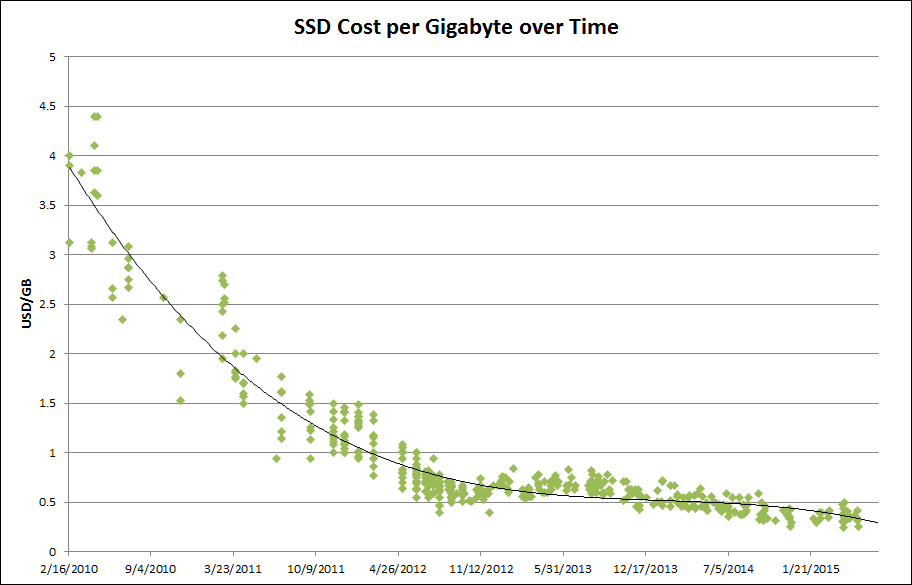
Its about 40% in a little over a year and a half. Significant, at least. Its at the point where you cannot recommend to anyone to use a mechanical hard drive as an OS volume anymore, at least, at any price.
[0] http://www.amazon.com/Samsung-512GB-2-5-Inch-Internal-MZ-7KE...
Cheapest new 256 GB SSD on NewEgg: $82.99
You can see there's about a 10x difference between the two on the logarithmic scale chart. The trend is slightly faster for SSD, but a quick straightedge-on-monitor projection suggests the intercept is closer to 2015, if ever.
The author, Jim O'Reilly, is not basing his article on historical analysis, but on an understanding of the impact of 3D NAND + his communication with the major flash providers - some of whom are committing to 8 TB and 16 TB SSD drives in the next 18 months. That, in conjunction with massively more efficient utilization of existing Fabs (both by dropping back a few process generations to increase Yield, plus stacking the NANDs in the Z direction) is going to create a huge disruption in the next 18 months.
Now - the question up for debate - does this disruption result in lower prices, does it result in large and expensive drives, or are the Fabs supply constrained such that they will be able to serve new markets, but not have sufficient capacity to drive down prices on high volume?
Regardless - 2015/2016 are going to be huge years for SSD storage.
For example on Newegg a vanilla 7200 HD from Western Digital, at 1tb, will run you $50. The lowest cost 1tb SSD will run in the mid $300s. A solid 7x difference.
In less than two years we'll see consumer retail 1tb SSDs for $150 to $200. What's actually going to happen, more than a violent price plunge pushing 1tb down to $50, is capacity will soar while prices fall more reasonably than the article indicates. So you'll be buying 5tb SSDs for $300 in three or four years. The difference is the friction the SSD makers will insert into the market, when it comes to falling prices; ie the difference between what they could sell them at, and what they actually will sell them at. The race will be to higher capacities first, then as capacity saturation nears, the bottom will fall out of lower SSD storage tiers on pricing.
Is there a point at which they simply cannot get cheaper?
Those new "shingled" Hard Drives are 8TB and pretty cheap. However, the hard drives have severe reductions in speed and are really only for archival purposes. IIRC, there's a path for 10TB, 16TB and beyond if you're willing to put up with the weaknesses of shingled hard drives.
Granted, SSDs are moving from MLC(2-bits per cell) to TLC (3-bits per cell) which reduce speed significantly without actually selling any "more" hardware. So both sides are "cheating" extra capacity out of the same hardware.
If you want to keep the same high-quality specs that the 4tb hard drives have (speed, reliability, etc. etc.), I don't think there's a valid upgrade path at the moment. There's some research to push the capacities beyond that while retaining the speed of current hard drives, but they're not ready for commercial use yet.
But the same is true for SSDs. 16nm MLC Flash might turn to 10nm or 8nm as process technology improves... but that's maybe a 2x to 4x improvment in capacity. TLC gives another 50% boost.
After SSD, what technology will take us to 100pb drives at $300? Is that even possible, while keeping the small size of the drive? No idea. It's going to require some amazing breakthroughs.
For any storage experts, will HDD still be preferable for long-term cold storage or are those even currently an unacceptable solution? Seems like cold storage might end up being more important over time. I guess AWS Glacier is <$1 per TB per month which is pretty cheap and can presumably even fall over time. I have no idea what the reliability of these services is though.
But this also reminds me LCD / CRT wars. LCDs were promised to be cheaper, but it took years to amortize the setup costs, but we got there eventually.
At this point prices will go up again.
If almost no one understands the performance and reliability difference a SSD can give, and almost no one 'enforces' users to buy SSD, how is this technology become cheaper in a so fast rate?
Consumers may not have gotten the message yet, but anyone running the numbers is going LED or nothing at all (small exceptions for grow operations or theater lightening).
So new installations get LED, but old ones are not retrofitted.
Comparing to incandescent is quite disingenuous. The bulbs just cost too much today, and the heat problems (i.e. much lower lifetime) are not fully solved, they work in some fixtures and not in others.
The LED has no advantages over the CFL, just extra cost, with no benefit.
The mercury vapor in CFLs is not very dangerous, it's elemental mercury which is not especially toxic, you need continuous exposure over a long time for it to cause any problems. One CFL is not going to do anything bad. How many CFLs do you break anyway? I've never broken a hot one, only a cold one that fell of the shelf, and cold ones don't release any mercury at all.
Buying an LED is an easier sell these days since the price has gone down, and the brightness has gone up, but I hope you did not avoid CFLs before now - that would have been very shortsighted.
Any potential cost savings just became really hard to recoup. I'm what, 6-10 years out now to save a $30 or so?
Cheap incadecent gives great quality light. Expensive LEDs give good quality light. Cheap LEDs ruin sleep patterns. Race to the bottom (and a lack of consumer awareness or ability tonbuy high quality bulbs) means LEDs are going to end up causing quite a negative impact for a non-trivial number of people.
FWIW my HOA put in shiet blueish LEDs everywhere outside. The entire complex now looks like a zombified wasteland. Evidence that I need to attend more meetings.
And judging from the reliability figures I'm hearing, it's more like a 1/10 multiplier and SSDs already outpace HDDs in value.
Doesn't sound as crazy when you think about it in that way.
I believe we are already at the point where SSDs are large enough and cheap enough for the majority of use cases. It's only going to get better. There has always seemed to be a price floor for hard disks, where making them smaller doesn't make them any cheaper, and I'm wondering if the floor won't be lower for SSD.
Anecdotally, USB sticks I throw in a drawer tend to go bad after a few years.
I'd still love to replace all the spinning disks with SSDs, though. Faster, smaller, less power, less fragile, silent, what's not to like? Hope the longevity issue gets better.
(sources: HP partner quote for the SAS disk, quick textchat with friend in HP for SSD)
http://www.amazon.com/Toshiba-Notebook-2-5-Inch-Internal-PH2...
Expecting 60% drop is not that crazy.
Cheapest 1 TB HDD on Amazon: $40
Expecting a 10x drop in prices in 1 year is ludicrous. Even if the prices follow a pseudo Moore's law and fall by half every 18 months, you're looking at at least 5 years before they reach parity. And in the meantimg HDDs would have gotten cheaper; so expect even more time for parity.
In other words: ain't happenin' in 2016.