Don't brush off what I'm saying before you try a direct-heat iron (Hakko sells them, Pace does, and JBC is the gold standard). They are usually expensive from the big names, but even a Pinecil direct-heat iron for $30$ would be many times better than non-direct-heat irons.
[1] https://hackaday.com/2024/09/12/review-ifixits-fixhub-may-be...
I don't even know when I last soldered and that's still tempting at a deep-seated nerd level.
You got me. Pinecil is en route. Thanks for the recommendation!
(It's also incredibly, incredibly useful for heat-set inserts, because you get to decide really precisely how long they will take to insert!)
Then I quickly learned that I had adjusted the temperature calibration. I reverted what I had done but now I am not confident about the temperature its operating at, at all. Seems a terrible interface design.
I recalibrated by using the thermocouple on my multimeter.
That's not my biggest problem though - my biggest problem has just been keeping tips tinned properly. I've succeeded once, but it constantly feels like a struggle.
Also keeping the tip at moderate temperature range helps avoid oxidation - most manufacturers recommend to never exceed 400 C. JBC recommends to not exceed 370 C.
Hope this helps.
The alternative, for a hobbyist, would be something like this new iFixit iron, the Pinecil, Miniware TS80/TS100 or one of the variety of chinese irons from amazon and Aliexpress that take Hakko T12 tips (Quicko and similar).
On the high-end, professional side, it's JBC and Metcal. Expensive.
The handle is so light! Active tips! Heats up in 2 seconds. Goes to standby mode when you put away the handle to save the tips.
There's even a lighter compatible precision handle that you can buy.
Luke Gorrie posted a bunch of Twitter threads where he compare the sizes of soldering handles. Can't find it now but https://github.com/lukego/soldering might lead you to them.
i still have it & i'm selling handwired keyboards at a very cheap price (made with it), trying to set a non-profit that sells fair priced handwired keyboards with Vial & aims to teach the basics of electronics for teens... i can't see myself supplying anything more expensive than cheap solders, nor i can see what joy i would get from an expensive solder tool
my wiring for reference -> https://happort.org/keyboard_example.png
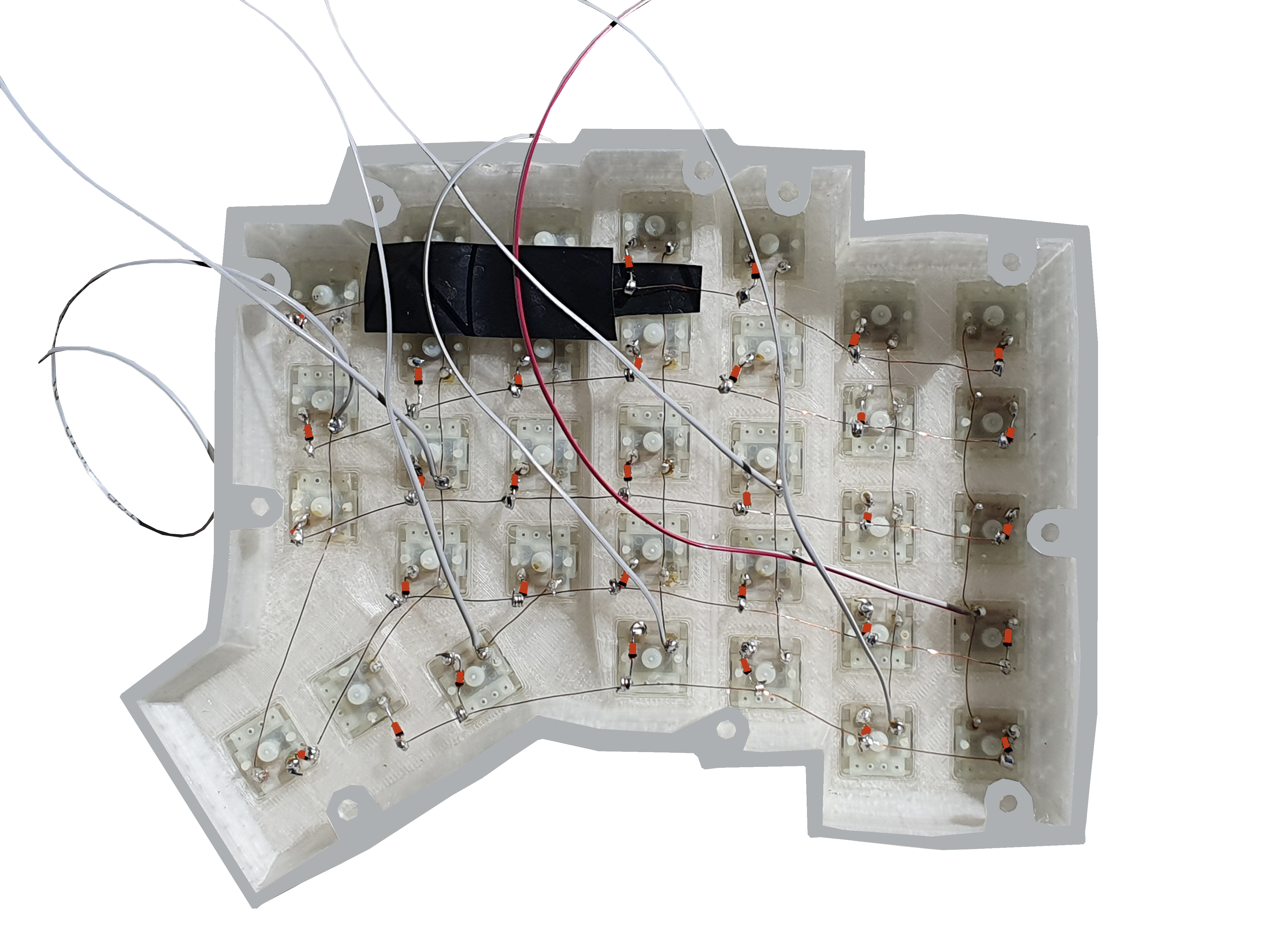
In case anyone else was wondering.
When you zoom out, I think home soldering is about as effective as it can reasonably get without fumigating your house.
That being said - leaded solder is easier to work with regardless of what iron you use. It's very easy to fix mistakes and even wicks up without a trace on most PCBs. I personally don't use it, but I think it's easy to see how people will blame their solder before their iron.
As you say, it's so much easier to get good solder joints (especially for the fine stuff like QFN/BGA) with lead blends and flux, that having a vent hood is likely required as well.
I've used only lead-free solder for a decade. Get the good stuff with some silver in it and it's not difficult.
Looking at videos of people using microscopes, the quality seems to be on-par or worse than my phone.
Plus USB scope things are like $80 on AliExpress and work fine.
I stumped up for a set of dental loupes many moons ago and they were nice, but expensive. They're safety glasses to boot.
They're come down dramatically in price since then. https://www.practicon.com/Loupes-Magnifying-Eyewear
From what I can see, the Mantis microscopes are in the $3500+ range and the JBC stuff is similarly expensive.
Most hobbyists would cringe at the price of buying a Thermaltronics soldering iron and that's like 5x cheaper. However, I can at least conclusively demonstrate the vast difference between something like that and a Hakko right in front of a person.
This stuff is like the difference between a $100 guitar, a $500 guitar, and a $2000 guitar. The difference between the $100 and the $500 one is obvious to almost everybody. The differences between the $500 and $2000 one won't be obviously noticeable until you get a lot of experience.
I find the lag to be murder when trying to solder very small things. I can use a USB microscope in a pinch, but it makes me miserable.
I would expect that this setup would work pretty well for a bench microscope setup if the camera can output video and isn't too big to mount on a tabletop tripod. Rather a lot can be done with crop zoom if you can get the focal length and lighting right.
At work I get to use a very very expensive Olympus binocular microscope. It is extraordinarily good, but at about 60k it costs more than a car.
They have great field of view (cm) at decent/variable magnification (20-100x) and response time is instant, whereas your phone/USB are going to have just enough delay to be annoying.
The fumes are flux fumes, not lead fumes. They're still bad to breathe but not specific to leaded solder.
In all seriousness, very little. I would personally want more than just a bathroom fan to do fume evacuation. Outside on a patio/balcony is my usual spot. I also have a 120mm computer fan that I hacked onto a gooseneck mount so I can blow the fumes away from my face.
The times I can't be outside, usually due to weather, I use a table right in front of an open window, and one of those dual fan window fans set to exhaust mode, and that sucks the fumes outside effectively.
I'd call that a reasonably good setup, and, as a bonus, the fumes don't hit me directly in the face, which soldering fumes have a tendency to do.
Also something to remember about ingestion is that, lead only forms salts in acidic environments, and, your stomach is quite acidic, which is why it's such a problem. Combine that with lead accumulating in your body and, well, it's best to avoid it, and it's simple enough to avoid it.
We had leaded (Ethyl) gasoline in cars which was banned 25 years ago and that had noticeable statistical effects on IQ an emotional regulation (violence) for more than a generation.
https://www.quora.com/Can-I-get-lead-poisoning-from-inhaling...
The primary means of exposure in a lab setting is through ingestion of particulate matter by getting it on your food or clothes -> mouth
Here's an environmental safety article from MIT. It mentions lead oxide fumes from soldering. What do I know other than the required lab safety training.
Based on standard soldering iron temperatures of 620°F-700°F and the melting point of lead (621°F), it is unlikely that lead fume will be generated during electronic soldering, unless the solder is heated to lead’s vaporization temperature of 3182°F.
   "During the soldering process in the form of lead filler metals, lead oxide
   fumes are formed and excessive exposure to lead oxide fumes can result in
   lead poisoning."
Most of the fumes come from the flux boiling way, not the solder itself. (Mind you, I still wouldn't recommend breathing flux fumes. Those are bad in their own way. Adequate ventilation is important!)
Lead is unequivocally bad for you, but the amount that actually enters your system from soldering activities is miniscule.
It's good to minimize these substances in our daily life since they do add up over decades. The problem with leaded gas in cars is that there were just so many cars out there burning the stuff. Duration of exposure and amount of exposure both matter.
That said... do wash your hands after handling leaded solder, especially before eating.
(I used to have a summer job in high school assembling circuit boards for an electronics test company. I easily clocked a couple hundred hours soldering under a magnifying lamp with leaded solder. I'm sure the burns I gave myself from accidently touching the soldering iron itself did more damage than the lead. :P)
The difference is not the amount of cars, but that the temperature and pressure in car engines makes lead vaporise, so it can be breathed in.
A soldering iron doesn't reach those temperatures (vaporising the lead is the opposite of what you want when soldering).
A sharp knife is also quite a bit safer than a dull knife. By heating to operating temperature in 5 seconds and rapidly pouring heat into the material, you don't have to hold the hot iron as long. As soon as you're done, pop on the safety cap and instantly shield the hot metal.
Soldering isn't remotely mainstream, and part of that is the quality of tools. We set out to streamline the entire process to make soldering as accessible as possible.
Corollary: learn to sharpen. The best steel in the world isn't going to cut anything if it's dull.
For the record, I sharpen chisels almost daily and I hate sharpening kitchen knives. The carbides set at the right angle in the handle you pull down the length of the blade will keep your knives a lot sharper than a set of Japanese water stones you never use.
They'll take their knives to these services and pay $5 or $6 per knife, and it will get done to perfection in just a few minutes while they wait. You can use these same services, there is no membership card needed to get in the door.
When we were still in the Boston area, a lot of the hardware stores and farmers markets would have a knife sharpening service come one day a month.
I don’t have actual knowledge, just what I’ve been told by chefs.
Giving an expensive knife to a new cook that has never cooked before will not make them a Michelin chef, but their progress will be faster when they don't have the knife working against them.
A better cook knows that if her knives are dull, she won’t perform as well.
The only thing a better knife does is save you prep time. Being a good cook is about understanding how different materials cook, when different foods are "done", how flavors work together, and how to improvise when things go outside the plan/recipe or adapt to novel situations.
Cutting technique is only important if you're a professional chef with actual time constraints and can't afford to spend an extra 30 seconds cutting an onion.
Pick any Michelin-rated restaurant at random and visit the kitchen. You'll find plenty of $50 knives in use. It doesn't take a lot of money to build a good-enough-for-world-class-cooking knife. Once you get beyond a certain price point, it's mostly about personal preferences and "situations that apply to me but may or may not apply to you".
I'll just point out that your standard workhorse Global 8" is easily available for $80ish. Probably even cheaper in Japan with the exchange rates.
That being said, I still prefer diamond stones (sharpening wise)
Tomatoes, meat, fish, I use my $4 serrated knife. Everything else is fine. With proper technique it's basically impossible to cut yourself even with a very dull knife.
it's not that you can't overcome adversity and do the thing anyhow, but you're certainly not making it easy. In all cases, using the proper tool allows you to remove the extra difficulty factor and focus on that task at hand.
But also, cutting a tomato with a sharp knife is way, way easier than with a dull knife. Same with soldering. Ignores the rest of the parts of being a chef, but you get the comparison.
You’re getting awfully literal, though.
It is like photographers with $5,000 worth of equipment in their camera bags telling you that equipment doesn’t matter. I mean, there is a reason why they spend all that money right? Of course a good photographer will be able to get good results with a cheap camera, but only in situations where that cheap camera can actually capture the scene. For example, if it is not sensitive enough to capture enough light at night time, you are not getting night time shots, period, no matter how good you are. (this very much used to be a thing 10 years ago)
If you employ programmers, you will buy fast workstations because it will make them MUCH more productive. A slow computer will interrupt your work by making you wait.
I think it is in fact the exact opposite, the better you are at something, the more likely it is that you become limited by your equipment. I will probably not be able to cook better if I get very expensive knives. But I would speculate that an actual professional cook or butcher will be able to work better with sharp knives that keep their edges well.
A knife that won't hold it's edge will mean you are explicitly going to perform worse as a chef - you will get ragged cuts, you will be more at risk for injuring yourself, etc.
A slow laptop will mean you learn more slowly - doubly so if you are working with compiled languages or anything where you spend significant processing time before determining the outcome of whatever you're working on. The quicker you can get feedback on your work, be it from compilation errors, manual review of the output, your tests running, etc., the more you get to iterate and the more you get to learn.
A cheap soldering iron explicitly can make soldering more difficult and result in worse outcomes, particularly for a beginner.
Be it cooking, soldering, photographing, programming, whatever, there is frequently a point where going from a cheaper tool to a more expensive one will make the life of a beginner easier and let them produce better outcomes. As you get more skilled you can learn how to more quickly and easily sharpen knives, or produce fewer bugs in your code, or how to better handle aperture vs. ISO or whatever. But in those cases there will still often be productivity/efficiency gains from using nicer tools
I dunno, I'm 56 and I'm about to finish the roll I bought as a teenager. (Albeit bought in pre-RoHS times.)
Yeah. Old high lead content solder is way nicer to solder with than modern stuff.
For any other Navy nukes, I wanted to link to a good reference on what ETMS is (was?) but couldn’t readily find anything. If anyone has a reputable link to publicly available course material on their solder grading rubrics or the 7-step, I’d be interested.
"THROUGH-HOLE SOLDERING GENERAL REQUIREMENTS"
https://workmanship.nasa.gov/lib/insp/2%20books/links/sectio...
This one might be relevant too (but it's too long for me to read through right now to confirm):
"Military Standard - Standard requirements for soldered electrical and electronic assemblies (1989)"
https://electromet.com/wp-content/uploads/2015/09/Electromet...
edit: if you’re ^soldering *Nuke* stuff underway, it’s because things have hit the fan, and that’s the whole point of ETMS. Other rates also solder underway and might also use (did use) lead, and perhaps none of our inhalation was warranted.
I do remember my first pound lasted about 15 years though...
And patience. As tempting as it may be, don't think "if I double the temp, I won't be waiting for this big joint to start pulling in solder".
good flux, clean/sharp tip and proper patience can take you a very long way! (a steady hand and good rubbing alcohol will take you the rest of the way)
Let’s couch it in real terms. You can try to attempt something poorly 20x because you can’t line things up and your hand isn’t steady and do a poor job with worse aesthetics and in 20x the time, risking damaging your part, or you can get it right the first time with ease and have it look great because everything was lined up and there was no real way that shaky hands might ruin it.
I speak from personal experience here. Spend a little bit and save time, money, and sanity and get a better result.
I'd just like to note for anyone googling for one after reading this- the Harbor Freight "helping hands" holder and its ilk are the exact opposite of what you want, unless your goal is to have your target falling over endlessly.
I guess it depends how much you are going to use it.
If your experience with soldering is one of those cheap flimsy $30 dollar things from Amazon paired with fat, chunky solder… yeah you will hate soldering and you’ll never get even remotely good results. You don’t need to spend $500 dollar or anything but something like what is in this post and a $40 roll of thin gauge solder (which will last the rest of your life) will make soldering actually fun and enjoyable.
…I should also mention a solid, heavy parts holder factors into this as well.