If people can wrap their head around the idea that landfills are not dumps and are instead very safe and borderline irrelevant, then the carbon emissions should clearly determine what one recycles.
Yeah... I'm not having an easy time with that one...
https://edition.cnn.com/interactive/2020/09/us/september-11-...
https://www.ncbi.nlm.nih.gov/pmc/articles/PMC5005946/
https://apnews.com/article/health-cancer-st-louis-missouri-1...
https://abc7ny.com/brookhaven-landfill-frank-p-long-intermed...
Quotes:
A proximity analysis, which modeled how many cancer cases could be explained by distance to Fresh Kills, found that none of the five cancer types had elevated rates closer to Fresh Kills between 1995 and 2004, although it did find that some thyroid and bladder cancer rates were higher near the former landfill site between 2005 and 2015. But the researchers still saw little evidence of a link to the landfill because they could not find any reasonable explanations for how residents would have come into contact with materials in the landfill that were known or suspected to cause bladder or thyroid cancers, especially since Fresh Kills closed.
“More plausible” explanations, the authors wrote, were higher screening rates for thyroid cancer and Staten Islanders’ higher smoking rates. Smoking is a known risk factor for bladder cancer.
For active landfills, yeah.
For decommissioned and capped-off landfills, nah, not if they've done it right. (And given that this is a regulated industry, it's very likely that they've done it right.)
In my experience in the American Southeast, Academy of Model Aeronautics airfields are often built on top of decommissioned landfills [0]... so I have spent a lot of time standing on and around these things. I've never noticed any odor, soft spots in the terrain [1] that is the cap, or any of most of the other weird things one might think of when one thinks "site of a former landfill".
[0] Why? Because the land is quite cheap, and a ~100 foot strip of tarmac, a few little structures (sun shelters and the like) and parking for a couple dozen cars isn't all that much weight.
[1] To be fair, the runway did have to be worked on every three, five years as the terrain under it settled. But bear in mind that we're talking about bumps in a runway for model aircraft, so the amount of settling was actually not very large.
But even if true, this is just making the argument that we should probably try to put them further away from people’s houses, which sure. I don’t want to live next to one even if there’s no risk at all so I agree.
I sort of am being paid to put my plastic in my recycling bin. My garbage company charges $47/quarter for a 35 gallon regular bin, and $22/quarter for a 64 gallon recycling bin.
It would require two regular bins to handle everything, which would be $94/quarter, which is more than the $69/quarter that one regular bin plus one recycling bin costs.
One would expect that the costs in that situation are likely to be more representative of the actual cost to dispose of the material, as the company can't obscure its economic reality with taxes.
The private collection incentives me to separate as much recycling as I can and provides nice big free bins for this.
If I understand correctly this is only economical because there is this whole system where all plastic soft drink bottles are made of PET, and so easily identifiable as PET and to get the refund you have to take it to a collection point where the only plastic entering the system are these bottles.
The big haulers here were all established parties that got to bid on these contracts and they played a very smart game but given the various downsides for society and the municipalities themselves in the longer term I can't rule it out either. It certainly doesn't make a whole pile of sense. One day glass was a valuable resource, the next you had to pay someone to get rid of it. Likewise for paper, compostables etc. This all happened in the 80's or so and recycling was the nominal driver. It outright ignored that we were already recycling. The big killer was to package everything in plastic and with plastic liners, even things that look like paper are often coated with plastic on the inside. So now we have two problems: the valuables are recycled and create a profit twice for the haulers and they charge real money for the ever increasing mountain of plastic.
People harp a lot on the straw ban, I get it, it is symbolic. But I would have gone much further: anything perishable that can be packaged in paper should be packaged in paper, and the paper industry should be incentivized to recycle as much as possible with the least energy as possible. Because right now recycling paper often gets skipped on account of the energy requirements (because we like our paper to be white). Instead it gets lumped in with the compostables or biomass and burned for electricity.
There is a ton of information on all this and it is obviously very variable from one locality to another but in the end resource extraction, energy use and leftover waste are the killers, those need to be curbed and far more drastically than we are doing right now. So much stuff is single use it is just terrible, and there are no real alternatives either. If you shop at a normal supermarket for a family of four at the end of the week you'll have a small mountain of packaging.
Individually wrapped candies in a plastic sleeve? Landfills will send you a invoice based on the volume that enters their site.
Phones designed to be replaced every two-years? You might be able to save money by making the original container a prepaid shipping box to cut back on sending out new ones for proper disposal.
Fruits and vegetables? That's bio-degradable and people will pay to have it in their soil. Make a deal with some local group to set up compost bins charging $1/scoop, and its like a built-in subsidy for farmers.
Have a novel solution that's 100% re-useable/recyclable? Enjoy the good times while entrepreneurs offer to pick that up for you to sell back to recyclers themselves.
EPA discovers that by "recycle" you meant "throw it in the ocean when no one's looking"? If you can't pivot quickly enough to cover both the new disposal fees and clean-up fines you'll be a good case-study for others who want to take shortcuts.
Sure, companies would absolutely pass the cost straight into the purchase price, but a company that wraps your sandwich in plastic and adds a $5 disposal markup won't last long when someone starts wrapping theirs in paper and only charging $1 more.
I know it's not that simple, but a man can dream, eh?
Also, I'm maybe a monster environmentally thinks utility needs to factor in. Straws are made of plastic because straws are useful and because plastic makes a very good straw. Paper makes a useless one, so they're pointless to even make. So many things use a lot more plastic than straws do, so I sincerely think straws should be the last to go after we've ended plastic water bottles, takeout clamshells, milk cartons, etc. Put all that crap in reusable glass or recyclable aluminum.
It's pretty easy for recycling centers to sort out most of the glass and metal from that stream and then as technology improves they can sort and recycle even more of the plastic.
As for the food waste, I just assumed it was mostly destroyed by the recycling process. The high temperatures for metal and glass recycling make that seem easy to me. Plastic would be harder, but I think that's also part of the reason plastic can only be recycled a couple of times (it's not "pure" after it's recycled.)
Biological Treatment: Organic waste, including food waste, is often separated either at the beginning of the process through manual sorting or through processes like anaerobic digestion. In some facilities, organic waste is processed separately to produce compost or biogas.
If it were economic to really recycle it, China wouldn't have stopped taking ours. And most of the rest of Asia followed suit, which is why municipalities are sheepishly hoarding it in warehouses now without a plan, or just admitting to themselves (if not their citizens) it's a sham and diverting most of those plastics we put in the blue bins straight to the landfill.
The problem is that a pound of aluminum goes for about $0.45.
That does not come close for paying for a weekly curbside pickup service, which is what most individuals use for recycling.
Heck, they probably wouldn't even take an unsorted collection of "recyclables". The company I am looking at drops the price for unspecified "dirty" aluminum to $0.25 per pound.
I have to take the cans down to the recycling center and throw them one by one into some machine and maybe they'll get recycled. Any compensation I might get is from the state, which is basically a dime for a can.
At that point I'm just going to throw them all in the trash, not worth my time nor fuel to drive down.
It's your dime, that you've paid. Included in the price. Same thing exists in Sweden for plastic, for example.
Usually such schemes are basically incentives for homeless (or poor) people to clean up streets paid from the can buyers pockets.
As far as I'm concerned, that ain't worth it; they can keep the dime and deal with the can in the trash bin, I couldn't care less.
Is it enough to slow aluminium on a conveyer or something?
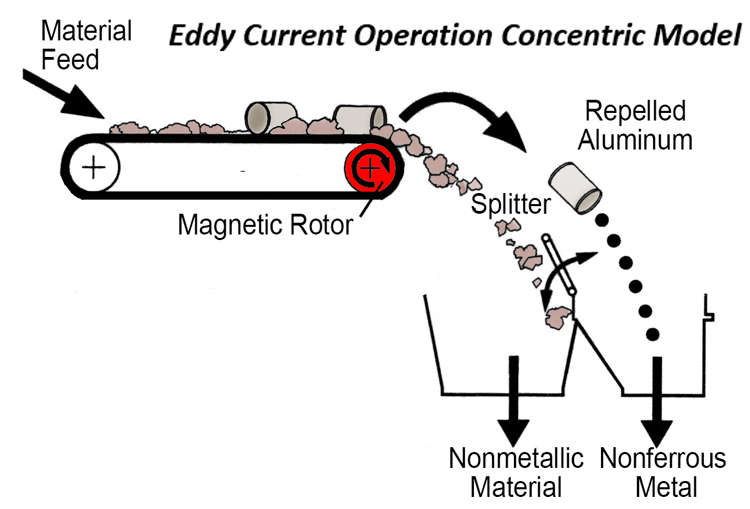
The rotor contains powerful magnets and when it spins quickly it induces a magnetic field in nonferrous metals like aluminum, repelling them from the rotor so that they overshoot the "other waste" bin.
But anyway, what I've been told is that any kind of adulterants on metals aren't even a big deal because that will easily burn off when they melt them. Think about the Terminator in Terminator II. The leather jacket, and indeed The Chip were not a problem when he was lowered into the steel. :'(
The whole segment is so pro Capitalism that it is anti caring about the Earth at all. The message could have more easily been "We were fooled by Big Plastic for corporate profits".
I'm also unsure how libertarianism is anti-capitalist.
Are you conflating Corporatism and Capitalism?
We do it all the time. Many facets of markets are not free. The pharmaceutical market is highly regulated, but boy is it capitalism.
A lot of the capital owning capitalists would prefer the markets to be less free in many ways. If I own a toll road, I really don't want a parallel toll road. This sounds like a ridiculous allowance in a capitalist system but look up the Ambassador Bridge. It is very much in that owner's interest for the market to not be free at all.
If you look at lobbying, many capitalists advocate for less free markets all the time. I'm not just talking about the capital owners either. Labor advocates push for less freedom in the markets consistently through wage floors and legal restrictions on employers.
It seems like there is an equilibrium point where a completely free (meaning every person for himself) devolves to the point where the lack of trust becomes too high of a transactional cost. Both food producers and food consumers benefit from regulations that don't allow you to sell sawdust disguised as flour just because you are able to convince someone that it will work the same.
US libertarians came from individualist anarchists, who basically thought that under capitalism, volontary exchange could not exist, as wage workers could be forced to work by power imbalance created by capitalism.
Even some neo classical liberals (liberalism is the ideology promoting free market) have played with the idea of natural monopolies created by land use. Hence you will see a lot of georgists amongst liberals who really thought about a perfect free market capitalism.
Finally, a good critique of free-market socialism (where every company is employee-owned, with real liability) is that interest groups will still form and lobby the government for advantages, distorting the free market, like the asset owners do currently (hence it cannot work in a representative democracy).
For those not aware, recycling aluminum is absolutely not a sham. It takes about 2x the energy to make new steel than to melt down old steel. For aluminum, that energy difference is 20x!!!
This is why people will actually pay you to recycle aluminum, because running electrolysis through bauxite ore to make new aluminum is incredibly energy expensive.