News for hackers. Stuff that matters.
Re:First new U.S. nuclear reactor since 2016 is now in opera... by internetter on Wednesday December 27, 2023 @04:00PM (#38786682)
One kilogram of uranium-235 (50 cm^3) can theoretically produce about 20 terajoules of energy. One square kilometer of solar panels can theoretically produce the same amount (as 50cm^3 U235) in a day. I'll take this bet.

Edit: Tried to edit the edit but somehow deleted the rest of the edit. It was something to the tune of how a big problem with renewables is the fact that peak solar production does not match peak energy consumption, and storage is very difficult, so realistically we'll need a wide variety of energy options to fully transition to renewables. Nuclear is reliable and to some degree adjustable, helping to alleviate the storage issue.

Re:First new U.S. nuclear reactor since 2016 is now in opera... by margalabargala on Wednesday December 27, 2023 @04:34PM (#38787028)
> One kilogram of uranium-235 (50 cm^3) can theoretically produce about 20 terajoules of energy. One square kilometer of solar panels can theoretically produce the same amount (as 50cm^3 U235) in a day.

Does the US have more 50cm^3 sized blocks of U235, or more square kilometers of land with low land values and high annual insolation?

There's an estimated 6 million tonnes of mineable uranium reserves in the world [0]. Of which 0.72% is U-235, so we have a worldwide reserve of 43200 tonnes, or 43.2 million Kg U-235.

Arizona is about 300k square kilometers. If we covered an area 10% the size of Arizona in solar panels, then they would have produced more energy than all the world's known U-235 in just four years. And would continue producing after those four years are up.

[0] https://world-nuclear.org/information-library/nuclear-fuel-c...

Re:First new U.S. nuclear reactor since 2016 is now in opera... by marcosdumay on Wednesday December 27, 2023 @08:47PM (#38789043)
The thing about mineral reserves is that they only make sense when you add the price-point to the number.

There is enough Uranium on the planet for a few centuries. Make it a few millennia if you breed it, and lots and lots of millennia if you expand your reactors to use other fuels. But most of it is way more expensive to get than what we use today... what actually makes very little difference for the final costs.

Re:First new U.S. nuclear reactor since 2016 is now in opera... by sandworm101 on Wednesday December 27, 2023 @05:28PM (#38787595)
There is way way more uranium than that. It is surprisingly common. And harvesting it from seawater opens up a supply that dwarfs any mining concept.

https://en.wikipedia.org/wiki/Uranium_in_the_environment

>> Uranium is a naturally occurring element found in low levels within all rock, soil, and water. This is the highest-numbered element to be found naturally in significant quantities on earth. According to the United Nations Scientific Committee on the Effects of Atomic Radiation the normal concentration of uranium in soil is 300 μg/kg to 11.7 mg/kg. ... It is considered to be more plentiful than antimony, beryllium, cadmium, gold, mercury, silver, or tungsten and is about as abundant as tin, arsenic or molybdenum.

How uranium ore becomes fuel rods: (Actually a rather simple process imho.)

https://youtu.be/9x7DozCqLxU

https://youtu.be/c7ehyxRBMbw

Re:First new U.S. nuclear reactor since 2016 is now in opera... by keep_reading on Wednesday December 27, 2023 @05:53PM (#38787867)
Nuclear is renewable for the same reason geothermal is renewable, and you can get uranium out of seawater for the same price as mining it

https://www.tiktok.com/@nuclearsciencelover/video/7092135813...

Re:First new U.S. nuclear reactor since 2016 is now in opera... by rajamaka on Wednesday December 27, 2023 @06:00PM (#38787933)
Why do people bother mining it?
Re:First new U.S. nuclear reactor since 2016 is now in opera... by mpweiher on Wednesday December 27, 2023 @06:10PM (#38788005)
Because mining it is relatively cheap. So cheap, in fact, that it is economical to throw away >95% of the fuel rather than try to burn it all or recycle it.

Fuel costs are 10% of the cost of nuclear electricity. The vast majority is financing.

Re:First new U.S. nuclear reactor since 2016 is now in opera... by danans on Wednesday December 27, 2023 @08:00PM (#38788770)
> The vast majority is financing.

The financing for nuclear is expensive primarily because:

1) The costs of construction are so high - so huge amounts of financing needed.

2) The amount of time before investors see any ROI is very long.

A long time ago, when electricity markets were fully monopolized end to end, the long-term ROI on nuclear and other generating assets was guaranteed by the government, and the financial risk was borne by society.

Now, electricity markets have been liberalized (at least at the generation level). Simultaneously, far less capital-intensive generation technologies have been created (renewables, combined-cycle gas, and increasingly storage). These technologies provide an earlier ROI for risk-averse capitalists.

Re:First new U.S. nuclear reactor since 2016 is now in opera... by bborud on Thursday December 28, 2023 @06:31AM (#38792390)
And as Bent Flyvbjerg mentions in "How Big Things Get Done", projects that last for a very long time are all but guaranteed to encounter one or more black swan events and/or recessions.

Bent makes a sensible argument for SMR reactor technology in that book too.

Re:First new U.S. nuclear reactor since 2016 is now in opera... by stephenr on Wednesday December 27, 2023 @09:11PM (#38789198)
> you can get uranium out of seawater for the same price as mining it

> Why do people bother mining it?

> Because mining it is relatively cheap.

Something does not add up here.

Re:First new U.S. nuclear reactor since 2016 is now in opera... by mpweiher on Thursday December 28, 2023 @03:16AM (#38791205)
Mining exists and is cheap enough that there is no incentive to invest in something new, even if it might just as good. Particularly because "just as good" is rarely a good reason for changing and investing, it would have to be significantly better.

(Though I have no real opinion on whether seawater extraction really is just as good...somewhat dubios)

Re:First new U.S. nuclear reactor since 2016 is now in opera... by defrost on Thursday December 28, 2023 @03:34AM (#38791313)
FWiW the latest in a long line of seawater extraction papers is (2020):

https://pubs.rsc.org/en/content/articlelanding/2020/ta/d0ta0...

https://sci-hub.ru/10.1039/D0TA07180C

which has the weasel phrases

     uranium production costs could be reduced to $80.70–86.25 per kg of uranium with this fiber, which is similar to the uranium spot price of $86.68 per kg of uranium
and

    suggests the possibility of economically producing nuclear fuel from the ocean.
Not to disrespect their work, many small scale lab tests confidently assert that costs could be reduced and might possibly be economic.

The fine print is that so far no pilot plants exist and no estimates on the capital plant costs for industrial scale extraction to achieve the possible unit throughput prices as yet exist.

This may yet happen.

There may also be a slip between paper and industrial plant at scale.

Re:First new U.S. nuclear reactor since 2016 is now in opera... by mpweiher on Thursday December 28, 2023 @11:27AM (#38795117)
> This may yet happen.

Yeah. But probably not for a long time as Uranium from present sources is cheap (enough) and plentiful (enough) and if that should ever get more expensive we can start looking at the huge stockpiles of 95% unspent fuel that we call "nuclear waste". Burning that would (a) give us a lot of electricity and (b) reduce the radioactivity of whatever is left dramatically.

Re:First new U.S. nuclear reactor since 2016 is now in opera... by stephenr on Thursday December 28, 2023 @03:38AM (#38791340)
To be clear: I'm not arguing for one or the other, I'm pointing out that one of the above statements doesn't align with the other.

If the other costs are equal (remember I said if) then extracting it from seawater would undoubtedly be easier overall simply because of abundance, and the non-destructive nature of collecting it would mean there's no issue with environmental challenges due to the destructive nature of mining.

Re:First new U.S. nuclear reactor since 2016 is now in opera... by mpweiher on Thursday December 28, 2023 @11:31AM (#38795178)
Not really. If the costs are equal, then there is no point in investing in a new technology, new plants etc. that don't provide a competitive advantage.

What's the startup question again?

What about your new product is 10x better than the incumbent?

Not sure too many VCs have advised companies as follows: "Hey your new product is exactly as good as the incumbent, you have an absolute winner on your hands here. Where do we need to send the check?"

Re:First new U.S. nuclear reactor since 2016 is now in opera... by stephenr on Thursday December 28, 2023 @11:51AM (#38795394)
> What about your new product is 10x better than the incumbent?

Well let's just ignore the idea that mining megacorps operate in any way like a startup does. At the top of the uranium mining food chain, even a 1% reduction in costs (or increase in extraction) would be add around $13M a year to their revenue, so fuck it lets play hypoethetical.

If someone came along and said "hey we have a startup that's exactly as profitable as YouTube, but there's essentially no risk of people protesting our business and using ad-blockers to deprive us of revenue" the VC vultures would be on that shit like a fat kid on cake.

As I said before: seawater is ubiquitous and for the purposes of human scale, essentially limitless everywhere, unlike mined uranium which to be cost effective, is only mined in certain areas where the return is higher.

Re:First new U.S. nuclear reactor since 2016 is now in opera... by mpweiher on Thursday December 28, 2023 @05:58PM (#38799806)
1. Not lower cost, same cost. Maybe.

2. Who said anything about no risk?

Re:First new U.S. nuclear reactor since 2016 is now in opera... by hef19898 on Wednesday December 27, 2023 @10:03PM (#38789518)
So we moved from using Twitter as a source to TikTok? We live in dark times...
Re:First new U.S. nuclear reactor since 2016 is now in opera... by dmix on Wednesday December 27, 2023 @11:59PM (#38790218)
I get the old man yells at sky reaction but it's just a short video... A snapshot of information which directly references with overlayed text a citation to the study he's discussing.

Not much different than most HN comments which 90% of the time are only one or two sentences.

Re:First new U.S. nuclear reactor since 2016 is now in opera... by c0pium on Thursday December 28, 2023 @12:10AM (#38790267)
None of this is true. Highly upvoted hn comments (the ones people read) bring receipts. This is just someone’s low effort opinion.

For what it’s worth, the cost to extract uranium from seawater is actually a very complicated subject. It is generally cited that the cost is approximately 2x the mining cost, but that’s based on estimates for seawater extraction.

https://www.researchgate.net/publication/280745206_Cost_Esti...

Re:First new U.S. nuclear reactor since 2016 is now in opera... by hef19898 on Thursday December 28, 2023 @04:35AM (#38791699)
Well, at the very least give a short summary of what you are linking to.
Re:First new U.S. nuclear reactor since 2016 is now in opera... by acidburnNSA on Wednesday December 27, 2023 @11:03PM (#38789903)
You can also get the same information from here, which has an extensive reference section at the bottom. Disclosure: I wrote it.

https://whatisnuclear.com/nuclear-sustainability.html

Re:First new U.S. nuclear reactor since 2016 is now in opera... by hef19898 on Thursday December 28, 2023 @05:32AM (#38792045)
Nice work. Do you know of any studies looking at the cost of powering the world that way? And the time need to transition?
Re:First new U.S. nuclear reactor since 2016 is now in opera... by c0pium on Thursday December 28, 2023 @12:05AM (#38790245)
TikTok is not credible. You can’t click the links or easily verify the conclusions. It’s the ultimate in trust me bro science.
Re:First new U.S. nuclear reactor since 2016 is now in opera... by _aavaa_ on Wednesday December 27, 2023 @04:56PM (#38787275)
It’s worth noting that the dichotomy you set up isn’t quite right. The land use for solar and wind isn’t an exclusionary zone. The area around a wind turbine can be used same as before (most often as farmland) without a negative impact on its productivity.

And the same is true for solar. In fact, a growing number of agro-voltaic projects are seeing a net positive on crop yields from solar panels due to the increased shading and decreased temperatures.

Re:First new U.S. nuclear reactor since 2016 is now in opera... by 1659447091 on Wednesday December 27, 2023 @08:19PM (#38788878)
This reminded me of a solar project at a US airport [0]. They placed solar panels to make a covered parking lot. I think it was part of a larger plan to use panels for cover and/or over some of the vast spaces that the airport covers

"Austin-Bergstrom International Airport (AUS) and Austin Energy celebrate the completion of a new solar panel array constructed on the AUS campus that will produce 1.8 megawatts of locally-generated, renewable energy. ... With 6,642 solar panels spanning across a distance that is equal size to two football fields, the array on the top floor of the airport’s Blue Garage is the largest on-site renewable energy installation on the AUS campus. The panels offer shaded parking for Blue Garage customers and will generate enough solar energy to power up to 160 homes per year."

[0] https://www.austintexas.gov/news/austin-bergstrom-internatio...

Re:First new U.S. nuclear reactor since 2016 is now in opera... by cpill on Wednesday December 27, 2023 @05:33PM (#38787656)
I was thinking of you set the solar up high, to create a diet of canopy, then you might be able to grow a rain forest under it which doesn't like direct sunlight and would allow animal habitat...?
Re:First new U.S. nuclear reactor since 2016 is now in opera... by orangepurple on Wednesday December 27, 2023 @05:18PM (#38787495)
Is it possible for solar panels to be semi-transparent so crops can still thrive underneath?
Re:First new U.S. nuclear reactor since 2016 is now in opera... by dralley on Wednesday December 27, 2023 @06:04PM (#38787955)
The logistics of trying to plant, maintain and harvest crops underneath a bunch of solar panels while also needing to deal with the subsequent issues of uneven runoff of water from rain make it seem impractical. Just cover parking lots, malls and supermarkets with them, we have plenty of those, and they're closer to where the electricity is needed than agricultural land.
Re:First new U.S. nuclear reactor since 2016 is now in opera... by gridspy on Wednesday December 27, 2023 @06:29PM (#38788163)
We absolutely should cover those, but there is a lot of farmland. There may not be enough "mall-land"
Re:First new U.S. nuclear reactor since 2016 is now in opera... by sandworm101 on Wednesday December 27, 2023 @06:44PM (#38788283)
Well, when i see solar panels atop every mall and commercial building, when every home has a solar roof, then i'll entertain chopping down wilderness or sacrificing farmland to the cause. I still see plent of bare rooftop to address first.
Re:First new U.S. nuclear reactor since 2016 is now in opera... by angiosperm on Wednesday December 27, 2023 @08:52PM (#38789066)
Literally nobody proposes "sacrificing" farmland.
Re:First new U.S. nuclear reactor since 2016 is now in opera... by jubjubbird on Wednesday December 27, 2023 @11:04PM (#38789907)
I'm looking at a legal agreement on my desk to lease 120 acres of productive eastern Nebraska farmland to build a commercial scale solar project. The land would be taken out of production ("sacrificed") for the 50 year lease, with payments about twice what the land leases for for agriculture (soybeans).
Re:First new U.S. nuclear reactor since 2016 is now in opera... by sandworm101 on Thursday December 28, 2023 @06:35AM (#38792424)
It is very common. Farming is hard, margins slim at best. And farmers are given great leeway in how they may make money from land. Regulation is lax. Many fields have been turned from the production of food to the production of electricity, while countless factory rooftops sit covered only in tar and asphalt.
Re:First new U.S. nuclear reactor since 2016 is now in opera... by verve_rat on Wednesday December 27, 2023 @07:36PM (#38788610)
Well good job it's not your decision to make then.

If the economic benefits of adding solar to their farm outweighs the costs then farmers will start adding them to farms.

Re:First new U.S. nuclear reactor since 2016 is now in opera... by adrianN on Thursday December 28, 2023 @07:15AM (#38792705)
As soon as we stop using farmland to grow energy crops when the same area could give us 20x the energy using solar panels.
Re:First new U.S. nuclear reactor since 2016 is now in opera... by _aavaa_ on Thursday December 28, 2023 @10:46AM (#38794548)
The home roofs are going to be done off the more expensive solar installations ($/kW) that we can build because they’re so small.

It’s also fascinating how quickly the Nirvana fallacy shows up when it’s time to talk about renewables. Supposedly chopping down forests for solar (which isn’t the main way of getting land) or the farmers choosing to put something on their land is top of mind. But chop those forests to make something else, or have the farmers grow super subsidized corn and there isn’t a peep.

Re:First new U.S. nuclear reactor since 2016 is now in opera... by angiosperm on Wednesday December 27, 2023 @08:50PM (#38789062)
You can make up whatever you like, saying "seems". Facts are better.

The fact is that agrivoltaics has been very successful, for reasons you probably would not guess in a wholesale void of facts. Looking up the facts, you could actually learn something.

Re:First new U.S. nuclear reactor since 2016 is now in opera... by mbgerring on Wednesday December 27, 2023 @10:58PM (#38789872)
Regardless of your opinion on this subject, agrivoltaics projects are being installed today at an increasing rate, and they’re going well, from what I’ve read. It’s not some theoretical proposal, it’s happening now. It’s likely that solar panels will be installed both in parking lots and over farmland.
Re:First new U.S. nuclear reactor since 2016 is now in opera... by philipkglass on Wednesday December 27, 2023 @05:26PM (#38787573)
Yes it is: https://www.pv-magazine.com/2021/07/02/transparent-solar-pan...

“Combining two usage modes based on Insolight’s optical micro-tracking technology, these modules focus light on high-efficiency solar cells,” Insolight said in a press release. “When aligned, the optical system can generate energy (E-MODE), but it is also possible to unalign it to ‘leak’ the light (MLT-MODE). The solar modules therefore act like a ‘smart’ shade adjusting the amount of light they let through.”

This makes it possible to optimize the photosynthesis of plants during the seasons and reduce the negative impact of high summer heat on the yields and quality of agricultural products, while recovering the rest of the light in the form of electricity. Starting from July, the panels will be tested for four years on a 165-square-meter surface area. They will replace protective plastic tunnels on strawberries and raspberries.

“Dynamically adjusting the light transmitted to the plants paves the way for increased protection from climate variations and possible increases in crop yields thanks to the matching of the light to the needs of the plants and the lowering of the temperature during heat waves via the shading effect,” said Bastien Christ, head of the berries and medicinal plants group at Agroscope.

A similar project using different module technology: https://www.pv-magazine.com/2023/10/31/baywa-re-starts-build...

Re:First new U.S. nuclear reactor since 2016 is now in opera... by jiggawatts on Wednesday December 27, 2023 @05:31PM (#38787623)
That's not needed, just have gaps between the panels so they provide partial shade. Many food crops can't tolerate "full sun" well, and will grow perfectly fine even with partial illumination.
Re:First new U.S. nuclear reactor since 2016 is now in opera... by internetter on Wednesday December 27, 2023 @04:44PM (#38787139)
I want to make clear that I am not arguing against solar. My belief is that nuclear is an important piece of a much larger puzzle. Wind is not reliable, and for solar to match the figures you provided, we would need to figure out storage, so lets diversify our portfolio :)
Re:First new U.S. nuclear reactor since 2016 is now in opera... by danans on Wednesday December 27, 2023 @08:10PM (#38788823)
> Wind is not reliable

I think what you mean is that wind alone is not baseload, not that it is unreliable. It is quite reliable in that its availability is predictable such that it can be coordinated with storage to create virtual baseload. Therefore its failure modes are relatively mild in impact.

In contrast, large centralized plants (whether combustion or nuclear) have far more consequential failure modes - for example, losing 1GW of power with little notice, as can happen with these plants, is usually a grid emergency event.

Re:First new U.S. nuclear reactor since 2016 is now in opera... by jodrellblank on Wednesday December 27, 2023 @05:28PM (#38787592)
Figuring out storage is hard if you think in terms of Lithium Ion grid-scale batteries, or mountains for pumped hydro, but[1] puts forward the idea of synthetic natural gas generated by solar panels. That can be pumped into existing national gas grids, existing gas storage, and sent into existing gas power stations to generate power in quiet times. The article says that solar power has dropped from $100/Watt in 1976 to $0.50/Watt by 2016, and that instead of slowing down as the low hanging fruit has been picked, that process is speeding up since 2011 when Solar started to become cheaper than other forms of power generation, which changed the feedback loops and is bringing in much more demand which brings more investment, research and production, than before when it was an expensive little-used alternative.

This is a linked graph of solar growth compared to International Energy Agency's World Energy Outlook predictions: https://rameznaam.com/wp-content/uploads/2020/05/IEA-Solar-G...
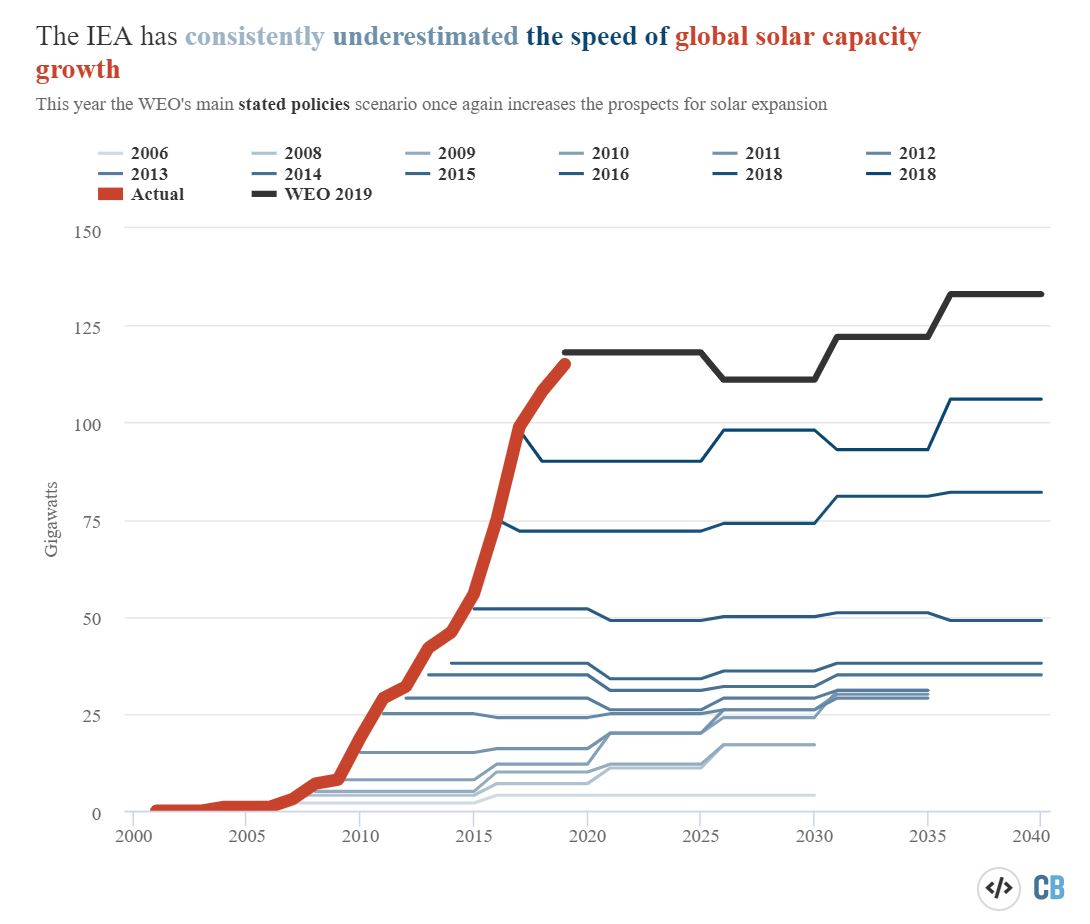
In each of 2006, 2008, 2009, 2010, 2011, 2012, 2013, 2014, 2015, 2016, 2018, the IEA predicted deployment of solar would stop accelerating (line going up) and steady off into consistant growth (flatline on that graph). Every year they have been very quickly wrong, and the 2019 predition of flatline is so wrong that by 2021 actual production of 190GW was WAYYYY off the top of that chart. At this rate we may not need to figure out storage nearly as much as we think.

> "What people have missed is that reaching cost parity on fuel synthesis will unlock huge new demand centers [and trigger an acceleration in demand/investment/research/cost decline of solar created synthetic fuels]."

[1] https://news.ycombinator.com/item?id=32197012 (article rather than comments)

Re:First new U.S. nuclear reactor since 2016 is now in opera... by Gare on Wednesday December 27, 2023 @07:41PM (#38788651)
Sure, if it pans out. I'm all for syngas if it can be produced somewhat efficiently at scale. But right now lithium batteries and hydro are proven technologies that can be utilized. That's the difference.
Re:First new U.S. nuclear reactor since 2016 is now in opera... by galangalalgol on Wednesday December 27, 2023 @08:33PM (#38788952)
If the story I link below is real, synthetic propane could become the standard for energy storage. Extremely efficient production from electricity and direct fuel cells convert it back even more efficiently. Hank Hill would be so proud.

https://news.ycombinator.com/item?id=37218727

Re:First new U.S. nuclear reactor since 2016 is now in opera... by datameta on Wednesday December 27, 2023 @05:42PM (#38787759)
Compression of air in underground cavities

> Hydrostor, which is based in Toronto, is one of several startups working on fixing those problems. The company says it’s figured out a way to capture and reuse the heat generated when air is compressed, eliminating the need to burn gas. It’s also figured out a way to make the mechanics work in areas where caverns must be dug out of hard rock, rather than salt. <

https://www.latimes.com/environment/newsletter/2023-01-12/th...

Re:First new U.S. nuclear reactor since 2016 is now in opera... by zo1 on Wednesday December 27, 2023 @07:38PM (#38788625)
The more I think about it, the more I'm starting to get of the opinion that this entire call or worry about "storage" when it comes to solar is a giant distraction.

This first thing we need to do is align the costs and incentives. What I mean by that is simply allow the market, or government, to dictate the real cost of providing electricity at night. If there are no solar panels (nighttime), and whatever grid-scale batteries are available cost 1$/kwh then so be it, charge that amount to the consumer. People will learn to forego "bathing" in electricity at night endlessly. For decades we've been spoiled with ridiculous "energy on a tap" that just gives us oodles at the flick of a switch, and we just need to take that away.

As a side-effect of this whole "switching off the endless tap", micro-grids are the future. Small communities with mini-grid-scale batteries and sharing of electricity will take over this stupid "national synchronized grid" idea that has gimped our ability to be agile wrt local energy generation.

Re:First new U.S. nuclear reactor since 2016 is now in opera... by smegger001 on Wednesday December 27, 2023 @08:01PM (#38788774)
"People will learn to forego "bathing" in electricity at night endlessly. For decades we've been spoiled with ridiculous "energy on a tap" that just gives us oodles at the flick of a switch, and we just need to take that away."

I take it you live somewhere warm in the winter. We are already looking at removing other heating options like propane and natural gas furnaces, coal and oil heating is mostly phased out, and burning wood isn't great for the environment either. So electrical heating is necessary anywhere where its normal to freeze for several months. Telling people to stop bathing in electricity at night when that what keeps them alive is bullshit.

"micro-grids are the future. Small communities with mini-grid-scale batteries and sharing of electricity will take over this stupid "national synchronized grid" idea that has gimped our ability to be agile wrt local energy generation."

Why don't you ask Texas residents how not being part of the national synchronized grid worked out for them 2 years ago?

Re:First new U.S. nuclear reactor since 2016 is now in opera... by avar on Wednesday December 27, 2023 @08:26PM (#38788918)
It's normal in many very cold places to entirely switch off your heating overnight.

You heat your home up during the day and evening, and as you retire for the night it's switched off. With sufficient insulation and warm bedding you don't need active heating overnight.

So it's absolutely compatible with an electric supply that's heavily biased towards the daytime.

Re:First new U.S. nuclear reactor since 2016 is now in opera... by zo1 on Wednesday December 27, 2023 @08:33PM (#38788959)
As an example, it may start becoming more economical to include heat-batteries (I forget the name) in house construction such that they retain heat and radiate it to maintain a not freezing ambient temperature inside a house. That, along with insulation, and some rather moderate changes to behaviour, could entirely eliminate the need for electricity-use during night time hours. We don't know what ingenious and wonderful things people may do when the real-cost of electricity at night is exposed to them.
Re:First new U.S. nuclear reactor since 2016 is now in opera... by gustavus on Thursday December 28, 2023 @02:01AM (#38790830)
Ya that's a level of unmitigated bull** where I live there is usually several days out of the year where the temperature is -40 (doesn't matter the units at that temperature it's the same) and massive wind chill. There's not really a reasonable way to heat a houseduring the day and have it remain warm with tempratures like that without major changes to the way houses are built.

This seems like the quintessential example of some Cali tech bro nor understanding that there is anyone outside of their little bubble and assui everyone just lives like them.

Re:First new U.S. nuclear reactor since 2016 is now in opera... by defrost on Thursday December 28, 2023 @02:13AM (#38790884)
Perhaps a Cali tech bro, maybe a standard scandanavian in a passive energy house with tight seals, good insulation, triple glazing, large solar heated hot water tank to hold thermal energy during the night, etc.

There are people outside everbodies particular bubbles.

Re:First new U.S. nuclear reactor since 2016 is now in opera... by zo1 on Thursday December 28, 2023 @06:03AM (#38792209)
What percentage of the world's population lives at a place that goes to -40C ever in the year? That's like 0.000001% of the world's population (didn't confirm, thumb sucking).

I think you need to admit, "bro", that you're far from a standard case and that maybe you should suck it up and move to a more hospitable spot instead of forcing the rest of us to subsidize your extreme lifestyle choice at the expense of our environment which we "all" apparently care so much about.

At least I'm suggesting insulation, and alternative methods of heating as opposed to just saying we should chug gigawatts so your butt could be warm at -40C outside.

Re:First new U.S. nuclear reactor since 2016 is now in opera... by jnsaff2 on Thursday December 28, 2023 @02:58AM (#38791105)
The cold places are usually extreme latitudes.

I live around 60 latitude and here during the winter it might not be even that cold (tho it can be -20 or -30C).

It’s that the amount of sunshine and the angle it shines at means that for about 3 months the PV production is essentially zero.

This is during the time the demand is highest.

Re:First new U.S. nuclear reactor since 2016 is now in opera... by zo1 on Wednesday December 27, 2023 @08:24PM (#38788907)
> "Telling people to stop bathing in electricity at night when that what keeps them alive is bullshit."

I never said anything of the sort. You're taking a really bad-faith and extreme straw-man of what I said, and I refuse to participate.

Re:First new U.S. nuclear reactor since 2016 is now in opera... by nicoburns on Thursday December 28, 2023 @04:01AM (#38791486)
Storing heat for a few hours can be done pretty easily and cheaply though. Indeed many houses already have technologies like water tanks and storage heaters that do this.
Re:First new U.S. nuclear reactor since 2016 is now in opera... by Gare on Wednesday December 27, 2023 @07:44PM (#38788668)
Well, for one I (and I presume many other people) would not vote for a platform with such an extremist position.
Re:First new U.S. nuclear reactor since 2016 is now in opera... by chihuahua on Thursday December 28, 2023 @12:22AM (#38790325)
Yes, imagine there was a governor whose position is "at night, everyone will be limited to no more than 100W." The best-case scenario for the governor would be that they're recalled quickly.
Re:First new U.S. nuclear reactor since 2016 is now in opera... by zo1 on Thursday December 28, 2023 @06:38AM (#38792441)
It would be more like "at night (or when there is little solar), you pay progressively more for your electricity." A lot of places do that already, you just do it to a slightly-palatable level instead of to the true cost. Partly because of, as you guys point out it's politically nonviable, but also partly because it's electricity from cheap coal as opposed to green solar + super expensive batteries.
Re:First new U.S. nuclear reactor since 2016 is now in opera... by heavenlyblue on Thursday December 28, 2023 @03:51AM (#38791421)
The future is the macro-grid: use electricity in northern hemisphere while it's summer in the southern hemisphere.

Pardon me, but there's zero future for the micro grids.

Re:First new U.S. nuclear reactor since 2016 is now in opera... by DeathArrow on Thursday December 28, 2023 @04:11AM (#38791534)
>For decades we've been spoiled with ridiculous "energy on a tap" that just gives us oodles at the flick of a switch, and we just need to take that away.

Why shouldn't I be able to have oodles of energy at the flick of a switch?

Why is it bad that people had more than 100 years of using energy at a reasonable price point? Why do you think it's good for the energy to become more expensive or not to be available at all?

We do need energy for everything.

Re:First new U.S. nuclear reactor since 2016 is now in opera... by defrost on Thursday December 28, 2023 @04:18AM (#38791578)
As you're asking, the bulk of the world's population survives with a much lower energy per capita usage than, say, a median US citizen.

For the high energy consumers it's more a perceived need than an actual need.

Further, energy availability appears to work akin to road availability; if you build a six lane highway traffic expands to fill it.

The obvious reason for wanting lower global energy use at this particular point in time is reduce the still increasing by products of energy production, greenhouse gases.

Once the climate parameters return to safer values energy production without those side effects can expand .. while we look at addressing the unwanted toxic by products of our new sources of energy - less greenhouse gases, more acids and waste associated with nickel, copper, lithium, et al.

Re:First new U.S. nuclear reactor since 2016 is now in opera... by tzs on Wednesday December 27, 2023 @05:16PM (#38787470)
> Wind is not reliable

Surface wind is not reliable. I've seen proposals to put turbines on large kites or gliders tethered to the ground. There's pretty much always strong winds over most of the United States somewhere between the surface and 10000 feet.

Re:First new U.S. nuclear reactor since 2016 is now in opera... by wkat4242 on Wednesday December 27, 2023 @06:35PM (#38788210)
Hmm what to do with the torque from the windmill though. Perhaps it could have counter rotating propellers to cancel it out. Otherwise it would entangle itself in the anchoring cable.

Also, a failure scenario would mean tonnes of windmill crashing down from high altitude. Hmmmmm

Re:First new U.S. nuclear reactor since 2016 is now in opera... by tzs on Wednesday December 27, 2023 @07:00PM (#38788392)
> Also, a failure scenario would mean tonnes of windmill crashing down from high altitude. Hmmmm

10000 feet is less than 2 miles. Even in high winds it wouldn't get more than a a couple or miles or so before hitting the ground.

There are plenty of places in the US where you could fly where it would be centered over a 6 mile diameter circle that contains no people or valuable buildings except for people and buildings that are part of the power facility.

Re:First new U.S. nuclear reactor since 2016 is now in opera... by _ph_ on Thursday December 28, 2023 @03:31AM (#38791301)
Nuclear would be the worst technology for filling temporary gaps in the production of renewables. The ramping speed of nuclear reactors is limited, and they cannot be throttled below 40% output without shutting them down entirely for quite some time. On top of that, the main expense of nuclear reactors is building and maintaining them, so throttling a reactor is not reducing the costs. You really want to run a nuclear reactor with a high load.
Re:First new U.S. nuclear reactor since 2016 is now in opera... by champtar on Thursday December 28, 2023 @01:23PM (#38796626)
French NPP can vary their power output 80% up or down in 30 min (https://fr.m.wikipedia.org/wiki/Production_pilotable_d%27%C3...)
Re:First new U.S. nuclear reactor since 2016 is now in opera... by _ph_ on Friday December 29, 2023 @05:26AM (#38803538)
Fine, than they can go a bit lower still. But for a grid mainly powered by renewables, they would have to be able to go all the way down to 0, what is really not a practical option for nuclear reactors.

But there is another catch: nuclear is extremely expensive, even when run most of the time close to 100%. But any time you throttle the reactor, you are driving the costs up. Because most of the costs are in building and operating the reactor, less so in fuel.

Re:First new U.S. nuclear reactor since 2016 is now in opera... by thelastgallon on Wednesday December 27, 2023 @07:07PM (#38788432)
40 million acres are used to grow corn for ethanol. This is 162,000 square kilometers. This can produce 3.24 exajoules of energy.

Also, solar panels don't need any land. There are so many places we can install solar without 'consuming' land. They can be roofs, floating on tops of lakes and reservoirs with the added benefit of preventing evaporation, agrivoltaics combined with farmland, vertical panels, superfund sites, deserts, along the highways, etc.

Re:First new U.S. nuclear reactor since 2016 is now in opera... by rainsford on Wednesday December 27, 2023 @07:24PM (#38788537)
For all the concern about land use for renewables, it really feels like subsidized ethanol has got to be the most wasteful use of energy investment dollars in terms of farmland used and every other possible metric. It's very interesting to think about using that money and land for other energy generation uses.
Re:First new U.S. nuclear reactor since 2016 is now in opera... by rcxdude on Thursday December 28, 2023 @05:32AM (#38792043)
yes, biofuel is a colossally bad idea and it should have been obvious to everyone involved right from the start.
Re:First new U.S. nuclear reactor since 2016 is now in opera... by mlrtime on Thursday December 28, 2023 @09:20AM (#38793703)
One counter point is that these fields can easily be turned into crops to feed the citizens of the country in an emergency. Solar panels not so much. Also, there was already infrastructure in place to easily maintain this energy source.

Not saying this is a reason to keep the subsidies, but I'm sure it made sense at the time.

Re:First new U.S. nuclear reactor since 2016 is now in opera... by burnerburnito on Wednesday December 27, 2023 @06:42PM (#38788257)
>"or more square kilometers of land [...]"

Technically you need to factor in the fact that a nuclear plant can be built relatively near the places where its power will be consumed; some mass of solar power in Nevada is highly inefficient for powering New York or Virginia, even if you built HVDC lines to cut down on total line losses, so you'll need to pick land tracts reasonably near battery banks that would in turn be near cities.

Re:First new U.S. nuclear reactor since 2016 is now in opera... by angiosperm on Wednesday December 27, 2023 @08:58PM (#38789103)
Inventing imaginary problems does not contribute to the discussion. Please use facts.
Re:First new U.S. nuclear reactor since 2016 is now in opera... by stephenr on Wednesday December 27, 2023 @09:19PM (#38789244)
Just as well New York and Virginia have oodles of open ocean right at their doorstep to run multi-gigawatt wind farms I guess huh?
Re:First new U.S. nuclear reactor since 2016 is now in opera... by fastball on Wednesday December 27, 2023 @11:13PM (#38789966)
Wind isn't reliable.
Re:First new U.S. nuclear reactor since 2016 is now in opera... by gustavus on Thursday December 28, 2023 @02:03AM (#38790839)
Yeah and all those people on the other side of the Appalachians can just take a hike, why do they need power anyway. They brought the problem on their selves with their dirty coal mining habits time for them to pay the price.
Re:First new U.S. nuclear reactor since 2016 is now in opera... by stephenr on Thursday December 28, 2023 @02:30AM (#38790971)
The comment I replied to talked about getting power from Nevada to New York. I'm not American so I had to look at a map but it seems like the other side of the Appalachians from New York is... Ohio?

Is there something about Ohio that means they have no atmospheric wind nor natural sunlight?

Re:First new U.S. nuclear reactor since 2016 is now in opera... by Turing_Machine on Wednesday December 27, 2023 @04:42PM (#38787106)
> If we covered an area 10% the size of Arizona in solar panels

And what are the various Friends of Rare Bugs and Small Furry Animals groups doing in the meantime?

I joke, but even I would balk at the environmental impact of that. Certainly it's going to be greater than any equivalent nuclear installation.

> Of which 0.72% is U-235

Fortunately we're not limited to U-235. With breeder reactors, there's enough nuclear fuel to run human civilization for billions-with-a-b of years.

Re:First new U.S. nuclear reactor since 2016 is now in opera... by jodrellblank on Wednesday December 27, 2023 @05:40PM (#38787736)
Cover 4,000 square miles of the USA in surface car parks[1] and that's freedom. Suggest covering 11,000 square miles of desert in solar panels which don't stop land being used for grazing or crop growing or insects or wildlife, and that's environmental distruction that "even" you would balk at.

[1] https://www.archdaily.com/976069/when-5-percent-of-the-unite...

Re:First new U.S. nuclear reactor since 2016 is now in opera... by internetter on Wednesday December 27, 2023 @06:16PM (#38788055)
Speaking of parking lots, it's not a terrible idea (and it's already been done before) to put solar panels above parking lots
Re:First new U.S. nuclear reactor since 2016 is now in opera... by Turing_Machine on Wednesday December 27, 2023 @06:37PM (#38788227)
False dichotomy.

The people who will be screaming about covering the desert with solar panels are exactly the same people who scream about covering the land with car parks.

Exactly.

The only energy source radical environmentalists like is one that exists only in a fantasy. As soon as it starts being built, it becomes evil.

Note that they're already up in arms about windmills killing birds.

Also, covering the desert is definitely going to change the local environment. At a minimum, every joule that goes into the power transmission lines is a joule that will not be available for use by the desert ecosystem.

Re:First new U.S. nuclear reactor since 2016 is now in opera... by angiosperm on Wednesday December 27, 2023 @09:01PM (#38789124)
The desert ecosystem wastes almost all of its incoming joules. The most valuable commodity in a desert is shade.
Re:First new U.S. nuclear reactor since 2016 is now in opera... by Turing_Machine on Thursday December 28, 2023 @12:17AM (#38790303)
If you were a cactus you'd no doubt disagree.
Re:First new U.S. nuclear reactor since 2016 is now in opera... by angiosperm on Thursday December 28, 2023 @02:38PM (#38797603)
And you have discussed this with a cactus? Or are you still just making things up?
Re:First new U.S. nuclear reactor since 2016 is now in opera... by evilos on Wednesday December 27, 2023 @04:56PM (#38787278)
I remember reading some article that said we could offset all of human emissions by painting Vermont stark white or something along those lines.

Covering a desert in solar panels seems like the exact opposite of that plan.

Re:First new U.S. nuclear reactor since 2016 is now in opera... by margalabargala on Wednesday December 27, 2023 @06:51PM (#38788330)
If you ignore all other variables, then of course the situation looks like what one variable would make it do.

Would covering a desert in solar panels cause more thermal solar absorption in that area than would otherwise happen? Yes.

But if we're optimizing for "offsetting the heating effect of human GHG emissions", then installing 4.5TW of solar (about 4x what has been installed worldwide to date) would have a much more positive effect.

The world currently has 1.1TW of solar installed, producing about 6% of all electricity. So our new installation would be on its own capable of supplying 25% of global electricity usage. The corresponding drop in GHG emissions from the shutdown of coal, gas, and oil power plants would far outweigh the fact that part of the desert has been turned black.

Re:First new U.S. nuclear reactor since 2016 is now in opera... by evilos on Wednesday December 27, 2023 @07:00PM (#38788396)
Has this actually been quantified? Earth's albedo is a critical factor in the portion of the sun's energy that is rejected into space, just as GHG incidence in the atmosphere is.

In theory, darkening a portion of the Earth with high albedo (snow, sand) is worse than darkening a portion of the Earth with low albedo (roads, roofs, forest). Then it should be better to use a greener area for solar panels so long as the capacity factors would be similar.

Re:First new U.S. nuclear reactor since 2016 is now in opera... by angiosperm on Wednesday December 27, 2023 @09:02PM (#38789137)
Millions of square kilometers of the arctic are being "darkened" by loss of sea ice. Nothing humans can do can approach even a tiny fraction of that.
Re:First new U.S. nuclear reactor since 2016 is now in opera... by evilos on Thursday December 28, 2023 @05:06AM (#38791896)
Many people would argue that humans did cause this loss of sea ice.

Also I don't see how that justifies adding to the effect? Especially if we don't know can't compute the trade off? I'm sure someone has done that work but my it didn't immediately jump out at me during a cursory search.

Re:First new U.S. nuclear reactor since 2016 is now in opera... by angiosperm on Thursday December 28, 2023 @02:37PM (#38797587)
Just the uncertainty in the ice cover prediction is orders of magnitude larger than any effect from adding any plausible amount of solar panels.

Inventing BS problems does not contribute to the discussion. Please stick to facts.

Re:First new U.S. nuclear reactor since 2016 is now in opera... by evilos on Friday December 29, 2023 @04:46AM (#38803247)
If you don't like discussion what are you doing here?
Re:First new U.S. nuclear reactor since 2016 is now in opera... by pfdietz on Friday December 29, 2023 @10:08AM (#38805719)
> Would covering a desert in solar panels cause more thermal solar absorption in that area than would otherwise happen? Yes.

This depends on the efficiency of the PV modules. When it's greater than the albedo of the desert, it will cool the desert, not warm it. Remember, the electrical energy produced isn't heat. It's turned to heat at the consumer, but that's true of electrical energy from a nuclear plant too. Oh, and did you know that nuclear plants also add 2x as much heat energy in the exhaust of their cooling system?

Re:First new U.S. nuclear reactor since 2016 is now in opera... by fooker on Thursday December 28, 2023 @04:32AM (#38791673)
One kg of Uranium is significantly easier to transport compared to the solar energy obtained in a corner of Arizona or Utah though.
Re:First new U.S. nuclear reactor since 2016 is now in opera... by kortilla on Thursday December 28, 2023 @11:06AM (#38794811)
And what happens when it gets dark? Solar is cheap, storage is not.
Re:First new U.S. nuclear reactor since 2016 is now in opera... by tiffanyg on Wednesday December 27, 2023 @04:25PM (#38786937)
Not unreasonable, but I would point out two options (not the only):

1) "Water batteries" - highly efficient (far more than the 'chemical' you are apparently referring to) & responsive

2) Methods for using 'renewables' to produce &/ support production of chemical fuels - with the added draw / potential goal of 'closing' the 'carbon cycle'

As to #2, one of the ideals that has been kicked around for decades is to do something like: use 'renewables' to sequester CO2 from the atmosphere and convert it into something like butanol, for example.

Now, last I was up-to-date on any of this sort of work (~10+ years ago), the economics were not favorable. Certain types of commodity chemical production with 'biological basis' (another type of renewable, typically) had much more favorable properties economically. And, indeed, you do see, for example, (thermo)plastic products made from chemicals like "PLA" increasingly. But, the "biofuels" concept is / was much more challenging, especially as "fracking" technology made great leaps etc.

Nuclear has its pros and cons - blanket disavowal is fatuous. Nevertheless, there are substantially more options, systems, technologies, etc. in development and production than are often discussed in too many of the pro-nuke(s) / no nuke(s) 'sniping' chains that have been prevalent in society & on the internet since I was a wee tyke myself.

Re:First new U.S. nuclear reactor since 2016 is now in opera... by internetter on Wednesday December 27, 2023 @04:54PM (#38787247)
> use 'renewables' to sequester CO2 from the atmosphere and convert it into something like butanol, for example.

are you referring to P2X? I think P2X is an awesome solution for existing infrastructure, but it's obviously not particularly efficient. I am excited about pumped storage as well, but my fear there is we'll run out of sites, and obviously the 80% efficiency is still not ideal.

By no means am I arguing nuclear is a one size fits all solution.

Re:First new U.S. nuclear reactor since 2016 is now in opera... by concordDance on Wednesday December 27, 2023 @04:58PM (#38787286)
> 1) "Water batteries" - highly efficient (far more than the 'chemical' you are apparently referring to) & responsive

"Highly efficient" is very vague.

What matters here are the numbers:

W/$

J/$

% round trip losses

% losses per hour

Number of cycles before replacement needed

Response time

Do you have them?

Re:First new U.S. nuclear reactor since 2016 is now in opera... by duped on Wednesday December 27, 2023 @04:52PM (#38787224)
The uranium can produce power when it's dark outside, unlike the solar panels. I wouldn't bet against clean energy that can produce on demand. We'll always need it from somewhere.
Re:First new U.S. nuclear reactor since 2016 is now in opera... by wongarsu on Wednesday December 27, 2023 @04:19PM (#38786871)
The US doesn't lack space. But investors like a quick return on investment; meanwhile nuclear reactors only make sense if you bet on high electricity prices for the next ~70 years. The time a nuclear plant spends on construction and decommissioning is about the same as the total lifetime of a solar installation.
Re:First new U.S. nuclear reactor since 2016 is now in opera... by smegger001 on Wednesday December 27, 2023 @08:13PM (#38788843)
How about recognizing that externalities of letting corporations do whats best for their own short term profits are costly to society, and that having safe cheap constant power is a social good that makes having government run nuclear power be a good idea. how about we not let the same people that have spent the last 50 years knowingly destroy the environment and hide their culpability be the ones to make the decision.

how about we as a society finally fulfill the promise of power to cheap to meter that we were told back in nuclears golden age before the carbon industry start the smear campaign against nuclear.

Re:First new U.S. nuclear reactor since 2016 is now in opera... by RcouF1uZ4gsC on Wednesday December 27, 2023 @09:58PM (#38789496)
> before the carbon industry start the smear campaign against nuclear.

The environmental Greens had a lot to do with the smear. Even recently, they were the ones who pushed for the shutdown of German nuclear power which ended up increasing German CO2 output.

Re:First new U.S. nuclear reactor since 2016 is now in opera... by ikt on Thursday December 28, 2023 @12:52AM (#38790483)
> which ended up increasing German CO2 output.

That's temporary, soon that will go back down again

Re:First new U.S. nuclear reactor since 2016 is now in opera... by _ph_ on Thursday December 28, 2023 @03:45AM (#38791390)
No need for pushing as the coalition of CDU/CSU and FDP had decided to shut down the reactors in Germany and had set the date.
Re:First new U.S. nuclear reactor since 2016 is now in opera... by hef19898 on Thursday December 28, 2023 @05:02AM (#38791860)
That's true. And it was Green ministers that pushed to keep the last German NPPS running longer, as long as possible. It was also the Greens who sent the first German troops abroad under NATO mandates, so one can say tge reputation of the Greens is not always matched by their actions. They are very easy scape goats so.
Re:First new U.S. nuclear reactor since 2016 is now in opera... by otherme123 on Thursday December 28, 2023 @03:58AM (#38791463)
Nuclear has a lot of externalities (residues, security, financing... usually paid and supported by others). You talk about nuclear like it was a small enterprise, when it's the very definition of "greedy corporation".

It's funny-and-sad to see the old behemoth of nuclear power begging for government support as they last chance to be alive.

Re:First new U.S. nuclear reactor since 2016 is now in opera... by smegger001 on Thursday December 28, 2023 @12:41PM (#38796033)
On the contary i dont think businesses big or small should do it I think the government should do it as a public good. Free carbonless energy for the people.
Re:First new U.S. nuclear reactor since 2016 is now in opera... by cool_dude85 on Wednesday December 27, 2023 @04:28PM (#38786968)
Nuclear is baseload and is the exact opposite of "instantly fired up". Best tech for that is gas or battery.
Re:First new U.S. nuclear reactor since 2016 is now in opera... by ggm on Wednesday December 27, 2023 @04:55PM (#38787259)
There is a line of reasoning that baseload is a billing and profit construction, an artifice of the needs of coal-fired and nuclear power.

There is nothing innately wrong with over building renewable and storage, and a transmission network.

It's an argument about economics, not physics.

Re:First new U.S. nuclear reactor since 2016 is now in opera... by jodrellblank on Wednesday December 27, 2023 @05:48PM (#38787805)
Can you realistically overbuild solar and wind in a way that works in winter? Here's Terence Eden in the UK, and his graph of rooftop solar[1] showing peak around 400kWh/month in summer and trough around 50kWh/month in darkest December - that's a difference of ~8x which might be possible...

But that's averaged over the month, what about a run of December days with heavy cloud cover, misty foggy atmosphere, still air, maybe some Icelandic volcano soot in the atmosphere, what's the worst we'd have to plan for, and how much overprovisioning would that take?

[1] https://shkspr.mobi/blog/2013/02/solar-update/

Re:First new U.S. nuclear reactor since 2016 is now in opera... by edent on Wednesday December 27, 2023 @06:10PM (#38788001)
FWIW I have updated stats at https://shkspr.mobi/blog/2023/04/3-years-of-domestic-solar-s...

They're also published as open data.

The dark and dreary days tend to be the ones with the most wind power. The tides around our coast are in constant motion.

But, the big challenge is still storage. Domestic solar panels provide 100% of our yearly electricity use. At the moment I can only store 4.8kWh of excess.

So we need to over provision and over store - hopefully both at the same time.

Re:First new U.S. nuclear reactor since 2016 is now in opera... by ViewTrick1002 on Wednesday December 27, 2023 @07:36PM (#38788606)
Wind is anticorrelated to sun and stronger in the north.

https://globalwindatlas.info/en

Re:First new U.S. nuclear reactor since 2016 is now in opera... by ggm on Wednesday December 27, 2023 @06:13PM (#38788023)
Re:First new U.S. nuclear reactor since 2016 is now in opera... by ZeroGravitas on Thursday December 28, 2023 @06:29AM (#38792380)
In the UK, given it's northern latitude and great wind resources, you'd be best overbuilding mostly wind.

Here's a worked example based on real weather data that suggests a wind capacity of double peak demand and converting about 8% of all demand with power-to-X would be the the low cost option.

https://www.wartsila.com/energy/towards-100-renewable-energy...

Re:First new U.S. nuclear reactor since 2016 is now in opera... by cool_dude85 on Wednesday December 27, 2023 @07:21PM (#38788518)
That's absolutely true, but the economic argument still carries weight. How many acres of land, how many rare earth minerals, etc. are required to produce the load profile you need with batteries and renewables vs including baseload flat generation from nuclear? This is still an economic question but very relevant.
Re:First new U.S. nuclear reactor since 2016 is now in opera... by angiosperm on Wednesday December 27, 2023 @09:11PM (#38789197)
Literally no "rare earth minerals" are used in production of solar or batteries. Exactly zero.
Re:First new U.S. nuclear reactor since 2016 is now in opera... by pfdietz on Friday December 29, 2023 @10:14AM (#38805793)
Nor in wind turbines, if you don't use permanent magnet generators.
Re:First new U.S. nuclear reactor since 2016 is now in opera... by tonyhb on Wednesday December 27, 2023 @04:33PM (#38787011)
Cant control rods can be lifted or inserted to meet demand?
Re:First new U.S. nuclear reactor since 2016 is now in opera... by cool_dude85 on Wednesday December 27, 2023 @04:34PM (#38787031)
There's typically a range of operation, so you can adjust a hundred MW but you can't drop to 0 or spin up from standstill without a time consuming process.

Edit: also, the economics are such that you rarely want to drop load from a nuclear plant unless it's offline or for system reasons. The fuel cost is negligible so you'd rather turn off your gas plant or lower the coal plant and save on those fuels.

Re:First new U.S. nuclear reactor since 2016 is now in opera... by belorn on Wednesday December 27, 2023 @04:56PM (#38787277)
That assume we still allow coal, oil or gas power plant to exist in the power grid. We should probably not assume that to be the case, especially after the temperatures rises to a break point and some of the major climate change crisis occurs.
Re:First new U.S. nuclear reactor since 2016 is now in opera... by xorcist on Wednesday December 27, 2023 @06:31PM (#38788175)
None of the commercially available (Western) reactor designs today are fast load followers, so you are dependent on having gas or hydro when you project for new nuclear power plants. That's one part of the reason why this stuff is politically charged.

From what I understand it's not a theoretical constraint, but mostly a lack of enough commercial interest for any other design. But it is what it is.

Re:First new U.S. nuclear reactor since 2016 is now in opera... by throw0101b on Wednesday December 27, 2023 @04:55PM (#38787264)
> Cant control rods can be lifted or inserted to meet demand?

Thermally it is difficult to dial a reactor up and down. Generally the way nuclear power is modified is by not-sending the steam to generators through a by-pass and quenching their heat in some fashion.

So thermal generation stays at 100% (or whatever), but electrical generation output can be dropped.

Re:First new U.S. nuclear reactor since 2016 is now in opera... by delroth on Wednesday December 27, 2023 @07:09PM (#38788446)
Usually you'd vary the concentration of boric acid being injected in the reactor's core instead, since that doesn't involve wear and tear on safety-critical elements of the reactor.

Nuclear reactors absolutely can vary their output to match demand, this is what France has been doing for 50+ years (and what Germany was doing before switching back to coal). It's not as reactive as coal/gas, but you can still vary within 30-100% of output power at a speed of 5% change per minute. Way more than enough to react to 1-day-ahead forecasted supply/demand, and way more than enough to react minute-by-minute if you've got a tiny bit of storage to stabilize the grid's frequency (e.g. pumped hydro).

Re:First new U.S. nuclear reactor since 2016 is now in opera... by ViewTrick1002 on Wednesday December 27, 2023 @07:39PM (#38788637)
It is a hugely complicated system where reactors which are earlier in their fuel cycle ramp more leaving the later ones to run at 100% around the clock.

Ramping once is easy. Ramping continuously through the entire fuel cycle requires a meticulously planned fleet.

Re:First new U.S. nuclear reactor since 2016 is now in opera... by _ph_ on Thursday December 28, 2023 @03:51AM (#38791427)
France is balancing their reactors with a massive amount of water power, so they are not doing it alone on the reactor side. But I think France is indeed one of the countries with the highest relative amount of nuclear in the grid. Germany went never over 30% nuclear in the mix, so demand matching was way less of a problem. But also, both countries tried to make demand mostly constant like with pushing inefficient heating systems which would consume electricity at night.

This is very far off from working well together with a mostly renewable grid, where renewables can cover 100% of the load on most days, but there are larger gaps to be quickly filled.

Re:First new U.S. nuclear reactor since 2016 is now in opera... by mpweiher on Wednesday December 27, 2023 @06:15PM (#38788039)
They can, though it depends a little on the plant design.

It just doesn't make any sense to use reliable nuclear as the "backup" to unreliable renewables.

Because this "backup" is already CO2 free. It is also reliable. And cheap to run. So just run it all the time (nuclear tends to have >90% capacity factor).

You then simply don't need the "primary".

Re:First new U.S. nuclear reactor since 2016 is now in opera... by angiosperm on Wednesday December 27, 2023 @09:13PM (#38789211)
A nuke operated at 50% of capacity costs the same as one operating at 100%. Thus, power from it at 50% costs twice as much per kWh. But nukes are already not competitive even at 100%, and get less so with each passing day.
Re:First new U.S. nuclear reactor since 2016 is now in opera... by adonovan on Wednesday December 27, 2023 @04:11PM (#38786788)
Perhaps I fail to understand, but doesn't this comparison depend on a number of parameters such as the total reactor fuel load and enrichment, the burn rate, the cost of nuclear fuel, the cost of solar PV, the lifetimes of each system, and the relative process efficiencies (notably the cost of decommissioning nuclear)?

Otherwise you might as well say a teaspoon (or whatever) of water has as much potential fusion energy as 1 Kg U235 at a fraction of the price. ;-)

Re:First new U.S. nuclear reactor since 2016 is now in opera... by internetter on Wednesday December 27, 2023 @04:46PM (#38787159)
Yes, the amount of estimations I made to get to that number is absurd, and very much "best case" with no regard for inefficiencies (both nuclear and solar systems are currently leaving lots on the table).
Re:First new U.S. nuclear reactor since 2016 is now in opera... by credit_guy on Wednesday December 27, 2023 @04:49PM (#38787188)
Small nitpick: one teaspoon of water has much less potential fusion energy than 1 kg of U235, and actually much much less than 1g of U235, even allowing for fusion technology that does not exist and will not exist in 50 years.

Here's why.

The Sun transforms hydrogen into helium. But that's a fairly complex chain and nobody in the industry or academia is trying to replicate that.

When people talk about fusion, here's [1] the reactions they are considering.

The best yielding fusion reaction is deuterium-tritium and deuterium-helium3 [1]. Tritium and helium-3 virtually don't occur naturally on Earth, and deuterium is very rare, at about 0.02% of the hydrogen. A teaspoon of water contains about 0.5 grams of hydrogen, and out of that about 0.0001 grams of deuterium. Let's say that someone magically brings the necessary tritium or helium-3. How does that compare with 1 gram of U235?

The fission of 1 nucleus of U235 yields about 190 MeV of energy. 1 MeV is one megaelectronvolt, and is a unit of energy. It does not matter how it translates into joules or watt-hours. It is the unit used when talking about fission and fusion. So, 235 nucleons produce 190 MeV, which is about 0.8 MeV per nucleon.

The two reactions mentioned involve 5 nucleons and yield about 18 MeV, which means 3.6 MeV per nucleon or 4.5 times more per nucleon than U235.

So, even if all the hydrogen in the one teaspoon of water was Deuterium and Tritium, in the correct ratios to do the fusion, we'd get only 4.5 times more energy than from one gram of U235. In reality, from one teaspoon of water we'd extract a very tiny amount of deuterium that's usable, and we'd need to breed Tritium or Helium-3 separately. By the way, separating deuterium from water is a very expensive process. The Nazis tried to do it during WW2, and they were doing it in Norway. Once the British special forces destroyed the plant, the Nazis could not restart the heavy water production, and their atomic project basically stopped then and there.

[1] https://en.wikipedia.org/wiki/Nuclear_fusion#Criteria_and_ca...

Re:First new U.S. nuclear reactor since 2016 is now in opera... by echelon on Wednesday December 27, 2023 @04:10PM (#38786775)
We need two things:

- More energy

- Energy diversification

That includes nuclear, solar, and even more fossil fuels as we wean ourselves off of them.

Writing off any form of energy is ideological, not practical.

Re:First new U.S. nuclear reactor since 2016 is now in opera... by internetter on Wednesday December 27, 2023 @04:48PM (#38787175)
Agreed minus the fossil fuels bit. It's my belief we should not further scale that infrastructure.
Re:First new U.S. nuclear reactor since 2016 is now in opera... by est31 on Wednesday December 27, 2023 @05:11PM (#38787432)
> One kilogram of uranium-235 (50 cm^3) can theoretically produce about 20 terajoules of energy.

That's missing the huge and expensive nuclear power plant around that kilogram of uranium.

If you don't account for the conversion device (for which solar is cheaper per GJ than nuclear power plants), then light is a much better medium: assuming 15% efficiency, which is a conservative estimate, solar panels can convert one kilogram of solar light (remember e=mc^2) into 13.5 terajoules of electricity.

https://www.wolframalpha.com/input?i=1+kg+*+c%5E2+*+15%25+in...

The sun bombards our planet with around 61 metric tons of light per day:

https://www.wolframalpha.com/input?i=2+*+pi+*+radius+of+eart...

Where the 6 kwh/m^2 come from: https://en.wikipedia.org/wiki/Solar_irradiance#Irradiance_on...

Re:First new U.S. nuclear reactor since 2016 is now in opera... by apatheticonion on Wednesday December 27, 2023 @06:09PM (#38787995)
I'm curious how the numbers stack up of completed plants - but I am not very good at math and don't have a great understanding of electricity units, especially at the grid scale and big numbers.

Any chance you could help compare the construction cost of this nuclear plant to another recently constructed solar or wind farm measured against... I guess capacity?

Given the intermittent nature of solar/wind, does capacity even make sense to compare in a context without supporting batteries?

I'll give it a shot but I am probably super wrong.

** Nuclear:

I'll use the plant from the article https://en.wikipedia.org/wiki/Vogtle_Electric_Generating_Pla...

Construction costs 18b USD (does that include loans?)

Nameplate capacity of 2302MW

Used capacity is 91% so 2094MW

$18b / nameplate capacity = $7.8 USD per rated W

$18b / used capacity = $8.60 per realized W

** Solar (excluding batteries):

I picked a relatively large, recent, US based solar farm from the list of plants in wikipedia

Agua Caliente Solar Project (2016) https://en.wikipedia.org/wiki/Agua_Caliente_Solar_Project

Construction costs 1.8b USD

Nameplate capacity of 290 MW

Used capacity is 28% so 81 MW

$1.8b / nameplate capacity = $6.2 USD per rated W

$1.8b / used capacity = $22 USD per realized W (that can't be right?)

** Note:

I don't know if my math is right, I don't know if the costs factor in loans, also the nameplate capacity for the nuclear plant is MWe and the solar plant is MWac so I am unsure how that works out.

Re:First new U.S. nuclear reactor since 2016 is now in opera... by est31 on Wednesday December 27, 2023 @08:38PM (#38788984)
> I picked a relatively large, recent, US based solar farm from the list of plants in wikipedia

> Agua Caliente Solar Project (2016)

Note that solar being cheaper than nuclear is a more recent phenomenon than 2016. The solar panel prices went from $0.63 to $0.26 in the time span between 2016 and 2022.

https://ourworldindata.org/grapher/solar-pv-prices?time=2002...

A better example is Spotsylvania Solar/Highlander Solar: https://www.sheppardmullin.com/assets/htmldocuments/PFI%2020...

Construction costs: $905m USD

Nameplate capacity: 618 MW

I couldn't find used capacity factors but Yuma is one of the sunniest counties in the USA while Spotsylvania county is further north and also has less sunny days. With an assumed capacity factor of 18%, one gets 111 MW.

$905m / nameplate capacity = $1.48 USD per rated W

$905m / used capacity = $8.24 USD per realized W

Re:First new U.S. nuclear reactor since 2016 is now in opera... by xbmcuser on Wednesday December 27, 2023 @09:33PM (#38789328)
This year alone prices for solar panels have dropped by 30-40%. The biggest reason for prices not dropping for solar farms/large scale solar at the moment is that the supply of other equipment needed like transformers etc can't meet the demand with delivery times having reached 2+ years. So the prices for solar will likely drop another 40%-50% in the next 2-3 years at least in the rest of the world maybe not in the US because of trade wars/restrictions.
Re:First new U.S. nuclear reactor since 2016 is now in opera... by surfaceofthesun on Wednesday December 27, 2023 @07:26PM (#38788541)
Using Solar Star as another datapoint [1]. 579 MWac x 32.8% capacity factor ≈ 190.

I found mention of a bond issuance and someone purchasing the project here [2]. If it’s $1b, then it’s $5.26. If $2b then $10.53.

So they’re in the same ballpark. But one type of plant runs 20-30 years and the other for 50-80 years @ 90% capacity factor. The CANDU reactors are especially cool in that they can use natural uranium and refueled without a shutdown [3].

—- [1] - https://en.m.wikipedia.org/wiki/Solar_Star [2] - https://www.sustainablebusiness.com/2013/06/1-billion-bond-o... [3] - https://energyeducation.ca/encyclopedia/On-line_refueling_of...

Re:First new U.S. nuclear reactor since 2016 is now in opera... by hef19898 on Wednesday December 27, 2023 @08:20PM (#38788889)
One thing you didn't include: Opex, a solar farm is pretty low maintenance and requires zero fuel. A NPP is the opposite.
Re:First new U.S. nuclear reactor since 2016 is now in opera... by apatheticonion on Wednesday December 27, 2023 @08:45PM (#38789035)
That's fair, I wonder if there are numbers on running costs.

I'm certain nuclear running costs would dwarf solar - I think solar just needs fresh water, cleaning and hardware maintenance (replacing inverters, and such).

Would be interesting to work the running costs into the "$ per realized W" calculation.

I'd also like to see how battery-backed solar compares. I assume the objective would be to solve the intermittency issue, but I am hopeful it would increase the capacity factor as well.

Another thing that's interesting to consider is multi-purpose energy utilization you get with nuclear - like desalination and hydrogen generation - though the latter is uneconomical because hydrogen produced from fossil fuels is much cheaper.

Re:First new U.S. nuclear reactor since 2016 is now in opera... by hef19898 on Wednesday December 27, 2023 @08:54PM (#38789080)
Had to dig in my comments, but there you go:

https://news.ycombinator.com/item?id=38303819

Self citing:

Better not use biased opinion pieces, when there numbers from government sources (US, but eho cares):

LCOE (total, incl. CAPEX, in USD per MWh):

coal 82.6, combined cycle 39.9, advanced nuclear 81.7, geothermal 37.6, biomass 90.1, onshore wind 40, offshore wind (that one was a surprise, since offshore wind should be quite cheap, mainly driven by capital cost of 104 USD per MWh) 105, solar 33.8, solar hybrid 49 and hydro 64.

Variable cost (same as above):

coal 23.7, combined cycle 27.7, adv. nuclear 10.3, geothermal 1.2, biomass 30, onshore wind 0, offshore wind 0, solar 0, solar hybrid 0, hydro 4.1

All number from here:

https://www.eia.gov/outlooks/aeo/pdf/electricity_generation...., page 9.

Re:First new U.S. nuclear reactor since 2016 is now in opera... by ametrau on Saturday December 30, 2023 @09:44PM (#38821298)
Does the solar figure include the batteries?

It is very sad that nuclear is actually cheaper than coal.

Re:First new U.S. nuclear reactor since 2016 is now in opera... by datameta on Wednesday December 27, 2023 @05:15PM (#38787463)
Hey thanks for adding links to formulas. Great use of wolfram alpha imo.
Re:First new U.S. nuclear reactor since 2016 is now in opera... by mixdup on Thursday December 28, 2023 @12:46PM (#38796099)
>That's missing the huge and expensive nuclear power plant around that kilogram of uranium.

Whereas I think you are missing the huge and expensive battery array for solar to be useful outside of peak times? And the fact that the best sites for solar are far away from the transmission network?

Re:First new U.S. nuclear reactor since 2016 is now in opera... by pfdietz on Friday December 29, 2023 @10:12AM (#38805769)
You dropped a decimal point. The 1 kg of sunlight at 15% efficiency produces 13.5 petajoules of electricity.
Re:First new U.S. nuclear reactor since 2016 is now in opera... by sandworm101 on Wednesday December 27, 2023 @05:38PM (#38787705)
But remember that a square kilometer of solar panels needs maybe ten square kilometers of actual land. Anywhere other than at the equator, the panels need to be spaced far enough apart not to shadow each other. On a north-facing slop they would be even more spaced out. Do that in two dimensions, so they can track the sun, and keeping one square meter of panels perpendicular to the sun requires a suprisingly large footprint.

And trees. Clearcutting forests to make room for a solar panels just seems wrong, a Captain Planet style of evil. There are all sorts of places where the terrain just isnt suited.

Re:First new U.S. nuclear reactor since 2016 is now in opera... by mminer237 on Wednesday December 27, 2023 @06:42PM (#38788264)
It's not 10x. The optimal ground coverage ratio in the South even for tracking panels is like 30%: https://www.sciencedirect.com/science/article/pii/S0038092X2...

Most of the US isn't wooded. I don't think a significant number of projects propose clear-cutting to build solar farms. I don't know where that came from.

Re:First new U.S. nuclear reactor since 2016 is now in opera... by sandworm101 on Wednesday December 27, 2023 @06:46PM (#38788297)
Try where i am, the pacific northwest. Its all mountains and trees. Large solar farms are always tricky, even residential rooftop solar often runs into issues with trees.
Re:First new U.S. nuclear reactor since 2016 is now in opera... by hn_throwaway_99 on Wednesday December 27, 2023 @07:33PM (#38788585)
If only it were possible to transmit electricity from one place to another...

Seriously, while a lot has been written about the need to update the grid and install more long distance transmission lines to support renewables, even with the current grid it makes much more sense to install wind and solar in locations where it is more efficient and then transmit the electricity elsewhere. In Texas, most of the wind farms are in West Texas hundreds of miles away from Houston, for example.

Re:First new U.S. nuclear reactor since 2016 is now in opera... by throwaway2037 on Thursday December 28, 2023 @02:11AM (#38790875)
This might be a controversial opinion: In many cases, it might be reasonable to clear cut 10 sq km for solar power. Pacific Northwest is enormous. There is plenty of undeveloped land that can be used for solar power. To be clear: I am not suggesting "cut down all of the tree for solar". I am saying: Choose 1/5/10 sq km plots, clear cut them, and install solar power. Ten to one hundred of these in the region would have minimal environmental impact, but very large impact to reduce use of hydrocarbons for electricity production.
Re:First new U.S. nuclear reactor since 2016 is now in opera... by _ph_ on Thursday December 28, 2023 @03:59AM (#38791471)
Then you probably shouldn't build large solar farms. Leaves still a huge amount of area open on top of roofs, parking lots, streets which could be used for solar without cutting down a single tree. Though it somehow didn't prevent those roads and houses to be build :p And while I don't like cutting down trees, just fire protection - and that gets an even larger topic in the future - should tell you to cut down trees directly around houses, so rooftop solar should be possible in most places.

But the thing is: the pacific northwest should be ideal for wind power. So that would be the main emphasis. And then build a high power line to Nevada. Which delivers solar to the northwest and in the nights wind power to Nevada.

Germany already has a 1.4GW powerline to Norway operational, where we network the grid to optimize renewable utilization.

Re:First new U.S. nuclear reactor since 2016 is now in opera... by ceejayoz on Wednesday December 27, 2023 @05:54PM (#38787875)
Good thing that cube of uranium doesn’t need any extra space around it! We can just line them all up next to each other. Criticality accident? What’s that?

Clear cutting forest to put in solar isn’t likely to be cost-efficient. There’s plenty of shitty desert and mountainside land available.

Re:First new U.S. nuclear reactor since 2016 is now in opera... by angiosperm on Wednesday December 27, 2023 @09:09PM (#38789184)
Nobody builds solar farms on "north-facing slopes". Nobody is making solar panels "track the sun". Nobody even proposes "clearcutting forests" for solar farms. Trolling is in strict violation of site guidelines.
Re:First new U.S. nuclear reactor since 2016 is now in opera... by cesarb on Wednesday December 27, 2023 @10:02PM (#38789514)
> Nobody is making solar panels "track the sun".

It's very common for utility-scale solar to use single-axis trackers (the panels move from pointing east to pointing west through the day), unlike small-scale solar which usually has fixed panels (normally pointing south or north depending on which hemisphere you're on). The gain from single-axis trackers is high enough and their cost is low enough (a single geared motor can move a whole row of panels) to make it cost-effective.

(I haven't, so far, seen any large photovoltaic solar power plant which uses two-axis trackers to really track the sun; but thermal solar power plants with a central tower need these two-axis trackers to aim each mirror at the correct angle.)

Re:First new U.S. nuclear reactor since 2016 is now in opera... by _ph_ on Thursday December 28, 2023 @03:53AM (#38791437)
I think trackers are a thing of the past. The cost of solar panels has sunken so low, they come essentially for free in installations. A tracker would be way to expensive. Here in Germany, people even start covering north-facing roofs with solar, and of course even walls and fences, if they are roughly in the right direction.
Re:First new U.S. nuclear reactor since 2016 is now in opera... by Lendal on Wednesday December 27, 2023 @10:01PM (#38789512)
Well, actually Florida (FPL) along I-10 is right now constructing new solar farms where there used to be forests. I'm not sure if what they did with the trees constitutes "clear cutting" but the solar panels are there now, and the trees are not. I've driven the route for many years. It was all forested.
Re:First new U.S. nuclear reactor since 2016 is now in opera... by throwaway2037 on Thursday December 28, 2023 @02:12AM (#38790879)
Do you know if those forests were professionally managed for paper production? It might be private land, and it very likely legal.
Re:First new U.S. nuclear reactor since 2016 is now in opera... by Lendal on Friday December 29, 2023 @01:05PM (#38808107)
True. There isn't any actual untouched forest land in north Florida. It's all been harvested and replanted many times. Almost certainly it was private sale or leased land. But those farm trees still produced more oxygen and stored more carbon than the solar panels will.
Re:First new U.S. nuclear reactor since 2016 is now in opera... by throwaway2037 on Thursday January 04, 2024 @10:29AM (#38868114)
> But those farm trees still produced more oxygen and stored more carbon than the solar panels will.

If those solar panels replace a coal fired power plant, is that still true? I am unsure.

Re:First new U.S. nuclear reactor since 2016 is now in opera... by spinach on Wednesday December 27, 2023 @10:18PM (#38789613)
I'm not sure about the other things but sun tracking tech for solar panels has been around for a long time and it's trivially easy to find through a search, such as [1].

"But there are also other ways to boost the energy production of solar panels – such as by tilting them to follow the Sun's path in the sky, similar to the way young sunflowers follow the sun from east to west during the day. Tracking technology, which is already in use on some land based solar arrays, helps increase the overall electricity production, as the panels constantly adjust to face the Sun."

1) www.bbc.com/future/article/20221116-the-floating-solar-panels-that-track-the-sun

Re:First new U.S. nuclear reactor since 2016 is now in opera... by sandworm101 on Thursday December 28, 2023 @06:33AM (#38792399)
Trackers are necessary if someone is doing math based on panels perpendicular to the sun. Of course they are rare, but are needed when doing the conversion. Whether the tracked pannel cast shadow, or more panels recieve less-than-direct sunlight, the math is the same.
Re:First new U.S. nuclear reactor since 2016 is now in opera... by angiosperm on Thursday December 28, 2023 @02:35PM (#38797567)
And it is all irrelevant. There is an absolute overabundance of pasture land, so spacing panels out so the grass can grow between and under causes no difficulty.
Re:First new U.S. nuclear reactor since 2016 is now in opera... by shwouchk on Wednesday December 27, 2023 @05:38PM (#38787706)
One interesting point that I think is often missed, is that solar and wind produce energy roughly at an anticadence to each other and so storage is of significantly less of a requirement than one might imagine.
Re:First new U.S. nuclear reactor since 2016 is now in opera... by ericd on Wednesday December 27, 2023 @06:54PM (#38788352)
Can we not overbuild solar and wind such that the troughs are nearly good enough, combined with high voltage cross-regional transmission lines, and limited storage for buffer? Solar panels are absurdly cheap, and the world has a lot of equatorial desert.
Re:First new U.S. nuclear reactor since 2016 is now in opera... by angiosperm on Wednesday December 27, 2023 @09:19PM (#38789243)
Yes, we can, and will do. Solar is so cheap that 4x overbuild is still cheaper than nukes, and cost is still plummeting.
Re:First new U.S. nuclear reactor since 2016 is now in opera... by asylteltine on Wednesday December 27, 2023 @07:17PM (#38788493)
Nuclear is the way forward. It’s a damn shame hippies stopped us from leveraging it. We literally wouldn’t have climate change if we kept increasing nuclear power plants in the 70s. It’s just a no brainer. Solar and wind are great but the amount of power they generate may as well be 0 compared to nuclear.
Re:First new U.S. nuclear reactor since 2016 is now in opera... by Faaak on Thursday December 28, 2023 @01:56AM (#38790809)
> We literally wouldn’t have climate change if we kept increasing nuclear power plants in the 70s

I highly doubt this

Re:First new U.S. nuclear reactor since 2016 is now in opera... by asylteltine on Thursday December 28, 2023 @12:01PM (#38795520)
Methane and coal is the largest driver of climate change
Re:First new U.S. nuclear reactor since 2016 is now in opera... by simplyluke on Thursday December 28, 2023 @10:19AM (#38794213)
> Solar and wind are great but the amount of power they generate may as well be 0 compared to nuclear.

This is very untrue both measured in absolute numbers, and in cost/kwh. Nuclear is 2x solar and wind, both of which are decreasing in cost rapidly YoY. https://www.statista.com/statistics/194327/estimated-leveliz...

Re:First new U.S. nuclear reactor since 2016 is now in opera... by ken47 on Wednesday December 27, 2023 @09:52PM (#38789457)
You're comparing a one-time-use resource in U235 vs. the land required for a solar plant, which will last indefinitely for all intents and purposes. Adding the "in a day" constraint is quite misleading in your comment when that is not the long-term limiting factor.

Let's not forget that the externalities of nuclear power are generally much more costly than solar / wind.

Re:First new U.S. nuclear reactor since 2016 is now in opera... by nojvek on Wednesday December 27, 2023 @10:55PM (#38789846)
We need to move away from coal as soon as we can. Coal is worst CO2 pollutant and not that energy dense.

Move to a mixture of wind, solar, geothermal, hydro, nuclear - whatever makes sense.

When the last coal powered plant is shut off in US, we should celebrate that as a day off for everyone.

Re:First new U.S. nuclear reactor since 2016 is now in opera... by AtlasBarfed on Wednesday December 27, 2023 @11:14PM (#38789973)
Have you seen the Lazard lcoe numbers? Nukes are 6x more expensive than wind solar.

And wind and especially solar have more economies of scale and materials research to make them even cheaper.

This comes from a LFTR fanboy. Boy howdy do I wish economical nuclear existed. But 6x as expensive? That ain't all red tape.

I think of course that LFTR has a path to cheaper nuclear with breeding and near waste elimination, full fuel use, safety, and scalability. But I don't think it will ever beat solar, especially once mature multifunction silicon perovskite cells or something like that and salt water batteries develop.

I hope to be proven wrong.nyclest power is so cool.