I think what you mean is that wind alone is not baseload, not that it is unreliable. It is quite reliable in that its availability is predictable such that it can be coordinated with storage to create virtual baseload. Therefore its failure modes are relatively mild in impact.
In contrast, large centralized plants (whether combustion or nuclear) have far more consequential failure modes - for example, losing 1GW of power with little notice, as can happen with these plants, is usually a grid emergency event.
This is a linked graph of solar growth compared to International Energy Agency's World Energy Outlook predictions: https://rameznaam.com/wp-content/uploads/2020/05/IEA-Solar-G...
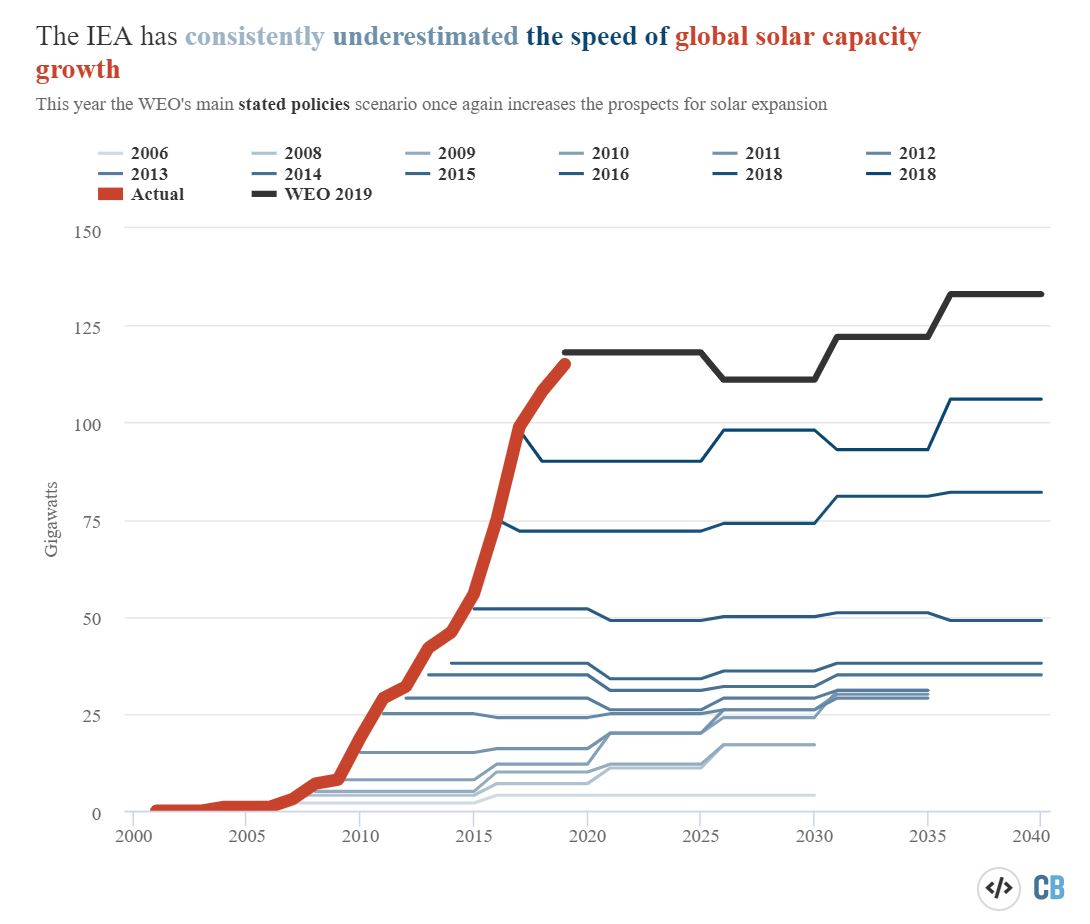
In each of 2006, 2008, 2009, 2010, 2011, 2012, 2013, 2014, 2015, 2016, 2018, the IEA predicted deployment of solar would stop accelerating (line going up) and steady off into consistant growth (flatline on that graph). Every year they have been very quickly wrong, and the 2019 predition of flatline is so wrong that by 2021 actual production of 190GW was WAYYYY off the top of that chart. At this rate we may not need to figure out storage nearly as much as we think.
> "What people have missed is that reaching cost parity on fuel synthesis will unlock huge new demand centers [and trigger an acceleration in demand/investment/research/cost decline of solar created synthetic fuels]."
[1] https://news.ycombinator.com/item?id=32197012 (article rather than comments)
> Hydrostor, which is based in Toronto, is one of several startups working on fixing those problems. The company says it’s figured out a way to capture and reuse the heat generated when air is compressed, eliminating the need to burn gas. It’s also figured out a way to make the mechanics work in areas where caverns must be dug out of hard rock, rather than salt. <
https://www.latimes.com/environment/newsletter/2023-01-12/th...
This first thing we need to do is align the costs and incentives. What I mean by that is simply allow the market, or government, to dictate the real cost of providing electricity at night. If there are no solar panels (nighttime), and whatever grid-scale batteries are available cost 1$/kwh then so be it, charge that amount to the consumer. People will learn to forego "bathing" in electricity at night endlessly. For decades we've been spoiled with ridiculous "energy on a tap" that just gives us oodles at the flick of a switch, and we just need to take that away.
As a side-effect of this whole "switching off the endless tap", micro-grids are the future. Small communities with mini-grid-scale batteries and sharing of electricity will take over this stupid "national synchronized grid" idea that has gimped our ability to be agile wrt local energy generation.
I take it you live somewhere warm in the winter. We are already looking at removing other heating options like propane and natural gas furnaces, coal and oil heating is mostly phased out, and burning wood isn't great for the environment either. So electrical heating is necessary anywhere where its normal to freeze for several months. Telling people to stop bathing in electricity at night when that what keeps them alive is bullshit.
"micro-grids are the future. Small communities with mini-grid-scale batteries and sharing of electricity will take over this stupid "national synchronized grid" idea that has gimped our ability to be agile wrt local energy generation."
Why don't you ask Texas residents how not being part of the national synchronized grid worked out for them 2 years ago?
You heat your home up during the day and evening, and as you retire for the night it's switched off. With sufficient insulation and warm bedding you don't need active heating overnight.
So it's absolutely compatible with an electric supply that's heavily biased towards the daytime.
This seems like the quintessential example of some Cali tech bro nor understanding that there is anyone outside of their little bubble and assui everyone just lives like them.
There are people outside everbodies particular bubbles.
I think you need to admit, "bro", that you're far from a standard case and that maybe you should suck it up and move to a more hospitable spot instead of forcing the rest of us to subsidize your extreme lifestyle choice at the expense of our environment which we "all" apparently care so much about.
At least I'm suggesting insulation, and alternative methods of heating as opposed to just saying we should chug gigawatts so your butt could be warm at -40C outside.
I live around 60 latitude and here during the winter it might not be even that cold (tho it can be -20 or -30C).
It’s that the amount of sunshine and the angle it shines at means that for about 3 months the PV production is essentially zero.
This is during the time the demand is highest.
I never said anything of the sort. You're taking a really bad-faith and extreme straw-man of what I said, and I refuse to participate.
Pardon me, but there's zero future for the micro grids.
Why shouldn't I be able to have oodles of energy at the flick of a switch?
Why is it bad that people had more than 100 years of using energy at a reasonable price point? Why do you think it's good for the energy to become more expensive or not to be available at all?
We do need energy for everything.
For the high energy consumers it's more a perceived need than an actual need.
Further, energy availability appears to work akin to road availability; if you build a six lane highway traffic expands to fill it.
The obvious reason for wanting lower global energy use at this particular point in time is reduce the still increasing by products of energy production, greenhouse gases.
Once the climate parameters return to safer values energy production without those side effects can expand .. while we look at addressing the unwanted toxic by products of our new sources of energy - less greenhouse gases, more acids and waste associated with nickel, copper, lithium, et al.
Surface wind is not reliable. I've seen proposals to put turbines on large kites or gliders tethered to the ground. There's pretty much always strong winds over most of the United States somewhere between the surface and 10000 feet.
Also, a failure scenario would mean tonnes of windmill crashing down from high altitude. Hmmmmm
10000 feet is less than 2 miles. Even in high winds it wouldn't get more than a a couple or miles or so before hitting the ground.
There are plenty of places in the US where you could fly where it would be centered over a 6 mile diameter circle that contains no people or valuable buildings except for people and buildings that are part of the power facility.
But there is another catch: nuclear is extremely expensive, even when run most of the time close to 100%. But any time you throttle the reactor, you are driving the costs up. Because most of the costs are in building and operating the reactor, less so in fuel.