There is enough Uranium on the planet for a few centuries. Make it a few millennia if you breed it, and lots and lots of millennia if you expand your reactors to use other fuels. But most of it is way more expensive to get than what we use today... what actually makes very little difference for the final costs.
https://en.wikipedia.org/wiki/Uranium_in_the_environment
>> Uranium is a naturally occurring element found in low levels within all rock, soil, and water. This is the highest-numbered element to be found naturally in significant quantities on earth. According to the United Nations Scientific Committee on the Effects of Atomic Radiation the normal concentration of uranium in soil is 300 μg/kg to 11.7 mg/kg. ... It is considered to be more plentiful than antimony, beryllium, cadmium, gold, mercury, silver, or tungsten and is about as abundant as tin, arsenic or molybdenum.
How uranium ore becomes fuel rods: (Actually a rather simple process imho.)
https://www.tiktok.com/@nuclearsciencelover/video/7092135813...
Fuel costs are 10% of the cost of nuclear electricity. The vast majority is financing.
The financing for nuclear is expensive primarily because:
1) The costs of construction are so high - so huge amounts of financing needed.
2) The amount of time before investors see any ROI is very long.
A long time ago, when electricity markets were fully monopolized end to end, the long-term ROI on nuclear and other generating assets was guaranteed by the government, and the financial risk was borne by society.
Now, electricity markets have been liberalized (at least at the generation level). Simultaneously, far less capital-intensive generation technologies have been created (renewables, combined-cycle gas, and increasingly storage). These technologies provide an earlier ROI for risk-averse capitalists.
Bent makes a sensible argument for SMR reactor technology in that book too.
> Why do people bother mining it?
> Because mining it is relatively cheap.
Something does not add up here.
(Though I have no real opinion on whether seawater extraction really is just as good...somewhat dubios)
https://pubs.rsc.org/en/content/articlelanding/2020/ta/d0ta0...
https://sci-hub.ru/10.1039/D0TA07180C
which has the weasel phrases
uranium production costs could be reduced to $80.70–86.25 per kg of uranium with this fiber, which is similar to the uranium spot price of $86.68 per kg of uranium
suggests the possibility of economically producing nuclear fuel from the ocean.
The fine print is that so far no pilot plants exist and no estimates on the capital plant costs for industrial scale extraction to achieve the possible unit throughput prices as yet exist.
This may yet happen.
There may also be a slip between paper and industrial plant at scale.
Yeah. But probably not for a long time as Uranium from present sources is cheap (enough) and plentiful (enough) and if that should ever get more expensive we can start looking at the huge stockpiles of 95% unspent fuel that we call "nuclear waste". Burning that would (a) give us a lot of electricity and (b) reduce the radioactivity of whatever is left dramatically.
If the other costs are equal (remember I said if) then extracting it from seawater would undoubtedly be easier overall simply because of abundance, and the non-destructive nature of collecting it would mean there's no issue with environmental challenges due to the destructive nature of mining.
What's the startup question again?
What about your new product is 10x better than the incumbent?
Not sure too many VCs have advised companies as follows: "Hey your new product is exactly as good as the incumbent, you have an absolute winner on your hands here. Where do we need to send the check?"
Well let's just ignore the idea that mining megacorps operate in any way like a startup does. At the top of the uranium mining food chain, even a 1% reduction in costs (or increase in extraction) would be add around $13M a year to their revenue, so fuck it lets play hypoethetical.
If someone came along and said "hey we have a startup that's exactly as profitable as YouTube, but there's essentially no risk of people protesting our business and using ad-blockers to deprive us of revenue" the VC vultures would be on that shit like a fat kid on cake.
As I said before: seawater is ubiquitous and for the purposes of human scale, essentially limitless everywhere, unlike mined uranium which to be cost effective, is only mined in certain areas where the return is higher.
2. Who said anything about no risk?
Not much different than most HN comments which 90% of the time are only one or two sentences.
For what it’s worth, the cost to extract uranium from seawater is actually a very complicated subject. It is generally cited that the cost is approximately 2x the mining cost, but that’s based on estimates for seawater extraction.
https://www.researchgate.net/publication/280745206_Cost_Esti...
And the same is true for solar. In fact, a growing number of agro-voltaic projects are seeing a net positive on crop yields from solar panels due to the increased shading and decreased temperatures.
"Austin-Bergstrom International Airport (AUS) and Austin Energy celebrate the completion of a new solar panel array constructed on the AUS campus that will produce 1.8 megawatts of locally-generated, renewable energy. ... With 6,642 solar panels spanning across a distance that is equal size to two football fields, the array on the top floor of the airport’s Blue Garage is the largest on-site renewable energy installation on the AUS campus. The panels offer shaded parking for Blue Garage customers and will generate enough solar energy to power up to 160 homes per year."
[0] https://www.austintexas.gov/news/austin-bergstrom-internatio...
If the economic benefits of adding solar to their farm outweighs the costs then farmers will start adding them to farms.
It’s also fascinating how quickly the Nirvana fallacy shows up when it’s time to talk about renewables. Supposedly chopping down forests for solar (which isn’t the main way of getting land) or the farmers choosing to put something on their land is top of mind. But chop those forests to make something else, or have the farmers grow super subsidized corn and there isn’t a peep.
The fact is that agrivoltaics has been very successful, for reasons you probably would not guess in a wholesale void of facts. Looking up the facts, you could actually learn something.
“Combining two usage modes based on Insolight’s optical micro-tracking technology, these modules focus light on high-efficiency solar cells,” Insolight said in a press release. “When aligned, the optical system can generate energy (E-MODE), but it is also possible to unalign it to ‘leak’ the light (MLT-MODE). The solar modules therefore act like a ‘smart’ shade adjusting the amount of light they let through.”
This makes it possible to optimize the photosynthesis of plants during the seasons and reduce the negative impact of high summer heat on the yields and quality of agricultural products, while recovering the rest of the light in the form of electricity. Starting from July, the panels will be tested for four years on a 165-square-meter surface area. They will replace protective plastic tunnels on strawberries and raspberries.
“Dynamically adjusting the light transmitted to the plants paves the way for increased protection from climate variations and possible increases in crop yields thanks to the matching of the light to the needs of the plants and the lowering of the temperature during heat waves via the shading effect,” said Bastien Christ, head of the berries and medicinal plants group at Agroscope.
A similar project using different module technology: https://www.pv-magazine.com/2023/10/31/baywa-re-starts-build...
I think what you mean is that wind alone is not baseload, not that it is unreliable. It is quite reliable in that its availability is predictable such that it can be coordinated with storage to create virtual baseload. Therefore its failure modes are relatively mild in impact.
In contrast, large centralized plants (whether combustion or nuclear) have far more consequential failure modes - for example, losing 1GW of power with little notice, as can happen with these plants, is usually a grid emergency event.
This is a linked graph of solar growth compared to International Energy Agency's World Energy Outlook predictions: https://rameznaam.com/wp-content/uploads/2020/05/IEA-Solar-G...
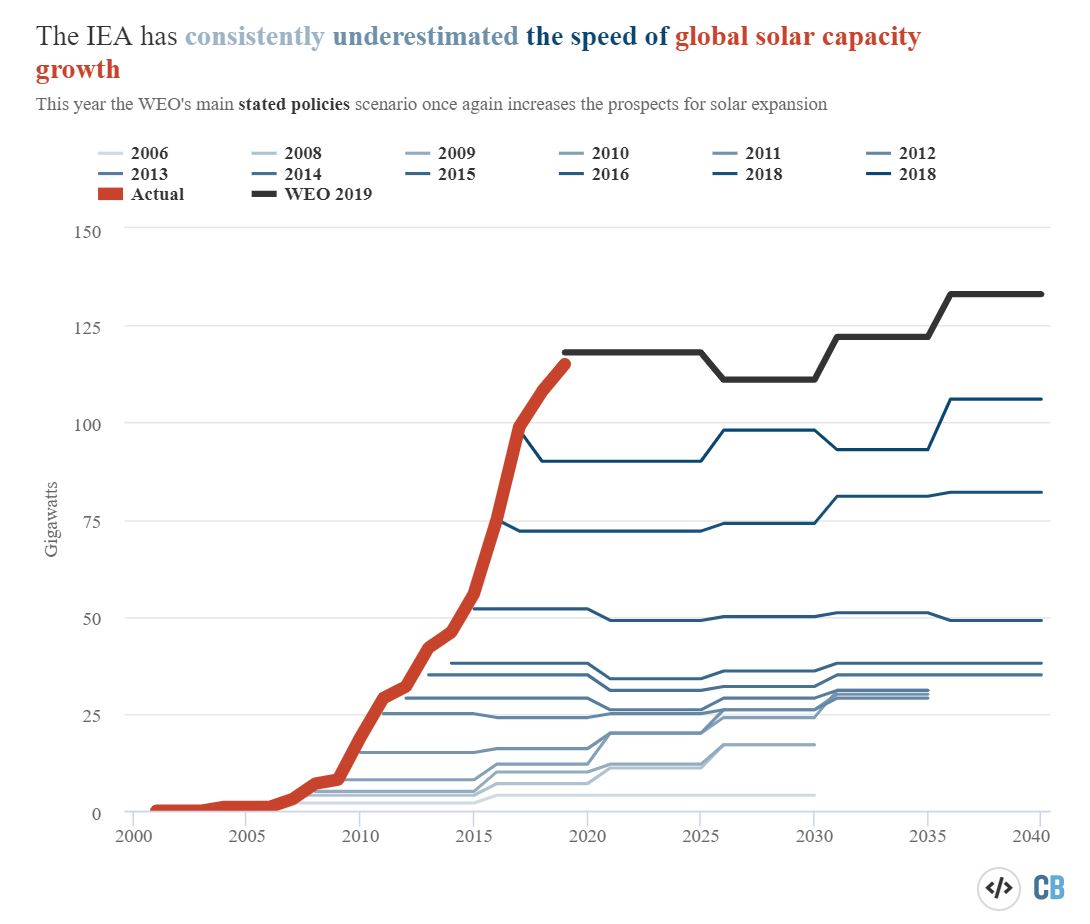
In each of 2006, 2008, 2009, 2010, 2011, 2012, 2013, 2014, 2015, 2016, 2018, the IEA predicted deployment of solar would stop accelerating (line going up) and steady off into consistant growth (flatline on that graph). Every year they have been very quickly wrong, and the 2019 predition of flatline is so wrong that by 2021 actual production of 190GW was WAYYYY off the top of that chart. At this rate we may not need to figure out storage nearly as much as we think.
> "What people have missed is that reaching cost parity on fuel synthesis will unlock huge new demand centers [and trigger an acceleration in demand/investment/research/cost decline of solar created synthetic fuels]."
[1] https://news.ycombinator.com/item?id=32197012 (article rather than comments)
> Hydrostor, which is based in Toronto, is one of several startups working on fixing those problems. The company says it’s figured out a way to capture and reuse the heat generated when air is compressed, eliminating the need to burn gas. It’s also figured out a way to make the mechanics work in areas where caverns must be dug out of hard rock, rather than salt. <
https://www.latimes.com/environment/newsletter/2023-01-12/th...
This first thing we need to do is align the costs and incentives. What I mean by that is simply allow the market, or government, to dictate the real cost of providing electricity at night. If there are no solar panels (nighttime), and whatever grid-scale batteries are available cost 1$/kwh then so be it, charge that amount to the consumer. People will learn to forego "bathing" in electricity at night endlessly. For decades we've been spoiled with ridiculous "energy on a tap" that just gives us oodles at the flick of a switch, and we just need to take that away.
As a side-effect of this whole "switching off the endless tap", micro-grids are the future. Small communities with mini-grid-scale batteries and sharing of electricity will take over this stupid "national synchronized grid" idea that has gimped our ability to be agile wrt local energy generation.
I take it you live somewhere warm in the winter. We are already looking at removing other heating options like propane and natural gas furnaces, coal and oil heating is mostly phased out, and burning wood isn't great for the environment either. So electrical heating is necessary anywhere where its normal to freeze for several months. Telling people to stop bathing in electricity at night when that what keeps them alive is bullshit.
"micro-grids are the future. Small communities with mini-grid-scale batteries and sharing of electricity will take over this stupid "national synchronized grid" idea that has gimped our ability to be agile wrt local energy generation."
Why don't you ask Texas residents how not being part of the national synchronized grid worked out for them 2 years ago?
You heat your home up during the day and evening, and as you retire for the night it's switched off. With sufficient insulation and warm bedding you don't need active heating overnight.
So it's absolutely compatible with an electric supply that's heavily biased towards the daytime.
This seems like the quintessential example of some Cali tech bro nor understanding that there is anyone outside of their little bubble and assui everyone just lives like them.
There are people outside everbodies particular bubbles.
I think you need to admit, "bro", that you're far from a standard case and that maybe you should suck it up and move to a more hospitable spot instead of forcing the rest of us to subsidize your extreme lifestyle choice at the expense of our environment which we "all" apparently care so much about.
At least I'm suggesting insulation, and alternative methods of heating as opposed to just saying we should chug gigawatts so your butt could be warm at -40C outside.
I live around 60 latitude and here during the winter it might not be even that cold (tho it can be -20 or -30C).
It’s that the amount of sunshine and the angle it shines at means that for about 3 months the PV production is essentially zero.
This is during the time the demand is highest.
I never said anything of the sort. You're taking a really bad-faith and extreme straw-man of what I said, and I refuse to participate.
Pardon me, but there's zero future for the micro grids.
Why shouldn't I be able to have oodles of energy at the flick of a switch?
Why is it bad that people had more than 100 years of using energy at a reasonable price point? Why do you think it's good for the energy to become more expensive or not to be available at all?
We do need energy for everything.
For the high energy consumers it's more a perceived need than an actual need.
Further, energy availability appears to work akin to road availability; if you build a six lane highway traffic expands to fill it.
The obvious reason for wanting lower global energy use at this particular point in time is reduce the still increasing by products of energy production, greenhouse gases.
Once the climate parameters return to safer values energy production without those side effects can expand .. while we look at addressing the unwanted toxic by products of our new sources of energy - less greenhouse gases, more acids and waste associated with nickel, copper, lithium, et al.
Surface wind is not reliable. I've seen proposals to put turbines on large kites or gliders tethered to the ground. There's pretty much always strong winds over most of the United States somewhere between the surface and 10000 feet.
Also, a failure scenario would mean tonnes of windmill crashing down from high altitude. Hmmmmm
10000 feet is less than 2 miles. Even in high winds it wouldn't get more than a a couple or miles or so before hitting the ground.
There are plenty of places in the US where you could fly where it would be centered over a 6 mile diameter circle that contains no people or valuable buildings except for people and buildings that are part of the power facility.
But there is another catch: nuclear is extremely expensive, even when run most of the time close to 100%. But any time you throttle the reactor, you are driving the costs up. Because most of the costs are in building and operating the reactor, less so in fuel.
Also, solar panels don't need any land. There are so many places we can install solar without 'consuming' land. They can be roofs, floating on tops of lakes and reservoirs with the added benefit of preventing evaporation, agrivoltaics combined with farmland, vertical panels, superfund sites, deserts, along the highways, etc.
Not saying this is a reason to keep the subsidies, but I'm sure it made sense at the time.
Technically you need to factor in the fact that a nuclear plant can be built relatively near the places where its power will be consumed; some mass of solar power in Nevada is highly inefficient for powering New York or Virginia, even if you built HVDC lines to cut down on total line losses, so you'll need to pick land tracts reasonably near battery banks that would in turn be near cities.
Is there something about Ohio that means they have no atmospheric wind nor natural sunlight?
And what are the various Friends of Rare Bugs and Small Furry Animals groups doing in the meantime?
I joke, but even I would balk at the environmental impact of that. Certainly it's going to be greater than any equivalent nuclear installation.
> Of which 0.72% is U-235
Fortunately we're not limited to U-235. With breeder reactors, there's enough nuclear fuel to run human civilization for billions-with-a-b of years.
[1] https://www.archdaily.com/976069/when-5-percent-of-the-unite...
The people who will be screaming about covering the desert with solar panels are exactly the same people who scream about covering the land with car parks.
Exactly.
The only energy source radical environmentalists like is one that exists only in a fantasy. As soon as it starts being built, it becomes evil.
Note that they're already up in arms about windmills killing birds.
Also, covering the desert is definitely going to change the local environment. At a minimum, every joule that goes into the power transmission lines is a joule that will not be available for use by the desert ecosystem.
Covering a desert in solar panels seems like the exact opposite of that plan.
Would covering a desert in solar panels cause more thermal solar absorption in that area than would otherwise happen? Yes.
But if we're optimizing for "offsetting the heating effect of human GHG emissions", then installing 4.5TW of solar (about 4x what has been installed worldwide to date) would have a much more positive effect.
The world currently has 1.1TW of solar installed, producing about 6% of all electricity. So our new installation would be on its own capable of supplying 25% of global electricity usage. The corresponding drop in GHG emissions from the shutdown of coal, gas, and oil power plants would far outweigh the fact that part of the desert has been turned black.
In theory, darkening a portion of the Earth with high albedo (snow, sand) is worse than darkening a portion of the Earth with low albedo (roads, roofs, forest). Then it should be better to use a greener area for solar panels so long as the capacity factors would be similar.
Also I don't see how that justifies adding to the effect? Especially if we don't know can't compute the trade off? I'm sure someone has done that work but my it didn't immediately jump out at me during a cursory search.
Inventing BS problems does not contribute to the discussion. Please stick to facts.
This depends on the efficiency of the PV modules. When it's greater than the albedo of the desert, it will cool the desert, not warm it. Remember, the electrical energy produced isn't heat. It's turned to heat at the consumer, but that's true of electrical energy from a nuclear plant too. Oh, and did you know that nuclear plants also add 2x as much heat energy in the exhaust of their cooling system?
Does the US have more 50cm^3 sized blocks of U235, or more square kilometers of land with low land values and high annual insolation?
There's an estimated 6 million tonnes of mineable uranium reserves in the world [0]. Of which 0.72% is U-235, so we have a worldwide reserve of 43200 tonnes, or 43.2 million Kg U-235.
Arizona is about 300k square kilometers. If we covered an area 10% the size of Arizona in solar panels, then they would have produced more energy than all the world's known U-235 in just four years. And would continue producing after those four years are up.
[0] https://world-nuclear.org/information-library/nuclear-fuel-c...