So they really have always been struggling with the difficulties of quickly serving an ice cream product for their entire existence. That's a long time to have a thorn in your side and put up with it. 80 years according to the other comment.
Edit: here's the "multimixer": http://www.sterlingmulti.com/multimixer_history.html
Take creative work. The pre-AI market was already extremely competitive. Few artists can chase autonomy, the rest needs to sell out to some level - usually significant; not the human flourishing we wanted.
AI may disrupt this; still, my guess is that the pool of profitable creative workplaces remains unchanged, at best.
If that's "selling out", then so be it. Why should society support the artist if his art has no value to anyone?
Otherwise, you'll need another source of income in order to create fulfilling art.
There's lots of software I'd like to write. I've spent my time writing code that lies in the intersection.
My personal dream was to become a swimsuit model, but it just wasn't working out, so I switched to software.
Accepting the hardship of reality is the only way you can realize deterministic change. Making blanket statements about "opportunity" in the US will have you immediately proven wrong no matter what you claim. Your opportunity is not the same as a Puerto Rican's which is not the same as an impoverished and sickly rural teenager in Montana. Changing your frame of reference is not any easier than it is to stop looking foreign or get a bunch of money really quickly.
gosh I thought you’d get to this punchline earlier.
I wrote Empire for my personal satisfaction eons ago, and when other people copied it and spread it around, I discovered that it was a lot of fun to get unsolicited emails from people who liked playing it and wanted to let me know. I still get them regularly!
Yes, many among family and friends.
> Any of them that are successful?
No.
> What you described wouldn't be "selling out," it'd be success.
"Selling out" is a common epithet leveled at artists who became successful. Nirvana, for example, was often accused of selling out.
Nirvana is the perfect example of what I was talking about.
If the art I’m interested in making doesn’t fit into this “utilitarian” monetary income model, it means that I can only pursue art in my “spare time”, outside of a necessary job and (for lots of us) family obligations. I guess I could become an art star, or a viral sensation, but we all know how unlikely that is for any one person. There’s not much middle ground.
The thing that we have to acknowledge as a culture is that we don’t generally value art, or highly-specific research avenues, or much of anything that isn’t “productive” in the most myopic sense. That’s a cultural choice, and it’s a bad decision. It fits in well with our naked pursuit of short-term optimization at the expense of everything else though, so at least we’re consistent. Yay.
People simply romanticize that kind of work because of its loose association with highly-prestigious creative work. I don't think we lose out on Picassos if we lower the number of graphic designers or caricature artists.
McDonalds is also at the far end of the spectrum of "human service jobs that are less-skilled but difficult to automate". There is plenty of demand for higher quality versions - requiring a higher degree of skill and creativity - of the same general type, like fine-dining.
Truly creative (in the sense of it having a high degree of novelty and quality) work is not at risk of being automated any time soon. What is at risk of being automated is the category of "creative" work that requires some skills but is mostly assembly line. Category-defining or truly novel art almost by definition can't be produced by existing AI in any form, because AI can only remix the content it's seen already. "Generic rock song" or "clip-art like picture of a guy yelling at a computer" are at risk of going away, but I hardly think that means humanity will no longer flourish - producing that kind of stuff is romanticized as a cool, highish status thing to do, but functionally I don't really see it as any different or more worth preserving than obsolete skilled labor of the past like carriage-makers or human-computers.
I also think people tend to make the "Lump of Labor" fallacy when thinking about this stuff - economically speaking, if human workers are no longer needed to produce some high-value output, in the long run the excess labor/"talent" that gets freed from that task finds other value-producing tasks to do: https://en.wikipedia.org/wiki/Lump_of_labour_fallacy. Long-term unemployment and underemployment is completely a solvable economic problem; both can increase due to short term shocks like technological development and shifts in supply/demand, and in some cases underemployment is more a matter of "wrongly skilled", but long term they're both a matter of ensuring there is enough money, liquidity, and capital deployed to drive demand for marginal increases in both jobs and quality-of-jobs (without ruinous inflation).
Have you ever worked in fast food? What makes you think it can’t be automated? From my experience (admittedly decades ago), it’s ripe for automation. The work is largely rote and well controlled. The main edge cases (eg an order of salt free fries, or custom orders) are fairly easily managed without out-of-the-box thinking. The processes are well-defined and controlled. In fact, that’s a major contribution of franchise model: the entire process is already defined largely turn-key. IMO one of the reasons they aren’t automated already is because we essentially subsidize wages with social safety nets. This allows the human wage rate to stay below the cost of automation.
We also may disagree on the idea of creative work. By my estimation, creative is defined as not being rote. Maybe the discrepancy is whether you believe combining preexisting ideas is creative; to a large extent most would agree, but that doesn’t, for example, pass the PTOs definition of “non-obvious” so I think there’s some debate as to if it’s truly creative work.
I currently think the jobs that are least likely to be automated are non-rote manual labor, especially non-greenfield repair. Fixing a non-routine plumbing issue or installing a one-of-a-kind control system would just not be economical to automate.
Service jobs COULD be fulfilling. Spending a few hours a day helping your neighbors access the goods and services that they need is a part of community-building; people enjoy that kind of labor. The problem is the corporatization and "shareholder value"-centric bone-deep resource cuts that characterize most of these workplaces, where employees are forced to work under conditions that nominally prioritize profit over everything else (but are really also about, specifically: employee control, legal ass-covering, and union-busting).
If people got paid well for working limited and predictable hours where they could rely on coworkers to keep the labor load reasonable, I think these jobs would be more desirable. What better way to spend the value unlocked by AI automation?
1) as already stated elsewhere in this thread, automation has been coming for manual labor jobs for decades/centuries before AI has been coming for knowledge workers
2) I think "service" jobs is the wrong discriminator. There are lots of service jobs that are fulfilling. We're a social species and generally have the desire to contribute to our tribe. Service jobs often scratch that itch. Personal training, wedding planners, hairstylists, chef etc. are all service jobs that are fulfilling enough that people want to do those things even when they don't get paid. That should be confused with the rote, drudgery that is associated with jobs like assembly line work or fast food. I'd argue it's less about the pay (although that can't be ignored) and more about the work. Just look at the service job of attorney with its relatively high bar of entry and high pay, yet it still has pretty insane attrition rates. Even if the pay and status is good, people want a job that's fulfilling.
2) You're conflating and categorizing jobs to benefit your argument, not as an accurate reflection of what I presented. Chef work is brutal, too. The main point seems to be that a mechanically unfulfilling job either needs to have fulfilling social contact (functioning as pressure relief, leverage, etc.), or high pay (i.e., an out). Most people would work a (safe) soul-deadening job for a year if they'd get 20 times the median wage out of it.
I’m only using the words you mentioned. You brought up service jobs, although you may have been using the term somewhat sloppily. Your explanation seems to bolster the point though. People will “put up with” a soulless job if it’s a means to an end. People don’t simply “put up” with a job that is inherently fulfilling. Circling back to the original point, AI forcing people into drudgery is probably not to the benefit of society, especially if there isn’t high pay.
This is the opposite of most takes, which hold that automation takes over when wages climb too high. But this again assumes capability that machines haven't demonstrated, and does not consider the social externalities.
>But that “silicon-based” piece is a constraint that wasn’t part of my original point
We're talking about AI.
I think you're letting your personal fears warp your analysis. It's clear that service jobs - I am using the correct denotation - are not ipso facto drudgery if structured in such a way as to minimize antisocial aspects. Namely, long hours, weird schedules, and understaffing, which exacerbate undesirable tasks. Happily, the value AI creates paired with the increased size of the service workforce ameliorates these concerns. Scanning groceries for 8 hours on minimum wage sucks. Scanning groceries for 4 hours for higher pay, and with backup in case you need a break, or to leave early, or have an irrate customer, sucks a lot less. This is the clear goal we should be aiming for in order to crowd out the actual dystopias in the works.
It's not when wages climb too high, it's when the cost differential between wages and automation climb too high. It's possible to have stagnant or declining wages and still be taken over by automation, if the cost of automation drops at a faster rate.
>We're talking about AI.
Yes, and the OP was talking about what happens when AI takes peoples jobs. I was making the larger contextual point that we can see what happens when people lose their job to technology. AI job loss is a subset of that broader context.
>It's clear that service jobs - I am using the correct denotation - are not ipso facto drudgery if structured
I think you've moved the goalposts to suit your arguement. The original point was that people will be working "retail/food" jobs.
>Every retail/food service job is understaffed. You ask what people displaced by AI will do for a living? That.
You took that original point and then expanded it to encompass all service jobs. I do not think all service jobs are drudgery, and I'm made that point clear. Will AI help us get to the point where all get semi-leisurely pro-social and fulfilling work in a service economy? Maybe to a techno-optimist, but I don't see evidence that is the direction our system tends toward. Even if it did, I think it will be a long, long time away with the potential for miserable local minima along the way. So while I do think that certain service jobs can be fulfilling, that is not the future the OP was initially claiming we'd inhabit.
You're splitting hairs to distract from the fact that you misrepresented the dynamic earlier. The point remains that the purported bare per-unit-hour cost savings of AI-based automation versus human labor doesn't necessarily account for newly-incurred costs and externalities, which is the real reason why the latter hasn't been replaced.
>I was making the larger contextual point that we can see what happens when people lose their job to technology. AI job loss is a subset of that broader context.
You broadened the scope to non-AI-based automation.
>The original point was that people will be working "retail/food" jobs.
Which is what I originally commented on. You keep asserting a fundamental drudgery inherent in those positions, and I'm saying that that's inaccurate. I'm not moving goalposts, I'm making a point about why more people working them, and having an interest in working conditions and pay being better, will lessen that drudgery.
>You took that original point and then expanded it to encompass all service jobs.
No.
>I do not think all service jobs are drudgery, and I'm made that point clear.
I don't think you have.
>Will AI help us get to the point where all get semi-leisurely pro-social and fulfilling work in a service economy? Maybe to a techno-optimist, but I don't see evidence that is the direction our system tends toward.
So, here is the crux of the issue. My argument was simple, but it's apparently so outside your concept of what's possible that you just... refuse to understand it. That's fine, people get dragged kicking and screaming into the future all the time. But that doesn't make me wrong. It just means you lack some combination of imagination and observation skills. And I'm sorry if that's rude, but I've had arguments with Trump supporters and nuclear energy advocates that were less frustrating.
>So while I do think that certain service jobs can be fulfilling, that is not the future the OP was initially claiming we'd inhabit.
To conclude, hopefully for good: I know. I'm (first mention of AI) OP. I explained the remedies for the current woes of such positions as workers are inevitably displaced to them.
They haven't installed ordering machines[1] at your local mcdonalds yet?
[1] https://assets.bwbx.io/images/users/iqjWHBFdfxIU/ihydn_7eemN...
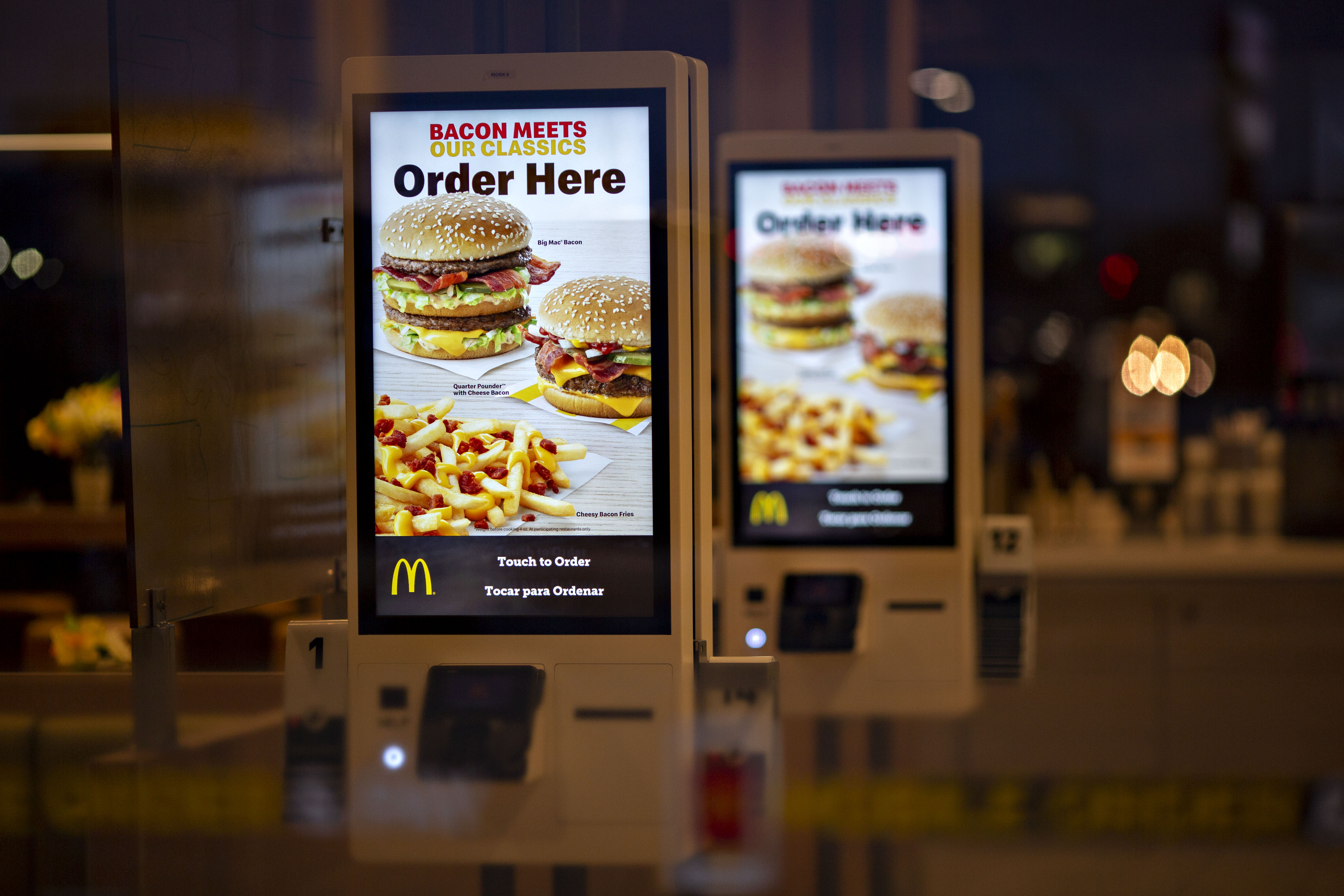
I do prefer them to ordering at the counter due to pretty bad eyesight and having more time and I usually pay by card anyway but they're not the best things.
Gross. But somehow I doubt the POS credit card reader would be any different. Those types of studies find grossness everywhere (feces on movie seats, urine in the bar peanuts etc)
I wanted a bag of ice, since they sell them cheaper than the Kwik-e-mart and I had some perishables I didn't want going bad on the way home.
Do I want to log in? No. Am I sure? But I could be earning bajillions of Rewards Points for my $1.75 purchase!
Now, where are bags of ice? It's not in an obvious category, there's no search, and finally, someone realizes I'm having trouble and looks herself, and then we finally find it at the bottom of the drinks menu, which has too many options to fit on the screen without scrolling randomly.
Now, I proceed to pay. Except I can't. I have a piece of crumpled paper issued by the central government I wish to exchange for my ice. But there's no note acceptor on the machine. The kiosk prints a receipt and I'm supposed to take it to the attended till to pay. Except there was nobody attending it. Again, try and flag down someone so I can finally complete my transaction.
Before, it was "Bag of ice, please." "$1.75", and I'm done in 1/4 the time. Of course, that was facilitated through labour, rather than $4000 worth of shiny touchscreen monitor and glorified Raspberry Pi.
No 'note acceptor'? Thank god, that shit is slow, finicky and ugly. Just PayPass with your plastic card and have the order number in 5 seconds. No, 99 of times from 100 I don't need any paper receipt with an order number, so I don't even click on "print the receipt" button in the first place.
And lastly, I don't buy bags of ice, shovels and dildos at McD.
> Do I want to log in? No. Am I sure? But I could be earning bajillions of Rewards Points for my $1.75 purchase!
Now this is what should bring a slightly boiling cauldrons and pitchforks made from chinesium to those who thought and designed that shit up.
Part of the problem is that for some of these jobs, there is only so much money an employee is able to generate. And for some industries you can only get away with raising prices so much (fast food is relatively easy to raise prices).
I have friends in the grocery industry and they are so hard up for workers (even unionized/good-paying ones) and the margins are already so razor thin that they are looking at starting to close the store on certain days of the week.
So even in unskilled positions, you are going to need huge increases in labor productivity. Which means more customers per employee. So bigger fast food places, bigger stores, bigger farms, bigger hospitals, etc.
Or you could tax the excess profits that companies are earning from eliminating jobs through automation and AI, use that money to pay for healthcare and cover subsidies to bring the cost of food and other necessities down. Then the cost of labor goes down and you don't need to torture people for more productivity.
* https://stats.oecd.org/Index.aspx?DataSetCode=RMW
> Real hourly and annual minimum wages are statutory minimum wages converted into a common hourly and annual pay period for the 30 OECD countries and six non-member countries for which they are available. The resulting estimates are deflated by national Consumer Price Indices (CPI). The data are then converted into a common currency unit using either US $ current exchange rates or US $ Purchasing Power Parities (PPPs) for private consumption expenditures.
I don't know about that. I used to order from a kiosk at a Burger King in 2007 and skip the line.. At a fast food joint, point of sale is likely the easiest job to replace with a machine. My guess for the hardest to replace is cleaning..
Personally I'd prefer that job be automated because it's so mindless.
And then the dystopia will be complete.
However, whether or not some people find those positions enjoyable isn't relevant to my point. If everyone has to work in those jobs, most people won't find that fulfilling or enjoyable because they're not suited to that sort of work. And when you add the fact that these are low-paying jobs, you have most people doing something they hate for very little pay, because (in this scenario) the work they are suited to do is unavailable. That's the beating heart of a dystopia right there.
(I put too much emphasis on the pay rate. I actually think the pay rate is of secondary importance for this point. A job you hate that pays very well will still make you unhappy.)
I don't disagree. I'd like you to think critically about why.
>If everyone has to work in those jobs, most people won't find that fulfilling or enjoyable because they're not suited to that sort of work. And when you add the fact that these are low-paying jobs, you have most people doing something they hate for very little pay, because (in this scenario) the work they are suited to do is unavailable. That's the beating heart of a dystopia right there.
I think this is incorrect. Firstly, because (per the proposal) they wouldn't be low-paying. Secondly, and to the contrary, if everyone has to work these jobs, then not only are they no longer jobs only for losers and the unskilled, they are suddenly jobs with a lot of staff with which to build accommodating and reasonable schedules.
I WANT a society where my doctor serves food or works the register for a few hours a week, or where someone laid off from their 6-figure coding job can earn (or even be given) enough to avoid losing their house. That's the opposite of a dystopia; that's a world where even the most educated and prestigiously-employed community members are connected to the rest of us. Maybe that's a dystopia for them?
It's got a happy ending actually.
That's only a little more than 100% increase from the current near $20 combo meal prices. McDonalds has high margins lately they can afford raises.
Also, McDonald's Corporation is a different company than the McDonald's franchise that sells you the burgers.
There is no such thing as unskilled labor. Put a fucking normie from the street into any of these 'unskilled' jobs and find out just how many skills are needed just to do something like customer service.
Looking down on those people is what will lead to another internal conflict. They'll be the ones you depend on when society goes to shit.
A plumber or electrician is equally "skilled" work as a software developer, largely due to the extensive apprenticeship requirements.
Most can't. Hence the frustration you are likely to feel dealing with a teenager in his or her first week on the job.
In particular, the emotional and interpersonal regulation needed to do well at these jobs sometimes borders on superhuman. People stress over office politics, like it's not child's play compared to getting through an 8-hour shift dealing with the sick and irritable public that come into Wendy's or Walgreens with zero leverage over these people who hold your employment in their hands (not even being able to pass things off to a manager, since they're likely bouncing between different stores).
And every workplace has systems and policies that have to be learned. Smart and experienced people can analogize and cut some of the learning curve, but it's still measured in days and weeks, not hours.
The food arrived by order number as like today in slot.
Then the backend machine vision can enough …
Sorry …
I did think my Go playing is safe you know.
The machine would flash and beep when the ice cream mix was low so we were always eager to shut it up.
How is that possible?
Edit: that’s not even mentioning when we would be short staffed, due to people not showing up / calling in, which happened every other day it felt like, and the shift wouldn’t be replaced.
Night shift is where you'll see the cluster-fucks occur most and it's when the ice cream machine will be "down" the most in my experience
I haven’t worked in fast food, but I’ve worked in retail, and it was my experience that the “nice” manager would schedule us, like… one extra person beyond the bare minimum.
Why do you suspect this, do you have any particular insight into these kinds of businesses beyond the rest of us?
Is dinner as busy per hour as lunch?
Quality of service will suffer.
You're doing the work of your buddies who called in. Your buddies called in because they're 17 and they're dad made them get this job. They hate it! This happens every damn day.
I started working there ~10 years ago and my starting pay was $7.30/hr. I made $10/hr as a manager
Back in high school I worked in fast food as a closer. One front end person, one backend person, one manager for dinner rush, late rush, clean up from the day both in the kitchen and the store, some basic prep for the next day (morning shift did main prep), and they kept pushing us to get our times down so that we could walk out the door as soon as the store closed rather than taking any time after closing for our cleanup, etc. Our labor cost per hour was likely around $17. The energy to run the ovens, refrigerators, etc was fairly consistent, while our labor cost for any extra time after closing was a variable cost that ate into their profit margin.
Doesn't matter what industry -- ask a doctor about their workload -- if management can squeeze labor costs, they will.
Everybody squeezes costs, including you and I. Don't you shop for the lowest prices? I do. Customers of fast food are pretty price sensitive.
In the case of the tech company...let's just say they are all but forgotten, while other players came along with competent management and have formed new multi-billion dollar businesses.
And, sure, there are a lot of incompetent employers. They usually go out of business. Businesses have a high failure rate, and it's pretty darn hard to make enough at it to put up with all the aggravation and work required to make it successful. Businessmen do not go into business to make a 3% return on capital, as anyone could buy a bond that pays 3%.
Bill Gates famously never went on vacation for something like the first two decades of Microsoft.
You must make the ice cream last. The car has to be at the window (or customer at the counter) when you start. This is the only item in the store that must be prepared like this so you must always have a free person to do this. McDonalds does't provide the labor budget to have "free people" standing around to get your ice cream when you need it. Making ice cream almost always hurt another area of the store in a small way.
Also making a soft serve ice cream cone is much harder than you think. Took me ~2 months to get it down. Dont even get me started on dipped cones.
Fun fact: This is why your mcflurry doesnt have candy at the bottom. Workers hate ice cream! They dont blend it with the machine, they'll just hand blend it to be quick.
The fix would be to take the burden off the the employees. Automate it just like they did drinks. Or increase the labor allowance to have the staff to handle ice cream. They'll probably never do that though.
Ive worked at several restaurants as a waiter and food prep staff. The businesses have very thin margins and most costs are fixed except for…labor.
When it’s lunch rush, it feels like every atom of your being is pressed to the limit. Then when that’s done your manager has to come around and start assigning random cleaning and other tasks so people aren’t just hanging around.
When they schedule, they want to just *barely* handle the busiest time or otherwise it’s an inefficiency in the system.
Also to mention, restaurant staff aren’t the most…stable workforce in the world. So even if they do schedule to have some buffer, people will quit and call in sick on a dime.
I know what op is talking about when they say they do the work of 2-3 people and I believe them. The system is designed to squeeze that extra bit out of everyone.
If there was a magic mystery inefficiency they found, that would translate to decreasing staffing per shift, not increased breathing room for the individual workers. (IMHO)
That specific problem can be solved.
And it would not enable any more decrease in staffing, because they're already not making the ice cream.
The question was not about trying to fix the general situation of being understaffed.
When you’re backlogged with multiple people in line, multiple orders, and you’re a 1-3 person crew in the front, every second counts. Ice cream was the easiest thing to cut because of the stereotype that it was always broken so people didn’t question that it was “down”, and those precious seconds made my 17 year old life much easier.
Competing fast-food franchises serve similar frozen dairy products, in a similar staffing environment, without their machines constantly being out of service.
This video covered the situation fairly well IIRC:
This happened all the time at every store I worked at.
BTW Our machine would legit break too. Maybe once a year it would be down for a day.
You lie to the customers and the workers cover for you (the shift manager) because they hate making ice cream.
The store looks dead but do you know if the night crew is caught up on their closing responsibilities? Doing dishes, stocking nuggest sauces, cleaning the grill, disassembling the fry hopper, organizing the stock room, etc...
If the store closes with none of these done the manager will blow their labor budget due to taking 3 hours to close and the employees will be pissed.
Your rebuttal is a good one and your somewhat right. Grabbing you an ice cream cone when there's no customers likely isn't a big deal. The manager usually cuts the ice cream while being overwhelmed (Ahh! 7 ice cream cones and we have 10 cars behind them. No more ice cream!) and never tells employees to start offering it again. Offering ice cream again would piss off the employees and also slow down the manager who's trying to hit labor and drive through times
I mean, I've never worked in fast food myself, but that split of responsibilities assumes that the night shift are closing, no? There are a lot of 24-hour McDonald's locations, where no explicit "closing" ever happens.
I would assume that in a 24hr location, a lot of what would otherwise be "closing" responsibilities are either spread out as "clean as you go", turned into something done at shift-start/shift-end for each shift (and so made a lot quicker by only having 1/3rd the accumulated workload for each shift), or pushed to the dead-est period (which according to one Quora post is "in the middle of the graveyard shift, 3-6AM".)
Source: Was one, did that for other things all the time.
> " Sorry, we don't deliver to your area on Mondays "
I was there for about a year IIRC, other than cleaning the machine "making ice cream" was dumping the premixed liquid into the top two compartments.
I've never heard one person tell "the truth" about this (at least in my personal experience).
Our ice cream machine was often down too but not because it was broken. Because we were short staffed and making ice cream is a HUGE time sink for employees. The manager would just tell the employees "no more ice cream" and they all knew what's up. They'd be very happy that they could focus on food and McCafe and thus not disappoint customers too much due to slow service.
Folks don't quite understand that McDonald's is consistently short staffed and the workers are often doing the work of 2-3 people just to try to get you fast and hot food.