Yes I am aware. Tragedy of the commons. Game theory. The solution to our global problem is not me stopping the AC, neither is it all of us stopping our ACs.
I guess we’ll end up A/C’ing the fields of dying crops too?
This is your interpretation of my perspective. I can do that also; the people dying of heat exhaustion in India should just decouple from the global trade network and go live in caves like in the olden days.
> I guess we’ll end up A/C’ing the fields of dying crops too?
Maybe? Or engineer heat resistant crops. Or figure out a different way to feed billions of people. If you think the only solution to climate change is net zero emissions on a global level, I'm not jealous of your imagination.
This will happen, as it is well within the reach of even smaller state actors (and even sub-state) and once you get a wet-bulb event killing thousands in, say India, that country will not have a choice.
And then we'll have to get crackin' building those nuclear power plants (as well as building out solar and wind and geothermal and tidal and storage). Because as another poster pointed out quite correctly: global warming is bad (but manageable), but pre-industrial society is far, far worse.
Nobody's talking about that. Your position will get us there.
> Or seed the atmosphere with sulfur dioxide
That's not solving the situation, that's temporarily mitigating some effects with poisons for a short term and at the same time emitting a ton of emissions from a lot of flights.
> global warming is bad (but manageable)
Warming, or better climate change, is only one of the symptoms of the overshoot. We've managed almost zero, nil, zilch in past 50 years (coal is still at 82%).
> but pre-industrial society is far, far worse
Calling mitigation strategies return to pre-industrial society ... i don't have words for that. But if we don't start solving it, and fast (yesterday was late), the nature will solve the problem for us. One way is better than the other.
If you're interested where else you're wrong, you should really spend some 30 mins here: https://www.youtube.com/watch?v=qPb_0JZ6-Rc
> That's not solving the situation, that's temporarily mitigating some effects
Yep, I clearly identified this is a temporary mitigating measure to buy us time for the real solution, which is the following:
>> And then we'll have to get crackin' building those nuclear power plants (as well as building out solar and wind and geothermal and tidal and storage).
But it is a mitigating measure that will work and will allow us to get to the actual solution, which is rapidly building out nuclear power (and others).
And of course, if you know that this scenario is possible, then you probably also start to understand why governments aren't as panicky about the whole situation as you seem to be.
And yes, the mitigation is for the most immediate short-term effect, the rise in temperature. We will still have to get the Carbon out of the atmosphere, for example to avoid Ocean acidification. But we have more time for that. And it will likely need quite a bit of energy (see the nukes).
And no, not going to listen to 30 minutes of someone ranting about the collapse of civilisation. We had the club of Rome with the same message in the 70s, and they were comically wrong. If there is something of actual substance, please make the point yourself here. So far you haven't.
In particular, I am still waiting for even a hint of shadow of an argument how building out nuclear power and other non-fossil energy sources, while at the same time mitigating the worst effects of global warming, will get us to a pre-industrial society.
So not ecosystems restoration (habitats restoration, reforestation and afforestation, wetlands restoration, streams and rivers restoration, sustainable land management, conservation and protected areas, plant-based diets, ...), but attempts at geoengineering with aerosols like sulfur dioxide, or mirrors in space, or whitening the clouds. The potential problems are enormous.
Solar radiation management is also an ungovernable technology. Even if we knew how to reflect the sun's rays, that means deciding on what is an international "best temperature". So what if cooling down the US means massive drought in China? What if China deploying this causes rainfall in India to drop? The Earth's climate is interconnected and block the sun's rays in one area affects another.
It seems obvious to me that this technology could cause massive conflict (violent maybe) over what is the best way to use it.
Anything to avoid doing the right thing.
> We had the club of Rome with the same message in the 70s, and they were comically wrong
There you're wrong again.
https://www.researchgate.net/publication/332655753_Limits_Re...
"We unravel the arguments that have raged for forty years in its aftermath and explore more recent findings which relate to the original hypothesis. There is unsettling evidence that society is still following the ‘standard run’ of the original study – in which overshoot leads to an eventual collapse of production and living standards. Detailed recent studies suggests that production of some key resources may only be decades away. Certain other limits to growth – less visible in the 1972 report – present equally pressing challenges to modern society. We highlight, in particular, recent work on our proximity to ‘planetary boundaries’ and illustrate this through the challenge of meeting the Paris Agreement on climate change. We also explore the economic challenge of a ‘secular stagnation’. If the Club of Rome is right, the next few decades are decisive."
https://www.resilience.org/stories/2021-08-16/revisiting-the...
https://advisory.kpmg.us/content/dam/advisory/en/pdfs/2021/y...
"I conducted a data update to Limits to Growth (LtG), best known from the 1972 bestseller that forecasted a scenario of global societal collapse occurring around the present time if humanity did not alter its priorities. Empirical data comparisons since then indicated that the world was still heading for collapse. My objectives were to examine whether this was still the case based on the most recent data, and whether there was opportunity left to change that trajectory. My research benefited from improved data availability, and included a scenario and two variables that had not been part of previous comparisons. I collected data from academia, (non- )government agencies, United Nations entities, and the World Bank. This was plotted along four LtG scenarios spanning a range of technological, resource, and societal assumptions. From these graphs and two quantitative accuracy measures, I found that the scenarios aligned closely with observed global data, which is a testament to the LtG work done decades ago. The two scenarios aligning most closely indicate a halt in growth over the next decade or so, which puts into question the usability of continuous growth as humanity’s goal in the 21st century. Both scenarios also indicate subsequent declines, but only one—the scenario in which declines are caused by pollution, including greenhouse gas pollution—depicts a collapse pattern. The scenario with the smallest declines aligned least with empirical data, however, absolute differences were rarely big and sometimes insignificant. This suggests that it’s almost, but not yet, too late for society to change course."
> If there is something of actual substance, please make the point yourself here
You're the one who should decide whether to stay ignorant or learn more on your own. You can't reasonably expect that someone will compress such complex and diverse topics into few social media comments. Few hours of attention and learning could possibly completely change your viewpoint ;)
> how building out nuclear power and other non-fossil energy sources
I'm not against that, and I'd tend to agree with you on that. But there are people who are more knowledgeable about energy (i'm more interested in biodiversity and agriculture) and more sceptical of the idea / possibility. One of them is Sid Smith ... you'd find those arguments in a well known talk of his https://www.youtube.com/watch?v=5WPB2u8EzL8
>I'm not against that, and I'd tend to agree with you on that.[..]
Glad you agree with my central point. Not exactly sure what all the ranting is about, then. ¯\_(ツ)_/¯
I haven't heard of Sid Smith and am not sure why I should have. Apparently some obscure random retired math professor who rants about collapse. I checked the video where he talks about nuclear, and there he just repeats talking points that are either wrong, irrelevant, or both. So same old same old. (I used to vote green, but them being instrumental in the worst environmental/economic and foreign policy decision of the last 50 years in Germany is putting a damper on that). Not sure why I should listen to the rest, but I might just for curiosity, though given what I've seen it is unlikely to be substantive or enlightening.
> So not ecosystems restoration. ... anything to avoid doing the right thing
Where did I say that? Nowhere, that's where. Please keep your straw men to yourself.
> Solar radiation management [problems]
And where did I write this was "good"? That's right: nowhere again. I said "bad, but manageable". And we know that it is manageable because we actually have data. Lots of it. From quite a number of volcanic eruptions.
Again, is this good? No. But it does mean that the doomsday scenarios people keep painting are wrong. The earth will not become uninhabitable due to runaway global warming, because we know how to stop that. And again, the ways of stopping it are certainly less than ideal, but they exist and are even fairly predictable.
Regarding the Club of Rome and LoG: sorry, but no. Their original claim was resource exhaustion on a fairly tight timeline, and resources are not becoming exhausted, and certainly not on anything like their timeline. See the Simon / Ehrlich wager, which put that theory to the test, and was lost in all resource categories.
And no, a political position statement by the UK green + labour parties is not evidence. The KPMG piece that claims to validate the original actually does nothing of the sort. In fact, it has to completely discard the original model's predictions:
"Around 1990, it became clear that non-renewable resources, particularly fossil fuels, had turned out to be more plentiful than assumed in the 1972 BAU scenario. Randers therefore postulated that not resource scarcity, but pollution, especially from greenhouse gases, would cause the halt in growth. "
This is in the "Updates to the LtG" section. Some "update". LOL.
"Remember the stuff we said about resources becoming depleted? Yeah, that was complete bunk. We now know that it is pollution. How do we know this? Well, because of the perfect forecasting record of our models that we just had to discard"
You can't make this stuff up.
See:
https://www.project-syndicate.org/commentary/economic-growth...
And you still haven't told me how "my approach", the one you agree with, leads to going to pre-industrial civilisation.
I never said that you did. I did, and you're taking it out of context.
>> Solar radiation management [problems]
> And where did I write this was "good"? That's right: nowhere again. I said "bad, but manageable"
You're misquoting youself.
You said that climate warming is bad, but manageable. And I don't agree with you there.
> See the Simon / Ehrlich wager
This bet was over a relatively short timescale and on a very narrow selection of resources, and so doesn't definitively prove or disprove the larger issues raised by the Club of Rome.
> You can't make this stuff up. See:
Lomborg views are very controversial, and even this article has some serious problems.
- resource abundance - while it's true that predictions about running out of certain resources haven't come to pass thanks to technological innovation and more efficient usage, this doesn't mean that all resources are infinite or that extraction doesn't have environmental costs. Extraction and use of fossil fuels, for instance, is one of the leading causes of climate change
- innovation - innovation isn't guaranteed to solve all problems, dependence on it to resolve issues of resource scarcity or environmental degradation might be risky
- economic growth - exponential economic growth is unsustainable in the long term given the finite planet
- pesticides and organic farming - he oversimplifies the issues, organic farming isn't solely about avoiding pesticides - it's also about soil health, biodiversity, and long-term sustainability
- pollution: is still a major problem worldwide, particularly in developing nations, he doesn't address climate change (a form of pollution) with poses massive risks at all
> "my approach", the one you agree with
You're misquoting me again. I tend to agree that nuclear should be a part of the solution. However, based on the opinions of more knowledgeable experts in the field, I'm not entirely convinced that it's possible or feasible on the scale and timeline required.
I'm not with you on your stance on solar radiation management. In my opinion, it's not a solution at all, and it would be extremely irresponsible and almost stupid to even attempt it.
Sure, I don't have any sources to back up my claims - just as you don't, and that's fine. That's why the White House is calling for further studies, not the implementation of the idea, while a number of experts express serious concerns and strong reservations about this "solution".
Dismissing SRM technology, Prof Joeri Rogelj of Imperial College, London, called it “irresponsible, dangerous and a threat to the manageability” of our survival, saying: “It is not a solution but an extremely dangerous band-aid that covers up the global warming problem without healing it, creating a false and unwarranted sense of climate safety while the core of the problem continues to fester.”
Imagination is after all, all in your head.
All things intelligent exist in one's brain and imagination is how each piece of everyone's understanding of the world began.
The social solution requires a removal of freedom. The removal of freedom will involve a war. I would say the risk tolerance isn't black and white.
No? Then clearly there’s a path to getting people onboard with fighting climate change, it just requires the right messaging and education
In other words, a group of truckers is enough threat to social order(in Canada) to call in a law that replaced the War Measures Act before it.
This was over a little needle in the arm. The events are not reasonably comparable in the slightest. It is an incredibly difficult thing to become carbon neutral in today's society.
What are you doing right now to fight climate change? I live my words and would consider myself carbon 'negative'. My actions reach outside of myself to positively influence the carbon impact of others.
Also, everyone does precisely nothing. There is no single thing in the universe which enjoys unanimous agreement.
The idea that the right messaging and communication is going to fix climate change is childish. It ignores reality. It is fantasy. I don't intend this in an aggressive or mean manner, it is my assessment of your proposal.
I love how you just throw stuff in my bag. I'm not willing to bet our world, nor can I do that. What I am not willing to do is make my family suffer today so that the people of the world can, tomorrow, get together and sing kumbaya, magically deindustrializing while preserving standards of living.
To me, the risky move seems to be to push away from the magic technical solution and towards the magic humans deciding to do worse for themselves solution.
Did you know half of all human emissions since 1750% were released in the last 30 years?
Even going back to 60s levels would do us well.
Moving back to simple foods instead of ultra processing. Embracing nuclear power. Driving less and flying less. All better options than sticking our heads in the sand and hoping some country geo engineers the earth in the future.
Because climate change is an existential human challenge, we all need to pitch in.
There were 3 billion people in the world in 1960, now we are 8 billion.
What about standards of living on the planet in the 60s? Not just the US and some parts of Europe. How will this be spread evenly on the planet? Do we ask China and India to get back to 60s levels? Do we ask Africa to not make any steps towards industrialization? Does US get back to lower levels than 60s so that emerging nations are on an equal step?
> Moving back to simple foods instead of ultra processing.
Why do I pay almost double for 'bio' foodstuff? Why do people today choose to buy ultra processed instead of simple foods? How do we feed 10 billion mouths in the future without processing? There's a reason we have an abundance of cheap nutrients.
> Embracing nuclear power.
This is innovation, which was my initial point.
> Driving less and flying less.
Who decides how much we can drive, and fly? Can I go visit my grand-dad in the countryside? Can Bill Gates go to the climate conference on the other side of the world to scold us?
> Because climate change is an existential human challenge, we all need to pitch in.
We all need to pitch in with innovative solutions or with votes for politicians that push for innovative solutions, not by closing our AC and voting for degrowth.
> All better options than sticking our heads in the sand and hoping some country geo engineers the earth in the future.
I'm pushing for actively trying to develop new technologies to mitigate the strategy and you are fighting against the viewpoint that we should put our heads in the sand and wait for a solution... I think this thread has run its course.
And some of them consume very little, and a western minority consumes much more than in 1960.
https://futureearth.org/wp-content/uploads/2015/01/great_acc...
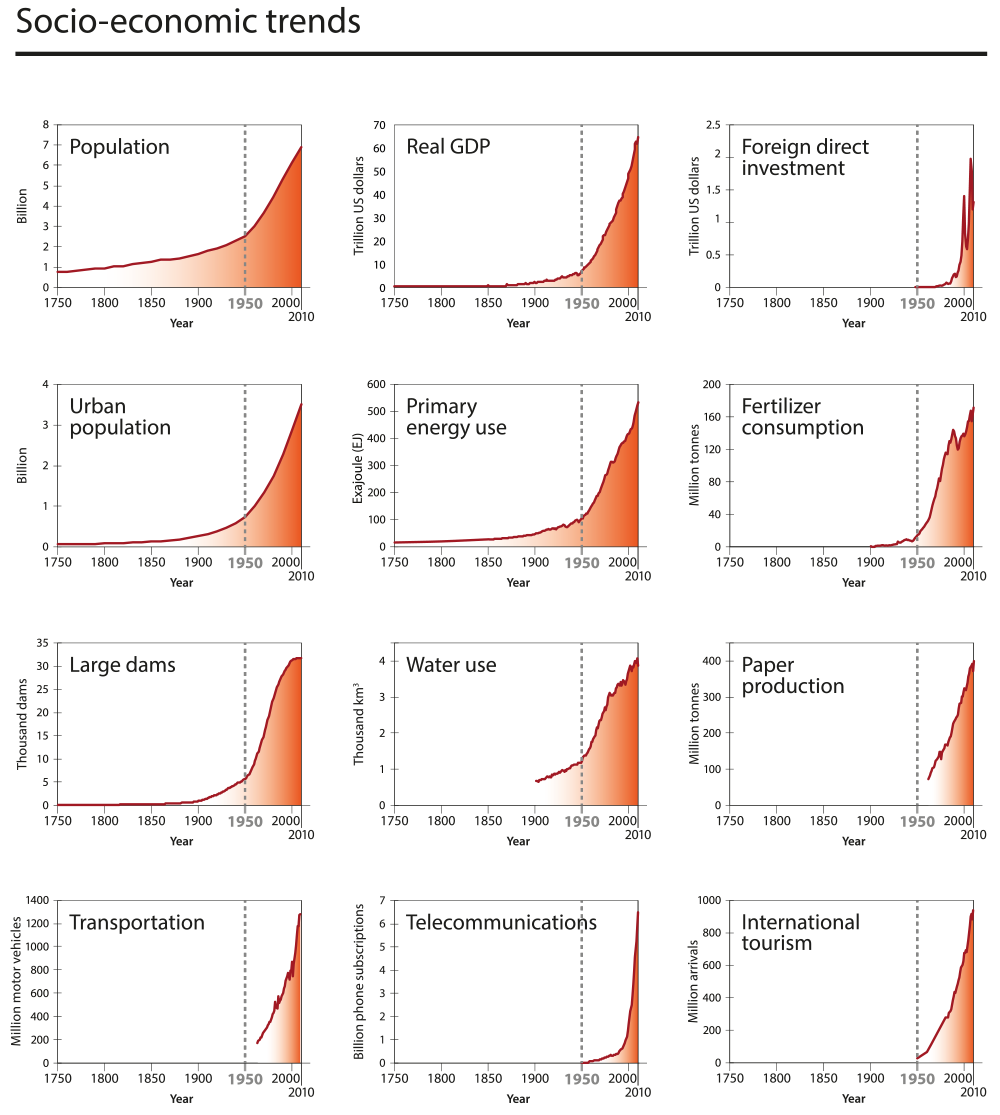
> Why do I pay almost double for 'bio' foodstuff? Why do people today choose to buy ultra processed instead of simple foods
Why is healthy food so expensive in America? Blame the Farm Bill that Congress always renews to make burgers cheaper than salad
https://fortune.com/2023/07/21/why-healthy-food-so-expensive...
The 2023 Farm Bill is projected to spend $700 billion over the next five years, with powerful industry lobbyists directing funds to enrich themselves at the expense of agricultural communities, human health, animal welfare, and environmental sustainability.
Most Americans have never heard of this massive omnibus bill, which Congress reauthorizes every five or so years, yet it impacts us every day. It shapes our food system–from subsidizing factory farms to funding food and nutrition programs, and it is why burgers are artificially cheap and salads cost more than they should.
> with votes for politicians that push for innovative solutions
Where did that got us in the last 50 years? Still business as usual.
> actively trying to develop new technologies to mitigate the strategy
You have one of the 4 classic viewpoints, pretty understandable, but not really realistic. https://www.youtube.com/watch?v=qPb_0JZ6-Rc
Our technology is a hell of a lot more efficient nowadays so hopefully these the answers to these questions will be uncomfortable rather than unbearable.
> Why do people today choose to buy ultra processed instead of simple foods?
Advertising. UPF allows companies to add value to food by making it more addictive/less filling/etc. See the obesity epidemic.
Whole foods take less fossil fuel to create -- less fossil fuel to process, less to transport, etc. They're not even that much more expensive.
> Who decides how much we can drive, and fly? Can I go visit my grand-dad in the countryside? Can Bill Gates go to the climate conference on the other side of the world to scold us?
The expense of how much fuel costs. The social stigma of driving a gas guzzling truck.
> I'm pushing for actively trying to develop new technologies to mitigate the strategy and you are fighting against the viewpoint that we should put our heads in the sand and wait for a solution... I think this thread has run its course.
It's sad that you don't see what you're doing for what it is. You started this thread by effectively saying you have A/C so technology will save us. What happens when heatwaves disable the electric system? When we have power outages due to climate changed caused storms? Will technology save us then?
My whole point is you are being too blase about the existential threat we face. You're not even a minority viewpoint. I hope we don't all come to regret this attitude.
We don't have to wait for it appearing.
We just have to build it out.
But we don't, because of irrational fears.
Well, actually countries are starting to turn around and re-investing in nuclear, because governments know that this is the only viable solution.
There is nothing we can do to help them now, apart from shipping them A/C units, diesel generators and diesel fuel to burn.
Do you know this as a fact? Or is it just wishful thinking?
Although we are making progress, that progress does not appear to be fast enough to avoid the "wet bulb events" that others have described (and linked to sources).
So that is going to happen. And once it happens, the governments where this happened will have a choice: protect their citizens or let them die.
What do you think will happen?
If people do survive in the Sahara, we can do that, too.
This country has half a million people alone: https://en.wikipedia.org/wiki/Western_Sahara
Here's the executive summary:
> It is as vast as the United States and so arid that most bacteria cannot survive there. Its loneliness is so extreme it is said that migratory birds will land beside travelers, just for the company. William Langewiesche came to the Sahara to see it as its inhabitants do, riding its public transport, braving its natural and human dangers, depending on its sparse sustenance and suspect hospitality. From his journey, which took him across the desert’s hyperarid core from Algiers to Dakar, he has crafted a contemporary classic of travel writing.
What was your point, again?
And I am sure I am not alone.
There are tribal societies that have been stable for tens of thousands of years. Modernity is an inherently unstable system.
With which average lifespan and enduring what pain? What was the solution for, say, a tooth going south?
Medicine was ugly back then. Between 1% to 1.5% of all the woman giving birth would die while doing so in 1600. Something insane like that. We've literally gone down at least 30x.
Also back then women couldn't really decide whether they'd become pregnant or not.
At 17 years old or so I got a medical emergency: doctor diagnosed an appendicitis that was missed a few days earlier for I was under strong painkillers. When it was diagnosed a few hours later I was undergoing surgery.
In 1600 I could very well have died of peritonitis / infection without the surgery. I see all those years I lived since then as pure win, thanks to modernity.
It comes at a cost but I live better than any king has ever lived (except for those who live/lived in modern times).
I had a terrible fever when I was 3, I probably wouldn't have made it if it wasn't for modern health care. Beyond that, though, I've only needed modern healthcare for ailments caused by modernity: Tooth problems from sugar and not chewing enough, and also I was hit by a car.
Talking about cruel healthcare practices, though, can you imagine being on your back with a tube shoved down your throat for weeks while you slowly suffocate to death like some of those peeps in the COVID wards?
3 of my 4 grandparents are dead, and all but one died in slow, drawn out and excruciatingly painful ways.
We kinda do. We just have an irrational fear of it.
The fact that we let irrational fears override real and pressing problems is an indicator that the problems aren't perceived as real and pressing enough.
Yet.
You are talking about nuclear, aren't you? I agree with you that nuclear is part of the solution. The pragmatic in me just insists that we cut drastically fossil fuel consumption after enough nuclear reactors are in operation.
And that seems like a good idea.
Well, in parallel. There’s quite a bit we can do while we build, but we need to build.
For example, biking more for short journeys not just cuts emissions, it is also healthy, makes you happier, and reduces congestion.
Having company doesn't mean that preference isn't selfish and short-sighted though.
Here are some of the planetary costs of the industrial revolution:
> The contemporary rate of extinction of species is estimated at 100 to 1,000 times higher than the background extinction rate
> 7% of all species on Earth may have been lost already
> only around 3% of the planet's terrestrial surface is ecologically and faunally intact
> roughly one million species face extinction within decades as the result of human actions
- https://en.wikipedia.org/wiki/Holocene_extinction
If you believe Sky Daddy only cares about humans, or that we out-value all other life on the planet because we invented rocketry and antibiotics, then I guess this is all fine. But I don't, and I'm not alone either.
Just as we can have capitalism without poverty, we can have industry without apocalypse. It'll upset some extraordinarily wealthy fossil fuel people, but they're the ones who put us in this mess.
Just how? I've not yet heard a proposal for a plan that is expected to work.
Turns out we already have nuclear power, so there is little need for innovation to get to zero emissions. Just need to get over our collective irrational fears and get building.
Even the baby steps we're making towards this are leaps compared to the degrowth crowd solutions.
So yeah, I'm pessimistic about how climate change will unfold.
It's probably not even a black and white thing honestly. For the person dealing with unlivable temperatures in India it might feel one way. For the person living in Siberia that just got a couple of hectares of farmland it might feel differently.
I'd wager a bet that in the future, more people will be impacted by war caused by climate change than the actual climate change effects, if we cannot solve the issue technologically.
Yes, it's adding to the problem, very little. Yes, it's helping you, very much. No, you don't have an alternative.
I sincerely wish you it doesn't break. Keep cool!
> Gareth Redmond-King, at the Energy and Climate Intelligence Unit in the UK, said: “As we keep burning fossil fuels, we fuel ever worse climate impacts. It won’t stop until we cut emissions to net zero. Politicians who attempt to delay [climate] measures are locking in more of these extremes.”
To be honest, this kind of extremism is turning me off from the whole climate movement. Emissions are never going to be cut to net zero. We have billions of people that still need to industrialize. People are not just gonna roll over and turn into cavemen. We have a global trading network that needs to be kept up. Politicians and corporations are not gonna do anything about it, maybe a meaningless tax.
I think the only way out of this mess is innovation, not net zero emissions.