myshpa
Re:New study definitively confirms gulf stream weakening
on Sunday October 08, 2023 @05:46PM (#37814696)
Re:New study definitively confirms gulf stream weakening
on Sunday October 08, 2023 @05:34PM (#37814621)
I see no positive effects. We should try to prevent the inevitable, while there's still some time. Not long. But some.
Re:New study definitively confirms gulf stream weakening
on Sunday October 08, 2023 @05:30PM (#37814591)
Maybe the biggest problem is how big a problem it is. It's maybe beyond the capabilities of a regular person to fully comprehend the extent of the problems we're facing.
Overshoot encompasses many aspects, including biodiversity loss, deforestation, pollution, resource depletion, and much more.
The fundamental issue lies in capitalism and the financial system, with its embedded need for constant growth. Almost all money in the system is created through loans by banks, and there is an interest on that money that must be paid, typically around 3% or so, and this interest compounds exponentially.
As a result, our growth is exponential, and there is no sign of it slowing down. Our GDP doubles every 30 years, while our finite natural environment is the first to be sacrificed in an attempt to service one's debts.
We don't see any real debate about degrowth, reforestation, equity, food system, financial system ... no real progress on any front.
Animal species have witnessed a 70% decline in just the last 50 years. How long until our insect and pollinator populations collapse? How long until forests lose their ability to generate rain completely? How long until oceans are devoid of fish or sharks (with 90% already gone), leading to the collapse of the entire marine ecosystem? How long until major crop failures occur?
When hunger and water shortages become widespread, police will give up, wars and slavery and hordes of cannibals will become our daily grim reality. There have been collapses of civilizations before, but there has never been a total collapse of the biosphere as well. So I too worry for the future of today's young.
Sorry for the rant.
Re:New study definitively confirms gulf stream weakening
on Sunday October 08, 2023 @04:30PM (#37814149)
> more definitive action will be taken against climate change
a) our problem is not only the climate change, but overshoot / polycrisis
b) there is a profit to be made even from the collapse, maybe bigger than ever
Nothing will get changed, because solving the problems would mean dismantling the system.
Re:New study definitively confirms gulf stream weakening
on Sunday October 08, 2023 @04:24PM (#37814095)
> global warming could result in local cooling in Western Europe because of a weakened Gulf Stream. We are still far from that.
https://en.wikipedia.org/wiki/Atlantic_meridional_overturnin...
In July 2023, a paper from a pair of University of Copenhagen researchers suggested that AMOC collapse would most likely happen around 2057, with the 95% confidence range between 2025 - 2095.
It may be a controversial paper, but all probabilities are off after this year. So there is a possibility that it could collapse as soon as two years from now.
Re:Questions to ask a teenager to start an important conversation
on Sunday October 08, 2023 @09:12AM (#37810156)
Many individuals neglect to address climate change (or rather overshoot), often shifting blame while maintaining their consumption habits. For instance, despite knowing its significant environmental impact, most people are reluctant to reduce meat consumption, risking a bleak future for their offspring. This inaction and mere talk reflect a hypocritical stance, as people avoid making meaningful contributions to climate solutions, ultimately burdening future generations with the problem.
Re:Questions to ask a teenager to start an important conversation
on Sunday October 08, 2023 @08:47AM (#37809979)
What do you feel about what’s happening to our planet?
Teenagers are thinking lots about climate change, and many of them, says Hannah, are quite terrified about what’s happening, so it can be really helpful to talk it through. “We need to take action – this is a very serious situation – but you don’t want your child to be fearful the whole time that we’re on the verge of extinction,” she says. Listen to their concerns and be ready to talk about what people can do to make a difference.
Hm ... take action ... extinction ... talk. That shall help.

Everyone Daydreams About Collapse. Few Understand It
Re:Shell Using Fortnite, TikTok, etc. to Convince Kids Fossil Fuels Ar...
on Saturday October 07, 2023 @08:16AM (#37801069)
How Shell Destroyed An Entire Country
Re:South American monsoon nears tipping point, likely causing Amazon d...
on Friday October 06, 2023 @03:56PM (#37795479)
This might interest you ...
https://www.oecd-ilibrary.org/environment/climate-tipping-po...
South American monsoon nears tipping point, likely causing Amazon dieback
Re:Type 2 diabetes diagnosis at age 30 can reduce life expectancy by u...
on Wednesday October 04, 2023 @06:25AM (#37763142)
https://nutritionfacts.org/topics/diabetes/
Type 2 diabetes, however, is almost always preventable, often treatable, and sometimes even reversible through diet and lifestyle changes. Like other leading killers—especially heart disease and high blood pressure—type 2 diabetes may be an unfortunate consequence of dietary choices. There is hope, though, even if you already have diabetes. Through lifestyle changes, you may be able to achieve a complete remission of type 2 diabetes, even if you’ve been suffering with the disease for decades.
People who eat a plant-based diet have been found to have just a small fraction of the diabetes rate seen in those who regularly eat meat. As diets become increasingly plant-based, there appears to be a stepwise drop in diabetes rates. Based on a study of 89,000 Californians, flexitarians (who eat meat maybe once weekly rather than daily) appear to cut their rate of diabetes by 28 percent, and those who cut out all meat except fish appear to cut their rates in half. What about those eliminating all meat, including fish? They appear to eliminate 61 percent of their risk. And those who go a step farther and drop eggs and dairy, too? They may drop their diabetes rates 78 percent compared with people who eat meat on a daily basis.
Type 2 diabetes diagnosis at age 30 can reduce life expectancy by up to 14 years
I Have Discovered That Giving Up on the World Can Set You Free
America’s Afghanistan war devastated the environment, may never be cleaned up
Musk mocks Zelenskyy; “He's fighting Russia. You couldn't fight Zuckerberg”
Re:Slovenia’s Beautiful Beehives Turn Apiaries into Art
on Monday October 02, 2023 @05:24PM (#37744618)
True ... but whether they are native or not, their effect on wild pollinators is the same.
Re:Slovenia’s Beautiful Beehives Turn Apiaries into Art
on Monday October 02, 2023 @03:56PM (#37743608)
That eternit/asbestos roof in the first picture ... no, thank you.
Another article about Slovenia's beekeepers: https://www.nytimes.com/2023/08/19/business/beekeeping-compa...
“If you overcrowd any space with honey bees, there is a competition for natural resources, and since bees have the largest numbers, they push out other pollinators, which actually harms biodiversity,” he said, after a recent visit to the B&B bees. “I would say that the best thing you could do for honey bees right now is not take up beekeeping.”
https://www.nwf.org/Home/Magazines/National-Wildlife/2021/Ju...
“Keeping honey bees to ‘save the bees’ is like raising chickens to save birds.”
https://www.nature.com/articles/s41559-022-01847-3
Greater bee diversity is needed to maintain crop pollination over time
Re:Return to Office Is Bullshit and Everyone Knows It
on Monday October 02, 2023 @01:02PM (#37741047)
WFH should be mandatory wherever possible.
https://e360.yale.edu/features/tire-pollution-toxic-chemical...
Road Hazard: Evidence Mounts on Toxic Pollution from Tires
https://www.pnas.org/doi/10.1073/pnas.2304099120
"in the United States, switching from working onsite to working from home can reduce up to 58% of work’s carbon footprint, and the impacts of IT usage are negligible, while office energy use and noncommute travel impacts are important"
https://www.irishnews.com/magazine/science/2023/03/18/news/i...
Impact of roadkill ‘more shocking' than previously thought – scientists
https://www.cnbc.com/2023/08/11/80percent-of-bosses-say-they...
80% of bosses say they regret earlier return-to-office plans
Tesla Semi travels over 1k miles in a single day
Just how bad is climate change? It’s worse than you think, says Doomsday author
Re:“Never write a database. Even if you want to, even if you think you...
on Saturday September 30, 2023 @04:36PM (#37719527)
Michał Niczyporuk @mihn
So when talk "Never write a database" is coming? ;)
Charity Majors @mipsytipsy
That's it. That's the talk.
"Never write a database. Even if you want to, even if you think you should. Resist. Never write a database. Unless you have to write a database. But you don't."
I will present this talk at any conference of your choosing.
Re:A Revelation About Trees Is Messing with Climate Calculations
on Saturday September 30, 2023 @04:16PM (#37719314)
Not really true.
https://newrepublic.com/article/163735/myth-regenerative-ran...
https://grist.org/climate-energy/cattle-grazing-is-a-climate...
https://www.nature.com/articles/nature25138
https://www.oxfordmartin.ox.ac.uk/publications/grazed-and-co...
https://plantbasednews.org/news/environment/george-monbiot-r...
“So any story that says it’s good to be farming these livestock, it’s good to be eating these livestock, is a story which justifies among the most devastating processes on Earth,” he said. “It is climate science denial.”
Monbiot linked this denial to the interests of major corporations like McDonald’s, General Mills, JBS, and the Murdoch Network, who he says have “backed and weaponized” the idea that grazing cattle is environmentally beneficial. “The story is false,” he said. “When you make a grand claim such as this one, that livestock can mitigate climate change, either you produce the evidence for that claim or if you cannot produce the evidence you withdraw the claim. The evidence has not been produced, the claim does not stand.”
Re:Farm robots inspired by ant brains
on Friday September 29, 2023 @04:20PM (#37709648)
Pesticides? You mean something like robotic cats catching mice? :) I mean, focusing on biodiversity conservation would be probably more impactful.
I dream of robots capable of weeding, replacing herbicides, and selectively pruning/mulching to reduce fertilizer usage.
Re:How many animals get slaughtered every day?
on Friday September 29, 2023 @11:18AM (#37705514)
> You omitted health
But we don't need meat for health.
American Dietetic Association
"It is the position of the American Dietetic Association that appropriately planned vegetarian diets, including total vegetarian or vegan diets, are healthful, nutritionally adequate, and may provide health benefits in the prevention and treatment of certain diseases. Well-planned vegetarian diets are appropriate for individuals during all stages of the life cycle, including pregnancy, lactation, infancy, childhood, and adolescence, and for athletes."
NHS UK
"A vegetarian or vegan diet can be suitable for everyone, regardless of their age."
British Dietetic Association
"[I]t is possible to follow a well-planned, plant-based, vegan friendly diet that supports healthy living in people of all ages, and during pregnancy and breastfeeding."
> Meat is a package of pre-processed vitamins, minerals and energy sources.
In addition to saturated fats, cholesterol, and common additives like nitrates and preservatives, meat consumption can also entail exposure to antibiotics, hormones, bioaccumulated pesticides and herbicides, and ethical concerns related to cruelty and mistreatment in the meat production industry.
> Other than health, taste, tradition, habit and convenience, what has meat ever done for us?
If everyone on Earth adopted the American or European diet, we would require more than five Earths to feed everyone [0]. Animal agriculture is already the leading cause of deforestation [1], biodiversity loss [2] [3], and water pollution [4]. Our current agricultural practices are pushing over a million species towards extinction [5].
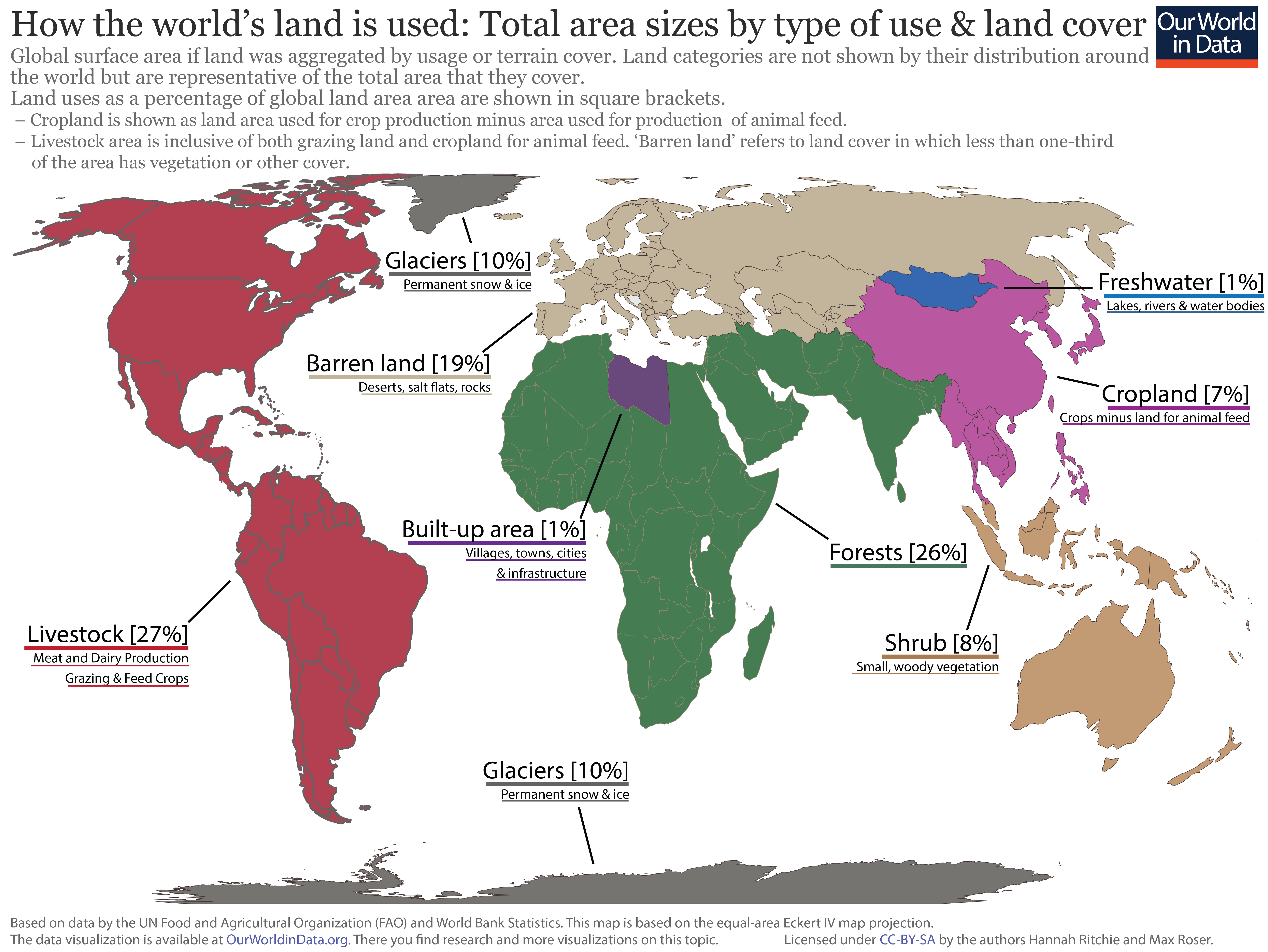
Switching to plant-based diets could free up an area equivalent to the combined size of both Americas [6], allowing us to reforest it and promote biodiversity recovery. By reforesting this vast area, we could sequester enough carbon to potentially reverse climate change [7] [8] (assuming a simultaneous phase-out of fossil fuels, of course) [9].
This approach represents the only sustainable way to feed a population of 10 billion [10] while reducing our agricultural land requirements from 4 billion hectares to 1 billion hectares [11]. Animal agriculture one of the culprits pushing six out of nine Earth boundaries beyond safe levels [12] [13].
So ... it does a lot.
[0] https://css.umich.edu/publications/factsheets/sustainability...
[1] https://ourworldindata.org/drivers-of-deforestation
[2] https://www.unep.org/news-and-stories/press-release/our-glob...
[3] https://pubmed.ncbi.nlm.nih.gov/26231772/
[4] https://blogs.ubc.ca/makingwaves/2017/02/07/cows-pigs-and-po...
[5] https://www.nature.com/articles/d41586-019-01448-4
[6] https://ourworldindata.org/uploads/2013/10/World-Map-by-Land...
[7] https://iopscience.iop.org/article/10.1088/1748-9326/10/8/08...
[8] https://journals.plos.org/climate/article?id=10.1371/journal...
[9] https://ourworldindata.org/emissions-by-sector
[10] https://www.eurekalert.org/news-releases/917471
[11] https://ourworldindata.org/land-use-diets
[12] https://www.stockholmresilience.org/research/research-news/2...
[13] https://en.wikipedia.org/wiki/Planetary_boundaries#Nine_boun...
Researchers find high concentrations of microplastics in cave water and sediment
Re:How many animals get slaughtered every day?
on Friday September 29, 2023 @06:12AM (#37701543)
Tradition, habit, convenience, taste. No other reasons exist.
Re:Inhibition of fatty acid oxidation enables heart regeneration in ad...
on Thursday September 28, 2023 @07:54PM (#37697573)
Re:Inhibition of fatty acid oxidation enables heart regeneration in ad...
on Thursday September 28, 2023 @07:53PM (#37697562)
> The question was about evidence which would show that it could reverse heart disease not prevent it.
It's under the video in the list of sources :)
Ellis FR, Sanders TA. Angina and vegan diet. Am Heart J. 1977 Jun;93(6):803-5
https://www.sciencedirect.com/science/article/abs/pii/S00028...
Four patients were placed on a vegan diet in 1977. Three of them adhered to the diet and experienced a reversal of the disease (an improvement in their symptoms), while one patient saw improvement but later switched back to a regular diet, resulting in a return of his symptoms.
Esselstyn CB Jr, Gendy G, Doyle J, Golubic M, Roizen MF. A way to reverse CAD? J Fam Pract. 2014 Jul;63(7):356-364b
https://pubmed.ncbi.nlm.nih.gov/25198208/
In a study involving 198 patients with cardiovascular disease, 89% adhered to a plant-based diet, eliminating dairy, fish, and meat while adding oil. These adherent patients experienced only one recurrent cardiac event (a stroke), resulting in a low recurrence rate of 0.6%. In contrast, 62% of nonadherent participants experienced adverse events. This suggests that intensive counseling on plant-based nutrition can be successful in reducing cardiac events and warrants further testing in broader populations to address the cardiovascular disease epidemic.