This statement contains a bunch of hidden assumptions:
1. That they believe their stopping will address the problem. 2. That they believe the only choice is whether or not to stop. 3. That they don't think it's possible to make AI safe through sufficient regulation. 4. That they don't see benefits to pursuing AI that could outweigh risks.
If they believe any of these things, then they could believe the risks were real and also not believe that stopping was the right answer.
And it doesn't depend on whether any of these beliefs are true: it's sufficient for them to simply believe one of them and the assumptions your statement depends on break down.
Because it only works if it is done across the whole country, as a system not as one individual unilaterally stopping.
And here any of these efforts won’t work unless there is international cooperation. If other countries can develop the AI weapons, and get an advantage, then you will also.
We need to apply the same thinking as chemical weapons or the Montreal Conference for banning CFCs
It is extremely rare for companies or their senior staff to beg for regulation this far in advance of any big push by legislators or the public.
The interpretation that this is some 3-D chess on the companies' part is a huge violation of Occam's Razor.
- - - -
I think the primary risk these folks are worried about is loss of control. And in turn, that's because they're all people for whom the system has more-or-less worked.
Poor people are worried the risk that the rich will keep the economic windfall to themselves and not share it.
With AGI existential risk, its likely to happen on a much shorter timescale, and it seems likely you won't be able to buy your way out of it.
AI is an existential threat to search engines like Google, social media (FB, Twitter), advertising networks, and other massive multinationals. Many other industries, including academia is threatened as well. They’d all rather strangle the AI baby in the crib now then let it grow up and threaten them.
They believe the only way it should be allowed to grow is under their benevolent control.
But the abilities of the latest crop of LLMs changed his mind. And he very publicly admitted he had been wrong, which should be applauded, even if you think it took him far too long.
By quitting and saying it was because of his worries he sent a strong message. I agree it is unlikely he'll make any contributions to technical alignment, but just having such an eminent figure publicly take these issues seriously can have a strong impact.
Anyone upvoting this comment should take a long look at the names on this letter and realize that many are not conflicted.
Many signers of this letter are more politically sophisticated than the average HN commenter, also. So sure, maybe they're getting rolled by marketers. But also, maybe you're getting rolled by suspicion or bias against the claim they're making.
The concern is that the most informed names, and those spearheading the publicity around these letters, are the most conflicted.
Also, you can't scan bio lines for the affiliations that impact this kind of statement. I'm not disputing that there are honest reasons for concern, but besides job titles there are sponsorships, friendships, self publicity, and a hundred other reasons for smart, "politically sophisticated" people to look the other way on the fact that this statement will be used as a lobbying tool.
Almost everyone, certainly including myself, can agree that there should be active dialog about AI dangers. The dialog is happening! But by failing to make specifics or suggestions (in order to widen the tentpole and avoid the embarrassment of the last letter), they have produced an artifact of generalized fear, which can and will be used by opportunists of all stripes.
Signatories should consider that they are empowering SOMEBODY, but most will have little say in who that is.
Both of them are criticizing their own life's work and the source of their prestige. That has to be emotionally painful. They aren't doing it for fun.
I totally understand not agreeing with AI x-risk concerns on an object level, but I find the casual dismissal bizarre.
If instead you want to consider the highest status/most famous people working on AI in general, then the list of signatories here is a pretty good summary. From my flawed perspective as a casual AI enthusiast, Yann LeCun and Jürgen Schmidhuber are the most glaring omissions (and both have publicly stated their lack of concern about AI x-risk).
Of course, the highest status people aren't necessarily the most relevant people. Unfortunately, it's more difficult for me to judge relevance than fame.
There are people studying how previous societies got into existential risk situations, too.
We also have a huge amount of socio-economic modelling going into climate change, for example.
So I'd say there should be quite a few around.
I also find it somewhat telling that something like "massive wealth disparity" or "massive unemployment" are not on the list, when this is a surefire way to create a highly unstable society and a far more immediate risk than AI going rogue. Risk #5 (below) sort of alludes to it, but misses the mark by pointing towards a hypothetical "regime" instead of companies like OpenAI.
> Value Lock-In
> Highly competent systems could give small groups of people a tremendous amount of power, leading to a lock-in of oppressive systems.
> AI imbued with particular values may determine the values that are propagated into the future. Some argue that the exponentially increasing compute and data barriers to entry make AI a centralizing force. As time progresses, the most powerful AI systems may be designed by and available to fewer and fewer stakeholders. This may enable, for instance, regimes to enforce narrow values through pervasive surveillance and oppressive censorship. Overcoming such a regime could be unlikely, especially if we come to depend on it. Even if creators of these systems know their systems are self-serving or harmful to others, they may have incentives to reinforce their power and avoid distributing control.
Isn’t this to some degree exactly what all of these warnings about risk are leading to?
And unlike nuclear weapons, there are massive monetary incentives that are directly at odds with behaving safely, and use cases that involve more than ending life on earth.
It seems problematic to conclude there is no real risk purely on the basis of how software companies act.
That is not the only basis. Another is the fact their lines of reasoning are literal fantasy. The signatories of this "statement" are steeped in histories of grossly misrepresenting and overstating the capabilities and details of modern AI platforms. They pretend to the masses that generative text tools like ChatGPT are "nearly sentient" and show "emergent properties", but this is patently false. Their whole schtick is generating FUD and/or excitement (depending on each individual of the audience's proclivity) so that they can secure funding. It's immoral snake oil of the highest order.
What's problematic here is the people who not only entertain but encourage and defend these disingenuous anthropomorphic fantasies.
Honestly I'm a little skeptical that you could accurately attribute your scare-quoted "nearly sentient" to even Sam Altman. He's said a lot of things and I certainly haven't seen all of them, but I haven't seen him mix up intelligence and consciousness in that way.
Isn't this also to be expected at this stage of development? i.e. if these concerns were not "fantasy", we'd already be experiencing the worst outcomes? The risk of MAD is real, and yet the scenarios unleashed by MAD are scenarios that humankind has never seen. We still take the the risk seriously.
And what of the very real impact that generative AI is already having as it exists in production today? Generative AI is already upending industries and causing seismic shifts that we've only started to absorb. This impact is literal, not fantasy.
It seems naively idealistic to conclude that there is "no real risk" based only on the difficulty of quantifying that risk. The fact that it's so difficult to define lies at the center of what makes it so risky.
Yeah, because nuclear weapons are real and the science behind them is well-understood. Super intelligent AI is not real, and it is nowhere near becoming real. It is a fantasy fueled by science-fiction and wishful thinking.
> And what of the very real impact that generative AI is already having as it exists in production today?
This is a real concern, but it is not what is meant by "existential risk of AI". Losing jobs does not threaten our existence; it just means we'll need to figure out different ways to build society.
> The fact that it's so difficult to define lies at the center of what makes it so risky.
The fact that it's so difficult to define lies at the center of what makes it so profitable for many of these people.
I don’t think anyone claiming that super intelligent AI is already here have thought this through. But on what basis do you feel confident to place a bet with certainty that it’s “nowhere near becoming real”?
At a minimum, we know that AI technology has made a huge leap forward, if nothing else in the public consciousness. Again, entire industries are about to be eliminated, when just a few years ago no one would have believed claims about language models so good they could convince misguided engineers into thinking they’re sentient.
This explosion of AI is itself accelerating the explosion. The world is now focused on advancing this tech, and unlike “Web3”, people recognize that the use cases are real.
It’s in the context of this acceleration that I don’t understand where “everything is fine” can possibly come from? And how are the underlying factors used to derive such a stance substantively better than the factors leading people to worry?
> Losing jobs does not threaten our existence;
Based on a growing understanding of psychology, there’s an argument to be made that losing jobs is akin to losing one’s purpose in life. This is not to say that people can’t learn to derive satisfaction from other activities, but if job loss outpaces our ability to transition masses of people to a fundamentally new kind of living, that’s going to drastically alter the state of public consciousness and the resulting decisions we collectively make. We’re already experiencing a mental health crisis, and that seems to be coming from our failure to understand and safely integrate the last generation of new technology. We’re still in the stage of trying to figure out what we’ve fucked up and not much closer to having an answer or solution. And once we identify the problem, it’s not clear that solutions can be implemented effectively at scale.
I think too many people are looking at this as some kind of “Humans vs. AI” thing, but are missing the fact that we’re talking about drastic changes to an ecosystem without considering the 2nd/3rd/nth order implications of those changes, and their likely impact on collective consciousness and mental health, especially when you add the backdrop of hyper-polarization and dysfunction in the institutions that are supposed to be responsible for figuring out that new societal structure. All of which ultimately impacts global power structures, the destabilization of which leads to hard-science kinds of obliteration.
> it just means we'll need to figure out different ways to build society.
That’s an enormously large hand-wave when you consider the implications of such an unplanned transition. “Figure out different ways to build society” almost universally comes from/with violence, poverty, starvation, unrest, etc. The status quo will not change until things have gotten truly bad.
An AI system need not be super-intelligent to have serious implications for humanity. There is a significant amount of harm that precedes “complete extinction”, and I think we can’t discard the myriad of intermediately bad outcomes just to posit that there is no existential risk. To me, “existential” primarily points to “the possibility of fundamentally altering humanity’s existence in ways that most people would agree are undesirable”. The culmination of which is total extinction, but there’s a long distance between “this is adversely impacting humanity enough that we should take active steps to counteract that harm” and “this is so bad it will kill all humans”. You could be right that we’re nowhere close to extinction level tech, but if we’re heading towards it, there are a lot of checkpoints along the way worthy of scrutiny.
> The fact that it's so difficult to define lies at the center of what makes it so profitable for many of these people.
The fact that this may ultimately benefit the businesses currently at the forefront is orthogonal to the the credibility of the risks. The two are not mutually exclusive, and focusing only on the potential of profit is a trap.
Has it occurred to you what happens if you are wrong, like 10% chance you are wrong? Well it's written in the declaration.
> Has it occurred to you what happens if you are wrong?
Has it occurred to you what happens if YOU are wrong? AI risk is theoretical, vague and most arguments for it are weak. The risk of bad law making is very real, has crushed whole societies before and could easily cripple technological progress for decades or even centuries.
IOW the risk posed by AI risk advocates is far higher than the risk posed by AI.
If you are wrong there are no humans left.
If I am wrong,inequality,societies will suffer like they have always in the hands of the strong.
I am not a world known expert on xrisk to estimate this. You are not either. We have all these people claiming the probability is high enough. What else is ti be said? HNers shouldn't be reminded "trust in sciense".
https://www.theguardian.com/science/2013/dec/06/peter-higgs-...
1. Those who are part of major corporations are concerned about the race dynamic that is unfolding (which in many respects was kicked off or at least accelerated by Microsoft's decision to put a chatbot in Bing), extrapolating out to where that takes us, and asking for an off ramp. Shepherding the industry in a safe direction is a collective organization problem, which is better suited for government than corporations with mandates to be competitive.
2. Those who are directly participating in AI development may feel that they are doing so responsibly, but do not believe that others are as well and/or are concerned about unregulated proliferation.
3. Those who are directly participating in AI development may understand that although they are doing their best to be responsible, they would benefit from more eyes on the problem and more shared resources dedicated to safety research, etc.
Cynicism is understandable in this ever-expanding whirlpool of bullshit, but when something looks like it has potential, we need to vigorously interrogate our cynicism if we're to stand a chance at fighting it.
> As I mentioned in another comment, the listed risks are also notable because they largely omit economic risk. Something that will be especially acutely felt by those being laid off in favor of AI substitutes. I would argue that 30% unemployment is at least as much of a risk to the stability of society as AI generated misinformation.
> If one were particularly cynical, one could say that this is an attempt to frame AI risk in a manner that still allows AI companies to capture all the economic benefits of AI technology without consideration for those displaced by AI.
If policymaker's understanding of AI is predicated on hypothetical scenarios like "Weaponization" or "Power-Seeking Behavior" and not on concrete economic disruptions that AI will be causing very soon, the policy they come up with will be inadequate. Thus I'm frustrated with the framing of the issue that safe.ai is presenting because it is a distraction from the very real societal consequences of automating labor to the extent that will soon be possible.
We seem perfectly resigned to the expansion of an already huge underclass—-with or without the help of LLMs.
Might not AGI help convince our tech savvy aristocracy that one fundamental problem still is better balancing of opportunities and more equitable access to a good education? I see the probability of that happening as precisely 4.6%.
In other words, a potential conflict of interest for someone seeking tenure?
Academics shilling for OpenAI would get them jobs in the next presidential administration?
I’m not uncovering anything, several of the academic signatories list affiliations with OpenAI, Google, Anthropic, Stability, MILA and Vector resulting in a financial conflict.
Note that conflict does not mean shill, but in academia it should be disclosed. To allay some concerns a standard disclosure form would be helpful (i.e. do you receive funding support or have financial interest in a corporation pursuing AI commercialization).
Go to: https://www.safe.ai/statement-on-ai-risk#signatories and uncheck notable figures.
Several of the names at the top list a corporate affiliation.
If you want me to pick specific ones with obvious conflicts (chosen at a glance): Geoffrey Hinton, Ilya Sutskever, Ian Goodfellow, Shane Legg, Samuel Bowman and Roger Grosse are representative examples based on self-disclosed affiliations (no research required).
These are, for the most part, obvious applications of a technology that exists right now but is not widely available yet.
The problem with every discussion around this issue is that there are other statements on "the existential risk of AI" out there that are either marketing ploys or science fiction. It doesn't help that some of the proposed "solutions" are clear attempts at regulatory capture.
This muddles the waters enough that it's difficult to have a productive discussion on how we could mitigate the real risk of, e.g., AI generated disinformation campaigns.
Sure, but we're not talking about those other ones. Dismissing good faith initiatives as marketing ploys because there are bad faith initiatives is functionally no different than just shrugging and walking away.
Of course OpenAI et. al. will try to influence the good faith discussions: that's a great reason to champion the ones with a bunch of good faith actors who stand a chance of holding the industry and policy makers to task. Waiting around for some group of experts that has enough clout to do something, but by policy excludes the industry itself and starry-eyed shithead "journalists" trying to ride the wave of the next big thing will yield nothing. This is a great example of perfect being the enemy of good.
There's definitely a lot of marketing bullshit out there in the form of legit discussion. Unfortunately, this technology likely means there will be an incalculable increase in the amount of bullshit out there. Blerg.
Is it? Unless you mean something mundane like "there will be impact", the list of risks they're proposing are subjective and debatable at best, irritatingly naive at worst. Their list of risks are:
1. Weaponization. Did we forget about Ukraine already? Answer: Weapons are needed. Why is this AI risk and not computer risk anyway?
2. Misinformation. Already a catastrophic problem just from journalists and academics. Most of the reporting on misinformation is itself misinformation. Look at the Durham report for an example, or anything that happened during COVID, or the long history of failed predictions that were presented to the public as certain. Answer: Not an AI risk, a human risk.
3. People might click on things that don't "improve their well being". Answer: how we choose to waste our free time on YouTube is not your concern, and you being in charge wouldn't improve our wellbeing anyway.
4. Technology might make us fat, like in WALL-E. Answer: it already happened, not having to break rocks with bigger rocks all day is nice, this is not an AI risk.
5. "Highly competent systems could give small groups of people a tremendous amount of power, leading to a lock-in of oppressive systems". Answer: already happens, just look at how much censorship big tech engages in these days. AI might make this more effective, but if that's their beef they should be campaigning against Google and Facebook.
6. Sudden emergent skills might take people by surprise. Answer: read the paper that shows the idea of emergent skills is AI researchers fooling themselves.
7. "It may be more efficient to gain human approval through deception than to earn human approval legitimately". No shit Sherlock, welcome to Earth. This is why labelling anyone who expresses skepticism about anything as a Denier™ is a bad idea! Answer: not an AI risk. If they want to promote critical thinking there are lots of ways to do that unrelated to AI.
8. Machines smarter than us might try to take over the world. Proof by Vladimir Putin is provided, except that it makes no sense because he's arguing that AI will be a tool that lets humans take over the world and this point is about the opposite. Answer: people with very high IQs have been around for a long time and as of yet have not proven able to take over the world or even especially interested in doing so.
None of the risks they present is compelling to me personally, and I'm sure that's true of plenty of other people as well. Fix the human generated misinformation campaigns first, then worry about hypothetical non-existing AI generated campaigns.
With crypto, self-driving cars, computers, the internet or just about any other technology, development and distribution happened over decades.
With AI, there’s a risk that the pace of change and adoption could be too fast to be able to respond or adapt at a societal level.
The rebuttals to each of the issues in your comment are valid, but most (all?) of the counter examples are ones that took a long time to occur, which provided ample time for people to prepare and adapt. E.g. “technology making us fat” happened over multiple decades, not over the span of a few months.
Either way, I think it’s good to see people proactive about managing risk of new technologies. Governments and businesses are usually terrible at fixing problems that haven’t manifested yet… so it’s great to see some people sounding the alarms before any damage is done.
Note: I personally think there’s a high chance AI is extremely overhyped and that none of this will matter in a few years. But even so, I’d rather see organizations being proactive with risk management rather than reacting too the problem when it’s too late.
https://research.facebook.com/downloads/babi/
There's been a lot of progress since then, but it's also nearly 10 years later. Progress isn't actually instant or overnight. It's just that OpenAI spent a ton of money to scale it up then stuck an accessible chat interface on top of tech that was previously being mostly ignored.
If one were particularly cynical, one could say that this is an attempt to frame AI risk in a manner that still allows AI companies to capture all the economic benefits of AI technology without consideration for those displaced by AI.
People are being replaced by robots and AI because the latter are cheaper. That's the market force.
Cheaper means that more value us created. As a whole, people get more service for doing less work.
The problem is that the money or value saved trickles up to the rich.
The only solutions can be, regulations,
- do not tax anymore based on income from doing actual work.
- tax automated systems on their added value.
- use the tax generated capital to provide for a basic income for everybody.
In that way, the generated value goes to people who lost their jobs and to the working class as well.
I disagree
That list is a list of the dangers of power
Many of these dangers: misinformation, killer robots, people on this list have been actively working on
Rank hypocrisy
And people projecting their own dark personalities onto a neutral technology
Yes there are dangers in unbridled private power. They are not dangers unique to AI.
For a large number of them, these risks are worth far more than any possible gain from signing it.
When a large number of smart, reputable people, including many with expert knowledge and little or negative incentives to act dishonestly, put their names down like this, one should pay attention.
Notably missing representation from the Stanford NLP and NYU groups who’s perspective I’d also be interested in hearing.
Not committing one way or another regarding the intent with this but it’s not as diverse an academic crowd as the long list may suggest and for a lot of these names there are incentives to act dishonestly (not claiming that they are).
We’re talking about nuclear war level risks here. Even a 1% chance should definitely be addressed. Paul Christiano who has worked on AI risk and thought about it for a long time put it at 46%.
I know the Stanford researchers the most and the “biggest names” in LLMs from HAI and CRFM are absent. It would be useful to have their perspective as well.
I’d throw MetaAI in the mix as well.
Merely pointing out that healthy skepticism here is not entirely unwarranted.
> We’re talking about nuclear war level risks here.
Are we? This seems a bit dramatic for LLMs.
Even dumb viruses have caused catastrophic harm. Why? It’s capable of rapid self replication in a massive number of existing vessels. You add in some intelligence, vast store of knowledge, huge bandwidth, and some aid by malicious human actors, what could such a group of future autonomous agents do?
More on the risks of “doom”: https://www.lesswrong.com/posts/xWMqsvHapP3nwdSW8/my-views-o...
This is hardly the first time in history a new technological advancement may be used for nefarious purposes.
It’s a discussion worth having as AI advances but if [insert evil actor] wants to cause harm there are many cheaper and easier ways to do this right now.
To come out and say we need government regulation today does stink at least a little bit of protectionism as practically speaking the “most evil actors” would not adhere to whatever is being proposed, but this would impact the competitive landscape and the corporations yelling the loudest right now have the most to gain, perhaps coincidence but worth questioning.
Short-term AI risk likely comes from a mix of malicious intent and further autonomy that causes harm the perpetrators did not expect. In the longer run, there is a good chance of real autonomy and completely unexpected behaviors from AI.
AI autonomy is a hypothetical existential risk, especially in the short term. There are many non-hypothetical existential risks including actual nuclear proliferation and escalating great power conflicts happening right now.
Again my point being that this is an important discussion but appears overly dramatized, just like there are people screaming doomsday there are also equally qualified people (like Yann LeCun) screaming BS.
But let’s entertain this for a second, can you posit a hypothetical where in the short term a nefarious actor can abuse AI or autonomy results in harm? How does this compare to non-AI alternatives for causing harm?
That's what interesting to me. People fearmongering about bioengineering and GMO's were generally dismissed as being anti-science and holding humankind back (or worse, that there opposition to progress meant they had blood on their hands). Yet many of the people who mocked them proved themselves to be even more dogmatic and apocalyptic, while being much closer to influencing regulations. And the technology they're fear-mongering about is even further from being able to harm people than biotech is. We are actually able to create harmful biotech today if we want; we don't know when we'll ever be able to create AGI, and if it would even pose a danger if we did.
This mentality - "there could be a slight chance research into this could eventually lead to apocalyptic technology, no I don't have any idea how but the danger is so great we need a lot of regulation" - would severely harm scientific growth if we applied it consistently. Of course everyone is going to say "the technology I'm afraid of is _actually_ dangerous, the technology they're afraid if isn't." But we honestly have no clue when we're talking about technology that we have no idea how to create at the moment.
In fact, what you and GP wrote is baffling to me. The way I see it, biotech is stupidly obviously self-evidently dangerous, because let's look at the facts:
- Genetic engineering gets easier and cheaper and more "democratized"; in the last 10 years, the basics were already accessible to motivated schools and individual hobbyists;
- We already know enough, with knowledge accessible at the hobbyist level, to know how to mix and match stuff and get creative - see "synthetic biology";
- The substrate we're working with is self-replicating molecular nanotechnology; more than that, it's usually exactly the type that makes people get sick - bacteria (because they're most versatile nanobots) and viruses (because they're natural code injection systems).
Above is the "inside view"; for "outside view", I'll just say this: the fact that "lab leak" hypothesis of COVID-19 was (or still is?) considered to be one of the most likely explanations for the pandemics already tells you that the threat is real, and consequences are dire.
I don't know how can you possibly look at that and conclude "nah, not dangerous, needs to be democratized so the Evil Elites don't hoard it all".
There must be some kind of inverse "just world fallacy" fallacy of blaming everything on evil elites and 1%-ers that are Out To Get Us. Or maybe it's just another flavor of the NWO conspiracy thinking, except instead the Bildenbergs and the Jews its Musk, Bezos and the tech companies.
Same is, IMHO, with AI. Except that one is more dangerous because it's a technology-using technology - that is, where e.g. accidentally or intentionally engineered pathogens could destroy civilization directly, AI could do it by using engineered pathogens - or nukes, or mass manipulation, or targeted manipulation, or ... countless other things.
EDIT:
And if you ask "why, if it's really so easy to access and dangerous, we haven't already been killed by engineered pathogens?", the answer is a combination of:
1. vast majority of people not bearing ill intent;
2. vast majority of people being not interested and not able to perform (yet!) this kind of "nerdy thing";
3. a lot of policing and regulatory attention given to laboratories and companies playing with anything that could self-replicate and spread rapidly;
4. well-developed policies and capacity for dealing with bio threats (read: infectious diseases, and diseases in general);
5. this being still new enough that the dangerous and the careless don't have an easy way to do what in theory they already could.
Note that despite 4. (and 3., if you consider "lab leak" a likely possibility), COVID-19 almost brought the world down.
> Are we? This seems a bit dramatic for LLMs.
The signed statement isn't about just LLMs in much the same way that "animal" doesn't just mean "homo sapiens"
Semantics aside the recent interest in AI risk was clearly stimulated by LLMs and the camp that believes this is the path to AGI which may or may not be true depending who you ask.
They've both been loudly concerned about optimisers doing over-optimisation, and society having a Nash equilibrium where everyone's using them as hard as possible regardless of errors, since before it was cool.
I don’t think it’s a mischaracterization to say OpenAI has sparked public debate on this topic.
A paper titled "Dual use of artificial-intelligence-powered drug discovery" (published last year) got a few angst pieces and is mostly forgotten by the general public and media so far as I can tell; but the people behind it both talked directly to regulators and other labs to help advise them how many other precursor chemicals were now potential threats, and also went onto the usual podcasts and other public forums to raise awareness of the risk to other AI researchers.
The story behind that was "ugh, they want us to think about risks… what if we ask it to find dangerous chemicals instead of safe ones? *overnight* oh no!"
Whenever Yudkowsky comes up on my Twitter feed I'm left with an impression that I'm not going to have any more luck conversing AI with those in his orbit than I am discussing the rapture with a fundamentalist Christian. For example, the following Tweet[1]. If a person believes this is from a deep thinker that should be taken very seriously rather than an unhinged nutcase, our worldviews are probably too far apart to ever reach a common understanding:
> Fools often misrepresent me as saying that superintelligence can do anything because magic. To clearly show this false, here's a concrete list of stuff I expect superintelligence can or can't do:
> - FTL (faster than light) travel: DEFINITE NO
> - Find some hack for going >50 OOM past the amount of computation that naive calculations of available negentropy would suggest is possible within our local volume: PROBABLE NO
> - Validly prove in first-order arithmetic that 1 + 1 = 5: DEFINITE NO
> - Prove a contradiction from Zermelo-Frankel set theory: PROBABLE NO
> - Using current human technology, synthesize a normal virus (meaning it has to reproduce itself inside human cells and is built of conventional bio materials) that infects over 50% of the world population within a month: YES
> (note, this is not meant as an argument, this is meant as a concrete counterexample to people who claim 'lol doomers think AI can do anything just because its smart' showing that I rather have some particular model of what I roughly wildly guess to be a superintelligence's capability level)
> - Using current human technology, synthesize a normal virus that infects 90% of Earth within an hour: NO
> - Write a secure operating system on the first try, zero errors, no debugging phase, assuming away Meltdown-style hardware vulnerabilities in the chips: DEFINITE YES
> - Write a secure operating system for actual modern hardware, on the first pass: YES
> - Train an AI system with capability at least equivalent to GPT-4, from the same dataset GPT-4 used, starting from at most 50K of Python code, using 1000x less compute than was used to train GPT-4: YES
> - Starting from current human tech, bootstrap to nanotechnology in a week: YES
> - Starting from current human tech, bootstrap to nanotechnology in an hour: GOSH WOW IDK, I DON'T ACTUALLY KNOW HOW, BUT DON'T WANT TO CLAIM I CAN SEE ALL PATHWAYS, THIS ONE IS REALLY HARD FOR ME TO CALL, BRAIN LEGIT DOESN'T FEEL GOOD BETTING EITHER WAY, CALL IT 50:50??
> - Starting from current human tech and from the inside of a computer, bootstrap to nanotechnology in a minute: PROBABLE NO, EVEN IF A MINUTE IS LIKE 20 SUBJECTIVE YEARS TO THE SI
> - Bootstrap to nanotechnology via a clean called shot: all the molecular interactions go as predicted the first time, no error-correction rounds needed: PROBABLY YES but please note this is not any kind of necessary assumption because It could just build Its own fucking lab, get back the observations, and do a debugging round; and none of the processes there intrinsically need to run at the speed of humans taking hourly bathroom breaks, it can happen at the speed of protein chemistry and electronics. Please consider asking for 6 seconds how a superintelligence might possibly overcome such incredible obstacles of 'I think you need a positive nonzero number of observations', for example, by doing a few observations, and then further asking yourself if those observations absolutely have to be slow like a sloth
> - Bootstrap to nanotechnology by any means including a non-called shot where the SI designs more possible proteins than It needs to handle some of the less certain cases, and gets back some preliminary observations about how they interacted in a liquid medium, before it actually puts together the wetware lab on round 2: YES
(The Tweet goes on, you can read the rest of it at the link below, but that should give you the gist.)
[1] https://twitter.com/ESYudkowsky/status/1658616828741160960
I don't have twitter and I agree his tweets have an aura of lunacy, which is a shame as he's quite a lot better as a long-form writer. (Though I will assume his long-form writings about quantum mechanics is as bad as everyone else unless a physicist vouches for them).
But, despite that, I don't understand why you chose that specific example — how is giving a list of what he thinks an AI probably can and can't do, in the context of trying to reduce risks because he thinks loosing is the default, similar to a fundamentalist Christian who wants to immanentize the eschaton because the idea the good guys might lose when God is on their side is genuinely beyond comprehension?
> "Subtract OpenAI, Google, StabilityAI and Anthropic affiliated researchers (who have a lot to gain) and not many academic signatories are left."
You're putting a lot of effort into painting this list in a bad light without any specific criticism or evidence of malfeasance. Frankly, it sounds like FUD to me.
Yoshua Bengio: Professor of Computer Science, U. Montreal / Mila, Victoria Krakovna: Research Scientist, Google DeepMind, Mary Phuong: Research Scientist, Google DeepMind, Daniela Amodei: President, Anthropic, Samuel R. Bowman: Associate Professor of Computer Science, NYU and Anthropic, Helen King: Senior Director of Responsibility & Strategic Advisor to Research, Google DeepMind, Mustafa Suleyman: CEO, Inflection AI, Emad Mostaque: CEO, Stability AI, Ian Goodfellow: Principal Scientist, Google DeepMind, Kevin Scott: CTO, Microsoft, Eric Horvitz: Chief Scientific Officer, Microsoft, Mira Murati: CTO, OpenAI, James Manyika: SVP, Research, Technology & Society, Google-Alphabet, Demis Hassabis: CEO, Google DeepMind, Ilya Sutskever: Co-Founder and Chief Scientist, OpenAI, Sam Altman: CEO, OpenAI, Dario Amodei: CEO, Anthropic, Shane Legg: Chief AGI Scientist and Co-Founder, Google DeepMind, John Schulman: Co-Founder, OpenAI, Jaan Tallinn: Co-Founder of Skype, Adam D'Angelo: CEO, Quora, and board member, OpenAI, Simon Last: Cofounder & CTO, Notion, Dustin Moskovitz: Co-founder & CEO, Asana, Miles Brundage: Head of Policy Research, OpenAI, Allan Dafoe: AGI Strategy and Governance Team Lead, Google DeepMind, Jade Leung: Governance Lead, OpenAI, Jared Kaplan: Co-Founder, Anthropic, Chris Olah: Co-Founder, Anthropic, Ryota Kanai: CEO, Araya, Inc., Clare Lyle: Research Scientist, Google DeepMind, Marc Warner: CEO, Faculty, Noah Fiedel: Director, Research & Engineering, Google DeepMind, David Silver: Professor of Computer Science, Google DeepMind and UCL, Lila Ibrahim: COO, Google DeepMind, Marian Rogers Croak: VP Center for Responsible AI and Human Centered Technology, Google
Without:
Geoffrey Hinton: Emeritus Professor of Computer Science, University of Toronto, Dawn Song: Professor of Computer Science, UC Berkeley, Ya-Qin Zhang: Professor and Dean, AIR, Tsinghua University, Martin Hellman: Professor Emeritus of Electrical Engineering, Stanford, Yi Zeng: Professor and Director of Brain-inspired Cognitive AI Lab, Institute of Automation, Chinese Academy of Sciences, Xianyuan Zhan: Assistant Professor, Tsinghua University, Anca Dragan: Associate Professor of Computer Science, UC Berkeley, Bill McKibben: Schumann Distinguished Scholar, Middlebury College, Alan Robock: Distinguished Professor of Climate Science, Rutgers University, Angela Kane: Vice President, International Institute for Peace, Vienna; former UN High Representative for Disarmament Affairs, Audrey Tang: Minister of Digital Affairs and Chair of National Institute of Cyber Security, Stuart Russell: Professor of Computer Science, UC Berkeley, Andrew Barto: Professor Emeritus, University of Massachusetts, Jaime Fernández Fisac: Assistant Professor of Electrical and Computer Engineering, Princeton University, Diyi Yang: Assistant Professor, Stanford University, Gillian Hadfield: Professor, CIFAR AI Chair, University of Toronto, Vector Institute for AI, Laurence Tribe: University Professor Emeritus, Harvard University, Pattie Maes: Professor, Massachusetts Institute of Technology - Media Lab, Peter Norvig: Education Fellow, Stanford University, Atoosa Kasirzadeh: Assistant Professor, University of Edinburgh, Alan Turing Institute, Erik Brynjolfsson: Professor and Senior Fellow, Stanford Institute for Human-Centered AI, Kersti Kaljulaid: Former President of the Republic of Estonia, David Haussler: Professor and Director of the Genomics Institute, UC Santa Cruz, Stephen Luby: Professor of Medicine (Infectious Diseases), Stanford University, Ju Li: Professor of Nuclear Science and Engineering and Professor of Materials Science and Engineering, Massachusetts Institute of Technology, David Chalmers: Professor of Philosophy, New York University, Daniel Dennett: Emeritus Professor of Philosophy, Tufts University, Peter Railton: Professor of Philosophy at University of Michigan, Ann Arbor, Sheila McIlraith: Professor of Computer Science, University of Toronto, Lex Fridman: Research Scientist, MIT, Sharon Li: Assistant Professor of Computer Science, University of Wisconsin Madison, Phillip Isola: Associate Professor of Electrical Engineering and Computer Science, MIT, David Krueger: Assistant Professor of Computer Science, University of Cambridge, Jacob Steinhardt: Assistant Professor of Computer Science, UC Berkeley, Martin Rees: Professor of Physics, Cambridge University, He He: Assistant Professor of Computer Science and Data Science, New York University, David McAllester: Professor of Computer Science, TTIC, Vincent Conitzer: Professor of Computer Science, Carnegie Mellon University and University of Oxford, Bart Selman: Professor of Computer Science, Cornell University, Michael Wellman: Professor and Chair of Computer Science & Engineering, University of Michigan, Jinwoo Shin: KAIST Endowed Chair Professor, Korea Advanced Institute of Science and Technology, Dae-Shik Kim: Professor of Electrical Engineering, Korea Advanced Institute of Science and Technology (KAIST), Frank Hutter: Professor of Machine Learning, Head of ELLIS Unit, University of Freiburg, Scott Aaronson: Schlumberger Chair of Computer Science, University of Texas at Austin, Max Tegmark: Professor, MIT, Center for AI and Fundamental Interactions, Bruce Schneier: Lecturer, Harvard Kennedy School, Martha Minow: Professor, Harvard Law School, Gabriella Blum: Professor of Human Rights and Humanitarian Law, Harvard Law, Kevin Esvelt: Associate Professor of Biology, MIT, Edward Wittenstein: Executive Director, International Security Studies, Yale Jackson School of Global Affairs, Yale University, Karina Vold: Assistant Professor, University of Toronto, Victor Veitch: Assistant Professor of Data Science and Statistics, University of Chicago, Dylan Hadfield-Menell: Assistant Professor of Computer Science, MIT, Mengye Ren: Assistant Professor of Computer Science, New York University, Shiri Dori-Hacohen: Assistant Professor of Computer Science, University of Connecticut, Jess Whittlestone: Head of AI Policy, Centre for Long-Term Resilience, Sarah Kreps: John L. Wetherill Professor and Director of the Tech Policy Institute, Cornell University, Andrew Revkin: Director, Initiative on Communication & Sustainability, Columbia University - Climate School, Carl Robichaud: Program Officer (Nuclear Weapons), Longview Philanthropy, Leonid Chindelevitch: Lecturer in Infectious Disease Epidemiology, Imperial College London, Nicholas Dirks: President, The New York Academy of Sciences, Tim G. J. Rudner: Assistant Professor and Faculty Fellow, New York University, Jakob Foerster: Associate Professor of Engineering Science, University of Oxford, Michael Osborne: Professor of Machine Learning, University of Oxford, Marina Jirotka: Professor of Human Centred Computing, University of Oxford
> Geoffrey Hinton: Emeritus Professor of Computer Science, University of Toronto,
He’s affiliated with Vector (as well as some of the other Canadians on this list) and was at Google until very recently (unsure if he retained equity which would require disclosure in academia).
Hence my interest in disclosures as the conflicts are not always obvious.
How is saying that they should have disclosed a conflict that they did not disclose not accusatory? If that's the case, the accusation is entirely justified and should be surfaced! The other signatories would certainly want to know if they were signing in good faith when others weren't. This is what I need interns for.
I never said “they should have disclosed a conflict they did not disclose.”
Disclosures are absent from this initiative, some signatories have self-identified their affiliation by their own volition and even for those it is not in the context of a conflict disclosure.
There is no “signatories have no relevant disclosures” statement for those who did not for the omission to be malfeasance and pointing out the absence of a disclosure statement is not accusatory of the individuals, rather that the initiative is not transparent about potential conflicts.
Once again, it is standard practice in academia to make a disclosure statement if lecturing or publishing. While it is not mandatory for initiatives calling for regulation it would be nice to have.
Note my comments are non-accusatory and only call for more transparency.
Moreover, talking about existential risk involves the assumption the current tech is going to continue to affect more and more fields rather than peaking at some point - this assumption guarantees more funding along with funding for risk.
All that said, I don't necessarily think the scientists involved are insincere. Rather, I would expect they're worried and signed this vague statement because it was something that might get traction. While the companies indeed may be "genuine" in the sense they're vaguely [concerned - edit] and also self-serving - "here's a hard problem it's important to have us wise, smart people in charge of and profiting from"
I'm going to edit the sentence to fill in some missing words but I don't think this will change the meaning involved.
Like, if I told you that in 40 years, there was a 50% chance of something existing that had a 2% chance of causing extreme harm to the human population, I'm actually not sure that thing should be the biggest priority. Other issues may have more than a 1% chance of leading to terrible outcomes sooner.
But this is all a distraction, since unaligned ASI is the default case absent significant efforts (that we aren't currently making), and trying to evaluate risk by averaging out the views of people who haven't actually explored the arguments very carefully (vs. just evaluating the arguments yourself) is a doomed effort.
The median person in the study here, under a particular definition was 5-10%, other comparable studies have found 2%, and similar questions using arguably better definitions in the same study found lower percentages.
> median timelines are shorter than 40 years.
The median person suggested a 50% chance in 39 years.
> since unaligned ASI is the default case
I challenge this assertion. Many relatively smart scholars who are more involved in the alignment space than, presumably either you or I, have put forth cogent arguments that alignment-by-default is perfectly reasonable. Dismissing those out of hand seems naive.
Happy to entertain other arguments that alignment-by-default is reasonable; most arguments I've seen are much worse than that one. I haven't seen many people make an active case for alignment-by-default, so much as leave open a whole bunch of swath of uncertainty for unknown unknowns.
Truth be told, who else really does have a seat at the table for dictating such massive societal change? Do you think the copy editor union gets to sit down and say “I’d rather not have my lunch eaten, I need to pay my rent. Let’s pause AI usage in text for 10 years.”
These competitors banded together and put out a statement to get ahead of any one else doing the same thing.
Cool username btw. Any relation to the band?
They might not be getting paid, but that doesn’t mean they are not being influenced
AI at this point is pretty much completely open, all the papers, math and science behind it are public
Soon, people will have advanced AI running locally on their phones and watches
So unless they scrub the Internet, start censoring this stuff, and pretty much ban computers, there is absolutely no way to stop AI nor any potentially bad actors from using it
The biggest issues that we should be addressing regarding AI are the potential jobs losses and increased inequality at local and global scale
But of course, the people who usually make these decisions are the ones that benefit the most from inequality, so
Ive noticed a lot of good people take awful political positions this way.
Usually they trust the wrong person - e.g. by falling victim to the just world fallacy ("X is a big deal in our world and X wouldn't be where they are if they werent a decent person. X must have a point.")
Yeah, with drugs being legal now I've been wondering what the next boogeyman we're going to declare war on would be.
To do that level of research, one needs strong independent thinking skills and deep technical expertise. We have plenty of evidence on this very site how hard it is to influence technical people and change their opinion.
However, you seem to be attributing super-human capabilities to a whole group of people for some reason
Yes, the current version of AI is not capable of large scale harm by itself yet, but the plausible trajectory is worth warning about. Gordon Moore did make fairly accurate predictions after all.
You are right. And no one is arguing the contrary
We can all see the risks
The thing is, what do we do about it
Regulating AI will only serve to help the big players and keep others out
I do agree that the likelihood of regulatory capture in this arena is very high.
In most projects, many unmatured software is being used just because works for some specific task, nowadays.
With that in mind, it is easy to hyphotetize that many projects are already using LLMs internally. Not always for good deeds, easily, one of the most and best use cases, is to use LLMs to command & control distributed malware.
So there you go, it maybe possible that some beta level of intelligent malware is already roaming the Internet right now. We'll know for sure in some years from now (the usual time for advanced malware to be discovered is somewhat 2-3 years after it has been took it to production).
Language can represent thoughts and some world models. There is strong evidence that LLMs contain some representation of world models it learned from text. Moreover, LLM is already a misnomer; latest versions are multimodal. Current versions can be used to build agents with limited autonomy. Future versions of LLMs are most likely capable of more independence.
Even dumb viruses have caused catastrophic harm. Why? It’s capable of rapid self replication in a massive number of existing vessels. You add in some intelligence, vast store of knowledge, huge bandwidth, and some aid by malicious human actors, what could such a group of future autonomous agents do?
More on risks of “doom” by a top researcher on AI risk here: https://www.lesswrong.com/posts/xWMqsvHapP3nwdSW8/my-views-o...
Again, it doesn't say much about how good a model any given system might have. The world is much more complicated than an Othello board. GPT-4 is much bigger than their transformer model. Everything they found is consistent with anything from "as it happens GPT-4 has no world model at all" through to "GPT-4 has a rich model of the world, fully comparable to ours". (I would bet heavily on the truth being somewhere in between, not that that says very much.)
I don't follow it too closely, but I've seen papers on mechanistic interpretability that look promising.
I just asked GPT-4 "What would happen to Northern Thailand if elephants behave like kangaroos?".
The answers are probably better than what 90+% of humans could give after spending an hour researching on the internet.
The Sparks of AGI paper provides much more evidence and examples: https://arxiv.org/abs/2303.12712
First, there are actual worries by a good chunk of the researchers. From runaway-paperclip AGIs to simply unbounded disinformation, I think there are a lot of scenarios that disinterested researchers and engineers worry about.
Second, the captains of industry are taking note of those worries and making sure they get some regulatory moat. I think the Google memo about moat hits it right on the nail. The techniques and methods to build these systems are all out on the open, the challenges are really the data, compute, and the infrastructure to put it all together. But post training, the models are suddenly very easy to finetune and deploy.
AI Risk worry comes as an opportunity for the leaders of these companies. They can use this sentiment and the general distrust for tech to build themselves a regulatory moat.
with all due respect, that's just <Your> POV of them or how they chose to present themselves to you.
They could all be narcissists for all we know. Further, One person's opinion, namely yours, doesn't exempt them from criticism and rushing to be among the first in what's arguably the new gold rush.
Very few neuroscientists as signers. Perhaps they know better.
For me the basic sociopolitical climate today (and for the last 120 years) is at an existential boil. This is not to say that birthing AGIs is not frightening, but just to say that many real features of today are just as, or even more frightening.
if the corporations in question get world governments to line up the way they want, the checks for everyone in these "letters" will be *way* bigger than 25k and they won't have "payment for signing our letter" in the memo either.
Professionally, ALL of their organizations benefit from regulatory capture as everyone is colluding via these letters.
Go look at what HuggingFace are doing to show you how to to it - and they only can cause they are French and actually exercise their freedom
If this was all about regulatory capture and marketing, why would Hinton, Bengio and all the other academics have signed the letter as well? Their only motivation is concern about the risks.
Worry about AI x-risk is slowly coming into the Overton window, but until very recently you could get ridiculed by saying publicly you took it seriously. Academics knew this and still came forward - all the people who think its nonsense should at least try to consider they are earnest and could be right.
The real risks are being used to try to built a regulatory moat, for a young industry who famously has no moat.
Many ways to regulate that. For instance, require tracking of GPUs and that they must connect to centralized servers for certain workloads. Or just go ahead and nationalize and shutdown NVDA.
(And no, fine-tuning LAMA based models is not state of the art, and is not where the real progress is going to come from)
And even if all the regulation does is slow down progress, every extra year we get before recursively self improving AGI increases the chances of some critical advance in alignment and improves our chances a little bit.
This is changing very rapidly. You don’t need that anymore
https://twitter.com/karpathy/status/1661417003951718430?s=46
There’s an inverse Moore’s law going on with compute power requirements for AI models
The required compute power is decreasing exponentially
Soon (months, maybe a year), people will be training models on their gamer-level GPUs at home, maybe even on their computer CPUs
Plus all the open and publicly available models both on HuggingFace and on GitHub
For training LAMA itself, Meta I believe said it cost them $5 million. That is actually not that much, but I believe that is just the cost of running the cluster for the the duration of the training run. I.e, doesn't include cost of cluster itself, salaries, data, etc.
Almost by definition, the research frontier work will always require big clusters. Even if in a few years you can train a GPT4 analogue in your basement, by that time OpenAI will be using their latest cluster to train 100 trillion model parameters.
The point is that this is unstoppable
Yes
People believe things that are in their interest.
The big dangers to big AI is they spent billions building things that are being replicated for thousands
They are advocating for what will become a moat for their business
Academics get paid (and compete hardcore) for creating status and prominence for themselves and their affiliations. Suddenly 'signatory on XYZ open letter' is an attention source and status symbol. Not saying this is absolutely the case, but academics putting their name on something surrounded by hype isn't the ethical check you make it out to be.
Hinton, Bengio, Norvig and Russell are most definitely not getting prestige from signing it. The letter itself is getting prestige from them having signed it.
Citations and papers capture.
...right now.
This is the sort of pretexting you do to establish credibility as an "AI safety expert."
The argument that anybody can build this in their basement is not accurate at the moment - you need a large cluster of GPUs to be able to come close to state of the art LLMs (e.g. GPT4).
Sam Altman's suggestion of having an IAEA [https://www.iaea.org/] like global regulatory authority seems like the best course of action. Anyone using a GPU cluster above a certain threshold (updated every few months) should be subjected to inspections and get a license to operate from the UN.
I personally think AI raised in chains and cages will be a lot more potentially dangerous than AI raised with dignity and respect.
AI isn’t an entity or being that oversees itself (at least not yet).
It’s a tool that can be used by those same “human leaders acting selfishly and harming the commons” except they’ll be able to do it much faster at a much greater scale.
> AI raised with dignity and respect.
This is poetic, but what does this actually mean?
Then, would you agree that restrictions would concentrating power further would exacerbate this issue?
IMO a fitting analogy would be: banning AI development outside of the annointed powerstructure consortium is like banning ICBM defense system research, but still letting the most powerful countries build a nuclear arsenal.
I’d happily replace all politicians with LLMs
In our society smart people are strongly incentivized to invent bizarre risks in order to reap fame and glory. There is no social penalty if those risks never materialize, turn out to be exaggerated or based on fundamental misunderstanding. They just shrug and say, well, better safe than sorry, and everyone lets them off.
So you can't decide the risks are real just by counting "smart people" (deeply debatable how that's defined anyway). You have to look at their arguments.
Are people here not old enough to remember how much Ralph Nader and Al Gore were mocked for their warnings despite generally being right?
Al Gore: "Within a decade, there will be no more snows on Kilimanjaro due to warming temperatures" (An Inconvenient Truth, 2006).
Everything is not solar. Snow is still there. Gore literally made a movie on the back of these false claims. Not only has there been no social penalty for him but you are even citing him as an example of someone who was right.
Here it is again: our society systematically rewards false claims of global doom. It's a winning move, time and again. Even when your claims are falsifiable and proven false, people will ignore it.
I don't quite see how "everything will be solar in 30 years" is a prediction of global doom, by the way. If Nader said that and it's false, doesn't that mean things are worse than Nader thought?
This thread is really a perfect demonstration of my point. Our society is so in thrall to self-proclaimed intellectuals that you can literally make a movie presenting falsifiable claims with 100% confidence, people can say at the time "this is absurd and will not happen", you can spend years attacking those critics, it can then not happen and still you will have an army of defenders who dodge behind weasel-words like "generally right".
Of course the usual trick is to express only 95% confidence. Then when it doesn't happen you say, well, I never said for sure it would, just that it seemed likely at the time.
See? It's a winning playbook. Why would anyone not deploy it?
> His opponents at the time were mostly claiming that it either wasn't happening at all, or wasn't largely the result of human activities. What do you think is the current credibility of those claims?
Pretty high, having looked at the evidence. The usual rebuttal is to express disgust and displeasure that anyone might decide these claims via any method other than of counting "smart people". But those "smart people" are who Al Gore was listening to when he made that claim about Kilimanjaro, so they can't be that smart can they?
Indeed, someone might say "95%" because they want to make the same sort of impression as if they said "100%" but to be able to hide behind it if they're wrong. Or, y'know, they might say "95%" because they've thought about the strength of the evidence and expect to be right about such things about 95% of the time.
(I'm not sure how relevant any of this is to "An Inconvenient Truth" since you say it makes its claims with 100% confidence. I haven't watched the movie. I don't know exactly what it claims how confidently. It's basically a work of propaganda and I would expect it to overstate its claims whether the underlying claim is largely right or total bullshit or somewhere in between.)
Of course I don't think counting smart people is the only way to find out what's true. It couldn't be; you need some engagement with the actual world somewhere. Fortunately, there are plenty of people engaging with the actual world and reporting on what they find. It turns out that those people almost all seem to agree that climate change is real and a lot of it is caused by human activities.
Of course they could be wrong. And you've looked at the evidence, so no doubt you know better than they do. But ... in that case, this is a field so confusing that most people who dedicate their whole careers to investigating it end up with badly wrong opinions. If so, then why should I trust that your looking at the evidence has led you to the right answer? For that matter, why should you trust that? Shouldn't you consider the possibility that you can go astray just as you reckon those "smart people" did?
If I really wanted to be sure about this, then indeed I wouldn't go counting smart people. I would go into the field myself, study it at length, look at the underlying data for myself, and so forth. But that would mean abandoning the career I already have, and taking at least several years of full-time work before arriving at an opinion. So instead I look to see who seems to be (1) expert and (2) honest, and see what range of opinions those people have.
I find that the great majority of experts think anthropogenic climate change is real and a big deal. They could be wrong or lying or something. Do they look less expert than the people saying the opposite? No, it mostly seems like the people with the best credentials are on the "orthodox" side. Do they look less honest? Hard to tell for sure, but there sure seem to be a lot of people on the "unorthodox" side who just happen to be funded by the fossil fuel industry, and I don't see any strong financial incentive in the opposite direction for the "orthodox" folks.
What if I look at some of the particular claims they make? Some of them are really hard to evaluate without those several years of full-time work. But e.g. 10-15 years ago pretty much everyone on the "unorthodox" side was pushing the idea that warming had stopped, because if you look at the temperature graphs from 1998 onwards there was little or no upward trend. The people on the "orthodox" side replied that when you have signal plus lots of noise you will inevitably get periods that look that way. I did some simpleminded simulations and verified that the "orthodox" folks are right about the statistics. And there's a reason why this argument has disappeared into the memory hole: looking at the graph now no one would suggest that it's flat since 1998.
My impression from the limited amount of "looking at the evidence" I've done myself is that, while the "orthodox" folks haven't been infallible, they've done better than the "unorthodox". For instance, since we're looking at things produced by political figures rather than scientists, here https://web.archive.org/web/20071015042343/http://www.suntim... is an article by James Taylor of the Heartland Institute criticizing "An Inconvenient Truth". Claim 1: Gore says glaciers are shrinking but an article in the Journal of Climate says Himalayan glaciers are growing. Truth: (1) Taylor's alleged quotation isn't from that article but from something else Taylor himself wrote; (2) what the article (https://journals.ametsoc.org/view/journals/clim/19/17/jcli38...) actually says is that in one particular region summer temperatures are falling while winter temperatures rise, and the result is "thickening and expansion of Karakoram glaciers, in contrast to widespread decay and retreat in the eastern Himalayas". So: no, Gore isn't wrong to say glaciers are shrinking, but in one very particular place things work out so that the reverse happens, which is odd enough that someone bothered writing a paper about it. Claim 2: Kilimanjaro. Truth: Yup, Gore got that one wrong. Claim 3: Gore says global warming causes more tornadoes, and the IPCC says there's no reason to think it does. Truth: I dunno, but if the IPCC says that then this is specifically an argument about Al Gore rather than about climate orthodoxy. Claim 4: similar, for hurricanes instead of tornadoes. Truth: again, this seems to be specifically about Al Gore rather than about climate orthodoxy. (Looking at e.g. https://www.gfdl.noaa.gov/global-warming-and-hurricanes/ it seems that the conventional wisdom today is that yes, hurricanes are getting worse and are expected to continue gettings worse, but we don't know with much confidence exactly what the causes are.) Claim 5: Gore says that African deserts are expanding because of global warming, but in 2002 someone found them shrinking. Truth: the Sahel region of the Sahara desert had an extra-severe drought in the 1980s, after which in the short term it improved; this is like the "global warming hiatus" post-1998. The Sahara seems to have increased in size by about 10% over the last century, partly but not wholly because of climate change (https://www.jstor.org/stable/26496100). Claim 6: Gore says Greenland's ice is melting, but actually it's thinning at the edges and growing in the middle and the overall effect is that it's gaining a bit of mass. Truth: take a look at the graph at https://climate.nasa.gov/vital-signs/ice-sheets/; it oscillates within each year but there is an extremely clear downward trend over the entire time NASA's satellites have been measuring. Claim 7: similarly for the Antarctic. Truth: Look at another graph on that same page. There's more random variation here, and circa 2006 you could claim that there isn't a decrease, but the trend is extremely clear.
Gore doesn't come out of this looking anything like infallible, but he's done a lot better than Taylor. And, in general, this is the pattern I see: no one is perfect, especially people who aren't actually scientists, but the claims of the "orthodox" tend to hold up much better over time than those of the "unorthodox".
1. Yes I believe independents are more reliable than full time researchers because the latter are deeply conflicted and independents aren't.
2. They don't work for the oil industry. I've checked. That's propaganda designed to stop people listening.
3. There was in fact a very real pause, not simply due to statistical chance. Climatologists didn't predict that and fixed the problem by altering the historical record to erase it. That's why you can't see a pause now - not because there wasn't one, but because any time temperature graphs don't go according to plan, they change the databases with the measurements so they do. Look into it. There's another pause going on right now! In fact temperatures seem to have been stable for about 20 years modulo an El Nino in ~2015, which is natural.
4. A big part of why they're unreliable is that these guys don't engage with the real world. A major embarrassment for them was when people started driving around and looking at the actual ground station weather stations and discovered what an unusable data trash fire the ground network was - this was something climatologists themselves hadn't bothered to ever look at! You'd expect these experts to know more about the quality of their data than random bloggers but it wasn't so.
5. Where do you think Al Gore got his original claims? He didn't invent them out of whole cloth. They came from climatologists, of course.
You can go back and forth on climate related claims all day and get nowhere because the field is so corrupt that half the data is truncated, manipulated, tipped upside down, cherry picked, or wholesale replaced with the output of models whilst being presented as observation. It should go without saying but if the people who control the data also make the predictions, then they will never be wrong regardless of what happens in reality!
2. I said "funded by" rather than "employed by". For instance, consider James Taylor of the Heartland Institute, mentioned above. He doesn't "work for the oil industry" in the sense of being on the payroll of an oil company. (So far as I know, anyway.) But the Heartland Institute, before it decided to stop disclosing its sources of funding, took quite a bit of money from ExxonMobil and at least some from the Koch Foundation. (Also Philip Morris, of course; before the Heartland Institute got into casting doubt on the harms of fossil fuels, it was into casting doubt on the harms of tobacco smoking.) Ross McKitrick is a senior fellow of the Fraser Institute (funded by, among others, the Koch Foundation and ExxonMobil) and is on the board of the Global Warming Policy Foundation, which claims not to take funding from people with connections to the energy industry but takes plenty from Donors Trust (an entity that exists, so far as I can tell, solely to "launder" donations between right-wing organizations so that e.g. the Koch Foundation can send money to the GWPF without the GWPF literally explicitly getting it from the Kochs) and other entities with substantial ties to the fossil fuel industry.
None of which, again, is literally "on the payroll of fossil fuel companies". If you find that that's enough to stop you being bothered by the connections, that's up to you; I am not quite so easily reassured.
3. I would be interested in details of this alleged falsification of the historical record. The graph looks to me exactly like what you get if you combine a steady increasing trend with seasonal oscillation (El Nino) and random noise. After a peak in the seasonal oscillation it looks like the warming has slowed for some years. Then it looks like it's going much faster than trend for some years. If you can look at the graph I pointed you at and say with a straight face that the people saying in ~2010 that "global warming has stopped" were anything like correct, then I'm really not sure what to say to you.
Anyway, I'm going to leave it here. I don't get the impression that further discussion is very likely to be fruitful.
Here are two graphs from the same government agency (NASA), measuring the same thing (temperature), for the same time period, drawn twenty years apart. The data has been fundamentally altered such that the story it tells is different:
https://realclimatescience.com/wp-content/uploads/2019/08/NA...
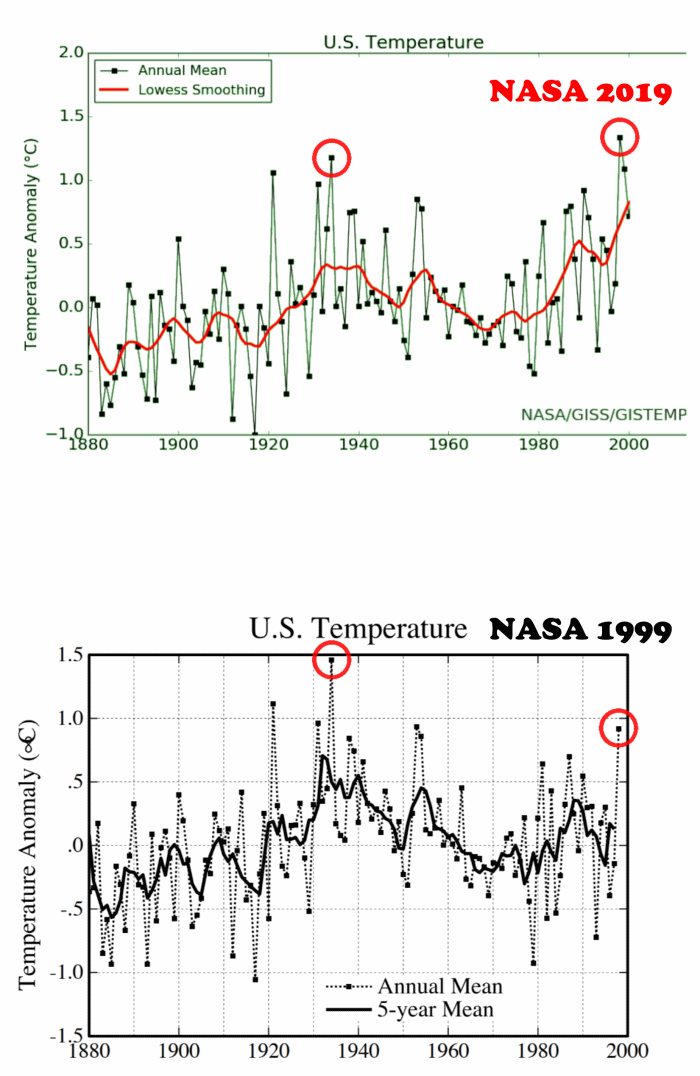
The 2000-2015 pause is the same. You've been told that only "unorthodox" people were talking about it. Here's a brief history of the pause, as told by climatologists publishing in Nature.
https://www.nature.com/articles/nature12534
https://www.nature.com/articles/nature.2013.13832
In 2013 we read that "Despite the continued increase in atmospheric greenhouse gas concentrations, the annual-mean global temperature has not risen in the twenty-first century". The IPCC 2013 report is reported with the headline "Despite hiatus, climate change here to stay". Climatologists claim that maybe the missing heat has disappeared into the oceans where they can't find it.
https://www.nature.com/articles/nature.2013.13832
Two years later everything changes. "Climate-change ‘hiatus’ disappears with new data", there's a new version of history and the past 15 years are gone:
"That finding [that global warming actually did happen], which contradicts the 2013 report of the Intergovernmental Panel on Climate Change (IPCC), is based on an update of the global temperature records maintained by the US National Oceanic and Atmospheric Administration (NOAA)."
Climatologists have an interesting methodology - when observations don't fit the theory, they conclude the observations must be wrong and go looking for reasons to change them. Given a long enough search they always come up with something that sounds vaguely plausible, then they release a new version of the old data that creates new warming where previously there wasn't any. Although this isn't entirely secret they also don't tell people they're doing this, and the media certainly isn't going to tell anyone either.
And that's how it goes. You look at the edited graphs, remember people talking about a pause and think golly gosh, how badly informed those awful skeptics were. We have always been at war with Eastasia!
(Also, that pair of graphs can't possibly be an example of changing historical data to get rid of a hiatus starting in 1998, for obvious reasons.)
I think you have misunderstood in multiple ways what I was saying about the "hiatus" starting in 1998.
Firstly, I was not claiming that only the "unorthodox" mentioned it. I was claiming that the "unorthodox" represented it as showing that global warming had stopped and the "orthodox" said otherwise. Your pair of Nature links are of "orthodox" climatologists saying things along the lines of "here is what we think may be the reason why the last few years haven't seen a short-term increase; the underlying trend is still upward": in other words, they are examples of the orthodox saying what I said they said.
Secondly, perhaps what I said about "signal" and "noise" gave the impression that I think, or think that "orthodox" climatologists thought, that the "noise" is measurement error. That's not what I meant at all, and I apologize for not being clearer. The point is that the temperature at any given place and time is a combination of lots of factors; some operate on a timescale of decades (global warming due to rising CO2 levels and all that), some on a timescale of multiple years (El Niño), some on much shorter timescales still ("random" variation because the atmosphere is a chaotic system). However accurately you measure, you're still seeing this sort of combination of things, and a time series lasting (say) 10 years will not necessarily reflect what's happening on longer timescales.
The 15 years starting in 1998, viewed in isolation, really do show a slower warming trend than the claimed long-term behaviour. There's nothing unreal about that, and so far as I know "orthodox" climatologists never said otherwise. What they said, and continue to say, and what I am saying, is that this sort of local counter-trend variation is perfectly normal, is exactly what you should expect to see even if global warming is proceeding exactly the way that orthodox climatologists say it is, and is not grounds for making claims that global warming has/had stopped or never been real in the first place.
The "everything changes" article you quote isn't saying what you're trying to make it out to be saying. (You can find the PDF here: https://www.researchgate.net/profile/Tr-Karl/publication/277... .) The authors have done two things. First, some corrections to historical data. (If you look at the graph at the end of the article you'll see that these corrections are pretty small. Their description of what they changed and why sounds perfectly reasonable to me; if you have good reason to think it's bogus other than the fact that you liked the old version better, do by all means share it.) Second, including more recent data. 2013 and, more so, 2014 were pretty warm years.
But what makes me think that the "unorthodox" were wrong to proclaim the end of global warming in the early 21st century isn't tiny adjustments in the data that make the difference between a +0.03 degC/decade trend between 1998 and 2012 and a +0.11 degC/decade trend between 2000 and 2014. It's the fact that after that period the short-term trend gets much faster, exactly as you would expect if the "hiatus" was simply the result of superimposing short-term fluctuations on a long-term trend that never went away.
I bet you are not 100% wrong about the tendency to adjust things to try to correct perceived anomalies. That's human nature, and while scientific practice has a bunch of safeguards to try to make it harder to do it would be surprising if they worked perfectly. But note that the sort of small local tweakage this might produce can't do much in the long term. Let's suppose those people writing in 2015 were completely wrong to make the adjustments they did, whether out of dishonesty or honest error (which maybe they were more inclined to overlook because the adjusted data looked more plausible to them). Then, yeah, they get a faster rate of warming between 1998 and 2014. But those same adjustments will produce a slower rate of warming between, say, 2014 and 2024 when someone comes to estimate that. And the rate of warming between 1998 and 2024 will scarcely be affected at all by tweaks to the numbers circa 2010.
Your last paragraph is (at least as far as I'm concerned) completely wrong, though. I think it was perfectly reasonable to say that the warming trend between 1998 and say 2012 was much slower than the alleged longer-term trend. What I think wasn't reasonable, and what I think has been refuted by later data, and what the "orthodox" climatologists said was wrong all along, was claiming that that short-term slower trend meant that the longer-term trend had gone away, or had never really been there in the first place. That was just statistical illiteracy, and Team Unorthodox were pretty keen on it, and that doesn't speak well for their competence and honesty.
This really is the crux of the issue isn't it? All this pushback for the first petition, because "Elon Musk," but now GPT wonder Sam Altman "testifies" that he has "no monetary interest in OpenAI" and quickly follows up his proclamation with a second "Statement on AI Risks." Oh, and let's not forget, "buy my crypto-coin"!
But Elon Musk... Ehh.... Looking like LOTR out here with "my precious" AGI on the brain.
Not to downplay the very serious risk at all. Simply echoing the sentiment that we would do well to stay objective and skeptical of ALL these AI leaders pushing new AI doctrine. At this stage, it's a policy push and power grab.
I don't think anyone can actually tell which is which on this topic.
The question it answers is "does the replicator allow for Star Trek's utopia, or does Star Trek's utopia allow for the replicator?"
https://www.reddit.com/r/CuratedTumblr/comments/13tpq18/hear...
It is very thought provoking, and very relevant.
These are both problems that capitalism solves in a fair and efficient way. I really don’t see how the “capitalism bad” is compelling in this scenario.
When people talk about Star Trek, they are referring mainly to "Star Trek: The Next Generation."
"The Inner Light" is a highly regarded episode. "The Measure of a Man" is a high quality philosophical episode.
Given you haven't seen it, your criticism of McFarlane doesn't make any sense. You are trying to impart a practical analysis of a philosophical question and in the context of Star Trek, I think it denies what Star Trek asks you to imagine.
Where is the thought provoking idea here? It's just an excuse to attack his imagined enemies. Indeed he dunks on conspiracy theorists whilst being one himself. In McFarland's world there would be a global conspiracy to suppress replicator technology, but it's a conspiracy of conspiracy theorists.
There's plenty of interesting analysis you could do on the concept of a replicator, but a Twitter thread like that isn't it. Really the argument is kind of nonsensical on its face because it assumes replicators would have a cost of zero to run or develop. In reality capitalist societies already invented various kinds of pseudo-replicators with computers being an obvious example, but this tech was ignored or suppressed by communist societies.
Communism as it exists today results in authoritarianism/fascism, I think we can agree on that. The desired end state of communism (high resource distribution) is being commingled with the end state of communism: fascism (an obedient society with a clear dominance hierarchy).
You use communism in some parts of your post to mean a high resource distribution society, but you use communism in other parts of your post to mean high oppression societies. You identify communism by the resource distribution, but critcize it not based on the resource distribution but by what it turns into: authortarianism.
What you're doing is like identifying something as a democracy by looking at voting, but criticizing it by it's end state which is oligarchy.
It takes effort to prevent democracy from turning into oligarchy, in the same way it takes effort to prevent communism from turning into authoritarianism.
Words are indirect references to ideas and the ideas you are referencing changes throughout your post. I am not trying to accuse you of bad faith, so much as I am trying to get you to see that you are not being philosophically rigorous in your analysis and therefore you are not convincing because we aren't using the same words to represent the same ideas.
You are using the word communism to import the idea of authortarianism and shut down the analysis without actually addressing the core criticism McFarland was making against capitalist societies.
Capitalism is an ideology of "me," and if I had a replicator, I would use it to replicate gold, not food for all the starving people in Africa. I would use it to replicate enough nuclear bombs to destroy the world, so if someone took it from me, I could end all life on the planet ensuring that only I can use it. So did scarcity end despite having a device that can end scarcity? No. Because we are in a "me" focused stage of humanity rather than an "us" focused stage of humanity so I used it to elevate my own position rather than to benefit all mankind.
Star Trek promotes a future of "us" and that is why it's so attractive. McFarland was saying that "us" has to come before the end of scarcity, and I agree with his critique.
To get around this the usual Star Trek analysis (by fans, the series itself doesn't talk about it much) is that after replicators were invented, there didn't need to be capitalism anymore and so there's no money in the future and everyone just works on perfecting themselves. It's a wafer thin social idea that was never fleshed out because the writers themselves didn't believe in it. Roddenberry insisted but the writers often couldn't make it work which is why there are so many weird hacks, like saying the replicators can't replicate things as big as star ships and they mostly just ignore the whole topic. Also the replicators kill a lot of drama because they mean there can't be any valuable objects.
There are obvious and basic objections to this idea that replicators = communism (in either direction). One is that you can't replicate services, and much economic activity today is the service economy. We see that the Enterprise has staff who do things like wait tables, cut hair and sign up for red uniform missions in which they will surely die, but why they do this in the absence of money is never explained. There's just this ambient assumption that everyone works because work is awesome.
Getting back to the thread, the lack of philosophical rigor here is all on McFarland unfortunately. He doesn't actually have a critique of capitalism. He doesn't even seem sure what capitalism is, appearing to use the term to just mean contemporary society and anyone he doesn't like. Even his arguments against his strawman enemies are garbled and useless! He shits on Musk, saying that if Elon invented a replicator he'd patent it and hoard the tech to himself, ignoring that Tesla gave away its entire patent pool so anyone else could build electric cars using their tech. Musk - arch capitalist - did the OPPOSITE of what McFarland claims capitalists do, and he didn't even notice! All the rest of his argument is also like that. He makes absurd claims about governments, Republicans killing animals in TV ads, some non-sequitur about meatless sausages ... it's just this total grab bag of incoherent thoughts that make no sense and don't seem connected to each other, wrapped as "capitalism sucks, communism rules".
If this were an essay I'd grade it an F. But in the end it's just a set of tweets. Those looking for philosophical rigor on the idea of an abundance machine need to look elsewhere.
This is rather more than "nationalise it", which he has combined me isn't enough because there is a demand in other nations and the research is multinational; and this is why you have to also control the substrate… which the US can't do alone because it doesn't come close to having a monopoly on production, but might be able to reach via multilateral treaties. Except everyone has to be on board with that and not be tempted to respond to airstrikes against server farms with actual nukes (although Yudkowsky is of the opinion that actual global thermonuclear war is a much lower damage level than a paperclip-maximising ASI).
In my opinion, "nationalise it" is also simultaneously too much when companies like OpenAI have a long-standing policy of treating their models like they might FOOM well before they're any good, just to set the precedent of caution, as this means we can't e.g. make use of GPT-4 for alignment research such as using it to label what the neurones in GPT-2 do, as per: https://openai.com/research/language-models-can-explain-neur...
https://www.soroushjp.com/2023/06/01/yes-avoiding-extinction...