In other words, there wasn’t much an incentive or recognized need to make the scribe’s job easy to pick up.
Caesar (I think) tells us that the druids of the Celts did not allow members of their tradition to write down their beliefs, traditions, etc. Writing in that context (prior to 50 BCE) was profane.
Of course, those of us in America are familiar with slaves being prevented from learning to read. Forced illiteracy in this context was a tool of oppression. [1]
I think in one of S.M. Sterling’s fictional books (On the Ocean of Eternity?? Part of the Island in the Sea of Time series, anyway) there’s a great exchange with a Babylonian scribe who laughs at the simplistic alphabet of the American, condescendingly remarking that child could learn that, to which the guy replied, yeah, that’s entirely the point!
Perhaps, but interpuncts between words are several centuries older than that and occur as natural developments in e.g. the Roman Empire. https://loeb-art-center.vassarspaces.net/wp-content/gallery/...
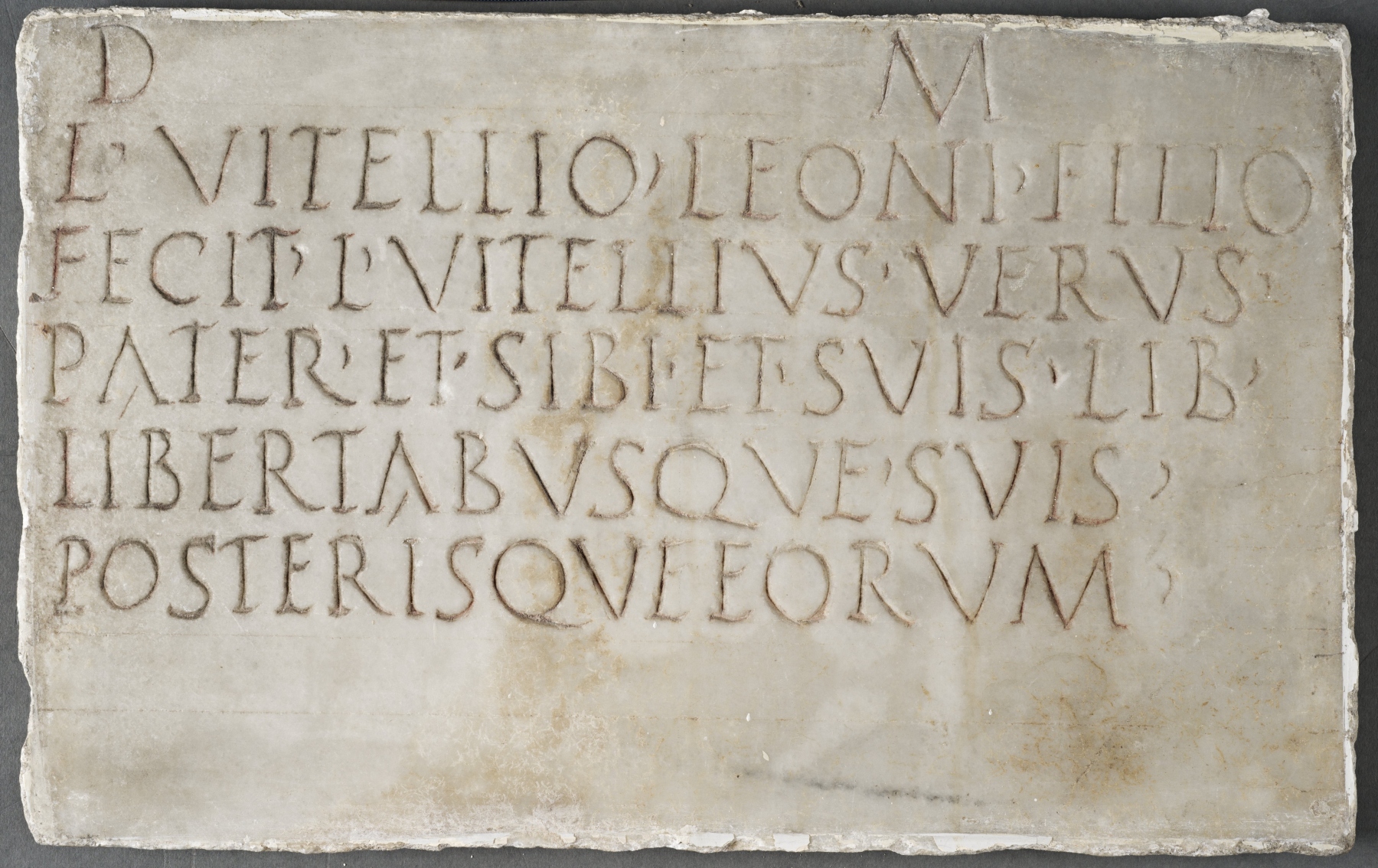
The concept of word separation is an obvious thing to have. Whether the separator is empty space is unimportant.
Since each character represents a syllable, rather than a specific sound, and the written language is essentially not phonetic, reading the characters is an entirely different experience.
OTOH, you have English and German and others that frequently use compound words, and the use of spaces becomes really important to understanding the writing.
I have zero experience with Thai.
Definitely. The logograms and being in a completely different language family are the real hurdles.
Schleifmaschinenverleih would like to have a word with you.
This is parsed as Schleif-Maschinen-Verleih. Verleih means a rental company. The middle one is machine, and the first one I find both sanding and whetting as translations, not sure which one it is. So you can rent sanding and/or whetting machines there.
There are cases where it's ambiguous but for the most part the lack of spaces in compound nouns in German is not an issue.
A somewhat infamous example is Rohrohrzucker which should be parsed as Roh-Rohr-Zucker (raw cane sugar), but Rohr-Ohr-Zucker is also possible (pipe ear sugar). It's pretty clear when it happens that you got the wrong parsing but it takes a while to figure out what the right parsing is :-)
As far as speaking is concerned: I guess the extra spaces in English don't necessarily translate to pauses, do they? Is plugin pronounced differently from plug-in due to the hyphen?
blueberry vs. blue berry
stand up vs. standup
online vs. on line (northeast US term for queueing)
cartwheel vs. cart wheel
Stick compound words in a sentence that doesn't have any spaces at all, and you either have to pause to grok context, or context won't even help you (blue berry vs blueberry). At least German capitalizes all of its nouns, which would certainly help.
Compare this with Chinese, Korean, Japanese or other similar languages that don't use spaces at all (except perhaps after punctuation).
Lexing is very clear in Chinese. It's never the case that you look at a Chinese sentence and don't know where a character ends and another begins. Take this sentence in both languages: "good morning, how are you"
早安,你好吗
This sentence clearly has "spaces" and I'm pretty sure any person illiterate in Chinese could tell you there are 5 characters / words. Technically the third character is composed of 人 and 尔 but I don't know that anyone, even kids or beginners, would mistake those as _not_ going together.
สวัสดีตอนเช้าคุณเป็นอย่างไรบ้าง
In contrast, Thai is as you say: lexing and parsing bleed together. There are 7 words in this sentence, but you need to lex the 10 syllables and run them through your mental dictionary to recognize the possible words they could be. My Thai is very limited, but there are examples of sentences out there that actually have multiple valid readings with different semantic meanings, depending on how you group sounds together.
> Same with Chinese language, thus lexing and parsing requires knowing many more words than in languages with spaces between words.
In English, can you get away with knowing the meaning of "good" and "morning" and not "good morning", and know that I'm greeting you instead of commenting on the quality of this morning?
Where I've had pain specifically with Thai is that I can't even know where a syllable begins and ends until I read a few "syllables" together and decide whether some vowels go with the consonant in front or behind it, and whether some an -ar should be pronounced as an -aan.
As mentioned in another comment, single syllable words are much more common in Cantonese, and word combinations are much more "free" in the sense that there are a lot more ambiguity as to what counts as a "word" and what is merely two single-character-words idiomatically used together. There are also cases where grammatical constructs (and also foul words) are inserted in between a two-character word/idiomatic combo, and sometimes the characters are reversed, to the extent that it used to be a meme: https://evchk.fandom.com/zh/wiki/Y%E5%B7%B2x
It's gotten to a point where, after thinking about it for a couple years, I've come to believe that segmentation on Cantonese is a fool's errand...
Of course, there's also classical Chinese where most of the time a character is a word.
The problem with proper nouns is that they don't end up in dictionaries, same with slang and other terms that for reasons don't end up in dictionaries.
The additional problem with Cantonese is that there's a larger class of words where the constituent characters can move around as if they were words themselves. Even for a native speaker with some experience in lexicography, it can be difficult to determine word boundaries as there are many cases where a word with characters X+Y can be interpreted as just word X and word Y with some idiomatic meaning. This issue is more pronounced in Cantonese because there are more single character words in active use.
I've actually done this before. My experience is that naive segmentation on Mandarin text with wordlist is probably 80+% accurate, while using the same algorithm in Cantonese text (with cantonese wordlist) will definitely end up "wtf".
I'm used to it in Asian languages but it still does my head in when I try to read older Latin documents.
It is interesting to me when written Chinese and Japanese use commas. It is pretty much never required, but pure style. It does help to breakup a complex sentence, similar to phonetic languages.
(I don't know Japanese so I can't speak to that)
起初我見到一碟芽菜同西芹,以為佢上錯菜,用刀叉掘咗幾下,終於見到埋咗響底嘅叉燒。
Nobody writes it like this:
起初我見到一碟芽菜同西芹以為佢上錯菜用刀叉掘咗幾下終於見到埋咗響底嘅叉燒。
Can people parse the latter (with some difficulty)? Sure. The commas are not required to the extent that you can butcher the sentence even more without losing its essential meaning, but why stop there? You can remove even more stuff from it and still retain most of the meaning:
初我見碟芽菜同西芹以為上錯用刀叉掘幾下終見埋底嘅叉燒
But that's not how people write.
Japanese has a lot of “hint” on word (nouns) ending.
This is unlike [C]hinese.
Say, for example:
"Korean people eat kimchi"
In Japanese/Korean, the structure would be:
Korean-person-topic marker-kimchi-object marker-eat-present tense.
In Japanese mixed script, that looks like:
韓国人はキムチを食べます。and would be read as "kankokujinwa kimuchiwo tabemasu".
Splitting it with spaces:
韓国人は キムチを 食べます。
The heftier kanji denoting "Korean person" and at the start of "eat" should be clear even to the untrained eye, while people who've studied the language can easily tell that キムチ is "kimuchi" written in katakana. The sentence is pretty easy to parse without spaces, at the cost of using one of the most insane writing systems in the world.
Now, what if we wrote the entire thing in hiragana instead?
かんこくじんはきむちをたべます。
... yyeaahh. Spaces. Please.
かんこくじんは きむちを たべます。There, much better, though almost no one fluent in Japanese has practice reading stuff like that.
In Korean, without spaces we'd have:
한국사람들은김치를먹어요. Again, similar problems. Korea has adopted spaces now that they don't use sinographs, so we'd have:
한국 사람들은 김치를 먹어요. (han'guk sa'ram'deul'eun kim'chi'reul mog'o'yo)
If we wrote "Korean person" with the same Sinitic loans in the Japanese sentence, we might get:
한국인들은 김치를 먹어요. (han'gug'in'deul'eun kim'chi'reul mog'o'yo)
Spaces clearly do help.
The thing that bugs me about written Thai is that there are spaces now and then and you would expect them to be at sentence breaks but they seem to be randomly placed throughout the text, almost as if that's where the writer felt like he needed to take a breath instead of where one sentence ends and another begins.
中国共产党, is that one word? should you break it up as 中国 共产党? what about 中国 共产 党? i dont think its nearly as clear which of these is correct as it is in english
So: some words end in a stop, which is sometimes counted as a different tone even though the pitch pattern isn't different. For example, consider fan versus fat.
I have an old Quora answer here that goes into more detail: https://qr.ae/pyNupi
The 5th and 6th tones are very close to two of the first four. If you pronounced them exactly the same as their nearest matches, Cantonese speakers would understand you.
The 7th, 8th, and 9th tones are basically very short versions of 3 of the first 4 tones. If you pronounced them the same, but just made the syllable very short, you'd be fine.
So yeah.... 4 tones. :-)
Whilst it is true that in the case of Cantonese some tones can be misused without the loss of the comprehension in a conversion, and the non-native speaker will still be understood if the surrounding context is clear and concise, that is not the case with the low falling tone, which is the most unforgiving of all. Cantonese speakers are prone to get thoroughly confused when the low falling tone is substituted for a flat low tone or a low rising one. Consider 墳墓 and 分母 when the context is insufficient to deduce which word was actually meant; it is perhaps not the best example but I can't think of a better one at the moment.
> It's difficult for a non-native speaker to distinguish between "low rising" and "mid rising".... so just treat it as a rising tone. I'm a native speaker and sometimes I forget which type of rising tone a particular word is.... I didn't learn it that way, haha.
Most native speakers of tonal languages are not even aware of the fact their native language has tones. They don't think about it, they don't think about the tones. Tones are a concept for speakers of languages that do not have the tones in the first place.
TLDR: No. There are 6 tones in Cantonese, the 9 "categories" are made referring to Middle Chinese.
---
Middle Chinese had 4 tones[1]. The 4th tone, "entering" (or "checked"), is words that end in stops (p/t/k). Because of the way it evolved, none of those words in Cantonese have tones 2, 4, or 5 (but not exactly, see below). In other words, they all have tones 1, 3, or 6.
To emphasize this observation and to make a connection to the 4 tones in middle Chinese, some analysis call them tones 7, 8, 9, with names upper dark/lower dark/light entering[2].
But such an analysis has nothing to do with how a modern Cantonese speaking brain process the sounds. E.g. Cantonese has a tone-change to tone 2 for the diminutive form, when this happens to a word that ends with p/t/k[3], the 9 tone framework cannot describe that.
---
Caveat: when I said "Cantonese" above I mean the dominant dialect of Cantonese spoken in Guangzhou/Hong Kong.
[1] https://en.wikipedia.org/wiki/Four_tones_(Middle_Chinese)
The number embedded in the Jyutping pronunciation indicates the tone.
However, the automatic tonal detection is not as straightforward as it might seem due the tone sandhi (the tone change of the word/syllable depending on surrounding morphemes), and not all tonal languages have the tone sandhi. Cantonese, Teochew and Hokkien languages can have a pretty complex tone sandhi, though.
For Cantonese and Jyutping specifically, the tone sandhi is marked as, e.g., «faan4*2» which means that the standard pronunciation is «faan4» (the low falling tone) can change into «faan2» (the high rising tone) depending on the following morpheme. The tone sandhi does not have fixed rules and depends on each morpheme. Depending on the tonal language, the preceding morpheme can initiate a tone change, or it can be the following one. Certain tonal languages can have a complex tone sandhi that affects the tonal change not just in a single morpheme but it the rest of the morphemes that comprise a full word.
We would really be talking about a full contextual, semantics aware automated translator that applies the approriate tone sandhi on the contextual basis* to give a Western reader the correct tone rendition in the transliteration.
Tone sandhi is phonologically motivated, i.e., the tone changes arise from the pronunciation of the surrounding words, and are thus largely predictable. Cantonese changed tones, however, are generally lexically motivated, i.e., the changed tone is part of the realization of the word itself. Cantonese changed tones are thus more akin to Mandarin's erhua phenomenon (https://en.wikipedia.org/wiki/Erhua), which is also seemingly as random with regard to the words to which it applies.
> For Cantonese and Jyutping specifically, the tone sandhi is marked as, e.g., «faan4*2»
Note that the Jyutping standard actually doesn't specify how tone changes are marked. I believe the * convention originated at https://www.cantonese.sheik.co.uk/ to facilitate Cantonese learning. Wiktionary has adopted a similar convention but using a hyphen (-) instead (https://en.wiktionary.org/wiki/Wiktionary:About_Chinese/Cant...).
On the other hand, languages such as Hmong exhibit the complex tone sandhi. Tone sandhi is not as pronounced in Cantonese as it is in some other languages.
> Note that the Jyutping standard actually doesn't specify how tone changes are marked.
No, it does not, and whether an asterisk or a dash is used, it is largely immaterial. What is important, though, is that not every Cantonese dictionary marks off a lexical tone change which might misguide the learner or the seasonal reader.
https://www.reddit.com/r/Chinese/comments/xx5g39/cantone_an_...
https://apps.apple.com/us/app/cantone/id1602297692
https://play.google.com/store/apps/details?id=com.cantone.ca...
There are also plenty of tonal languages outside East/Southeast Asia, in South Asia, Africa, Europe, North America, and that's just ones I know of.
Languages also switch, like ancient Greek.
There's some linguistic pattern where consonant clusters at the end of words get dropped, but their 'effect' on the vowel remains and that's how these kind of tones develop.
IIRC there's also two different kind of tones, pitch tones, and register tones....
Languages are crazy.
> In finals that end in a stop consonant, the number of tones is reduced to three; in Chinese descriptions, these "checked tones" are treated separately by diachronic convention, so that Cantonese is traditionally said to have nine tones. However, phonetically these are a conflation of tone and final consonant; the number of phonemic tones is six in Hong Kong and seven in Guangzhou.
Using tones is so natural that many native Cantonese speakers are unaware that the language even has tones lol.
When you read about tonal languages online, there is so much emphasis on "tonal languages are special". I don't understand why accent and pitch isn't added to the same bucket. In Japanese, accent and pitch is rarely taught, but incredibly important in daily life. Japanese is stuffed full of homophones which makes listening a tricky matter. BTW -- I am sure there are other "non-tonal" languages that I don't know about where pitch and accent are important (Korean?).
If you consistently pronounce words with the wrong accent or pitch, (average, uptight) Japanese listeners will refuse to understand it. Say what you like about it (fake/real/whatever), it is a common response.
In Guangzhou Cantonese, 衫 (shirt) and 三 (three) are not homophones, but they are in Hong Kong Cantonese. The Jyutping romanization (from the Linguistic Society of Hong Kong) reflects this change in HK Cantonese (saam1), whereas Yale, based on the older pronunciation, could represent the difference in tone (sāam vs sàam).
Interestingly enough, the high-falling tone is still retained in Hong Kong Cantonese for one exceedingly common word, the final particle 㖭 (tim1/tìm)!
It would be interesting to give a Hong-Konger a test with pairs of characters, one of 1st tone and the other 7th tone, and see whether they can guess which is which.
I suspect with minimal training they'd be able to score significantly better than random chance. (Willing to try it out!)
Tone systems are different in the sense that each syllable has it's own countour. (Of course, when realized, these get merged according to various phonological processes) Japanese differs from tone systems in that it has only one culminative pitch contour over multi-syllable words.
(Disclosure: I am an expert in Japanese phonology, especially in pitch accent.)
Disclosure: I am an expert in Japanese phonology, especially in pitch accent.
1) "Culminativity" is actually considered the most helpful functionality of the pitch accent. It helps making sense of word boundaries, as there can be only one prominent syllable per word. In spoken word of any language, there are no "spaces" (there are no spaces in written Japanese either, though), so languages need to provide accommodations for aural parsing strategies.
2) The other functionality provided by the pitch accent is distinctiveness, which means that there are some homonyms (similar-sounding words), that are only differentiated by the pitch accent. However, that is only a secondary functionality. In Mandarin Chinese, tones play a lot more important role for making sense of the meaning of the word. In Japanese, they play a role, but not a significant one. (There are some hundreds of minimal pair words that differ only by the pitch accent pattern, but as many regional dialects also have slightly different accent patterns, clearly 100% nailing the pattern isn't required for communication, as long as the general principles (such as one drop per word) are followed.)
3) Japanese is said to be an "isochronic" language, which means it has (or at least, is perceived to have) a simple integer-based rythm. For example, Haiku, a famous genre of Japanese poetry is based on these rythms, unit of which is called haku (拍) in Japanese or mora in Latin/English. In context of poetry metrics, mora is often misrepresented as a "syllable", but actually, there are uni- and bimoraic (and rarely, trimoraic) syllables in Japanese. An example: 2-mora "ma-to" means a target (in archery etc). 3-mora "ma-t-to" means a "mat/carpet". 3-mora "ma-n-to" means a cloak. 3-mora "ma-to-o" meas "let's wait". 3-mora "ma-to-n" means "mutton meat". 4-mora "ma-t-to-o" means "proper/straight". But every one of these are two-syllable words!
4) The rythm of Japanese speech is not concerned with the pitch accent prominence, unlike stress in English, which tends to make stressed syllables longer and louder (and more defined in vowel quality). Indeed, it is often said that "syllables" are an irrelevant concept for Japanese. However, phonologically that isn't true at all. The rythm of Japanese is indeed dependent mostly on moras, but the pitch accent patterns, where the prominent drop of pitch tends to happen, is highly dependent on syllable structure. It never happens on "weak" morae, which are called the "coda" or tail of the syllable. It always happens on the start of a syllable.
(Source: 10 years learning Japanese, followed by marrying someone from Taiwan.)
How many songs do you misunderstand the lyrics for on the first few listens, in your native language? For me, in English, I either can't tell exactly what they're saying for some proportion of lyrics, or just totally mishear them _quite_ often (especially depending on the genre).
Music doesn't require every word to be perfectly understandable. Communication does, ideally.
So there's this
https://www.youtube.com/watch?v=pdz5kCaCRFM
and more interestingly
Contrast that with Cantonese, which I believe still uses a single syllable for most words. (Someone please correct me if I'm wrong)
So it makes sense with less tones, because you have more syllables to disambiguate.
Not sure about "most" (depends on the sample distribution I suppose), but single syllable (i.e. character) words are used much more often relative to Mandarin.
So in general you're probably right. Not sure whether that is a cause of more strict adherence to tones in songs though. It could be alternatively argued that the more complex syllable (due to more tones among other things) in Cantonese allowed it to retain single syllable words without having to add extra syllables to clarify any ambiguities.
Yes, pretty much.
Both languages descended from a common ancestor, so you can't necessarily say that one is newer than the other. However, it is the case that Cantonese preserves several features that Mandarin has lost, in particular the complete inventory of final consonants and all of the tone categories of Middle Chinese, which makes it seem better suited for reciting 1000+ year old Tang dynasty poetry where rhyming and tones were especially important.
On the other hand, Cantonese has lost other features that Mandarin has preserved (such as medial vowels and the three-way distinction of initial sibilant consonants), but these features aren't as critical with respect to reciting Tang poetry. For this reason, Cantonese may seem "older" than Mandarin, even though in reality, its simply that they each have preserved different features and the features that Cantonese preserved happened to make it better for reciting old poetry.
> Languages tend towards laziness, so I wonder if it settled on the right number, of if it's an ongoing trend.
All languages change and will continue to change over time, and while laziness may drive changes in some features of a language, often times other parts of the language become more complex to compensate. This process is called grammaticalization, and is thought to occur in cycles: http://websites.umich.edu/~jlawler/TheGrammaticalizationCycl...
Modern English has less complex verbal morphology and noun declension (as you mentioned, only in pronouns). But the set of vowels in Modern English is more complex than that of Old English. Also the vocabulary of Modern English has two main sources: Germanic words (native) and French/Latin/Greek words where a single idea can be expressed in either vocabulary source with different nuances. Old English was mostly comprised of Germanic words with some words borrowed from Latin.
Another interesting thing to note is that languages without tones can gain tones (tonogenesis) and in Old Chinese tones played a much smaller role than the modern descendants. This is often the result of syllables/sound systems becoming less complex and losing contrast so the tone of the word becomes contrastive to maintain a distinction between words.
> For Chinese, modern songs in Mandarin and Cantonese exhibit very different behaviour with respect to the extent to which the melodies affect the lexical tones. In modern Mandarin songs, the melodies dominate, so that the original tones on the lyrics seem to be completely ignored. In Cantonese songs, however, the melodies typically take the lexical tones into consideration and attempt to preserve their pitch contours and relative pitch heights.
[1] https://journals.linguisticsociety.org/proceedings/index.php...
There are therefore an enormous number of homophones in Mandarin, which makes it very challenging to comprehend without context. I've often had native speaking friends eavesdrop on a conversation, only to tell me that they're not sure what is being discussed.
It also means that the language cannot be usefully written phonetically, and thus unique characters are required.
some discussion here:
https://chinese.stackexchange.com/questions/40574/why-does-m...
https://chinese.stackexchange.com/questions/39695/does-chine...
https://chinese.stackexchange.com/questions/14596/how-many-s...
Unique characters being required to distinguish homophones in modern written Mandarin is mostly a circular effect due to the characters already being available, so people use them in ways that would be ambiguous when read aloud (as intentional puns or simply to be more concise.)
If there had been no preexisting writing system and written Mandarin was a simple transcription of spoken Mandarin, introducing characters would be about as helpful as indicating the Indo-European roots of words in English writing, which is to say that some people might get a feeling of epiphany after realizing the connection between seemingly disparate words, but it would hardly be practical for everyday use.
> Unique characters being required to distinguish homophones in modern written Mandarin is mostly a circular effect due to the characters already being available, so people use them in ways that would be ambiguous when read aloud (as intentional puns or simply to be more concise.)
Indeed, because of the way Dungan is written, it ended up evolving differently with respect to how new vocabulary is derived, often borrowing words phonetically from Russian instead of constructing them from Chinese morphemes that might otherwise be considered ambiguous when used individually.
While true, I'd bet that some combinations dominate because they sound better/are easier to pronounce.
Also just because you can technically differentiate 160k sound pairs doesn't mean you can do it in a noisy environment.
Japanese and Korean have a similarly limited number of syllables and have very long words compared to English. I'm guessing because they don't have tones.
If you look at communication theory you don't only need distinct sounds, you also need error correction. Which requires extra bits of redundant information.
Tones just make it possible to carry extra bits.
Longer strings of syllables like in Japanese and Korean do the same.
More complex syllables, like in English, too.
It's just multiple different ways of carrying enough bits in speech to work in a noisy environment.
Another analogy could be password strength. You can have a very long numeric password (Japanese & Korean), A password with a mix of a-zA-Z0-9 of medium length (English). A password with weird special characters but shorter (Chinese), and they all end up having the same entropy (given that the password rules are known to the attacker).
Sure, but English needs them because there are only around 26 letters; compare this to Mandarin, where estimates are in the 400 range.
If anything, letters being overloaded limits the number of syllables we can express.
There are many common homophones in English that are distinguished by context. Conversation tends to have a lot of context. As a Mandarin speaker, I've never really experienced this context problem. You can make up some artificial examples in English and Chinese but they don't really reflect average communication. Like "The bat and the bow are on the table". It is important to know that a good percentage of words in Mandarin are multi-syllabic (not just one character).
Mandarin can be written phonetically perfectly fine. Currently the most popular systems are Hanyu Pinyin (used in China, Singapore and Malaysia) and Zhuyin (used in Taiwan). Kids learn these systems in school before they learn characters. Chinese characters have a strong historical and cultural value, that's why they are still around.
>Mandarin can be written phonetically perfectly fine
It can, and I use hanyu pinyin daily, but my point is that given the small space of possible sounds, it often has a great deal of ambiguity, and is mentally taxing to read. Have you ever tried reading an essay or book in pinyin? With syllabic spacing? There will be many places where it is simply not possible to know for certain what a particular word is. And then there are text books, scientific books.
Chinese characters do indeed have strong historical and cultural value, but that is not why they are still around. They are still around because they are essential to the written language.
This argument used to be made in Korea, yet the country seems to have transitioned to alphabetic writing without issue. A lot of the tax of reading phonetic scripts of Chinese or Japanese is that fluent speakers are simply not at all used to it, even if they can read it.
For example:
ᚦᛁᛋ ᚨᚱᚷᚢᛗᛖᚾᛏ ᚢᛋᛖᛞ ᛏᛟ ᛒᛖ ᛗᚨᛞᛖ ᛁᚾ ᚲᛟᚱᛖᚨ, ᛃᛖᛏ ᚦᛖ ᚲᛟᚢᚾᛏᚱᛃ ᛋᛖᛖᛗᛋ ᛏᛟ ᚺᚨᚹᛖ ᛏᚱᚨᚾᛋᛁᛏᛁᛟᚾᛖᛞ ᛏᛟ ᚨᛚᛈᚺᚨᛒᛖᛏᛁᚲ ᚹᚱᛁᛏᛁᛝ ᚹᛁᚦᛟᚢᛏ ᛁᛋᛋᚢᛖ. ᚨ ᛚᛟᛏ ᛟᚠ ᚦᛖ ᛏᚨᚲᛋ ᛟᚠ ᚱᛖᚨᛞᛁᛝ ᛈᚺᛟᚾᛖᛏᛁᚲ ᛋᚲᚱᛁᛈᛏᛋ ᛟᚠ ᚲᚺᛁᚾᛖᛋᛖ ᛟᚱ ᛃᚨᛈᚨᚾᛖᛋᛖ ᛁᛋ ᚦᚨᛏ ᚠᛚᚢᛖᚾᛏ ᛋᛈᛖᚨᚲᛖᚱᛋ ᚨᚱᛖ ᛋᛁᛗᛈᛚᛃ ᚾᛟᛏ ᚨᛏ ᚨᛚᛚ ᚢᛋᛖᛞ ᛏᛟ ᛁᛏ, ᛖᚹᛖᚾ ᛁᚠ ᚦᛖᛃ ᚲᚨᚾ ᚱᛖᚨᛞ ᛁᛏ.
Same normal English, but Elder Futhark as the script. If you grew up reading that you'd read without issue. Now? It's a pain.
You can still write the name in Hanyu Pinyin or Zhuyin perfectly fine. It is just that we like character names and that most characters are valid to be used in names so there is a lot more flexibility in what can be a name versus other cultures where there is a less flexible set of names. You can still do something similar in English where you say your name is "rainbow" but you spell it "rhaynbeau", people aren't going to be able to guess that.
> given the small space of possible sounds
Again, see languages like Hawaiian and Vietnamese. They also have small sets of sounds and do fine with romanization.
> Have you ever tried reading an essay or book in pinyin? With syllabic spacing?
Yup, it is just that most people are used to reading Chinese characters and not in romanized Mandarin. There may be other advantages to Chinese characters like quicker recognition and occupying a smaller space, and I am not trying to advocate for eradication of Chinese characters, but I want to stress that is perfectly possible to read and write Mandarin phonetically and characters are not essential.
Also I read and write Taiwanese (Hokkien) in romanized form. Feels like a waste of time to worry about characters, but many people do and end up not writing Taiwanese or using mixed script.
>You can still do something similar in English where you say your name is "rainbow" but you spell it "rhaynbeau",
This is an insulting borderline racist comparison and ties to the same old western trope of treating our names like random sounds. "rhaynbeau" Isn't a word and doesn't carry any meaning.
I am not sure what you mean by holding on for religious reasons? IThere are lot of reasons to write Taiwanese. Anyway, I don't know anything about these forums or have Presbyterian affiliation, but in my real life I use it quite often with friends and family. The reason few people can read it is because few people have learned it. For the majority of Taiwanese speakers it is only a spoken language. Written Taiwanese does not play a large role in public education in Taiwan.
> "rhaynbeau" Isn't a word and doesn't carry any meaning.
It's an imperfect example for non-Chinese speakers to illustrate that it can be hard to guess the character of another person's name but people still understand the sounds when hearing it. A lot of thought goes into choosing the characters for a Chinese name. Other cultures have names that are not related to meaning or are separated very far form the original meaning (the words are for names). Others allow variations on previous names or borrowing from other langauges so likewise those names might be challenging to know the spelling.
Vietnamese is written in alphabet without issue. The Dungan people of Kyrgyzstan and Kazakhstan even write their Mandarin-descended language with the Cyrillic script without any tone markings at all - the tones are supplied in a dictionary, but that's it. It works.
Most of the homophones etc. stuff come from people having decided that sinographs are good and then coming up with justifications for keeping them, not really an actual analysis whether Sinitic languages or Japanese would work without. This is a Chinese dictionary: https://imgur.com/a/rdxVh9i
> Mandarin can be written phonetically perfectly fine.
To reinforce this to the readers: https://www.pinyin.info/readings/pinyin_riji_duanwen.html
The author is a native Mandarin speaker who specifically requested that her work not be rendered in sinographs. It should be standard Pinyin orthography except that the author writes 'de' as 'd'.
Yes, people often confuse the "way I do it", "the way it's always been done" or the "official way" as the only way it can be done.
Here's another quote from the source you use:
> "There is no doubt that romanized Classical Chinese would be gibberish"
Invariably these proponents of phonetic writing for Chinese are non-native speakers[1] from the west who seem to have an intense hatred for any aspect of the Chinese language that they consider "Classic Chinese" derived[3]. This of course extends to any sentence that goes beyond "where's the bathroom" and "hello my name is bob" except not even the second example because Chinese names are what these people would consider "classical derived". So you propose a system that would not be able to transcribe __names__. Go to Korean wikipedia and click on a disambiguation page[0]. Or go ask them to show you their ID card[2]. These are a people whose entire national identity is based around not using Chinese writing. A lifetime of both native chinese speakers and non-chinese alike not being able to pronounce my NAME right when rendered in Pinyin is apparently not evidence enough that it's an inadequate system.
> This is a Chinese dictionary: https://imgur.com/a/rdxVh9i
You also leave out that double digit percentages of the Dungan language comes from Arabic and Persian, Russian, Turkic etc. Not even their names are Chinese. What little Chinese is left is a fraction of the amount of Chinese morphemes a normal Chinese speaker knows. Even in your example the entry for "da" has 10 semantically, phonetically, and etymologically different entries. The PRC also tried to enforce phonetic writing on the Yi and Zhuang languages, which had their own scripts that work on the same principles as Chinese. The result was low literacy rates and a population that predominantly still used the old writing system.
I could very well turn your argument against you. Why doesn't English spell pique, peak, peek the same? Pours, pores, poors? Why did a phonetic writing system slowly evolve into what is essentially a logographic script. Why were you able to read the above example relatively easily, but sdrow eht esrever I fi ylkciuq sa ylraen ton? It's almost as if mature readers of all scripts focus primarily on morpheme clusters when reading, and whatever gains you have from supposedly phonetically regular spelling are offset by that, assuming no pronunciation differences of course. By the time you force everyone to either memorize the "proper" pronunciations or simply force them to only use your privileged dialect your orthography will already be out of date. You can reform again, but by then your lexicon will be so etymologically and semantically starved[6] that you'll probably have to construct all your technical terms from some dead language with a stable orthography anyways.
> an actual analysis whether Sinitic languages
It's called general Chinese. The only phonetic system that works for most dialects, and whose spelling requires the same amount of memorization as writing with logographic characters. Of course if your kind had your way, by the time you could force it on every Chinese speaker it would be out of date and not even regular anymore. Of course these discussions usually don't even touch on the concept of morpheme regularity.
Of course all this text is useless because you probably don't speak Chinese well enough to evaluate any primary source, and the motivation for all this is less rational and more a personal vendetta you non-native speakers hold against Chinese being "too hard to learn"[5]. What's funny is it's the same sentiment you expats have for Vietnamese and Korean, Arabic or even Dutch. Even if we lobotomize our language for your sake you'll simply demand we all adopt English anyways.
[0] https://ko.wikipedia.org/wiki/%EC%88%98%EB%8F%84_(%EB%8F%99%...
[1] or some sort of deranged newspeak proponent, usually diaspora
[2] https://learn.microsoft.com/en- us/answers/questions/815368/acceptable-types-of-identification-%28az-900-test%29?orderby=newest
[3] Usually the argument against 施氏食獅史, somehow a several sentence long story every native chinese reader would understand being rendered as gibbereished shi shi shi shi shi shi, or maybe shi Shi shi shi shi if you're generous, is a totally reasonable reform in your eyes.
[4] https://www.ddginc-usa.com/can-you-read-this.htm
[5] Not limited to language apparently, no cultural differences can be tolerated by you globalists types. Even chopsticks compel your type to proclaim > "Really? A fork and a spoon is far more superior. It shocks me that chopsticks are still used and that people like using them" https://news.ycombinator.com/item?id=35877051
[6] > Romanticized bullshit views built around Chinese characters.
Leads to Oxymoronic statements where Refusing To "Romanize" is because of "Romanticism". How absurdity like this is supposed to be easy for non-native learners and native children to grasp is beyond me.
I gotta ask, you're the third white western male living in Taiwan who brings up this same tired argument with the same contrived source; Do you people have a club or something?
I'm not saying that your points on the underlying topics are wrong–for all I know you're 100% right—but you can't abuse HN like this, no matter how right you are or feel you are. As you've broken HN's rules many times in the past and ignored our repeated requests to stop, I've banned the account.
https://news.ycombinator.com/item?id=33904225 (Dec 2022)
https://news.ycombinator.com/item?id=27830573 (July 2021)
https://news.ycombinator.com/item?id=22713311 (March 2020)
https://news.ycombinator.com/item?id=22591936 (March 2020)
https://news.ycombinator.com/item?id=20712243 (Aug 2019)
https://news.ycombinator.com/item?id=20191623 (June 2019)
It's a pity, because you're clearly knowledgeable on some of these topics and I hate to ban a knowledgeable user. But we don't have a choice when people break the rules like this and don't respond to warnings. If you don't want to be banned, you're welcome to email [email protected] and give us reason to believe that you'll follow the rules in the future. They're here: https://news.ycombinator.com/newsguidelines.html.
So, in Hong Kong, when somebody writes a song/lyric that doesn't quite have matching tones, we ask "which church are you from?" to make fun of it.
If you want the Cantonese lyrics to be translations of English lyrics, it severely limit the words you can choose, to the point it is impossible to fully match the melody.
That said, I still think your post raises some excellent points. To refine it, how about an online learning app that plays a sound or video clip from a national news TV or radio program. (Usually, the speakers have perfect pronunciation.) You repeat the words; the online app records it; then, it shows your tones/pitch/accent versus the native speaker. I think that could be incredibly useful. My point: Speech reco is an impossibly hard problem (currently) due to infinitely broad context in spoken languages. My idea would have "perfect context", so speech reco could really work.
When I was learning tones for a while, I used to record myself, then replay it. It's amazing to hear the difference between what you think you sound like and what you really sound like. An online app could help to fine tune your pronunciation very quickly.
Is this still the case?
How does 2001 software compares to 2023 software? Or 2010 to 2023 for that matter
I haven't tried differentiating tones for discrete words with the recent batch of generic models but I think it might still struggle. I suspect a fine-tuned task-specific classifier might be needed for decent results.
It's free and fast. It's very helpful when you want quick feedback.
I learned a lot from it about the pronunciation of consonants as well. The k-sound has way more air in it. You need to pronounce it as "kh". Same thing with the t-sound.
I just came back from a trip to China and it was noticeable how much more people understood me. Still need to work on vocabulary though...
Well, if you are Dutch, all other consonants from all other languages need a lot more aspiration ;)
GET https://translate.google.com/translate_tts?ie=UTF-8&tl=zh_CN&client=tw-ob&q=<url encoded text>
It's not the most natural sounding TTS engine, but it's free, unauthenticated and trivial to use.
It will be very helpful if someone come up with automatic tonal detection systems for language learners to automatically check the correctness of their pronunciations as they speak in real-time. This can be accomplished by using time-frequency analysis that detect its accuracy similar to these language pronunciation apps like ELSA speak for English [1][2].
[1]Time–frequency representation:
https://en.wikipedia.org/wiki/Time%E2%80%93frequency_represe...
[2] ELSA Speak:
https://elsaspeak.com/en/