I wonder what effect that’s had on a humans immune system. I’d imagine eating spoiled meat containing bacteria, etc was giving their immune system a run for its money until a tolerance was built.
That's only kind of true. Exposing a healthy person to small amounts of weakened virus tends to build immunity. Exposing the healthy person to large amounts of the virus overwhelms the immune system and may not even lead to a strong viral immunity.
If I had to guess, eating rotten meat is something that indigenous peoples have adapted to over time and they are resistant to the specific things in rotten meat that make modern day humans sick. I think it would be wrong to suggest the rotten meat eaters are somehow better off for doing this, or that they have stronger immune systems in general.
Immune systems aren't like a muscle that you can repeatedly train to get stronger and stronger and stronger ad infinitum.
https://pubmed.ncbi.nlm.nih.gov/36238714/ https://www.nature.com/articles/ncomms4654
That's probably as close as you are going to get to truly paleo diets... not paleo-bros that eat only bacon, butter and meats.
The Paleo Cafe would get closed down by the Health Department real fast if it actually served paleo foods.
This is why you can’t render rotten meat safe by simply cooking it. That said, people still age meat. Small birds for will get left for 4-9 days in a cool space before being butchered etc. https://magazine.outdoornebraska.gov/2014/01/hanging-pheasan...
"Just cook it out" plus "your nose can tell" (it can't, spoilage microbes aren't usually illness microbes) are false beliefs that still get people killed.
> stewing over many hours seems like would work fine.
It won't! Good luck with it though.
But my agenda is more selfish. I like to cold-smoke meats for adding to stews, based on the knowledge that stewing in > 85'C [1] water will destroy the botulism toxin. I could just stay away from cold-smoked meats to be safe; but then I would lose out on some of the tastiest food ever :-)
It can be a confusing topic because there are 3 different things to worry about: the active bacteria, the spores, and the toxin. Of the 3, the spores are the most resistant to heat, and according to the WHO link [1] can survive multiple hours in boiling water. However the toxin seems relatively unstable.
I really need to track down their sources though.
[1] https://www.who.int/news-room/fact-sheets/detail/botulism
Although the boiling doesn't destroy the toxin itself, only the bacterial spores.
The other way around
2) Why is there such a precise known number for that issue? Don't bacteria grow differently? It just seems odd that 152 days would definitely be ok and 153 days would definitely kill.
I've recently seen proof of that. A dead horse was left on a trail I frequently hike, and I saw dogs eating it a week later.
I don't even want to imagine how awful that meat was after sitting in the sun for a week.
We do know that humanity from its earliest days over the Rome Empire [1] up to, what, maybe a century or even less ago has had massive infestations of all kinds of parasites, including gastrointestinal.
Would it be possible that these parasites actually could have a symbiotic relationship, in helping to break down spoiled food?
[1] https://www.livescience.com/53303-ancient-rome-infested-with...
I think there's a bit of a slightly saner way to put this viewpoint-- that:
- Humans evolved in a very different environment from which we live now
- Our degree of genetic adaptation to modern living is relatively small, because there's been a blink of an eye for it to happen in
- Even if something newer has a sane rationale for it being "healthier" or "better" despite us not having genetically adapted to it, it may not be so: most of our handwaving rationale about complex systems ends up being wrong after careful trials and measurement, and the rest we may be missing a lot of second-order and third-order effects.
Not that I'm advocating for eating rotten meat. I'm just saying that the system is complicated and has a bunch of set-points learned from very different conditions.
I too don't like rejecting things outright, but knowing that, I also don't accept things outright either. We have no reason to believe that eating rotten meat wasn't a choice made out of necessity rather than out of some sort of optimal health.
First, basically every choice could be said to be made out of some kind of necessity.
There's a big middle ground even from this. E.g. "eating rotten meat caused a lot of harms, but it also happened to fulfill a couple of somewhat important functions, and thus there was no evolutionary pressure to meet these requirements in any other way"
Thus, even if eating rotten meat today would be a net negative for many, many reasons (and I strongly suspect this is the case), it makes a lot of sense to think about and study what possible benefits it could have had besides merely being available.
By eating spoiled and contaminated food, ancient people were certainly getting internal parasites too (also something that a big fraction of pets have).
One time my dog and cat both ate some human food which was perfectly fine for them, but the cat didn't like the flavor. So the cat vomited. The dog looked at the cat, looked at the food, looked at the cat, and then vomited also.
Then the dog finished all the food and was fine.
-- http://www.nmto.ca/sites/default/files/igunaq.pdf --
Igunaq-Aged meat
Igunaq is fermented ( aged ) walrus or seal meat that has been cached away for future use. Meat is usually cached beneath stones or pebbles. Aged walrus meat is extremely high in protein, iron and vitamins. Igunaq has been traditional medicine to keep the digestive system clean, as it flushes away anything in its way. It is also great eating for those who have acquired the taste and can go beyond the smell.
Too fermented, igunaq can be poisonous and can kill people. People have died from eating over-aged meat from walrus and polar bear. These two mammals are very rich in vitamins. The fat is often light green colored when the meat is aged properly. The fat will be darker green if the meat is over-aged or even brownish. Among Inuit it is a delicacy usually eaten with apples. To prepare the meat for eating people find that washing in cold water is better than washing with hot water. Cold water takes away the smell more.
Igloolik and Hall Beach are known to have the best igunaq in Baffin Island. These two communities are blessed with walrus and proper gravel. Meat ages better when it is fermented in loose gravel. It takes time to make good igunaq. One has to store away the meat at the right season when it is not too hot or too cold. Temperature plays a big role.
Cached meat is usually saved for the winter for people to eat but polar bears are known to steal the cache before people can claim them. Regardless the weight of the stones for caching, the polar bear will easily get at it. Polar bears are extremely strong animals.
Common phrase...“ I wonder how many polar bears I have fed to date?” Meaning...Hoping that the cache is not eaten by polar bears yet.
As noted igunaq is good for the digestive system as it cleans it completely of any foreign objects such as viruses and sickness a person may have. A person may experience a natural “high” if they have not eaten aged meat for a while. Men who grew up with igunaq are usually more physically muscular than those who have not. Igloolik, Hall Beach and Cape Dorset have muscular looking men compared to other communities on Baffin Island. It is believed that igunaq contributes to the physical appearance of the people who eat it.
Igunaq is such a delicacy that people that have no access to it will fly it in from communities that do have good igunaq. Igunaq is often brought in at special occasions such as Christmas for community feasts. Some communities look forward to Inuit organizations having meetings in their communities...igunaq is surely to be part of the feast. Igunaq when on sale, will sell better than fresh meat. Interestingly due to its odor some airlines in the north will not carry igunaq. People often have to disguise it to get the aged meat on a plane to take them home. It is said that if you can get beyond the smell, you’ll enjoy the food as it is very nutritious and gives you energy and warmth....and you will be physically ready for your next outing. On a final note a full stomach will also make you concentrate better. Try it! It’s a true Northern experience!
By Elijah Tigullaraq
June 2008
-- end --
Here is one of the articles I found that wasn't too focused on how gross it is that these people eat this and instead digs into the history and purpose of the food. https://www.atlasobscura.com/articles/what-is-kiviaq
https://modernfarmer.com/wp-content/uploads/2014/10/fermente...
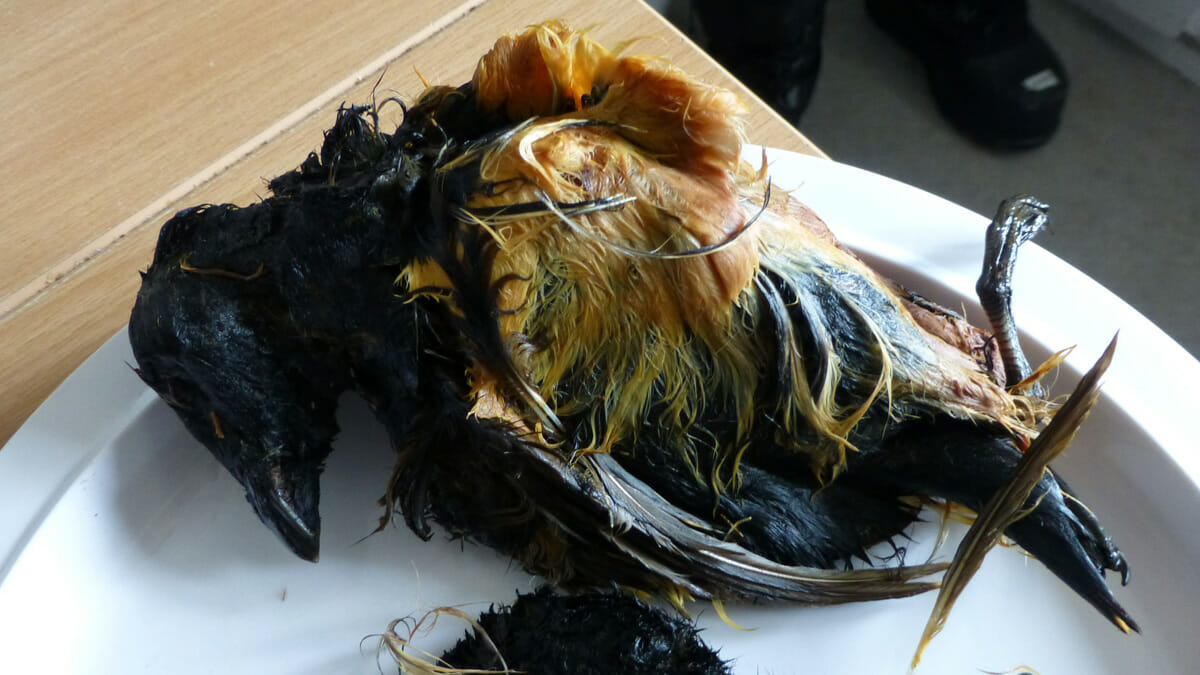
But seriously, the extraordinary power of hunger and culture are on full display with the items discussed in this thread.
The flesh of the Greenland shark is toxic because of the presence of high concentrations of trimethylamine oxide (TMAO). . . .
Traditionally, this is done by burying the meat in boreal ground for 6–8 weeks, which presses the TMAO out of the meat and also results in partial fermentation. The meat is then dug up and hung up in strips to dry for several more months.[46] It is considered a delicacy in Iceland.
I would agree, both in terms of actual immunity and taste response, although generally-speaking eating rotten meat (especially when well-sourced) is not nearly as risky as common wisdom would make it out to be. Many folks in the deeper circles of online carnivoria dabble in "high meat" (fermented rotten meat, a method of preparing meat learned from Inuit peoples who would feed it to their dogs) and swear by it, even if the taste can be unbearable to the uninitiated.
Ah yes, the Nov 22, 2010 issue of the New Yorker: https://www.newyorker.com/magazine/2010/11/22/natures-spoils
big h/t for "deeper circles of online carnivoria", you win phrase of the day
The wonders of the internet!
Bill: In the olden days, a country squire would age his pheasants for weeks before they were deemed fit for consumption.
Lisa Miller : In the olden days, people died of ptomaine poisoning and blamed it on ghosts.
- spices and seasoning was a lot less common and meat was gamey, not the well-fattened meats we're used to. So this stuff already tasted bland and not amazing as a baseline
- it was preferable to starving, and hunger is the best spice of them all
If anything, the persistence running hypothesis in some way discredits the idea that hominids relied on rotten meat. If they could catch fresh prey, why eat spoiled meat? Yet our stomach acid has a very low pH, more acidic than even that of cats.
What's more likely, in my opinion, is hominids began to supplement their diet by eating the leftover kills of larger predators as well as any rotting carcasses they may have encountered, and then developed hunting strategies around when they began developing tools. Even having sharp knives made of stone or volcanic glass would have been an obvious advantage in food procurement, and it wouldn't have taken millions of years to figure out that slashing an animal's throat in the right place would take it down quickly. No need for persistence running at all if a group can corner a mammoth or buffalo or lead it to a dead end.
There are some examples [0], although admittedly they are isolated cases.
Dmitriy Lykov(1940-1981) of the Lykov family living an isolated life in Siberia developed a method of persistence hunting, despite or perhaps because of, the absence of any sort of hunting culture in his tiny, isolated group.
Those are just two very recent examples off the top of my head of people persistence hunting for survival. Maybe you're out of your depth on this subject.
“despite or perhaps because of, sucks” - https://idlewords.com/2003/04/despite_or_perhaps_because_of_...
Additionally, while it is true that hominids were making tools by the time they developed to subsist on meat, it is important to remember that the development of technology is a gradual process. It is possible that early hominids were using simple tools like rocks to scavenge for meat before developing more sophisticated weapons like spears and knives.
As for the argument that hominids wouldn't waste energy running if they had access to primitive weaponry, it is important to remember that hunting strategies are often shaped by a variety of factors, including the behavior of the prey species and the environment in which the hunt takes place. In some cases, chasing prey over long distances may have been the most effective strategy available to our ancestors.
Finally, while it is true that the low pH of our stomach acid suggests that our ancestors were not relying on rotten meat as a primary food source, it is important to remember that scavenging for meat was likely an important part of their diet. It is also possible that the ability to run long distances gave our ancestors an advantage in scavenging for meat, as they could cover greater distances in search of carrion.
In conclusion, while the persistence running hypothesis may not be the only explanation for how early hominids acquired meat, it is a compelling hypothesis based on a range of biological and anthropological evidence. It is important to consider multiple hypotheses when trying to understand the behavior of our ancestors, and to remain open to new evidence and alternative interpretations.
Whether it's GPT or a human, this is wrong:
> Finally, while it is true that the low pH of our stomach acid suggests that our ancestors were not relying on rotten meat as a primary food source, it is important to remember that scavenging for meat was likely an important part of their diet. It is also possible that the ability to run long distances gave our ancestors an advantage in scavenging for meat, as they could cover greater distances in search of carrion.
The point I was making was that our ancestors were relying on scavenged, and probably spoiled meat.
"But when it comes to long distances, humans can outrun almost any animal. Because we cool by sweating rather than panting, we can stay cool at speeds and distances that would overheat other animals. On a hot day, the two scientists wrote, a human could even outrun a horse in a 26.2-mile marathon."
what other animals? I used the dog example because it fits perfectly here: they don't sweat yet it's impossible to catch up to them if they are running away. Even if they overheat they don't just drop dead, they slow down to a human's walking pace.
And what about running animals that do sweat like horses? makes no sense. What makes more sense is to approach from multiple fronts and spear/arrow it down. Plus, all remaining hunter-gatherers hunt with the help of dogs. Sure, you do have to run, a lot. But the endurance side is the least important.
I've gone running with plenty of different dogs in temperatures of above 30 degrees over the years. Smaller or stockier dogs (like a staffy) fade very fast. Within a couple of kms. Working breeds (retrievers/poodles/kelpies/collies) will leave you in their dust but this is why the endurance hunting hypothesis relies on efficient tracking while running. If they're running on the lead, especially when it's a bit hotter, they seem to lose it after about 10kms. On a cooler day these same dogs would leave me dead.
Again I'm not saying it's "literally" impossible. Just not feasible. Actually, chasing an animal worth hunting to exhaustion sounds more like a feat of strength someone would do as a rite of passage. Something you could do once in a lifetime, rather than a reliable source of food.
As far as I'm aware, every land animal on Earth. (In hot weather. It's very different in the cold. Might also be different if it's very humid enough, so sweating doesn't work.)
> I used the dog example because it fits perfectly here: they don't sweat yet it's impossible to catch up to them if they are running away. Even if they overheat they don't just drop dead, they slow down to a human's walking pace.
For an hour or two, sure. Now try doing that for twelve solid hours, on a hot day in the open. The dog will collapse from heatstroke long before a fit, practiced human has to bow out.
I used to believe in the endurance hunting thing until I realized playing with my dog it didn't make sense. They DO get tired, but they take a 1 minute break and it's like they are back square 0.
For the record, I'm in shape and with a pretty light frame (181cm/70kg) and go for 10km/1 hour jogs regularly.
Try to play with your dog for an hour at high intensity. If your dog belongs to a large or very large breed it'll get tired much more quickly than you - assuming you're in somewhat good shape.
I'm not advocating in favor of endurance hunting, I'm only stating that we can out-endure some large-ish animals.
[1] https://www.irunfar.com/aleksandr-sorokin-smashes-24-hour-wo...
Still, this is an exception to the rule - overall humans outperform almost all animals when it comes to endurance running.
I think you're misunderstanding how endurance hunting works. There is no land-dweller on Earth that can outpace a fit, prepared human in a hot, dry environment indefinitely. Not even a horse; Google it. We're slow in the sprint, but we're monsters of endurance.
(By "fit" I mean "makes a living this way," not "jogs and hits the gym regularly.")
I have no idea whether that's an adaptation to endurance hunting or just to normal ambush hunting over long distances in the hot and humid African wet season, but it's pretty undeniable that dogs don't have more long-distance endurance than a fit man on a hot day.
This is the main point why I don't believe in the endurance running hypothesis. Humans are lazy. Why would the opt to run for days over just waiting at the local watering hole for prey?
I don't think you realize how easy it is if you know how to track and jog for 2-3 hours for antelope, even less for cats. All you need is a club. 'Running' isn't necessary.
The tribe thought it was absolutely hilarious that he would get up early and just go run for fun.
Many watering hole types of animals also don’t just fall right over after being struck, particularly with a “rudimentary” weapon. Even if you get a decent shot off, you will still most likely be chasing it for quite a while. Not to mention the dangers of what’s hanging around, looking to take what you (hopefully) managed to score.
The odds were not in our favor!
Have you ever fought a dog, a deer or a boar? Fighting means wounds, possibly fatal ones. Spear or no spear, you're going to die in one of those fights. Running on the other hand is pretty safe and not that tiring, especially if you've been doing it for years and your weight is close to 50-60kg. Ability to sweat more should be even more advantegous in a warm climate. I sometimes run in 30°C for an hour / an hour and a half. It's hard, but you get used to it. I imagine most animals would just drop by that time.
Not to mention, the first weapons would have been far more basic and require closer range than a bow and arrow or a throwing spear. So, to your point, early humans would have had to have taken advantage of the sickly or exhausted in order to avoid injury. With exhaustion occurring as a byproduct of the hunt, it would have been an “accidental” discovery.
I believe the Khoi in the Kalahari still hunt this way. I also thought that's one of the reasons we might have lost our hair and the way we perspire?
Many breeds of modern dogs are very far removed from the lifestyle and habits of their wild brethren.
That being said, still agree with the premise. When you're truly hungry, food is food.
Apparently the advantage of losing body hair is fewer problems with lice (consider how much time other primates devote to grooming)
However, I would also argue that a more common approach, at least when there are multiple hunters working together, is to "herd" animals into kill zones such as pit traps, or channels. We have lots of evidence of those in the archeological record, such as here [2] and here [3].
I actually suspect that bacterial "preprocessing" of meat would assist in digestion. Rather famously, it is hard to get everything you need in a raw food diet, and a well known argument in anthropology is that cooking with fire is our way to make food easier to digest (rather than approach the problem the way, say, cows do). Fermentation can also improve the digestibility of foods (increasing bioavailability of calories, nutrients, etc.).
[1] https://www.journals.uchicago.edu/doi/10.1086/508695 [2] https://albertashistoricplaces.com/2018/07/18/pronghorn-trap... [3] https://torbygjordet.com/food/hunting/
A few hours after reading this article, I realized that we're learning that exposure to peanut proteins at a certain age prevents peanut allergy.
I wonder if eating rotten meat during formative years similarly confers resistance to the ill effects of such meats. Or more generally, develops our immune response enough to where it's not a problem. (Akin to people in developing nations not having a problem with the tap water)
There's also the simple observation that no doubt many of us have already made: animals all around us seem to have no issues with partially decomposed meat. Dogs don't seem to mind it, nor do cats, nor do other primates like chimpanzees. It's obvious that at least in our very recent evolutionary history we had far higher tolerance to spoilage.