senko
Re:Jepsen: ParticleDB 1.1.4
on Sunday November 01, 2026 @03:47PM (#50329700)
MongoDB could lose your data on a single instance after acknowledged write. And corrupt the entire database in case of server crash.
Yes, this is worse, but in both case the root cause was human carelessness, not AI.
Re:Jepsen: ParticleDB 1.1.4
on Sunday November 01, 2026 @03:12PM (#50329267)
To everyone pointing out that artificial intelligence is to blame here, you may want to read his takedown of MongoDB back in 2013: https://aphyr.com/posts/284-jepsen-mongodb
Re:Jepsen: ParticleDB 1.1.4
on Sunday November 01, 2026 @03:02PM (#50329171)
I guess MongoDB was also vibe-coded back in 2013: https://aphyr.com/posts/284-jepsen-mongodb
Re:HackerTube: YouTube built from videos recommended by HN
on Saturday October 31, 2026 @06:08PM (#50320735)
So the cost was zero.
Re:HackerTube: YouTube built from videos recommended by HN
on Saturday October 31, 2026 @05:57PM (#50320649)
It'd cost ~$250 via API (ie. paying current API pricing per token).
Source: copy pasted the tokens into a chatbot and told it to figure it out.
Re:Using AI to reverse engineer hardware
on Friday October 16, 2026 @02:09PM (#50122091)
The author has been a free software author, contributor and active community member to many projects including GNOME, Freedesktop, GStreamer/Pipewire, and (if I recall correctly) LibreOffice for decades.
kids these days have no respect...
Re:Using AI to reverse engineer hardware
on Friday October 16, 2026 @02:07PM (#50122051)
TFA addresses that:
> I decided to buy a negative photo scanner and found that the Plustek 8200i was supported under Linux so I bought that. Only to discover that the chipset in the scanner had changed to one that wasn’t supported under Linux anymore
Re:Market selloff, rising rates test AI data centre deal boom
on Friday October 16, 2026 @01:47PM (#50121753)
HTTP was created in '91 and HTML in '93. SMTP in '81. That's 9-19 years before the dotcom boom, depending on how you want to count.
In '93 people were still complaining that computers weren't bringing in productivity improvements (Solow paradox):
> You can see the computer age everywhere but in the productivity statistics.
The big change is that we now (due to the internet and interconnectedness of everyone) learn about the technology much faster than before.
But diffusion through business and population still takes time. Especially if there's a hardware crunch that acts as a brake.
I lived through the dotcom boom era (went online in '93 or so). If you can't compare that change to the magical science fiction we're living through (I can press a button, speak to my computer and tell it to build me a 3d game, then play through it 15 minutes later), I beg to differ.
(edit to add: not to mention the existential crisis many artists, developers and mathematicians are going through right now...dotcom was nowhere near that in terms of psychological impact)
Future is already here, it's just not evenly distributed (also said in '93, and I believe it's applicable again).
Re:Why do LLM pelicans look like this?
on Wednesday October 14, 2026 @01:40PM (#50091701)
Models do seem to have a preferred style, see for example what Opus likes to do: https://s3.us-east-1.amazonaws.com/vault.senko.net/blog/quic...
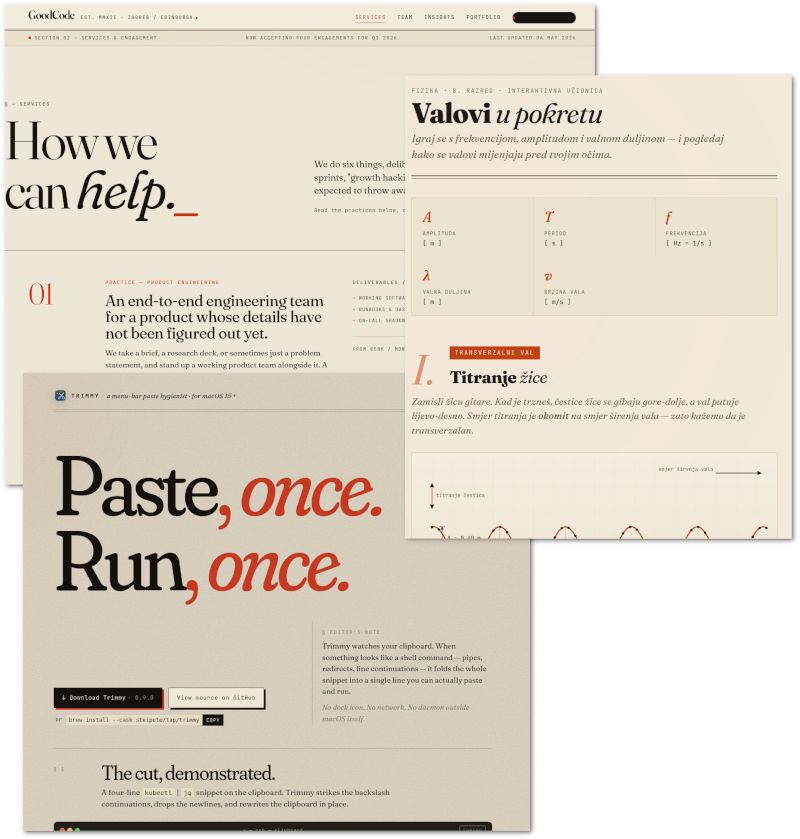
The pelican from the post can be changed by prompting, as other commenters show. But I found it pretty hard to guide Opus away from the above.
Other models' results look different, but also show style convergence.
You can also see in "creative" game output (Astra loves 3d), or text output.
It's not all bad - this shows we should treat AI as a tool and assume any creativity (or lack of it) as coming from the human.
This nicely redefines slop as work you slapped together without much care, irrespective of what the tool was.
Re:Astro Recommender
on Monday October 12, 2026 @11:49AM (#50058170)
Ranks deep sky objects for tonight at your location.
A single-binary Go CLI (feat. WASM port for in-browser use) that tells you what to image tonight from a given location.
Re:Lobbying is corruption
on Saturday October 10, 2026 @10:25AM (#50033342)
Depends, is my friend getting paid a lot of money to give me this advice, by a 3rd party that will massively benefit if I take it?
I might just trust a random redditor more...
Re:Deno Is Joining Cloudflare
on Saturday October 10, 2026 @10:22AM (#50033309)
> Astral [...] The actual product was secondary at best.
No one who has tried ruff, uv and ty would agree with that.
Nor go back to any of the previous alternatives Astral's products replaced. (With the possible exception of ty since that's still pretty new)
Re:Meta and Microsoft Limit Employee Use of Claude AI Tools
on Wednesday October 07, 2026 @03:55PM (#49997998)
I love the typo.
Re:AI Companies Are Parasites
on Monday October 05, 2026 @04:17PM (#49970075)
The post is a zero-information personal rant (good for him/her!), impossible to comment on without violating at least half of the HN guidelines[0].
[0] literally; even this comment violates a few
Re:Web Search API
on Monday October 05, 2026 @01:55PM (#49968137)
A crawler that respects robots.txt is useless in practice since many sites only allow Googlebot and maaaybe Bing - by name.
Re:Kolibri – Tech Report [pdf]
on Saturday October 03, 2026 @02:42PM (#49946651)
Since it's a PDF, here's an excerpt from the summary:
> This report introduces Kolibri, an English–German Mixture-of-Experts transformer with 78.1B total parameters and 3.46B active parameters per token, released as open weights under the Apache 2.0 licence.
> We built Kolibri for sovereign and specialised deployment, with a particular focus on German and on regulated domains such as public administration, industry, and aerospace. To support these settings, we control the full model-development process, including data, architecture, training infrastructure, post-training, and evaluation.
Re:An Update on Orion for Linux and Windows
on Saturday October 03, 2026 @02:38PM (#49946617)
As a Linux user, sad to hear, but totally understandable. As a paying Kagi user, I don't want them to spread their resources too thin.
Thanks for the honest attempt! Hope someone takes the torch and carries it forward.
Re:Ask HN: What're You Reading?
on Tuesday September 29, 2026 @06:25PM (#49901633)
Warning: Hyperion ends on a cliffhanger, you'll want to get The Fall of Hyperion (the sequel).
The entire cantos is great, tho I prefer the first two to the Endymion/Rise of Endymion.
Re:Jeff – Jev-compatible 0.8B decision models, trained at home, ~30 ms
on Tuesday September 29, 2026 @05:17PM (#49900720)
> if my product/company was focused on some sort of classification problem
It's more likely the product is focused on something else, but a classification model could come in handy...
Re:Jeff – Jev-compatible 0.8B decision models, trained at home, ~30 ms
on Tuesday September 29, 2026 @08:06AM (#49891793)
You need to have enough high quality data to train with, knowledge how to do it, and developer time.
In practice, that's enough of a barrier to not even try the approach on a number of cases where it might potentially be useful.
I wouldn't be surprised if Jev turned out to be a "gateway drug" that validates approach on a use case, the team gathers experience and labeled data, and switches to an in house locally tuned model to minimize costs.
Re:Jeff – Jev-compatible 0.8B decision models, trained at home, ~30 ms
on Monday September 28, 2026 @06:53PM (#49885588)
> The OP seems to have anticipated this and mentions you can fine tune it for your use case. Did you try that?
You can already so that with classification models such as ModernBERT, at 0.4B.
Jev's value is its zero shot performance without having to fine-tune.
Re:When did Google get so f-ing weird?
on Sunday September 27, 2026 @05:50PM (#49871213)
I have a few qualms with this response:
1. For a techie, you can already de-Google yourself trivially by asking the AI to build you a bespoke web crawler and run it on Lambda or Cloudflare workers to index the entire internet and store it in DuckDB.
2. The answer doesn't actually help the user get back useful results from Google.
3. "Let me know" doesn't scale, and it's not obvious how talking to random internet strangers about their Google problems will increase your startup SEO?
Re:Claude Code reads AGENTS.md only when telemetry is on
on Wednesday September 23, 2026 @09:35AM (#49815939)
I hope disabling /r if telemetry is disabled is also unintentional...
Re:Claude Opus 5.5
on Tuesday September 22, 2026 @04:37PM (#49807724)
Opus 5.5 is neck-and-neck with Fable 5.1 and Astra 6 in my vibe-coding tests - maybe even better than Fable 5.1
Minecraft clone: https://senko.net/vibecode-bench/2026/voxel-opus-5.5.html (Opus 5.5) vs https://senko.net/vibecode-bench/2026/voxel-fable-5.1.html (Fable 5.1) vs https://senko.net/vibecode-bench/2026/voxel-gpt-6-astra.html (Astra 6)
Warcraft clone: https://senko.net/vibecode-bench/2026/rts-opus-5.5.html (Opus 5.5) vs https://senko.net/vibecode-bench/2026/rts-fable-5.1.html (Fable 5.1) vs https://senko.net/vibecode-bench/2026/rts-gpt-6-astra.html (Astra 6)
The above Opus games took ~45min to generate with the cost between $11 and $14 (per ccusage - I'm on a Max sub). Used from Claude Code with xhigh effort.
Full tests with prompts: https://senko.net/vibecode-bench/
Re:How Meta's Muse works, revealed by the 6.8 GB filesystem it sent me
on Tuesday September 22, 2026 @01:08PM (#49804596)
How about just not connecting it to nukes, then?
Re:Learning Programming in an Age of LLMs
on Wednesday September 16, 2026 @07:06AM (#49724785)
> Just five years ago, the only way to build a working project of moderate complexity was to learn the basic to intermediate concepts required to make an MVP.
> Now, if you can steer an LLM reasonably well, you can quickly build an MVP that goes well beyond your own understanding of the implementation.
Somewhat agree. Five years ago you could build an MVP without understanding how to open TCP sockets or how to parse HTTP headers. You didn't need to understand relational databases, let alone B-trees or cache locality. You didn't need to know how to install Linux.
Now you don't need to understand the details of connecting to Stripe or Auth0 or setting up a Kubernetes cluster.
> You have to intentionally build your understanding as you build your projects.
Some things you need to understand-others, not so much. Depends on what you're doing, the scale, risks, etc, but that's always been the case.
Re:Bending Spoons buying Miro for $1.355B
on Thursday September 10, 2026 @03:58PM (#49649417)
Maybe not to the same extent. In a company I worked with recently they used it a lot but didn't store data in it, meaning there was very little lock-in: mostly inertia/convenience.
If BS slightly raise the price and ruthlessly cut costs (think - leave just a skeleton crew to keep it running), the calculation may make sense even if there's slow churn in the users and no special lock in.
(disclaimer: pure outsider speculation on my part)
Re:Bending Spoons buying Miro for $1.355B
on Thursday September 10, 2026 @10:53AM (#49644780)
Shit that sucks. They'll probably all be let go if BS do their usual thing.
Re:Bending Spoons to buy Miro in $1.36B cash deal
on Thursday September 10, 2026 @10:28AM (#49644316)
Dupe: https://news.ycombinator.com/item?id=49643848
(this one is older but the other one got to the front page and will accrue more discussion)