News for hackers. Stuff that matters.
Re:Winter & Cold Weather EV Range Loss in 7,000 Cars by crazygringo on Sunday December 18, 2022 @11:08AM (#34038995)
I find it strange that the charts only go down to 20°F, when for example at the moment I write this comment, it's -5°F (-21°C) in Bismarck, North Dakota.

And sub-zero Fahrenheit temperatures are pretty common in the winter across the Northeast, especially at night. "Normal" driving conditions extend way below just 20°F.

Re:Winter & Cold Weather EV Range Loss in 7,000 Cars by remarkEon on Sunday December 18, 2022 @11:24AM (#34039219)
Came here to say that (am in Minnesota for Christmas holiday, where it’s currently 1°). It gets much colder than 20°F for extended periods in the Midwest. Is there just not a large enough sample of EV driving in those temperatures to extend the graph?
Re:Winter & Cold Weather EV Range Loss in 7,000 Cars by KennyBlanken on Sunday December 18, 2022 @12:18PM (#34039822)
Exactly. They likely didn't have enough data, because a)it doesn't actually get that cold for very long, even in the coldest parts of the US and b)there aren't many people in those locations (North Dakota, grandparent comment's home state, has the same population as Boston, Massachusetts. Not the region - just the city itself) and c)there aren't many EVs, either - due to lack of infrastructure for them, lower income levels, and (drumroll please) their lower ranges.

Contrary to the knee jerk reaction some people seem to be having, this isn't an conspiratorial attempt to pull the wool over the eyes of Real Americans(TM).

I don't understand the reaction, anyway - ICE vehicles plunge in range with cold temperatures too, and there are a bunch of reasons why EVs seem well-suited to rural life.

The range reduction doesn't mean squat when the longest average commute in the US - Maine - is 10 miles. Who cares if your 300-350 mile EV only gets 200 miles, when that's still 20 days of commuting, and every hour your car is in your garage, it's "gassing up" with no intervention on your part beyond a few seconds to plug in a cord when you get home?

FYI, looking at a smattering of temperature charts, "much colder than 20 degrees for extended periods" is a slight exaggeration for Minnesota.

Re:Winter & Cold Weather EV Range Loss in 7,000 Cars by remarkEon on Sunday December 18, 2022 @03:32PM (#34042896)
I guess I meant “extended periods” to mean “longer than two weeks”, which is about how often I’d fill up the gas tank when growing up there. Average temp in January through March is below 20°F per Wikipedia for most of the state.

Regardless, I agree there’s still good use cases for EVs in cold climates.

Re:Winter & Cold Weather EV Range Loss in 7,000 Cars by tantony on Sunday December 18, 2022 @01:50PM (#34041214)
I have owned a Model 3 in Iowa while living in an apartment with no garage. This was at the beginning of the Covid lockdown where it stayed unused for extended periods of time. The battery was cold-soaked in temps below 20F. Whenever I drove the car, I had almost zero regen-braking, reduced acceleration and the range was decreased by about 30%. For short commutes, that would persist throughout. But whenever I went on longer trips, a one hour drive would get it back to its original performance. The range would stay a bit lower due to higher energy use (~330 Wh/mi instead of 240 Wh/mi in the summer). The navigation would account for this when planning trips and also pre-condition the batteries prior to going to superchargers. On average it added maybe one extra charging stop during road-trips.
Re:Winter & Cold Weather EV Range Loss in 7,000 Cars by hunter2_ on Sunday December 18, 2022 @02:42PM (#34042020)
> almost zero regen-braking

This is interesting. I wonder if large capacitors could alleviate this: somewhere to quickly dump the regen energy, and charge the battery with it at some slow rate equivalent to the long-term average regen load. Not only would it help in cold situations where the battery can't be charged quickly, but also situations where the battery would be healthier if not charged quickly, which is always.

Re:Winter & Cold Weather EV Range Loss in 7,000 Cars by blonder on Sunday December 18, 2022 @11:46PM (#34048600)
While not giving any energy back, Teslas can now detect when regen breaking is limited, and blend in the regular brakes for you, so that you don't have to change your driving style. It has only come out in the past couple of weeks, but I cannot tell the difference when regen is supposedly limited after enabling the feature. Before it was a little dangerous to have to modify your driving style and watch out for how much regen your car uses compared to its normal amount, since after a week of driving an EV in the summer you don't ever really touch the break pedal.
Re:Winter & Cold Weather EV Range Loss in 7,000 Cars by ericvsmith on Monday December 19, 2022 @01:48PM (#34055941)
> almost zero regen-braking

Are you sure this is related to the cold, and not just that the batteries were fully charged so that regen had nowhere to put the energy?

[Edited to add]: I say this because I see this in all types of weather: I live on the top of a hill, and if the car is fully charge there will be no regenerative braking when heading down the hill.

Re:Winter & Cold Weather EV Range Loss in 7,000 Cars by j33zusjuice on Sunday December 18, 2022 @11:20AM (#34039149)
I don’t understand it either. Lows well under 20°F are fairly common in the US. The _average_ temperature in the winter is in the mid-20s where I currently live.
Re:Winter & Cold Weather EV Range Loss in 7,000 Cars by mrits on Sunday December 18, 2022 @11:37AM (#34039352)
We are sub 20F next week in Austin,Tx. I'm going to IL for the holidays where it looks like will be -7F for Christmas.
Re:Winter & Cold Weather EV Range Loss in 7,000 Cars by Sakos on Sunday December 18, 2022 @11:22AM (#34039183)
I figure 20F is just sufficient to prove their thesis (effects of cold on EV cars). I don't think it purports to be an all-encompassing study, especially since there are variables like cabin heating which can have significant effects on range in lower temperatures.
Re:Winter & Cold Weather EV Range Loss in 7,000 Cars by Grim-444 on Sunday December 18, 2022 @11:40AM (#34039395)
At even colder temps than that EV batteries start having even more problems, for example they become permanently damaged if charged at freezing temps or below, so even more energy has to be used to heat the batteries for the batteries to be able to accept a charge.
Re:Winter & Cold Weather EV Range Loss in 7,000 Cars by Reason077 on Sunday December 18, 2022 @12:08PM (#34039695)
Easily mitigated by good charging practices (eg: charge when you finish a drive and the car/battery is still warm, not after leaving it in the cold overnight)
Re:Winter & Cold Weather EV Range Loss in 7,000 Cars by saltcured on Sunday December 18, 2022 @12:39PM (#34040069)
Wouldn't that also mean it has to be heated before driving, or regenerative braking is also off the table?
Re:Winter & Cold Weather EV Range Loss in 7,000 Cars by Reason077 on Sunday December 18, 2022 @07:21PM (#34046340)
Yes, in very cold conditions, regen braking can be reduced/restricted until the battery warms up sufficiently. The car will warn you about this, so hopefully no surprises!
Re:Winter & Cold Weather EV Range Loss in 7,000 Cars by bmicraft on Sunday December 18, 2022 @07:37PM (#34046500)
That's true, regenerative braking is mostly disabled until things have warmed up.
Re:Winter & Cold Weather EV Range Loss in 7,000 Cars by karmelapple on Sunday December 18, 2022 @01:13PM (#34040566)
Agreed, and that’s as someone who grew up in North Dakota and now lives in the milder northeast US, near the ocean.

’d also be interested in seeing it colder for trips back to ND, sure. But the majority of folks in the US live in places where it isn’t as brutal as a North Dakotan winter, so doing a study at 20 F seems reasonable to me.

Re:Winter & Cold Weather EV Range Loss in 7,000 Cars by quickthrowman on Sunday December 18, 2022 @11:32AM (#34039300)
Agreed, I’m in MN and it’s 5F. Starting next Wednesday, we have a forecast for 5 days in a row where the highest temp is 4F.
Re:Winter & Cold Weather EV Range Loss in 7,000 Cars by dwighttk on Sunday December 18, 2022 @11:13AM (#34039061)
Maybe there aren’t many people driving EVs there
Re:Winter & Cold Weather EV Range Loss in 7,000 Cars by FartyMcFarter on Sunday December 18, 2022 @11:21AM (#34039169)
If that's the case, it might be even more important to show this data so that people there can decide whether to start getting EVs.
Re:Winter & Cold Weather EV Range Loss in 7,000 Cars by whoisthemachine on Sunday December 18, 2022 @11:16AM (#34039100)
While they aren't as popular in the Dakota's, there's quite a few EV's in Minnesota, where the temperature ranges are similar (1 degree Fahrenheit at the moment).
Re:Winter & Cold Weather EV Range Loss in 7,000 Cars by dwighttk on Sunday December 18, 2022 @11:21AM (#34039170)
> It includes aggregated and anonymized data from 7,000 vehicles in the Recurrent community from across the United States as well as tens of thousands of data points from on-board devices that provide data on energy usage.

Maybe some more Northerners should join Recurrent?

Re:Winter & Cold Weather EV Range Loss in 7,000 Cars by rconti on Sunday December 18, 2022 @11:14AM (#34039080)
Well they're quite common in nordic countries; of course, the population of nordic countries tends to be in the southern latitudes.
Re:Winter & Cold Weather EV Range Loss in 7,000 Cars by mason55 on Sunday December 18, 2022 @11:39AM (#34039378)
Average January low in Oslo is 22 F. In Fargo, ND it’s 0 F. Oslo is at 59 degrees north latitude, Fargo is at 46 degrees north (south of both Paris and Munich)
Re:Winter & Cold Weather EV Range Loss in 7,000 Cars by duxup on Sunday December 18, 2022 @11:21AM (#34039172)
Also I think being near the ocean helps with temperature.
Re:Winter & Cold Weather EV Range Loss in 7,000 Cars by LinuxBender on Sunday December 18, 2022 @12:27PM (#34039920)
I'm in the Rockies, about 6300' elevation and the temp in the winter is often sub-zero with extremes being around -25F but only a few days usually. None of the locals have an EV but I have seen them on the highway going up to Yellowstone so I have not been able to ask them about range.

The UPS drivers here will soon have a couple EV delivery trucks. I talk to them all the time so perhaps that will be useful data I can relay. It won't be graphs, just happy or grumpy driver anecdotes. I hope they give the drivers good heaters.

Re:Winter & Cold Weather EV Range Loss in 7,000 Cars by dwighttk on Monday December 19, 2022 @04:46PM (#34058208)
If you know any Pepsi distributors see if you can get some numbers on the Tesla semi… ;)
Re:Winter & Cold Weather EV Range Loss in 7,000 Cars by D13Fd on Sunday December 18, 2022 @11:49AM (#34039500)
It’s probably due to lack of data. To some extent, the further the temp is from the mean, the harder it is to find a time and place to test.
Re:Winter & Cold Weather EV Range Loss in 7,000 Cars by barbariangrunge on Sunday December 18, 2022 @11:53AM (#34039528)
As I’m sitting here reading this, it is -35 C after windchill. The reason we didn’t get an ev is because we are getting the sense that the companies that make them do not take Canadaian weather into account

It looks like some of those manufacturers only lose 3% of their range in weather like this, but that’s estimated. The verified numbers are far lower?

Re:Winter & Cold Weather EV Range Loss in 7,000 Cars by Reason077 on Sunday December 18, 2022 @12:05PM (#34039660)
Plenty of people drive EVs in the arctic far north of Norway (Troms & Finnmark). Not quite as cold as Canada, maybe, but close.

Of course EVs will have less range in cold conditions, but they also have some advantages in the cold: pre-heating from an app so the car is warm when you set out, for example. They may be more reliable than petrol and diesel vehicles in extreme cold conditions, and no need for engine block heaters, etc.

Re:Winter & Cold Weather EV Range Loss in 7,000 Cars by zackkitzmiller on Sunday December 18, 2022 @12:37PM (#34040046)
Nearly every modern gas vehicle has remote start, and has for years. This isn't an EV feature.
Re:Winter & Cold Weather EV Range Loss in 7,000 Cars by wil421 on Sunday December 18, 2022 @12:41PM (#34040089)
Lots of people park in garages where it’s not an option.
Re:Winter & Cold Weather EV Range Loss in 7,000 Cars by rosnd on Sunday December 18, 2022 @01:05PM (#34040407)
My gas powered Mercedes heats up just fine without starting the engine.

This has been a common feature for like ... idk, 20 years? I think even the 80s W214 had this option, although that used a separate burner system instead of batteries.

Re:Winter & Cold Weather EV Range Loss in 7,000 Cars by rvba on Sunday December 18, 2022 @05:06PM (#34044098)
You are getting downvoted, while you write the truth.

High end cars had that feature for years. Lower end ones used various block heaters / car heater boxes / webastos.

Re:Winter & Cold Weather EV Range Loss in 7,000 Cars by thesmok on Tuesday December 20, 2022 @05:14AM (#34063918)
It still burns fuel and exhausts CO2 doing that.
Re:Winter & Cold Weather EV Range Loss in 7,000 Cars by iancmceachern on Sunday December 18, 2022 @12:45PM (#34040127)
Replying to the comment below about garages. One can simply open the garage door, also remotely. Step 1, open garage door remotely, step 2, start car remotely.
Re:Winter & Cold Weather EV Range Loss in 7,000 Cars by LeoPanthera on Sunday December 18, 2022 @12:48PM (#34040156)
A big difference is that while an EV is sitting plugged in, it can heat itself from wall power, rather than burning gas to do it.
Re:Winter & Cold Weather EV Range Loss in 7,000 Cars by nightski on Sunday December 18, 2022 @12:52PM (#34040197)
It's called a block heater and they have been in use for many decades in cold climates.
Re:Winter & Cold Weather EV Range Loss in 7,000 Cars by zoklet-enjoyer on Sunday December 18, 2022 @01:47PM (#34041173)
Block heaters don't heat the cab, so it's still uncomfortable
Re:Winter & Cold Weather EV Range Loss in 7,000 Cars by nightski on Sunday December 18, 2022 @02:02PM (#34041431)
I wasn't claiming that they did. The block heater keeps the engine warm to allow for easy remote start.
Re:Winter & Cold Weather EV Range Loss in 7,000 Cars by enduser on Sunday December 18, 2022 @02:42PM (#34042015)
An EV can do both, without emissions, from wall power.
Re:Winter & Cold Weather EV Range Loss in 7,000 Cars by SoftTalker on Sunday December 18, 2022 @04:14PM (#34043491)
Not directly, but the warm water in the block will mean that at least some heat is immediately available once you start the car. The main benefit of block heaters is not in heating the cab, but heating the engine itself so that it's actually possible to start it.

That aside, never understood the value of "pre heating" the car interior. If it's that cold, you're wearing a coat and gloves (or should be). Start the car, drive off, and you'll have heat within a few minutes.

Re:Winter & Cold Weather EV Range Loss in 7,000 Cars by bagels on Sunday December 18, 2022 @05:52PM (#34044943)
The value is not having to wear all that gear while driving, and just comfort generally.

Living in the bay area it's nice that the Teslas have this capability to warm the interior from 55 to 70 before I get in the car. It means I can leave the house in a t shirt in the morning.

Re:Winter & Cold Weather EV Range Loss in 7,000 Cars by SoftTalker on Sunday December 18, 2022 @05:54PM (#34044988)
If you're driving around in subzero weather without a coat, gloves, and preferably a few blankets in the car, you're asking for more trouble than I am.
Re:Winter & Cold Weather EV Range Loss in 7,000 Cars by Scoundreller on Sunday December 18, 2022 @06:31PM (#34045599)
You can have them in there, but not wear them!

It’s kinda a pain to drive with a big puffy jacket, especially once the cabin gets warm.

I’m often in this position: car is in underground car park that sits above zero (Celsius) when it’s far colder outside, so I hand-carry my jacket and keep the vent off until the engine heats up.

Re:Winter & Cold Weather EV Range Loss in 7,000 Cars by zoklet-enjoyer on Sunday December 18, 2022 @08:14PM (#34046891)
I don't like driving on icy roads with gloves on, I feel like I have less control of the car
Re:Winter & Cold Weather EV Range Loss in 7,000 Cars by rosnd on Monday December 19, 2022 @07:11AM (#34051175)
You don't need to wear the gloves, you want to have them in the car in case you end up in an accident and your car is rendered unable to keep you warm.

Essential safety equipment while driving in the cold.

Re:Winter & Cold Weather EV Range Loss in 7,000 Cars by eMSF on Sunday December 18, 2022 @05:09PM (#34044138)
Fuel-type block heaters heat the cabin as well (they turn on ventilation once the coolant has warmed enough). Electric heaters are meant to be used with a cabin heater that uses the same external power source.
Re:Winter & Cold Weather EV Range Loss in 7,000 Cars by bbbbb5 on Sunday December 18, 2022 @08:41PM (#34047148)
Pretty sure most people in cold countries have these https://pic.beely.crasman.cloud/BVC-228/BVC228_11.jpg
Re:Winter & Cold Weather EV Range Loss in 7,000 Cars by zoklet-enjoyer on Sunday December 18, 2022 @10:27PM (#34048052)
I've lived in North Dakota for almost 30 years and have never heard of this
Re:Winter & Cold Weather EV Range Loss in 7,000 Cars by mellavora on Sunday December 18, 2022 @03:32PM (#34042897)
And the nice thing about wall power is that it generates itself thanks to the magic elves.
Re:Winter & Cold Weather EV Range Loss in 7,000 Cars by t-writescode on Sunday December 18, 2022 @03:35PM (#34042939)
Or water or nuclear or wind or solar.

Not everything is burning dinosaurs.

Re:Winter & Cold Weather EV Range Loss in 7,000 Cars by Johnny555 on Sunday December 18, 2022 @04:35PM (#34043751)
And another difference is that I can preheat my EV while it’s inside the garage. While I’d never warm my gas engine car inside the garage, not even with the garage door open.
Re:Winter & Cold Weather EV Range Loss in 7,000 Cars by LeifCarrotson on Sunday December 18, 2022 @12:57PM (#34040279)
Running the engine is a very inefficient way to heat the oil (sometimes requiring a plug-in _electric_ engine block heater if it's so cold the bearings and rings would be insufficiently lubricated to start), and doesn't work at all to warm up a gelled tank of diesel. It's ridiculously inefficient to try to cool the cabin.

EV heating and cooling is far superior to warming up a gas vehicle.

[dead]
Re:Winter & Cold Weather EV Range Loss in 7,000 Cars by mcspiff on Sunday December 18, 2022 @03:29PM (#34042838)
In Canada, electric block heaters for the engine are fairly common as well: https://en.m.wikipedia.org/wiki/Block_heater . Similar concept to fire under the engine, but a bit more modern
Re:Winter & Cold Weather EV Range Loss in 7,000 Cars by bbbbb5 on Sunday December 18, 2022 @03:35PM (#34042948)
>Wow. That would be "nearly every modern gas vehicle in north America".

>Seriously. Running a cold petrol engine under low load in freezing conditions only for heating i just simply a bad idea. Never understood how this is even remotely OK in the US. This is illegal in most of Europe. And for good reason.

My German BMW 7 series definitely had remote start (and an auxiliary heater too). Maybach GLS has an auxiliary heater.

These are hardly uncommon features in vastly cheaper cars either. Various Webasto systems have been around for ages, often installed by OEMs.

Re:Winter & Cold Weather EV Range Loss in 7,000 Cars by nszceta on Sunday December 18, 2022 @05:57PM (#34045044)
> Actually heating the cabin is nothing but wasteful.

Americans value comfort and they get it. Europeans want it too but they can't afford it (taxation and energy scarcity)

Re:Winter & Cold Weather EV Range Loss in 7,000 Cars by Reason077 on Sunday December 18, 2022 @07:18PM (#34046302)
It's to do with safety, not economics. Remote start on a combustion vehicle presents a carbon monoxide poisoning risk. This is perhaps more significant in Europe where more people park indoors and in confined spaces.

Pretty much any EV in Europe has a remote cabin heating feature. If it were about energy and economics, wouldn't that be banned also?

Re:Winter & Cold Weather EV Range Loss in 7,000 Cars by nightski on Sunday December 18, 2022 @07:55PM (#34046708)
If you are parked indoors you don't need remote start. Our garage stays about 32F degrees even when it is -10F out. The entire point of remote start is for the case when you are parked outside, such as at work.
Re:Winter & Cold Weather EV Range Loss in 7,000 Cars by Reason077 on Monday December 19, 2022 @12:01AM (#34048692)
Sure, but is the car actually smart enough to detect when it's indoors and block remote start? Many countries ban or restrict remote start features due to the risk of carbon monoxide poisoning.

In any case, not all indoor parking is climate-controlled. It's nice to be able to remotely warm (or cool, in summer) the cabin to a pleasant temperature before you arrive! 32F is still pretty chilly.

Re:Winter & Cold Weather EV Range Loss in 7,000 Cars by rosnd on Sunday December 18, 2022 @08:25PM (#34046998)
> Pretty much any EV in Europe has a remote cabin heating feature

Surely pretty much any equivalent gas car remote cabin heating too, it's a very common feature.

Re:Winter & Cold Weather EV Range Loss in 7,000 Cars by Reason077 on Sunday December 18, 2022 @11:55PM (#34048655)
> "Surely pretty much any equivalent gas car remote cabin heating too, it's a very common feature."

Remote cabin heating in a gas car requires a "remote start" feature, which is illegal in many European countries - particularly Germany. This is not a common feature in Europe, except in EVs.

Re:Winter & Cold Weather EV Range Loss in 7,000 Cars by rosnd on Monday December 19, 2022 @06:02AM (#34050760)
No it doesn't. It just requires an auxiliary heater, which has been a common feature in cars sold in Europe for at least 20 years. It's a feature you can find in cars sold during the 80s, like the W214.

> This is not a common feature in Europe, except in EVs.

It's a common feature in fancy cars and has been so for ages. Most EVs definitely fall into the fancy car category.

Re:Winter & Cold Weather EV Range Loss in 7,000 Cars by Reason077 on Monday December 19, 2022 @10:16AM (#34053010)
Fair point, but what, maybe 5% or so of gas cars are fancy enough to have a fuel-burning auxiliary heater in Europe? (not just Scandinavia)

Where as most EVs have a "remote HVAC control" feature - even the pretty basic ones. And EVs, of course, will cool the cabin in summer time as well, something that an auxiliary heater can't do.

Re:Winter & Cold Weather EV Range Loss in 7,000 Cars by rosnd on Monday December 19, 2022 @12:27PM (#34054769)
It's definitely much more than 5% of new ICE cars.
Re:Winter & Cold Weather EV Range Loss in 7,000 Cars by Reason077 on Monday December 19, 2022 @06:03PM (#34059086)
Across all of Europe? No way. No cars sold in Southern Europe have this, and afaik it's rare (at best) in the UK. In Scandinavia? Maybe.

But aren't most premium new ICE cars in Europe now (mild) hybrids anyway? Why not use the big 48V battery to power an electric aux heater? Surely way cheaper, simpler, and less dangerous?

Re:Winter & Cold Weather EV Range Loss in 7,000 Cars by Gud on Monday December 19, 2022 @06:36AM (#34050971)
Not sure where you’re getting this info from, but it’s wrong. 1) remote start is not required 2) auxiliary heaters are very common
Re:Winter & Cold Weather EV Range Loss in 7,000 Cars by prottog on Sunday December 18, 2022 @07:08PM (#34046172)
> the oil tray (bad english, but you get it... under the engine)

It's almost perfect English -- it's called an oil pan ;-)

Re:Winter & Cold Weather EV Range Loss in 7,000 Cars by foxyv on Monday December 19, 2022 @10:27AM (#34053157)
For $30-40 you can buy a block heater. They are a very nice to have in cold weather.

https://www.amazon.com/KENUOS-Thermostat-Self-Adhesive-Dipst...

Re:Winter & Cold Weather EV Range Loss in 7,000 Cars by WirelessGigabit on Sunday December 18, 2022 @01:35PM (#34040956)
That's not allowed in Europe.
Re:Winter & Cold Weather EV Range Loss in 7,000 Cars by rosnd on Sunday December 18, 2022 @08:30PM (#34047045)
s/remote start/auxiliary heater/

Fixed for EU. End result is same, ICE car warm.

Re:Winter & Cold Weather EV Range Loss in 7,000 Cars by WirelessGigabit on Monday December 19, 2022 @05:23PM (#34058602)
It's an additional component. It adds extra weight that you're always lugging around. Engine, pipes, pump etc.

And it's weird that it is allowed in Europe, as it has more emissions than a normal engine.

https://www.sciencedaily.com/releases/2021/09/210909123913.h...

Re:Winter & Cold Weather EV Range Loss in 7,000 Cars by anecdotal1 on Sunday December 18, 2022 @03:06PM (#34042393)
Audis don't come with it because it's illegal in Germany according to my old neighbor so he always had to install an aftermarket one...
Re:Winter & Cold Weather EV Range Loss in 7,000 Cars by nikau on Monday December 19, 2022 @06:50AM (#34051055)
If its cold enough in Europe they install dedicated heaters rather than idling the engine - they install a small heating device and pump plumbed into the cooling loop and to the petrol or diesel supply.

When it runs it heats the coolant and circulates it through the engine block.

Newer ones can also talk to the ECU to open the heater core valve and fans to pre heat the interior too. They also can use either SMS messages or an app to turn on remotely if you don't want to use fixed timers.

Re:Winter & Cold Weather EV Range Loss in 7,000 Cars by gwbas1c on Sunday December 18, 2022 @03:52PM (#34043201)
You can't do remote start in a garage. I remote start my Tesla in my garage all the time on super-cold days.

If I did that with a gas car, I'd get carbon monoxide poisoning.

Re:Winter & Cold Weather EV Range Loss in 7,000 Cars by Reason077 on Sunday December 18, 2022 @07:15PM (#34046256)
> "Nearly every modern gas vehicle has remote start, and has for years."

And every year in the US, at least 430 people die from accidental carbon monoxide poisoning.

Re:Winter & Cold Weather EV Range Loss in 7,000 Cars by barbariangrunge on Sunday December 18, 2022 @12:07PM (#34039685)
I was under the impression that cars died in the cold due to the battery dying. Are evs more reliable because they are likely to be plugged in over night?
Re:Winter & Cold Weather EV Range Loss in 7,000 Cars by Retric on Sunday December 18, 2022 @12:14PM (#34039778)
It depends on how cold you are talking about. Lead acid batteries run into issues, but portable jump starter is a cheap and easy solution for that. However, if your talking -40C both oil and fuel both run into problems with ultra low temperatures so people need to use heating blankets.

The nice thing about EV’s is you can have them warmup while plugged in an unheated parking space. The bad thing is cars are poorly insulated so at ultra low temperatures they need to use a lot of energy to keep warm.

Re:Winter & Cold Weather EV Range Loss in 7,000 Cars by rosnd on Sunday December 18, 2022 @08:34PM (#34047074)
> The nice thing about EV’s is you can have them warmup while plugged in an unheated parking space

Just like people have been doing with ICE cars for literally decades? This has been super common since at least the 80s and probably even earlier, https://upload.wikimedia.org/wikipedia/commons/7/75/Standhei...
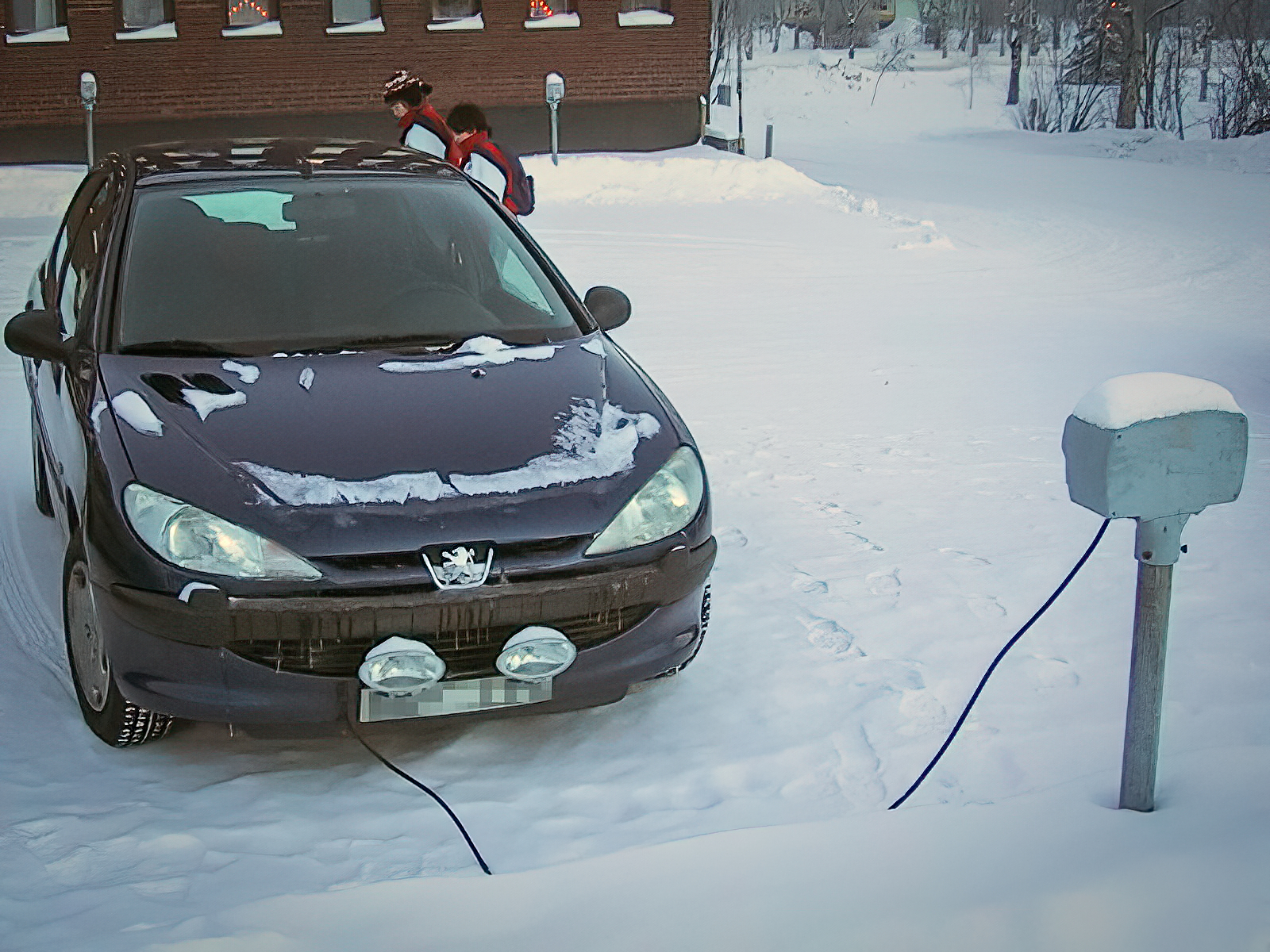
It's called a block heater, it's normal for most parking spaces in cold countries to have sockets for these.

Re:Winter & Cold Weather EV Range Loss in 7,000 Cars by Retric on Sunday December 18, 2022 @09:57PM (#34047813)
That requires extra equipment or aftermarket upgrades. EV’s come out of the factory with everything already setup.

It might not seem like much, but not everyone is local.

Re:Winter & Cold Weather EV Range Loss in 7,000 Cars by d_runs_far on Sunday December 18, 2022 @11:24PM (#34048468)
Or a standard feature if you're living on the Canadian prairies.

In the mid 70's my uncle left Edmonton to do his doctorate in the Bay Area, and had his classmates at Berkeley convinced that his big Dodge Charger was electric because of the block heater cord on the front of it :-)

Re:Winter & Cold Weather EV Range Loss in 7,000 Cars by lazide on Sunday December 18, 2022 @12:28PM (#34039936)
EVs are mechanically far simpler. Mechanical parts always have issues dealing with large temp ranges (it becomes a very hard engineering problem), and the simpler the better. It’s not just oil (not needed to the extent it is in ICE cars), but everything.

For EV’s, the chemistry will have issues at low temps (fixed with battery warmers), and it has to use propulsion energy to heat the cabin, both of which will cause some loss of range.

As long as the battery doesn’t run down too low though, it’s a decent choice if other things are engineered correctly.

Re:Winter & Cold Weather EV Range Loss in 7,000 Cars by Reason077 on Sunday December 18, 2022 @12:12PM (#34039760)
Li-ion batteries perform better at low temperatures than Lead-acid. The traction battery is also a lot bigger so it retains heat for much longer. And in some models, the car's battery management software can kick in some heating to prevent it from getting excessively cold if necessary.
Re:Winter & Cold Weather EV Range Loss in 7,000 Cars by cmrdporcupine on Sunday December 18, 2022 @12:12PM (#34039747)
An EV battery is entirely different than a lead acid accessory battery in a combustion car.

It has a whole system dedicated to maintaining its temperature within ideal ranges.

They don't die in cold weather. I've never heard of one doing so.

The only issue with cold weather is reduced range. So just make sure you buy one with a battery big enough to handle your commute even with reduced range in cold. Which is pretty much all of them these days, honestly.

Re:Winter & Cold Weather EV Range Loss in 7,000 Cars by jeffreyrogers on Sunday December 18, 2022 @12:58PM (#34040283)
Phones and laptops get worse battery performance in cold weather and use similar batteries to EVs.
Re:Winter & Cold Weather EV Range Loss in 7,000 Cars by hunter2_ on Sunday December 18, 2022 @02:23PM (#34041731)
Those don't have "a whole system dedicated to maintaining its temperature within ideal ranges" although now you've got me wondering whether a laptop that expends some energy to keep its battery warm would actually last longer in extreme cold than an otherwise-identical laptop that doesn't... of course one would need to also consider whether the keep-warm energy is drawn while plugged in (which would obviously let it last longer) or not (which I'm not sure about).
Re:Winter & Cold Weather EV Range Loss in 7,000 Cars by prottog on Sunday December 18, 2022 @07:15PM (#34046257)
> far north of Norway (Troms & Finnmark). Not quite as cold as Canada, maybe, but close.

Not even close! The Gulf Stream keeps them nice and toasty. Tromsø or Hammerfest, for example, sees wintertime overnight lows similar to e.g. Worcester, Massachusetts (28 degrees of latitude further south). A far cry from places like North Dakota where the daytime highs in December and January are colder than the overnight lows in Tromsø, let alone places in inland Canada.

Re:Winter & Cold Weather EV Range Loss in 7,000 Cars by hanche on Monday December 19, 2022 @10:17AM (#34053030)
The interior of Finnmark in northern Norway can get very cold indeed. Temperatures approaching -40 degrees are not unheard of there. The coast is much warmer most of the time as you say.
Re:Winter & Cold Weather EV Range Loss in 7,000 Cars by HeyLaughingBoy on Sunday December 18, 2022 @09:41PM (#34047679)
But those aren't real differentiators. You've been able to remote start ICE cars for years, so it's warm when you get in. With a block heater, even diesels will start well below zero. Even without one, my 20 year-old ICE car starts up in -20F. And if you've got a place to charge your EV, then you've got a place to plug in your block heater.
Re:Winter & Cold Weather EV Range Loss in 7,000 Cars by jcadam on Sunday December 25, 2022 @03:59PM (#34131180)
> pre-heating from an app so the car is warm when you set out, for example

Remote start has been a common feature of many ICE vehicles for a long time.

Re:Winter & Cold Weather EV Range Loss in 7,000 Cars by thatfrenchguy on Sunday December 18, 2022 @12:27PM (#34039925)
I don’t know, I’ve been to Quebec and there’s a ton of EVs there so I assume people manage?
Re:Winter & Cold Weather EV Range Loss in 7,000 Cars by cmrdporcupine on Sunday December 18, 2022 @11:54AM (#34039552)
Your car doesn't feel wind chill.

I drive an EV in Canadian winter all the time. Not at all an issue. Range loss is a thing but it's not like the car stops working. In fact it starts more reliably and heats up more quickly for me. And I start mine remotely while it's still plugged in, so the cabin is warm and ready to go without wasting battery energy. And can do this safely in the garage without concerns of carbon monoxide poisoning or stinking up the garage.

Aside: I wish people in this country would stop reporting wind chill temps as if they're some sort of accurate measure of anything. They're only useful as a relatively subjective measure for people who aren't dressed properly.

Re:Winter & Cold Weather EV Range Loss in 7,000 Cars by wolfram74 on Sunday December 18, 2022 @11:56AM (#34039574)
Might be more accurate to describe it as cars generate more windchill from driving than the weather station is likely to experience from wind?
Re:Winter & Cold Weather EV Range Loss in 7,000 Cars by jcampbell1 on Sunday December 18, 2022 @12:42PM (#34040101)
Wind chill is because your body heat makes a bubble of warm air which the wind blows away. When you have a full body suit and helmet, wind chill doesn’t matter.
Re:Winter & Cold Weather EV Range Loss in 7,000 Cars by leereeves on Sunday December 18, 2022 @12:01PM (#34039618)
Doesn't the cold have the greatest impact when the car isn't moving, because the car warms itself while driving?

And the reported wind chill matters when the car isn't moving.

Re:Winter & Cold Weather EV Range Loss in 7,000 Cars by nkurz on Sunday December 18, 2022 @12:31PM (#34039971)
> And the reported wind chill matters when the car isn't moving.

It matters in the sense that a parked car in the wind will cool to ambient temperature faster than it would when the air is still, but not in the sense that it will ever get colder than the actual still-air temperature. Wind chill affects rate of cooling, but (in the absence of evaporation) not the actual low temperature that is reached. Since the concern with loss of range or or starting capacity usually has to do with how the batteries perform at at extremely low temperatures, it's probably closer to true to say that "it does not matter".

Re:Winter & Cold Weather EV Range Loss in 7,000 Cars by ghaff on Sunday December 18, 2022 @12:51PM (#34040189)
Wind chill is mostly a number for TV weathermen to use to hype up cold weather. It does matter to some extent for people in that they may want to be careful to cover exposed skin and wear something windproof. But it's more about dressing for cold windy conditions than about an absolute number.
Re:Winter & Cold Weather EV Range Loss in 7,000 Cars by hunter2_ on Sunday December 18, 2022 @02:38PM (#34041960)
> Since the concern with loss of range or or starting capacity usually has to do with how the batteries perform at at extremely low temperatures

Isn't heating the cabin also a major component of the concern? That's where heating the cabin on grid power would help get some range back.

Re:Winter & Cold Weather EV Range Loss in 7,000 Cars by wolfram74 on Sunday December 18, 2022 @12:22PM (#34039860)
In the best case scenario where the car is in a garage, I've heard that you can pre-emptively bring it up to temperature on grid power and a great deal of the cold-induced range loss goes away. Might still work for outdoor parking, just a bit less shielded of an environment.
Re:Winter & Cold Weather EV Range Loss in 7,000 Cars by dkqmduems on Sunday December 18, 2022 @12:01PM (#34039615)
Air velocity certainly impacts heat transfer.
Re:Winter & Cold Weather EV Range Loss in 7,000 Cars by kube-system on Sunday December 18, 2022 @12:28PM (#34039939)
The air velocity as measured relative to a parked car is not relevant to EV range. When the vehicle is moving the relative air velocity is far different than what it is when parked.
Re:Winter & Cold Weather EV Range Loss in 7,000 Cars by notdonspaulding on Sunday December 18, 2022 @12:40PM (#34040076)
Doesn't the range of an EV drop as the heating load of the cabin of an EV increases?

And doesn't the heating load of the cabin increase as the air velocity over all of its metal and glass surfaces increases? Isn't the shell of the car essentially a giant heatsink with a 70mph relative wind moving across it?

Re:Winter & Cold Weather EV Range Loss in 7,000 Cars by kube-system on Sunday December 18, 2022 @01:19PM (#34040664)
Yes, yes, and yes.

However the speed of air over the car while driving is unrelated to the airspeed that meteorologists use to calculate the wind chill in your local weather report

Re:Winter & Cold Weather EV Range Loss in 7,000 Cars by cmrdporcupine on Sunday December 18, 2022 @12:04PM (#34039653)
Wind chill is a measure of the perception of winter temperatures on human skin.

Certainly the car is affected by wind in cold temps. But that's something else that we would measure entirely differently.

Re:Winter & Cold Weather EV Range Loss in 7,000 Cars by dkqmduems on Sunday December 18, 2022 @07:16PM (#34046275)
'Feeling cold' is measure of heat flux.
Re:Winter & Cold Weather EV Range Loss in 7,000 Cars by mikestew on Sunday December 18, 2022 @12:04PM (#34039654)
…and therefore your argument is that the wind is somehow blowing on a battery that is enclosed, as are most EV traction batteries?
Re:Winter & Cold Weather EV Range Loss in 7,000 Cars by wpietri on Sunday December 18, 2022 @12:48PM (#34040151)
> They're only useful as a relatively subjective measure for people who aren't dressed properly.

Depends on your interpretation of "properly". Since 2001, the wind chill numbers for US, CA, and UK are based on a "bare face": https://en.wikipedia.org/wiki/Wind_chill#North_American_and_...

Wanting to know how cold it's going to feel on one's face seems like a pretty reasonable need. At the very least, to know when to break out the balaclava.

Re:Winter & Cold Weather EV Range Loss in 7,000 Cars by crazygringo on Sunday December 18, 2022 @01:20PM (#34040674)
> They're only useful as a relatively subjective measure for people who aren't dressed properly.

That's a bizarre thing to say when to dress properly, you need to know the wind chill.

If it's 25°F out no wind, vs. 25°F out but it's 5°F with wind chill, that's an entire additional layer I need to put on during my morning walk.

Wind chill is a very accurate measure for judging what to wear. How do you think it's not accurate? It's literally an equation that accounts for the fact that wind makes you colder. You can scientifically, objectively measure the faster cooling effect of wind on an object. (Granted there are marginal differences in its effect on a human body depending on one's height and weight, but that still doesn't make it subjective.)

Re:Winter & Cold Weather EV Range Loss in 7,000 Cars by Epa095 on Sunday December 18, 2022 @02:22PM (#34041726)
But if you only know the windchill temperature, how do you dress? If it is 10f with wind chill, do you prep for wind or not? I want to know temperature and windspeed, and then I know how many layers of wool I need (from the temperature) and how windproof I need to dress (from the windspeed).
Re:Winter & Cold Weather EV Range Loss in 7,000 Cars by hunter2_ on Sunday December 18, 2022 @02:33PM (#34041891)
Interesting point: if we need to know two things, one of them being air temperature and the other being [windspeed or windchill], the second thing ought to be whichever delivers more overall value.

If you can figure out how to dress based on either one equally well, then it comes down to what else can be gleaned from windspeed vs from windchill. I would tend to agree that windspeed is more valuable, as it's better at readily telling you if an activity you're planning to do, which is only possible under certain windspeeds (like using a tent or something), will be doable.

Re:Winter & Cold Weather EV Range Loss in 7,000 Cars by euroderf on Sunday December 18, 2022 @03:44PM (#34043069)
Windchill addresses the user request "Don't make me think". Wind speed requires actual thought.
Re:Winter & Cold Weather EV Range Loss in 7,000 Cars by crazygringo on Monday December 19, 2022 @09:52AM (#34052705)
You dress for the wind chill. I'm actually having trouble understanding your question because I can't think of any circumstance where you wouldn't.

I don't care about the wind speed as a separate number because it's useless to me except in how much it converts to wind chill, since I'm not going outside to fly a kite.

Perhaps I simply don't understand the concept of dressing to be windproof or not. Virtually all winter outerwear is "windproof" enough. People aren't usually going outside for an extended period of time in a cable-knit sweater as their outer layer.

Also -- you do understand that the wind still makes you colder regardless of how windproof your clothing is?

Re:Winter & Cold Weather EV Range Loss in 7,000 Cars by fsh on Sunday December 18, 2022 @12:53PM (#34040216)
There is no such thing as windchill for a car.
Re:Winter & Cold Weather EV Range Loss in 7,000 Cars by aaronax on Sunday December 18, 2022 @12:57PM (#34040276)
Generally true, but could be relevant for calculating heat loss rates of cabin or battery. Only when parked I guess, as air velocity due to driving would typically be much greater.
Re:Winter & Cold Weather EV Range Loss in 7,000 Cars by ChrisClark on Sunday December 18, 2022 @12:53PM (#34040218)
In the summer, I can drive from Calgary to Edmonton without stopping to charge. I did one trip at -40 (without windchill) and I had to charge in Red Deer for about 30 minutes to make it.
Re:Winter & Cold Weather EV Range Loss in 7,000 Cars by thinking4real on Sunday December 18, 2022 @12:08PM (#34039693)
Everyone’s repeating they find this strange. Is it really strange?

I’ve been excited for EVs all my life. But there’s a certain level of propaganda that’s come with them.

Explicitly talking about their downsides seems to be taboo. Like you’ll get downvoated or banned on many social media platforms for doing it.

Re:Winter & Cold Weather EV Range Loss in 7,000 Cars by PaulBGD_ on Sunday December 18, 2022 @12:11PM (#34039743)
I think it’s because most people who are pro electric understand their downsides, and usually the downsides are presented as dismissal (eg why buy an electric, you have to stop when you’re traveling cross country.) It’s kind of a boring topic unless there’s something new to discuss.
Re:Winter & Cold Weather EV Range Loss in 7,000 Cars by itsoktocry on Sunday December 18, 2022 @06:40PM (#34045753)
This is the exact opposite of my experience, on many, many car related forums.

EVs are presented as a panacea, doing everything an ICE can do, only better. It's not true. There are tradeoffs.

Re:Winter & Cold Weather EV Range Loss in 7,000 Cars by thinking4real on Tuesday December 20, 2022 @05:49PM (#34073938)
I think you’re lying to yourself because you’re an EV fan.

You have to consider what the pushers are saying and if there’s sufficient pushback when they’re misaligned.

Currently that doesn’t happen. Currently you face everything up to deplatforming for speaking against the narrative that EVs are the one true solution.

Re:Winter & Cold Weather EV Range Loss in 7,000 Cars by criley2 on Sunday December 18, 2022 @12:36PM (#34040034)
Quite the opposite, I find every thread about them (including this one) to be entire dominated by the naysayers who claim they are repressed but in actuality are the loudest and most visible voices.

It's a bit ironic you claim "propaganda" and "downvotes".... in the most upvoted, top thread on this post, a thread which is highly skeptical/negative to EV.

These days I find it difficult to find real-world data or anecdotes from EV real owners amongst the tidal wave of gasoline vehicle operators predicting how terrible an EV would be (and justifying their ego/decision to not buy one).

Re:Winter & Cold Weather EV Range Loss in 7,000 Cars by itsoktocry on Sunday December 18, 2022 @06:45PM (#34045853)
Because nearly every article posted on HackerNews comes from a website whose entire purpose is to promote electric vehicles. The "naysayers" in the comments offer a balancing view.

You'll note it's RARE that the article is negative towards EVs, only the comments. Because it's pro-EV, all the time.

Re:Winter & Cold Weather EV Range Loss in 7,000 Cars by Philip-J-Fry on Sunday December 18, 2022 @12:18PM (#34039829)
I assume it's because temperatures like that during the day (when most car travel takes place) is less common than at night. It's more representative of the general use case.
Re:Winter & Cold Weather EV Range Loss in 7,000 Cars by mdorazio on Sunday December 18, 2022 @12:31PM (#34039962)
The majority of Americans do not live in areas that get below 20F average for extended periods of time. Your particular use case is atypical, especially for EV buyers, so it isn't shown.
Re:Winter & Cold Weather EV Range Loss in 7,000 Cars by Teever on Sunday December 18, 2022 @12:34PM (#34040006)
As a Canadian I guess data from events that Americans rarely experience isn't really that useful or interesting.
Re:Winter & Cold Weather EV Range Loss in 7,000 Cars by seanmcdirmid on Sunday December 18, 2022 @12:43PM (#34040113)
Northern Minnesota and North Dakota are pretty cold, not to mention parts of Alaska.
Re:Winter & Cold Weather EV Range Loss in 7,000 Cars by mdorazio on Monday December 19, 2022 @09:03AM (#34052119)
If you want data on outside-the-normal situations, you shouldn't expect it to come from blogs or news posts targeted at average users. Here's a more technical blog with some data on lower temps based on telematics driving data: https://www.geotab.com/blog/ev-range/
Re:Winter & Cold Weather EV Range Loss in 7,000 Cars by chmod775 on Sunday December 18, 2022 @12:48PM (#34040154)
> Your particular use case is atypical

Norwegians alone account for ~5-10% of Tesla's global sales in recent years.

I don't think it's far fetched to assume that at least one tenth of all Tesla vehicles (and other EV vehicles in that price class) are driven in areas that do routinely experience longer periods below that temperature. It's likely much more than that, because in Europe you can easily find these temperatures many places far south of Norway.

Re:Winter & Cold Weather EV Range Loss in 7,000 Cars by mdorazio on Monday December 19, 2022 @08:50AM (#34051980)
Did you even bother to look up average temperatures by month in the populous parts of Norway before posting this? It doesn't get that cold: https://www.climatestotravel.com/climate/norway/oslo
Re:Winter & Cold Weather EV Range Loss in 7,000 Cars by chmod775 on Friday December 30, 2022 @04:16PM (#34190212)
I suppose what you got there is an average of averages over multiple years.

It absolutely does get that cold: For most of January 2021 the average daily temperature was below 20F in Oslo (21/31 days), dropping as low as 3F average and 0F for the lowest recorded temperature. February 2021 wasn't much warmer, only creeping above 20F in the second half.

https://www.wunderground.com/history/monthly/no/gardermoen/E...

https://www.wunderground.com/history/monthly/no/gardermoen/E...

Re:Winter & Cold Weather EV Range Loss in 7,000 Cars by zoklet-enjoyer on Sunday December 18, 2022 @12:31PM (#34039972)
I'm in Fargo and one of my coworkers recently got a Model 3. It's going to get much colder in the coming week and I'll be asking him about what kind of mileage he's getting.

Edit: Just looked through r/Fargo and found this thread on EVs here https://www.reddit.com/r/fargo/comments/wvdud0/evs_in_fargo/

Re:Winter & Cold Weather EV Range Loss in 7,000 Cars by orasis on Sunday December 18, 2022 @02:00PM (#34041389)
Two winters ago I tried to drive my model 3 across North Dakota - never will I do that again. Range was cut in half and I had to stop at every single supercharger.
Re:Winter & Cold Weather EV Range Loss in 7,000 Cars by mjevans on Sunday December 18, 2022 @02:15PM (#34041635)
The charts should _all_ have the same range and scale so that they can be visually compared. As it stands they appear optimized for maximizing the data acuity of each individual car without consideration for visually comparing curves between cars.