I feel like the author is looking at using amendments as a way to implement legislation that is permanent. Our Federal constitution is fairly concise, whereas some State constitutions are so easy and readily amendable that legislation gets codified in almost every session [1]. The challenge with doing this is that the constitution itself converges into just another body of law.
[1] https://en.wikipedia.org/wiki/Constitution_of_Alabama
Edit: Instead of "permanent", "decisively" would be more appropriate. A constitution that can easily be amended can just as easily be un-amended. A response to this comment said "way to settle national controversies" which seems far more fitting than what I originally wrote.
What it really does is sap political power from the Supreme Court, which is a reasonable goal for someone like Lepore to have right now.
But at least with two hundred years of general acceptance, so clearly there was something to it.
But say, 80 years (FDR's expansion of executive power, which reactionaries in the courts are currently dismantling) is not?
Hardly anyone alive remembers it in any other way by this point, and everyone involved in setting that state of affairs has been dead and buried for a generation. And yet...
It's also strange how people seem to be fine to cherrypick a superset of (constitution + a bunch of other two-centuries old political babble), but exclude mountains of conflicting (two centuries-old political babble). It's almost as if the desired outcome is pre-determined, and we're just looking for fig leaves to justify it.
As for what the framers thought, Wikipedia has some choice quotes, including from Thomas Jefferson: https://en.wikipedia.org/wiki/Judicial_review_in_the_United_...
Concise to the point of vacuous. It says practically nothing. It describes only the barest outlines of government, and effectively all of the actual implementation has been a matter of legislation, judicial decisions, and tradition. Individual words are scrutinized as if they will somehow be unambiguous if we stare at them long enough, or bring in enough cherry-picked outside context.
The section on the courts is especially hilariously short. It basically says "We should have one". Everything after that -- included the vaunted ability of the Supreme Court to "interpret the constitution", is a matter of them deciding that it was something they were going to do and everybody else going along with it.
Is that not the whole point? "The powers not delegated to the United States by the Constitution, nor prohibited by it to the States, are reserved to the States respectively, or to the people."
So the federal government is essentially taxing the state's citizens, then giving some amount of it back to the states in exchange for rowing the boat in the right direction. States that increase their own taxes to compensate for refusal of federal funds would become noncompetitive to other states who don't.
The biggest handout of all is small states getting two senators despite having 1/50th the population. SALT deductions are nothing in comparison, you could always redirect federal money to make sure red states are net beneficiaries of federal money… and whaddya know, even with the SALT deduction they were.
It's antithetical to the federal nature of the US that the overwhelming majority of tax dollars are paid to the federal government and not to state and local governments. The federal government's share of taxation should be limited to support its constitutional mission, and more should remain at the state and local level to achieve state and local missions, including things like social services and infrastructure.
That way, some states may choose to have an expanded role of government with high levels of social services and infrastructure spending, some may choose the opposite, and none are left sucking on the federal teat -- the milk from which, may I remind you, are collected from people who live in every state, not just the ones with "better infrastructure".
In the end government money is just people's money taken by taxation. When you let the federal government take most of it, you allow it to browbeat the states into doing whatever the federal government wants, conveniently escaping the limitations that the Constitution placed on it.
To summarize:
“Our Constitution is not good. It is a document designed to create a society of enduring white male dominance, hastily edited in the margins to allow for what basic political rights white men could be convinced to share. The Constitution is an imperfect work that urgently and consistently needs to be modified and reimagined to make good on its unrealized promises of justice and equality for all. And yet you rarely see liberals make the point that the Constitution is actually trash. Conservatives are out here acting like the Constitution was etched by divine flame upon stone tablets, when in reality it was scrawled out over a sweaty summer by people making deals with actual monsters who were trying to protect their rights to rape the humans they held in bondage.”
Excerpt From Allow Me to Retort Elie Mystal https://books.apple.com/us/book/allow-me-to-retort/id1549926... This material may be protected by copyright.
The framers were well before the Industrial Revolution; if they intended a right-libertarian bias, the economy they wanted unchecked was a smaller and tamer beast than this one. But anyway, they did give us the Commerce Clause.
They were well before radio, TV, internet, trains, automobiles, airplanes, nuclear power, and many other things that do not strictly respect state lines. "Leave most decisions to the states" made a lot of sense in 1789 but we live in a different world now.
It makes sense if you sort of skim over the idea that Germany, Sweden, and Spain are just "states" in a federation. But obviously, they are not.
Maybe a US state is something legally different than an EU country, maybe not. I would say the two weren’t intended to be different, and whatever trends have produced such a difference were a mistake. Either way, that doesn’t address the practicality question.
Of the 27 amendments that have been ratified, the most recent was one of the twelve submitted as the Bill of Rights, so there are literally none that have come later. Sixteen have come in between (one from the BOR was never passed.)
Also, the most relevant amendment to the issues upthread, for most purposes in US law (since things like defamation law and most of the cases where the evidence differences matter are state, not federal) is the 14th, which is not part of the BOR.
A lawyer once said that "show me a contract that's one page, and I won't be able to break it. Show me one 20 pages long, and I'll break it."
You are missing the point. The point is comparing it to a hypothetical constitution that is 20 pages long, instead of 1 page long.
So, the 20 page long constitution, is probably easier to break, despite you misleading focus, on the irrelevant point, of the exact way the statement was phrased.
How?
While it is in many ways the main provision that gives meaningful impact to rights both in and beyond the BOR (though the 13th Amendment competes with it on that front, since if people can be treated as property instead of people, they have no rights) by applying them to the main locus of government authority, the states, which the BOR itself neglected to do, the 14th Amendment, which was at issue in Dobbs, is not part of the Bill of Rights.
So Dobbs doesn’t illustrate an assault on the Bill of Rights so much as its irrelevancy in the absence of subsequent amendments.
The founders understood the nature of power, and thus the importance of decentralization and diversity.
But also consider that nobody has yet been put in jail for harshly criticizing the President. And you can still buy a gun.
You call out Article III, for example, so I'll focus on that. It doesn't say "we should have a Supreme Court and other courts Congress may establish." It says the judicial power of the United States shall be vested in them, and that judges shall be appointed. It isn't magisterial or clerical power. It clearly establishes the United States as a common law system. That's further reinforced by the use of the term jurisdiction — literally the power to say what the law is. It's clear that any and all courts established by Congress are "inferior" to the Supreme Court, which is a significant protection of judicial independence. It's also clear that Congress can't reduce their pay as retribution - ditto. And that's just the first section.
It's a much richer document than your previous comment gives it credit for.
Congress should not get to seat its own checks and balances, and it doesn't particularly matter if Congress is only allowed to establish and ordain inferior courts to that of the Supreme Court, if they already effectively establish and ordain the Supreme Court's delegations - and thereby its power.
WTF do they even let people online
Supreme Court Justices are, "nominated by the President and confirmed by the United States Senate". The President is appointed by Congress through the Electoral College. Congress seats its own checks and balances by direct and proxy.
You should allow people to think of you as an idiot, rather than vomit on your keyboard and remove all doubt.
I'm not going to ban you right now because (unlike with the other account) I didn't see a lot of this in your history—but please don't do it again.
Is it that you don't see the linkage between the text of Article III and Marbury's famous line, "it is emphatically the province and duty of the judicial department to say what the law is"? Because jurisdictio literally means "to say what the law is"
The fact judicial review is not in the constitution is not controversial.
Here's what Administrative Office of the U.S. Courts web sight says:
"The best-known power of the Supreme Court is judicial review, or the ability of the Court to declare a Legislative or Executive act in violation of the Constitution, is not found within the text of the Constitution itself. The Court established this doctrine in the case of Marbury v. Madison (1803)."
https://www.uscourts.gov/about-federal-courts/educational-re...
In my experience, programmers do the same with law. Just because technical people operate in a world of constraints does not mean they are experts in the law. A little more humility would be helpful.
The website is intended for a lay audience, and doesn't constitute persuasive or binding authority in any case.
But the fact of the matter is that judicial review is found within the text with any amount of close reading. There is exegesis required, yes, but that exegesis is extremely straightforward and clearly delineated in Marbury, which I would encourage you to read.
But even without relying on Marbury, what exactly do you think "appellate jurisdiction ... as to law" means if it doesn't implicate judicial review?
The Framers clearly thought it meant judicial review when they wrote it, and they said as much when they enacted the Judiciary Act of 1789. Section 25 thereof: "a final judgment ... where is drawn in question the validity of a treaty or statute of, or an authority exercised under the United States ... may be re-examined and reversed or affirmed in the Supreme Court of the United States." The procedural posture is a bit different, due to the then-current presumption of parity between state and federal courts, but the fact of the matter is that the Framers clearly knew what "appellate jurisdiction ... as to law" meant, even if it's trendy for some people today to claim that they, themselves, do not.
It's a trendy take to say that judicial review isn't in the Constitution, and that may be superficially true, but it ignores two important facts that contradict that take:
(1) Article III's explicit grant of "appellate jurisdiction ... as to law"
(2) The Framers' own words in the Judiciary Act of 1789, which explicitly anticipates cases "draw[ing] in question the validity of a treaty or statute of, or an authority exercised under the United States, [where] the decision is against their validity" and reaffirms that such decisions may be "reversed or affirmed in the Supreme Court of the United States."
It is very clear what "appellate jurisdiction ... as to law" in "cases, in law and equity, arising under this Constitution, the laws of the United States, and treaties made" means. And for anyone who has any lingering doubts, just look to how the Framers implemented it in the very first Judiciary Act, less than seven months after the Constitution went into effect.
It's a shitshow through and through
The 18th Amendment (Prohibition) is an example of what can go wrong with amendments.
Constitution design is an academic field, a very niche area of political science, and nobody would ever implement anything like the US Constitution today. It would be like using ALGOL for a new project today instead of Python or Java.
The US Constitution was very much a version 1.0 project, written before people even knew political parties would be a design constraint. Constitutions are on like version 5 or 6 now. (I'm making up numbers but you get the idea.)
The article argues that newer versions of constitutions often overly lengthy due to attempting to include too many laws within the constitution, which can cause problems. The article argues: "Overly long constitutions often create conflicts between articles that can only be resolved with further tampering. And “if everything is highest law, then nothing is highest law anymore,” points out Dr Versteeg. Omnibus amendments require voters to balance the merits and drawbacks of many changes at once, making it harder to generate consensus."
In brief, the article's view is that the inclusion of too many laws in more recently-written constitutions leads to greater incentives for constitutional rewrites as times and political views change, which is why the article takes a viewpoint in favour of shorter constitutions that guarantee fundamental rights, and are thus more difficult to rewrite.
[1] (Paywalled, though I've included a summary above): https://www.economist.com/international/2022/08/25/dictators...
The modern approach is generally a parliamentary system rather than a presidential system, and multiparty proportional representation (sometimes with multi-member districts) rather than two-party first-past-the-post single member districts. Some places to start:
https://en.wikipedia.org/wiki/Parliamentary_system
https://en.wikipedia.org/wiki/Proportional_representation
If you want to look at more "advanced" constitional forms, then consociationalism is a good place to start, although much less widely adopted and more controversial as to whether it's progress or not:
I’m not a constitutional scholar but I take issue with that characterization.
Federalist #10 by James Madison is all about factions, how they are inevitable, and how the system of government should be structured so that their self interests balance out for the good of the nation. Madison wrote the Virginia Plan which proposed the three branches of government and he wrote down exactly what his thinking was at the time. For most of the 18th century the British empire was a single party state ruled by the Whigs which is what they were trying to avoid by explicitly allowing room for many factions.
https://www.google.com/search?client=firefox-b-1-d&q=bouie+s...
From The Economist's article: "[...] But academics have noticed patterns. Frequently changed constitutions are often a symptom of political corrosion, and tinkering can cause chaos in turn. Attempts to amend charters have led to violence in Burkina Faso, Burundi and Togo among others in recent years. The world’s longest charters, such as India’s and Brazil’s, are also among the most changed.
"There is a strong case for brevity, too, in which constitutions establish the ground rules of how a state functions and leave the specifics to politicians. Overly long constitutions often create conflicts between articles that can only be resolved with further tampering. And “if everything is highest law, then nothing is highest law anymore,” points out Dr Versteeg. Omnibus amendments require voters to balance the merits and drawbacks of many changes at once, making it harder to generate consensus."
The viewpoint by the writer of The Economist's article would actually conflict with the view held by the original commenter, as it notes that many more recently-written constitutions that have taken different approaches from older constitutions have contributed to political instability (though the writer also acknowledges that other factors have also been at play behind instability).
[1] https://www.economist.com/international/2022/08/25/dictators...
Even while many people in the US might like the things a parliamentary system has to offer, there is no viable way to transition to one culturally. As much Americans hate how politics works presently, they hate the idea of replacing it even more. The socio-cultural hesitancy is real, paradoxical, and cannot be ignored.
..cites two of the most important examples
Hm... Germany's system changed at least 3 times in the 20th century. France is on its Fifth Republic. Italy is a shitshow.
To me it seems that the oldest democracies (UK, US) are the most stable (even today!) and they're majority systems (first-past-the-post).
The worst for representative democracy is literally Hitler. The second worst (you could argue that Hitler was a unique set of circumstances) is the dysfunctional German, Italian, or French states.
The best case is probably Switzerland (party proportions barely change, I assume because the power of parliament is diminished because of elements of direct democracy that Swiss practice).
What's the worst case for first-past-the-post democracy?
Only if you believe fake news media propaganda who equated "mostly peaceful protest" with "coup" (for real examples of a coup, look no further than Libya, Ukraine, or Myanmar; hint: it usually involves guns & people getting killed).
I'll take a version 1.0 which is focused on reifying the natural God-given rights of man vs version 3.0 which reifies power of the State & Corporate "persons" over man.
The primitive low-level tech opens the space to what is possible. Improving low level components opens up a large space of possibility that is often inconceivable at the time the improvement is done. The reverse is disimproving low level components restricts the range of possibilities.
This is why we have seen so much churn in the front end & application libraries. More recent front end & application libraries have sought to improve the low level apis to improve the development context of complex software.
A more evolved system (e.g. version 3.0) built with worse components is bound by the lack of quality of it's underlying components. So if version 3.0 Constitution is built with disimprovements in version 2.0 or earlier, it could be rendered worse than a version 1.0 built with quality components & quality first principles.
While the latter has a vast test bed of real world utilization that reveals PL efficacy, the former can only be evaluated from the standpoint of theory, with a heavy heap of ideology.
https://en.wikipedia.org/wiki/Comparative_politics
Lest you think this is ideological or theoretical, no -- it's entirely about collecting data of real-world political operation, how similar or different constitutional structures result in similar or different outcomes given similar or different populations and histories.
It's incomparable to PLs, which have perhaps billions of case studies on which comparative analysis can be done.
Because there are probably only ~200 PL's with truly significant usage, and they tend to have a variety of purposes and be used in historically different contexts -- much like constitutions.
The same arguments that programmers have over declarative vs imperative is much like the arguments political scientists have over parliamentary vs presidential. Static vs dynamic type checking is much like civil law vs common law.
And there's similarly nothing "scientific" in proving that one programming language is "better" than another, but people have strong opinions, and experience will tell you which ones are good ideas to pick for a project and which ones are not.
By the way, I'm not sure you know what a case study is -- it's a report written by a person. Nobody's written billions of those. And you don't do comparative analysis on case studies -- a comparative analysis is a case study, where the cases are countries (or programming languages).
I can agree with the broad point that inertia is a major cause for constitutions to stay the same over time. But I disagree with the original commenter's implication that more recently-written constitutions tend to be better than older ones due to lessons from the past, because of the idea (perhaps relating to yours) that contemporary political and ideological considerations can introduce weaknesses into more recently-written constitutions, which overlook potential lessons from the past.
But neither are really great or terrible. Canada didn’t really change much, and South Africa hasn’t been doing great.
The “West German Basic Law” was widely condemned:
* it was unrealistic to have strong privacy protections for a nation filled with refugee camps and few private homes
* the protections for the family were meaningless when so few nuclear families survived (something like 70% of the country was female)
* the mandate to reunify was unrealistic and possibly undesirable
* there were no provisions for the victims of Nazi Germany
* it favored the establishment of strong, stable leaders - which brought back memories of Hitler
* many of the civil liberties - such as abolishing the death penalty - were just excuses to prevent punishment of war criminals (which was true)
* claiming the lands East of the Oder as part of Germany was unrealistic
Buy it turned out to be an extremely effective Constitution that lead to the transformation of Germany and its eventual reunification (mostly).
The amendment process is very onerous. 7/10 provinces haven't ever really agreed on the colour of the sky, let alone something as important as new constitutional rules. It took some very special backroom wrangling to pass it in the first place and I don't see a path to amending it during my lifetime. Meech Lake came close and very nearly broke the country.
The notwithstanding clause was necessary to get it passed at all, but really takes some of the teeth out of the charter of rights and freedoms. When parties hold majority control of the House of Commons or a provincial legislature a lot of what keeps their power in check is mostly norms it turns out. One of the few actual laws that would really impede them is the charter, but portions of it can be ignored.
Overall I'm very happy we have the 1982 Constitution Act, but I certainly wouldn't offer it up as a blueprint if someone came asking for assistance in drafting a constitution. The Charter itself as a portion of the larger constitution (minus the notwithstanding clause) is a very special piece of law that deserves some recognition internationally, but as a whole it wasn't even 10 years before the real issues were exposed with the whole document.
She suggested insurrectionists in Egypt emulate the South African and Canadian Constitutions, rather than the US Constitution.
She wasn’t insulting the US Constitution, just emphasizing it’s the product of circumstances that didn’t apply to Egypt.
Seems like the Canadian Constitution is similarly constructed - taking the specific time, place, customs into account.
Not a bad thing at all.
https://www.factcheck.org/2018/12/ruth-bader-ginsburg-taken-...
> My source for Canada and South Africa is Ruth Badger Ginsburg.
So just the one legal scholar then?
Ruth Badger Ginsburg should be a Supreme Court Justice on a kids show filled with animals who makes landmark decisions the real Ruth Bader Ginsburg would have proud of.
Your own link contains my very point: the Charter of Rights and Freedoms is a modern piece of human rights legislation. RBG specifically calls out the Charter, not the Canadian constitution as a whole.
The Charter is like the US Bill of Rights, a small section of a larger document dealing specifically with civil rights. The rest of the Canadian constitution is a messy bit of parliamentary wrangling from across 2 centuries delegating the country of Canada into existence and separating it from the UK.
So the law can override it as they please? I prefer the US version that says "Congress shall make no law ..."
We're much more like the UK than the US in the function of government and the construction of laws, though Parliamentary Sovereignty is expressly subject to judicial review in Canada, something the UK is going to have to grapple with over the next decade now that they are no longer subject to the European Court of Human Rights.
The government can't just override the charter as they please using the language in the Guarantee. The charter allows for things like hate speech laws, but they have to fall under "reasonable limits", something the Supreme Court of Canada rules on all the time, nearly always in favour of citizens compared to the government. A recent example being medically assist death, where the Supreme Court ruled bans on assisted death violated the Charter.
The US is a free speech extremist country, but since even the US Supreme Court has ruled there are limits on speech (like threats) this isn't a night and day difference between our countries in my view. The US allows far more speech than Canada does, yet we rank higher on the press freedom index.
The thing that really lets the Charter down is section 33, the 'notwithstanding clause'. It allows the federal and provincial governments to pass laws overriding certain rights for a period of 5 years. The charter itself would likely never have come into being without it, but it does take some of the teeth away.
Jeez, it is hardly extreme. BTW, free speech does not include libel, slander, specific threats, or inciting riots.
> we rank higher on the press freedom index
Canada does? Based on what? Note that no matter how extremely negative the press was about Trump, never once did the government make any legal threats against them about it.
Reporters Without Borders maintains a press freedom index. Their justification is detailed here: https://rsf.org/en/index
Canada ranks 19, the US 42
I remember an interview with John Carreyrou, the French-American journalist who broke the Theranos scandal.
He said very clearly that if it had happened in France, no press outlet would have covered it.
Theranos had a board of trustees that included Henry Kissinger, a future secretary of defense, etc.
And the publisher of the, WSJ, Rupert Murdoch, had invested hundreds of millions.
I doubt it would have been published in the UK or Germany either.
I’m shocked to hear this! I thought the UK was still very much subject to the European Court of Human Rights!
Just because you wrote a good constitution doesn't make the government good. You can put anything you want into a constitution if you don't have the institutions set up right to maintain it.
Further, it's intentional that the federal government at times becomes unable to do it's job in times of intense disagreement. That was an intentional design feature.
THAT'S where the "V.1" honor comes from.
Most that seek to change the constitution want to take away rights or add new ones. It is good it is hard to change, especially when many of the change seekers can’t even get the popular support to get a law passed or a veto overridden.
I used to admire the US constitution. I've grown up now.
Who could possibly be opposed to human rights - i.e. human beings having rights? And indeed, the US constitution does appear to be largely about rights.
Over the years I've increasingly leaned to the view that these rights are mostly a legal fiction, and that the things that are supposedly rights are highly subjective political footballs. Nowadays I think of a constitution as a largely non-political set of rules for how government works; i.e. it's a description of a mechanism, not a description of an outcome.
From that point of view, the US Constitution is an awful constitution.
What do you mean? US citizens have pretty much the most rights of any people in the world.
Can you list the countries that guarantee freedom of speech, freedom to bear arms, freedom from unreasonable searches and freedom to stay silent (not incriminate yourself)?
(Of course, the implementation of these rights is ... imperfect.)
My contention is simply that these rights are legal fictions and political footballs, and should not be in-scope for a constitution. They shouldn't be baked-in; they should be simple legislation.
I mainly don't believe in these "rights". I think people should be treated fairly and equitably; and I think that should be a matter of law. But constitution is about meta-law - how laws are made, not what their effect is.
How many times have you seen people on HN advocating, to much popular support, for infringing upon the 4th amendment for people who are involved in specific types of business or the infringing upon 5th amendment protections for people engaged in certain activities?
The fifth constrains courts from forcing people to testify against themselves.
These rules are often framed as "rights", but they are really restrictions on the power of government officials.
I'm not sure why you have put this in terms of "specific types of business" and "certain activities". What types of business, and what activities, receive special protection under those amendments? What are you getting at?
They're inherent to being a human being - those "inalienable" rights mentioned in the Declaration of Independence.
The US Constitution did not create those rights, it recognized them.
/me not subject to USA law.
I've already said that I think "rights" are a fiction; so to me, inalienable rights are an inalienable fiction. Just because they've been written down doesn't make them real.
What are these rights? (I'm not asking for their enumeration; I want to know where they come from, what they're made of, if you like). I did philosophy at University (a long time ago), including a module on political philosophy. I don't know of any basis for the notion of a "right", other than privileges freely granted by others.
So, for example, I have a right to a state pension; I've paid for it all my working life, and I'm over 65. But the government can infringe that supposed right simply by passing a budget that abolishes it. It's a privilege, not a right.
The US constitution claims to protect these "rights" from infringement by legislators, enforced by the Supreme Court. But I have to say, the Supreme Court nowadays looks more like just another legislative body than a superior appeals court.
As far as "communist rights" are concerned, I don't think the idea of rights has much prominence in communist thought.
And your linking of rights (as you conceive of rights) with "thriving" (which you haven't defined, but I assume you mean wealth) is pretty fishy. Many people in the USA are not wealthy at all.
And you still aren't addressing my question, which is what are rights, and where do they come from.
In practice the US performs rather badly when scores on civil liberties.
Here is one methodology https://knoema.com/atlas/ranks/Civil-liberties-index?mode=am... but you can find similar results across many others.
Just take our prison population per capita if you want a glaring metric on how poorly we do at freedom.
Nothing says "human rights" like criminalising protests, confiscating money, and prohibiting unvaccinated people from leaving the country.
Which IMO is mostly a reflection of a country in which a large subset of the electorate do not really believe in human rights beyond the extent of a useful legal fiction to be quietly ignored in the pursuit of specific outcomes.
If the people had a hardline stance on human rights and civil liberties the government would reflect that.
We're 'free' in an Orwellian sense. Freedom to be educated, have health care regardless of one's employment|wealth, welfare with dignity for those in need — none of these concepts come into consideration into what 'freedom' actually means in practice.
My political leanings started libertarian. Over the years, I have traveled and read, and came to see the US for the farce it is, and encounter the deluded population convinced America is 'the greatest nation ever'. It has potential for sure, but when will we unlock it and truly taste real freedom?
None of the Bill of Rights is guaranteeing free stuff.
The US has thrived, meaning its definition of rights is reasonably on the mark.
Anyway, my point was that I don't think these rights exist, and that framing things in terms of rights is arse-over-tit. I'm not interested in arguing whether the US chose the right set of rights; I'm saying I have no idea what a "right" is, other than a privilege granted by law.
Americans love to wallow in "oh, woe is us!" whereas if one reads history books, the US is in a golden age.
Yep, and Constitutions define these privileges and make them supreme, above other laws.
And you're still baldly asserting that rights exist, without explaining what rights are or where they come from.
Ultimately all constitutions are just ink on paper (or parchment depending on age) and are only as good as the people who govern.
> things that are supposedly rights are highly subjective political footballs.
The fabric of society is a pitch where political football is played. The US Constitution is a product of the times when it was created, and so our pitch was created to balance the power of populous states vs. rural states with proportional representation (House) and fixed representation (Senate) and the electoral college. It took great pains to prevent rule by fiat of the executive because of the lesson from English rule. It's surprising it has held up, but a lot of the pressures that existed when it was created are still present (red state/blue state is really urban/rural) in the US today.
> From that point of view, the US Constitution is an awful constitution.
If a slow, plodding government that is largely effective only when faced with unifying crisis or there is a very high level of consensus is what you want, then the US Constitution works.
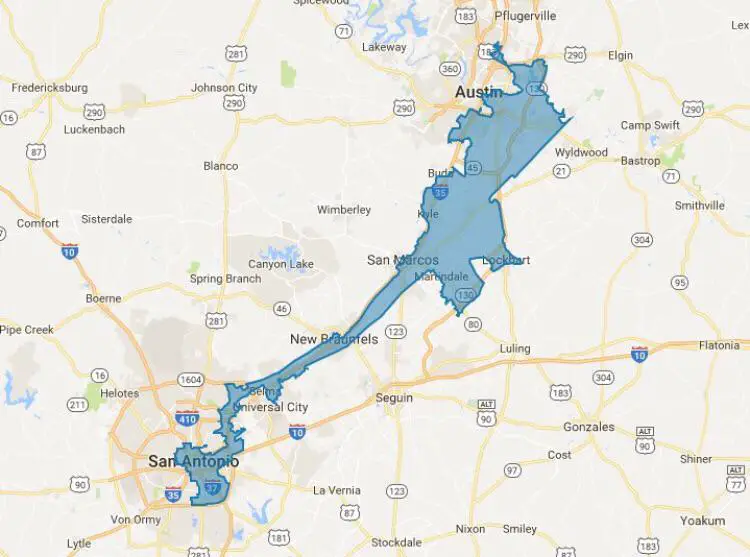
How Texas draws congressional districts is up to the people of the Great State of Texas.
I think it's crazy that national (federal) elections are held under rules that vary from state to state; and that a congressional district the shape of a snake is permissible at all, whoever gets to draw the district. It seems obvious to me that national elections should be held under uniform national rules. But it's none of my business; I don't live in the USA, and I'm not from the USA.
It’s a delineation of governmental responsibilities between the various federal branches and the states. It wasn’t until the Bill of Rights was later ratified that it has anything to say about individual rights other than to deny them.
The (lack of a) Bill of Rights was a major concern when the Constitution was drafted. It was passed with the promise that amending it with a Bill of Rights would be the first priority.
The Constitution was only passed without it so the convention wouldn't keep dragging on.
The mistake here is thinking that "political science" is actually a science, and so being on "version 5 or 6" is actually some kind of objective marker of progress in knowledge. That's a dubious assertion at best.
I mean, Americans always talk about their Constitution's supremacy, but they never want to give it to others (not even to Puerto Rico).
Then again, US nation building tends to be an abysmal failure (though, tbf, constitutional structure is not high on the list of defensible reasons for that.)
Besides, what committee ran Japan? McArthur ran it as he saw fit.
The US took exquisite care after WWII, to the point of sharply limiting things like denazification, to preserve civic and administrative infrastructure of the relatively advanced states it occupied to avoid having to nation-build in Germany and Japan.
A key test for a constitution is whether a substantially similar constitution would pass the amendment process today. If it wouldn't, the constitution is obsolete and should be rewritten. If people no longer believe in the spirit of the constitution, they will increasingly try to subvert it. Institutional checks and balances may protect the constitution for a while, but if people don't believe in the constitution, they probably won't believe in the institutions either.
Scalia has a great speech on this. Our Constitution has been outdone several times over the centuries, even by Russia. Ours is the best, though, because ours is still standing and the others are not. The bottom line is that the gridlock and glacial pace of progress that others decry is what gives the Constitution its robustness that other lack.
For the most part I think the constitution is fine, but I also think it's standing in the way of having meaningful debates about the future of the country because half the debates can be quickly shut down with "the constitution".
Now these are all very successful societies relative to most of the world but imo its pretty hard to argue that the US is special.
I feel like the first amendment is one of the few bipartisan issues of the constitution, though. The only issue seems to stem from those who misinterpret it as some almighty protection against being abrasive. It's simply meant to say that the government can't punish you for your speech or other association outside of a few cases where you are endangering others. I'm not quite sure if even the most diehard liberal or conservative wants to enable more of that from the government.
there are certainly topics within first amendment rights that can be interpreted, but that's a different matter than addressing the constitutional amendment.
This is the first time I’ve heard that the First Amendment was hated, much less widely hated, and that it has been so widely hated since the founding of the country. What are you basing this off of?
Not really. Everyone loves what it says, they just all think that what they dislike falls into a hidden “but...” clause.
It's the supreme law of the entire country. Amendments shouldn't come easy.
"Scalia said fewer than 2 percent of the population could prevent enactment of a constitutional amendment. “It ought to be hard, but not that hard" https://www.abajournal.com/news/article/how_scalia_and_ginsb...
The bizarre circus of Supreme Court nominees coyly pretending to be apolitical in a plainly partisan nomination process is another indicator that there's something wrong.
It's not guaranteed, but you can usually guess when Presidents are popular enough to stick around for 2 terms.
The hard truth is that most amendments that get discussed today are around issues with no level of national consensus.
I would like to see the U.S. take a page from Canada, which has what is called a "Notwithstanding Clause" in its own constitution:
https://www.thecanadianencyclopedia.ca/en/article/notwithsta...
The clause essentially says that if the judicial branch declares a law unconstitutional, then the legislative branch, with broad support, can issue a temporary override, which lasts for five years and can be renewed.
If the U.S. were to ratify a similar amendment, then there would be two ways to head off or invalidate SCOTUS decisions on constitutional issues. With the assent of 3/4th of states, an amendment can be ratified outright, either to prevent or respond to a court ruling. Alternatively, with the assent of 2/3rds of Congress, a specific Supreme Court decision can be temporarily overruled.
Yeah. I’m with you there. It’s that way by design along with things like the presidency not having ultimate power.
The system’s not perfect, but let any modern politician make substantive changes, and I’d bet heavily on the system getting worse.
I tend to agree more with Thomas Jefferson:
"On similar ground it may be proved that no society can make a perpetual constitution, or even a perpetual law. The earth belongs always to the living generation. They may manage it then, and what proceeds from it, as they please, during their usufruct. They are masters too of their own persons, and consequently may govern them as they please. But persons and property make the sum of the objects of government. The constitution and the laws of their predecessors extinguished then in their natural course with those who gave them being. This could preserve that being till it ceased to be itself, and no longer. Every constitution then, and every law, naturally expires at the end of 19 years. If it be enforced longer, it is an act of force, and not of right.—It may be said that the succeeding generation exercising in fact the power of repeal, this leaves them as free as if the constitution or law had been expressly limited to 19 years only. In the first place, this objection admits the right, in proposing an equivalent. But the power of repeal is not an equivalent. It might be indeed if every form of government were so perfectly contrived that the will of the majority could always be obtained fairly and without impediment. But this is true of no form. The people cannot assemble themselves. Their representation is unequal and vicious. Various checks are opposed to every legislative proposition. Factions get possession of the public councils. Bribery corrupts them. Personal interests lead them astray from the general interests of their constituents: and other impediments arise so as to prove to every practical man that a law of limited duration is much more manageable than one which needs a repeal."
https://jeffersonpapers.princeton.edu/selected-documents/tho...
I have to believe that even if it were true that many or most politicians in 1780 were similar to politicians today on levels that you mention that they still had a serious crop of worthy political intellectuals whereas today we have probably 0.
Sadly too, there has been for some time an under current of anti-intellectualism in politics. It is my understanding that Barack Obama, as an example, is highly educated, no doubt could engage in lofty discussions… that would be political suicide.
That quote is from a letter from Jefferson to Madison.
Barack Obama famously wrote a book. A "leader" leads by example. So I have a different take than your "sadly politicians are discouraged from thinking" and it goes like this:
Patronizing and conditioning the political discourse to be at the level of 'high school civics class' is a powerful mechanism for keeping actual thinkers away from politics.
i'll give him credit for having a consistant platform and world view, but if he had his way we'd hand control of everything over to corporations -- and that's what his son is doing everything in his power to make happen.
The constitution should be hard to amend, its purpose is to give stability. That you disagree with parts of it is one thing, but remember that if it's easy to amend, there's no guaranteed it will be in a way you like.
It's not just the Constitution, it's the entirety of the American system, which seems designed to use "checks and balances" as veritable roadblocks to slow everything down.
I agree that - in theory - it's great and very smart, because if the government was indeed designed around truths that are self-evident (i.e. inherently "true" and immutable) than everything should settle at the mean of those truths.
The problem is that when the country was being formed, incredible compromises to those self-evident truths were made left, right and center. So we ended up with a country that claimed that all men are created equal but did not actually adhere to this.
Further, the Constitution & Bill of Rights is full of things not related to these core truths. They tend, often, to be functions of their time. Those are the things that should be open for change, and the core truths should be canonized and unbreakable.
lol - and yet we did eventually fix it. So much for the unchangeability of US government. So yeah, the rigidity still worked - and continues to work. It's absolutely not a bug, but the most important feature in preserving our republic.
> yet we did eventually fix it. So much for the unchangeability of US government.
As far as I understand, African Americans were still not considered equal in many states over 100 years after the very bloody Civil War to abolish slavery of African Americans. I don't consider this a good example of a highly changeable government. Or am I misunderstanding your point of the US "eventually fixing it"? 100 years is not a trivial amount of time in a country that is only a little over 200 years old.
I don't they are. The law that abolished slavery changed, but racial segregation was - by definition - inequality. That it was postfixed "but equal" really underscored how hard they tried to dress it up.
It was confirmed - by governments - in a number of cases, Plessy v. Ferguson being the canonical one.
I didn't say it was "unchangeable," and ... well, that's obviously not true.
This is all about the difficulty of changing. My premise is that changes that push closer to the stated core principles of the founders are more likely to happen than others.
I wouldn't say rigidity "works" in this case, as several generations of slaves and women and other minorities might attest. Had we been more open to change in the spirit of the constitution rather than the word, perhaps there'd be less resistance.
I _very much disagree_ with the assertion that the US constitution's rigidity is its greatest strength. Similar to taking on too much technical debt, this rigidity makes it impossible to update in response to changing circumstances! I'm not convinced that's ever a good thing; what good reason is there to believe that a constitution conceived over 200 years ago (when the US had roughly 1% the people, ~1/3 the land, legal slavery, an early-industrial / agrarian economy, etc., etc., etc.) is useful today?
Even if we agree that "free speech" and "free association" are reasonable universal rights (and I think we do), what these concepts mean in practice must necessarily evolve as technology gives us new ways of speaking and associating - and we will _always_ have to deal with the difficult question of what to do when someone, through exercising these rights, deprives others (intentionally or unintentionally) of the ability to exercise theirs. This balance necessarily changes as our methods of exercising free speech and association change.
Overall, I'd argue that this rigidity - in the constitution, in the calcified two-party system, in US politics / political systems in general - maybe started out as a unique strength, but is _very much_ a weakness in more complex and rapidly changing times.
[1] https://en.wikipedia.org/wiki/Amendments_to_the_Constitution...
What good reason is there to believe a politician today could do better? Or are you simply trying to use slavery as a cudgel to get people to not argue with you? Politicians today are a ruling class that are worth hundreds times more than the average citizen, receive better benefits like healthcare, can use privileged information for financial gain, are often large land owners, etc. Nothing has changed - at all. If anything, it's probably gotten worse at scale.
> Even if we agree that "free speech" and "free association" are reasonable universal rights (and I think we do), what these concepts mean in practice must necessarily evolve as technology gives us new ways of speaking and associating - and we will _always_ have to deal with the difficult question of what to do when someone, through exercising these rights, deprives others (intentionally or unintentionally) of the ability to exercise theirs. This balance necessarily changes as our methods of exercising free speech and association change.
Political interpretation by the lunatics in a post-mcarthy world are the reason that people think the bill of rights should be flexible. "But the founding fathers never talked about the internet!" is a very pathetic excuse from a very pathetic ruling class that currently controls this country. Any violation of the freedom of speech no matter the medium is a deprivation of rights. We have chosen to interpret it differently. Once you start opening this can of worms up you get all sorts of problems with what is intentionality, what is association, does "free speech" include things I don't like, etc. Right now there are plenty of politicians on every side of the spectrum who'd love to ban everything they don't like.
What I guess I am saying is people are the problem. Greedy, slimy, humans. The world is no more complex at it's core than it was 200 odd years ago. We have made it complicated by spending time finding gotchas instead of treating the constitution as a series of unquestionable meta-laws. Fix the politicians. The document is fine. To use your analogy, allowing simple amendments would be like changing the entire PR review process because a handful of malicious engineers refuse to ever follow the rules. Just fire the engineers!
Seems like Ireland lasted 2 years before (in practice) removing all constitutional limits on government power forever. Oh sure, it's only "if so resolved by both Houses of the Oireachtas" but that's slim comfort to me.
Ireland has population of ~5 million or about the same as Alabama. It isn't the best example.
Instead of a general critique could you instead offer a specific general improvement?
I would tend to agree that larger, more pluralistic societies may have a larger downside to the ability to rapidly changing their laws. As one group gets within power, they have the ability to make lots of changes, only to be upset by the next group that ascends to power. The U.S. has a history of voting out the current party in power and that constant whipsawing of policy might be a recipe for instability.
That's largely a US two-party thing. Elsewhere, there's not as much a singular "party in power", and they all need to compromise and tamper their more radical agendas to gain the votes needed.
I wonder, too, if it's part of the primary voting process.
We did away with the people in smoke-filled rooms selecting candidates, which seems great. But it also creates more polarized candidates which seems to constantly alienate voters.
For each electable organization, in a two-party system, one of the parties is always in power. The different organizations in the US government (president/senate/house) are more like stages of decisionmaking with intricate interplay. They can be ruled by different parties, but any change of power within one of those organizations is always a full flip-flop within that "stage".
Contrast that to a multi-party system, where such an organization might have power split in ratios like 6:5:3:2. The party with representation of 6 still needs to cooperate with at least two of the others. Even if they lose votes and the 6:5 flips to 4:7, cooperating with the other parties tempers the rule of the new rising party, 4+3 is 7 and all that.
This means the system is much more likely to evolve into the parties making deals with each other and compromising, as opposed to the flip-flop between opinions A and B.
Obviously currently, it's left wing talking points that they want enacted - abortion, gun control, probably free speech limits. I'm sure if/when the court gets packed with Democrat-leaning judges, Republicans will do the reverse.
I'm fine with both sides doing that - it's politics after all - it's when activists try and portray their attemps as non-partisan that it annoys me.
When the author throws in left-wing dog whistles like "There’s a good reason that American constitutional amendments are not decided through national referendums. (Consider, after all, that Brexit was decided by a national popular referendum.)" you can immediately determine their motives.
What if you’re not a liberal but haven’t figured that out yet? Sanctity of the constitution appears to me to be the defining feature of much conservative thinking, or so they say.
The article is just a whine-fest about how "we could ban things I don't like and make law things I do!" Just from the perspective of a historian which doesnt mean they're immune to someones extreme biases.
> It's about how the modern Constitution has become "un-amendable", but it spends a big chunk of the middle of the piece demonstrating the Constitution was never really all that amendable: successful amendments are extraordinarily rare, especially when they're about big-ticket issues. Our biggest structural changes occurred after an enormous civil war.
Indeed, the greatest success of America is the unamenability of the constitution. Yes, in edge cases like slavery you would wish something could be done. However, nothing in said constitution explicitly permit slavery. Interpreted in the most charitable way slavery should've been unconstitutional from the get-go. At any rate, the constitution is about as close as we can come to a "ground truth". Other countries have constitutions that are more amenable. As a result, there's political chaos all the time as every politician does their own thing and undoes other things. Since these are ground truths all other laws can be forged from them. It appears this historian needs to go back to US Government 101. Nothing in the constitution explicitly forbids abortion, immigration, etc. In fact, the constitution should take no position on these issues. They are not "ground truth" rights that we are given for simply existing. If you head down that path, then suddenly we are codifying what will end up looking like the 10 commandments instead of a book of rights. The constitution is not a moral guide. It's a series of meta-laws from which all others can (should) be derived.
I don't think it's a good article though. In particular, I don't think it coheres. It's about how the modern Constitution has become "un-amendable", but it spends a big chunk of the middle of the piece demonstrating the Constitution was never really all that amendable: successful amendments are extraordinarily rare, especially when they're about big-ticket issues. Our biggest structural changes occurred after an enormous civil war.
There's a sort of obvious framing to the piece that the Constitution should be more fluid and easy to amend. I think 2022 is a very weird time to prioritize that. I'm not a doomer about US politics, but they're not in a very good state right now. Lepore talks about national abortion, immigration, and firearms policy and how they'd be impacted by a more readily-amended Constitution, but I think she should take a wider view and look at things like how speech and free association would be impacted.
I'm a liberal, in a cohort of people this article portrays as atypically open to changing the Constitution, and I think the rigidity of the Constitution is probably it's greatest strength.