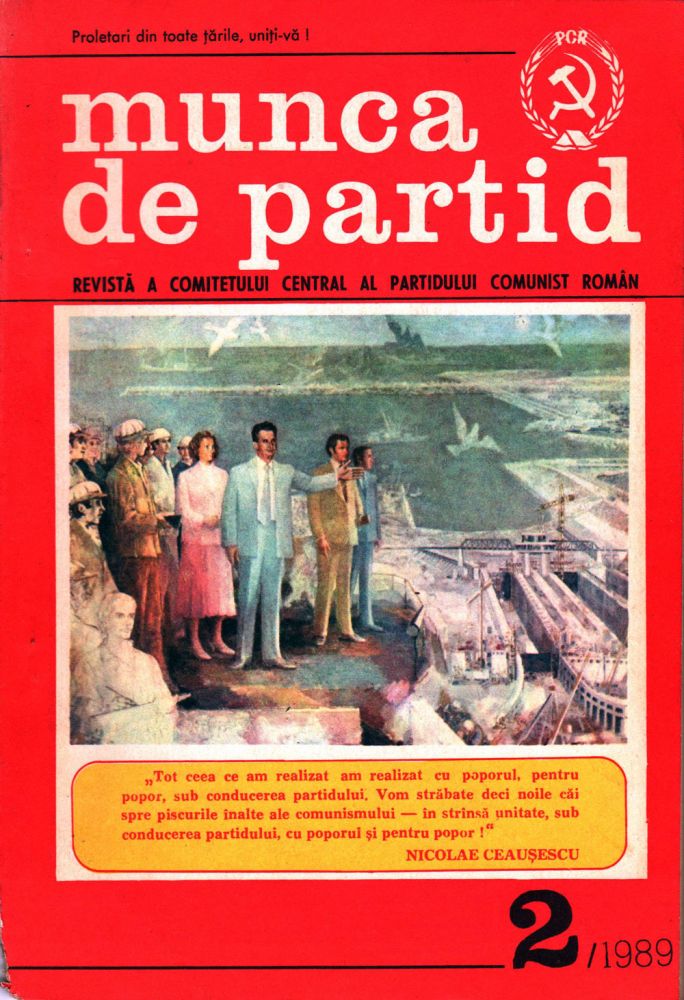
As a Romanian who grew up as a kid in the '80s and the '90s I'm sort of glad that this was a shared Eastern-European experience, it's something that people from the other side of the wall will most probably never understand completely. When I was spending the summer at my grandparents me and my brother were sometime wiping our asses off with pages taken from "Munca de Partid" (roughly translated as "Party Work"), which was the official magazine of the Romanian Communist Party's Central Committee. Our granddad had been a communist mayor in the village and he had almost the entire collection of those magazines.
[1] https://www.cosminnasui.com/wp-content/uploads/2014/01/Munca...
Growing up in the 90s in Bulgaria, my parents had to line up for hours or half a day to fill up gas in the car. This went on for weeks/months.
If I complain that people are complaining too much in the modern world, I would be complaining as well. So I won't, otherwise it will be an infinite loop.
Obligatory Monty Python sketch:
"I had to get up in the morning at ten o'clock in the night, half an hour before I went to bed. … And when we got home, our dad would kill us and dance about on our graves, singing Hallelujah!"
- Monty Python, Four Yorkshiremen https://www.youtube.com/watch?v=iEIApUNVBKg
When there is no toilet paper, your ass learns to read.
In India I tagged along with my father when he applied for a physical phone connection when I was in class 8. By the time the application made it through the bureaucratic labyrinthine and all sorts of hurdles I was in class 10.
So now a days when I see someone rant for 2 month wait period for a car I silently laugh. The current generation though is growing up getting conditioned to instant gratification.
Listening to my favourite song for me, while growing up, meant convincing my father to give me money, walking to a cassette store, wading through their catalogue and finally get it. So for me waiting comes naturally. In a way for my generation (and earlier) waiting is second nature. Wait in line for movie tickets, at bank counter, ration stores, just to name a few.
Certainly, the issues are indeed valid for them and nothing to be scoffed at.
What is fascinating about India of my growing up years was that most of the scarcity was artificial, mostly due to government regulations and policies. So money didn't speed up things in a big way. But all that has changed unrecognisably now. Now, if one has money there's almost nothing that can't be gotten.
Things improve, so people's expectations change. People from generations ago could "silently laugh" at someone complaining about a missed flight and a long layover when they had to travel by sea instead of air.
From what I understand, this was the real driver of the shortage. The toilet paper manufacturers had to retool for home-size rolls to meet demand, where they were previously making tons of office-size rolls. Highly efficient manufacturing processes don't turn on a dime.
It's because it doesn't clog toilets as much. If you stock two ply in an office, people will do unspeakable things with their literal shit, and it's just not good times.
I worked in one place that switched briefly to more home-style twoply, and we very quickly switched back. It wasn't because of the cost. It was because of the poop. Everywhere. All the poop.
Commercial fixtures need higher pressure than a home fixture, and sometimes the office building can not provide proper pressure, combined with wanting under a gallon of water per flush and well bad things happen
I generally restock on paper goods like that ever 3-6 months, not weekly...
One benefit is that I use a fraction of the amount of toilet paper.
People don't get that even a 25% jump in consumption is going to take quite a while to rattle through our optimized supply chains.
Everything has been optimized to the penny for exactly the consumption as it exists--and not a whit more. Inventory anywhere is seen as a dire business failing to be eradicated. As such, there is zero cushion against even small demand changes.
Maximally efficient is minimally robust.
Towel, or get a bidet with an air drying option (but few models have effective dryers, so shop carefully).
I have yet to find a comparison of embedded energy costs between bidet dryers and a supply of cotton towels, but I wager towels will win out when taking into account bidets breaking down. As far as I can tell, they're very repair-hostile designs, and would love to find a manufacturer that stocks all the parts for their models for a long time.
I waited for a long time because I thought I needed an outlet to plug it in (for warm water), but it turns out that cold water is totally fine. So you just attach it to the existing valve right next to the toilet. It's fairly easy and not expensive (< $100)
The fact that people were now at home and using different types of paper than what offices use was as far as I can tell a very small factor, it was mostly panic hoarding.
I mean the shortage was very real and lasted a long time. Here (outskirts of Silicon Valley) I couldn't find toilet paper in any local store at any time for a few months. Later I was able to buy one (max limit) only at closing time when they started stocking shelves, at any other time of day there was none to be had. The shelves were mostly empty of paper into 2021. It's only the last ~6 months that it is reliably available again.
Which is great! Despite the flaws of capitalism, it's literally the point! As supply chains were impacted, new businesses and solutions filled the void. Given the vast amount of competition in things like toilet paper, automotive, etc, "shortages" just meant not getting your favorite brand for a few weeks.
> I know adults who act like they're going to starve because their peas were touching their potatoes.
I would take this over the horror shows of communism any day.
It's never a knock to say "your country is so good you've never had the massive hardships we have had!"
My point was that people in the United States do not have experience dealing with even very minor hardships effectively. If they were presented with truly difficult physical situations similar to what people in many parts of the world deal with frequently, they would not be able to handle it effectively on a number of levels.
Again, yes! Due to our success! These aren't at all a knock on American's. It's what every generation of ours has fought for. An easier life for our children.
I am very very very grateful that my son does not have to deal with what people in other parts of the world deal with. I love that the idea of having no running water, defecating in the streets, surrounded by dead bodies is a completely foreign concept to him. That he wouldn't know how to deal with such a situation. And I hope his children have it even easier. That we're so wealthy we have UBI, and they can study art and music, and want for nothing.
I'm not going to romanticize Communist shortages, but I think this sentence shows a fundamental misunderstanding of human nature, and highlights the primary problem with capitalism. The idea that if we have UBI, that we're suddenly going to be a nation of poets, artists and philosophers is a utopian fantasy in my opinion.
I know more than a couple trust fund kids. They literally do "want for nothing", and they are universally miserable. Anecdata, sure, but even when you look at trust fund kids that are happy, it's usually because they were instilled with a strong work ethic - they had to find how to struggle at something, even if it wasn't financial.
If you talk to what most people and find what really makes them happy (and their have been actual studies about this), it is human relationships, a sense of dignity, and pride in themselves that brings them happiness. More cheap consumer goods from China are unlikely to fill that void.
It wasn't flag football or nerf that got us to the top.... We literally dominated everyone in everything, and continue to do so. Whether it be the military, sports (we just got done dominating the Olympics), tech, whatever.
It's absurd to think that given societal collapse, it would be the American's that struggle the most, and not, you know, the people that can't even make it when times are good...
You can knock us with a bunch of made up criticisms, like "emotional fortitude". But at the end of the day, every country still bends the knee to our "physical stamina". So that doesn't really say much about the rest of you surviving if conditions took a turn for the worse.
The “people who can’t make it while times are good” are already surviving under the difficult conditions we are discussing, so I’m not sure what you mean.
I do believe that emotional fortitude is a real thing that affects people’s ability to function under duress. And you’re correct, America currently maintains an incredibly expensive military dominance. I’m not sure how you think that addresses anything I said. My concerns are about the social fabric of the country not being particularly resilient and middle/upper class individuals being entirely inexperienced at dealing with actual physical hardships. That’s not something that a strong military or past success is going to fix for us.
The (very briefly touched upon) topic is what Americans would do if they had to endure conditions such as those experienced in the USSR, for any theoretical reason. Basically all I said is that many people would find it difficult, having never experienced that.
TP and ammo were user-caused panics. Superficial.
Microchip/Atmel just gave me 50 week lead times on really common chips. My products use these common chips, so do a TON of other things. If you can’t buy a tooshbrush or a thermostat in a few months, you might not realize it’s because of chip shortage or containers.
I think things are going to get worse. Our supply chains aren’t resilient, more than they are so large it takes a lot/longer time to see effects.
I think we’re going to hit the peak of the bullwhip soon and it’s going to surprise a lot of people what shutting the world down for almost 2 years will do.
During this experience I had the morbid thought that we're only a a natural/human disaster away from having to do the same for more necessary things. Get familiar with web scraping or buying communities of things you need while you can.
This latest… similar, but worse obviously. At least there is a real world event tied to it.
It’s coming down, but I feel like between inflation and commodity prices we aren’t going to see pre-panic prices ever again. Extremely skeptical I’ll be able to get 1k of 9mm delivered to my door under $250 going forward let alone the previous $160.
It’s a larger condition that there is distrust of government, the spread of bullshit at light speeds, diminishing personal freedoms, and a media cheering it all on. So I get why people are hording bullets a bit, but it’s funny that actual good defensive ammo isn’t more sought after. Just the cheap training stuff.
High prices and a larger market should attract increased manufacturing capacity.
Could be interesting for a new highly automated robotic factory to bring down costs?
Factories generally have to fill their government orders first, then sell govt runs 2nds/rejects (in military calibers) to consumers, and then manufacture consumer specific rounds with surplus factory capacity.
Automation at factories to this point has generally resulted in lower quality products. People still want it because it's cheap, but there's a balance between price and how bad of a product people will tolerate.
If Federal or Sellier invest in a n% more machines now, they will be a year or two out, and who knows what the market will look like then? Under Trump, the market was fairly slow and these companies would have had too much capacity for their sales.
Normally, I’m told the ammo companies like to plan perfectly filling one shift. Then on panics being able to run 3 shifts a day (which they all are now). Being set up to run your 10 big machines for 24hr at a time is a better plan than 30 machines and 20 normally sitting idle, because in the scenario you COULD run 30 machines at 24hr, you are going to run out of components anyhow.
That is another issue, it isn’t the assembly that is the ultimate bottleneck, almost powder comes out of maybe four places in the world, same for primers. Right now as I understand, it’s really a primer shortage, but no on is sitting on mountains of spare powder either.
I’ve had 20k primers carved out on order of 200k for 9 months now. I don’t expect to see them anytime soon.
Now that this comfortable situation is starting to unravel even slightly, the reaction is one of incredulous disbelief. "Surely this can't be happening, we live in prosperous times!" seems to be the gist of a lot of people's reactions.
We have become so used to (near-)instant gratification, that maybe we need to take a step back and recalibrate our desires, demands and expectations.
I'm glad my family has always had a modest outlook and ability to comfortably live within our means, often finding creative solutions when money was a bit short.
It has ingrained in me that compromise is not a hateful thing, realistic expectations make everything more manageable. For instance, I don't hold the specific car I own• to be some essential part of my identity or image. I take the more practical view that if it performs the tasks I need and meets an acceptable level of quality and economy, I am satisfied. Then it doesn't matter if it's a Mercedes, a Toyota or a KIA. If someone looks down on me or thinks less of me because they don't agree with my choice, then that is their problem, not mine.
• I don't own one right now, but it goes for any other possession, really.
Moderation needs to come back into fashion, in a big way.
Trying to impress others with one's car is a game you can never win, in some sense.
If the government had some guts they would put their foot down, personally go to every single one of those ebay sellers' homes, throw them in jail, and then restrict sales of all of the above products to a generous and reasonable amount per person with government ID required to purchase. Problem would have been solved.
But our government is too chicken to do that.
The reason you had fake shortages last year is exactly because the government stayed out of it.
There wasn't even an actual shortage in the manufacturing of TP, so if the government rationed it, the rations per person could be extremely generous, to the point that as long as you were using it to wipe your ass instead of an investment vehicle you wouldn't even need to think about the limits.
Yes, there was, because COVID-related closedowns of job sites and public venues shifted demand from commercial TP to consumer TP which have separate and not-easily-converted production lines (and aren't convenient direct substitutes, because they aren't made for the same fixtures and the commercial versions mostly aren't easily used without fixtures), so there was no way to spool up consumer production to meet increased demands. People were going to the bathroom just as much, and more of it was at home, but the quantity supplied of the TP for home use was constrained. That is a real shortage.
So don't convert them, sell the commercial stuff to consumers. It's TP, either home or enterprise edition is compatible with any ass.
That's exactly how I got my TP when I needed it, I ordered from commercial supply websites.
But ban the eBay hoarders who exacerbated the problem for consumers; they were literally lining up at 6am to clear out shelves out of the local supermarkets to resell on eBay to make a quick buck.
The soviet union died a miserable death at the hands of nationalists, profiteers, and american intervention. Covid was a manageable health crisis that spiraled into a food shortage as well. Beans rice and bottled water simply didn't exist in some stores and with rural america largely dependent on a single Walmart there are no other stores to go to.
Our supply chains despite being touted as best in the world collapsed almost overnight.
Did they though? Were there really people who had to go without necessities for a meaningful length of time? My whole point is that they did not.
I was impressed that I had no trouble getting an iPhone 12 Pro within a day, and my friends had no trouble getting M1 MacBooks. If anything it’s the Apple supply chain that might be the most resilient of all.
[1] https://www.jhsph.edu/research/affiliated-programs/johns-hop...
The line is hours long and your best option is to simply line up or you're gonna be out of gas, for example. Family members sometimes would take turns waiting at the gas station for a few hours.
There were more shortages in the early 90s right after the collapse of the Soviet block, but I don't personally remember those.
I imagine in many other countries there will be massive shortages of medical care as delta burns through earth's population.
This is probably the worst shortage we'll experience as part of the pandemic, because staffed hospital bed shortages means people will die of conditions they normally wouldn't die from.
Corporatism is not "capitalism without control", Corportism is the direct result of governments picking winners and loosers in the market place. It is the direct result of government putting their hands on the scale of the market.
So expecting government to solve the problem it created is foolish. I have no love for corporation, or corporatism. you want to eliminate that I am all for it. However lets stop blaming capitalism for the problems created by government
In relative terms well in east block in 80s you were not expecting to have anything on the shelves when you went to the shop. You were expecting to wipe with newspaper for rest of your life and sometimes if you are lucky get rolls of TP.
When we live nowadays, we plan that we go to the shop and we will have it.
Like a car example, your father was not planning a road trip next year because he knew he is not going to get a car.
Nowadays people might plan a road trip make arrangements and then be surprised by car shortage - who is losing more? I expect that person who made arrangements for a road trip and then got nothing because there are no ICUs to make cars.
In all seriousness, that's not entirely true. From first person accounts I've heard, in the early 80s and throughout the 70s everything was more or less OK in the Soviet block. Of course the selection was not as great as in the West, but essential 20th century conveniences were available. In the late 80s things really started to fall apart and it became painfully obvious that their economic model is not competitive and ultimately unsustainable.
However what I am saying is that we don't actually have real impact on our lives today. From what I can tell, nobody actually failed to get a car and had to cancel their road trip (to use your example)
Since the pandemic, there are 3 shortages that were in the news that were relevant to my family: toilet paper, chips/automotive, and ammunition (my father in law and I got into target shooting during the pandemic)
I would say the max impact of all these things was: you had to work a LITTLE harder, pay a LITTLE more, and wait a LITTLE longer to get what you wanted.
For example, in USSR I remember wiping my ass with cut-up newspaper for months at a time. That's what a TP shortage / deficit is. Over the last year, the max I had to deal with was going to a second store and not being able to buy lots and lots at once.
We ended up having to buy a car this summer. Shortage manifested in two ways - some trims/models were not available. IE - you could still get a car at any point, just may not be the exact one you want. We ended up ordering one because we cared about something specific and despite warning, we picked it up in a few weeks.
In contrast, my dad had to wait something like 10 years to get his Lada Niva.
What this means to me is our supply chains are INCREDIBLY resilient. The fact that these things basically translated into mild inconveniences is quite impressive.