You make it sound like a prerequisite. I'm pretty sure the reason LPDDR is Low Power is not due to (currently) being unavailable in socketed modules - that would seem to be a side-effect of the original target market (smart phones).
They are just some BGA packages, I see no reason they couldn't be soldered onto a board with a socket. If you scan through the features that make LPDDR LP, they have nothing to do with sockets, or anything affecting sockets: lower operating voltage, more power states, partial refreshing etc:
I think the number of pins is a practical limitation. Current DDR DIMMs use 260-280 pins if I remember correctly, while an average LPDDR4X BGA package is 400 balls or higher. Apple uses chips with 877 balls. It is definitely possible to design modular RAM with high-pinout, but would it be economically feasible?
As an example, even moving away from edge-connectors (which are just a non-starter for 800+ pins) Samtec's highest-density high-speed connector, the NovaRay line [0] advertises 224 signals per square inch, so an 800 pin module would require 4 square inches of connector space alone, not to mention making the system PCB assembly thicker and compromising on speed, power and thermals.
[0] https://www.samtec.com/connectors/high-speed-board-to-board/...
Not to mention that socketting parts reduces your production yield over SMT, increases your assembly cost, and cuts reliability (it's fine on a desktop because you almost never move your desktop, and there's usually a big thermal assembly bolted on top).
One possible other compromise could be soldered LPDDR RAM, but with a DIMM expansion slot for DDR as well. I wonder whether the DDR could be switched off and the baseline power draw eliminated if the RAM usage was below needing it.
The desktop version of LPDDR4 is there, it's just called DDR5.
That said, I don't know that RAM chips are the hill I want to die on, anyway. Could we get to a better place if we dispensed with the whole, "just the one big motherboard," design, and looked to the old backplane-style physical layouts? Then you could have a module that contains the CPU and RAM and suchlike all in a single package, and move other things that may not want to be quite as tightly integrated off to another package.
I definitely remember ordering a replacement headphone socket board for an old MacBook and just putting it in myself, and I've done similar with, eg, the connector port board on a PS4 controller.
But I guess this is one of the hazards of Apple having their AppleCare programme— they can do the math and calculate that saving a dollar on the cost of making and mounting and connecting that extra component still makes them money even if they have to eat the occasional full motherboard in the first three years of ownership.
https://www.ifixit.com/Guide/MacBook+Pro+15-Inch+Logic+Board...
You can see the ports still in place after the motherboard has been removed.
If you design to a socketed DIMM package, you actually have two trace domains, the CPU to the socket, and the socket to the RAM chips. For that to be reliable, you have to adhere to standards for DIMM (or SODIMM) so that multiple manufacturers can build compliant interchangeable parts.
If you solder the chips down to the main board directly, you only have once domain for the traces, CPU directly to RAM. At that point you can tweak the design for several goals, speed, power, etc.. And you can tune the drive strength on the signalling the same.
That is how you end up with more efficient soldered designs over socketed designs.
DDR5 has more roots in the LPDDR4 than in the regular DDR4.
Edit: I guess to clarify, the plausibility challenge is that whether or not it is theoretically possible, the platform owner (Intel, AMD, etc) or the memory vendors (Samsung, SK Hynix, Micron) are unlikely to support the lark.
Like it or not, repairable/upgradable laptops are a thing of the past. There’s just not component support or sufficient market demand to make the parts removable anymore.
Laptops also make up a major component of that still very alive market so no, I disagree that there is not enough market demand for having laptops that can be repaired or upgraded. It's the industry themselves that have worked to hamper the right of repair while giving nebulous pseudo-technical rationalizations for it.
Given the option between thicker w/ a bit more battery life or thinner and lighter, consumers are choosing thinner and lighter.
> ...consumers are choosing thinner and lighter.
A) I'm guessing actually lighter more than thinner.
B) Are consumers really clamouring all that intensely for "Thinner! Thinner!", or is that a) because that's all that's offered, and b) the relentless hype from manufacturers -- above all, bendy phone maker Apple -- amplified by rarely-critical media?
For instance, in a iPhone 11, the battery occupies less than half of the surface of the phone[1]. On a Macbook pro, it's about the same.[2] [1] see this ifixit video if you want to see it by yourself: https://www.youtube.com/watch?v=Feyqwf3cYtw&t=161s
[2] https://guide-images.cdn.ifixit.com/igi/noPvQ2CLs1jptX2p.hug... You can see that the motherboard is much, much bigger than a smartphone.
It doesn't matter that the rest of the form factor is larger: there's not a lot of empty space in these, so a larger main board will still mean a larger and heavier device.

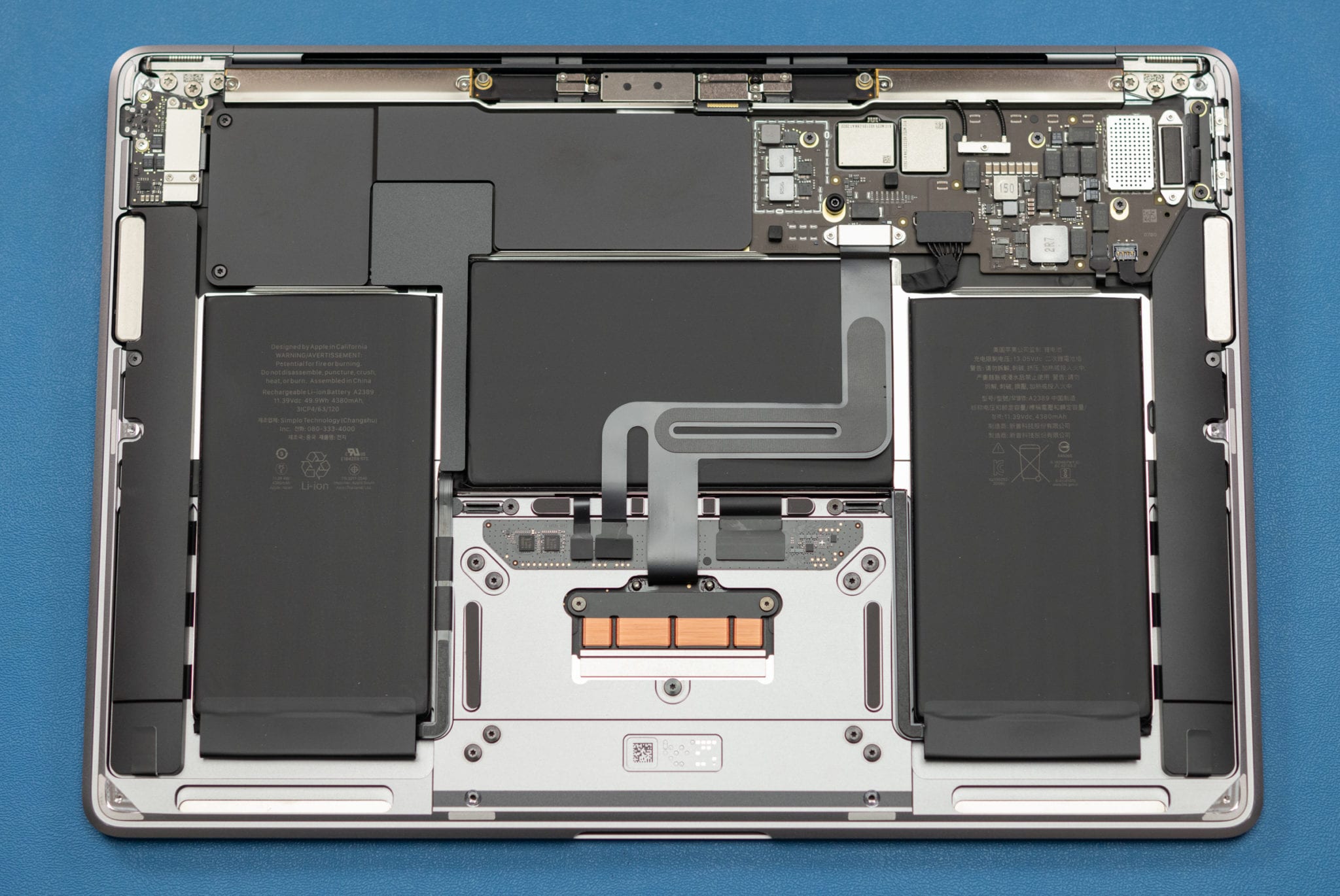
Still bigger than a smartphone (it occupies the entire width of the laptop (when counting the heatsink, 2/3 of the width otherwise), and around one quarter of the whole area).
Also, your original sentence was
> Modern laptop motherboards can easily be about the size of a cell phone.
Here we see that the one and only best laptop in this regard comes close to the cell-phone-sized motherboard. That's far from what “modern laptop can easily be” means. Most laptops sold today have a much bigger motherboard than this.
(BTW, as much as I'd like to see non x86 laptops going mainstream, software compatibility is huge issue for an ecosystem as diverse as the Windows one (and Roseta 2 being too much of a coinflip isn't encouraging…), we might get there at some point, put it's gonna be slow and painful.)
Or, instead of soldering chips, make little LGA slots for the individual chips. I can't imagine the tiny added resistance from an extra millimeter of wire and pin surface contact would impact much of anything and even if it does, I'd rather take that than have no options when the next Windows update makes my machine a paperweight (obviously exaggerating, but it's getting there).
But the majority of people couldn't give a toss about how much of their laptop ends up in a landfill. They're using paper/glass straws, you see.
Perhaps electronics landfills should be local again.
Hold on. This is true for excessive modularity.
Yet, most of the time, lack of modularity (e.g. bundling) creates lock-in reducing customer's choice and ultimately increasing prices.
When PCs became standardized ( https://en.wikipedia.org/wiki/IBM_PC_compatible ) prices dropped incredibly.
Literally - 100Wh batteries are maximum you can take on planes
Strangely, the rule comes from ICAO.
Some countries too follow the 160wh standard, but most airlines simply don't bother enforcing anything, but the lowest common denominator.
a hand grenade typically releases 250kJ, or about 70Wh
you're asking for the equivalent of 1.5 grenades in your lap :)
And don't get me started on flour, not only it stores a ton of energy (50 grenades per kg) but it's also highly explosive! [1]
[1]: (only with the right air to flour ratio of course, but accident happen every once in a while: https://www.grupa-wolff.com/a-tragic-flour-explosion/)
The flour conditions of exploding are far more difficult to achieve than a LiIon battery conditions - orders of magnitude difference.
Neither does a NiMH battery. There's no link between vulnerability to external damage and ability to power a laptop.
In fact, there's no fundamental reason why we couldn't run our laptop on chocolate[1], just that it's very far away from current technology.
vs
A grenade releasing that as KINETIC energy into YOUR FACE over the span of LESS THAN A MILLISECOND and protected by a spring and a keychain ring.
Even if a lithium battery of that size experienced a critical failure right in your lap, you'd get away with a few scars and some serious but treatable burns. And I've only heard of one commercial product in the last 15 years that had serial critical battery failures...
Hopefully your laptop and hand grenade have radically different power discharge profiles.
Li battery fires are not unheard of, unfortunately, so the profiles may start to resemble sometimes.
Next, let's calculate the energy input required to heat a small cup of coffee and compare that to a hand grenade. (Hint: The coffee wins easily.) I wonder how many hand grenade equivalents a 10 minute lukewarm shower equates to?
Preferably yelling 'fire in the hole!' each time.
No. If it starts to smoke, you commit & push --force, then you throw it away.
FWIW, the book Design Rules: The Power of Modularity systematically explores the tradeoffs.
https://www.amazon.com/Design-Rules-Vol-Power-Modularity/dp/...
Written by two economists, it's the only prescriptive definition of architecture that I've managed to find. Influenced me deeply.
Their core contribution is modeling the options with net present value (NPV) to remove the guess work.
--
Tangentially...
They also explain the dependency structure matrix (DSM), a tool for modeling and visualizing architectures.
One big takeaway for me was their explanation of "complexity catastrophe". The crossover point when the cost of change exceeds the benefit. A metaphor superior to most interpretations of "technical debt", IMHO.
So when you have a DSM, these kinds of problems pop out, can't be ignored.
In the DDR5 timeframe, there is less of a power delta as well between DDR5 and LPDDR5.
And even if the DIMM design (it's more than just a slot) doesn't make sense anymore, we could easily make a new "dumb" memory slot standard that would allow us to swap out the chips directly - like we have for CPUs.
You could, but it would take up a lot of space, given the higher pin count, and would most likely increase power consumption.
There is certainly some impact to using DDR4 instead of LPDDR4, but we believe it is still the better choice for most consumers by allowing for greater product longevity at lower cost.
The only thing that really changes between DIMM and soldered on is a somewhat increased trace length. That accounts only for a very small increase in power.
What are you basing this statement on?
- Socketed RAM is limited by the number of pins, DDR SO-DIMM for example has 2-3x fewer pins than your average LPDDR4X module. Having more pins helps running the chips on lower power as it was explained to me by an engineer (something to do with grounding and lower voltage, I am not really sure how it works but I trust the guy)
- Socketed RAM is a least common denominator, there will inevitably be some variance between different modules, which leaves you with less possibilities for optimizing the electrical connection
- Current LPDDR is much more sophisticated than regular DDR, the protocol is different etc. So you can't just stick LPDDR chips on a DDR SO-DIMM and expect it to work
I am sure one could design a modular system based on LPDDR, but the question is whether such system would be feasible. It would be limited to premium laptops only (as modular system would take too much space in a smartphone), it would probably need a higher pinout (which would mean a complex mounting bracket of some sort) and it would require laptop manufacturers to agree on a certain standard.
There are other considerations as well, especially if one wants to break the current performance boundaries. For example, Intel has announced that they will integrate HBM with their upcoming Xeons. How do you intend to make that socketable, that's 2048-bit memory bus. Or consider Apple's new in-house SoCs. By mounting RAM directly onto the package substrate they can potentially deliver high-bandwidth RAM in an energy efficient package without increasing the cost and the complexity of the mainboard. E.g. their upcoming hardware is widely expected to use 256-bit RAM, something that has so far been reserved for workstations. As you make the interface wider and wider, modularity becomes more and more expensive. Why don't GPU's offer modular RAM for example?
It's not physically impossible to make DIMMs with LPDDR4, just nobody really wanted to come with a standard.
I don't think this is the driver of these decisions per se, but it is undeniably a bonus for the manufacturer; non-upgradable devices become obsolete faster, necessitating new replacements.
But it wasn't an artificial limitation. In practice, once larger capacity memory became available with the same technology and form factor, it would work fine. I have upgraded several ThinkPads with memory beyond what the original datasheets said was possible.
The same CPUs that have a socket equivalent for desktops. It's a travesty.
That said, manufacturers have huge ambition to not allow for modular design.
You are cherry-picking an example that fits only a specific category of laptops.
Even so, CPU and RAM could be bundled together into a socketed cartridge that is easy to upgrade.
The real reason is all about planned obsolescence and profit margins.
It only somewhat matters for power consumption in sleep mode when the RAM is the only component being powered, but at least on Windows that’s solvable with a fast SSD and hibernation.
VRAM consumes substantial power to deliver that performance. On many GPUs, VRAM chips are actively cooled. System RAM doesn’t even need passive heatsinks, uses too little electricity to care.
Just really blew my mind how much heat the VRAM contributed.
Modular laptops, phones, etc.. will be always penalized in terms of either performance or battery life for a given size.
[Citation needed], there is no real electrical engineering reason why you couldn't.
Where there's a will there's a way. The problem is there's no will.
"Typical Power Consumption of PC Components - Power Draw in Watts" https://www.buildcomputers.net/power-consumption-of-pc-compo...
In a universe where you want high-performance energy efficient RAM. Premium ultracompact laptops have long moved to LPDDR which is both faster and consumes significantly less energy than regular modular DDR. And LPDDR does not come in DIMMs. And then you have Apple who are using custom package technology with custom RAM chips to cut down RAM power consumption to under one watt active, delivering close to 20 hours battery. You simply can’t have this with socketed RAM. Modularity is not a free lunch, as much as some people like to pretend.