I think the number of pins is a practical limitation. Current DDR DIMMs use 260-280 pins if I remember correctly, while an average LPDDR4X BGA package is 400 balls or higher. Apple uses chips with 877 balls. It is definitely possible to design modular RAM with high-pinout, but would it be economically feasible?
As an example, even moving away from edge-connectors (which are just a non-starter for 800+ pins) Samtec's highest-density high-speed connector, the NovaRay line [0] advertises 224 signals per square inch, so an 800 pin module would require 4 square inches of connector space alone, not to mention making the system PCB assembly thicker and compromising on speed, power and thermals.
[0] https://www.samtec.com/connectors/high-speed-board-to-board/...
Not to mention that socketting parts reduces your production yield over SMT, increases your assembly cost, and cuts reliability (it's fine on a desktop because you almost never move your desktop, and there's usually a big thermal assembly bolted on top).
One possible other compromise could be soldered LPDDR RAM, but with a DIMM expansion slot for DDR as well. I wonder whether the DDR could be switched off and the baseline power draw eliminated if the RAM usage was below needing it.
The desktop version of LPDDR4 is there, it's just called DDR5.
That said, I don't know that RAM chips are the hill I want to die on, anyway. Could we get to a better place if we dispensed with the whole, "just the one big motherboard," design, and looked to the old backplane-style physical layouts? Then you could have a module that contains the CPU and RAM and suchlike all in a single package, and move other things that may not want to be quite as tightly integrated off to another package.
I definitely remember ordering a replacement headphone socket board for an old MacBook and just putting it in myself, and I've done similar with, eg, the connector port board on a PS4 controller.
But I guess this is one of the hazards of Apple having their AppleCare programme— they can do the math and calculate that saving a dollar on the cost of making and mounting and connecting that extra component still makes them money even if they have to eat the occasional full motherboard in the first three years of ownership.
https://www.ifixit.com/Guide/MacBook+Pro+15-Inch+Logic+Board...
You can see the ports still in place after the motherboard has been removed.
If you design to a socketed DIMM package, you actually have two trace domains, the CPU to the socket, and the socket to the RAM chips. For that to be reliable, you have to adhere to standards for DIMM (or SODIMM) so that multiple manufacturers can build compliant interchangeable parts.
If you solder the chips down to the main board directly, you only have once domain for the traces, CPU directly to RAM. At that point you can tweak the design for several goals, speed, power, etc.. And you can tune the drive strength on the signalling the same.
That is how you end up with more efficient soldered designs over socketed designs.
DDR5 has more roots in the LPDDR4 than in the regular DDR4.
Edit: I guess to clarify, the plausibility challenge is that whether or not it is theoretically possible, the platform owner (Intel, AMD, etc) or the memory vendors (Samsung, SK Hynix, Micron) are unlikely to support the lark.
Like it or not, repairable/upgradable laptops are a thing of the past. There’s just not component support or sufficient market demand to make the parts removable anymore.
Laptops also make up a major component of that still very alive market so no, I disagree that there is not enough market demand for having laptops that can be repaired or upgraded. It's the industry themselves that have worked to hamper the right of repair while giving nebulous pseudo-technical rationalizations for it.
Given the option between thicker w/ a bit more battery life or thinner and lighter, consumers are choosing thinner and lighter.
> ...consumers are choosing thinner and lighter.
A) I'm guessing actually lighter more than thinner.
B) Are consumers really clamouring all that intensely for "Thinner! Thinner!", or is that a) because that's all that's offered, and b) the relentless hype from manufacturers -- above all, bendy phone maker Apple -- amplified by rarely-critical media?
For instance, in a iPhone 11, the battery occupies less than half of the surface of the phone[1]. On a Macbook pro, it's about the same.[2] [1] see this ifixit video if you want to see it by yourself: https://www.youtube.com/watch?v=Feyqwf3cYtw&t=161s
[2] https://guide-images.cdn.ifixit.com/igi/noPvQ2CLs1jptX2p.hug... You can see that the motherboard is much, much bigger than a smartphone.
It doesn't matter that the rest of the form factor is larger: there's not a lot of empty space in these, so a larger main board will still mean a larger and heavier device.

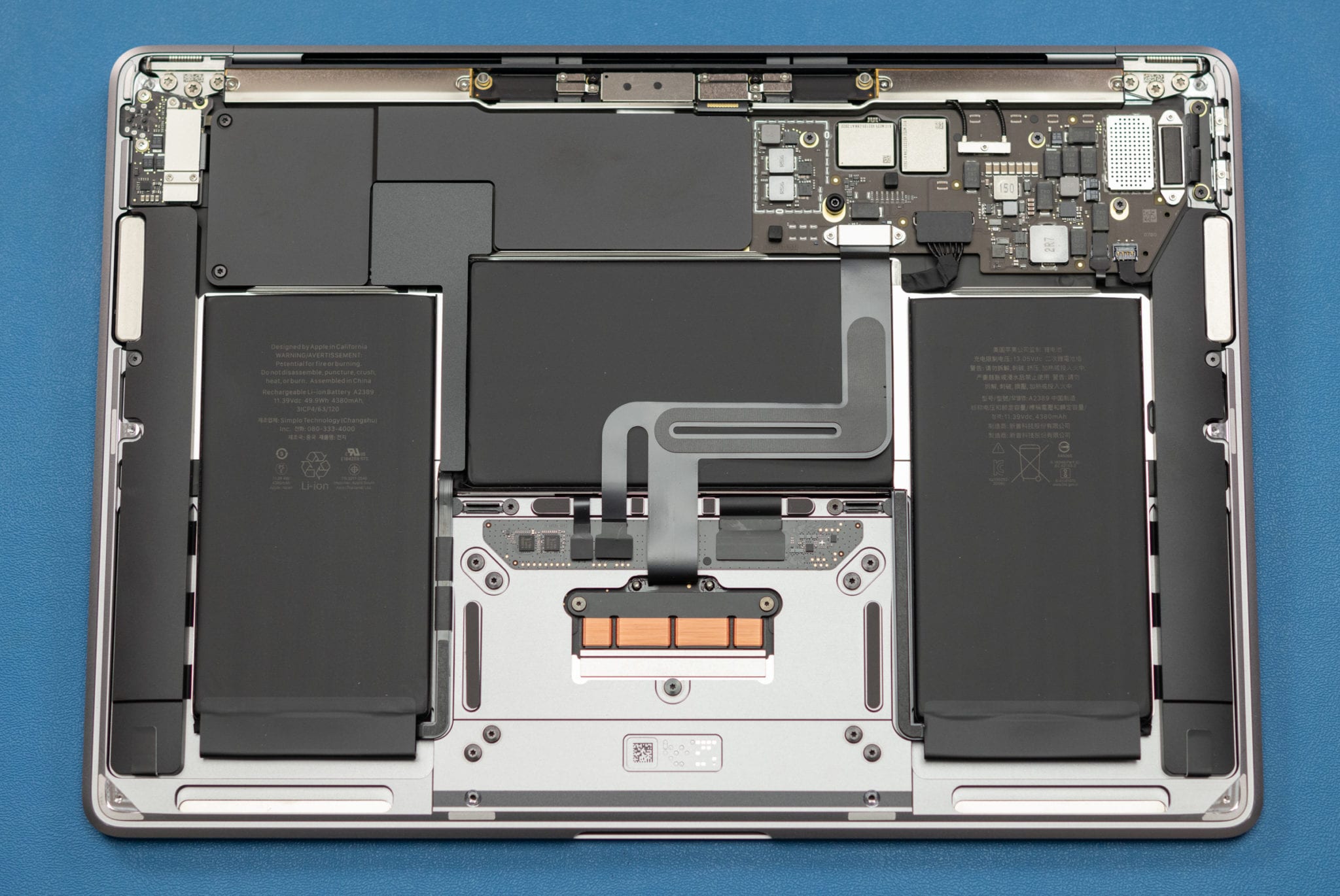
Still bigger than a smartphone (it occupies the entire width of the laptop (when counting the heatsink, 2/3 of the width otherwise), and around one quarter of the whole area).
Also, your original sentence was
> Modern laptop motherboards can easily be about the size of a cell phone.
Here we see that the one and only best laptop in this regard comes close to the cell-phone-sized motherboard. That's far from what “modern laptop can easily be” means. Most laptops sold today have a much bigger motherboard than this.
(BTW, as much as I'd like to see non x86 laptops going mainstream, software compatibility is huge issue for an ecosystem as diverse as the Windows one (and Roseta 2 being too much of a coinflip isn't encouraging…), we might get there at some point, put it's gonna be slow and painful.)
You make it sound like a prerequisite. I'm pretty sure the reason LPDDR is Low Power is not due to (currently) being unavailable in socketed modules - that would seem to be a side-effect of the original target market (smart phones).
They are just some BGA packages, I see no reason they couldn't be soldered onto a board with a socket. If you scan through the features that make LPDDR LP, they have nothing to do with sockets, or anything affecting sockets: lower operating voltage, more power states, partial refreshing etc:
https://en.wikipedia.org/wiki/LPDDR