No. There is a gigantic machine in China, its name is Shenzen. Its magic is that you can find any part and people who can rebuild them differently.
This is the entire “valley” that USA should bring back home. USA should bring back the construction of the Macbooks, phones, servers and routers, and the entire ecosystem of tinkering that comes with it. This is the backbone of USA’s national security.
We just have to acknowledge that having local industries means having poverty and dirty waste disposal at home instead of 9000km away. Which is not necessarily a bad thing either, so we can innovate on efforts.
-You cannot get skilled labor to work for less than competing unskilled work
- Welfare and benefits erase the savings.
You just make it prohibitably expensive to deal with your foreign competition, subsidize it, or some combination.
It was the simple desire of “solving it with taxes” which was the root of a despicable trend that has mechanically “exported” poverty to where it can’t be seen, because we couldn’t sustain the sight, for about 60 years now. It’s a sin and a bane.
Taxes (eg tariffs against countries that produce goods efficiently) only extract private value to put it in public hands, which politicians use to favouritize groups they like (or military projects they like, concerning US). It doesn’t make companies innovate in average - only the side that receives the taxes innovates somewhat, and based on non-market incentives, rather political ones. France is full of those non-performing startups that end up 4th on the market, if that is what you aim for, so France doesn’t have technological sovereignty.
At least if we accepted poverty in the USA in exchange for bringing industry back home, those workers would be poor but work in a safe environment.
Nobody's stopping anyone from opening up a factory that pays people $7/hour in the US.
Since bringing industry back home is so important, are you ready to go work in it for those kinds of wages?
It's easy to demand that other people accept poverty. It's hard to explain why market actors would be willing to work for low wages in a high-COL country.
Kids can be taught otherwise. And a minority of the rich can be told to stfu by the masses, or enjoy working in the coal shovel jobs.
We pretend there’s a meritocracy lifting these folks up, but it’s been argued well it’s nothing more than network effects and really just seeing no upside to being egalitarian while the masses sit around being apathetic political agents.
And believing you’re going to achieve perfect sovereignty is non-sense. It’s a shared planet. Nation state politics worked fine when technology and access to the world were control by monarchs.
Not enough old people are going to be around to confirm their common sense awareness of these heavily distributed “truths”.
The social narrative will be whatever the political engaged make it.
Avoiding political engagement all but insures this.
Then by using financial regulations to require loans which expand quantity of legal tender in circulation to be issued on security of the replacement cost of tangible industrial capital, structures, plant, and equipment values rather than on security of the present value of future property rents.
Then by replacing regressive sales, consumption, and payroll tax with a distributive ground rent tax on property owners.
Promoting industrial development through regressive taxes and wage suppression is only the aristocratic form of industrialization pursued by right-wing governments when they are unwilling to eliminate after tax ground rents and non-industrial super profits enjoyed by the rich.
When you say “ Then by using financial regulations to require loans which expand quantity of legal tender in circulation to be issued on security of the replacement cost of tangible industrial capital, structures, plant, and equipment values rather than on security of the present value of future property rents.”
This is interesting to imagine, but how? (Sorry if it’s a stupid-obvious question, but I am earnest in asking it. Perhaps I am stupid tonight.) I could certainly see regulation to kill the “future rents/superprofits industry” but not quite sure how to require loans for ... call it the future-tangible-industry-industry? Also sorry this question is formulated in such a round about way.
Gleeful aside: Me thinks the status quo elite would not like it. ;)
Finally; I am happy to do research -> how might you suggest I google my way into this viewpoint most directly?
I ask the same question too, because when people speculate on computing:
> security of the present value of future property rents
often
> replacement cost of tangible industrial capital, structures, plant, and equipment values
Are often included included in the models because often this is the collateral that can actually have a liquid market value in the event of liquidation, but this is also subject to market conditions at the time this needs to be liquidated and the cost of actually liquidating.
Not to mention it would lower loan values since other non tangibles are often considered (IP, investor sentiment on corporate managers executing any given strategy, market conditions, etc).
But 1) subsidies are what we would call a 'distortion' and those should be dealt with, possibly with anti-dumping tariffs;
2) There is such a thing as 'strategic investment' in key industries where the bar is very high and $10M from a VC won't help. This is where we need coordinated leadership.
3) There are other ways of 'building stuff'. Automation, AI etc. present opportunities for creating substitutes for those value chains.
In particular, I think what the DARPA should push for is a robotic 'pair of hands' - i.e. a very easily programable set of very nimble robotic hands with accompanying vision, that can be made to do specific tasks within parameters i.e. 'pick up that part, add this other part' and handle most of the weird things that can go wrong.
4) In germs of geopolitics ... it may be more ideal to push for more diversity in sourcing and to help develop India, Malaysia, Mexico etc. towards doing at least more of those things. That's hard though.
We will have lost our knowledge and it'll take decades to recover, if we can recover at all.
The billionaires will escape unscathed.
I agree with point 4. If we had distributed supply chain then things may work better longer term but I am amazed that businesses still look to offshore everything without looking at the long term prospects of their workers and communities.
Now the reason for that is that behind every hour of work of an average westerner there's a lot more capital helping, and more educational capital too. But if developing countries do get closer, then inevitably prices will start rising.
Not all industries can benefit so much from added capital. Those that can, and the service economy, are done in developped countries. Those that can't, are done in developing countries. If the two equalize, then the inequality in labour hours will equalize and westerners will either have to work more or consume less of products that are made in developing countries.
There is no natural force driving it.
You could argue the trade imbalance in which money flows a little bit more in one direction, but that can actually go on so long as the 'Richer Nations' are growing the economic base and expanding the money supply in serviceable terms.
But what's hidden in the obvious discussion of which direction money is flowing in trade ... is the direction that surplus is flowing. The economic surplus is pretty much on the side of the more powerful countries. Everyone benefits, but the rich nations benefit more.
Almost all of the corporate value (i.e. net profits) in the iPhone is realized in the US. The consumer surpluses are also vast but they are distributed to whoever actually buys an iPhone.
As long as trade isn't too imbalanced and much of the actual cash can be returned to 'Rich Nations' by sale of services etc., and, those net consumer/industrial surpluses remain big ... the equilibrium of 'poor countries doing labour and rich countries doing services' can go on essentially forever.
The factors that will change are:
1) China is going 'up market' and will provide more advanced things.
2) The Rest of the World will start to provide competitive labour - and more importantly - be vehicles of consumption as well making rich export markets for everyone.
3) AI will probably affect production in fairly significant ways. Robots with a little bit of dexterity and AI might very well be able to do some tricky assembly ... can you imagine that they could actually lay out, fold and cut fabric? And then sew together pieces? I can see that happening.
Finally, I would say it's definitely not good to look at all of this as a 'zero sum' game, and ultimately wealth is only relative anyhow.
If we ignore the geostrategic and social issues about power, and 'liberal democracy' etc. - there's every opportunity for a lot of poor nations to move up the ladder very quickly (already happening) and for rich countries to stay rich. As those nations 'catch up' their rate of acceleration slows down somewhat as it's rather difficult to 'get ahead' let alone 'stay ahead' for long. I don't even think China will ever actually 'get ahead' - they are, per capita, still quite poor on the whole and their growth is slowing.
As cultural values start to shift, the very measures we use for 'Purchasing Power Parity' start to shift as well. For example, how do we put a price on clean air, vacation, basic freedoms? And from a less secular but still hugely relevant perspective - living among one's culture, with one's 'people', the architecture, the view from your office/home, the lovely bike path to work, the gardens, the local bier garden where you see your friends, the local football team etc. etc.. People already to value those things a lot (see: Europe) they just don't directly factor into our equations. Over the next few decades we're going to rely less heavily on GDP and more on other measures.
It doesn't need to become exactly equal. The gap just needs to shorten. And it does, at exponential speeds.
Already the average GDP in the West is only twice the worldwide average, this only shrinks every year.
Honestly, anyone who falls for a paradox of competition deserves it.
Same for the film industry. Piracy is common consumption, law has had no power in this billion dollar industry, and yet this industry is striving. I say, companies should be allowed to protect their films with the DRM they want, but once the film is in the open, the law shouldn’t try to protect it from being copied. So you’d just pay to be among the first to see the movie, in a good quality, and the rest of peer-to-peer would be legal.
IP law and patents is a weird contraption, making very little money compared to what it costs, and a major risk to any innovating company. IP law is a major drag on our industry, that’s not even respected by our real competitors.
The theory is: Nobody will invent anything if they don't have a monopoly on the idea. As if without patents, someone would have a great idea and say "I'm not going to invent this thing and become a millionaire, because someone else might copy it cheaply and become a bigger millionaire! Nope, rather just keep stocking shelves!"
They are reproducible if we have the political will.
Whichever ones are essential to national security.
The ability to manufacture local, trusted hardware is important for military purposes, just like the ability to manufacture high-performance aircraft parts was and is important in the case that overseas suppliers are hostile or cut off.
https://federallabs.org/labs/defense-microelectronics-activi...
Has Shenzen become a startup hub? What large startups have come out of it?
For ICs:
Design, Fabs and Packaging should all be looked at from a national security standpoint. IMHO it needs to be viable to compete with foreign fabs. Whether that looks like subsidies, tax breaks/credits, or guaranteed minimum volumes... Those each are different policy decisions that have pros and cons.
We also need to consider the larger electronics manufacturing supply chain:
PCB manufacturing, contract manufacturing, pick and place/automation, etc. are all extremely important and should have similar thought put into it. Today it isn't reasonable for most people to do a significant electronic manufacturing run in the US because we essentially pushed it all overseas in the 80s and 90's. There just simply aren't enough CMs and PCB houses to do large runs in the US and its the same chicken and egg problem that you have with IC fabs: You can't do it in the US because there isn't enough volume to get good pricing and there isn't a decent pricing because the PCB houses are focused on low volume runs.
Ironically, when we pushed all that stuff overseas, the major reasons were because of costs (primarily) and environmental impact. At the time, many electronics had a non-insignificant amount of hand assembly and it was stupid cheap for labor in China. Coupled with the fact that companies in China just did not give a fuck about the environment, there were literally no downsides.
Today, things have changed a ton. First, almost everything is surface mount and is well suited to automated pick and place machines. Second, PCBs have become easier to manufacture/design and there are new technologies that could make this even better. Third, with things like ROHS and all the lead free/environmental requirements, many of the advantages of going to a country that doesn't care about the environment isn't as beneficial, because the requirements are for the end products, not the process.
It really wouldn't take a massive amount of government encouragement to really bring back most of this stuff, I think though there is the big issue that there just aren't that many direct jobs created. Most of the money is going to get sunk into machines that make things and sure, there will be people who mind the machines, but you just don't need that many people for these automated processes. Lets just say that spending $50 million on roads produces a lot more jobs than spending $50m in a PCB house. The flip side is that while the $50m on a road might help transport several billion dollars worth of goods over its lifetime, a PCB house focusing on specific types of PCBs could/will enable companies generate billions of dollars worth of profits on the goods manufactured.
So then either you have to 'force' people to take Shenzen-laborer level wages in the US, or the costs of manufacturing in the US will be higher than in Shenzen.
Cleaning yourself of this "moral guilt" is selfish as hell.
What is important is manufacturing culture. Without that one can clone a factory, but it will not help with the next generational process.
And it is known how to build such culture in relatively short time frame, culture. Just look at Japan, South Korea or Taiwan.
There's a cool documentary called "The Engines That Came In From The Cold" (available on youtube[1]) and if you have a Netflix subscription, I recommend the documentary "Cosmodrome" (2008)[2] which is about the history of the Soviet space program and these engines.
I'm sure you're aware that the US Space program has been reliant on ex-Soviet heavy lift vehicles for decades more or less. Especially, since the Space Shuttle program was canned, if it weren't for SpaceX, the Russian lift would be the only bus on the route, aside from NRO launches and other um..stuff
Indeed, the Soviets had a completely parallel semiconductor and electronics industry as well. I don't know for certain but it was undoubtedly lagging western developments by a large margin. Nonetheless, the Soviets had some very interesting developments of their own, such as the Kola superdeep borehole. It is all terribly fascinating.
[0] https://sputniknews.com/russia/201704081052440303-russia-roc...
The Soviets were willing to put large amounts of effort towards scientific advancements and exploration with little obvious profit motive on the other side, and it spooked the US into funding fantastic levels of basic scientific research.
It's interesting to see the percent of federal spending on basic research has fallen off a cliff since 1989: https://www.gspublishing.com/content/research/en/reports/202...
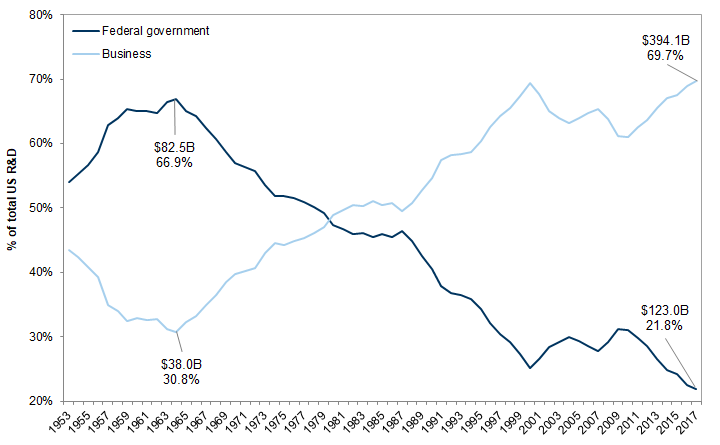
The lion's share is by business now, which is more likely to invest in things that have more obvious immediate profit avenues.
Well except for SpaceX’s reusable rockets which are the future.
Im sure there will be some use for current Soviet rockets in the future but unless they come out with something to compete with Elon’s they are going to be left behind.
The Raptor engines are better, but they haven't flown a mission yet.
But the killer feature of Soviet rockets is really their cost. They are much cheaper than anything else due to much cheaper design and engineering for their performance. The Merlin engine is much much more difficult to manufacture than the NK-33 and much more expensive.
This leads to a situation where it's much cheaper to build and entire Soyuz, throw it away, and build another one, than to use a reused Falcon rocket to put people into the ISS, per person.
The Soyuz, even when you throw it away, is so cheap that IIRC most of the cost is from operational expenses and not actually purchasing the craft.
Even with more advanced nickel based "superalloys" the US has still been unable to build a closed cycle kerolox engine.
I don't disagree with you either, it's another example of how misplaced development priorities can look like winning big until the handkerchief reveals a fat, dead rabbit.
edit: the rabbit stinks, too.
These numbers are from 2-3 years ago, total launch cost is 4 billion rubles, while the cost of a Soyuz FG is 0.9 billion rubles. So the rocket is actually less than 25% of the cost of the launch, which is why Soyuz will for the foreseeable future be more efficient at its task than any rocket, reusable or not (!!!)
So as a product intended to fulfill a task, the Soyuz is actually the result of much better engineering decisions and really engineering and manufacturing in general than anything else. Because it's performance here is launch reliability, where it's #1 and can launch in conditions the SpaceX craft can't, as well as cost, where it is still lower and will be lower than anything else for over 50 years.
Since I was a boy, I had wondered why we hadn't improved our launch vehicles, I saw new cars and planes and electronics and whatnot produced every year, but I often wondered why the Space Shuttle was still the thing we used "to go into space".
I learned about RAMJET/SCRAMJET, doted on Star Trek warp drives and fantasized about teleportation, I kind of never questioned that rocket lift technology might have just reached some newtonian limits. I've certainly never considered the total cost of launches and the reliability or weather considerations.
A 25% cost reduction from vehicle recovery sounds great, but I've read "Eccentric Orbits" and am now considering there are many additional factors in these programs. I don't know very much about launch economics, especially since there is clearly much to consider. Thanks for the perspective.
Q: Why has space technology remained fairly stagnant?
A: Because the economic demand to fund improvements hasn't existed.
We look at the market and say "But all those satellites! Surely they could pay for it." But that's underestimating (a) the cost of development (HUGE! And there's a low-quantity of launches to amortize over) & (b) the value of incremental improvement (negligible, as most current customers aren't cost sensitive).
That's SpaceX's real genius. Reusability isn't a competitive advantage unless it coincides with increased demand. Demand which they themselves seeded via the StarLink constellation.
Japan, SK and Taiwan are the kinds of places where you could convince a lot of people to 'do this and that for the good of the country' - especially since they were flat on their backs and rebuilding from nothing, at the same time facing existential external powers.
'Post-War' was a quasi-authoritarian national strategy almost as much as the actual war or preparation for it was.
In North America especially, we live in a 'Safe Bubble' we don't really have the sense of existential angst that a place like Korea might have, what with a direct record of thousands of years of war and tumult from any number of neighbours which still exist today.
Even in W. Europe the living memory of that stuff seems rather fargone.
Indeed. To expand on that, there is an economist Richard Werner [1] who has studied that process in depth.
The TLDR is that new money/credit creation needs to be allocated primarily toward production and innovation, vs consumption or asset speculation (the three things money can be allocated toward).
In post-WWII Japan this process was called "Window Guidance" [2], an informal system by which the BoJ directed the banking system to fund industrial development.
The Asian Tigers and then China all copied the model in their development program too, so it's clearly portable, but interestingly remains informal. You would think an effective model like this would be formalized into law at some point.
[1]:https://professorwerner.org/; https://www.researchgate.net/profile/Richard-Werner
[2]:http://princesoftheyen.com/central-bank-money-creation/ (scroll down to Window Guidance section).
"MITI'S SUCCESSES AND FAILURES IN CONTROLLING JAPAN'S TECHNOLOGY IMPORTS" https://www.jstor.org/stable/43294946
I support most any kind of national policy. Industrial, agricultural, transportation, education, etc.
Sure, use markets, incentives, competition.
Use some combo:
- private & public orgs
- private & public capital & finance
- top down & bottom up organizations, ranging from risk minimizing to hail mary.
Basically, whatever basket of strategies works.
But mostly I simply support directed, sustained investment in ourselves and our future.
But who chooses the investment? While I'm not anti-tax, I generally think the aggregated intelligence of the free market makes the best decisions, in most cases.
There are a lot of scenarios where selfish behavior is rational for the individual but only permissible for a minority but if literally everyone does the selfish behavior everyone loses more than if they had done nothing.
Throwing good money after bad makes me grumpy. So we need feedback loops, post mortems, etc.
Currently, every bit of legislation requires a fiscal note. Expected costs, projected impact, ROI, etc.
We'd all benefit if society worked harder to do the obvious followup steps.
Because it consumes resources that are needed elsewhere, such as for healthcare, education, etc. Because it centralizes power in politicians and in large corporations. Because it's not freedom.
> we need feedback loops, post mortems, etc.
Agreed, but let's not expect people to suddenly start doing those things.
What garage startup will succeed if money is distributed by the fiat of powerful rather than by a merit-based market (and yes, we can improve the meritocracy).
No single approach results in the 'best' decisions, and I'm not sure what the "global economy" and the "United States' represents in this case - both are very large collections of various people and interests.
The U.S. does have a very strong emphasis on freedom, you know, and has done very well with the free market and free trade - no country, in aggregate, has gotten richer following any system in the history of the world. Truly.
I'm open to improvements that distribute benefits better, but what do you suggest would work better?
If there was we could have avoided WW2 and a lot of other wars.
The owner of the machine can effectively charge all customers the marginal cost to build a new machine in perpetuity as a natural monopoly.
Odds are Semi is heading in the same direction where it doesn't make sense to build new fabs except for national security reasons, and whoever controls the massive fab can charge the marginal cost of building a new one to each of their customers indefinitely.
Maybe it doesn't make sense for private parties, since it clearly makes sense for nations to not rely of adversaries for their supply chains.
I would also argue that it your ability to rely on a competitor that is critical to your supply chain depends on which laws that prevent anti-competive practices are present in the relevant jurisdictions.
Investments aren't financed by customers, they're financed by investors.
I reckon in today's money-printing world it's easy to get even $1bn if you can credibly say to the investors that you can charge each customer 90% of the full investment (hell, even for 10% it's still a great business!)
It's a bad deal for investors to race to the bottom with an existing market player in a commodity business. It only makes financial sense for customers who dislike the marginal rate or feel there is a security need requiring their own supply chain.
The only way to break out of this would be a technical invention which allowed lower capacity production or technical innovation obviating the need for the monopoly. In the case of an industrial press this is a less likely outcome due to the physics of the machine and the intended application.
https://www.forgemag.com/articles/84706-invisible-strength-f...
The conclusion about the inability of the market to develop alternative or similar manufacturing techniques isn't established by observing that the state did.
The alternative to forging the wing spars is to create a sub assembly from a dozen or more smaller components. The fasteners, drilling, and overlapping joints create a mechanically weaker, larger, and heavier assembly with worse material properties than a one-piece forged part.
In addition, assembling a wing spar from a dozen parts creates wasted materials from additional steps in the process (machining, forging, drilling, riveting a dozen parts) which takes much more time, requires skilled technicians, and decreases tolerances in the resulting assembly.
Machining titanium has different and worse metallurgical properties than a single forged part. You can heat treat the forged titanium part which has totally uniform mechanical properties, where in an assembly each part might have different inclusions and defects that are much harder to control for in process. This aids QC as well, as you can just X-ray the forged titanium part once.
So yes, they did, but its much more than that. The forged wing spars improve dozens of manufacturing, QC and engineering problems in addition to the material savings. Even without that, the forged parts are still a prerequisite for modern air frames.
EDIT: sorry, I didn't notice your edit. It may be that the market would provide these Heavy Press machines, and I mean the DoD partnered with ALCOA and other existing experts to build and run the presses, and the private market owned and profited from them, but in 1945 there wasn't a market for this except to the Air Force. That's why the DoD funded it. I'm sure the market could have also invested the absurd dollar sums, I mean the things are still used today, what was the total ROI on the Iron Giant presses... its incalculable.
But I'm almost certain today's globalized manufacturing would do what they are doing now: Make them in Taiwan, China, developing nations, and ship them across the ocean. The point is that the Air Force recognized the value of making the wing spars in country, so you can't bomb, flood, or capture the presses. We should definitely be able to crank out i7's on our continent, I don't care how.
Agreed. I'd add that the export of dollars is related to central bank policy.
Its mind blowing how much that the post war era is still affecting current affairs.
Where the petrodollar required somewhat incoherent rationales for war, a supranational carbon credit regime would offer somewhat more self-coherent rationales.
It isn't difficult to imagine how it might play out.
"Nation X's refusal to honestly participate in the carbon credit system is a crime against the Earth. Sanctions have been insufficient. The global coalition must act militarily to protect the Earth from..."
Regardless, I'm not sure there is a practical way to get the US back on track to where markets are more free and investment in domestic industry isn't distorted. A 25% tax credit or outright government funded or perhaps an initially nationalized industry? The difference is only in degree.
But this is a great opportunity to observe some of the engineering challenges with these advanced manufacturing techniques.
Tesla Model S and X were constructed with alloy control arms (Tesla calls them 'fore links') which sometimes did not meet specifications, resulting in catastrophic failures[0] termed "Wompy Wheel" in the press.
I don't know if they are extruded or forged, I think they are extrusions but I haven't had a really close look. One thing that I've noticed about the failures is that the control arms have what appear to me to be unusually large rubber bushings. I don't know what conclusions can be drawn from that observation, but there it is. I would speculate that the largeish bushings provide improved ride quality. On another note, Tesla wheels were kind of weirdly large, with uncommon tire specs.
I've had the opportunity to examine some more resent Tesla suspension components and they appear quite resilient. However, YMMV, I am not an X-Ray.
[0] https://www.motorbiscuit.com/this-is-bad-whompy-wheel-syndro...
The major problem the US, and the West, face right now is that its more profitable to speculate on financial and real estate assets than it is to actually produce anything.
In 20201 in Sydney and Vancouver for example, the average house price has increased more per day than the average daily salary for a worker...
The other issue is that the West (particularly the Anglosphere) is intent on importing as many low-cost workers as possible, from countries with poor records of innovation, who then bring their own problems such as caste favoritism and high in-group preferences.
The simplest solution would probably be to import Taiwanese engineers en-masse, and formally create new chipset companies (which are not Intel), which it seems only China is really doing.
A direct policy approach could be for the USA to offer anyone with a university degree or trade skill and under the age of 40, from non-oil countries with a HDI of over .85 the ability to permanently migrate to the USA for a nominal fee:
https://en.wikipedia.org/wiki/List_of_countries_by_Human_Dev...
And at the same time, deporting all illegal immigrants (to free up housing) and building walls along the southern border - the shortage of cheap labour will encourage automation and innovation.
How about putting some reins on the real estate and trading markets instead of “getting better immigrants”? Sounds a little bit more logical.
Can you elaborate what deep prejudice you got from that comment?
Building a wall is just a dumb move regardless.
And as I said before, the southern border is mostly made up. People crossed it for thousands of years without some crappy wall in the way. They will continue to cross it even with a wall.
What are you in favor of, then?
A border wall is an ecological tragedy.
Do you also deport citizens who are not a “net benefit”? Would be the logical thing to do.
No, I do not want citizens deported; they are citizens. However, we should be extremely selective with immigrants.
These people are responding to demand for cheap labor and trying to better themselves. The real way to address this is severe criminal punishments for their employers.
Finding them requires a level of police state that it's unclear the US will tolerate, even if you promise them it will only be applied to non white people. It would start with mandatory ID and work up from there.
It is surprising that helping your neighbors not become a threat to the US through voluntary means is not on the table.
In WW2 after examining the components from aircraft kills, german wing spars would often survive. It was discovered that Germany used unique forged alloy wing spars to achieve their excellent aircraft performance, perplexing allied engineers. These wing spars' strength and weight is critical to the structural properties of modern air frames. Without them, jet air craft like the f-15 would have been impossible.
Machining these advanced alloy parts proved difficult, expensive, error prone, and impossible to manufacture but a die forged alloy wing spar was stronger, lighter, cheaper and beyond the industrial capability of every allied nation. We did not have the metallurgical technology to create such a large forged alloy wing spar in 1945.
After the war, the US and Soviets recovered designs for the extremely large press assemblies required for advanced air frames. In the 1950s, a huge national program was geared up to create absolutely massive Heavy Press machines. The Soviets had a massive 30,000lb press for these parts, and we created a couple of monstrous 50,000lb machines[1] that are still in operation today. These things are older than we are and still out there cranking out air frame parts today for modern air frames in 2021.
Without this kind of national investment in this kind of unique manufacturing, we would be unable to fly without importing 747 parts from wherever they could be created.
[0] https://en.wikipedia.org/wiki/Heavy_Press_Program [1] https://www.youtube.com/watch?v=iZ50nZU3oG8