I've seen this in my own feed. Any time some "bad" person is exposed, I'm almost guaranteed to scroll past 30 almost identical takes on it by the same 30 people on my friends list. I click them, and 80% of their feed is just their takes on the daily outrage du jour. I don't really know who they actually are as people anymore, unless this is the entirety of their being now.
So now as a general rule I don't post anything about current events on social media, and stick with things actually about myself. I might make a comment on someone else's post sometimes, but not post about it myself.
I will probably make an exception here or there about climate change, because in my opinion that subject is being way too glossed over by society as a whole and is a much larger and more imminent threat than "this person did a bad thing and we must shun them now".
I appreciate the sentiment, but there are just too many (terrible!) inequities in the world to live by this and not have it be a full time preoccupation.
Humans have a need for a certain kind of emotional high, that in whatever way, people find a source. Some people find it in competition, drugs, sex, music, art, creation, fear, ... there's probably a whole taxonomy in there.
One of the ways people find it is in social displays of moral superiority. People hated this about organized religions and left in droves, and yet here we are with the exact same behavior.
There probably was a very valid evolutionary reason why this is so prevalent in humans, but like most things that make us feel good, uncontrolled they get taken to terrible extremes.
The point is recognizing that this behavior is a need finding a source of stimulation. If you want to fix it you have to find better sources for that feeling and recognize what is happening... and distribute that recognition into the public consciousness.
I want to be careful not to "speak something into existence", as I heard someone say recently, but it occurred to me this morning that if someone is your enemy, you probably derive pleasure from their pain. I kind of feel like our society is in denial that many of its members are "soft mutual enemies" of a sort. It seems if things went wrong (e.g. food shortages etc.) it could become a serious problem. (Personally I "pray for my enemies" when I'm in my right mind, but I have doubts as to whether it makes up for the vitriol when I'm not.)
As for the parent's post's concern for global warming, using less can be emotionally satisfying.
And if big oil is standing in the way, maybe they should be offered the position of producing solar energy systems. (Similarly if drugs were legalized it might make more sense to offer the cartels the position of distribution.)
The most basic idea is once you join a psychological group you stop being fully rational and mostly act on emotions driven by the group.
Everything just makes sense after digesting parts of that book.
The part you mention about organized religions is also just the group.
Of course do they actually ever do anything beyond sharing a post and acting like a good person? Nope. I don't see these people volunteer, donate, or do anything except share crap. So when they are someone I know in some way I just mute them instead of unfollowing.
I get that a lot of this was unintentional, but the dynamic has now been known for a decade and has only gotten worse. Why has Twitter the company and its employees not taken action to deal with this? Instead spending their time creating tools and methods to censor non-mob participants? (e.g. those who were exploring the lab leak hypothesis) Why isn't the mob a top priority?
Part of that is the incentives going in the opposite direction, as other commenters have noted.
Even assuming they are in good faith, though, I believe it is an extremely difficult problem. Building and maintaining large scale communities is next to impossible, you can't just turn off a switch and make the mob go away, a mob is, by definition, out of control.
Historically, we have solved this problem by effectively limiting access to large scale communication, with small elites acting as gatekeepers. Social media tore down the metaphorical wall, allowing any random person to talk to anybody who will listen.
This is, by and large, a good thing. However, those elites did play a role, because they could keep each other in check and enforce standards of behavior that would prevent the worst abuses.
So the question is not how we go back to the 70s or something (yet again, the change is overall in the right direction), but how we can replace the missing piece. Needless to say, I don't even know where to start.
Communities are built on trust and relationships, what happens at social platforms is that people with "large communities" are just creating followings the same way that celebrities always have, which are a weird modern corruption of the idea of a community (or if you want the academic term for it, a parasocial relationship).
What makes a difference to me are the insights you get here combined with thoughtful answers, as in rarely the lowest common denominator type of discussions.
For that there are all too many forgettable social media sites.
Hacker News is a very large and impersonal forum. You can have interesting conversations on a forum, but the degree to which they are a community is the degree to which you develop relationships with the other people. I wouldn't call /r/videos (or any other massive subreddit) a community either, and they have the same level of social intimacy.
Agreed. Aside from recognizing some familiar usernames[1], unless you know someone from IRL or via another social media platform, the posts all 'pseudo-anonymously' blend together. The standardized comment formats, fonts, and command bar next to each comment help make it so, even if you perform per-page custom styling.
[1] my personal list OTOMH is tctpateck(sp?), dragonwriter, doreenmichelle, dang(ok thats a gimme), sklabnik
I don't agree that social media (qua social networks) has moved us in the right direction.
Web forums and blogs were better.
I don't think we need to find the missing piece. I think we need to remove the unnecessary, super profitable poison.
Something like private, self hosted forums with universal log in, but no cross-contamination of "likes" and comments, and no algorithmic attention management.
I think I need to write my senators.
I don't think they were inherently better. And don't get me wrong, I have a mostly positive experience with forums and blogs and an extremely negative experience with social networks, eventually I deleted every single account I am not required to have for work-related reasons.
However, I believe the underlying reason is that pre-Facebook communities were more "selective". Being part of those forums or reading blogs was more of a deliberate choice rather than the societal average, something like HN, early Slashdot or early Reddit. This resulted in user bases that were not cross-sections of the general population.
In the alternate universe where forums and blogs became the mainstream, I believe we would have seen the same problems.
Algorithmic feeds are literally evil incarnate and I'd love nothing more than to see them nuked out of existence, but I don't think they are the root of the problem, at least not in this particular case.
* the notion of voluntary association. How many social media users use social media because they think they're supposed to? Voluntary association facilitates the perception of good faith on the part of others by its nature.
* the type of user, e.g. an enthusiast vs otherwise. A lot of social media's problems stem from it's crazy scale, which, as a byproduct, increases the amount of bad apples and their visibility.
Forums and their ilk had similar problems with cabals and such, but the fact that they weren't the single destination to be made the stakes lower. I can see a future where we cede current social networks to the very online crowd and let them continue to play their power games in their own little sandbox while the rest of the world moves on.
Remove the algorithmic feed
Remove the Trending bar
Increase character length
Ban witch hunts
I think retweets/quote tweets are a bigger problem. I can understand why a large number of people I follow might tweet about the same thing, but I don't need to see that thing reproduced 10 times.
What? No. Where had you heard that? Twitter was meant to be SMS in the Internet - for quick comments, quick news, quick updates, short notices, short etc.
Any moral dilemma slightly more complicated than 'is killing wrong' is a tradeoff, and sometimes you can't blame people if they prefer a point on the curve different from the point on the curve you like.
Maybe in this case they are just wrong -- I have no sympathy for Twitter either. But I'd rather companies, in general, not try and play God. Even more so, I really would rather the government not try and play God.
Even killing is a trade off. Every country has a military of some sort. Every village has some form of police that can kill (some are much more likely to kill than others, but eventually all police forces can bring on death if the situation is bad enough). There have been cannibal societies in history (not very common from what I can tell, but they did exist) that would give a different answer as to what killing is moral than most of us.
Companies like Twitter and Facebook exist and thrive because they have taken the less ethical route.
And I don't think it's easy; I suspect corporations do bad things despite the good intentions of employees. Each one, driven by subtle incentives, makes a somewhat less ethically sound decision than they would otherwise. And the effects of those decisions are often abstracted away from the decision-makers. The status quo gradually becomes worse and worse.
one of the theoretical principals of capitalism is that free markets allow people to use their money as a proxy for ethical support and ethical decision making.
this principal is theoretical because of straight up apathy - people just cant be fucked. there are other minor contributing factors like information asymmetry, but the real issue with capitalism, like any politcal/economic system, is the people. PEBKAC.
if people cared and the market was free enough, ethical companies would simply put others out of business.
They did. They tried many things, still do. But it's hard to fix without wasting the whole platform and becoming another reddit. What makes Twitter great is also what makes it aweful.
You can spend tons of money on trust & safety, tweaks to the UI, whatever. But a bad system design is still a bad system design.
It's kind of like trying to make an old C codebase secure by throwing in lots of calls to strlen() and changing some sprintf()'s to snprintf(). It may help a little, but it's not enough to turn the ship.
This would explain why "social media" like FB and Twitter are so much worse than their predecessors (blogs, forums, email, sms, ...). All of the previous media could be bad too, but this is different.
It's often not the case that people see a mob forming and jump in, in most cases. What people see is someone they know quote-tweeting an obnoxious person, or someone they already follow saying something obnoxious, and they condemn the obnoxious behavior. The more engagement an original tweet gets the more likely other people are to see it in their feed, regardless of whether it's obnoxious, funny, or whatever.
One time I replied to a sanctimonious statement from a politician with a mildly critical but also mildly witty reply, read a few other tweets and went on with my day. I don't get notifications from Twitter and was astonished to find the next day that my tweet had blown up and been quoted in a national publication. In fact all of my 'high performing' tweets over the years have been casual witticisms, but I've never seen one take off in real time because I only look at it intermittently. I suggest that rather than an angry mob, what you're seeing is simply the aggregation of multiple similar reactions. Few to none of those were necessarily invested with enormous significance by the people making them, unlike a real world mob.
This is not to say, of course, that theren't people who like going around condemning others, and Twitter does have a habit of showing you multiples of people posting about the same thing, as opposed to showing The Thing once and observing that 10 people you follow have left comments about it.
Because it's not their job to moderate this stuff.
Angry, pissed off, outraged users are, from the perspective of social media companies, the best users. They refresh constantly (so more ad views), they come back constantly, and if they've gone away for too long, you can just figure out what's likely to piss them off the most, send them a notification, and they're right back into the ad delivery mill, engaged and outraged.
And all that means more money for the company. Which is their interest.
YouTube's guiding goal (at least some years back, as I heard it) was to increase hours watched. Period. Hours watched was the metric they optimized for, above all else. And it showed in the various recommendations that looked very broken from the outside world, but those tended to add hours watched.
I don't think the algorithms were nearly smart enough to know that they were recommending some conspiracy theorist gateway video, or extreme political content, or such. They simply knew, "If we get people to watch this video, they will then spend a lot more time on YouTube." So, the more people that watch that video one way or another, the more hours watched, problem improved! It's very "paperclip maximizer" seeming sort of algorithm.
Given that it's been known for years how to "drive your users nuts to keep them coming back" and social media companies have refined this to near perfection (it's Vegas in your pocket, without any of the regulations and rules Vegas casinos have to abide by), I'm in favor of some regulation on this sort of stuff, but I'm not at all sure it will actually matter. :/
And I'm not sure it would be better if it were. I don't care if a bunch of people I've never met are talking about what a horrible person I am (well ok, I do, but that's more of a me problem than a them problem). I do care when my employer joins the mob and ignores any evidence I might present of my innocence. What we need are for the people who can mete out the consequences to start thinking longer and harder before they capitulate to the outrage mob. A little less "better him than me" and a little more "I'd hate to be treated this way myself".
> I'm in favor of some regulation on this sort of stuff
You really nailed the problem but I am not so sure about your solution. The gambling industry's regulations do not do very much to reduce the volume of lives ruined by the gambling industry.
We've been gambling since the paleolithic period, and like other vices, its regulation serves largely to hide it from public view, rather than actually fix any social problems. Regulating social media in any meaningful way will do the same; compliance with these regulations will force the issue further into the corporate depths and away from public view.
We already know the social media firms collude with governments around the world in secretive tribunals to deal with issues of "national security." We don't want to encourage further developments on this front.
No, but if I walk into a casino, there's at least some chance I can come out with more money than I went in with.
Consider a slot machine app. Not only do you have no idea what the payout is, you're guaranteed to lose money if you pay for any coins in that game, which I assure you, people do. For reasons I don't understand, but I've seen it happen.
The list of people who had their 15 minutes of fame on social media platforms is endless and constantly growing.
In addition, individual citizens (not “consumers” or “users”) matter immensely as well. Companies are aggregations of individuals and the behavior of each of us determines the behavior of companies. The cultural, legal, biological, and environmental factors that affect all of us individuals determine the macro behaviors of companies and governments. We can and must strive to improve these factors and thus improve the macro dynamics.
Obviously, the details of this will involve endless debate and there are many ways to approach the problem. But if we don’t try, we are asking to live in a shitty world.
P.S. These are rough thoughts that I quickly typed up and could definitely use some polishing. Some other time…
In the long term, these users make a community toxic and less viable in the long run. People don't come back after a long enough time.
There can be no mob without twitter's involvement.
There are always two parts to social media; social media the people at scale and social media the recommendation engine with impulse driven features that actively rank orders and promotes what content meets what eyes. By definition internet brings the scale, i.e. the size. But size in itself does not create a mob. You could walk around in a crowded square and mumble all the controversial things to yourself; people will at most give a bad stare, but mostly ignore you, a mob will not form after you.
It would take a shit-stirrer to actively salience the thing you said to the people in that crowd who would be most motivated to come after you.
Twitter et al are the shit-stirrers that makes money every time they can make a person engage with a content, regardless of the thoughtfulness or the sentiment of the engagement.
If you're mis-identified and doxxed then your life can be in danger.
https://nymag.com/intelligencer/2020/06/what-its-like-to-get...
And the consequences for the accuser are nothing.
“We are seeking the public’s assistance in identifying the below individual in reference to an assault that took place this morning on the Capital Crescent trail. Please contact Det. Lopez with any information,” read a tweet sent June 2 from the department and shared more than 55,000 times.
But the Park Police had made an error. “Correction, the incident occurred yesterday morning, 6/1/2020,” they wrote in a follow up tweet. As with most such clarifications, it had only a fraction of the reach: a mere 2,000 shares.
[...]
On Twitter, Maryland attorney general Brian Frosh [...] had asked all of Twitter for help finding the man in the video. “If anyone can identify this man, please let me know,” he said, and nearly 50,000 people retweeted him.
[...] He sent a tweet confirming that there was a suspect and “it is not Mr. Weinberg.” (228 retweets.)
Relying on people to amplify accuracy and context is doomed to failure because people react to sensation. You show a video of a person doing something awful, naturally there will be a big reaction. The follow up tweet specifying some overlooked but important detail is simply not emotionally activating the same way.
However, it is within Twitter's capability to automatically propagate that additional context/correction to everyone who interacted with the original tweet. Indeed, it's within Twitter's capability to force them to look at the update and not proceed with using Twitter until they've acknowledged it.
Another approach could be that when a public figure (especially an authority figure) makes a mistake like this, they should be billed for the cost of advertising the correction to an equivalently large audience.
That's a great point. Accusers are not only incentivized to whip up a mob, but have virtually no downside. No skin in the game if they're wrong. That asymmetry needs to be resolved somehow.
This is how I felt yesterday reading the repl.it thread.
But so many time it ends up being entirely wrong I really wonder why it's still at play.
We kinda had to invent justice structures to avoid blunt reactions.
Also who thinks internet focuses too much on endless debates and abnormal relations. Did we spend so much time arguing before ? I'm so jaded I just want sharing chitchat jokes and food and nothing more. And I kinda believe that it's a more balanced approach to society. But i'm kinda digressing (an proving the opposite of my point partly)
Twitter sounds awful in a vacuum if described like this, and indeed it does have lots of problems. But, if we are going to have very huge and influential corporate sources of information, Twitter is MUCH more defensible than e.g. MSNBC/CNN/Fox, in that its significantly more "little d" democratic. The thousands of voices available there are far better than the tiny few coming from many other sources, and because the platform is generally "open" in that we can see what others post.
I think Twitter is actually doing an excellent job, given the incredible difficulties involved with what it does, especially as compared to a Facebook, etc.
Whole Twitter experience become so much better when you only keep to people you like. Don't think twice to unfollow someone.
Your words now will make as much impact on the people you hope it will as they would have had at the time on you.
Ah, yes. Necklacing. https://en.wikipedia.org/wiki/Necklacing
Also, from the wiki, in 1986, Winnie Mandela, then-wife of the imprisoned Nelson Mandela, stated, "With our boxes of matches, and our necklaces, we shall liberate this country", which was widely seen as an explicit endorsement of necklacing. Lovely.
Size is power, and size comes from Engagment. Each voice gives more attention to the problem and prevents it from sinking in the ocean of meaninglessness of twitter. At least for the moment the topic is trending.
> I am ashamed to say I've done it myself, back when I was on Twitter. My feed would start lighting up with some really Bad thing that so-and-so said -- and generally it was "Bad" -- and I'd add my voice somewhere to that cacophony. Not necessarily writing to the Bad Person, but chiming in on someone's long thread.
And now you are here; is this not the same?
> Mobs are scary, because everyone thinks they are justified.
Who says they are not? It's just one little voice. One of many, but still one.
Whether it's justified is more a matter of perspective. In the end it's just people talking and gossiping, they have no real power. But people are giving them power by listening to them. But it's also questionable how many are doing this. At the end the mob is still a single voice of many, maybe moving something, maybe not.
> A good friend of mine grew up in Kenya and recounted that when he was about nine, he saw a mob catch a thief. Joining in with everyone else, he took a wire and whipped the man. Next thing he knew, the crowd had put tires over the alleged thief and set him on fire. He has never forgotten the guilt he felt.
Ok, that's definitly a different dimension than Twitter. That's not your typical cybermob. Though, there is also this insanity spreading from Virtual Places to real world. But this is not limited to Twitter. Reddit has their dark history in that area, as also facebook, discord, even ancient IRC and usenet had this crap.
...no, because I'm not participating in a mob here?
I am positive you are not blind to the parallels between your current actions and the actions of which you claim to be ashamed.
I imagine the distinctions matter more to you than the similarities, but I honestly cannot tell why. Are you now better than the twitter user because less people use hacker news? Or are you better because the people you shame are faceless rather than a specific individual? Or is it simply because you reached the top of the comments section rather than being the 10000th voice?
I don't condemn you. I believe you should be allowed to speak your opinion. I just don't support your condemnation of others, especially the fallacious comparison to a violent, physical mob.
The only way out is through due process and supporting it even for the worst of the worst.
(EDIT: Weak downvoting this comment without responding with a counter comment.)
Some people have reached a point where not even disagreeing with them, but simply mentioning someone they don't like in a positive light or mentioning someone they do like in a negative light, no matter how factual the statement is, will get you downvoted.
They can't even articulate it, hence why you didn't get any responses - they just got used to being in their echo chamber where their opinions are always echoed and fervently applauded. After a while, whatever the echo chamber promulgates becomes that person's ground reality. As soon as they see something that disagrees with this reality - it is an offense to them and their whole worldivew, but they can't argue for their beholden view or against the offending view, so they have an emotional outburst.
I've met a few people who proclaimed themselves to be very politically educated individuals, but as soon as it came to a debate they'd get frustrated by failing to answer basic questions about their opinions and excuse themselves. No wonder, who wants their whole paradigm to be crashed in one evening?
> Lauren being accused of trans/biphobia (Lauren herself identifies as gay)
In the context of OP's link, it is fair to respond with reference to the attacks on Margret Atwood that accused her of being a 'bad feminist'. Atwood directly addressed the issue of a failed legal system but also asked the still unanswered question, what should replace it, swarms on the internet? [0] Sadly, I probably agree with most of the people frustrated downvoting me. Moreover, I'm adding to the conversation that Lauren is having about due process not in a legal court but rather in the court of public opinion and personal attacks on the internet as it has hurt not only Margret Atwood but Al Franken or closer to home, Douglas Crockford which at the time paradoxically hurt young women with computer science degrees finishing school looking for work more than it hurt Crockford.
This morning I was thinking about making a Reddit / Hacker News clone with one small change to the algorithm. Can't downvote a post or comment without making a response. It used to be fun to have debates on the internet.
[0] https://webcache.googleusercontent.com/search?q=cache:J8YvMk...
For the sake of my analogy, let's just assume that you did it.
Now, John Ruth wants to take you back to Red Rock to stand trial for murder.
And if you're found guilty, the people of Red Rock will hang you in the town square.
And, as the hangman, I will perform the execution.
And if all those things end up taking place, that's what civilized society calls justice.
However, if the relatives and the loved ones of the person you murdered were outside that door right now, and after busting down that door, they drug you out into the snow and hung you up by the neck, that would be frontier justice.
Now, the good part about frontier justice is it's very thirst-quenching.
The bad part is it's apt to be wrong as right.
Well, not in your case.
In your case, you'd have it coming.
But other people, maybe not so much.
OSWALDO: But ultimately, what's the real difference between the two?
HANGMAN: The real difference is me.
The hangman.
To me, it doesn't matter what you did.
When I hang you, I'll get no satisfaction from your death.
It's my job.
I hang you in Red Rock.
I move on to the next town.
I hang someone else there.
The man who pulls the lever that breaks your neck will be a dispassionate man.
And that dispassion is the very essence of justice.
For justice delivered without dispassion is always in danger of not being justice.
>And that dispassion is the very essence of justice.
>For justice delivered without dispassion is always in danger of not being justice.
Based on the reporting I've read on the internal cultures of police departments and the wider "law enforcement" community (federal law enforcement, prison administration, etc) I am pretty skeptical that "justice" is dispassionate. Instead, I think these groups wrap themselves in a myth of dispassion while they place thumbs (and larger things) on the scale in a way that reflects their personal beliefs and biases.
The political science class I took back in college (over 20 years ago now) began with the Oresteia trilogy, by Aeschylus. The issue there is between "frontier justice" (actually, blood feuds) and civil justice (justice of the polis). The message there is that there can be no civilization unless the people of a society sublimate their (intrinsic?) passion for frontier justice towards civil justice.
The myth, as you call it, is there to bind us as a society — as any myth does.
I don't know what movie is being referred to above, but the idea from that passage doesn't originate with the movie.
When the process is followed in a specific case, people can accept it even if they don't like the outcome, because they had a hand in the process that produced the outcome. Over time you can improve the process. That's justice.
Really long (it's more of a stage play), but like most of Tarantino's films, the dialogue is stellar.
I think the nuance of these specific injustices is important because the solutions are different. A killing could even be lawful but racist and therefor unjust, but that’s a distinct (albeit important) problem from mob violence or murder.
Someone went apeshit on Twitter[2], and now all the puns are gone while Lone Star reviews them for sensitivity.
I'm politically liberal, and I'm fucking ashamed of the fact that this kind of stupid behavior is associated with liberal politics.
1. https://lonestarbottlecaps.com
2. https://www.mysanantonio.com/food/bars-drinks/article/what-h...
There is a real desire to be outraged. The mob members get awarded with internet points and smug self-righteousness when they are outraged. Combined with the zero downside they face, _any_ amount of mental gymnastics to be outraged at something is worth it. That's how they can think a completely normal thing, that millions of people do, is suddenly a symbol of fascism or whatever.
See also: wearing red hats is "bad" according the mob[1][2]. Its a perfect metaphor, really. They can't bother to look at the hat and see if its MAGA or not, they just see something vaguely similar to something they don't like and go off. This one in particular annoys me because I have an actual "red hat" baseball cap from redhat the linux company. Its a really cool hat but I get snide comments every time I wear it. Absolutely ridiculous that the mere color red "triggers" some people.
[1] https://www.nytimes.com/2019/07/20/style/red-baseball-hats-m...
[2] https://www.nationalreview.com/2019/09/liberal-author-normal...
Sure, it's just a pun, but for many people it conjures a very particular image. They don't want to open their beer to an image of a noose, regardless its context. And really, the lone star is the emblem of the Republic of Texas which was founded in large part due to Mexico's outlawing of slavery.
The noose on a Lone Star bottle cap has this particular context. I think it's pretty gross and I'm glad they chose to remove it rather than defending it has "history" or something.
Really, though, I always buy the cans.
All that stuff you said may be true in the strictest sense, but I still think one has to train themselves to get mad about that kind of thing. It's unnatural to instantly get infuriated and see hate in a bottle top, is all.
The last black man lynched in Texas was in 1942. The last black man lynched in the US was in 1981. And the noose itself continued to be used as a symbol of terror, just like the burning cross.
No body had to "train" themselves to get mad at "that kind of thing," that was done by the people doing the lynchings.
> Even had they quietly said "sure" to removing it
You think there's any chance that that would have happened without someone making a "stink" about it?
And in the US there's no such thing as a noose that's unrelated to race. They are being used, today, as racist threats. When a noose appears, lynching is the assumed meaning, and not just by black people [1].
So it's a good thing that Lone Star is taking a look at the entire project. Using a noose was a mistake. One presumably made in good faith, but a mistake nonetheless. So the right thing to do is pull not just it, but to make sure that they didn't make other mistakes -- a sign of good faith.
I'm all for accepting a good and sincere apology. A lot of people have made bad and insincere apologies, and not only does that not help, it makes things worse by giving people an excuse to pretend that good apologies aren't worth doing. This is a good choice and I'd encourage people to take that.
[1] https://thehill.com/homenews/state-watch/554694-amazon-closi...
"There is no such thing blah blah" - yes, there is, it's called context. Someone who feels threatened by a pun "headline news" with a noose is not properly adjusted to the adult world.
Do kids not play hangman anymore?
More broadly, I think twitter lowers the bar for whining and manufacturing rage. In a pre-Internet world, would that woman have cried, or otherwise been mortified at the beer top? Would she have taken a picture and sent it to the investigative reporter in Dallas where Lone Star is brewed? Or would she have gone "Huh, that's rude, how strange" and thrown it away?
It's easy to get wrapped up in the hate-think, and I think this is a case of it.
People do frequently hang themselves, and there have been some stories of people tying nooses as jokes about suicide or overwork that were misinterpreted as racist threats.
I'm not sure if a joke about suicide is much better than a joke about lynching, and not being aware of the possible racist interpretation is tremendously ignorant at best, but it's clearly not as horrendous as an actual, real death threat.
We should strive to leave at least a little room for nuance and context, and making broad statements like "in the US there's no such thing as a noose that's unrelated to race" leaves none.
Does this picture suggest to you that he's planning to do some black people lynching in the holidays or something else?
https://www.reddit.com/r/TheSimpsons/comments/218bbe/not_tod...
I'm sorry, but this is just ignorant of American history. Lynchings were part of a reign of terror that whites, mostly in the South, inflicted on Blacks for over a hundred years.
Between 1882 and 1968 over 3000 black men were lynched by mobs. Families would go and have picnics, bringing their kids so they could watch the lynchings. They would sometimes then carve up the bodies for people to take home a souvenirs, and many of the hanging bodies of the lynched men were photographed and turned into postcards that were sold all over the South. The postcards were usually inscribed with racist text or poems, and people used to send them just as regular postcards -- photos of men hanging on the back of a casual letter. So many were being sent that the postmaster eventually had to ban them being sent through the mail, though they were still produced and sold.
Lynchings of Black men were absolutely a huge part of the American consciousness. They were one of the main ways that the South kept African Americans living in terror, and a major cause of Martin Luther King Jr's movement and the ensuing civil rights era. Songs like "Strange Fruit" were sung in protest of them.
The last black man lynched in Texas was in 1942. The last black man lynched in the US was in 1981. And the noose itself continued to be used as a symbol of terror, just like the burning cross.
https://www.espn.com/racing/nascar/story/_/id/29345568/nasca...
It's disappointing how explicitly and consistently HN responds to discussions of slightly-subtle racism with a very explicit not-at-all-subtly-racist pretension that it doesn't exist. "It doesn't bother me therefore it shouldn't bother you" and "You should look at the context", as if being black isn't a context.
And yes, it was a symbol as well as a reality. Here is a noose carried by a Klansman to threaten Black people and keep them from voting in 1939 [1]. Here is a mock lynching at the University of Mississippi in 1962, to scare off the university's first Black student [2]. Black men at work would find nooses at their stations [3]. Nooses were mailed to NAACP Secretary, and in 1956 a noose was hung in a schoolyard tree during a battle over desegregation [4].
You said yourself you're an "outside observer of American culture." Well, this is a history lesson. The noose has been an extremely potent symbol of terror for over a hundred years.
1. https://www.shutterstock.com/image-photo/masked-ku-klux-klan...
2. https://cdn.cnn.com/cnnnext/dam/assets/200623111206-noose-do...
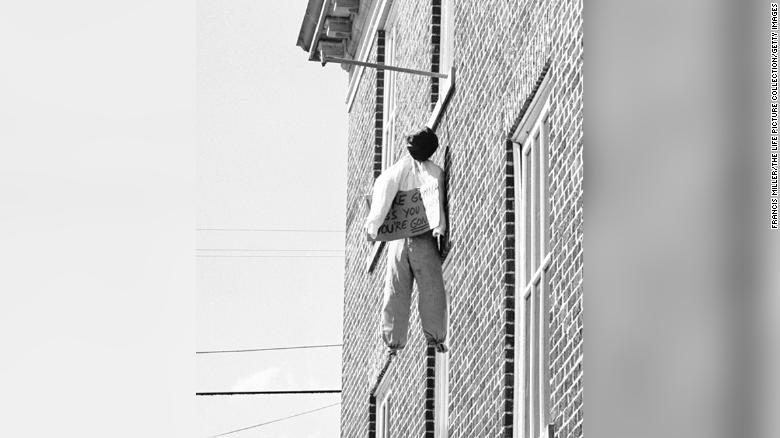
3. https://www.adl.org/media/10204/download
4. https://www.latimes.com/opinion/op-ed/la-oe-shuler-noose-hat...
A single person brave enough to think against crowds could have STOPped this atrocity from happening.
Reminds me of how Mahatma Gandhi was attacked in South Africa by a group of predominantly white-males, was literally being beaten to death, when just one white-female STOPped this atrocity from happening (source: Gandhi the Man - https://www.amazon.com/Gandhi-Man-Changed-Himself-Change/dp/...).
Most of us are too afraid to stop atrocities (Ex: Recently Muslims getting killed in Delhi while Modi was adulating Trump). But a few who do could may help save humanity.
I mean sure, if you see an injustice taking place in front of you, you should certainly attempt to intervene. But there is absolutely not guarantee your intervention will be effective.
Here is a case [1] of a man being falsely doxxed for the assault on two kids on a bike path last summer. The voices calling for him to be brought to justice, calling him a racist, etc, numbered in the tens of thousands. The retractions from people who realized they had made a mistake for calling for the blood of the wrong person numbered in the tens.
Beyond the psychological damage this may have caused, will this man ever feel safe submitting a resume for a job again? When he does so, does he need to attach a note saying "When you Google my name, all those mentions of me being a racist are false." If he does that, does he already subconsciously look distasteful in the recruiter's eyes?
1. https://nymag.com/intelligencer/2020/06/what-its-like-to-get...
I think you can mostly forgive the cowardly behavior of these authority figures up to about a year or so ago on the grounds that the social media mob sure feels like a real mob that can literally put tires around you and set you on fire. But we know now that that's a mistake. They can't do that. And so people in positions of power need to understand that in most cases they can actually just ignore the mob and nothing happens.
Every institution should have a "social media mob" procedure (i.e. what to do when a member of the organization becomes a target). If you plan to handle this in an ad hoc way, then you'll almost certainly make mistakes (because the ad hoc approach usually boils down to, "Ahhhhh! this feels bad! We have to do something! Quick, get rid of the person!") People should be thinking about how they'll handle it when it happens to one of their employees or members.
[0] I think I'd want to clarify that I actually agree that the braying mob does inflict its own kind of harm; it's merely that it's a harm I'd be willing to endure as a consequence of putting my ideas out there on a platform like Twitter, whereas nobody would be willing to endure getting kicked out of college or fired from their job just to have an argument on the internet. For example, my comment above is getting downvoted to hell. Feels bad! But it's several orders of magnitude removed from losing your job.
Careers and lives are made and lost on the back of reputation. Companies can be destroyed by the social media mob.
"Everyone should just ignore them" is not a reasonable argument. Even if there were no actual consequences, fear of consequences or fear of others' fear of consequences... is enough. It's a coordination problem.
The bicyclist in the example wasn't trying to persuade anyone on Twitter of anything. It was the public authority figures who misdirected the crowd's attention to him by releasing inaccurate information about when a (real) crime had occurred.
When the telecoms were buying up media companies and film/tv studios, suddenly all of their most expensive assets (actors & personalities) started falling out due to cancel culture. Bill Cosby, Matt Lauer, Rosanne Barr, etc., must have driven the execs at AT&T, Comcast, and Verizon completely nuts. The highest paid CEO used to be CBS's, until they also got him on cancel culture. If CBS's most profitable asset, Judge Judy, were a man, she'd already have been cancelled a decade ago. (She's fought with CBS execs over her exorbitant contract for over a decade now.)
Crucially, if you can find a way to ignore the mob and/or manage the onslaught from an emotional point of view, then you've solved that problem, but if your boss fires you, then it doesn't really matter how well you personally handled it.
I am ashamed to say I've done it myself, back when I was on Twitter. My feed would start lighting up with some really Bad thing that so-and-so said -- and generally it was "Bad" -- and I'd add my voice somewhere to that cacophony. Not necessarily writing to the Bad Person, but chiming in on someone's long thread.
Now I look back and see I was another participant in the mob.
Look, the author described in the post absolutely did herself no favors. Her book may have been great, but the way she interacted with people on social media was absolutely not. But being the 10,000th person to tell her that is never necessary. That's just wanting to join a mob, because mobs are fun, because you're all justified in this act together.
Mobs are scary, because everyone thinks they are justified. A good friend of mine grew up in Kenya and recounted that when he was about nine, he saw a mob catch a thief. Joining in with everyone else, he took a wire and whipped the man. Next thing he knew, the crowd had put tires over the alleged thief and set him on fire. He has never forgotten the guilt he felt.