I'm a US expat and escaping this culture is one of the things that's made me happiest - I tend to call it the bullshit culture because my favorite example is... writing a good paper for class is admired - but what's really praised is writing a paper that gets good marks without ever having read the subject matter. Being able to spin lies about a topic you've no understanding of and turn that into a marketable skill is a dark potent for the future of America. I think it's always been somewhat present, but since emerging strongly out of the business world in the eighties it's gained a lot of steam.
We are a society that can benefit from cooperation where everyone gets a fair slice of the pie, but that society is eroded if we praise and not shame those people who betray societal trust and cheat the system.
At least in academia, American universities (and Western universities in general) have had a good track record overall with academic integrity, and it has set them apart. This seems to have degraded recently, perhaps because of the increasing pressure of the “publish or perish” system (or dozens of other potential causes).
We do celebrate people who excel academically seemingly effortlessly. But we don’t celebrate bullshit artists so much in school. In business, and particularly tech, it’s another story.
This is a bit of a public secret, but quite widely researchers don't really trust articles anymore, if they ever did. Maybe some plot or dataset may give some insight and maybe some discussion has worthy information to ponder on. But mostly they're just some ads to put in a yet another funding application.
Most articles are just churned out to get some lines to CV or to look good in some metric. Publish or perish has turned into full-on bullshit or perish. The whole peer-review system (which is just around 50 years old anyway) is on the verge of just grinding to a halt due to the stupendous volume of hastily hacked together manuscripts.
I think many are still sort of hoping that this will somehow sort itself out. But the collapse of the quality after the explosion of electronic journals, consolidation of publishing houses and overall structure that doesn't really care at all about what is actually in the papers doesn't give much realistic hope.
It should be noted that there's sort of a "parallel reality" in academia behind the publication show. The ethos for academic integrity is still quite strong, teaching tends to be valued by the community (but not by the system) and face-to-face discussions can be of very high quality. But the signal-to-noise is so low in publishing that it's not really worth following.
We really need to get some new arrangement so that we don't drown in all this bullshit. Word-of-mouth, open data repos, conferences and just blogging and pushing stuff to git repos probably is most that's needed. The publishing structure is becoming just plain unnecessary bureaucracy.
SEO is a kind of explicit analogy. Google pagerank was modelled on academic publishing, and it worked until it went live. From that point, links started to decrease as a quality signal.. spam. Publish or perish is a similar sort of dynamic.
Honestly, I think most legible systems for determining merit have these sort of issues. If advancement, accolade, grants or somesuch are determined by a formal system, whatever that system used as a signal or metric becomes corrupted. Hence why Word-to-mouth, open data repos, conferences and just blogging and pushing stuff to git repos does work. It's informal.
A sort of reputation system is in place in almost all peer-to-peer societies, it tends to form automatically. I don't think we really need any of this weird mess of a system.
We have Wikipedia, we have open source, we have OSM, we have all sort of things that should be "impossible" given the dismal perception people have of other people. This perception is just plain wrong and really harmful.
It's a hard sell though. The cost of metering is subtle. The do-nothing tenured professor is visible.
Wikipedia, OSS, etc really are the shining beacons. Existence proof for something better. Someone needs to write The Cathedral and the Bazaar, but in non geekish.
Perhaps surprisingly to some, many in academia would just like to research and teach with some quite modest salary and don't have to think about money at all. E.g. I would gladly and with no hesitations take a €2000/month tenure and keep on doing what I'm doing just more efficiently for everybody. I've been trying to pitch this idea to the funders here in Finland, but to no avail, they simply don't care if the funding system is useful or not for the academic community or humanity, they're focusing on playing the same old (maybe 10 years or so here) application lottery that's not only waste of time, but corrupts the whole community and even the very content of thinking in academica.
"Money" in academia is really abstract as well, and when discussed its not salary, but funding for projects or students or such. And because the funding structure is so bizarre and convoluted you just see big numbers with currency signs flowing everywhere, but this doesn't seem to have much to do with anything concrete happening around.
If academia becomes a place where you can get rich, the system will be in just years corrupted into some bizarre thing where advertisers advertise to each other for the sake of advertising.
Luckily cats can't be herded.
Some of it is intentional "motive hacking." As you say, prestige, research funding and the like are as (or more) operative as salary.
Some of it is unintentional. Before publish or perish, publishing volume probably was a signal for something. I doubt it was ever a signal for high quality research, but low (or no) volume may have been a signal for low quality. Also, formal decision making bodies (like grant makers or tenure committees) tend to gravitate to quantitative, legible metrics.
Whatever the reason initially, publishing volume became a hugely important thing with impacts on many aspects of research.
At the same time, in CS especially, the number of researchers has also ballooned. That's a whole other strain on a system of, at core, knowledge dissemination.
My comment was on the historical status of academia in the US as a whole (think last 120 years), not just the current state globally.
You’re lamenting the quality of academic publishing in particular. The US now publishes less than 17% of science and engineering papers, but its papers are often the most highly cited. So yes, there has been a huge increase in the number of papers, and number of low-quality papers, but this isn’t necessarily being driven by the US, as the original comment would have implied.
You claim researchers don’t really trust articles anymore, and I agree that it takes a lot more work to filter out the noise now, and I’m less optimistic that authors are presenting an honest, objective appraisal of their results. But significant research is still happening, and academic publishing is still the primary way that information is disseminated. People seem to rely more on name recognition (author, school, journal) now. It probably varies field but field. I’m in a field where results are often proof-based and that tends to be harder to fake.
Internationalism is so ingrained in the academic culture (at least on fields I'm familiar with) that it doesn't even really register what country somebody's from or is working in. There are definitely some differences especially in the more "overt" parts of the culture (hats and robes and different titles etc), but these are of very little significance for anything but some ceremonies.
My working experience is from Finland, Sweden and UK, but in academia people come and go between countries very frequently so colleagues tend to be from all over.
There are at least some stereotypes that some countries are more prone to the e.g. citation rings, but I don't find that very relevant, as I think the whole system is quite broken and the publishing (at least in English language) forums are typically not country specific at all. Probably something like this happens in more or less any country.
> It should be noted that there's sort of a "parallel reality" in academia behind the publication show.
So what should be the guidelines for someone who is not a researcher, but an engineer, and hopes to stay informed by reading relevant papers from a specific field. (You know the folks who should apply some of that in practice)
Also individual papers tend to focus on one very specific problem at a time. This is typically related to some actual larger "debate" and can be difficult to see if one's not familiar with the larger issue. Also especially conclusions tend to have quite heavy implied assumptions that are just generally accepted in the field.
I "stay informed" mostly by face-to-face discussions and emails and such. I don't read much papers myself, but many of my colleagues do and I just hear from them, or ask them if there is new stuff around related to something I'm pondering.
To get an overall view of "state-of-the-art" I'd recommend starting with masters' or doctoral theses. These typically require more elaborate presentation of the background and its typically put out in more readable terms with less assumptions of the readers background knowledge.
In some fields review articles are a good starting point as well, and they tend to briefly sum up the required background, but my understanding is that some fields don't do those much.
If you read "random" articles, I'd do a quick smell-test before digging in. See if code is available, ignore papers with clear hype in the abstract off-hand. You can also "navigate" the field by following citations, although this can be technically annoying as the publishing format is still tailored towards print, even though very few journals are actually printed anymore. If you hit a paywall, try sci-hub or just move on to a next one unless you're looking for something really specific.
If you have something more specific in mind, just email or call or go talk some researcher that looks to be doing something related to what you are looking for. Researchers tend to be quite eager to answer to the public of their stuff, and its seen as sort of a public service duty as well. Depends on the researcher quite a bit though. Maybe a good starting point would be somebody a bit "lower on the ladder". Maybe a postdoc or a PhD student (this depends on the country as well). Professors tend to be busier and actually may not be that up-to-date with their field (especially on technically detailed level) as they spend most of their time in administration and the funding ratrace.
Depending on the country you can just attend lectures too. At least in Finland university lectures are public by law (with some restrictions on e.g. practical lab stuff etc). You can see if the lecturer doesn't seem too busy after the lecture and just go and ask.
You can also just try go to conferences. They usually have a fee in theory, but I don't think you'll be turned away if you just browse around for posters or so, especially if its a smaller one. The fees are just sort of a scam (long and sad story) and researchers organizing the thing usually don't care about the fees at all.
For some fields there are some good youtube channels that provide summaries that can get you started. E.g. Two Minute Papers is good for machine learning/machine vision/"AI"/etc related stuff: https://www.youtube.com/channel/UCbfYPyITQ-7l4upoX8nvctg For computer graphics SIGGRAPH "video papers" are really nice and even entertaining: https://kesen.realtimerendering.com/sig2021.html
Hard to give more specific tips with such broad question. If you have a field or topic in mind, I could maybe give something more concrete.
The antagonistic view is not just towards my colleagues, I'm not particularly proud of my own papers either. I find it more a nuisance to "pay the bills" and a lot of my research goes unpublished (at least in journals) due to all the IMHO unnecessary hassle involved. Just a blog or something would be a lot nicer and probably would communicate the work better, and would ease the pretension of objectivity which I find mostly causes wrong impressions and makes writing really a chore.
The difference is that these collusion rings or bogus studies are discussed and exposed publicly. It's not the case in Asia.
This was not my experience of school in the US. Just as one example, two words: Cliff's Notes.
You can read a bunch of articles on Bernie Madoff, Martin Shkreli and Billy McFarland that romanticize the cunning with which these folks exploited others. Most pieces on them will present an overall negative tone but often feature some pretty glowing admiration of them. Let's also not forget that tax evasion by Trump was praised repeatedly as him beating the system - that's a pretty common view point, more common (especially when it comes to taxes) than the view that those individuals are failing to pay their fair share from what I've observed at least. Trumps a complicated example due to all the political baggage around him so maybe just look at companies like Apple, Google and Facebook - they regularly offshore large portions of their profits and I really doubt the people working to those ends feel any shame, instead it's likely a "beating the system" motivation.
I don't think this is an American thing. In fact, I've never seen this praised anywhere outside of maybe a few people back in High School.
I worked for a company that expanded rapidly with distributed offices all over the world. One of the growing pains we had was that the managers from certain countries, America included, were very trusting by default. This opened the door to a lot of manipulation from employees in certain other countries (which I'm deliberately not going to name) where getting away with a lie was more or less considered acceptable as long as you weren't caught.
Really? Cause I'm an American who has lived, studied, and worked overseas. Let's just say it's not American (or generally Western) coworkers and classmates who are NOTORIOUS for cheating.
And I think many of us here who've attended "diverse" universities or work for companies with "multicultural" staff have a pretty damn good idea which cultures and nationalities are more likely to be cheating.
Not that I ever believed him much about that (I do think he believed what he said...).
At once, such a great, and terrible, sentence.
At once such a great, and terrible, sentence.
We used to have strong institutions that were supposed to help push groups into not choosing the bad corner of the prisoners dilemma, but they all seemed to have degraded. I suppose they could have always been like this and the curtain has just been removed, but I’d argue that the perception that following the rules was the best personal choice is almost as valuable as it being true
This animated gif makes it clear: https://invisible.college/reputation/declining-trust.gif
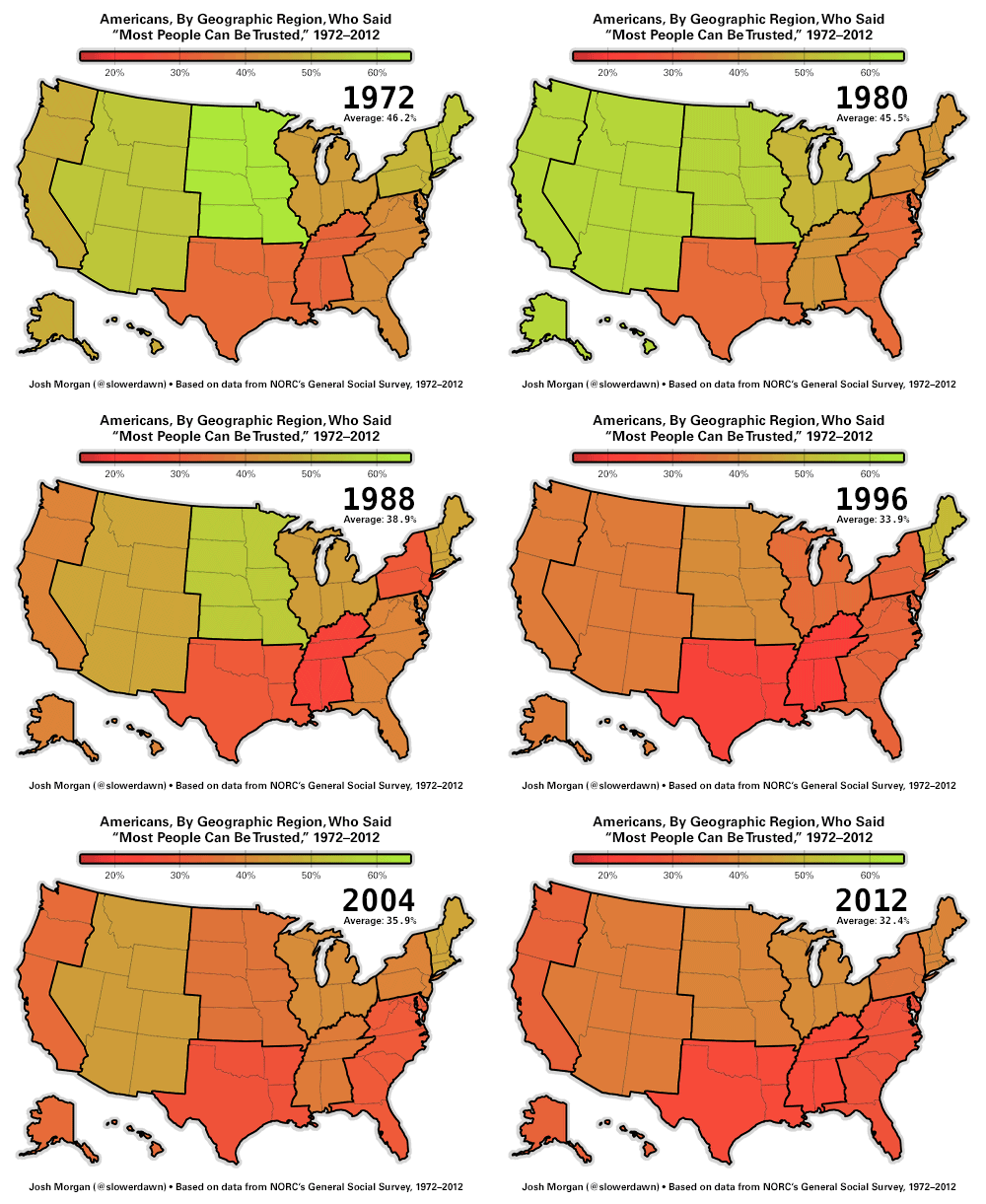
The classic example of the later are the politicians who rant “if only these people would get married and stay married, they wouldn’t be so poor” and neglect to consider that impoverished communities create the conditions for rampant single motherhood. The desire to raise children does not magically vanish merely because there are exactly zero worthwhile men in your community that aren’t your father’s age.
(1) If you lose trust in someone, you'll be less likely to try to find truth in their statements. Finding truth in someone's statements requires time and attention, and we'll invest that attention in people we trust.
(2) If you find falsehoods in their statements, you will lose trust in them.
Overall in Psychology, trust is a primary indicator of a relationship, marriage, partnership, or organization succeeding or falling apart. It's both a symptom and a cause of all other factors.
This trust is greatly eroded by calls to eliminate direct taxes on land holders. In America the local property tax is the most important thing holding society together. It provides residents with assurances that regardless of how corrupt the public process for distributing legal tender becomes, that the richest cannot simply buy the entire country and turn the continent into a private estate which their descendants will inherit in perpetuity without paying enormous taxes to everyone else.
When James Madison organized the assessment of property taxes at the national level during his presidency it resulted in the 'Era of Good Feelings' and a relative low point of political polarization. In contrast when state governments introduced sales taxes for the first time to reduce property taxes it prolonged the Great Depression, and when NYC gave the largest property tax abatements in the country to Donald Trump it lead to the Trump presidency which increased political polarization.
More specifically, it's the perception of a breakdown that drives this behavior.
When it comes to cheating, there's a growing perception that "everyone else is doing it" and therefore it's not wrong to play the same games as everyone else.
The current political and social media discourse revolves around ideas that "the system is rigged" combined with a die-hard notion that anyone who disagrees with you is wrong and/or evil. When people are bombarded with these ideas every day on their social media feeds, cheating a little bit to get yourself ahead doesn't feel like cheating. It just feels like leveling the playing field.
Depends on how you define "lose". And also on what you think the "rules" are.
For example: most drivers in the US routinely exceed the posted speed limit on roads. Is that "violating the rules"? In a legal sense, it is, since if a cop catches you he can give you a ticket and you pay a ifne and points go on your driving record. But nobody considers you a bad person for doing it, and I would argue that doing it, if you don't cause an accident, is not harming anyone. However, obeying the speed limit is also not considered a bad thing; all it really means is you get where you're going a bit slower. The tradeoff is yours to make; you don't "lose" by choosing to obey the posted rule.
Now consider an example at the other end of the spectrum: all of the shenanigans with mortgages and the financial system that caused the crash of 2008. Those who "followed the rules" leading up to the crash--for example, those, like my wife and me, who limited our mortgage and the size of house we bought to what we could comfortably afford--did not "lose". Sure, the value of our home went down, but we had no need to sell it then. It was still a house and we could still live in it just fine. Sure, we didn't have a bigger house with more bells and whistles, but we also didn't have to worry about what might happen if the housing market crashed. In other words, we made a tradeoff not much different from the one made by the person who obeys the speed limit and just gets where they're going a bit slower--but still gets there.
america has urbanized rapidly in the last half century, at the same time that family formation has broken down and life-long jobs have become a thing of the past. we are atomized and thrust into constant competition. i don't mean to idealize a past that i did not even experience, but there is something to be said for having roots and knowing your neighbors. we arguably have more opportunity at the cost of stable identity -- reputation and trust naturally accrete around the kind of stability we lack.
if you talk to older people, people around my grandparents' age or thereabouts, you will hear that they no longer recognize america, that it is fundamentally different than the culture they grew up in, in terms of values. i find myself thinking about this a lot.
I think knowing your neighbors is overvalued. My evidence is Tokyo and living in transient, largely ethnically homogenous sharehouses — in ethnically homogenous areas — for long periods of time.
In the old days you had to know your place. WASPs smoked cigars and ran things. Those old guys drinking sherry and wearing tweed helped each other out. The Irish were cops, Italians firemen.
In tech it’s pretty obvious to see various constituencies doing dishonest shit help others out.
From the outside this degradation of values and "social lawlessness" has been apparent for years now, especially since 2016.. Really hope this doesn't spill over.
Oh, and good lucking mending this.
Anecdotally, I've heard stories about Zuckerberg confessing/bragging about all sorts of nasty things at these dinners.
Really, this stuff should just be shamed. Sadly, too often calling out bad behavior just gets you called a "hater"...
This coworker told me he and his "startup":
- routinely lied to potential customers on the size of their client list
- misled clients on the depth and completeness of their product
- blatantly broke CA laws to cut cost corners
All of this was done to secure contracts in order to secure more funding. "Always be selling", he said.
He literally fucking said to me that he learned to "be dubious, not deceitful" which is probably one of the most deceitful things I've ever heard.
Made me sick to my stomach and pretty much validated (1) why I never moved to SF in the first place, instead moved to NYC and (2) how much of a fraud YC has become. Absolute fucking madness.
https://en.wikipedia.org/wiki/Joseph_Tainter
Quoting from the book:
“Sociopolitical organizations constantly encounter problems that require increased investment merely to preserve the status quo. This investment comes in such forms as increasing size of bureaucracies, increasing specialization of bureaucracies, cumulative organizational solutions, increasing costs of legitimizing activities, and increasing costs of internal control and external defense. All of these must be borne by levying greater costs on the support population, often to no increased advantage. As the number and costliness of organizational investments increases, the proportion of a society's budget available for investment in future economic growth must decline.”
It's up to you and me. Nobody else is coming to save us.
One way we can make the world better is by fixing the rules. Getting rid of ones that are unjust, and making the rest more consistent.
I once saw sign on a street: do not do something (do not remember what) and reference to a City Bylaw numbered as 37 thousand and something. That is just for one city. Good luck changing this sheer insanity.
And I think it is. At this quantity the quality will definitely suffer. Besides, I did read some bylaws at some point out of curiosity and without going into details many of them are outright unjust/deficient/etc (in my opinion of course)
The question of course is, peoples interpretations of which laws are just and unjust are subject to bias and individual incentives.
Incidentally, while I recognize thr popularity of this quote, its fairly ridiculous taken literally for laws which are prohibitory rather than obligatory.
Viewing a prohibition as unjust does not obligate me to violate the prohibition; believing people should be free from government constraint to do something doesn’t require me to do that thing.
“Disregard” or “discount” in place of “disobey” would be more generally valid.
So outlawing theft, rape, fraud, kidnapping, false imprisonment, etc. - that's all unjust?
Having 'hustle' is actually important at a startup, it's part of the essential aspect of it. I'd argue a 'hacker' has a kind of hustle.
I'm pretty suspicious of these things as well, but I've also come to believe in my many years that a bit of koolaid is fine as long as it has self awareness.
I wish Elon would stop posting all the stupid things he does, but I think that's what you get with 'all the other stuff'.
If Elon were fully polite, conscientious, a 'good listener' I'm not sure Tesla would exist. So we pay for the existence of Tesla by accepting that he's going to do dumb tweets about Crytocoins.
I think that's a BS excuse for bad behavior. How would being polite and concientious harm Tesla? It's simply that he has power and has low standards for his behavior.
I know plenty of successful people who do what Musk fails to do.
Except you don't know any successful people who've remotely done what he's done either.
Talking about 'Dogecoin' is a little unseemly, but it's nowhere in the realm of 'toxic' or 'bad acting'
Without massive public support and sympathy, Telsa wouldn't exist, it's a movement as much as anything, and so you need kind of a showman.
His appearances on SNL etc. are part of that public drama that keeps Tesla stock going with enough support to keep the legitimacy of the dream alive.
I'm seriously doubtful that a quiet, unassuming person would have been able to do most of that.
Expressive, bombastic characters will by virtue of the volume of their actions, sometimes creep up to the line. It's normal. There's nothing wrong with Elon, he's just a little cheezy and spouts too hard with some things.
You are absolutely right that trust and reliability are very valuable. Societies with high trust tend to be richer and much more productive than societies overriden by cheating and corruption.
Like the anecdote that he leased a new car every month so he could avoid registering it with the state.
This almost necessitates some cheating to survive and the only people left are those who survived this system and hence the culture slowly rots.
(I'm trying to respect the HN tradition/guideline of not talking about votes. I don't really care about Internet points; I think the implied interest in the issue is worthwhile and applicable in this case.)
I'm not sure that you intended it this way, but this reads as very oblique (i.e., "wink and nudge"). Which subculture are you referring to, and what particular relationship do you think they have to research in Computer Science?
I am referring to no particular subculture. Lots of people around me embrace it, including from all over the political spectrum (if that's what you are thinking).
I think the broader society sets the norms for computer science, as with everything else. For example, when star athletes like Barry Bonds, or entire teams like the Houston Astros, or much of college sports, cheat with few reprocussions (and in the past, that wasn't the case - players were banned and school sports programs were basically shut down, etc.) that affects computer science research.
Getting a divorce court judge to force you to sell your Enron shares at the top, nuking the regulator’s ability to charge you with insider trading, while you elope with your younger hotter high libido stripper nymph to the mountain you bought?
These are our role models
Both “Athens and Jerusalem” are principled according to honest toil. And look at the results!
Basically if all it takes is getting citations, then forming a citation ring is "Chabuduo" and you'll only lose face if you are caught (not good enough).
[1] https://news.ycombinator.com/item?id=27052249. This reminds me of the Japanese buzzword bingo of earlier decades.
Arguably, it's the opposite. Once people realized academics could do this kind of cool shit, they got showered with money and told to do whatever the they want. That's how we got the incredible scientific and engineering advances of the second half of 20th century.
Then the beancounters started asking questions about what the money actually buys, and research quickly turned into another short-term, self-contained, profit-chasing game, starved for resources and only occasionally producing something actually useful.
As it is, if our researchers are spending almost all their time thinking about and doing things other than research, what do we expect?
On a tangent, software industry has a bit of similar problem, with the best developers being forced to enter management roles[0] instead of solving technical problems. That is, a developer progresses from doing shoddy work to doing mediocre work and then, just as they start doing high-quality work, they get told to manage a new cohort of juniors doing shoddy work instead. I wonder if that's why so much software is hot garbage these days.
--
[0] - Whether proper ones on management path, or "fake" ones like principal developer, where you get all the managerial responsibilities with none of the authority.
Thaaaaannnkkk you. It has technically been reserved for Christian Aristocracy, which is practically a world where there is no desperation for calories. Instead many of the greats had an anxiety of their immortality (see Fourier).
Why should it be possible at all to game Journals in this way? Particularly in Computer Science journals where people think about edge cases for a living...
Absolutely. I think people are intimidated, demoralized (de-moralized) and where once they believed anything was possible, any social problem could be solved (even those old as history, such as women's rights, human rights, etc.), now they've somehow drunk the wrong Kool Aid, some stuff distributed by Jim Jones.
Time to get to work.
Those systems that can be built to be resistant to greed would definitely benefit from it - but I think it's more of an issue with society at large.
(The redeem/blueteam thing is kinda unethical, so maybe the University of Minnesota should do it...)
It has predictable results. Where are we going to get reliable research, and anything else, if we can't trust each other. Trust is an incredible business tool - highly efficient when you can take risks, be vulnerable, and don't have worry about the other person. Trust is an incredible tool for personal relationships, for the same reasons, and because if you can't trust them and can't be vulnerable, you have a very limited relationship.