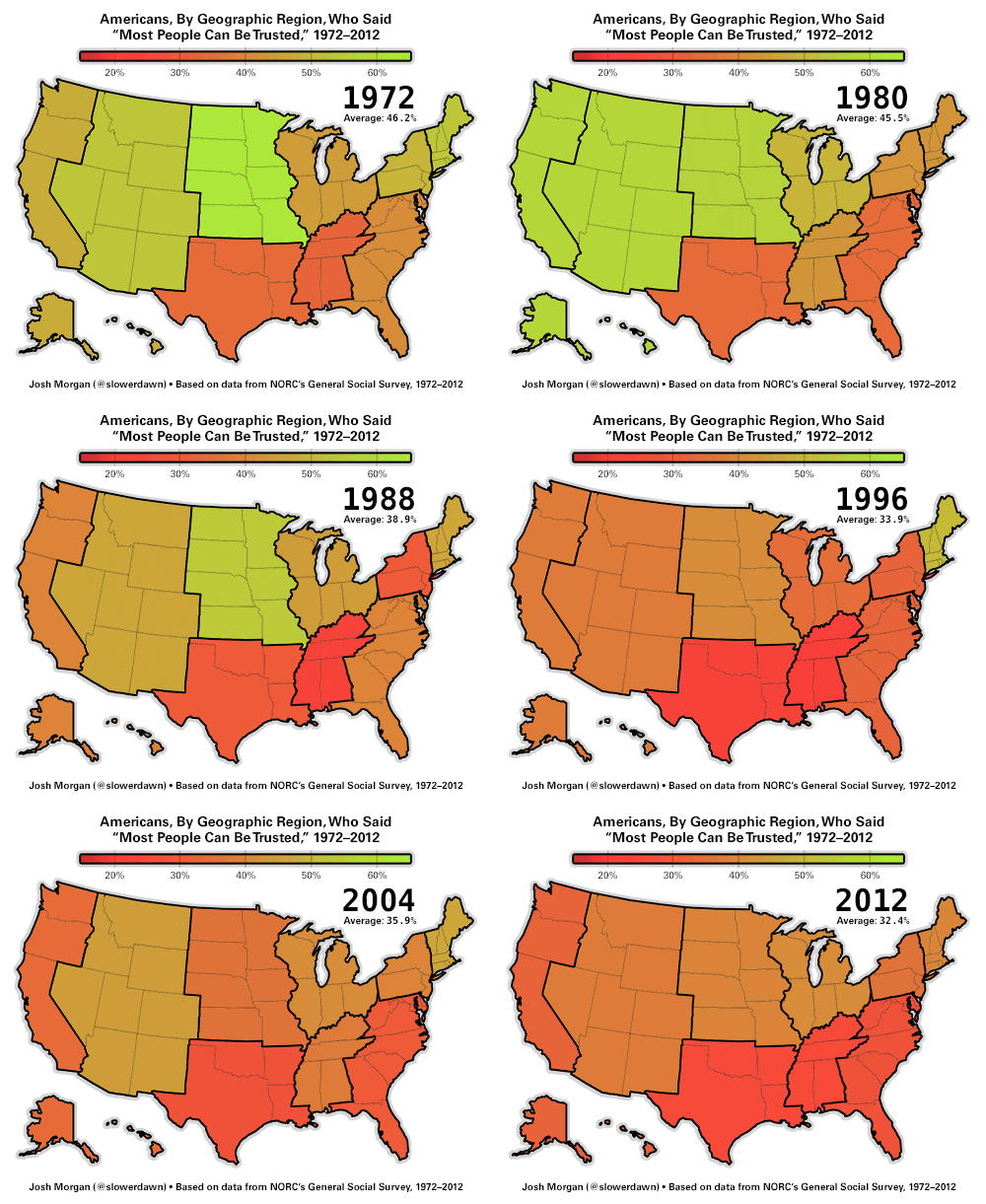
This animated gif makes it clear: https://invisible.college/reputation/declining-trust.gif
The classic example of the later are the politicians who rant “if only these people would get married and stay married, they wouldn’t be so poor” and neglect to consider that impoverished communities create the conditions for rampant single motherhood. The desire to raise children does not magically vanish merely because there are exactly zero worthwhile men in your community that aren’t your father’s age.
(1) If you lose trust in someone, you'll be less likely to try to find truth in their statements. Finding truth in someone's statements requires time and attention, and we'll invest that attention in people we trust.
(2) If you find falsehoods in their statements, you will lose trust in them.
Overall in Psychology, trust is a primary indicator of a relationship, marriage, partnership, or organization succeeding or falling apart. It's both a symptom and a cause of all other factors.
This trust is greatly eroded by calls to eliminate direct taxes on land holders. In America the local property tax is the most important thing holding society together. It provides residents with assurances that regardless of how corrupt the public process for distributing legal tender becomes, that the richest cannot simply buy the entire country and turn the continent into a private estate which their descendants will inherit in perpetuity without paying enormous taxes to everyone else.
When James Madison organized the assessment of property taxes at the national level during his presidency it resulted in the 'Era of Good Feelings' and a relative low point of political polarization. In contrast when state governments introduced sales taxes for the first time to reduce property taxes it prolonged the Great Depression, and when NYC gave the largest property tax abatements in the country to Donald Trump it lead to the Trump presidency which increased political polarization.
More specifically, it's the perception of a breakdown that drives this behavior.
When it comes to cheating, there's a growing perception that "everyone else is doing it" and therefore it's not wrong to play the same games as everyone else.
The current political and social media discourse revolves around ideas that "the system is rigged" combined with a die-hard notion that anyone who disagrees with you is wrong and/or evil. When people are bombarded with these ideas every day on their social media feeds, cheating a little bit to get yourself ahead doesn't feel like cheating. It just feels like leveling the playing field.
Depends on how you define "lose". And also on what you think the "rules" are.
For example: most drivers in the US routinely exceed the posted speed limit on roads. Is that "violating the rules"? In a legal sense, it is, since if a cop catches you he can give you a ticket and you pay a ifne and points go on your driving record. But nobody considers you a bad person for doing it, and I would argue that doing it, if you don't cause an accident, is not harming anyone. However, obeying the speed limit is also not considered a bad thing; all it really means is you get where you're going a bit slower. The tradeoff is yours to make; you don't "lose" by choosing to obey the posted rule.
Now consider an example at the other end of the spectrum: all of the shenanigans with mortgages and the financial system that caused the crash of 2008. Those who "followed the rules" leading up to the crash--for example, those, like my wife and me, who limited our mortgage and the size of house we bought to what we could comfortably afford--did not "lose". Sure, the value of our home went down, but we had no need to sell it then. It was still a house and we could still live in it just fine. Sure, we didn't have a bigger house with more bells and whistles, but we also didn't have to worry about what might happen if the housing market crashed. In other words, we made a tradeoff not much different from the one made by the person who obeys the speed limit and just gets where they're going a bit slower--but still gets there.
america has urbanized rapidly in the last half century, at the same time that family formation has broken down and life-long jobs have become a thing of the past. we are atomized and thrust into constant competition. i don't mean to idealize a past that i did not even experience, but there is something to be said for having roots and knowing your neighbors. we arguably have more opportunity at the cost of stable identity -- reputation and trust naturally accrete around the kind of stability we lack.
if you talk to older people, people around my grandparents' age or thereabouts, you will hear that they no longer recognize america, that it is fundamentally different than the culture they grew up in, in terms of values. i find myself thinking about this a lot.
I think knowing your neighbors is overvalued. My evidence is Tokyo and living in transient, largely ethnically homogenous sharehouses — in ethnically homogenous areas — for long periods of time.
In the old days you had to know your place. WASPs smoked cigars and ran things. Those old guys drinking sherry and wearing tweed helped each other out. The Irish were cops, Italians firemen.
In tech it’s pretty obvious to see various constituencies doing dishonest shit help others out.
From the outside this degradation of values and "social lawlessness" has been apparent for years now, especially since 2016.. Really hope this doesn't spill over.
Oh, and good lucking mending this.
We used to have strong institutions that were supposed to help push groups into not choosing the bad corner of the prisoners dilemma, but they all seemed to have degraded. I suppose they could have always been like this and the curtain has just been removed, but I’d argue that the perception that following the rules was the best personal choice is almost as valuable as it being true