But that's what makes this country so great. We take our divisions, within cantons, and leverage them for positive externalities to (accidentally) benefit the greater good.
In CH, every very canton sets their own citizenship policy. Its not a coincidence. Did you hear about the woman that's been living in Zug, and been denied citizenship for years? Why? Because she's annoying. She doesn't respect her neighbor's customs. That's literally why. Yes! Our canton can't even agree between about who can be a citizen, and who may not! But we argue far more... and it won't make the papers. We argue about the standard size of doors, whether we can vote electronically, whether a free trade agreement with andorra should be allowed. Etc etc
This means, big project ambitions get cut down to size, and few grand things if any, get done at the federal level. But this is glorious: it is very hard for regulations to become calcified within the state apparatus.
So, while spain sends soldiers to die in Afghanistan, or the UK wastes decades of development on a grand EU project, or US citizens get spied on by their own govt via Patriot Act.... CH is just sitting pretty, doing its thing. Arguing about every little detail to exhaustion.
The best thing that could happen to us, is to remain just as we are. I welcome the next 800 years of peace and economic development.
And yet, Switzerland's nationalised train network is one of the most extensive and effective in the world.
How did that happen?
> How did that happen?
Two hypothesis:
a) The railroad net in Switzerland is fairly small when compared to Germany.
b) The numbers in the punctuality statistics are skewed. For example, once a train from Germany is late and wants to cross the border to Switzerland (e.g. Freiburg-Basel crossing), it is put on hold and has to wait until it falls into the next swiss train slot, entering Switzerland "on time". In Germany, this would be counted as a delay.
Source: Lived in Switzerland for a while.
>While European rail operators such as French SNCF and Spanish Renfe have emphasised the building of high-speed rail, SBB has invested in the reliability and quality of service of its conventional rail network.
As a Brit I'd probably prefer that to £100bn on HS2 and god knows what on the proposed Boris Burrow.
The good thing that came out from it is that I realized that even Switzerland's central bank cannot be trusted, and moved to Bitcoin. I never looked back.
So in summary - The country can only do so much before the big guns aimed at it take their pound of flesh.
I am not sure the central bank is faultless in the example you cite, however, appreciate that we live in a world where other powerful people are not interested in the well being of swiss banking customers.
At the same time I was used to the trains and trams being precise by the second in Zurich (I loved taking the train to work every day), and everything being predictable, that’s why it was a wake-up call for me.
Switzerland can afford to do this because it's surrounded by countries that protect it from the real world. It doesn't have a real foreign policy because it doesn't have to.
>The best thing that could happen to us, is to remain just as we are. I welcome the next 800 years of peace and economic development.
That's not up to you. As I've said earlier, you're lucky to be surrounded by countries with bigger fish to fry as long as Switzerland toes the line.
They remain independent because they are a mountainous country that set its defenses up cleverly so that any invasion would be a pyrrhic victory at best.
Nazi Germany did not invade Switzerland, because Switzerland was actually more useful as a neutral state for Nazi Germany to exchange gold for commodities, for spying and Switzerland produced militiary equipment for Nazi Germany anyway.
Switzerland didn't end up getting divided between Germany and Italy thanks to the Red Army hurtling more humans west than the Wehrmacht could supply bullets east. Swiss munitions production wouldn't be risked.
"In 1991 following a decision by the Federal Supreme Court of Switzerland, Appenzell Innerrhoden (AI) became the last Swiss canton to grant women the vote on local issues."
Notice how it was a court decision, not a result of the political process. I'd say 1991 is a bit too late to have full voting rights for women.
https://en.wikipedia.org/wiki/Women%27s_suffrage_in_Switzerl...
Google returned zero results– did you misspell it? Google usually can't find documents for misspelled rare words
What I admire about the Swiss is how they live and let live - they may disagree with the neighbour, but let them be.
Please.
The idea you’re dismissing is that of allowing small groups of people rule themselves which does mean some will use unconventional ways they consider best. Note that the Apenzellers didn’t hinder anyone who disagreed to leave or refuse to trade with them. They also didn’t force their way onto others.
Switzerland was once just a bunch of small independent nations in a military alliance, which allowed them decentralisation and having multiple competing systems, without everyone having to do it one way. If you have that, you must agree that your neighbour may live in a way you disagree with - but in exchange they will let you live in a way they disagree with, as I’m sure many from Apenzell think of the Züricher.
I imagine the Apenzellers argued that the job of the state is military protection. Conscription means the state forces you to give your life for it, and voting rights for conscripts means soldiers will only go to wars they collectively agree with, effectively ruling out wars of aggression. That’s how it was in my country, but I’m not familiar enough with Apenzell (except for their cheese) to talk about their history in this depth.
So I found your comment disingenuous and that's why I left a sarcastic remark, not aligned to HN rules sure, but yeah I did it. Also, if you think HN is an excellent place and not tainted, I have no words.
Edit: Grammar, wording.
HN is not perfect, but it’s far from the norm online regarding good faith rational discussion, and I’ve certainly witnessed people here accepting and learning facts and from rational arguments.
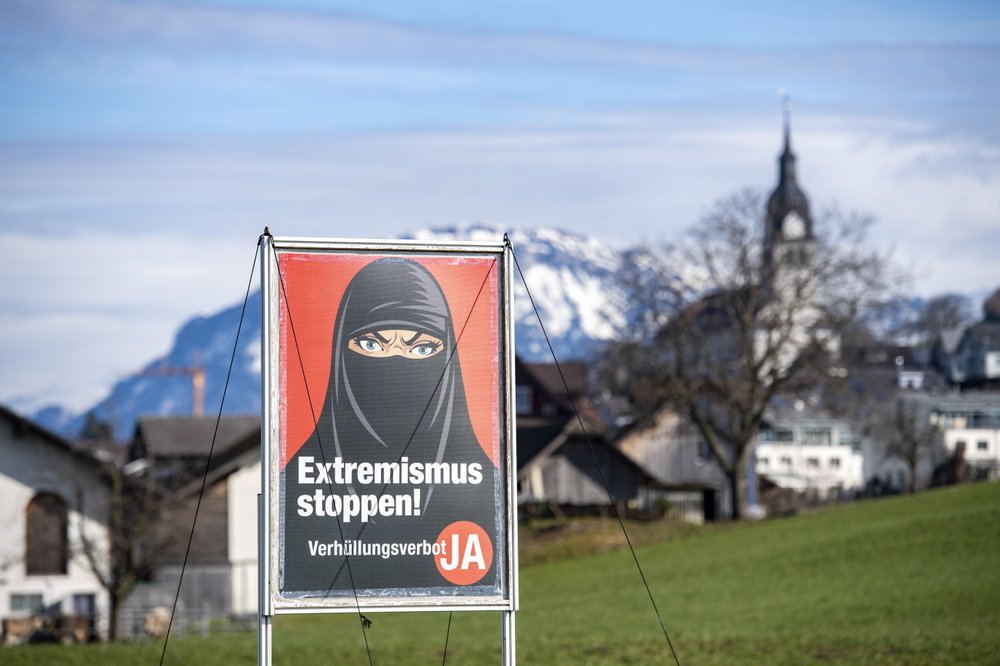
Firstly "accepting a law" implies - in western liberal democracies - a legislative process in which a law is proposed and accepted by some kind of parliament. This is not what happened here - in Switzerland, laws can be given to the population directly by non-parliamentary, non-governmental organisations in referenda, which then become binding. The law you are referring to was accepted by the general Swiss population with about 51% of the votes yesterday.
2. The law is not specifically forbidding women particularly forbidding to wear burkas. It forbids anyone to hide their faces when in public (with the exceptions of traditional customs, e.g. during carnival season). The basic idea behind this is that in a free society, we meet each others face to face. This generally good idea was abused by right-wingers to point out that this prevents visible Islamisation of an ultimately christian-conservative country, and by left-wingers to imply it was sexist and islamophobic.
3. Men and women can still wear whatever they like ... in private. In public, all societies have acceptable clothing standards. Try going out wearing nothing but three straps of leather and a gimp mask in front of a school, anywhere in the world, and see what happens.
A little tyranny of the majority is not always a bad thing.
You can read this in a positive light or a negative light. I know a guy who had that surgery done as an adult and it was incredibly painful and took a while to fully heal. I want to say it was almost a month. You could certainly argue that it's a lifetime of pain if it's done and you don't like it but that's likely a slippery slope in some regard.
I can agree that we should probably be doing a better job of explaining to parents the pros and cons of each so they make more informed, realistic choices but some of the outrage rhetoric around circumcision is a bit much.
Medical science is very clear about both male and female genital mutilation: lots of risk and potential harm, not real benefits.
And this does not grow back like nails and hair. It's not a fashion. It's literally putting a knife in your baby because some old culture prescribes it. No problem with that: just do it when the kid reaches the age of consent.
Freedom of religion may not constitutionally compete with bodily integrity (nor with freedom of expression (blasphemy)).
This is more of a tangent, but I would contest the idea that "accepting a law" implies that it is passed by a parliamentary body. This was maybe true in the 1800s, but not today when plenty of western liberal democracies have some form of direct democracy with electoral referendums on important issues. Some (e.g. California) have a system roughly comparable to Switzerland, although it's obviously at the state level in the case of CA.
Imho that was the deciding part.
If it's the latter, that's a reason for them to seek help from the authorities.
The Swiss rule their house, and let others rule theirs, and this is what I mean with living and letting live.
My point is that while the majority of Swiss cantons decided to not have gender restrictions on voting, they allowed Apenzell to keep being the weird one, and in response the people of Apenzell don’t force their way onto others. If I don’t want my neighbour to tell me how to run my household, I must also not force them. Apenzell didn’t force their way into the Züricher.
Although in the end, the people of Apenzell were forced to change their way.
You and I probably agree that a 12yo should not have the right to decide what the state should do with its might, but the argument is the same regarding how the legal voting population of this tiny state of 16k citizens decide to expand who gets to vote in their local elections.
What I say is that I’m impressed by the federal government of Switzerland for allowing even such a tiny group such self determination to select who can vote in local elections - until the UN forced them to conform in 1991 that is. I think this is why they don’t have civil wars when they disagree - they instead let others do their thing and the cantons run their competing systems simultaneously.
Regarding your question whether I would think it was ok to have a Swiss canton where local government was ran by one person, it’d be ridiculous but I would not think it’s right to use force to stop it, unless that local government hindered anyone from leaving. This is at least, as you have identified, the logical conclusion of the argument I am making, and the Swiss did until 1991. In reality no single person would likely run it well, and it would end up an economic disaster, and sooner or later change. Instead of coercion letting a hundred seeds grow, before separating the wheat from the chaff
And if the simplest solutions to problems of governance become violence, rather than the system itself, then you have failed at the main purpose of government.
The executive council is elected by the parliament and also contains candidates that haven't been member of that parliament. This election takes part "seat by seat", so every member has to be explicitly re-elected.
Since it's not done by popular vote, political games in that process are rare or just not excessive. The people trust the parliament with the process of electing their leaders, you better shouldn't fail them. So they mostly elect according to the current concordance.
> Until 1999, the Constitution mandated that no canton could have more than one representative on the Federal Council. Until 1987, the place of origin was used to determine which canton a Federal Councilor was from. After 1987, the place of residence (or, for councilors who were previously members of the Federal Assembly or of a Canton's legislative or executive body, the canton from which they were elected) became the determinant factor. Nothing prevented candidates from moving to politically expedient cantons, though, and the rule was abandoned in 1999. Since then, the Constitution has mandated an equitable distribution of seats among the cantons and language regions of the country, without setting concrete quotas. Whenever a member resigns, he/she is generally replaced by someone who is not only from the same party, but also the same language region. In 2006, however, Joseph Deiss, a French Swiss, resigned and was succeeded by Doris Leuthard, a German-speaking Swiss, and in 2016, Eveline Widmer-Schlumpf, German-speaking, was succeeded by Guy Parmelin, a French Swiss.
https://apnews.com/article/health-legislation-coronavirus-pa...
I am not responding to your expression of opinion - just clarifying how the Swiss electoral system is structured.
That vote was a referendum, which is another component of the Swiss system, separate and complimentary to the Executive Council.
Populist ideas, can easily thrive in a direct democracy.
Every country has some clothing requirements. Some mandate headscarfs (for women only), some mandate the face remains visible. No laws were needed for this in Swiss because no people were covering up. But now this has changed, so laws come. I dont find any problem with it, and hope that the "custom" of genital mutilation done to children is next to be forbidden. You can still do it, at 18, but yr parents should not be able to decide for you. Not against jews/muslims, just in favor of childrens rights. Scandinavia is front running on this one.
A few dozen women in a country of 8.5 million do not need a law, especially one that doesn't really do anything for the victims, see https://news.ycombinator.com/item?id=26380029
(I'm a woman. I've had a college class in Women's History. FWIW.)
Which totally misses the point. You shouldn't have been importing burqua if women were already were allowed to go outside without it.
Additionally, one way to spread religion is to be tolerant of the existing culture of the people you are hoping to spread the religion to. This is Christianity is associated with a lot of holidays that have seemingly inane and random traditions, such as Easter and Easter Bunnies and hiding Easter eggs.
What on earth do bunnies and hiding eggs have to do with each other, much less the risen Christ? Not much, but it's some pagan set of traditions that got tolerated by the Christian church and that's how you have bunnies and hidden eggs all wrapped up with the risen Christ.
It's kinda sad that so many supported this and I'm happy that this wide ban would (probably...) be unconstitutional in Germany.
I don't even know how you get the leftists in there but at this point I'm too afraid to ask...
But your solution is to implement a law which punishes the victim, rather then doing anything about their presumed victimizer.
If the women who didn't want to wear the covering didn't want to wear it, what is stopping them from simply not doing it to start with? The answer of course is husband's, brothers, family etc. and probably that they'd be recognized in their community.
But this is someone's religion - a fair bit more important to them then the laws of the state in a lot of cases. So you haven't answered how you're going to protect those women from being targeted and forced to simply never leave the house, if they are being targeted by people who are forcing them to do something they don't want to.
Your law offers no solution to this - and again - implements itself by targeting the apparent victims it proposes to protect with punishment.
Setting aside that the government can stay the hell out of what I choose to wear, this is just a monumentally stupid approach to anything.
To do so creates conflict where there should be none, which is against the very purpose of a state.
At minimum, show the non-religious benefits of doing (or not doing) a thing and why it is relevant for the individual. Don’t punish the victim for doing the thing; if someone must be punished, make it the person imposing the action.
That's only slightly better than getting a fine. If gov would run a ad campaign / school program with "making women wear burka is bad" then the victims would still be the ones to suffer because it's still directed at the way of life as they know it.
This is about swiss nationality and customs. Not about women's rights.
Just like you don't go to your greek neighbor's dinner party wearing a turkish flag, there are things you don't do when you are the guest at someone else's party.
The burka represents a lot of very nasty things, in countries that the overwhelming majority (60%) believe 911 was totally OK and beheading or stoning minorities is OK.
The fact is, you don't frown on people because they are spitting on some ideal of freedom. You frown of them because they don't get the basic rules of decency.
My house. My rules.
There are countries in Europe that are majority Muslim (Bosnia, Kosovo, Albania) where nobody thinks that, and where any kind of face cover is totally up to the choice. Turkey isn't that extreme either. Neither is Indonesia, Bangladesh, Nigeria, etc etc.
Why don't people ever think of those and jump straight to the Middle East? There are just as many Muslims living in India as there are in the Middle East.
Have you ever been to the beach? Have you noticed that in many western countries, all the men have bare chests and all the women are covering their breasts? Does this custom limit women's rights? Providing that women have the same legal right as men to go bare chested, as far as I can tell no rights are being infringed.
But maybe you disagree, do you think a law banning the wearing of bikinis by women would be a victory for women's rights?
The 7 member Executive Council is composed of the top 7 candidates from each election. The chairperson of the executive council rotates each year, so that the top 4 vote winners each get a turn at being chairperson.
This means that different social and political priorities get implemented in turn. It also means the way the government works is more cooperative, because each council member, including the chairperson, knows there will be a new chairperson next year.
So, if a pro-business candidate places 1st, and an environment candidate 2nd, and a social welfare candidate 3rd, and a libertarian candidate 4th, it is in all their interests to cooperate and create legislation that serves all of their interests as much as possible. Instead of disregarding the environment, the pro-business council member is encouraged to develop green business initiatives that will be supported for the full 4 year term under the different chairs.
The system creates a leadership team that looks for win-win, rather than a sole victor who can abuse majority rule.
[1]. https://en.wikipedia.org/wiki/Federal_Council_(Switzerland)