The CARES act allocated most of the money to individuals, state and local governments, public health, and education initiatives.
The amount given to large corporations (much in the form of loans that will be paid back) is less than that given to individuals:
NPR has a good breakdown. The idea that corporations are receiving “trillions” in cash payments is a myth. https://www.npr.org/2020/03/26/821457551/whats-inside-the-se... I fully agree that the allocation and lack of oversight around the funds to corporations is not good, but it’s incorrect to suggest that trillions are going to corporations or that more money is going to corporations than individuals under this bill.
Furthermore, you can’t compare loans and measures like quantitative easing to cash payments like that. Giving someone a cash payment and giving a loan to a business have very different actual costs in the long-run, obviously.
The CARES act is a good attempt at providing fair outcomes for everyone, but that is just one of the things the fed is funding. Take a look at their balance sheet from their own website: it went up over 2 trillion in the blink of an eye and they are not done yet: https://www.federalreserve.gov/monetarypolicy/bst_recenttren...
There are winners and losers in what is going on now, and corporate America is without doubt the biggest winner. By proxy, the wealthiest Americans that are the biggest owners of the financial assets the fed is supporting are also the biggest winners. Since we are accomplishing all this by printing money, those that don't win lose even more because their dollars are worth less. The long-term result on the current course will be even greater wealth disparity between the rich and the poor.
You might have noticed many people complaining about this wealth disparity during the recent economic recovery in which the fed has added almost 4 trillion dollars to their balance sheet (again see the fed's chart).
These wealth gaps historically lead to populism, which gets us our current president.
[0]: https://www.federalreserve.gov/releases/h41/current/h41.htm
In June they just committed to deploying an additional $250 billion https://www.wsj.com/articles/fed-will-amass-corporate-bond-p...
Add this to the existing billions of debt already purchased and we could easily be at half a trillion dollars of independent fed action to buy corporate debt in a short time frame.
The CARES act also reduced corporate taxes by 210 billion. So There is at least half a trillion dollars not mentioned in articles like the one from NPR.
The CARES act separately authorized 500 billion just to the largest corporations in America. Some of the additional hundreds of billions deployed to "small" businesses is really to large companies as well.
It would be great to get a detailed breakdown of what the fed is doing, I am certainly not doing it justice in my description.
Unemployment is money given away to another. It's a permanent giveaway.
A debt purchase is either money that was given to you, that you're now returning (Treasury securities) or money that you're giving to others which will be returned (corporate bonds). It's not a giveaway at all - the net exchange is $0.
These cannot be compared as equivalent.
The tax reduction changes the way loss is calculated to better capture the reality of the economy falling apart in one year, letting losses be deducted from income generated in past years. There's a tax savings, but it's reflective of real loss incurred by business.
The corporate tax reduction is equivalent to a handout since it won't be paid back. As is the paycheck protection program.
I agree that debt is not a 100% handout, but it is definitely not a 0% either. The fed is not that worried about qualifying its purchases and some of these companies will still go bankrupt: those cases may be 100% handouts. The debt is being purchased at above market rates and inflating prices for the asset so that's still a noticeable percentage of handout for the loans that get repaid.
But I wouldn't assume that corporate debt will ever truly get repaid until I see the fed balance sheet go down. They tried to unload just a little bit last year and the stock market went down so they stopped. We now have 1.9 trillion in mortgage backed securities even though the housing crisis is over and housing prices are back to the levels of the prior bubble.
The tax change isn't a reduction per se, it's a change in the way we account for losses across multiple years. It's also very new -- it's removing a new carryover rule that was added in 2017. I think it's also disingenuous to frame this as a reduction as the losses would be carried forward anyway. It is, like most of the other "corporate handouts," more of a shift in when the money is paid rather than a change in the amount.
Thanks for the correction on the corporate tax reduction.
Purely from the financial side, another way of looking at this is: if bail outs were really net positive then the private sector would handle it. If the government has to handle it, it is a bail out. Governments almost always lose money on bail outs. Sometimes, like the last one, it is falsely claimed that the government made a profit. It probably lost money [1] and we still have 1.9 trillion mortgage backed securities on the fed's books that are unaccounted for in such claims.
I agree that these things are not a 100% handout, but they are most definitely a bail out.
[1] http://gcfp.mit.edu/wp-content/uploads/2019/02/BailoutsV12.p...
Historically, looking back at 2008-2009, purchases of corporate debt by the government either turned a profit or lost very little money. The 'bailouts' had aggressive terms and were repaid.
If it does turn into a subsidy, the correct measurement is the difference between what the government pays today and what they sell it for later, or, if it defaults, the bankruptcy settlement value (which in the case of collateralized loans is rarely zero). Not the dollar amount of bonds purchased or money lent.
This year, purchasing of corporate bonds has been focused on investment grade debt. It is unlikely they will experience any significant loss on this.
Yet our current president is presiding over exactly what you’re describing.
Also, as the other commenter explained, there are several problems with your understanding of the Fed’s operations and what they mean in terms of long-term budget. It’s not correct to compare cash payments to individuals with counter-cyclical quantitative easing.
My lay understanding is that if you recycle your debt at 3%, and now you can recycle it at 1%, that is a 2% "bailout". You quite literally have a lower cost of funds (cost of doing business), and it is artificially low due to government intervention.
It becomes an invalid comparison when you compare nominal values without making the appropriate cost adjustment (multiplying the loan by 2% in this hypothetical).
We should also note that some of the companies will go bankrupt and the fed is doing little to qualify its loans. So it is not really a loan in the traditional sense (it is a low interest rate loaned handout).
Combining these two together, we have the potential to create a situation like Japan where the government is constantly managing the debt of some of the private sector. The cost on society for this can be much higher than the difference on interest rates shows.
The true cost is almost certainly somewhere between 2% and 100%.
This just in! The Fed will allow schools and hospitals to use its $1.5T repo line, letting any school with $1B in Treasuries temporarily exchange them for $1B cash for 3 months. "We have no idea why you wanted this," said a confused Fed. "Are you sure you know what we do?"
[0] https://mobile.twitter.com/ESYudkowsky/status/12388153445353...
Much of the $377b in Small Business PPP money actually went to large corporations like Shake Shack, Ruth's Chris, Kura Sushi. And of the $2.3t, only about 1/4 went to individuals, so it's a bit misleading to paint the picture as if individuals got the lions share here.
Also there are additional benefits to large corporations not reflected in that $500b figure such as $210b in loosened tax deductions for interest and operating losses. https://www.reuters.com/article/us-health-coronavirus-usa-bi...
Some were more clever in how they got the money:
I want to stress this because many are missing it.
- Money to people = cash gift or grant.
- Money to companies = loan.
Companies have to pay it back, with interest. This also happened during the recession and the US made a hefty profit from it.
I often run into people that think that companies received these loans as grants. This of course makes for a lot of confusing discussions because two people are operating with completely different mental models.
hoo boy.
Individuals will never have political power like a billion dollar corporation.
If you can rise up the ranks, you get some of this power.
Sure it's a moonshot, but how many self made people make billion dollar companies? You could count them.
I think I'm going to pick a major fortune 500 and leach off it. Even if I hang around there for 30 years, I get profits and tax payers will subsidize the losses.
And while you might have job security, that can be tenuous as well. Really just depends on how savvy you are at promoting yourself and managing up.
Having a baby was otherwise so expensive we weren’t sure we could afford it.
https://www.verywellfamily.com/how-much-does-ivf-cost-196021....
The drugs are separate, but I think we paid around $5K for them.
Now if you're unlucky, you might have to go through multiple cycles, but our specialist only charged us the base cost. We had to pay for the additional drugs however.
Stimulus payments are gifts, and the government loses money on them.
To be clear, the stimulus payments are essential for helping people and are a great thing for the wider economy. But you can't compare them dollar-for-dollar, as they are not like each other.
[1] https://www.federalreserve.gov/monetarypolicy/bst_recenttren...
People who are angry seldom take the time to understand how finance works.
I guess you could argue that we're making money, but that's only because we get to print money to buy these for free and de-value everyone else's dollars.
https://www.rollingstone.com/politics/politics-features/2008...
https://projects.propublica.org/bailout/
The government handed out $634B.
The government recouped $390B + $364B = $754B.
So, $120B profit. Again, I'm not saying we should bailout corporations and ignore the little guy. The stimulus checks are critical. But you can't compare them dollar for dollar.
Is this actually the case? They have a money printer. What’s the problem with using it, as long as inflation stays low?
I mean, I suppose technically seigniorage is part of the budget but then your statement is just a statement of definitions, not an insight.
Not to say its impossible, or that we shouldn't try--we should. But when you have a bunch of senators arguing, it's easier to point to the easy numbers.

I think you said it yourself with your comment about senators arguing. The root cause is an overall lack of political will, not any technical or logistical impediments in modelling impact.
The U.S. Census, GAO, and various other bureaucratic organizations (USDR, EPA, etc), all seem to be quite competent when it comes to performing studies and gathering data.
So is the IRS, Department of Defense, etc.
Of course there are lots of problems, but the U.S. Federal Government has plenty of agencies able to competently perform some sort of study.
Clearly, the current administration puts corporate profits over the lives of Americans. Clearly, the current administration is allergic to hard work. Hopefully, Americans can send the message in November that there's no room in our government for people like that.
People realized that was idiotic? Don't celebrate that someone accidentally did something worthwhile for a terrible reason. Target your efforts at doing things that are worthwhile, not at doing things that are hard.
This
>Don't celebrate that someone accidentally did something worthwhile for a terrible reason.
Doesn't track with this.
>Target your efforts at doing things that are worthwhile, not at doing things that are hard.
I think you're missing nuance.
I say, condemn those who lazily do the easiest jobs that don't interrupt their sleep at night.
Rather, we should all be trying to make the greatest positive impact within 40 hours of work a week. Those who do more are being taken advantage of one way or a dozen. Those who do less are taking advantage.
By setting a floor and a ceiling we limit abuses on both sides and,hopefully,better distribute labor.
Also,doing things that are hard for the sheer sake of it is not idiotic. It can be a positive characteristic, just like avoiding difficulty is a negative one.
I don't think it would be especially controversial to say it was done for a terrible reason. We didn't do that specifically because it was hard; those are just words from JFK's speech. We did that because the Soviet Union had beaten us to putting a man (and a satellite) in orbit, and we thought it was crucially important to beat them to something related.
What is "terrible" about advancing science and putting humans in space?
Neither of those was a reason for the project.
Basically, it doesn't matter how quickly we re-open if people don't have any money to spend, don't feel comfortable spending, and aren't leaving their homes.
[1] https://tradingeconomics.com/united-states/unemployment-rate
Let's say the market rate for a loan like this is 4% and the government is loaning at .5%. Sure, the government has "made" .5% (less any defaults), but by any realistic understanding of what's going on, they lost 3.5%.
But don't muddy the waters by saying that they are making money on the program if they're giving below market loans. They might have good reasons to do it, but they're not making money on the deal.
The fact that a market coalesced around the asset isn't that significant because the Fed can't withdraw from the market now without watching prices for the asset collapse.
The recent airline loans/bailouts require maintaining the same staff until September 30th.[1]
I would imagine that there will be layoffs once that requirement expires.
[1] https://www.businessinsider.com/airlines-coronavirus-bailout...
"""But the challenging economic outlook means we have some tough decisions ahead as we plan for our airline, and our overall workforce, to be smaller than it is today, starting as early as October 1."""
-Oscar Munoz, Chief Executive Officer, and J. Scott Kirby, President,
https://hub.united.com/united-message-munoz-kirby-2645729257...
Serious question. I fail to see how bailing out mismanaged companies is worth more than an equivalent sum straight to people. Companies can be nationalized if they're essential. Can't raise the dead. Can't squeeze blood from a stone.
This is false as related to the PPP loans ($700B program, to put that in perspective during the 2008 financial crisis law makers passed an $800B stimulus to prevent total financial collapse). Its argued the banks paid that 2008 money back with interest (I won't touch that claim), but the PPP loans ($700B) are intended to be forgiven.
>> Because bailouts (usually) make the government money in the long run. They're in the form of low-interest loans, they aren't just handing out money to corporations.
> This is false as related to the PPP loans
GP was comparing unemployment to QE and "corporate bailouts". Forgiveness of PPP loans is contingent on keeping staff on payroll and salary levels constant. So it's very much targeted at helping main street. In this sense, the intended use of PPP loans was closer to augmenting unemployment than a corporate bailout.
To the extent that PPP loans have actually gone to small businesses, my impression is that that's mostly worked out -- it's basically unemployment without the lack of employment. To the extent that they haven't, the federal government should find a way to retroactively claw back abuse and/or exclude abusers from future rounds of assistance.
BTW, worth noting that the PPP loans aren't really a handout if they're not paid back; their interest rate of 1%. Rates of return on fixed income are super low right now.
Helps main street? Businesses just got free money from taxpayers. Sure for the forgiveness you have to spend 75% on payroll, in many instances what the amounts to is a business owner paying themselves 8 weeks of salary with taxpayer money and then that loan being forgiven. In the instance it actually goes to employees, again taxpayers basically just paid for 8 weeks of your payroll (these helps politicians by keeping unemployment numbers artificially low for 2 months, and keeping people off the temporary Covid unemployment benefits), the jury is still out if any of these employees will remain employed after 8 weeks (or we will see unemployment again be flooded with millions of applicants, only the extra $600/week won't be there).
>my impression is that that's mostly worked out
Its as much of a scam as the NINJA (no income no job applications) were leading to the financial crisis, people just formed businesses made up salaries and got a free 8 weeks of said salary (up to $100k salary). Or the fact that law makers and their families have specifically been exempt from any ethics review for conflict of interest, and in some cases law makers set up brand new companies just to obtain PPP loans.
Sorry, I don't really understand why this is a problem. The alternative would be laying those people off and paying them via unemployment anyways, right? The idea was to keep people tied to their employers and keep otherwise productive businesses in tact in order to enable a quicker recovery. Digging into today's jobs numbers confirms this was largely successful: the bounce in employment was mostly ended furloughs.
> people just formed businesses made up salaries and got a free 8 weeks of said salary
Now you're just making shit up. Businesses had to exist prior to February 15, 2020 and the amount received is computed based upon payrolls from Jan 1 to Feb 15 2020. If people are doing this, they are putting a lot of effort into intentional fraud and are 100% going to end up in jail.
If the alternative was laying people off, that is the free market at work. And there is no "keeping employee tied to their employers" as you claim, it is just free money to businesses for 8 weeks of payroll (+25% extra for non-payroll expenses like rent - so taxpayer paid rent for businesses, where is the taxpayer paid rent for taxpayers?). There is no promise or guarantee business will keep employees or even remain open beyond that 8 week period.
Finally, and most importantly, you touch on it:
>paying them via unemployment anyways, right?
Yes, this was about: 1) free money to businesses and 2) hiding the real unemployment numbers.
It was not about employees, if it was there are much better ways to go about it. At minimum law makers wouldn't have been allowed to pass the bill, create a brand new business, and obtain PPP loans for these new businesses (which would normally be prohibited, but both law makers and their family were excluded from these prohibitions against conflict of interest)
The economic shock was caused in part by a government-imposed shutdown of economic activity in response to a pandemic.
> There is no promise or guarantee business will keep employees or even remain open beyond that 8 week period.
Which is why another aid package will probably be passed in July. The initial aid package was not intended as a one-time fix. Even as the legislation was being drafted, its key sponsors were stating that a follow-up package would be required in the summer.
> At minimum law makers wouldn't have been allowed to pass the bill, create a brand new business, and obtain PPP loans for these new businesses
Again: businesses had to exist prior to February 15, 2020 and the amount received is computed based upon payrolls from Jan 1 to Feb 15 2020. If people are doing this, they are putting a lot of effort into intentional fraud and are 100% going to end up in jail.
No, the economic shock was caused by businesses being over leveraged and not having cash reserves. I keep hearing how this was the greatest economy the World has ever seen, how good could it really be if businesses are existing paycheck to paycheck?
>Which is why another aid package will probably be passed in July.
Exactly why taxpayers and not businesses should have received the lion share of the bailout funds.
>businesses had to exist prior to February 15, 2020
Look up shelf corps or ready corps. There is rampant fraud with respect to the PPP loans, including by law makers, none of them will end up in jail.
A lot of these businesses didn't have much cash reserve because they were launched by ordinary folks and operate in industries where the profit margins are razor thin. If you're running the local pub, there's simply no opportunity to build up capital reserves that can survive a several-month-long shutdown. Even cutting payroll down to a minimum, rent, utilities and minimal maintenance is expensive.
I don't think there's a reasonable argument to be made that wiping out the current owners of bars, coffeeshops, garages, gyms, etc. is going to result in more resilient or more competent locally owned businesses in the long term. I just don't buy that there's a massive amount of well-capitalized individuals ready to run bars/coffeeshops/garages/etc. better than the current owners.
That said, there is a critical mass of super well-capitalized and competent restaurant/bar/coffeeshop management machines, which can take over if all those local businesses fail.
The effect of the policy you're suggesting would be the walmartification of the last remaining outposts of local ownership in most economies.
The airline bailout was apparently complex and not all of the info seems to be public [2].
[1]: https://www.paulhastings.com/publications-items/details /?id=7b8f1b6f-2334-6428-811c-ff00004cbded
[2]: https://www.nytimes.com/2020/04/14/business/coronavirus-airl...
On the whole the fed's balance sheet actually went up by 4 trillion dollars during the 2008 recovery [1] even though the loan program was less than 1 trillion. There is a trillion dollars of mortgage backed security purchases there that are a less visible bailout. The fed has already added 2 trillion this time with more to come.
[1] https://www.federalreserve.gov/monetarypolicy/bst_recenttren...
Let me make that clear. Whenever people say "Wall St was bailed out by the taxpayers", they don't understand finance well enough to know that the taxpayers actually earned a significant PROFIT from that bailout.
...and naturally the media doesn't report on that important detail.
"socialize the losses, privatize the gains" is a slogan based on complete ignorance.
She's done research and cites evidence. You CAPITALISE basic terminology to patronise people out of wanting to challenge you.
Seriously, this is just bleating, tired banker/cronyist narrative we've always seen when the Economy blows up like in 2008; there are billions/trillions for Bankers destroying the economy but if that is re-directed to the People who have lost their jobs because of State incompetence hell breaks loose--I worked in Culinary so I'm one of those, but I have a diverse skill-set so I can pivot unlike mnay of my co-workers. Also, I've been immersed in the Hong Kong struggle since 2014, and when this mystery pandemic kicked off in mid-January and the CCP was forcing borders open there and dissappearing journalists, citizens and punishing physicians I knew the spread was going to happen if all nations didn't contain it as China was not going to. Flash forward to February and the CCD did this despite what was coming out in PUBLIC MEDIA:
https://www.dallasnews.com/news/public-health/2020/03/02/cor...
https://ktla.com/news/nationworld/wuhan-evacuee-released-fro...
Hong Kong was already quarantining by mid Janurary and their economy and the protests started to decrease due to the influx of Mainlanders invading HK and overwhelming the Medical Industry.
The fact that this spread throughout the rest of the World was an inevitability as travel remained, I was personally in San Antonio when they released those people from Wuhan on my way back from Boca Chica headed back to Colorado.
This is State incompetence at its most extreme sense and should be just as a stark wake up call as Police Brutality was for Society; the fact is this is a scale issue, not an individual party one should not be ignored. There was no way anyone would accept a shutdown of the Economy of any significant size,or even on a logistical level even when they were gawking at Wuhan leaked videos in early January and commenting on Social Media about it.
The only ones that did were small city-states like Hong Kong, Taiwan and larger island nations like New Zealand and South Korea who are on constant alarm due to N. Korean and CCP interference and constant missile alarms so knew how to mobolize when needed--a very undesirable.miserable thing when you realize the SK population is 41 million, or roughly that of California.
In summary: some would have you believe that the People, especially those who have had their Industry and entire Life's work destroyed, don't deserve to have financial support but are often those who pay the most in real terms for the ever increase in taxes/cost of living.
But God-forbid the Jamie Dimon's or Lloyd Blankfein's of the World go without their corporate welfare. F-them, seriously: even when Dimon/JP Morgan came out in support of Bitcoin I only hoped he gets his much deserved comeuppance soon.
No, it was a deliberate choice to make total benefits bump up to approximately full earnings at a low-but-not-quite-bottom-barrel working income with common state formulas while providing (proportionate to income) less benefit to high income workers (presumed to, when working, have greater surplus income.)
That at the very low end this meant that benefits would be above usual working income was known, but considered by supporters to have limited moral hazard since it required involuntarily becoming unemployed to qualify and unemployment was (and remains) high so that most people with it wouldn't be able to get new jobs anyhow, because of propensity to spend at the low end, the extra income was also viewed as general stimulus as well as individual relief.
It was also controversial from the beginning, with the Right raising moral hazard arguments that it would encourage people to become and remain unemployed, as if that were an option for most recipients.
> or assuming that our government has enough money lying around to pay everyone this much all of the time
Federal spending doesn't come from money laying around, in the first place, it comes from money the government decides to have because it wants to spend it. Even if you buy into the mythology of the fisc, marginal spending comes out of borrowing at, typically, very low interest rates (currently, IIRC, at negative real interest rates), not
I don't get it -- you're talking like the concern was dubious, even as we see that prediction came exactly true.[2] And yes, not seeking re-employment, or not asking to return to work is an option; see all the stories about employers being unable to get employees to return to work because they'd take an income cut [1].
And, to be sure, that may be the desired outcome, that people stay away from work while receiving some income, so as to mitigate the epidemic risk, while preserving financial security. That's a fair argument to make. But the moral hazard concern was 100% correct, that it would layer on an extreme disincentive to work that overcorrects well beyond the incentives we might actually want.
>Federal spending doesn't come from money laying around, in the first place, it comes from money the government decides to have because it wants to spend it. Even if you buy into the mythology of the fisc, marginal spending comes out of borrowing at, typically, very low interest rates (currently, IIRC, at negative real interest rates),
It's true that the federal government can borrow on favorable terms and so it's probably prudent to borrow now for epidemic mitigation -- especially at negative nominal rates! -- but that doesn't make it "myth" that the federal government is not some infinite pot of real resources that will be able to indefinitely cover these expenses; eventually they have to hit a wall. We can debate where that point will be, but it's not mythical.
[1] https://www.newsweek.com/baltimore-restaurant-owner-cant-get...
[2] Even on HN, it was like pulling teeth just to suggest this was a real effect to worry about; see this thread where I tried to point out the effect: https://news.ycombinator.com/item?id=22640082
Also maybe the issue is the sad state of low-income jobs, and the lack of hazard pay continuing to encourage people to risk their lives. Again, risk their lives, because the pandemic is NOT over. "Come back for low pay, no medical benefits and be at serious risk of dying or being maimed yourself, or infecting a loved one." It's kinda gross that is not considered the real moral hazard here.
Why do you ask? I was just making (what should be) an uncontroversial point that there's a bound at all, because someone was dismissing all concerns of affordability of any program on the grounds that:
>>>Federal spending doesn't come from money laying around, in the first place, it comes from money the government decides to have because it wants to spend it.
i.e. trivializing those concerns the federal government can (in several senses) print money. So why the extreme scrutiny and demand for rigor? Is it that bad to concede this very minor point? Remember, it allows that we could have plenty of slack to cover situations like this, just that you can't totally dismiss the concern because of a complex variant of "lol money printer go brr".
>Also maybe the issue is the sad state of low-income jobs, and the lack of hazard pay continuing to encourage people to risk their lives.
I think I addressed that:
>>And, to be sure, that may be the desired outcome, that people stay away from work while receiving some income, so as to mitigate the epidemic risk, while preserving financial security. That's a fair argument to make.
But either way, we shouldn't be creating situations in a position where working more reduces your net pay.
What's so controversial here?
And again, it sounds like you're agreeing with the point that I'm making. We can disagree about when it will be a problem, but you can't just trivialize the very idea of any mitigation effort being unaffordable because "we just print the money anyway, so affordability is meaningless", as the original comment was effectively arguing.
That said, given our current economy, inflation is not a concern. If you are concerned about real resources, such as human lives, then that is basically what we're exchanging right now for hypothetical inflation prevention at some unknown point in the future. We have a very real physical threat now versus a potential economic threat in the future. How many lives are worth preventing a few fractional percentage points of inflation?
Also the economy running without restriction right now greatly inflates medical costs, and overwhelms real medical resources. We're kind of in a catch-22, as the medical system cannot keep up in areas that try to fully open the economy, and that just aggravates losses of "real resources"(human lives). The economy is hitting medical limits before inflation is anywhere near a concern.
Affordability and inflation is murky. Even how we measure inflation is iffy. Cost of living varies greatly by region. There are subsidies obfuscating the real cost of goods. Tons of money has been spent on worse things. It just seems penny pinching always comes out when it comes to social programs that help those with the least to gain, and most to lose from the situation.
Somebody dismissed the very idea of there being limitations to our ability to pay for stimulus, yes, which was why I originally entered the thread to address this excessive dismissal:
>>or assuming that our government has enough money lying around to pay everyone this much all of the time
>Federal spending doesn't come from money laying around, in the first place, it comes from money the government decides to have because it wants to spend it.
I said so at the time, and all the other times I referred back to that claim when you asked. Sorry, but I think I'm past the point of diminishing marginal returns here.
Also may this finally dispel the myth that servers get made whole with tips. This owner is putting out the numbers, 2400/month is 15/hr, the servers would be making 50%/66% of that so 7.50 to 10 an hour. Minimum wage is $11 in maryland.
It applies to the entire time someone could be doing other SIP-compatible work.
Pretty much every businesses was offering some kind of SIP compatible role (delivery, remote communication, and socially distanced adaptations). New positions are created and destroyed every day in response to demand. That's how economies work. You can't possibly justify a claim of five businesses.
>Moral hazard exists everywhere, especially for people who have known the word longer than 6 months.
And if it were so obvious, we wouldn't have people being ridiculed for pointing it out early on, or being surprised today at the result of the incentive structure.
"I can't get my employees to come back because that would mean they would be making less money. I can't envision any solution to this problem"
If an employer wants employees to risk their lives as the quarantine lifts and the second wave continues to spread, they need to offer more money.
It means their pay would have to be some $600 over and above the regular amounted needed to compensate for the inconvenience and utility of work. So they're effectively "taxed" at over 100%. At that point, it's not the employer's fault for not offering enough.
At the very least, they could just make it so that unemployment (i.e. same logic as behind the UBI -- have social benefits, but don't [significantly] contract them as you work more).
This wasn't an oversight or logistical concern [1].
[1] https://www.washingtonpost.com/nation/2020/03/26/coronavirus...
"I'm making more doing what I'm supposed to be doing" seems like a good approach, not a side effect of rushed legislation.
Aren't you also not eligible for this unemployment if your work has reopened? You only get unemployment if you're willing to work.
Uncle Sam has long since stopped paying for things with tax money. Any new expense is handled by borrowing or printing money.
Secondly, people get confused between extension of credit and money printing. For that you want the separate measure "M2".
Thirdly, the real lesson of the hyperinflation crises of Germany, Zimbabwe, Argentina etc. is that you can't print oil, gold, or the foreign currency needed to buy them. Germany was paying a huge amount of reparations to France (which would be where the family silver ended up - 20 billion goldmarks was paid, which had to come from somewhere).
The United States is in a hugely privileged position. It has enough domestic oil and food production for its needs. The gold standard is no longer relevant. Inflation and interest rates remain low.
If you imagine a dial with a yellow warning at "8" and a warning redline at "9", the US is currently arguing over whether turning it from 1 to 2 is going to be the end of the world. The limit does exist, but it's a long way away.
No one - who's talking at least - seems to understand what's going on with this. It's uncharted territory in a world economic system way more complex than when text books were written.
I have to think fundamental reality must catch up sooner or later, possibly unravelling in a sudden crash.
Then again, I do not understand this!
Conventional explanations include "price stickiness": wages and prices don't change overnight, they have to be deliberately changed by individuals in the market. And the more technical "transmission mechanism": just as an automatic transmission doesn't immediately convert faster engine RPM into faster road speed, there is substantial lag in the mechanisms by which money production affects prices.
The reverse process was seen round about the introduction of the Brazilian "Real". People had become used to inflation and re-negotiating prices regularly. Swapping out the name of the currency helped reset that in the minds of the public. https://en.wikipedia.org/wiki/Plano_Real
One of the more convincing ideas is that, because fiscal policy is either conservative or only expansionary for high earners, monetary expansion doesn't affect most consumption prices and only affects assets. e.g. house prices and the stock market.
The moment people think a currency is shaky, they get their money out of it and into something else. That leads to a huge oversupply of that currency in exchange markets, crushing exchange rates, and making the prophecy of inflation self-fulfilling. Much like borrowing, the moment people think you need to print money to survive is the moment everything goes to hell.
That being said, I think the fed's policy has been pretty reasonable. Europe and Japan have been more aggressive with monetary policy than the U.S. over the last decade, making the dollar very strong and worsening the trade imbalance.
It certainly helps that US debt is denominated in its own currency so debt is as much of a burden on the US as the Fed wants it to be.
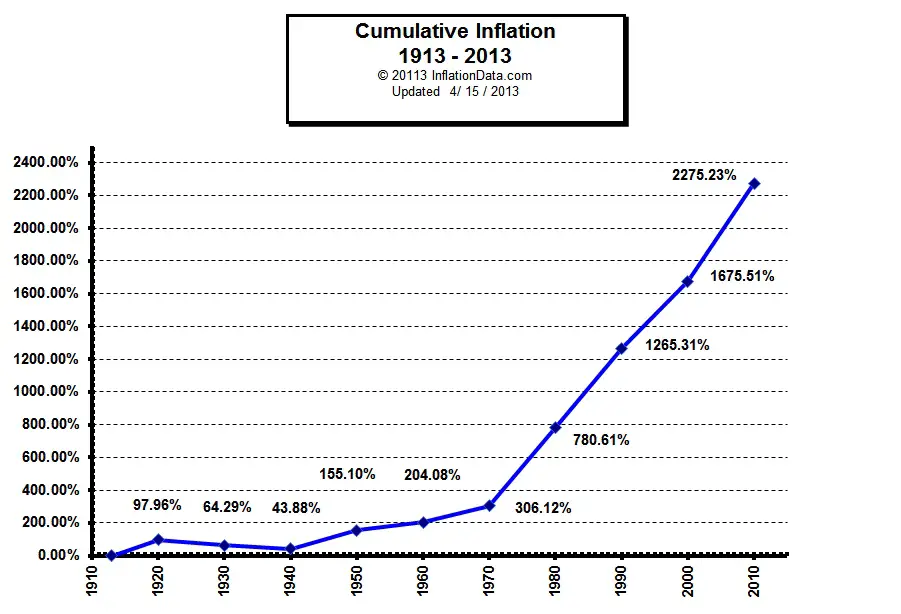
Seems to me like breaking the gold standard has lead to quite a bit of inflation.
One problem with our view of inflation is that it's compounding...
Now, I think the real reason we have compounding and printing of money is that it's a form of taxation (on currency holders) and it makes government debt cheaper and cheaper each year that passes.
For example, compare 1940 to 1950 with 1990 to 2000. Cumulative inflation rises 110% for 1940-1950 and 450% for 1990 to 2000. But, $1 in 1940 will be worth 57¢ in 1950 (145%/255%), and $1 in 1990 will be worth 77¢ in 2000 (1365%/1775%).
There are two ways to fix this: you could plot yearly inflation, but it's difficult to see long-term trends; or you can plot cumulative inflation on a logarithmic scale, but people aren't as used to logarithmic scales.
yearly: https://en.wikipedia.org/wiki/File:US_Historical_Inflation_A...

cumulative: https://uploads-cdn.omnicalculator.com/images/cpi-inflation/...
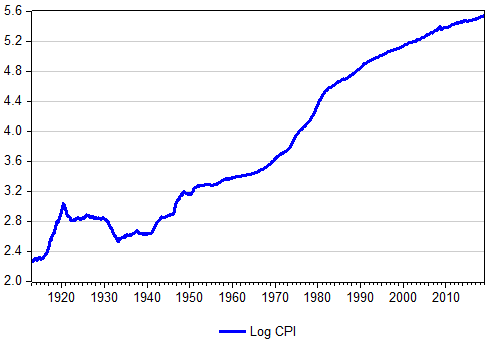
We have seen large inflation in stock prices, houses, etc.
That’s very disingenuous. Obviously we all know that spending is financed by debt.
But where do you think we get the money to service that debt? We can’t borrow infinitely.
Remember that PUA applies to normally disqualified workers like gig economy and 1099 workers. No processes exist to process and monitor wage data for these workers. (By design, there’s a reason why Uber, etc uses “contractors”) With normal employees state labor departments have near real time monitoring of employer tax filings and can recapture fraudulent benefits.
States administer the programs, and their ability to pivot their systems ranges from “meh” to “lol”.
End of the day, the moral hazard of letting people pay rent is pretty minor compared to the benefit of getting aid available quickly, etc. Ironically the people in congress worried about the morality of this were/are fighting to keep direct payments to companies secret.
Do you use this years tax return? What if they haven't filed it yet? Maybe last years? Well what about tipped income? What about seasonal workers? What about people who do not typically qualify for unemployment? etc etc etc.
Frankly, it's just easier (from as administrative stance) to sorta throw money at the problem, and sorta hope it all washes out in the end. And since many states are reimposing shut down, it seems prudent to extend enhanced UI for the time being (at least until we're able to safely reopen). People like to bash against the US for "only" giving a one time payment of $1,200, but to ignore enhanced UI as part of the stimulus is intellectually dishonest.
Will this policy cost us? Sure it will! It will likely mean higher taxes (and not just on wealthy people, but certainly they're the place to start) to maintain a stable GDP/debt ratio in the future. But the cost of not doing so and tanking the US economy is almost certainly worth it.
I don't know how long an amendment would delay the bill, but depending on the time period an argument could be made that this was intentional. Yes, if this was going to delay the bill a few weeks, it probably was just rejected to get it out, but if it would be a few days I think it would be reasonable to consider it.
[2] https://www.vox.com/2020/3/25/21194278/lindsey-graham-corona...
The real problem is that the law lets companies pay so many people so little to begin with.
Not saying you necessarily disagree. I think language has a tangible and often unconscious impact on our thought porcess so wanted to point it out.
In America, large companies should be required by law to pay their employees a living wage. Its not OK for working people to be food insecure, unable to save for retirement or their childrens education, etc. Id say that is the root problem.
Economists pretty much across the board disagree with you.
If you don’t allow companies to pay market rate for low-value labor, they’re simply not going to hire those people at all. They’re not going to lose money paying $15/hr (or whatever) for a job that only nets them half that.
All a “minimum wage” law actually does is eliminate categories of employment available to people with low skills or ability. You’re not helping those people by unemploying them.
Your position that people are hurt by not having access to what is essentially slavery, because that is precisely what you're advocating for here, hurts people is absurd. Minimum wage laws put a floor on just how much you can abuse your staff. The fact that you don't understand this shows that you take your considerable privilege for granted without even appreciating it.
You’ve obviously not grasped the point - these people are not paid “less than minimum wage” - they are paid nothing, zero, because well-intentioned but economically clueless people have decided that it’s not morally proper for low-skilled people to make whatever their labor is worth.
> Minimum wage laws put a floor on just how much you can abuse your staff
No, it puts a floor on who is employable, hurting the least capable people the most.
> you take your considerable privilege for granted
Chastising me doesn’t work - try again with a reasonable economic/utilitarian argument. Thus far you haven’t said anything to suggest you’re approaching this from any kind of reasonable framework.
Incorrect. Disability, social security, etc are payments. Payments that we all bear when people, rightfully, opt out of this oppressive, toxic, dog eat dog workforce. Or worse, when someone's body is sacrificed for the sake of profits. If you're getting rid of minimum wage you should probably get rid of all social safety nets to deal with perverse incentives.
>because well-intentioned but economically clueless people have decided that it’s not morally proper for low-skilled people to make whatever their labor is worth.
eesh. Let's play out what happens when you treat human beings like livestock, from living memory: We get the company town(1). We get China's foxconn suicides(2). We get slave labor camps (active in China and the United states, like today, right now(3,4)). Then, or concurrently we get death camps for the infirm(5); if we can't hope to pay even a subsistence wage for all labor then how can we possibly allow these parasites to live on, homeless and impoverished, with the ills those kind bring to a civilized land.
>No, it puts a floor on who is employable, hurting the least capable people the most.
That's merely a point of debate, not a fact, as you suggest(6). In light of the cited history I've outlined, I would argue that such an argument is debunked and does not merit further discussion without extraordinary evidence.
In regards to your last statement. What you've arguing for has been tried before, and is explained, with citations, for you to read at your leisure, on the Wikipedia page for minimum wage. I beg that you take a cursory examination of the available history and literature. I would rather like to avoid repeating the bloody mistakes of history.
1. https://en.wikipedia.org/wiki/Company_town
2. https://en.wikipedia.org/wiki/Foxconn_suicides
3. prisoners, many due to racist laws under the guise of paternalism(see paternalism from (1)).
4. https://en.wikipedia.org/wiki/Xinjiang_re-education_camps
5. https://www.hmd.org.uk/learn-about-the-holocaust-and-genocid...
> how can we possibly allow these parasites to live on
Private charity is and always has been more effective than government welfare, although the proponents of government welfare would like you to believe otherwise. With the elimination of the rule against perpetuities in the West, the Waqf model would be a superior solution to what we have now.
I'm glad you're having fun. None of these topics are laughing matters, but, like the insults you're throwing, they're not novel either.
>you don’t have any coherent understanding of the economics of price controls
If you had 'coherent arguments' or citations, you would not lower yourself to attacking me instead of my arguments.
>so you just go on about Communist China and and the Holocaust.
If you'd bother to consider my arguments you'll find that my citations are in fact real world examples of what happens when people with ideas like yours take power.
>Surely at some level you realize this is embarrassing?
yawn if I'm wrong, prove it
If you had cogent arguments you would've made them instead of attacking me and moving the goalposts.
>Private charity is and always has been more effective than government welfare, although the proponents of government welfare would like you to believe otherwise. With the elimination of the rule against perpetuities in the West, the Waqf model would be a superior solution to what we have now.
Debunked(1).
Regardless, if you're just going to keep repeating years debunked tea party talking points I'm happy to keep correcting you.
1. https://www.seattletimes.com/nation-world/private-charity-no...
2. I’m curious how what you say applies to countries like Sweden, France, Norway, Germany, etc.
This has actually often been the case I live, because the social welfare system gas a cut off threshold rather than a sliding scale, so if you have, for example, commute or child minding costs, you can easily make less net than you’d get if you stay on social welfare (for minimum wage to low paying jobs), so there isn’t much incentive for unemployed to seek those jobs. I personally know people who gave up on trying to work because they ended up with only €10 or €20 more per week, while being away from their children.
Meanwhile European nations have suffered much lower unemployment because governments decided to subsidize salaries instead of paying people to stay off payroll, the former being a non-starter in the US given the current House composition.
Instead, we’ve dithered, and the long term economic damage is looking far greater.
If you want to learn more about why this statement is completely wrong, read Stephanie Kelton's new book.
Even based on your own assumptions about "paying for it", the COVID unemployment increases/extensions have a negative cost, meaning they saved Americans more money than they cost. Thanks, Keynes.
"Few employers have compensated extra for on-site work amid the health crisis. A recent survey by the Economic Policy Institute found that fewer than a third of people who had to leave their homes to work during the pandemic received additional pay or benefits. As U.S. coronavirus cases persist and some states are even backtracking their reopening plans, workers have flooded social media with calls for hazard pay."
The concern is entirely about people being paid more than their jobs to stay home. In some conversations I've had with people, there's an attitude that staying at home is just a giant vacation that they'd like to go on as long as possible.
It's an understandable position as well for anybody who won't see much of an impact from the economic side effects. When people begin asking to extend the stay-at-home-pay program, there are a lot of people who will support the idea of getting paid excessively to stay home and anyone who tries to correct that fiscally unsustainable situation is going to be made out to be the bad guy.
Hazard pay for essential workers makes complete sense.
It's the excessive unemployment for people to stay home that's the problem. For a bunch of people, it's a giant vacation. For others who are working through all of this, they are strained, stressed out, worried about getting sick and their nerves are shot.
All in for hazard pay, but fix the unemployment problem. It's completely out of balance.
In an ideal world I would agree with you. In the world we live in my suspicion is that (not saying this is you specifically) calls to “balance” “excessive” (imho a case can be made for unemployment being higher than ones previous pay - parents for example have to home school now in addition to work - they paid taxes for schools but e kids can’t attend them. One theoretical.) unemployment right now are really just political cover for eliminating pandemic-related financial support for citizens from the federal government entirely.
[EDIT: I encourage downvoters to explain why they downvoted and point out what assertion I make about worker exploitation in the U.S. is not empirically verifiable.]
Can anyone explain to me how you get around greed like that in Capitalism?
If Americans laborers want to maintain their economic disparity, there are two paths.
One is protectionism. The biggest benefit of maintaining this ”trade war” is not that we will get a better deal, it's that it add enough uncertainty to global labor arbitrage that loss aversion make US workers appear the ”safe bet”.
The other path is higher productivity. In order to pay Americans orders of magnitude more than workers in other countries, they need produce orders of magnitude more. This means, better training and better machines. It's not an accident that computers and networks have both been the dominant machines of the past couple decades and working to create and use them has been accompanied higher compensation.
The temporary COVID unemployment bill was so rushed that they didn’t index the unemployment to the person’s earnings. If you lost your job or had your hours reduced, you get an extra $600/week on top of state unemployment. About half of people receiving this are receiving more from the combined unemployment measures than they did from their jobs.
This is was a necessary compromise to get the relief enacted as quickly as possible. We didn’t have an easy way to implement a more complex unemployment system at a national level, so we compromised with a flat rate for everyone. Unfortunately, many people are misinterpreting this and assuming that unemployment is always this lucrative (it’s not, and the $600/week ends after July) or assuming that our government has enough money lying around to pay everyone this much all of the time (we don’t, this is actually very expensive for the taxpayers).