Secondly, people get confused between extension of credit and money printing. For that you want the separate measure "M2".
Thirdly, the real lesson of the hyperinflation crises of Germany, Zimbabwe, Argentina etc. is that you can't print oil, gold, or the foreign currency needed to buy them. Germany was paying a huge amount of reparations to France (which would be where the family silver ended up - 20 billion goldmarks was paid, which had to come from somewhere).
The United States is in a hugely privileged position. It has enough domestic oil and food production for its needs. The gold standard is no longer relevant. Inflation and interest rates remain low.
If you imagine a dial with a yellow warning at "8" and a warning redline at "9", the US is currently arguing over whether turning it from 1 to 2 is going to be the end of the world. The limit does exist, but it's a long way away.
No one - who's talking at least - seems to understand what's going on with this. It's uncharted territory in a world economic system way more complex than when text books were written.
I have to think fundamental reality must catch up sooner or later, possibly unravelling in a sudden crash.
Then again, I do not understand this!
Conventional explanations include "price stickiness": wages and prices don't change overnight, they have to be deliberately changed by individuals in the market. And the more technical "transmission mechanism": just as an automatic transmission doesn't immediately convert faster engine RPM into faster road speed, there is substantial lag in the mechanisms by which money production affects prices.
The reverse process was seen round about the introduction of the Brazilian "Real". People had become used to inflation and re-negotiating prices regularly. Swapping out the name of the currency helped reset that in the minds of the public. https://en.wikipedia.org/wiki/Plano_Real
One of the more convincing ideas is that, because fiscal policy is either conservative or only expansionary for high earners, monetary expansion doesn't affect most consumption prices and only affects assets. e.g. house prices and the stock market.
The moment people think a currency is shaky, they get their money out of it and into something else. That leads to a huge oversupply of that currency in exchange markets, crushing exchange rates, and making the prophecy of inflation self-fulfilling. Much like borrowing, the moment people think you need to print money to survive is the moment everything goes to hell.
That being said, I think the fed's policy has been pretty reasonable. Europe and Japan have been more aggressive with monetary policy than the U.S. over the last decade, making the dollar very strong and worsening the trade imbalance.
It certainly helps that US debt is denominated in its own currency so debt is as much of a burden on the US as the Fed wants it to be.
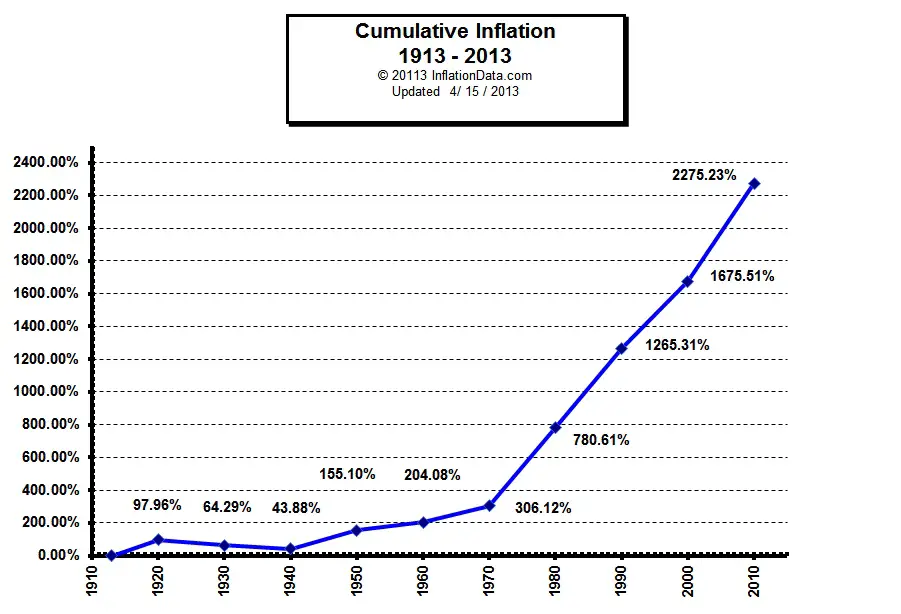
Seems to me like breaking the gold standard has lead to quite a bit of inflation.
One problem with our view of inflation is that it's compounding...
Now, I think the real reason we have compounding and printing of money is that it's a form of taxation (on currency holders) and it makes government debt cheaper and cheaper each year that passes.
For example, compare 1940 to 1950 with 1990 to 2000. Cumulative inflation rises 110% for 1940-1950 and 450% for 1990 to 2000. But, $1 in 1940 will be worth 57¢ in 1950 (145%/255%), and $1 in 1990 will be worth 77¢ in 2000 (1365%/1775%).
There are two ways to fix this: you could plot yearly inflation, but it's difficult to see long-term trends; or you can plot cumulative inflation on a logarithmic scale, but people aren't as used to logarithmic scales.
yearly: https://en.wikipedia.org/wiki/File:US_Historical_Inflation_A...

cumulative: https://uploads-cdn.omnicalculator.com/images/cpi-inflation/...
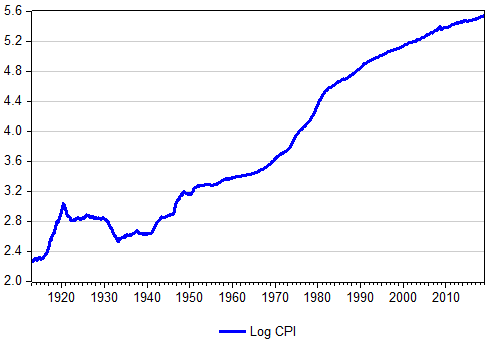
We have seen large inflation in stock prices, houses, etc.
That’s very disingenuous. Obviously we all know that spending is financed by debt.
But where do you think we get the money to service that debt? We can’t borrow infinitely.
Uncle Sam has long since stopped paying for things with tax money. Any new expense is handled by borrowing or printing money.