Education is the key to local talent, and is the key to equality. Yet, what has the US done to make our education better?
It explains a non-trivial logical connection, showing how something that could look unpopular from the surface, would pay off in the long run. Except you cannot make comments like this in public anymore. Because all it takes is an angry mob leader shouting "%USERNAME% is %CLICHE%ist" and that's it. Your employer fires you, your friends abandon you, you are socially bankrupt in an instant.
There are many bright people our there with great perspectives to share. Except they have to maintain radio silence, because they are not willing to take that risk. So the only voices to be heard are the most extreme ones that have nothing to lose.
I sincerely hope we can overcome this and get people to discuss problems and work together on solving them before our civilization sinks into medieval barbarism.
Can you point to something you've said that's resulted in the problem you've described?
Generally I've seen people reach for "cancel culture" when:
1. Fear-mongering the left over perceived injustice.
2. Defending bad takes by tone-policing any disagreement.
Can you point to a comment by john_moscow where they've been 'cancelled'? Or maybe a comment by you?
I think you should be embarrassed at edgelord takes like "I don’t see the value an impoverished set of humans can provide" [1], and I don't have any interest in talking with far-right extremists. Bye.
A highly effective education system that really gets the best out of every person involved is also going to be selective, it is going to group people into different classes based on ability, and the resulting output is going to be highly offensive to the militant people who right now are literally doing their best to take over American cities.
So no, we can't fix this problem. We can spend more on it, but ultimately all of that money is just IOUs against a decaying system that demands everyone be equal, even if that lowest common denominator means all but the super-rich end up living in a favela within a few decades.
That will fix it.
What I mean to say is that 99.9% of those programs are just abusing the system (even if 10% of them started out with honest intentions).
The war on drugs - have unfairly targeted minorities breaking up families and when they get out of jail, its harder to get a job because of their criminal record. No matter how good the education system is, if the students home life is unstable, education suffers.
Government funding through court ordered fines and tickets that also cause people to enter the criminal justice system when they can’t afford to pay. They end up in jail and lose their jobs. Again an unstable home life.
Lack of affordable higher education. Also, colleges love to give spots to non US citizens because they pay the full tuition costs.
Education funding is based on local property taxes. The rich get richer and the poor get poorer.
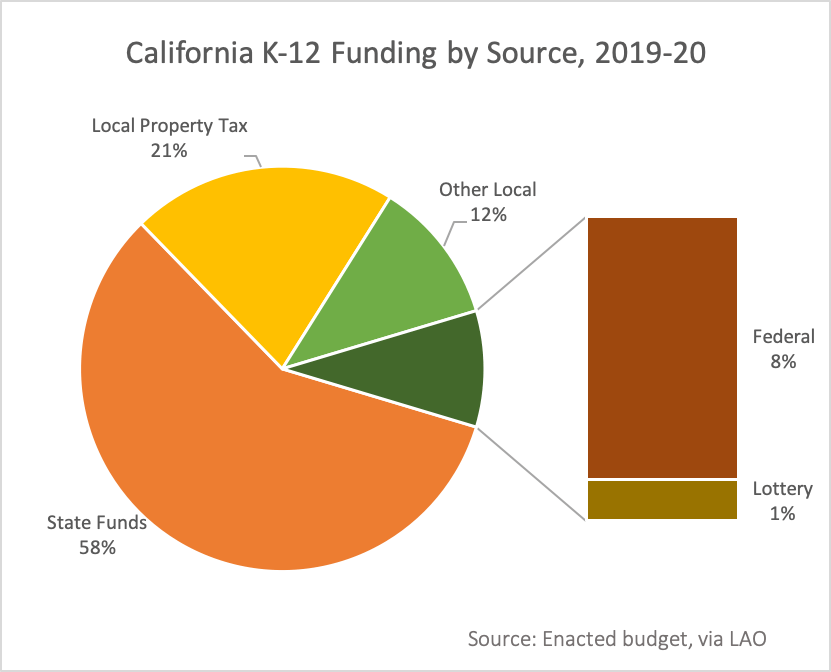
I know in my Metro area the more affluent parts of the city, love breaking off into their own city to keep their money even more localized.
It does not, not even per pupil since there is a 20% supplement for each designated “high needs” pupil, and additional funds iif “high needs” pupils exceed a certain threshold.
It allocates the state funds that make up the vast majority of education funding among the counties. It doesn't specifically direct how counties spend the money.
That’s between untrue and misleading. The state allocates a very large share of the total education funding among counties, but it does not allocate the funding counties have (whether from the state or from local funds) by line item.
Growing up in a poor area, I went to some of the "worst" schools you can imagine (one even had to get shut down) and I had one of the most inspiring history teachers there, that I still remember to this day. And all the other teachers were great too. It's not the fault of the teachers when students are too busy pencil fighting and throwing basketballs at the teacher's head, rather than studying.
What on earth do you mean with "low quality education"? I certainly didn't see that in the worse schools I went to. I think people misunderstand term "bad schools" and take it literally to mean that the schools are bad. this is completely incorrect. When people say "bad schools" it means the students who went to the school performed bad on standardized tests. It's not a reflection of teachers, or schools or funding. I went to such schools and still did just fine, so did many others.
You're lucky to have great teachers, and I just think we need more of such kind. As for bad schools, let me give you a few examples and you can check out the documentary Waiting For "Superman" to get a more grim picture.
- Did you know that teachers in some Cupertino schools asked parents to grade student homework?
- Did you know that a straight-A student who graduated high school in NYC couldn't pass the math placement exam in The City College of New York? I mean, placement test in a college, how hard could that be, right? The story was featured in NYT, IIRC, a few years ago.
- Did you know that only 48% of public school students who took the California Assessment of Student Performance and Progress (CAASPP) met or exceeded grade-level standard in 2016. And we're talking about CAASPP, a standard that is really not that high.
- Did you know that SAT is not differentiating to say the least, yet the average score of SAT math in California is merely 536. Pathetic, shall we say?
- Did you know that elite students in the Bay Area routinely completed more than 10 AP classes, yet the average students could barely understand Algebra 1?
And now let me give a few counter examples to show what good teachers can do to students:
1. All 14 students in Jaime Escalante's class passed AP Calculus I back in 1982, even though the school was in a hood. The success was so shocking that people thought the students cheated.
2. KIPP. Merely extending the school time to 6:00pm and offering classes in summer helped students stay in school and make steady progress towards entering college.
3. Schools in other countries. Take the schools in China, for instance. Teachers enforce cultures. Great scientists and philosophers and writers become household names because of them. They form research groups to continuously improve teaching materials. Better ways to teach, better problem sets, better projects, and better exams. It is widely assumed that teachers are better problem solvers than students in China. Can we assume that in the US?
By the way, a student doing well in standard test may not be a good student, but a student who does not do well in standard test is definitely not good academically. I don't really see why people keep blaming standard test for student's miserable scores. Do we really think these students could solve much harder free-form problems when they can't eve deal with much easier standard test? There is a reason that multiple-choice problems are the easiest ones in other country's college entrance exams. It suffices to say that if students in a school couldn't even pass standard tests, then the school has failed the students.
As some one who worked in US and returned to India. Let me tell you immigrants will support this as soon as they get their US passports and Green Cards.
It's just which side of the fence you sit on. Once these people have a stake in your country, they magically shift their loyalties to the exact opposite position to what they had before.
In India itself, many of these elites oppose policies like Right to Education Act. knowing well they can fund their kids higher education in foreign countries, and eventually their kids getting settled in US. They don't want poor people to have literacy or any edge in education. Meaning, less competition the better. Why work for Right to Education, when your kids go to expensive private schools, tuitions, coaching classes and then foreign universities, with jobs and citizenships overseas. You want less competition and lesser poor people and underprivileged people studying so that more opportunities are freed up for your kids.
People are deeply selfish at a personal level and unless they have a stake they feel no need to change. I honestly feel things in India will improve with fewer visas. People will work for good domestic education facilities once they realize they are trapped in their own country.
But as long as the discrepancy exists, then it seems like there would be a tremendous benefit in allowing people to freely immigrate, even for those already at the destination. Fear of immigrants is based on the idea that they will work for less, but if it's still more than they were making, then the competitive situation for labor has improved, as long as one accepts that it is a global market. I wish there was a way to get political traction for this, as a self-interested goal for American (or other developed country) workers.
At this point, more money is not going to help. Education in the US is fundamentally broken. Combination of "no child is left behind" and standardized testing (because everything else will be called discrimination) ensures uniformly bad results. If you pour more money in, it's just going to be wasted on bureaucracy and busywork.
So H1-B is actually a great idea. If we can't educate, let's attract well-educated people from elsewhere. They want to live here, so we can choose.
We don't mind buying electronics made in China because they can do it better and cheaper, why not do the same with people. Finland seems to be doing just fine with education at a fraction of US cost, let the market do its thing and flex the comparative advantage.
Despite the USA spending a ton of money, it doesn't curate quality education.
The entire system needs to be reworked.
I know there are some classes for stuff like electronics and mechanics, but why not offer more career based classes?
I think the requirement for more advanced computer classes has come down, don't need a AP calc/trig credit to take a basic programming class anymore (it's been well over 20 years since I graduated).
The only reason that students have to study highly simplified models is that the real-world is too complex. Without years of study of "simplistic physics" in high school, there is just no way that one can learn rigid-body mechanics. Without years of practice on algebra 1/2 in high school, an ordinary kid will have no hope of understanding calculus, and without understanding calculus, the kid loses hope of understanding stats, and without understanding stats, the kid loses hope of understanding machine learning, and without understanding machine learning, the kid won't be able to jump on the gravy train of being a machine learning researcher. And now should the kid cry wolf the world is not fair and the system is rigged? Of course, this is an extreme example and there are thousands of other professions. All I'm saying is that sometimes a subject looks hard and mundane and pointless, but it is actually useful in the long run.
And as specific as Math on Money? It's nice to have, but it's not necessary. I have no problem studying on my own the theory of options and quantitive finance even though I had no idea how money worked. But I have strong background in math, in stats, and in computer science, and some background in economics. And really, such fundamentals carries me a long way.
There are many ways this power is collected and maintained through the prison-industrial complex, including creating mass media images that keep alive stereotypes of people of color, poor people, queer people, immigrants, youth, and other oppressed communities as criminal, delinquent, or deviant.
This power is also maintained by earning profits for private companies that deal with prisons and police forces; helping earn political gains for “tough on crime” politicians; increasing the influence of prison guard and police unions; and eliminating social and political dissent by oppressed communities that make demands for self-determination in the US.
If mass media images are a problem then why do these groups not join Trump saying MSM is problematic and untrustworthy?
For profit prisons are more efficient, because the government can’t run anything without substantial cost. So privatizing prisons saves costs.
Perhaps take a look at Norway's system.
The reason we DON'T do that is because state prisons are glorified slave rackets. The very existence of for-profit prisons is an obscenity that will be seen as being as barbaric as slavery in the long run.
For profit prisons are more cost effective than government run prisons. We are a capitalist society, people seek profit here, including the entirety of the country.
And most people don't "seek profit" here in their day to day lives. That's zero-sum idiocy.
And the second part, I’m guessing most people don’t work then?
We have the technology to amplify a great teacher's lecture to millions. However, the education system relies on the model of interactive lectures given to a class of people of whom many are not acutely interested in the subject. Following that lecture, parents are drafted as involuntary teachers to help their kids with homework. If the student's parents have sufficient background, this works. Else, we end up with the situation where students continue to fall behind as their parents are unable to teach them.
We need to bootstrap our students' learning to the minimally accepted level that sustains self-directed learning. I would define that as mastery of arithmetics as first phase and algebra as second phase. However, we are talking about mastery that does not require a review, which means spending more time on in-depth training without jumping ahead.
Such classes should be separate from mainstream math classes so as to not to bore those of us who already have achieved that mastery.
I am working on this.
What you are saying is how can the US turn their bottom tier performers to match this
Nothing lights a fire under your ass as realizing you are a layoff away from leaving the country and having to start over
You need to change the cultural mindset. You need to build more colleges. Computer science programs are already maxed out. You need more professors.
Good parents with good parenting skills raise good kids. Bad parents/single parents - it is much harder to raise kids and give them good education.
if you want reforms - you need to adopt Scandinavian policies in America (high taxes, universal healthcare, universal childare, universal K-12, universal college system) - that way it will be easier to raise well educated kids
And from a parent point of view, why would I want my kids to waste his or her time in school learning very little, and then to spend my own time tutoring them? All I want is my teachers to do their job, and do it decently.
Majority H1B from India and China are stuck in green card backlog; with the current immigration system, they will never get the green card. Option for them is to stay in the USA on H1B in green card waiting queue or return home. (I do not think this is right or wrong people who are stuck in the queue, they chose to come to the USA and work here, it is up to that person to decide if they want to stay or go back or go to another country). After returning to home country from the USA, Social Security and Medicare deducted is a contribution to the USA (I am not saying this is right or wrong, just a fact).
The only requirements to meet is 10 years of work in the US (i.e. "40 quarters of coverage (QC's)"). I spoke to someone from India sometime ago, who had come to the US in their late 40s or early 50s. They were planning on going back to India after they had accrued 10 years of tax-paying years in the US, so they could collect on Social Security Old-Age when they retired in India.
With the exception of a few countries,the US government will in fact directly deposit money in your foreign bank account. [a] You don't need to have any ties to the US. The whole thing is actually quite profitable, if you've only worked in the US for 10 years. Per the formula [b], if they earned $130k per year, in 10 years they made $1.3 million (and contributed $198,900 at 15.3% in FICA taxes), which divided by 420 yields $3,095 - the AIME (Average Indexed Monthly Earnings). The benefits payable for it is: 960 x 0.9 + (3095-960) x 0.32 = $1,547. They can get $1,547 from age 67. If they live until 87, that's 20 years. And 20 * 12 * 1547 = $371,280.
All other federal benefits, plus the other programs funded by FICA taxes (ie OADSI / SSI + Medicare taxes) including SSI, the other parts of OADSI, and of course Medicare, are not available to non-resident non-citizens (with a few exceptions).
It would seem reasonable to place an intake limit of 10% from any one country, and limiting males to a maximum of 49%.
Right now, lets be honest, the H1B is giant immigration scheme for Indian males to get into the USA: 75% of applicants are Indian, and roughly 70% of applicants are male.
https://tech.economictimes.indiatimes.com/news/people/three-...
https://www.computerworld.com/article/3050365/how-many-h-1b-...
With these kind of diversity requirements, it would also be much harder for crooked companies like Infosys to racially discriminate against non-Indians:
https://economictimes.indiatimes.com/tech/ites/infosys-faces...
The green card lottery visa has diversity metrics built into it explicitly, which is probably why it receives minimal negative attention.
India holds 17% of the world's population. Any program that is designed for diversity would have a 15-20% Indian population. That is much smaller than the current number, and in fact it would be a fairly different set of Indians: victims of sexism, casteism, "colorism", etc.
This could work out pretty well. Indian social inequalities would be reduced, US tech companies would get an infusion of extremely diverse workers on strong career tracks. If you believe that diversity is good for the workforce, this would be a huge boost.
But the straight/cis/brahmin/male Indians would get mad.
I feel less positive about the program these days given that a number of companies have made it a point of pride to emphasize hiring of "diverse" employees, which seems in reality to be a pretext for H1B hiring that would not otherwise happen. This stings a little bit for me personally, as it's become clear that I'm losing some jobs to H1Bs. And I'm sure it really stings for native techies that can't find work during this incipient economic depression. (I'm old enough that being whacked by H1Bs just means unexpected early retirement.)
For whatever reasons, I suspect the American base will continue to hollow out and turn into something different. It's a bit like British cuisine, which has (in my impression) been essentially overrun by Indian cuisine and that of other countries. Is that bad? I guess it depends on your point of view.
Anyway, as long as the hiring is legal, I'm good with it. Certainly I've never met a colleague from another country that I didn't enjoy working with.
Mushy peas, on the other hand, are probably unsalvageable. Except, maybe, with a nice curry sauce... :-)
If the concern is with abuse, then let's crack down on that.
Even big tech companies like Amazon and Facebook hire h1b workers so they can create sweatshop environments. H1b workers are afraid of being deported if they do not perform well, and a certain percentage of workers are forced to be on the PIP plan every year in the stack ranking.
Can even lead to suicides or suicide attempts. Ex:
https://www.cnbc.com/2019/10/15/facebook-employee-i-was-fire... https://www.businessinsider.com/amazon-employees-share-thoug...
But most of the "IT" work done by InfoSys and others are things that can practically be done by Americans as well. It would take training, but it wouldn't take a degree from a top university.
So - companies like InfoSys and Tata are a good place to start.
People like Zuck aren’t advocating for more h1bs under current rules out of the goodness of their hearts.
You can argue FB (and other FAANG companies) can just pay more. But 1) the FAANG compensation is already plenty high and 2) the talent pool is finite, and if FB pulls more from the local pool there is just less left for other companies. As it is less well known tech companies were (pre covid anyways) already having a hard time hiring because they can't afford to pay FAANG comp. Theoretically if you get rid of H1B workers and force up top end compensation, then we'll just have less workers available for the lower tier companies.
The average engineer at these companies is not all that competent, the interview process is very noisy. I know many people barely able to write basic stuff like fizzbuzz, lots of them slither their way into middle or upper management.
There are no H-1B immigrants.
There may be H-1B holders who plan to become immigrants, but H-1B is a nonimmigrant work visa.
> Now all these immigrants have learned your language, passed job interviews, and are competing to come to your country to give you 1$M and help your economy.
No, they are competing to come and reduce the market clearing cost of labor and increase the returns to capital in our economy. Which is good for you if you are (1) one of the incoming laborers, or (2) a person whose main interaction with the US economy is via capital investment, not labor income.
> To those who say we must invest in local workforce, I wonder why would you have to stop immigration to start investing in local workforce?
You don't have to stop immigration.
You do, on the other hand, need to stop importing labor in a manner specifically and selectively designed to avoid upward pressure on wages (and thereby, stop the incentive to develop domestic supply) for high-skill, high-demand positions and to terminate temporary residency when it no longer serves that purpose.
Or, you need to better capture the returns produced by those means and direct them to domestic workforce development.
I'm one of the most pro-immigrant and pro-immigration and anti-Trump, people you’ll find, and I would shed not a single tear if Trump managed to permanently kill, rather than merely temporarily suspend, the H-1B program.
I'm not saying I'm not against people who are abusing H1B. That should be banned NOW.
this part is completely wrong: "If they have more workforce they can do more".
The demand for labor is not determined by the supply of labor, it's determined by the demand for those products. When companies higher engineers for example, they don't just go, "hey, we just had two brilliant engineers interview, so instead of highering 1, we'll higher 2." It never works that way. Companies need the amount of labor they need, and not one person more.
The reality is there's a vast oversupply of labor right now in most fields. Wages have been stagnant for a long time. And even in the bay area, average engineering salaries lag behind the local COL.
Furthermore, the US simply won't allow for enough housing to be built. Even with the population we currently have, there's no where near enough housing. this problem is only getting worse. Sure, it's just politics, it's a choice voters have made, but we're stuck with that choice. And, having more immigrants/increasing population makes it worse.
A friend of mine last year got a job as a L5 at Google, for around $380k a year in total ($190k base + $28.5k bonus + approx $160k stock). Plus a sign-on of $50k. First year pay is $430k. He's not doing rocket science, or managing. He's an individual contributor writing back end code.
Meanwhile, there are folks doing a similar jobs in Canada, who are making 100k CAD (on the high end), which is $73k USD. And the cost of living in big cities in Canada is shockingly high.
Now, you were saying something about bay area salaries being low? The salaries are, if anything, over the top insanely high.
Also, I'm trying to understand why companies go through all the processing delays, legal costs, frequent unjust denials since 2017, to hire someone who is not a citizen, while paying them well above the median for the job, if there is a supposed oversupply of talented top-tier skilled people who are looking for a job. The truth i that oversupply myth is just a lie, spun by people with anti-immigrant animus, plain and simple.
I can't fathom the head space you would have to be in to think that salaries are low. Incredible arrogance and entitlement, combined with a generous dose of xenophobia probably. Instead of being thankful, there are people who want to cut off / deport / exclude people from working in the US (and I mean people making these high salaries).
Also, I know a lot of H-1B holders with high salaries. I myself am one of them. (In fact I don't know any low-paid H-1B holders, but my social circles are all folks working at top companies or friends from other social groups.) The intense amount of hatred for immigrants on HN always continues to appall and amaze me.
I usually tend to refrain from commenting on these threads, because the toxic amount of contempt and hatred for immigrants that I come across in these threads is extremely upsetting, but sometimes it's better to speak up, than be silent.
second, it's not about hatred for immigrants. It's just about jobs and housing. And, there's simply not enough of those to go around.
I mean, sure we could have more immigrants. But, make no mistake, it will reduce the amount high end jobs available and reduce the housing supply even more.
And, actually, most blue states are very welcoming to new immigrants which is especially ironic since they're the ones that don't want to support the housing growth needed to house an increase in population.
Here are comments from just one user on HN (who was sadly banned), but who is/was on the H-1B, who owns a $1.15 home, has an American kid, has lived in the US for 17 years, and makes $650K a year:
1) https://news.ycombinator.com/item?id=20473537
2) https://news.ycombinator.com/item?id=19993373
3) https://news.ycombinator.com/item?id=19944062
4) https://news.ycombinator.com/item?id=19525820
5) https://news.ycombinator.com/item?id=19222618
The laws of U.S. that were written by Congress, make it practically impossible for India-born to ever become citizens or even permanent residents through the EB2 or EB routes. This is large topic, I've covered in some of my previous comments like: https://news.ycombinator.com/item?id=19857687 (short comment) or https://news.ycombinator.com/item?id=19857878 (long comment).
Your entire post seems fairly out of touch. You're talking about Google L5, basically the top 1% of H1-B jobs in the US.
> Also, I'm trying to understand why companies go through all the processing delays, legal costs, frequent unjust denials since 2017, to hire someone who is not a citizen, while paying them well above the median for the job, if there is a supposed oversupply of talented top-tier skilled people who are looking for a job. The truth i that oversupply myth is just a lie, spun by people with anti-immigrant animus, plain and simple.
Just because you can't understand it, doesn't mean it's not happening. I have personally witnessed the oddly-specific job requirement postings, and have had friends who worked at some of these consulting companies as H1-B. Things are very different outside of the top tech companies. There is absolutely abuse happening. This is not some "anti-immigrant animus". This is happening. It's frankly ridiculous that you blame this on xenophobia on HN of all places.
I can't fathom the head space you would have to be to believe there isn't widespread H1-B abuse after reading countless articles and comments about it. Incredible arrogance and entitlement, combined with a generous dose of disdain for citizens wanting to protect their country from abuse probably.
Criticism of a widely abused immigration system and the companies that abuse it is not anti-immigrant sentiment.
In order for the HB1 program to pass muster, and validate its value for US citizens, people taking advantage of HB1 must put into the US least as much as they are taking out.
I dont see US citizens emmigrating / benefitting from similar benefits at foreign countries, like those given by HB1s within the US. In fact, as far as i know, there are no USA emigres going to india to work, drawing india SS retirement benefits, for example.
In other words, the HB1 program is asymetrical. Americans put in a lot more than they get out of it.
As such, the only logical thing for the HB1 to be discontinued.
> the US simply won't allow for enough housing to be built
You don't see the connection here? Why do you think there will be enough housing even with less immigration? The "housing must increase value at all costs" mantra is responsible for this.
[0] https://247wallst.com/housing/2019/09/30/there-are-over-17-m...
[1] https://endhomelessness.org/homelessness-in-america/homeless...
[0] https://www.uscis.gov/working-united-states/temporary-worker... [1] https://www.wsj.com/articles/a-new-look-at-the-h-1b-visa-pro... [2] https://www.sciencemag.org/careers/2015/05/economists-h-1b-v...
Did you try increasing salaries until you could find applicants. I'm virtually certain that you did not.
What you mean is that you couldn't find American workers at the price you were willing to pay, and because you weren't willing to pay the market price, you found another market.
If you could hire 20 people on H-1Bs but you only have enough money to hire 10 local people. You have displaced 10 American workers.
This is completely wrong. Jobs are zero-sum. One H1-B worker hired is one lost American job opportunity. It's not that hard to understand and taxes have nothing to do with this. Yes, companies can scale jobs but how often are they doing this and how does it help if they are also scaling up the number of H1-B workers?
Are you already tired of "helping" others? Don't forget that we aren't trying to cooperate for a very long time as it may seem to be. We aren't still great at doing it either.
What may seem to be broken to you isn't wrong in essence. We should help each other. We should support each other. And less poverty is better for all of us. Maybe we should just do it differently. Perhaps the way we are doing it isn't good and we should find a better way to do it.
Social Darwinism is entirely based on misunderstandings of science and history. It is a dead-end philosophy, and needs to be eradicated with knowledge, replaced by the spreading of compassion and cooperation wherever it is found.
Also I would love some papers on how natural selection is no longer valid, this sounds like pure opinion.
That's a bit of a stretch, don't you think? Bonded laborers were forbidden to leave their jobs under penalty of the law (like actual prison time). H-1B holders are free to leave any time, they just experience a massive drop in income.
In addition, this line of reasoning totally discounts the very real benefit of foreign transfer payments from workers in the United States to their international families, often supporting large extended families.
Thus, if they go home, they will not likely be "lifting their country out of poverty"—they will just be stuck in one of the jobs that is available there. Low-skill, low-pay jobs, without any prospect for advancing to something more like they would be able to do here.
I don't know to what extent this is true, but this is my understanding of their post.
(The counterpoint to this, which the GP didn't talk about, is that this person is still likely to be able to retrain and be productive in that society in other ways.)
The end result looks similar but motivation matters.
Let me fix that for you:
Think how much investment you miss out on — investment in a child's education to make them into a citizen who will carry your country's patrimony into the following generation.
There are companies like Cognizant/InfoSys/Tata/... whose business model is based on abusing the H1B system, and that's obviously wrong and I'm quite surprised they get away with it. I'm not defending that.
To those who broadly argue against skilled visas, consider this: Most H1B immigrants are between 20-30 age range. The prime age to join the workforce. Think how much investment you have to make on a child's health care and education to make them into a highly skilled workforce. It would at least cost you 1$M and probably much more. Now all these immigrants have learned your language, passed job interviews, and are competing to come to your country to give you 1$M and help your economy. Why would you not want that? People seem to think that number of jobs is a limited constant and if you stop immigrants that will have a positive effect on the economy. But in reality companies can simply just scale. If they have more workforce they can do more. Things get done faster and they just make more profit. Stopping immigration obviously would dent the economical growth. Never mind that many top tech companies in the US were founded by immigrants or children of immigrants.
To those who say we must invest in local workforce, I wonder why would you have to stop immigration to start investing in local workforce? As if allowing immigration would reduce the amount of money for investment, while in reality immigrants pay taxes. I personally have paid hundreds of thousands of dollars in taxes so far. I'd be happy if this money was used to educate the American workforce. However I know that it doesn't. I would like to see that change.