Yes, all the major tech companies are engaged in rent seeking. But Apple is the only one that says users must either must pay rent or throw away their hardware.
The App Store and its policies are not the problem. The App Store is Apple's store, just like Amazon.com is Amazon's store. But the App Store shouldn't be the only way to get software on my phone. And no, reinstalling apps from a computer every seven days doesn't count.
(The semi-exceptions are game consoles. I don't like that either, but since they're single-purpose devices I find it much less bad.)
1) Never need to learn what a "sideload" is
2) Never be exposed to Apps that havn't been vetted by a trustworthy party (in this case Apple)
Apple is taking the opportunity to milk app developers, but they've done an effective job of positioning the milking process so that it is done in the user's interests. It is quite possible that things like this 30% App Store tax are one of the reasons why iPhones remain so prominent.
And yet, even after being vetted malware still gets in
https://www.bankinfosecurity.com/apple-battles-app-store-mal...
I see this a lot, and to be honest, this 'Apple products are free from malware' meme has been carried on as long as I can remember in one form or another since the early Mac days. The amount of people that used to say they used Macs because 'they didn't have viruses' is about the same as the people who say 'I use iphones because Apple makes sure I'm safe'.
It's been Apple's marketing strategy for a long time, despite being slightly exaggerated, early Macs did have viruses and yes, malware makes its way onto the app store.
But Apple's marketing strategy sure has been working a long time.
I don't remember ever seeing Apple promise that 100% of apps will be 100% safe 100% of the time. Can you provide a link?
Apple's review process is done by people. People make mistakes. Things get through when bad people are trying to hide that they're doing bad things. But I'll take Apple's 1-in-a-million mistake environment over the anything goes Android environment.
You're describing the value of an app store, not the App Store. So the problem is not the value proposition, the problem is Apple's monopoly on this value proposition. It is why we can't have a Google iOS App Store, Microsoft iOS App store etc. list from which the user can pick, which would completely satisfy the convenience and peace of mind criterion, would increase competition regarding the cuts, vetting quality, curation quality etc.
But Apple customers can be sure of that anyway--just don't sideload apps. Anything essential is going to want to be in the App Store, in order to reach customers.
Well, no. At some point they'd need to know what it is to decide if they wanted it or not. At some point they'd encounter an App that isn't in the App store and have to figure out sideloading. We've got a whole heap of people commenting here today who give off a distinct "I want to bypass the App Store" vibe. User hat on, I'd rather they were forced to use it.
I don't think there is enough reflecting here on just how critical a phone is. At the extremes, the US government sometimes targets predator drones based on phone GPS. I suspect an enormous number of phones contain compromising pictures. Phones contain detailed logs of where I am, who I'm talking to, and potentially access to actual records of what was said.
I really don't want to be in a situation where 'Wowfunhappy' is executing arbitrary unknown code on a phone owned by me or my family. I don't want Google and Facebook browsing through and indexing this stuff either. Apple isn't even a good gatekeeper, but they are much better than nothing.
But see, I'm think that's exactly what I'm doing--the app store gives China an easy way to take safety apps from protestors. A phone is too important for it to be out of the user's control.
I understand the security implications, but when I weigh the societal issues, Apple's model seems much more dangerous.
Imagine a world, where your Telco or anyone else for that matter can't remotely tell your phone to turn on. A world where you and only you have ultimate control over your phone, and where instead of millions of engineer hours going into making your phone convenient for developers to utilize, it is instead made easier for the user to actually understand.
That is the world I want to see. Hell I want to be part of making. I'll be damned if I can figure out how to make it work with our Market's current optimization function.
Incidentally, to the last paragraph, you can help make it work—go work on Linux mobile UX/UI. Things like the PinePhone and the Purism Librem 5 exist, and there's a market for them, they're just missing a polished user experience.
The logical extension of that argument is that the Hey app would still be in the App Store and still be facing this exact problem.
If Hey became a cultural phenomenon, I'd bet that Apple would magically reinterpret their rules. This is exactly the purpose of having competition.
Please trust me on this but, even if your app is far and away the #1 grossing app on the app store and hundreds of media outlets have literally used the term "cultural phenomenon" to describe it, Apple is still a huge stickler on the rules and it still takes forever (and a lot of stress) to get approved, every single update.
This applies even if your CEO has Tim Cook's personal cellphone number and talked to him about the issues with app store approval a week before, in person.
Even now, major apps do have power. Unlike Hey, Netflix and Amazon are at least still in the App Store, and Amazon is even allowed to sell video rentals through their app without going through Apple's payment system: https://www.theverge.com/2020/4/1/21203294/amazon-prime-vide...
Edit: My posts probably read like contradictions. I see it like this: (1) The safe and vetted App Store is a part of the iPhone's appeal, which (2) Apple is currently enforcing through anti-competitive tactics. If Apple wants to maintain the App Store as a product differentiator (which of course they do), they should have to do the work to keep developers happy. Where "keep happy" means very basic things like not taking a full 30% of their revenue.
I thought John Gruber laid this out pretty well: https://daringfireball.net/2020/06/hey_app_store_rejection_f...
No one "eats up" that loss.
My understanding is that neither major mobile app store has done a great job of vetting.
[1]: https://www.apple.com/shop/iphone/iphone-upgrade-program
There are also three major consoles, PC, Steam, and a ton of other ways to distribute games. It's a highly competitive landscape. If you want a phone, you've got only two options.
DOJ, burn the Apple and Google monopolies to the ground.
That's not true at all. There's 2 primary OS choices, but on the Android side there's dozens of manufacturers, all with their take on things. Android is not a single option, it's hundreds. You even have choice of app stores. There's even options that have zero Google at all - like the Huawei P40 Pro. Or for an older take, silent cirlce's Blackphone or Amazon's Fire Phone. And even if you are in the very small minority that actually buys a Google phone, they even provide instructions on how to unlock the bootloader & flash a different OS: https://source.android.com/setup/build/running#unlocking-rec...
This is a contrived point of view, and I'm sure the product managers at Nintendo, Sony, Microsoft, Apple, and Google would all strongly disagree.
Remember when the PS3 used to be used for super computing? Sony quietly ended that program when they realized that wasn't the business they wanted to be in.
The certification process for consoles is also a lot tougher and more expensive.
No, I don't want to install your lousy app that's only a front-end to your web service anyway. Of course it gives you more control and opportunity for certain features. This only means that web browsers still have a long way to go. If apps were reasonably small, maybe I could install more of them, but as it is, it's just impossible.
Either way the back-end providers profit.
It's interesting you'd say that because it's actually not true (I am not accusing you of lying at all - I take your statement at face value!)
What I mean is the following:
When I buy a phone - no matter the maker - I have deep within me a default assumption that if I want some app, some provider, some service, some feature, on my phone - that it will be, that it can be, and if someone thinks it up it'll be there shortly. I DO NOT assume that because Apple wants to steal people's work, some apps will never appear there.
Do you remember the early days of the app store and the saying "There's an app for that" (usually referring to things like fart generators and TV quotes).
Nowadays you'd NEVER think to say such a thing because Apple is ensuring it cannot be true - and more and more developers and platforms are choosing not to use it.
It's pretty plainly clear to me that Apple ONLY wants large, rich, well-known companies publishing apps; they grudgingly publish apps for small or individual developers, but really deep down wish they didn't have to.
Stuff like what we are seeing now with Hey is their endgame to finally get everyone except their exclusive club off the list.
I bought an iPhone and had no idea bit torrent clients were banned
If Apple had promised customers that Age of Empires runs on Macs, then they would have a hard time getting Microsoft to give them 30%. But Apple has made not such promise to consumers.
Besides, there’s an email client for the iPhone. If there wasn’t, consumers might complain. If Hey was the only game in town, I’m sure they’d be given a sweeter deal.
The POINT that I'm making is that people their phone is theirs and they can install what they want on it. Even if that thing comes from the app store. EVEN NOW when I want to do something I go looking for an app. I don't assume my phone can't do it. And I certainly don't assume it can't do it thanks to shenanigans on Apple's part.
The reality however is far different and there are LOTS of things Apple doesn't allow and they are not above using their platform to stifle competition.
Given that Age of Empires has actually had Mac versions, I'm not sure this is the comparison you're looking for here. :)
The only value added by Apple is some kind of vetting (they don’t do code review, they just check that the app meets their recommendations... and they are called RECOMMENDATIONS not REQUIEMENTS).
My app was recently rejected because i refused to sell in-app purchases and want to keep purchases only on my website.
Why should Apple care what software makers want?
I get that it's a pain to develop software for the iPhone and then have to pay rent to Apple to get it to users; but that's not Apple's problem unless enough users either complain or switch hardware to cut into Apple's revenue. That doesn't seem to be happening. Sure, there are plenty of users (I'm one of them) who refuse to buy an Apple device precisely because of limitations like this, but there are plenty more users who don't seem to care; whatever they are getting through Apple's curated app store appears to satisfy their needs. As long as that remains true, Apple has no incentive to change its policies, and that's just a business reality that any software developer contemplating making an app for the iPhone is going to have to deal with.
And you’re defending that?
Personally I think devs should just pass the 30% to consumers or withdraw their apps. That is how you get leverage.
The Mafia didn't build things. It just came in and took over things others had built.
Apple built its app store. It built the iPhone. It got its users fair and square, by providing a product that users want. If you think that's the same as the Mafia, you have a very skewed view of business.
They do no such thing. They just prevent other stores from providing apps for their own product. Which they are within their rights to do, since it's their product.
I'll bring it up again: game consoles. Steam. And no, they don't deserve a pass.
Why Steam? No one ever has to use Steam--you can install whatever you want on your PC. Steam isn't even installed by default in 99% of cases.
As for the why: I'm thinking from the point of view of a developer. For me it's all the same. Paying 30% to Apple is the same as paying 30% to Steam or x% to console makers. In practice it doesn't matter if the appliance the user runs my software is essential or not, or if the store is exclusive, or comes preinstalled or not. I'm still paying a percentage to someone.
Sucks in all cases.
I personally have platforms I simply will not use (or refuse to spend money on directly, like EA's Origin, where I only own/care about C&C) regardless how good of a deal it is.
Valve has the ability to set whatever rules they want within their store. A world where we didn't allow this would get very complicated very quickly. Do we also make Walmart and Target carry every brand? How much are they allowed to markup the price? Who decides?
If Steam provides such a valuable service that consumers aren't willing to shop anywhere else even when they can, then that's what it is.
And, I think that's what would largely happen on the iPhone anyway if side-loading was allowed, outside of extraordinary circumstances like when protesters can't access a critical safety app. But, in order to keep apps on their store, Apple would have to make a (slightly) greater effort to keep developers happy.
(I also think Steam zealots are ridiculous, but that is a separate discussion.)
Can you imagine if Best Buy required Apple to add "Best Buy Payments" to MacOS so that Best Buy could collect a 30% fee on top of any services subscription that Apple sells to that MacBook user? All for the privilege of selling their products through the BB stores.
Apple isn't marking up a product for resale in it's retail environments. It is, in many cases, forcing its developers (who provide their valuable products to Apple for free, after paying Apple an annual fee) to completely rearrange their business models in order for Apple to collect a huge portion of their revenues, entirely on their terms.
As for your Best Buy example, Best Buy can make that demand, but Best Buy would lose more from not having Apple’s products than Apple would from not being placed on Best Buy’s shelves.
The second part there is what a lot of people seem to have difficulty accepting.
(Apple is in a frustratingly unique position compared to Walmart, Target, Best Buy, et. al., of course, in that the App Store is the way to get applications onto iPhones.)
I’d be so impressed if one of you would just head over to Android and make a non-iPhone app that took the world by storm. Prove to us all that the 30% is a bad bargain, that Apple needs to change, that your software is valuable even without their store.
I guess it’s disheartening to see instead just another set of entitled complaints and dubious concern over end users, most of whom have no idea your $10 app exists and never thought about it when buying their $1000 phone.
But, it's also becoming more and more critical as phones take an increasingly central roll in our lives.
Your Apple hardware is your Costco Membership Card. You aren’t able to buy Sam’s Club products using your Costco membership, and Costco’s under no expectation to make them available to you.
You don't need to muddy the waters by making a ridiculous analogy that somehow equates a computer to a membership card (of all things!).
The computer is a computer. Full stop. There is a store on the computer. There should be other stores on the computer but they're not allowed because the people that make the computer are partaking in anti-competitive, anti-consumer shenanigans.
Your iPhone is not compatible with any software.
Some things are compatible and some things are not.
Edit: “Compatible” is not about the tech in this case (the binary would theoretically run) but about the terms of your agreement with the manufacturer.
If you buy a Costco fridge and with it a contract to only store Costco-sold food in it, then you have a better analogy. 80% of the world seems to prefer the AnyFood Fridge, and for some reason 20% buy the Costco with the agreement.
--
Edit response: How many people do you think read the agreement they signed with Apple? How many realize Apple is increasing the price of software by ~30%?
The parameters have been clear for over a decade, and it’s really time to stop whining that the iPhone is not an open platform. Apple is the only iPhone app distribution channel and they make the rules. If you don’t want that, don’t buy an iPhone/don’t make iPhone apps. If you make iPhone apps, own it.
Instead of, you know, just accepting bad things because they've been bad for a decade. Slavery was around in the US for more than 100 years. Did that make it right? Maybe slave owners said similar things to Abolitionists, "but it's been this way for ages!!"
According to Apple, if your app is not a "reader" app it must allow subscribing in-app.
When the case in point is an email client this argument seems especially facetious. Is any customer really being defrauded because “there’s not an app for email”?
Maybe you are happy with one of the 2 shitty choices, but there might be people that would prefer to not be forced to chose what shit taste better, it is live you live in place and you have only 2 drinking water choices, both contain different poisons but you have a choice, why should people complain and try to fix a bad situation when you could chose your poison? I seen lots complaining that there is not enough competiotion in X or Y market (like mobile or ISPs ) but Apple fans don't want more competition on the iOS, you wouild thinkt he average Apple user would have been already scammed 100 times on their Macbooks because of the missing walls , this is how hard the security excuse is mentioned.
https://play.google.com/store/apps/details?id=com.epicgames....
https://www.polygon.com/2020/4/21/21229930/fortnite-availabl...
Pointing out that apple is not alone in a thread trying to raise awareness about apple's practices both distracts from apple's unethical behavior and contributes to normalizing the behavior in public perception.
So my question to you is: do you want to see these unethical behaviors end? or continue?
I get that it's unpleasant for developers who don't like the policy, and at some point it might have business consequences for Apple if they don't change the policy, but why is it unethical?
This is only part of the complaint, right? The other parts is that:
* Apple has the only keys to the hardware platform.
* This is in contrast to Google or Steam, who also charge 30%, but do not completely own access to their respective hardware platforms.
* This is also in contrast to physical stores, because if a store does not sell a product (i.e. a grocery store chain does not carry some brand of beer), the product owner can usually still put it somewhere else that the consumer can freely access (excluding transportation costs).
* The policy regarding whether Apple should be entitled to the subscription fee is inconsistent and full of exceptions, which this website illustrates. My cynical take is that these exceptions have no real philosophy behind them, other than the fact that Apple needed certain major apps to be on iOS (i.e. Netflix, Tesla, Bloomberg, etc.).
* Slightly separate point, but still relevant: if Apple is entitled to subscription fees, Apple can make competitors that undercut other subscription services like Spotify, because they don't have to pay themselves the 30% fee. This is what Spotify complained about last year, and what I believe the EU is looking at. [1]
[1] https://www.theverge.com/2020/6/16/21292651/apple-eu-antitru...
(edit log: added newlines for easier reading)
It's the part I'm interested in. I get that Apple's policy is a pain in the ass to a lot of developers, that Apple is inconsistent and arbitrary about how it applies that policy, and that all this greatly restricts developer access to users of Apple's hardware. What I don't get is how any of this is unethical. Bothersome and irritating, yes, but why unethical?
Developer don't necessarily want to distribute their software through that app store, they are forced to do that if they want to sell their software to people who happen to use that operating system. Operating system and app store are distinct products, but app store exclusively gatekeeps the functionality the user can achieve through the operating system they bought.
If app store was a standalone offering that aimed to benefit the user, there shouldn't be any problem allowing multiple competing app stores people paid for the convenience of vetted and curated apps and letting the market forces decide the winner. That is obviously not happening.
Therefore, strongarming the ecosystem and stifling market dynamics is the unethical move here. Less competition, less innovation, less user benefit, less developer income (which translates into even less innovation) etc is the price everyone pays in aggregate in order for Apple to exact its rent, which goes to their idle pile of cash or comes back to humanity as a 0.002 grams lighter iPhone++ next year.
If a business' property taxes go up, that cost is passed on to its customers. Why do people think that because something is on a phone that it should be any different?
Just like Hey doesn't tell its customers what percentage of its fee goes to the water company, or the electric company, or to company travel.
This is how business works.
I think that you and I are broadly in agreement. If Hey were allowed to charge $142 in their iPhone app, and $99 on their website, I'd think that was much less ridiculous than the situation as it stands today.
And we call those situations market failures. Besides, in this case the market failure is due to a monopolistic mechanism, which doesn't happen "all the time in every industry". If we are going to do markets, let's do it properly.
Increasing price %30 causes a corresponding decrease in the demand, and in aggregate this can cause a decrease in the total profit. The fact that the developer is forced to set a new price point this way is a source of inefficiency for the entire app economy.
Besides forced price increase is not the only harm done by the monopoly of the App Store. As this website exemplifies, it has monopoly over ontological decisions (whether a certain type of app can exist or not), over design decisions (signups, in app purchases etc) and whatnot. These are further points of inefficiency or outright failure. Apple might or might not be doing a good enough job making the best out of these decisions, but the bottom line is we don't have a choice of another player emerging with potentially better choice-making and therefore a better app store.
To the extent that this situation is a "market failure", it's not one that's fixable except by users changing their preferences.
> in this case the market failure is due to a monopolistic mechanism
Apple only has a "monopoly" on their own app store because they built it. Users are not being forced to use iPhones; they choose to because they believe iPhones give them better value overall than the alternatives. That's called free market competition, not monopoly.
By definition market failures can't be fixed by market dynamics. That is why state does tons of interventions/regulations to make it work.
> That's called free market competition, not monopoly.
No. Vertical integration means there is no free market at the integration point to begin with, which integration of a software application store with a physical phone is. We are talking about a $50bil/year market that is not free.
That's why I put "market failure" in quotes. If you think anything fixable by users changing their preferences isn't a "market failure" by your definition, fine, then the Apple situation is not a market failure by your definition.
> That is why state does tons of interventions/regulations to make it work.
No, the government does tons of interventions/regulations to favor particular market players, under the guise of "fixing market failures". In almost all cases, these interventions/regulations actually make things worse overall, but of course they make things better for the particular market players that were favored.
> Vertical integration means there is no free market at the integration point to begin with
Throwing around buzzwords proves nothing. Apple created the iPhone and its app store. It can do whatever it wants with them because it owns them. It has the market share it has because users have freely chosen to use its products instead of those of its competitors. That's the essence of a free market. The fact that you don't like doesn't make it not a free market.
These are technical terms, not buzzwords and calling them so doesn't make much of a counter-argument.
> That's the essence of a free market
No it is not. You seem to equate free market with unregulated market which is not always true. Markets fail to self-regulate in the absence of open competition, which is what precisely the App Store on iPhone is. Nearly half of the mobile phone apps in the US comes from a closed market. Imagine instead Apple owned half of the roads in the US and stipulated what businesses could use those roads, e.g. only certain grocery store's trucks can deliver goods over them. That would be far from a free market too.
The technical definitions of these terms don't support the claims you are making using them, so you're not using them as technical terms, you're using them as buzzwords.
> You seem to equate free market with unregulated market
Not at all. A free market is regulated by the voluntary choices of market participants.
> Markets fail to self-regulate in the absence of open competition
So your definition of "open competition" is "Apple can't choose the terms on which it is going to provide products and services that it built itself". By that definition, "open competition" has nothing whatever to do with "free market", since in a free market every market participant gets to choose the terms on which it is going to provide goods and services that it built itself. Forcing market participants to provide goods and services on terms they would not choose for themselves is not a free market.
> Imagine instead Apple owned half of the roads in the US and stipulated what businesses could use those roads
Roads are not the same as smartphones or apps; roads are exclusive in a way that smartphones and apps are not.
And if all that would benefit users more, users would be demanding it, or switching from iPhone to something else. But they're not. Users seem overall to be quite satisfied with what they are getting from their iPhones. So your claim here appears to be empirically false.
> strongarming the ecosystem and stifling market dynamics is the unethical move here
All this depends on your factual claim above being true, which, as I have noted, it appears not to be, based on actual user behavior.
But let's put that aside and assume that your factual claim is true. If that makes what Apple is doing unethical, then probably every single large corporation on the planet is unethical. Certainly every large corporation in the tech industry is. They all do these things; they just don't all do them with an app store.
A lack of reduction in observable demand doesn't imply an absence of cost.
Let's say the cost of having a singular app store for the user can be expressed as 99$, but the average utility they derive from using their iPhone is valued at 100$. It would be rational for that user to still prefer iPhone despite incurring great cost and we wouldn't see any drop in demand.
> Certainly every large corporation in the tech industry is. They all do these things; they just don't all do them with an app store.
That is appeal to tradition. Indeed, monopolistic nature of tech combined with vertical integration is a large unsolved problem of our era and it haven't completely played out yet.
Waving your hands and throwing random numbers around doesn't imply a presence of cost.
> That is appeal to tradition.
It is no such thing. I'm just trying to figure out what your actual position is.
> monopolistic nature of tech combined with vertical integration is a large unsolved problem
Which makes it clearer what your position is: you think the problem with tech is "monopolistic nature combined with vertical integration".
I disagree. I think the problem with tech is that it is giving away valuable things for free, or selling them at or below cost, in order to capture users and sell their data and their eyeballs or corner markets. Apple is actually the least guilty of this of the major tech players; I'm far more worried about Google and Facebook and Amazon than I am about Apple. But at any rate, that problem is not a problem of monopoly and vertical integration. It's a problem of shortsightedness in general--putting short term gain and convenience over long term stability and trust.
Come on, let's not go in circles. I posited there is a cost to user in being locked into a single app store. You claimed if there was such cost, we necessarily would have seen decrease in user demand. My handwaving numbers were to demonstrate that it doesn't have to be true, there can be substantial user costs without any decrease in user demand.
> giving away valuable things for free, or selling them at or below cost, in order to capture users and sell their data and their eyeballs or corner markets
You're close but not there. Being able to give away things for free come from the giant profits accumulated through monopolistic vertical integration. Google has a compute platform that runs a search engine/youtube that sells adds that is viewed through their browser that runs on their mobile phone. Those are multiple integration points (though not all are monopolistic). If for example Google were to pay for an external compute platform that is not theirs, they would have to pay for the profit margin of the service provider, but without is all of that money stays within the company, and that is one of the factors that enable them "giving away valuable things for free".
Data integration is a completely different game. Selling data to outside is the least powerful way to make money out of it, especially if you have other data and products. It is akin to a 3rd world country selling their raw resources. What makes the most money is the integration of multiple data sources through multiple products and even 3rd party vendors. The magic of an SQL join is that joining table-a and table-b can yield more information that neither a and b had alone. When you join the data of a browser and a search engine and 3rd party information you bought to sell more clickable ads, that is when the most money is made out of the data. The more money you make, the more you can run loss leaders, buy competitors, create barriers of entry (a la app stores), and meanwhile damage the entire ICT ecosystem in the name of even more money. That is why ensuring market health is important.
And the person to judge that question is the user, not two people having an argument on an Internet site. And not app developers either.
> You claimed if there was such cost, we necessarily would have seen decrease in user demand.
I said that if there is no discernible change in user demand, that means the users, who are the ones in a position to judge, evidently don't see a significant enough cost to change their behavior. Any change in the cost-benefit relationship will change the behavior of some users. Sure, they won't all switch from iPhones to something else, but some percentage of them will.
> Being able to give away things for free come from the giant profits accumulated through monopolistic vertical integration.
No, it comes from having some other source of revenue besides the users of the thing that is being given away for free. "Monopolistic vertical integration" might help in getting other sources of revenue, but it's not the root problem. The root problem is that the actual users of the service are not the paying customers, someone else is, so the incentives of the provider are skewed.
Now lets say that they also own the city bank, and they are the only one allowed to take their bank's debit card as payment. Most people don't use the other, newer bank because everybody they know is using the flee markets bank as it was first. So if you want to take credit card payments you have to sale at the flee market.
Is it still fair and good for them to continue to set all terms relating to how sales are conducted in a selfish way when they have a monopoly gained in part from first mover advantage? eh, maybe, maybe not.
Now they say that if you sale any spare parts or consumables for a product that was originally sold at the flee market, you must only do so at the flee market.
Is it still fair and good for them to use the fact that the transaction is happening on their property to set higher fees on these follow up transactions when they require these follow up transactions to happen on their property? While exploiting a first mover advantage that causes more of the initial transactions to happen on their property?
Never forget that you can't just look at each piece, the whole matters too.
Each individual piece of the macro is ethically an "eh" at most, but the whole is a bit more then "eh"
Is nothing like the situation with respect to Apple, so I don't see how your extended analogy here is relevant.
Make it a web site. Make it an Android exclusive. Do any of the dozen other things you need to do to be a success. You don't have to be on the App Store to survive. Hundreds of thousands of developers and their programs aren't.
The "problem" being your convenience. Sorry, that's not anyone's problem but yours.
If that were the case, there would be nothing unethical about a 30% tax nor a 90% tax.
Therefore, it’s not the size that’s the problem, but the fact that the tax isn’t communicated to the consumer, and also that Apple wants you to charge the same price in-app as elsewhere (though I’m not sure if that part is enforced)
Doesn't Apple have its own version of this in the App Store?
That said, the comment is a simple terse statement of "facts".
OSS authors could distribute on a non-commercial CC license.
Distributing under a NC-license would also go against that idea. (Apart from tipping the perception of "Open Source" towards something more restrictive which is always a bit bitter.)
I don't get the objection to this one. Isn't the point of open source to let the best vendor win?
Too many companies fail to realize that you must relentlessly wage war on cost to survive.
This is already happening. A lot of projects that are nominally open source are more and more influenced by the decisions of particular companies which erodes its purpose.
I might be ignorant here, but isn’t it the “open source companies” that are actively doing this, rather than Amazon? It seems to me that these companies that represent an open source project are realizing that you don’t get it both ways: it turns out that releasing open source software means that the source code is open, which means that you don’t get automatic business just because the name of your company is the same as the name of the open source project.
If authors want credit and money, the license needs to state as much. You can't publish something saying "do whatever you want" and then complain that people aren't being fair to you.
Well… you can complain. You just can't sue them. But the complaint would still be valid.
You can act like a jerk and follow all the laws at the same time, it's just that the consequences for you won't be identical.
I am sure some people don't steal/murder because of laws, but I optimistically think the majority don't because they don't wish to hurt others.
The licenses weren't conceived of with the thought of something like AWS. Now that we're in the midst of things that's changing but what is an officially supported open source license [0] is too slow so you can't use the OSS label if you've you're not using the approved licenses. Both Mongo and Elasticsearch have changed their licenses to prevent cloud players from taking advantage of their work and companies like Gitlab make a clear distinction between their FOSS parts and what they make money on by using two different licenses. The issues are only a little over a half decade old now the OSS players are starting to figure it out.
Open source just doesn't mean anyone can use it, there's a definition to adhere to and and org managing that definition. [1]
It was never intended as a free for all.
[0] https://opensource.org/licenses [1] https://opensource.org/about
You mean...a hosting company? I find it hard to believe that the open source movement was blindsided by the realization that there are companies that sell hosting services and that somehow this destroys the viability of their movement.
* You have people that are ideologically driven (FSF)
* You have companies that Open Source as a weapon [0] (Chromium)
* You have projects that are very pragmatic. They believe it is the path to technical excellence.
* You have individuals do it for their resume
* You have individuals that do it just for fun :)
[0] https://www.gwern.net/Complement#open-source-as-a-strategic-...
The issues are only a little over a half decade old now the OSS players are starting to figure it out.
Open source just doesn't mean anyone can use it, there's a definition to adhere to and and org managing that definition. [1]
It was never intended as a free for all.
[0] https://opensource.org/licenses [1] https://opensource.org/about
There is an expectation of contribution back.
All the problems from app store racket still applies such as the tax. And I am not saying android doesn't need a lot of those changes, it's just they break things without helping. There are many examples if you look around.
1. Disguised ads in search results (they have been making ads less obvious) - https://i.postimg.cc/h4V8TbqF/Screenshot-20200620-041823-Goo...
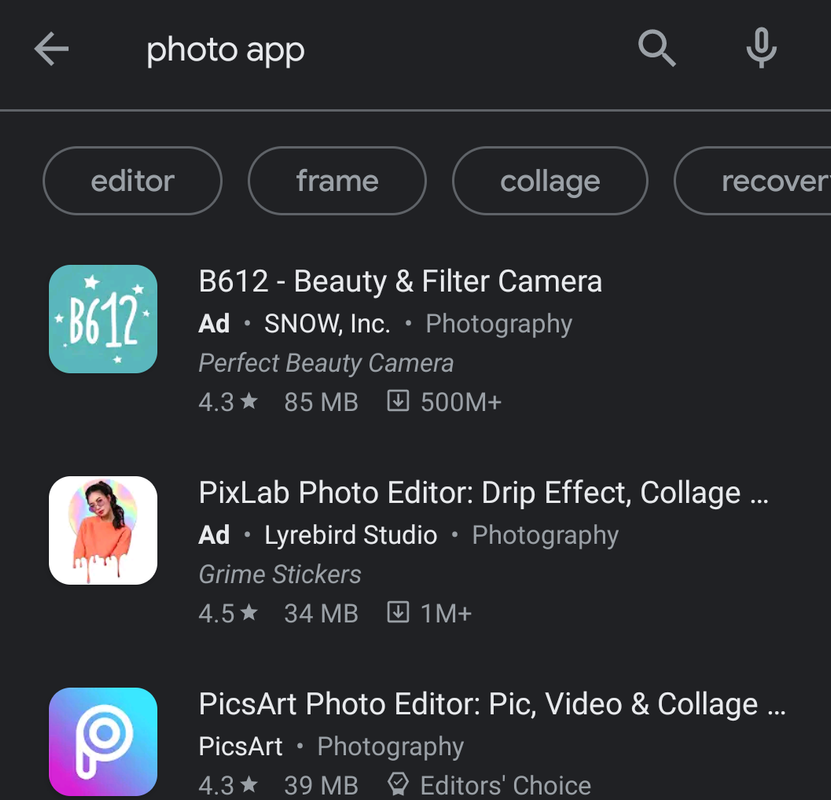
Even if you search the exact name, it will bombard you with whoever is paying the most.
2. Google closed source their play billing library recently. Apps which use the library can't be put on fdroid.
3. At Google I/O 2018, Google introduced an alternative app distribution format called the Android App Bundle with the file extension .aab. This format requires giving a copy of your app’s signing key to Google. AABs are harder for users to manually sideload as they aren’t natively supported by Android’s package installer and must be unpacked and devs have to do more work to distribute on other platforms.
4. Google killing Termux with Android 10 and many others relying on the functionality by removing the perms to execute binaries.
5. Fdroid can't auto update because of restrictions by google.
6. Broke custom recoveries such as TWRP.
7. Irresponsible automated ban of anything covid. Surprisingly this doesn't or never affect popular apps. Must be because they whitelist them.
2] https://www.xda-developers.com/f-droid-android-apps-google-p...
3] https://www.xda-developers.com/google-play-billing-v3-app-bu...
4] https://github.com/termux/termux-packages/wiki/Termux-and-An...
6] https://www.xda-developers.com/twrp-lead-explains-android-10...
Microsoft hardware with Android, a decent update lifecycle, MS365, alternate store, MS billing APIs, etc. would make a compelling offering IMO. The only thing I think MS would screw up would be sideloading. They seem to be all in on the current code signing / trust system and it's absolute trash.
There are so many industries that have been turned into complete garbage by rent seekers that I feel like anything that doesn't absolutely screw developers and customers would be super successful. The problem is that we only have about 5 tech companies on the planet that are big enough to compete.
App bundle is a way to reduce hassle of uploading multiple apks for cutting down apk size on different targets. Developers can and always have to build regular apks for other distribution platforms or for users to sideload. I don't see how AAB makes devs do more work.
All search engines do this. It doesn't depend on building scale and then exploiting it. The experience is better for the user.
> Amazon kills OSS business models by offering managed OSS services on AWS at an unbeatable cost.
All cloud providers do this. It also doesn't depend on building and exploiting scale. The experience is better for the user.
Apple needs to be transparent that it's not selling devices, it's licensing devices. Users do not control the devices they own.
Corporations buy up all the viable land, then rent rooms, or sell stock. They “bank” all your money and use it to profit for themselves.
Wax cylinders and vinyl records are like human society: round and round they go, skipping on all the same old knicks.
The financial ownership model is your real problem. Money is speech now in America.
Good luck.
Google scrapes info and displays it in widgets above links to the actual content. Google charges trademark holders AdWords ransom to protect searches for their own brands.
Amazon kills OSS business models by offering managed OSS services on AWS at an unbeatable cost. Amazon picks off the best performing market place categories with Amazon Basics ‘recommended’ competitors.
The list goes on and on.
Tech is an industry defined on building scale and then collecting rents. Apple IAP is just the current outrage but the entire industry is working towards building the next ‘platform’ for others to sharecrop on.