News for hackers. Stuff that matters.
Re:DirecTV races to decommission broken satellite before it ... by Zenbit_UX on Friday January 24, 2020 @09:47AM (#22138706)
> That's why they want to get it up into the graveyard orbit before the eclipse, so if it explodes, it does so in a orbit where the debris are very unlikely to disrupt the operation of active satellites.

A graveyard orbit sounds like it will be flying around up their indefinitely as high speed shrapnel. Does anyone know why they would choose this instead of destroying it on re-entry?

Re:DirecTV races to decommission broken satellite before it ... by tehbeard on Friday January 24, 2020 @10:08AM (#22138860)
https://en.wikipedia.org/wiki/Graveyard_orbit puts the difference in delta V requirements for a geo-sync orbit at ~1500m/s to de-orbit vs 11m/s to get boost up to graveyard orbit.
Re:DirecTV races to decommission broken satellite before it ... by leni536 on Friday January 24, 2020 @12:24PM (#22140362)
Interestingly it takes slightly less delta v to send the satelite out of Earth's gravity well from a geo-sync orbit than to deorbit it.
Re:DirecTV races to decommission broken satellite before it ... by greglindahl on Friday January 24, 2020 @02:09PM (#22141415)
Yes, direct-to-GEO missions sometimes dispose of the upper rocket stage in solar orbit for this reason.
Re:DirecTV races to decommission broken satellite before it ... by dls2016 on Friday January 24, 2020 @11:41AM (#22139835)
What's the physical intuition here? Is it that you want the de-orbit to hit the atmosphere at a shallow angle instead of plunging to earth?
Re:DirecTV races to decommission broken satellite before it ... by penagwin on Friday January 24, 2020 @12:18PM (#22140298)
Geostationary orbit is REALLY far away from earth (and also the atmosphere) compared to other orbits, but it's very special and so we want to keep as little junk in it as possible. Other types of orbits are so low, that they have to keep maintaining their orbit or they'll decay into the atmosphere.

So we're in a stable orbit with a high periapsis (closest part of our orbit to earth). To de-orbit we need to lower the periapsis so that it touches the atmosphere, and on each pass the satellite will slow down, further lowering the apoapsis and periapsis. The problem is that to do this we have to burn all that horizontal velocity that's keeping us in orbit in the first place, which is a crapload.

An alternative is to instead change the orbit so it's no longer in geostationary orbit and potentially interfering with live satellites, so instead they just push the satellite further out into the "graveyard orbit".

There's 100x difference in the needed energy for the two methods, and I'm sure you can see why most would opt for the graveyard orbit.

EDIT: To add, it's actually rather difficult to "plunge into earth". To do this you need to burn all of your horizontal velocity (I think that's around 3.07 km/s in geostationary orbit?). Reaching the sun is actually really difficult as well for the same reason, you have to lose all of your horizontal velocity, and earth has a ton.

Re:DirecTV races to decommission broken satellite before it ... by mark-r on Friday January 24, 2020 @02:09PM (#22141410)
How much of a danger is debris from an exploded satellite? Each fragment is going to be independent and have its own orbit. Any orbit higher or lower than the geostationary belt won't be a problem. Any orbit equal to the original satellite's won't be a problem either. Only those pieces maintaining the same altitude but a different direction will ever intersect the belt, and that will be a rare occurrence.
Re:DirecTV races to decommission broken satellite before it ... by Floegipoky on Friday January 24, 2020 @03:41PM (#22142228)
You're correct that each fragment will have its own independent orbit, based on the delta-v that it gained from the explosion. But they won't circularize; each of those new orbits will intersect the original orbit at the point where it exploded. The orbital periods of the fragments will also not match the original, meaning that the relative intersection will shift along the original orbit every time. So an explosion in geostationary orbit would be a Really Big Deal and could potentially threaten the whole geostationary fleet.
Re:DirecTV races to decommission broken satellite before it ... by Aperocky on Friday January 24, 2020 @02:27PM (#22141595)
Orbit can be both higher and lower, actually, any deltaV except purely in the axis of movement will result in exactly that.

Yes. you can accelerate away from the Earth and have a lower periapsis (conversely, you can accelerate towards the Earth and have a higher apoapsis). The only way you can maintain the same periapsis is by accelerating in the same direction you're going. Highly impossible in an explosion.

Also note, it is impossible to raise periapsis in a single event (or single time frame), except by leaving Earth orbit entirely (i.e. eject to planetary space)

Re:DirecTV races to decommission broken satellite before it ... by Aperocky on Friday January 24, 2020 @01:45PM (#22141197)
Wernher von Kerman approves this message.
Re:DirecTV races to decommission broken satellite before it ... by penagwin on Friday January 24, 2020 @04:57PM (#22142865)
My understanding of orbital mechanics is mostly because of KSP (and Scott Manley).

I HIGHLY recommend both of them.

Re:DirecTV races to decommission broken satellite before it ... by dvtrn on Friday January 24, 2020 @02:40PM (#22141711)
Jeb seems concerned
Re:DirecTV races to decommission broken satellite before it ... by willis936 on Friday January 24, 2020 @12:22PM (#22140338)
Geosynchronous orbit is a Very high altitude. It’s 6% of the distance to the moon. Inverse square law tells us the surface area that we have to worry about for debris is massive compared to lower altitude orbits. Additionally, it takes a lot of fuel to be able to de orbit high altitude satellites. As orbital altitude increases, de orbit costs start getting out of hand and there is less benefit to deorbiting. So while lower altitude, crowded orbits are required to de orbit to avoid catastrophic cascades from collisions, higher altitude orbits are allowed to simply get out of the way.
Re:DirecTV races to decommission broken satellite before it ... by ska on Friday January 24, 2020 @06:35PM (#22143401)

   Additionally, it takes a lot of fuel to be able to de orbit high altitude satellites.
I don't think this is so much an a 'additionally', as a 'mostly'.
Re:DirecTV races to decommission broken satellite before it ... by willis936 on Friday January 24, 2020 @08:30PM (#22144034)
Forest for the trees. The point is there is a crossover point in terms of cost/utility. That one word doesn’t seriously help in making the point.
Re:DirecTV races to decommission broken satellite before it ... by s_tec on Friday January 24, 2020 @12:22PM (#22140341)
Sattelites are always falling to the ground, but they are also going sideways really fast. Imagine tossing a pebble off of a bridge onto a boat - if the sideways velocity is too high, the pebble will miss the boat and land in the water instead. Sattelites are like that. They are going sideways so fast that they miss the Earth entirely as they fall to the ground. If you want a sattelite to come back to earth, you need to get rid of that sideways velocity, which takes fuel.
Re:DirecTV races to decommission broken satellite before it ... by pdonis on Friday January 24, 2020 @12:00PM (#22140079)
> Is it that you want the de-orbit to hit the atmosphere at a shallow angle instead of plunging to earth?

De-orbiting to hit the atmosphere at a shallow angle would actually take slightly less delta-v than de-orbiting to a straight plunge to Earth. But both are much larger than the delta-v required to get to a graveyard orbit.

Re:DirecTV races to decommission broken satellite before it ... by Dylan16807 on Friday January 24, 2020 @12:00PM (#22140074)
It doesn't de-orbit at all.

For physical intuition, uh, the atmosphere is a hundred times further away than the graveyard orbit.

Re:DirecTV races to decommission broken satellite before it ... by jvm_ on Friday January 24, 2020 @02:57PM (#22141863)
Earth orbit is like a funnel. If you're in geo-synchronous orbit, you're at the top edge (Earth is down by the hole). It's easier to jump off the edge of the funnel (and fall into the Sun's funnel) than it is to climb all the way back down to earth.
Re:DirecTV races to decommission broken satellite before it ... by fennecfoxen on Friday January 24, 2020 @03:15PM (#22142009)
The idea that there is an "edge" to the funnel is misleading. And if there were any edge, and it was at geosynchronous orbit, the Moon would have fallen off long ago.
Re:DirecTV races to decommission broken satellite before it ... by jvm_ on Friday January 24, 2020 @03:17PM (#22142020)
I guess the edge is more of the sweet spot where geosynchronous exists, too close or too far are both non-GEO.
Re:DirecTV races to decommission broken satellite before it ... by jessaustin on Friday January 24, 2020 @11:56AM (#22140027)
A small change in momentum requires less energy than a large change in momentum.
Re:DirecTV races to decommission broken satellite before it ... by jessaustin on Saturday January 25, 2020 @07:10PM (#22149495)
Umm, wat? Does someone seriously disagree with this?
Re:DirecTV races to decommission broken satellite before it ... by hanniabu on Friday January 24, 2020 @12:56PM (#22140709)
Interesting, but then we also need to somehow fly through that when launching outer space rockets. Amazing how we can avoid the debris.
Re:DirecTV races to decommission broken satellite before it ... by DuskStar on Friday January 24, 2020 @01:23PM (#22141004)
The graveyard orbits are ~40,000km above the earth's surface - there's a LOT of space to avoid debris in.

The issue with space debris is with orbits in the 500-5,000km range. Lower than that and the debris will reenter quickly, higher and you start getting spread out enough to not matter as much.

Re:DirecTV races to decommission broken satellite before it ... by dreamcompiler on Friday January 24, 2020 @01:39PM (#22141143)
> The graveyard orbits are ~40,000km above the earth's surface

They're also in a ring in the plane of the equator. Easy to avoid.

Re:DirecTV races to decommission broken satellite before it ... by hanniabu on Friday January 24, 2020 @02:41PM (#22141725)
I had no idea about this. How do they get it aligned with the equator? (I'm assuming when the stuff is in operation that it's not just around the equator)
Re:DirecTV races to decommission broken satellite before it ... by 0xffff2 on Friday January 24, 2020 @03:14PM (#22141996)
Geostationary satellites are in fact in a ring around the equator. No other orbit would keep them stationary in the sky.

Geosynchronous orbits are orbits at the same altitude, but not necessarily aligned with the equator. Most of what I know about orbital mechanics I learned from Kerbal Space Program, but given that it's very expensive to change orbital inclination, I would be shocked if geosynchronous satellites were returned to a flat inclination before being disposed of.

Re:DirecTV races to decommission broken satellite before it ... by outworlder on Friday January 24, 2020 @09:15PM (#22144197)
KSP is a very good approximation for most types of orbits we care about, including this case. Anything not involving N-body, like Lagrange points.
Re:DirecTV races to decommission broken satellite before it ... by dreamcompiler on Friday January 24, 2020 @08:30PM (#22144039)
Geostationary satellites are launched from near the equator and then accelerated into a true eastward orbit when they're put into service (eastward because the earth rotates in an eastward direction and we want the satellite's orbit to synchronize with the earth's rotation). They could in principle be launched from far away from the equator e.g. Florida but that would require a ridiculous amount of fuel to get them into an equatorial orbit. Once they go out of service, their onboard thrusters fire (accelerating the craft in a mostly easterly direction -- not "up"!) which has the effect of raising their orbital height to a graveyard orbit.
Re:DirecTV races to decommission broken satellite before it ... by dreamcompiler on Saturday January 25, 2020 @11:47AM (#22147094)
Too late to edit the above, but I need to make a major correction: US geostationary satellites are indeed launched from Florida, followed by a fuel-expensive plane change to get them into the equatorial plane. Other countries launch them from land they own or control closer to the equator.
Re:DirecTV races to decommission broken satellite before it ... by pacificmint on Friday January 24, 2020 @03:07PM (#22141942)
No, geostationary satellites actually are in a plane around the equator. That’s the only way geostationary orbit works. Otherwise they’d be moving with respect to the surface.

So they already are aligned and just need to be moved to a higher orbit.

Re:DirecTV races to decommission broken satellite before it ... by fennecfoxen on Friday January 24, 2020 @03:17PM (#22142018)
Well, they start getting spread out — except when you have everything together for that one special geosynchronous orbit. That's a bit of a problem too.
Re:DirecTV races to decommission broken satellite before it ... by penagwin on Friday January 24, 2020 @10:50AM (#22139238)
Oh... Yeah that explains it for sure.
Re:DirecTV races to decommission broken satellite before it ... by zymhan on Friday January 24, 2020 @11:30AM (#22139701)
Essentially, you need a ton of fuel to take a satellite back down to earth.
Re:DirecTV races to decommission broken satellite before it ... by staticautomatic on Friday January 24, 2020 @11:28AM (#22139670)
So it's more expensive to design satellites that can de-orbit?
Re:DirecTV races to decommission broken satellite before it ... by penagwin on Friday January 24, 2020 @01:48PM (#22141224)
From Geostationary Orbit yes, for other orbits it can be the opposite.

Satellites in lower positions actually have to maintain their orbit due to orbital decay. Because Geostationary orbit is so far away, there's a lot less decay.

For example SpaceX's starlink only has a lifespan of 5 years, and this is because of their low orbit.

Re:DirecTV races to decommission broken satellite before it ... by mumblemumble on Friday January 24, 2020 @11:40AM (#22139819)
It depends on where they are. Take a look at the diagram on that Wikipedia page linked above - a geosynchronous orbit is very high; 50 or so times further out than the ISS, for example. And that's about as far out as we ever put satellites, so you've only got to boost it by a little bit to get out of the way of active space traffic.
Re:DirecTV races to decommission broken satellite before it ... by snuxoll on Friday January 24, 2020 @10:34AM (#22139096)
> A graveyard orbit sounds like it will be flying around up their indefinitely as high speed shrapnel. Does anyone know why they would choose this instead of destroying it on re-entry?

Because the ∆v required to re-enter the atmosphere is significantly higher than that required to leave geosynchronous orbit for a higher graveyard orbit.

But yes, ultimately it will remain up there as "high speed shrapnel" - which is not an ideal situation, and continuing to treat disposal as we have may put us in a situation where these orbits become so full of high speed garbage that they are unusable. As a species, we need to do more work on cleaning up our space garbage before it's too late.

Kurzgesagt actually has a great video on the topic of space debris for anyone interested: https://www.youtube.com/watch?v=yS1ibDImAYU

Re:DirecTV races to decommission broken satellite before it ... by phkahler on Friday January 24, 2020 @10:40AM (#22139162)
Starship should make it feasible to go garbage collecting up there. That doesnt mean anyone will pay for it though.
Re:DirecTV races to decommission broken satellite before it ... by penagwin on Friday January 24, 2020 @10:52AM (#22139261)
Keep in mind to do garbage collecting you are essentially trying to intercept high-speed objects that likely have no telemetry. If your speed and orbit aren't correct, or if there's shrapnel or other debris, you'll destroy your ship.

And you can only pickup garbage that's in a similar orbit too.

Re:DirecTV races to decommission broken satellite before it ... by greglindahl on Friday January 24, 2020 @02:13PM (#22141453)
We're talking about the graveyard orbit, which is not far from geosynchronous orbit.

In fact there's such an intercept being done soon, the mission extension vehicle (MEV) is going to rendezvous with an old but still controlled satellite in order to extend its useful life. This rendezvous is being done in the graveyard orbit in case something goes wrong.

https://en.wikipedia.org/wiki/Mission_Extension_Vehicle

Re:DirecTV races to decommission broken satellite before it ... by toyg on Friday January 24, 2020 @11:12AM (#22139487)
There is an old anime about that: Planetes.
Re:DirecTV races to decommission broken satellite before it ... by ShakataGaNai on Friday January 24, 2020 @12:06PM (#22140147)
I watched that one back in the day. It's been as while but as far I as remember it was fairly decently done on the space physics/what can go wrong aspects.
Re:DirecTV races to decommission broken satellite before it ... by gerikson on Friday January 24, 2020 @12:37PM (#22140499)
One of my favs. I love the mix of SF and slice-of-life.
Re:DirecTV races to decommission broken satellite before it ... by slowhand09 on Friday January 24, 2020 @11:21AM (#22139591)
I prefer having technology to vaporize rather than collect. But if we have the technology, just a scanning tractor beam to collect the debris. My guess is it'll all be too primitive for any reuse. So collecting it with a beam, then projecting it in a sun-seeking trajectory by reversing the beam.
Re:DirecTV races to decommission broken satellite before it ... by fennecfoxen on Friday January 24, 2020 @03:24PM (#22142083)
"Vaporizing" a satellite is a misleading concept which draws on atmospheric analogies that do not hold up.

A satellite is made out of metal and such things. You can heat that metal hot enough to melt it, but then its structural integrity will fail, and the liquid will disperse into a cloud of metal droplets while other satellite-parts drift away. When the metal droplets cool off, they will still remain in about the same orbit. This does not make an impact with any of these droplets particularly safe.

Transporting the amount of energy to properly vaporize metal is also problematic and expensive.

We do not possess tractor beam technology. Our tractors on this planet all use mechanical linkages. If we did have tractor beam technology, powering it would remain a problem.

Re:DirecTV races to decommission broken satellite before it ... by wahern on Friday January 24, 2020 @05:12PM (#22142946)
We do possess optical tractor beam technology:

> However, about 10 years ago, researchers found that the object may experience an optical pulling force (OPF) toward the source direction when illuminated by an unfocused beam, such as a diffraction-free (nondiffraction) Bessel beam, which is named an optical tractor beam (OTB). Although it seems counterintuitive, OPF has been theoretically proved and experimentally demonstrated within recent years, as will be reviewed in this paper.

Source: https://www.spiedigitallibrary.org/journals/advanced-photoni...

Although, there's a lot of distance to cover between the current state-of-the-art and actually capturing orbital debris.

Re:DirecTV races to decommission broken satellite before it ... by dvtrn on Friday January 24, 2020 @02:45PM (#22141756)
I prefer having technology to vaporize rather than collect.

The ESA is putting a lot of focused attention behind this very thing, to certain extents [0]

[0] https://conference.sdo.esoc.esa.int/proceedings/sdc7/paper/7...

Re:DirecTV races to decommission broken satellite before it ... by fennecfoxen on Friday January 24, 2020 @03:24PM (#22142093)
Only for breaking up satellites already approaching the atmosphere, though.
Re:DirecTV races to decommission broken satellite before it ... by ufmace on Friday January 24, 2020 @10:06AM (#22138839)
Geostationary orbit is very high. It would be cost-prohibitive for satellites designed for geostationary service to maintain enough fuel to drop their orbits into the atmosphere. Instead, they move them into a slightly higher graveyard orbit, where hopefully any collision or breakup debris is unlikely to be able to get to an orbit where it could intersect a satellite still in service.

I guess there's a hope that someday we'll figure out a way to recover and permanently de-orbit all of them.

Re:DirecTV races to decommission broken satellite before it ... by klarstrup on Friday January 24, 2020 @10:53AM (#22139267)
"It would be cost-prohibitive not to litter"

If one can't do business without carelessly leveraging finite public resources I would argue that that business is untenable

Re:DirecTV races to decommission broken satellite before it ... by ineedasername on Friday January 24, 2020 @11:24AM (#22139616)
Untenable only in a stable-state eco/technological culture. If, however, the technological culture of which satellites are a part is able to bootstrap itself through behaviors that are only viable in the short term, and burst through to levels of capability that are long-term viable and can rectify the short-term behaviors that came before, then everything can work out alright.

I know, I know, the above is close to hopelessly optimistic. It's like when I was younger: I remember thinking, "I'm not going to smoke cigarettes, but if I did it would probably be okay. By the time it would really matter, medicine will have surely found cures." I was an idiot, though I never did smoke.

Re:DirecTV races to decommission broken satellite before it ... by 627467 on Friday January 24, 2020 @11:50AM (#22139962)
This is the type of judgmental comment/rationale that we hear around climate change as well... 'if humanity never knew how to do it properly - considering forseen and unforseen circustances - we should never have done it'

Public resources are always consumed while public exists. We should thrive to always experiment, learn from it and evolve/do better.

Re:DirecTV races to decommission broken satellite before it ... by ufmace on Friday January 24, 2020 @07:13PM (#22143585)
Something like that suggests it would be good to step back a bit and rethink things. So why is litter bad? Litter is usually regarded to mean disposal of trash consisting of manufactured goods in natural areas, such as parks, forests, oceans, lakes, etc. It's considered to be bad because it's visually unsightly to humans, may interfere with wildlife in various ways, and may result in various types of toxic chemicals leaking out into the environment.

When we're talking about satellites in graveyard orbits, no humans can see it, there's no wildlife, or really any environment to damage. None of the concerns we have with litter apply. Trying to speak against it as if it's litter is then either an attempt to shoehorn a concept into a place where it doesn't apply to make a snap judgement, or a malicious attempt to attach something for other reasons. No comment on which is going on here, but if you're going to convince anybody not to enjoy the many benefits of geostationary satellites, you're going to need to make a better case than likening it to "litter".

Re:DirecTV races to decommission broken satellite before it ... by fennecfoxen on Friday January 24, 2020 @04:10PM (#22142483)
Do you hold graveyard orbits located 11m/s above GEO to be an inadequate or irresponsible way of preserving the integrity of GEO?
Re:DirecTV races to decommission broken satellite before it ... by Dylan16807 on Friday January 24, 2020 @12:07PM (#22140174)
Not cost-prohibitive. Just cost. Devoting 5% of the mass to an ion deorbit thruster wouldn't be particularly hard.
Re:DirecTV races to decommission broken satellite before it ... by mNovak on Friday January 24, 2020 @12:15PM (#22140266)
How long would that take to deorbit? Don't want junk slowly drifting through every other orbital path on the way down, either.
Re:DirecTV races to decommission broken satellite before it ... by Dylan16807 on Friday January 24, 2020 @12:24PM (#22140368)
A single digit number of years, I think. Not too bad, especially since you can control its path.
Re:DirecTV races to decommission broken satellite before it ... by mongol on Friday January 24, 2020 @12:27PM (#22140403)
Why is it higher, rather than lower? If it is higher, will it not eventually be back in geostationary orbit?
Re:DirecTV races to decommission broken satellite before it ... by zentiggr on Friday January 24, 2020 @12:43PM (#22140569)
At these orbital heights, there is no atmosphere for drag effects, so adding energy to move to a slightly higher orbit, outside of true geosync altitude, is a permanent change.

Low Earth orbits do have atmospheric drag issues, and those items need to have fuel to replace lost velocity and restore the correct orbit.

The ISS page has a neat table of orbital height over time where you can see the burns to 'jack it back up'.

Re:DirecTV races to decommission broken satellite before it ... by sidewndr46 on Friday January 24, 2020 @09:53AM (#22138750)
Getting from Geostationary orbit to re-entry is not easy. It isn't like the ISS where essentially if you blink, the thing burns up in the atmosphere. You need a huge amount of delta-v. My guess is the satellite is in poor enough condition they aren't 100% certain they can get it to start hitting the atmosphere before the imminent explosion occurs.
Re:DirecTV races to decommission broken satellite before it ... by larkeith on Friday January 24, 2020 @01:15PM (#22140929)
Note that because the Earth is tilted, this region of space is pretty much useless - there's very few (if any) useful orbits beyond a geostationary, and any spacecraft heading into interplanetary space is going to be aligned with the plane of the solar system (ecliptic), and won't pass through GEO or graveyard orbits. So while you do get shrapnel, it's spread across a very large region through which nobody travels.
Re:DirecTV races to decommission broken satellite before it ... by nucleardog on Friday January 24, 2020 @02:05PM (#22141374)
This graphic on Wikipedia is probably really helpful to visualize some of this: https://en.wikipedia.org/wiki/Kessler_syndrome#/media/File:D...

While there's a lot of space junk up there, you can see that the graveyard orbit is in fact a fairly tight line around the equator. It should be quite easy to avoid.

From the look of it, it's kinda functionally equivalent to putting a fence around an airport. I mean, sure, it theoretically limits your options, but not in any practical way.

Re:DirecTV races to decommission broken satellite before it ... by orclev on Friday January 24, 2020 @09:57AM (#22138780)
> A graveyard orbit sounds like it will be flying around up their indefinitely as high speed shrapnel. Does anyone know why they would choose this instead of destroying it on re-entry?

It sounds like there's confusion about that point. The article says that the plan says that they're going to de-orbit the satellite so it can burn up on reentry, and that it will be in a graveyard orbit, which are contradictory objectives to each other. It sounds like AT&T hasn't responded yet to clarify which of the two they actually meant.

Re:DirecTV races to decommission broken satellite before it ... by zentiggr on Friday January 24, 2020 @12:47PM (#22140614)
I think in this case the use of 'de-orbit' only means removing it from its in-service geosynchronous orbit, to the graveyard orbit.

De-orbit down around usual LEO altitudes is more drag-effect, you will return to Earth soon enough anyway.

Re:DirecTV races to decommission broken satellite before it ... by alex_young on Friday January 24, 2020 @11:44AM (#22139870)
For everyone worried about polluting geo distance orbits, consider that geosynchronous is about 35,786 km from the surface, or about 6x the radius of the earth away.

Suffice to say this is a very great distance, and the probability of a collision orbit at this distance is so phenomenally unlikely that even if left in place there is nothing to consider of this risk.

Moving to a higher and unused orbit means nothing will ever impact it in any human time horizon.

Re:DirecTV races to decommission broken satellite before it ... by azinman2 on Friday January 24, 2020 @11:56AM (#22140028)
Can that really be true? You’re still having the thing rotate along. I worry about space filling up with satellites with no good ability to retrieve them..
Re:DirecTV races to decommission broken satellite before it ... by mandevil on Friday January 24, 2020 @12:17PM (#22140289)
Space is really, really big. When you hear that the Sun has an Asteroid belt, you imagine that it is like Empire Strikes Back. In actuality, the belt works out to 1 extra atom per m^3 of space, because, well, see above about how big space is. That is basically what we're talking about with satellites here- all of our space junk in graveyard orbits is less dense than that, last I checked (which was 4-5 years ago).

Low Earth Orbit is a bigger concern; but much of the concern in that region is spent rocket stages which have enough propellant inside them that they eventually explode and then for several months-years we have lots of debris (and then threat of a Kessler Cascade). The international community has responded to this threat by adding regulations on the proper disposal of spent rocket stages. (Occasionally, similar to this satellite, there are failed stages which do explode, but it should not happen often or on a normal path.)

Re:DirecTV races to decommission broken satellite before it ... by dralley on Friday January 24, 2020 @09:53AM (#22138752)
My guess is that Geosynchronous Orbit at too high an altitude for them to re-enter the atmosphere under their time or fuel constraints.

http://acqnotes.com/wp-content/uploads/2014/09/Orbit-Map.png
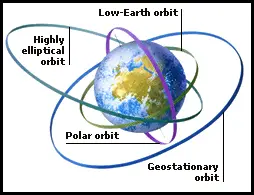
But it's just a guess.

Re:DirecTV races to decommission broken satellite before it ... by panzagl on Friday January 24, 2020 @10:13AM (#22138901)
It would take too much energy to de-orbit quickly, it's probably pretty big and unlikely to be fully destroyed in the atmosphere, and there's not much beyond geo for a shrapnel cloud to run into.