News for hackers. Stuff that matters.
Re:Duolingo becomes first VC-funded $1B Pittsburgh tech startup by orliesaurus on Friday December 06, 2019 @06:38PM (#21727212)
They have users... but the tool(app), other than being really cute and well made, is super basic... You can't expect to be fluent enough in a language JUST with Duolingo, at most you will be able to read a few sentences and spit out a few basic sentences and words.

Is that enough? Definitely not. Not for me at least. They basically give you the 'hello world' of a language.

I speak 5 languages (learned through school and life choices) but when I tried to learn a 6th on Duolingo I felt like the experience was not good enough for me. A tutor or a class would probably be mandatory and using Duolingo just for re-affirming some basic concepts would be a nice to have, like a companion app..but they have to be able to let teachers create their own lessons.

Re:Duolingo becomes first VC-funded $1B Pittsburgh tech startup by newguy1234 on Saturday December 07, 2019 @02:37AM (#21729003)
This is the big problem in edtech. If you want to gain tons of users in edtech then you just need to make a bunch of very basic type materials which allows users to not get frustrated (and leave) and allows the platform to create lots of easy to develop content. For anyone serious about edtech, this is a problem because only having a basic understanding of a subject is pretty much useless. At a certain point, you need high-quality (college-level equivalent) type content. For edtech companies, that content is both harder to make and thus more expensive. At the same time, the userbase interested in that level of material declines rapidly.
Re:Duolingo becomes first VC-funded $1B Pittsburgh tech startup by PopeDotNinja on Saturday December 07, 2019 @04:46AM (#21729367)
I concur. I'd phrase like this... at some point you transition from offering the course highlights to simply offering the course. And the highlights seeker is probably a different customer to the more ambitious student.
Re:Duolingo becomes first VC-funded $1B Pittsburgh tech startup by Roritharr on Saturday December 07, 2019 @03:42AM (#21729202)
This is interesting, looking from the outside I've always assumed that edtech had the problem of their content becoming less valuable too fast and figured they should invest more in better presentation and delivery of user-generated/curated content than on content itself.
Re:Duolingo becomes first VC-funded $1B Pittsburgh tech startup by jaredhansen on Friday December 06, 2019 @08:41PM (#21727871)
>I speak 5 languages (learned through school and life choices) but when I tried to learn a 6th on Duolingo I felt like the experience was not good enough for me.

Well of course it isn't, but that's like saying "I'm a fighter pilot (trained in the air force), but when I try to use Flight Simulator X, it feels like the experience isn't good enough for me." The DL experience isn't really for you at all. It's for people would a little bit like to learn a new language. Not people who want to do it so badly that they'll invest substantial time in school and "life choices" to make it happen.

Re:Duolingo becomes first VC-funded $1B Pittsburgh tech startup by jinushaun on Saturday December 07, 2019 @06:31AM (#21729711)
No, Duolingo is just actually bad. They gamified language learning and I have “beaten the game” in a few languages and it did not make me conversational in those languages. Nor could I read a real world newspaper or Wikipedia page in the target language. That is entirely Duolingo’s fault.

The app teaches you facts, but not conversation. The sentences increase in grammar complexity, but not depth or diversity of topics. Even with their language bots, you’re still having super basic conversations about nothing.

They could easily fix this by simply improving the quality of the sentences in the later lessons. Or switch to a different testing format, which worked in the beginning but don’t scale well once you’re past the middle and comfortable with the language. Maybe include substantial reading and listening comprehension exercises (i.e., multiple sentences), instead of a single complex sentence.

Duolingo has concrete problems with concrete solutions.

Re:Duolingo becomes first VC-funded $1B Pittsburgh tech startup by simias on Saturday December 07, 2019 @07:31AM (#21729936)
Duolingo is useless on its own, especially for harder language pairs. The only reason it's popular is because of the gamification, I find that apps like Memrise or LingQ are massively more useful to actually improve your language skills. Those apps focus on specific skills (vocabulary learning through spaced repetition for Memrise, learning comprehension for LingQ) which means that you have to use other methods to work on other aspects like grammar and conversational skills but at least they attempt to do one thing and they do it mostly well.

The only added value I have from using Duolingo is getting some amount of practice actually constructing my target language but even then it's hugely limited because:

- You never have any context which makes the experience always completely artificial and makes it harder to get a feel or the language. IMO Duolingo would be 10x better if lessons followed (even very loosely) an internal story instead of just having random, often contrived sentences one after the other. Something as simple as recurring characters, simple common situations etc... It would make it a lot easier to have a mental model of the world you're talking about and it doesn't seem like it would complicate things heavily.

- The bulk of the practice involves translation exercises which is limiting and can even be counterproductive. A very important step towards fluency in any language is to stop translating and start constructing the language directly. I'm not a native English speaker but as I write these words I'm not translating a French internal monologue, I know what I want to say and I say it in English directly. It's faster and more natural that way.

- The killing blow is that those translation exercises are corrected by, as far as I can tell, some sort of complicated regexp engine. It's very common for a correct-but-unexpected solution to be rejected and when it gets reported it can lingers for years without being fixed. As such you start not to trust the correction given when you don't understand precisely why your sentence was wrong.

That last point is really frustrating. I'm a native French speaker and I tried finishing the "French for English speakers" tree using shortcuts to get an idea of the quality and I simply can't reliably unlock the checkpoints on my first try because some of my perfectly fine and idiomatic French sentences end up not fitting the regexp and be marked wrong.

Re:Duolingo becomes first VC-funded $1B Pittsburgh tech startup by umanwizard on Sunday December 08, 2019 @10:52AM (#21736468)
I'm a non-native French speaker, but I had very similar thoughts: https://news.ycombinator.com/item?id=16827225

(I've since been told that people in France do say "le menu", but I stand by the rest of that comment.)

Re:Duolingo becomes first VC-funded $1B Pittsburgh tech startup by yabadabadoes on Saturday December 07, 2019 @07:29AM (#21729924)
I think the issue is that they want people who use it less than 10 minutes a day to still make progress and feel they are making a lot of progress. Following spaced repetition rules they can only add minimal amounts of vocabulary and they need to spend that vocabulary on intros to new themes that can be completed in 30 minutes or less.

Older versions were a little less tuned to keeping the large audience, did typing without seeing the options, and went into some areas of interest of members of each language group. Reverting any of which would be improvements for teaching the most engaged users at the cost of losing 10X as many barely engaged participants.

It is the general problem of tuning content to learner's with out an outside authority preventing tuning to learner laziness.

Re:Duolingo becomes first VC-funded $1B Pittsburgh tech startup by krustyburger on Friday December 06, 2019 @08:48PM (#21727909)
They aren’t promising the equivalent of a flight simulator, they’re claiming you’ll actually learn these languages. So I think the parent comment’s is a valid critique.
Re:Duolingo becomes first VC-funded $1B Pittsburgh tech startup by dx87 on Friday December 06, 2019 @10:01PM (#21728190)
My parents are a good example of their target audience. They live in Alaska and planned a weeklong vacation in Panama, so they used Duolingo for 4-5 months before they left in order to learn enough spanish that they could ask and answer basic questions during their trip, but they have no desire to spend the time required to be fluent enough to have a full conversation.
Re:Duolingo becomes first VC-funded $1B Pittsburgh tech startup by AlchemistCamp on Saturday December 07, 2019 @04:07AM (#21729257)
The sad thing is that if they'd spent just one month on a Michel Thomas or Pimsleur course, they'd have been at a higher level and been ahead in accent, too.

Typing word and sentence translations from your L1 into a language you don't speak just isn't a good way to learn a language.

Re:Duolingo becomes first VC-funded $1B Pittsburgh tech startup by dkarras on Saturday December 07, 2019 @08:05AM (#21730069)
Nothing sad about it, those cost money and are not as gamified so they require consistent willpower. If duolingo didn't exist, they would not put in the work to start learning, period. Different people have different aims. I'm halfway through the Dutch course (230 day streak, so I put in at least 10 minutes every day for the last 230 days) and found it immensely valuable. It helped me build a habit magically, which is something I struggle with all my life. I would never work on something 200+ days in a row. Some days I study more than an hour, some days I do the bare minimum but I do it every day to keep my streak. I am able to form novel sentences and express my ideas with the vocabulary I have. That is all I need.

Right now I can comfortably comprehend any A1 text, and can get by with A2 text when I look up the meaning of some words. I'm only halfway through. I can speak enough to at least successfully use speech to text on my phone (I answer textual questions on my phone by speaking and letting it turn my speech to text). I can understand some children shows. I have ONLY worked with Duolingo (and I read Dutch reddit comments). If it weren't for Duolingo I would never stick to it.

Re:Duolingo becomes first VC-funded $1B Pittsburgh tech startup by Jestar342 on Saturday December 07, 2019 @05:18AM (#21729473)
Duolingo has (automated) vocal lessons.
Re:Duolingo becomes first VC-funded $1B Pittsburgh tech startup by simias on Saturday December 07, 2019 @07:14AM (#21729862)
That's the worst part of the app because they use synthetic voices for most courses (the only one I know that doesn't is the Latin one, probably because there aren't many off-the-shelf Latin text-to-speech).

I'm often hanging on the (absolutely terrible from a usability perspective) Duolingo forums to help people attempting to learn French and as such I often encounter people complaining that they can't figure out what the voices are saying. As a native speaker I can generally make out what it's supposed to say but it definitely sounds off and artificial. And even when the pronunciation is technically correct it's completely flat and lacks the natural emotion and emphasis a native speaker would use.

The fact that an app who's supposed to teach you languages relies on crappy text-to-speech to teach you pronunciation tells you everything you need to know about Duolingo.

Re:Duolingo becomes first VC-funded $1B Pittsburgh tech startup by organsnyder on Saturday December 07, 2019 @09:49AM (#21730526)
The Spanish voices are quite good—real people, and with similar pronunciation to what I hear from native speakers.
Re:Duolingo becomes first VC-funded $1B Pittsburgh tech startup by mkl on Saturday December 07, 2019 @12:25AM (#21728665)
How did they go? Was it sufficient?
Re:Duolingo becomes first VC-funded $1B Pittsburgh tech startup by pikma on Saturday December 07, 2019 @12:44AM (#21728726)
Anecdotally I did the same before a trip to Brazil and I found it very useful.
Re:Duolingo becomes first VC-funded $1B Pittsburgh tech startup by dhdjdhd on Friday December 06, 2019 @09:48PM (#21728139)
My wife is using to learn Spanish, and she doing pretty good.

First she’s really dedicated to it.

And then she also has a lot of exposure to it. My kid goes to Spanish school, my parents speak Spanish, and she already understand a third latin language.

So I see duolinguo as a way to systematically increase vocabulary so that you can better understand the language your exposed to.

Re:Duolingo becomes first VC-funded $1B Pittsburgh tech startup by munmaek on Saturday December 07, 2019 @11:35AM (#21731101)
You can’t learn a language without making substantial investments of time. Anyone can “learn” some words and maybe a little grammar, but that’s not learning a language in the slightest.

Duo lingo is trash for learning languages, particularly Asian ones. People just get suckered in with illusions of learning a language without doing any real work, which is flat out impossible.

You’re better off using almost anything else, such as glossika.

Re:Duolingo becomes first VC-funded $1B Pittsburgh tech startup by amelius on Saturday December 07, 2019 @06:31AM (#21729716)
The comparison to fighter pilot is inaccurate, because literally anyone can learn to speak a language.

The correct comparison is between motivated and unmotivated people.

Re:Duolingo becomes first VC-funded $1B Pittsburgh tech startup by guptaneil on Friday December 06, 2019 @06:46PM (#21727267)
I agree that Duolingo is not sufficient to become fluent in a language, but I’d argue that no app could be. Immersion is generally the only way to become fluent.

Having said that, I’ve found the learning experience on Duolingo varies wildly depending on the language. French, for example, has an excellent curriculum with stories and live conversations with bots. Dutch or Hindi on the other hand are extremely lacking.

Re:Duolingo becomes first VC-funded $1B Pittsburgh tech startup by benatkin on Friday December 06, 2019 @08:22PM (#21727794)
It's worse than virtually any other way to learn a language. Saying that you can't expect it to be perfect doesn't justify it being really bad.

DuoLingo isn't optimized to learn a language, it's optimized to give people the feeling they're learning a language.

Flash cards are better, books are better, CDs are better, Spotify is better, YouTube videos are a lot better, and learning in person is way better.

Re:Duolingo becomes first VC-funded $1B Pittsburgh tech startup by SpicyLemonZest on Friday December 06, 2019 @08:28PM (#21727823)
But is that actually true? When I see people say Duolingo is bad, they're always comparing it to some highly optimized language learning strategy, where you weave together Anki and suchandsuch grammar resource and a strict regimen of 30 minutes of target language media every day.

I'd agree that Duolingo significantly compromises effectiveness for the sake of engagement, but to most people engagement is the hardest part of learning a language!

Re:Duolingo becomes first VC-funded $1B Pittsburgh tech startup by AlchemistCamp on Saturday December 07, 2019 @04:18AM (#21729287)
Yes, it's true. Using Duolingo is significantly worse than just about all your other options, including picking up a $30 Living Language textbook/workbook/CD set of whatever language you want. Living Language isn't aimed at university students or the most motivated people either. It's just one of the cheaper options.

This is not just a throwaway comment, either. I've built and run a language school for four years (with two partners), taught thousands of children, worked at a language learning startup, and have read a lot L2 acquisition papers and know this space pretty well. I also contributed to Anki long ago, but I'm not a huge fan of using SRS for learning vocabulary. Extensive reading (and listening once you can) is a far better strategy. (Anki is pretty good for memorizing discrete pieces info though, such as how to write each Chinese character or all the atomic weights and numbers on the periodic table).

As for engagement, I think Duolingo is pretty boring compared to making new friends, talking with people or even just reading a book about something I'm curious about. If you're learning any popular language (e.g. English, French, Spanish, Mandarin, Japanese, etc), you'll be able to find some pretty good graded readers aimed at beginners that let you start actually reading in your first few months of studying.

Re:Duolingo becomes first VC-funded $1B Pittsburgh tech startup by Jd on Saturday December 07, 2019 @05:53AM (#21729585)
> I'm not a huge fan of using SRS for learning vocabulary. Extensive reading (and listening once you can) is a far better strategy

Can you explain your logic and how you measure success? FWIW I'm ~8 languages deep and started using SRS with my 5th language. For the last couple languages I've tracked my metrics extensively (i.e. words learned and retained per day). Also with the SRS tool I use I read sentences along side the words I'm learning so I get some context.

Re:Duolingo becomes first VC-funded $1B Pittsburgh tech startup by AlchemistCamp on Saturday December 07, 2019 @06:32AM (#21729721)
There's a lot of L2 acquisition research on extensive reading and it's definitely worth checking out.

I covered some of my reasoning about the limitations of SRS in the 2nd half of this podcast: https://alchemist.camp/learning-machine/spaced-repetition-sy...

Re:Duolingo becomes first VC-funded $1B Pittsburgh tech startup by Jd on Saturday December 07, 2019 @01:40PM (#21731818)
Seems like you pretty much contrast:

[1] SRS flashcard apps as an exclusive language learning system

[2] Extensive reading

While (2) is clearly better if those are your only choices, as you point out yourself SRS can easily be integrated into other curriculum or used as a supplemental tool. I'm not sure how many languages deep you are but I find getting through the first 1000-3000 words a real slog in the language and it is also quite hard to read in a language when you are at sub-3000 words unless you are reading especially prepared texts in a textbook for language learners.

My preferred method is to do the basic grammar of a language and first 2000 words as quickly as possible with a cram method and then work on speaking and transitioning from passive to active vocabulary. SRS is a nice tool, esp. if the SRS tool you are using also has included sentences in context (I mostly use learnwitholiver.com). Then usually I work to train for the state run test of the language that I'm studying at a reasonably high level.

Re:Duolingo becomes first VC-funded $1B Pittsburgh tech startup by Jd on Sunday December 08, 2019 @07:46AM (#21735621)
Turns out Gwern has a very well researched article on SRS: https://www.gwern.net/Spaced-repetition
Re:Duolingo becomes first VC-funded $1B Pittsburgh tech startup by AlchemistCamp on Sunday December 08, 2019 @09:10AM (#21735949)
That's odd. Your strategy of rushing through basic grammar and a small number of words quickly is actually a use case I said SRS is useful for.

In the link you're responding to, I said:

> "The second situation where spaced repetition works really well is when you're studying something more complex, but you can use spaced repetition as a scaffold to get through the initial phases a bit faster. Learning vocabulary is like this. Though there are the issues that pointed out earlier about context and collocations and word boundaries, spaced repetition can still be a huge win. And that's because you don't have to use it to learn and remember everything. You can use it to get a scaffold, to get started with whatever foreign language you're learning or medical vocabulary or whatever kind of vocabulary. And after having memorized, say, five hundred or a thousand or even five thousand words in this new area that you're studying, you can then do a lot of reading and use those words and encounter them in many different contexts and actually acquire a solid grasp of that topic."

I would definitely start with training my ear to the sounds in a language at the very beginning, but flashcards can also be a useful supplement early on. It's funny you mention Oliver! I was in contact with him when he first launched his site (just for Chinese, initially). For what it does, it's made well. LingQ is probably my favorite for getting the initial base down, though.

FWIW, I don't think I've every encountered anyone who saw SRS as an exclusive language learning system, except maybe a few hopeful app developers who have realized how easy it is to make a flashcard app.

The real question is how much of your study time do you want to spend on decontextualized sentences or words vs time spent on sustained reading, listening or conversation?

Re:Duolingo becomes first VC-funded $1B Pittsburgh tech startup by Jd on Sunday December 08, 2019 @11:35AM (#21736688)
I track my time via 22 minute segments and typically do ~3 per day of vocab vs 9 per day of structured language learning and another 6 per day of reading and writing. So of the structured time I spent language learning it is a bit less than 20% of the time I spend. My target is about 100 words per day but my actual best time over an extended period is about 58 words per day on tracked words. Oliver is good but there are a bunch of features I'd add if I could. Will check out LingQ as well.
Re:Duolingo becomes first VC-funded $1B Pittsburgh tech startup by DiogenesKynikos on Saturday December 07, 2019 @10:00AM (#21730579)
One of your criticisms of spaced repetition is the difficulty of representing associations between words on flashcards. I agree that that's difficult (though you can mitigate it by including example sentences in your deck). However, I think that that criticism expects too much of spaced repetition. It's a very powerful technique for learning and holding onto new vocabulary, but it doesn't replace reading, listening and speaking. You really can't learn nuances of word meaning with flashcards alone, but you can build up and retain a large vocabulary. You can deepen your understanding of the subtleties of the language in other ways.
Re:Duolingo becomes first VC-funded $1B Pittsburgh tech startup by claudeganon on Friday December 06, 2019 @10:58PM (#21728366)
I would say that Duolingo does the distinctly American thing of optimizing for making you “feel good” about your progress, even if that progress has no correlation with actual language ability. It’s more of a self-esteem simulator by way of language-learning than it is a useful tool for foreign language instruction.
Re:Duolingo becomes first VC-funded $1B Pittsburgh tech startup by DiogenesKynikos on Saturday December 07, 2019 @02:57AM (#21729068)
The point is that if you want to learn a language, you either follow an intensive regimen like the one you've described, or you don't and you make essentially no progress. Learning languages is not rocket science. It's mostly just work and dedication.
Re:Duolingo becomes first VC-funded $1B Pittsburgh tech startup by sjy on Friday December 06, 2019 @09:27PM (#21728050)
What do you mean by worse? I’ve spent a lot of time on Duolingo as well as in face-to-face language classes, in high school and university. I’ve also spent a smaller amount of time self-studying from books, CDs and software that predated Duolingo. I’m not fluent in any of the languages I’ve studied because of a lack of immersion, but I learned a lot more from Duolingo than any other source because it was so easy to establish a daily habit and stick with it without having to pay anything. I’ve had basic conversations as a tourist in France after learning French exclusively from Duolingo. I’m sure I would have learned more if I spent that time in class instead, but I didn’t because it’s very expensive and inconvenient compared to spending 30 minutes a day on Duolingo while I’m commuting.
Re:Duolingo becomes first VC-funded $1B Pittsburgh tech startup by benatkin on Friday December 06, 2019 @09:43PM (#21728117)
It is inefficient. The vocabulary lessons on Spotify run through words a lot faster. You don't have free reign of what category to study things in. It teaches vocabulary when you should be learning grammar. It teaches pronunciation just by having you repeat words, which is inadequate - the specifics of pronunciation (including emphasis of syllables) must be explained.
Re:Duolingo becomes first VC-funded $1B Pittsburgh tech startup by sjy on Friday December 06, 2019 @09:59PM (#21728185)
I don’t doubt that it’s less efficient than learning from a human teacher, if you just look at the time spent by the student and ignore the “efficiency” of software that interacts with millions of students at the same time. I’ve never heard of anyone learning a language by passively listening to Spotify, so I have a hard time seeing it as a Duolingo alternative, but I’m sure just like Duolingo and other language tapes, it would be a valuable complement to any other language-learning tool. None of them will make you fluent without immersion.

What makes you say that explicit instruction in grammar (which does exist in Duolingo, although you’re right that the emphasis is on vocabulary) and pronunciation is necessary? That’s not how people learn their native languages. Considering that anyone can learn any language with enough exposure, and most people fail to achieve their language learning goals due to giving up after less than a thousand hours, I’m skeptical of this kind of pedagogical criticism.

Re:Duolingo becomes first VC-funded $1B Pittsburgh tech startup by wbl on Friday December 06, 2019 @11:00PM (#21728371)
Language acquisition after the developmental window is fundamentally different. Native language learning is not a good model for second language learning.
Re:Duolingo becomes first VC-funded $1B Pittsburgh tech startup by sjy on Friday December 06, 2019 @11:57PM (#21728557)
The evidence for that “is limited, and support stems largely from theoretical arguments and analogies to other critical periods in biology such as visual development”: https://en.wikipedia.org/wiki/Critical_period_hypothesis
Re:Duolingo becomes first VC-funded $1B Pittsburgh tech startup by yorwba on Saturday December 07, 2019 @04:19AM (#21729292)
I think it's not so much that second-language acquisition is harder than first-language acquisition, but that first-language acquisition is horribly slow. After five years of full-time study, do you want to reach the level of a five-year old or do you want to be able to handle any communication you could handle in your first language? Not to mention that you probably don't have the time to study a language full-time anymore.

Babies spend a lot of time babbling, basically brute-forcing their way to a correct pronunciation. But what if you could make use of phonological research and resources like https://www.seeingspeech.ac.uk/ipa-charts/ to help you get there faster?

Parents spend a lot of time playing "look at the X" games to help them learn vocabulary from examples. But what if you just look up unknown words in a dictionary and use spaced repetition to efficiently retain them?

Second-language learners have already bootstrapped their way to being able to communicate with other humans. So why not just make use of that, rather than repeating the same slow process of trial and error for another language?

Re:Duolingo becomes first VC-funded $1B Pittsburgh tech startup by foldr on Saturday December 07, 2019 @06:59AM (#21729812)
>do you want to reach the level of a five-year old or do you want to be able to handle any communication you could handle in your first language

In terms of grammar and vocabulary, five year olds have a much higher level than all but the best L2 speakers. I would regard the ability to speak as well as a 5 year old native speaker as an excellent outcome for five years of full time study of a language. Very few people achieve such a high level within that time.

Re:Duolingo becomes first VC-funded $1B Pittsburgh tech startup by yorwba on Saturday December 07, 2019 @09:20AM (#21730369)
> In terms of grammar and vocabulary, five year olds have a much higher level than all but the best L2 speakers.

I don't know about grammar, but I found a study [0] that estimates children in kindergarten (age 6) to have a mean vocabulary size of about 3000 root words. If you wanted to beat that in 5 years using spaced repetition, you'd only need to add less than 2 new flashcards per day. In my experience, 10+ new flashcards per day is doable. (When I was adding that many, I spent an hour a day on reviewing flashcards, which eventually made me scale back because I was only studying for fun in my free time.)

If you know full-time language students who don't have as large a vocabulary, I wonder how full their time actually was.

[0] https://www.researchgate.net/publication/232518465_Estimatin...

Re:Duolingo becomes first VC-funded $1B Pittsburgh tech startup by foldr on Saturday December 07, 2019 @09:23AM (#21730386)
That's an estimate of expressive vocabulary (i.e. the range of words typically used). It's very obviously not the case that a typical five year old knows only 3000 words of English.
Re:Duolingo becomes first VC-funded $1B Pittsburgh tech startup by yorwba on Saturday December 07, 2019 @03:07PM (#21732269)
The methods section of the study I linked begins as follows:

Testing reported herein was conducted in Mayand June of 1999. Testing was done individually for children in kindergarten through Grade 2. The investigator introduced herself and said

I’m going to ask you what some words mean. Later, I'll ask you to read the same words and some others. Some of these words are common and some aren’t. If you want to stop at any time, you can. I’m going to read you a sentence and then ask you what a word means in that sentence. You can use words, pointing, or acting to explain the meaning of that word.

We then gave three examples, including, “ ‘I bought a new car.’ In this sentence, what does car mean?” We continued with “ ‘Johnny fell and broke his arm.’ What does arm mean?” If the child had difficulty with these examples, we would go over them and explain how to answer. (In the arm example, pointing to one’s arm would do.) A final example involved a hard word: “ ‘The material was translucent.’ In this sentence, what does translucent mean?” This example was given so that we could explain that there would be words children did not know, and that it was alright to say, “I don’t know.” (No children actually knew translucent.)

This seems to me like a test of which words children know, not the range of words typically used.

I can't find the term "expressive vocabulary" anywhere in the paper. Did you assume that's what they were estimating because the number seems low? Actually, 3000 words is quite a lot. The Simple English Wikipedia tries to use only the most common 1500 or so words, for example. Most concepts can probably be expressed in words a five-year old is familiar with. It's just that not everyone takes care to express themselves that clearly, so having a larger vocabulary is still beneficial.

Re:Duolingo becomes first VC-funded $1B Pittsburgh tech startup by foldr on Thursday December 12, 2019 @04:09PM (#21776485)
>Did you assume that's what they were estimating because the number seems low?

Yes, look for any estimate of 5 year olds' vocabulary and it's much higher than this (unless it's an estimate of expressive vocabulary).

You don't really need to look at studies, though. Just talk to some 5 year olds.

Re:Duolingo becomes first VC-funded $1B Pittsburgh tech startup by sjy on Saturday December 07, 2019 @05:07AM (#21729437)
This is a good point. I did take a class on phonetics at uni, and it helps a lot with learning the basics of a new language. Maybe Duolingo should do a phonetics course which teaches IPA using examples from a range of different languages!
Re:Duolingo becomes first VC-funded $1B Pittsburgh tech startup by foldr on Saturday December 07, 2019 @04:07AM (#21729259)
You can't trust Wikipedia on linguistics.
Re:Duolingo becomes first VC-funded $1B Pittsburgh tech startup by thaumasiotes on Friday December 06, 2019 @11:49PM (#21728534)
> I’ve never heard of anyone learning a language by passively listening to Spotify

Maybe not, but learning a language by passively listening to podcasts is a popular strategy.

Re:Duolingo becomes first VC-funded $1B Pittsburgh tech startup by davidzweig on Friday December 06, 2019 @09:27PM (#21728053)
I'll plug our own mostly free-to-use project here, I think many will find it useful: http://languagelearningwithnetflix.com (bilingual subs for Netflix and more)
Re:Duolingo becomes first VC-funded $1B Pittsburgh tech startup by ant6n on Friday December 06, 2019 @10:39PM (#21728306)
I find a very good way to learn languages by Netflix is to watch content in foreign language plus foreign subs. This is really good for English, because virtually all content is subbed with closed captions. French on the other hand is nearly impossible since virtually all content has mismatches between the audio and the caption (i.e. they always have subtitles, never closed captions). I've yet to find way to search for closed captions (vs subtitles) on Netflix.
Re:Duolingo becomes first VC-funded $1B Pittsburgh tech startup by davidzweig on Saturday December 07, 2019 @10:20AM (#21730684)
Way ahead of you :-)

http://languagelearningwithnetflix.com/catalogue.html#langua...

(should update the catalogue data though, bit old now.)

Re:Duolingo becomes first VC-funded $1B Pittsburgh tech startup by ralfd on Saturday December 07, 2019 @06:08AM (#21729630)
I was sceptical, but this does look neat. I am German and trying to learn Spanish.

- Can one disable the voice when looking up words in the dictionary?

- Does it only work with Netflix or do you have plans for Amazon/Disney+?

- Do you have large costs (hosting?) and plan paid pro features?

Re:Duolingo becomes first VC-funded $1B Pittsburgh tech startup by davidzweig on Saturday December 07, 2019 @10:16AM (#21730670)
-- No, currently TTS always plays on opening dict. It would be simple to put an option, just maybe don't want to overload the user with options. If the issue is that the voice isn't very pleasent, maybe it's better to address that.

-- Just Netflix for now. We'll release a beta version for Youtube in about two weeks. Most of our users are in East Asia (75k in Korea), so, we'd look which services are popular there.

-- Hosting costs, well, not too bad. We use firebase.. outgoing data is 10c per Gb, but, we might add a few nginx catches on a digital ocean VM (in different regions) for some endpoints to get this down, and reduce latency for dictionary. Machine translations are the main cost (it's actually a paid feature already).

Re:Duolingo becomes first VC-funded $1B Pittsburgh tech startup by davidzweig on Saturday December 07, 2019 @07:30PM (#21733628)
Oh, wait. There is a way to open dict without TTS. In the settings, look at 'On Left Click'.
Re:Duolingo becomes first VC-funded $1B Pittsburgh tech startup by iandanforth on Friday December 06, 2019 @11:12PM (#21728425)
At first glance this is really well done. Subtitles and translations for Japanese are tricky due to furigana so good job!
Re:Duolingo becomes first VC-funded $1B Pittsburgh tech startup by davidzweig on Saturday December 07, 2019 @10:18AM (#21730682)
Thanks.
Re:Duolingo becomes first VC-funded $1B Pittsburgh tech startup by ilikehurdles on Friday December 06, 2019 @10:38PM (#21728301)
How many people go through these other better methods for learning a language? In that sense, it’s a great way to learn a language if you wouldn’t otherwise be learning a language.
Re:Duolingo becomes first VC-funded $1B Pittsburgh tech startup by benatkin on Friday December 06, 2019 @10:51PM (#21728346)
I think most go through a bunch of them. I have, and I've used DuoLingo, and it helped some. I might not be giving it enough credit, as it did help me get started, but since exploring other methods I've stopped using it.
Re:Duolingo becomes first VC-funded $1B Pittsburgh tech startup by claudeganon on Friday December 06, 2019 @11:40PM (#21728511)
Using an ineffective language learning tool to maybe memorize a handful of terms is not in real terms more useful than never getting to or dropping other methods. If anything, it’s worse because it instills people with a false sense of their progress at a real goal (language acquisition) by simulating it with a fake one (accomplishing tasks on Duolingo).
Re:Duolingo becomes first VC-funded $1B Pittsburgh tech startup by matt_the_bass on Friday December 06, 2019 @08:12PM (#21727757)
Interesting. I speak 2 foreign languages fluently (French and German) learned through formal training and immersion.

I go to the Netherlands at least once a year for work and can understand a little. So 2 weeks ago I started The DL Dutch lessons. I think they’re great! Certainly not a substitute for immersion, but I totally think that in 5 mins/day, I’ll be ready to converse a bit in a month or two.

Not to say that DL couldn’t be better, but for what I’m paying, Dutch lessons from DL seem to be worth my time.

Re:Duolingo becomes first VC-funded $1B Pittsburgh tech startup by philsnow on Friday December 06, 2019 @09:23PM (#21728037)
Dutch is so similar to German though that you're not having to learn any of the "hard parts".

English speakers have a really hard time with German and Dutch piling up verbs at the end of giant clauses. You've already learned that when you became fluent in German.

I would probably piss a lot of people off if I were to call Dutch a "dialect" of German, but Dutch is definitely the closest language to German.

If you wanted to know whether Duolingo worked for language learning you'd be better off trying a language family that you're not already familiar with, but not one that's renowned for being particularly difficult like Japanese. Maybe Russian?

Re:Duolingo becomes first VC-funded $1B Pittsburgh tech startup by xnyan on Friday December 06, 2019 @11:09PM (#21728407)
You’re preaching the truth here. I’m an English speaker who learned Russian and then taught russian for a decade or so. Duolingo is not going to help almost anyone significantly. What I mean by that is if you were a casual learner (nothing wrong with that) dedicating 5 to 30 minutes to duolingo a day, you will never be able to do anything other than say a few phrases or maybe pick out a few words of spoken russian here or there. Unless you are a language genius you will never be anything close to functional much less fluent without living in a 100% or close russian-speaking environment for a couple years at least. This is not me calling anyone dumb, russian is just really hard for almost all english speakers and requires an extreme amount of time and dedication. I don’t know if it’s true for other languages but I have a suspicion is that it is.
Re:Duolingo becomes first VC-funded $1B Pittsburgh tech startup by jefftk on Friday December 06, 2019 @11:32PM (#21728488)
There State Department thinks Russian is hard for English speakers to learn, but has Arabic, Chinese, Korean, and others as even harder: https://en.wikibooks.org/wiki/Wikibooks:Language_Learning_Di...
Re:Duolingo becomes first VC-funded $1B Pittsburgh tech startup by thaumasiotes on Friday December 06, 2019 @11:55PM (#21728551)
Russian is an Indo-European language, like English, and therefore has fundamentally similar grammar. Arabic, Chinese, and Korean are much more different (from English) than that.

That said, the State Department's estimation of the difficulty of Chinese is inflated by the difficulty of the writing system, which has nothing to do with the language itself. When people try to rank languages more-or-less objectively by how difficult they are to learn -- without reference to which other languages the student might already know -- Chinese and English are both common examples of the simplest class of languages. There is a theory in linguistics that seeks to explain this finding by reference to the history of "simple" languages -- they tend to be spoken across wide regions and learned by adults for pragmatic reasons. The theory goes that the influx of struggling adult learners changes the language to accommodate them.

Re:Duolingo becomes first VC-funded $1B Pittsburgh tech startup by jefftk on Friday December 06, 2019 @11:57PM (#21728558)
Chinese would definitely be easier without the writing system (and I wish my two years of studying it had been verbal and pinyin only). But it's also tonal, which speakers of non-tonal languages generally have a really hard time with.
Re:Duolingo becomes first VC-funded $1B Pittsburgh tech startup by crispinb on Saturday December 07, 2019 @11:39PM (#21734372)
> which speakers of non-tonal languages generally have a really hard time with.

Is this actually true? I only did some basic Mandarin, but its tonal system is so simple (and plainly transliterated) that it seemed like a non-issue to me. Done & dusted in a couple of hours or so, compared to the hundreds of hours needed for vocabulary, idioms etc. Not to mention the terrifying writing system. And I have no natural advantages, carrying a common disability (native monolingual English), and having only learned German previously.

Re:Duolingo becomes first VC-funded $1B Pittsburgh tech startup by thaumasiotes on Saturday December 07, 2019 @12:29AM (#21728682)
But English is a tonal language; that hypothetical problem can't be a source of extreme difficulty for English-speaking learners.

(I do have problems with English tones interfering with my attempts to speak Chinese, but that's really not the same problem as "My language doesn't use tones, so I don't know how to produce them". I do know how; I just don't have good control over them.)

Re:Duolingo becomes first VC-funded $1B Pittsburgh tech startup by yorwba on Saturday December 07, 2019 @05:26AM (#21729499)
English doesn't have falling-rising contours like the Mandarin third tone, so there's at least the difficulty of having to learn a new category of pitch change. I do wonder whether e.g. Mandarin speakers have similar difficulty acquiring the different contours of e.g. Cantonese. Intuitively, I'd expect it to get easier the more different categories one can already distinguish.
Re:Duolingo becomes first VC-funded $1B Pittsburgh tech startup by thaumasiotes on Saturday December 07, 2019 @05:52AM (#21729577)
English does have such a contour, in the fairly special case of the three-tone "I don't know" sequence. (On the "know".)
Re:Duolingo becomes first VC-funded $1B Pittsburgh tech startup by xnyan on Saturday December 07, 2019 @11:18AM (#21731007)
I won’t argue with you there, I’m not qualified to compare anything but russian and english (and maybe Ukrainian). I’ve heard others say the same thing you are and my research agrees with that assessment. A friend of mine is fluent in both Russian and Arabic and English and would agree that Arabic was harder. When living in Ukraine I knew a lot of people from the Middle East studying medicine in Kharkov and they mostly all learned Russian very well, I can’t say the same for my english speaking students learning russian in East Ukraine.

I am biased so I personally think Russian is a fantastic language both to speak and read. In addition to the literature and people, russian seems to be the most common non-English language after chinese on the internet which lets me see some corners of the web I would not otherwise.

Re:Duolingo becomes first VC-funded $1B Pittsburgh tech startup by matt_the_bass on Tuesday December 10, 2019 @06:58AM (#21751654)
Oh I agree with you that Dutch is very similar to German. So far it seems like a “simplified German with mostly English word order and a funny accent”. I agree that’s an advantage for a Germans speaker.

But my point was that Duolingo is offering me value. Yes there are other tools. Yes I think language learning can’t be achieved with our interactions. But at the same time I think that duolingo Has been a good use of my time so far. I don’t have 20 minutes at a time to take a class but I do have 3 minutes 6-7 times a day when I can pull out my phone and practice.

Re:Duolingo becomes first VC-funded $1B Pittsburgh tech startup by sjy on Friday December 06, 2019 @09:34PM (#21728074)
I’ve studied French (easy for an English speaker), Japanese (hard but I already knew the basics from school) and Russian (hard and I didn’t know the alphabet when I started) on Duolingo. I assure you I have learned some things about those languages, even if I would have learned more if I spent the same amount of time in class. Of course, some of the courses are better than others, and languages that are less like your own are harder to learn, but that doesn’t mean you can dismiss the experiences of those who have used the app to build their knowledge of easy languages.
Re:Duolingo becomes first VC-funded $1B Pittsburgh tech startup by orliesaurus on Friday December 06, 2019 @06:53PM (#21727303)
Considering the amount of funding and market share they have, I am surprised they don't have anything more for users who want to really really learn a new language. Not even a meetup strategy (for example, I am thinking of various usergroups for diff tech stacks around the world that are mostly on meetupdotcom) or so..
Re:Duolingo becomes first VC-funded $1B Pittsburgh tech startup by wlkr on Friday December 06, 2019 @06:56PM (#21727325)
There are 'official' meetups [0] but whenever I've looked there's been nothing local to me. It seems to be very dependent on where you live, although that's to be expected.

[0]: https://events.duolingo.com/

Re:Duolingo becomes first VC-funded $1B Pittsburgh tech startup by orliesaurus on Friday December 06, 2019 @07:08PM (#21727395)
I feel you and also hear you but...at the same time there are Python/Java/Php meetups in every medium and large cities
Re:Duolingo becomes first VC-funded $1B Pittsburgh tech startup by TaylorGood on Friday December 06, 2019 @08:08PM (#21727745)
Is AI good for this space? Human-like conversation without overhead of human hours.
Re:Duolingo becomes first VC-funded $1B Pittsburgh tech startup by blotter_paper on Friday December 06, 2019 @09:42PM (#21728113)
I had this same thought, but my fear would be that it could be confusing/misleading. GPT-2 is really impressive but sometimes it produces phrases that look like a natural language at first glance but don't make any sense when you really try to parse them, or statements that do make sense on their own but are directly contradicted by the next statement it makes. I'd hate to be learning a language and pick up nonsensical language use from an AI. My guess is that we're not quite there, and an attempt at this would end up being really confusing/misleading for the learner, but I fundamentally agree that an app could give you fluency via AI conversations and I suspect it will be done in the nearish future.
Re:Duolingo becomes first VC-funded $1B Pittsburgh tech startup by barney54 on Friday December 06, 2019 @08:21PM (#21727791)
There are Duolingo meetups. https://events.duolingo.com/events/ I haven’t been to any, but they exist.
Re:Duolingo becomes first VC-funded $1B Pittsburgh tech startup by rgoulter on Friday December 06, 2019 @09:47PM (#21728137)
"extremely lacking" is an understatement for the neglected courses. My experience is that questions where the expected answer is ungrammatical aren't fixed for months/years.

I wish they opened this up to community curation a bit for the less lucrative languages.

Re:Duolingo becomes first VC-funded $1B Pittsburgh tech startup by twiceaday on Friday December 06, 2019 @07:01PM (#21727353)
Teaching a billion people ten words makes a lot more money than teaching 100k people 100k words. The stated goal is to teach _you_ a language but the actual goal is to be lightly used by as many people as possible.
Re:Duolingo becomes first VC-funded $1B Pittsburgh tech startup by adatavizguy on Friday December 06, 2019 @08:20PM (#21727786)
I saw Luis von Ahn speak at the at the LAB in Miami circa 2013. His goal has always been to crowd source translating text like the New York Times everyday into several languages. Professional translators probably translate text better than Duolingo, but not at the price point they offer. One thing he brought up in that talk is that they hired a bunch of respected academics in the field of language learning. He asked them which parts of speech should be taught first which the consultants didn't have an answer so they implemented A/B testing to see which order of words and concepts people learned fastest with. Several years later the thing that surprises me is that with data backed learning they haven't got further. Working through he courses isn't such a bad waste of time for most of the users even though there might be better more expensive ways to learn a language.
Re:Duolingo becomes first VC-funded $1B Pittsburgh tech startup by henrikschroder on Friday December 06, 2019 @11:39PM (#21728506)
> He asked them which parts of speech should be taught first which the consultants didn't have an answer so they implemented A/B testing to see which order of words and concepts people learned fastest with.

Here's a crazy thought: People are different, and different people will have different best ways of learning a foreign language, depending on what they know beforehand, and how they like to learn.

Some people are having great success with duolingo, good for them. I'm not one of them, I think its structure sucks for me, I need way more grammar and structure rules, not an endless string of random sentences.

And the thing is, duolingo could add what I wanted to their lessons. They could absolutely add lists of pronouns or prepositions, or several sentences with small variations to their repertoire.

Re:Duolingo becomes first VC-funded $1B Pittsburgh tech startup by echelon on Friday December 06, 2019 @08:00PM (#21727706)
I don't know. If we could figure out a way to instantly impart someone with full fluency in a language for $100k, there would be so many takers.
Re:Duolingo becomes first VC-funded $1B Pittsburgh tech startup by orliesaurus on Friday December 06, 2019 @07:09PM (#21727409)
10 words...yeah not that good then.
Re:Duolingo becomes first VC-funded $1B Pittsburgh tech startup by gbear605 on Friday December 06, 2019 @07:16PM (#21727457)
10 words is an understatement, but the more reasonable estimate of probably around 1000 isn’t fluency either
Re:Duolingo becomes first VC-funded $1B Pittsburgh tech startup by yoz-y on Saturday December 07, 2019 @01:49AM (#21728896)
But 1000 is more than enough to get around.
Re:Duolingo becomes first VC-funded $1B Pittsburgh tech startup by gbear605 on Saturday December 07, 2019 @08:32AM (#21730187)
Yeah, Duolingo is definitely enough of a tool if you want to start to use the language in the foreign country, but it’ll be very obvious that you’re a beginner. I’d say that’s probably the best way to learn, but you have to be prepared to be very confused.
Re:Duolingo becomes first VC-funded $1B Pittsburgh tech startup by yoz-y on Sunday December 08, 2019 @04:26AM (#21735062)
In the end I think that the only way to really learn a language is immersion and/or daily usage. Any class, tutor, book or app can only get you so far.

Get some basics and then practice by reading, watching stuff and most importantly: talking with other people. Duolingo is pretty good to get you to the start line.

Re:Duolingo becomes first VC-funded $1B Pittsburgh tech startup by henrikschroder on Friday December 06, 2019 @11:30PM (#21728484)
I've tried duolingo, but it's not for me. It just teaches you phrases and words, without teaching you the structure.

I need grammar rules and lists of prepositions and verb endings. I need ten examples in a row where you change out a single word, to teach you how it changes the rest of the sentence.

Duolingo is just random flashcards, claiming to be grouped into lessons. I can absolutely see it as a companion tool to a proper language course, but it's not sufficient in itself, at least not for me.

Re:Duolingo becomes first VC-funded $1B Pittsburgh tech startup by trilliumbaker on Friday December 06, 2019 @11:37PM (#21728496)
I worked as a language teacher for a while. You see products like Duolingo come along all the time. They're always accompanied by hype in how they will help you become fluent. It's simply not the case.

The products are not necessarily useless, but they only help some people make some progress some of the time. They never live up to the hype around them.

Language acquisition is a multifaceted endeavor which takes time and effort. Anyone who tells you otherwise is either misinformed or lying. (There are some outliers who can learn/acquire languages with great speed, but they're very rare.)

Re:Duolingo becomes first VC-funded $1B Pittsburgh tech startup by charlesism on Saturday December 07, 2019 @07:04AM (#21729829)

   > Anyone who tells you otherwise is either misinformed or lying. 
Duolingo's "Goal" settings:

   > Basic 1XP | Casual 10XP | Regular 20XP | Serious 30XP | Insane 50XP per day
50XP requires no more than 25 minutes of work.

So, according to Duolingo, it is "Insane" to devote 25 minutes per day on learning a language. To learn a language typically requires 50,000 minutes. And that's just to reach a basic level.

I wonder if Duolingo's "Casual" learners realize that that setting implies a 30 year commitment.

Re:Duolingo becomes first VC-funded $1B Pittsburgh tech startup by cheez on Friday December 06, 2019 @07:36PM (#21727580)
Just an anecdote. My son was taking an extra language at school and wasn't doing too well. Duolingo every day for 6 months with one rest day and he went from a C to an A.

I believe it gives people basic, basic competency like you would get if you were a Chinese person who never learned English formally but watched English movies all the time.

Re:Duolingo becomes first VC-funded $1B Pittsburgh tech startup by thaumasiotes on Friday December 06, 2019 @11:59PM (#21728568)
> My son was taking an extra language at school and wasn't doing too well. Duolingo every day for 6 months with one rest day and he went from a C to an A.

School language classes are notorious for leaving their students unable to function in the language that was supposedly "taught". I don't think that's the fault of the school or the classes, but I also don't think an improved grade in such a class is evidence of much additional competency.

> I believe it gives people basic, basic competency like you would get if you were a Chinese person who never learned English formally but watched English movies all the time.

Without some instruction at some point, the level of English competency you'll get by watching English movies all the time is zero, exactly the same as if you never watch anything.

[dead]
Re:Duolingo becomes first VC-funded $1B Pittsburgh tech startup by thaumasiotes on Saturday December 07, 2019 @04:59PM (#21732844)
Well, what's your goal in going to school? If it's to learn a foreign language, this is a perfectly reasonable viewpoint.
Re:Duolingo becomes first VC-funded $1B Pittsburgh tech startup by tooMuchCensor on Friday December 06, 2019 @08:20PM (#21727788)
For a class, I can see it helping.

For speaking it seems useless.

Memorizing nouns is what Duolingo does best

Re:Duolingo becomes first VC-funded $1B Pittsburgh tech startup by hombre_fatal on Friday December 06, 2019 @10:57PM (#21728363)
Nothing is useless when learning a language. Any consistent exposure is useful.

To get any good at a language, you need more than one magic bullet, anyways.

I don't really understand these posts from people who have allegedly learned a language yet lambast Duolingo for not making them fluent. There is literally no magic bullet for fluency. You need to be running the whole gamut (books, shows, interaction, podcast, whatever) every day to get good. So it's hard for me to take the critique seriously.

"Duolingo won't make you fluent" sounds like the critique of a beginner who is just now, after a month, discovering that there isn't a magic app that can take you from 0 to 100. But Duolingo is a great tool for daily exposure as part of your repertoire.

Re:Duolingo becomes first VC-funded $1B Pittsburgh tech startup by cheez on Saturday December 07, 2019 @10:51AM (#21730850)
Yep, exactly.
Re:Duolingo becomes first VC-funded $1B Pittsburgh tech startup by ben_w on Saturday December 07, 2019 @03:39AM (#21729192)
Duolingo got me up to about B1 German; I’ve been continuing with it (for practice), Clozemaster (for vocabulary and a much broader range of example sentences), and German language news podcasts specifically aimed at language learners (to get a broader range of voices with easy content).

I’m also using Duolingo for Esperanto and Greek, and I don’t feel like it’s teaching me either of those languages to the same standard it taught me German.

Nevertheless, it’s good enough for me to subscribe.

Re:Duolingo becomes first VC-funded $1B Pittsburgh tech startup by ArmandGrillet on Saturday December 07, 2019 @04:10AM (#21729268)
I didn't know about Clozemaster, seems really useful to learn complex sentences!

Would you mind sharing the podcasts you're listening to? I'm watching "Arte journal" in German but it sometimes goes too fast and news for kids like "ZDFtivi logo!" do not teach you a lot of vocabulary after a while.

Re:Duolingo becomes first VC-funded $1B Pittsburgh tech startup by ben_w on Saturday December 07, 2019 @04:34AM (#21729326)
Re:Duolingo becomes first VC-funded $1B Pittsburgh tech startup by tasubotadas on Saturday December 07, 2019 @05:40AM (#21729536)
I basically had the same journey. Did you find any tech-related or business-related podcasts in German that would be interesting to listen to?
Re:Duolingo becomes first VC-funded $1B Pittsburgh tech startup by ben_w on Saturday December 07, 2019 @06:35AM (#21729733)
Not at my skill level. The closest I’ve encountered are occasional German language YouTube adverts that sometimes run before tech videos — but I wouldn’t call those interesting.
Re:Duolingo becomes first VC-funded $1B Pittsburgh tech startup by kerakaali on Friday December 06, 2019 @07:22PM (#21727498)
I think it's too hopeful to learn the ins and outs of a language through an app alone. As you mentioned, Duolingo is a tool and very rarely does one tool fit all use cases.

I see Duolingo as more of an interactive digital textbook, but as always there is a gap between completing exercises and applying your knowledge to the real world.

Re:Duolingo becomes first VC-funded $1B Pittsburgh tech startup by netwanderer3 on Saturday December 07, 2019 @05:53AM (#21729586)
Grammar is one specific area I found Duolingo is lacking. Their method mainly focuses on vocabulary learning while completely ignoring grammar, at least that is the case in Spanish language.

Grammar is so fundamental as it is the spinal core of any language. Without comprehension of grammar, we effectively cannot construct full sentences that make sense. We would be limited to just knowing random words and phrases.

There are many different ways to express the same idea in Spanish and so without understanding why a sentence was written in such a specific order, it is almost impossible to formulate a long-term pattern for that sentence structure in our brain. This is why grammar acts as a spinal core that holds all vocabulary together.

For Duolingo to improve its effectiveness beyond its current capability, its development team needs to add additional modules/lessons that focus more into this area.

Re:Duolingo becomes first VC-funded $1B Pittsburgh tech startup by netcan on Saturday December 07, 2019 @05:53AM (#21729584)
>>You can't expect to be fluent enough in a language JUST with Duolingo

This is true, but I don't think it's damming. It's also true of exercise books, flash cards and such that they replace.

Duolingo teaches a basic vocab grammar, "spoken" in one-liners. Within that scope, it is, imo, a nice app. The core theme is "no pain," and it is enjoyable.

"Not good as a tutor" is a high bar. Not sure it's fair.

OTOH, "as good as a tutor" is the right bar. It would be awesome if they (or anyone) had software that teaches through to working fluency.

In any case, I think we should avoid thinking of good outcomes in tech monolith/monopoly terms.

We don't need Duolingo to "eat the world" of language learning. Say we have 20 or 30 duolingos^ that add up to online language learning.

Re:Duolingo becomes first VC-funded $1B Pittsburgh tech startup by Rebelgecko on Saturday December 07, 2019 @02:25AM (#21728978)
When I tried it before, the app felt like flash cards but their actual website included grammar lessons that explained what was going on. Things like the boring old table of verb conjugations that you'd expect in a textbook, which the app tries to teach you more organically.
Re:Duolingo becomes first VC-funded $1B Pittsburgh tech startup by simonswords82 on Friday December 06, 2019 @07:46PM (#21727642)
I dare you to come up with something better that has more traction. It's far too easy on HN to put other's work down - they've done fantastically well and made the world a slightly better place IMO.
Re:Duolingo becomes first VC-funded $1B Pittsburgh tech startup by orliesaurus on Friday December 06, 2019 @08:10PM (#21727750)
Oh here we go again...typical HN comment.

I ain't putting them down, I am saying they have a lot of headspace to improve now that they proved their worth and valuation. Sharing ideas and feedback on startups is still the focal point of HN last time I checked.

Re:Duolingo becomes first VC-funded $1B Pittsburgh tech startup by droithomme on Friday December 06, 2019 @11:06PM (#21728397)
Sounds like an excellent opportunity for you to beat them with your own superior ideas.

I look forward to your upcoming "Show HN". Good luck.

Re:Duolingo becomes first VC-funded $1B Pittsburgh tech startup by muzani on Saturday December 07, 2019 @05:58PM (#21733173)
That's really the point of the comment. It hasn't really solved a problem, and yet it has a lot of 'traction'. It does worse than say, just picking up a kids book and a dictionary.

If anything, I think it makes the world a slightly worse place. It means that someone committed to learning a language spends a lot of time on Duolingo and not something that works. They feel like they've made progress, but after weeks and months, they still can't read a label in the language.

I'm saying this as someone who has been using Duolingo heavily this week and was getting frustrated at how inefficient it is.

Re:Duolingo becomes first VC-funded $1B Pittsburgh tech startup by progval on Saturday December 07, 2019 @10:12AM (#21730650)
I had German courses in middle and high school, but forgot most of it to the point I could barely understand simple sentences.

I started re-learning it on Duolingo a year ago, and rapidly caught up at the level I had in high school (which was very low, but still), and now I'm making some progress. eg. I can read a newspaper article and have a rough idea of what it's about.

I can't say whether or not I could learn a new language from scratch with Duolingo, but at least in my case it was helpful.

Re:Duolingo becomes first VC-funded $1B Pittsburgh tech startup by tomlu on Friday December 06, 2019 @07:10PM (#21727415)
Is there a better option to reach beginner-intermediate level? I am going to have to learn French from scratch in about a month and I'm finding the prospect daunting.
Re:Duolingo becomes first VC-funded $1B Pittsburgh tech startup by umanwizard on Friday December 06, 2019 @08:07PM (#21727730)
Well it depends how much time you have to put into it...

Buy (or pirate, but really, you should buy them if you can afford it, they’re great) the entire set of Pimsleur French tapes. There are 90, each 30 mins long. Do one tape every day. Note that this will take you longer than 90 days as you are supposed to repeat tapes when you don’t remember ~80% of the content.

Concurrently, get Anki (flashcard program) and find a French vocabulary deck ordered by frequency. Learn as many new words per day as you have time for. Do all your required reviews every day.

Concurrently, spend as much time as you can every day reading or listening to appropriate material and trying to understand it. Search for “French graded reader” for some good books to buy.

Re:Duolingo becomes first VC-funded $1B Pittsburgh tech startup by fatalogic on Saturday December 07, 2019 @12:13PM (#21731321)
To add on to these great suggestions I'd also say speak to people. Go on Italki or HelloTalk. Caveman brute force a 5 min conversation if you have to but imo speaking asap is essential and using the resources above + a frequency list can get you through the the first 5 minutes of conversation very quickly.

I think a lot of language learns focus too much on vocabulary and grammar when starting out but they don't take the time to drill/ use the vocabulary they are learning in actual conversation. There is no point in passively knowing 1000 words if you can barely use 100 in an active conversation.

Another resource that I like but wouldn't recommend it unless it was on sale is the mimic method. Learning the phonetics and how to hear/create the unique sounds of your target language is really important but it's too expensive for what you get imo.

Re:Duolingo becomes first VC-funded $1B Pittsburgh tech startup by iaabtpbtpnn on Friday December 06, 2019 @09:35PM (#21728076)
You can probably also rent these tapes from your local library!
Re:Duolingo becomes first VC-funded $1B Pittsburgh tech startup by unhammer on Saturday December 07, 2019 @03:26AM (#21729159)
I also recommend Pimsleur. Unlike with Duolingo, I feel like I can actually produce new sentences with the constructions that I've practiced with Pimsleur. Of course, Duolingo covers more vocabulary, but with Pimsleur I feel like I can actually speak the words and produce new sentences, not just type/recognise them.

(I've also heard Assimil is a good alternative to Pimsleur.)

Re:Duolingo becomes first VC-funded $1B Pittsburgh tech startup by AareyBaba on Friday December 06, 2019 @08:11PM (#21727752)
This is what I did for Pimsleur Spanish. I recommend Pimsleur.
Re:Duolingo becomes first VC-funded $1B Pittsburgh tech startup by Ididntdothis on Friday December 06, 2019 @08:38PM (#21727857)
Same here. I only wish there were more Spanish levels. I have gone through all of them but now I am stuck at a still very basic level.
Re:Duolingo becomes first VC-funded $1B Pittsburgh tech startup by ronyeh on Friday December 06, 2019 @07:57PM (#21727691)
Try out the Pimsleur method. You'll quickly get the hang of "sounding" correct, even if you can't hold a conversation.

I think it's one prong of a multi-pronged approach to language learning.

I used this method to learn some basic phrases and greetings in Russian. It helped me get by as a tourist, along with earning some surprised looks from the locals.

Re:Duolingo becomes first VC-funded $1B Pittsburgh tech startup by thaumasiotes on Saturday December 07, 2019 @12:18AM (#21728638)
> I am going to have to learn French from scratch in about a month and I'm finding the prospect daunting.

I'm intrigued by the fact that you can see this requirement coming up. What's imposing it on you? What defines "success" in learning French?

If you're interested in the experimental views of a random person on the internet, babies learn language in the following sequence:

1. Listen to the language with no understanding or context. By the time you're born, you will be able to tell the difference between your language(s), and a foreign language.

2. Practice producing sounds that could be part of the target language. If you're learning French, then at this stage you're pronouncing nonsense syllables, but at least they're nonsense French syllables.

3. Be exposed to many example sentences for which you already know the meaning. (This is actually an ongoing process which never terminates -- seeing an unfamiliar word used in a sentence for which you know the meaning is how you learn new words.)

4. Learn some single words. ("Mom". "Moon". "Jump".)

5. Use your words to communicate with the people around you. Look how they smile!

6. With your growing understanding of sentence structure, move on to sentences.

---

As an adult learner, you can collapse the phases (as do babies, really) and take advantage of formal instruction to learn things much faster than a baby can. I strongly recommend using formal instruction to go from "nothing" to "beginner" level. But stages 2, 3, and 6 remain crucially important for pronunciation, understanding, and production, and you should probably focus some time on each of them.

You may not need certain abilities. Foreign learners frequently never achieve native-like pronunciation, because strange pronunciation is only a minor barrier to communication. And many people learn a language to the point that they can understand it but can't really produce it themselves.

And a word of warning from personal experience -- I can converse well enough over text messages in Chinese for Chinese speakers to feel basically comfortable. All of my practice is in text -- in person, I still can't speak at all. You'll only develop skills that you use.

Re:Duolingo becomes first VC-funded $1B Pittsburgh tech startup by tluyben2 on Sunday December 08, 2019 @04:42AM (#21735108)
I would say 2. is pretty underrated; especially anglo saxon folk (and in my experience, Americans being the worst) speaking any foreign language sound absolutely like they skipped this step entirely. Funny things like Grissom in CSI supposedly being a German expert and managing to pronounce literally every word wrong to people coming to Paris with college French and have people look at them like they are aliens. The knowledge of grammar is there but the pronunciation is off by miles.

My first and last name are not sounds in English apparently and polite people try to pronounce them correctly (I do not really care how it is pronounced; I am not important) them, English and American (and Australian) cannot even hear side by side that they pronounce it really differently. They ask me to record the correct and then their way and they cannot even hear they are pronouncing it differently. How can you learn a language correctly like that? It must be practice right? I came here from another thread because I am sure this is the same as me learning Mandarin; I have been ordering green forks instead of green tea for a long time...

Re:Duolingo becomes first VC-funded $1B Pittsburgh tech startup by matwood on Saturday December 07, 2019 @07:27AM (#21729913)
> What defines "success" in learning French?

This is similar question I had. I think a lot of people on HN think learning means becoming an expert, but many people just want tourist level of fluency. That means vocabulary, phrases, and basic conversation. Whether someone learns perfect pronunciation and sentence structure or not means little as a tourist trying to get by.

I found Duolingo sufficient for tourist level fluency.

Re:Duolingo becomes first VC-funded $1B Pittsburgh tech startup by melling on Friday December 06, 2019 @08:07PM (#21727738)
I built an app to help learn the first hundred words:

https://apps.apple.com/us/app/hundred-words/id1469449237

Re:Duolingo becomes first VC-funded $1B Pittsburgh tech startup by jazzyjackson on Friday December 06, 2019 @08:15PM (#21727772)
I've really enjoyed the Mango app + website, which I got free access to via my library. It's conversational and has a great interface to repeat things over and over again with native speakers.

[0] mangolanguages.com

Re:Duolingo becomes first VC-funded $1B Pittsburgh tech startup by pumanoir on Friday December 06, 2019 @07:16PM (#21727456)
Search for Michel Thomas tapes/cds at your local library
Re:Duolingo becomes first VC-funded $1B Pittsburgh tech startup by claudeganon on Friday December 06, 2019 @10:41PM (#21728311)
Duolingo is just a language learning simulator, gameified to make people feel like they’re accomplishing something they’re actually not. It’s ultimately a disservice to foreign language learning overall because there are legitimate self-study courses that can teach people to read various languages (speaking requires practice, back-and-forth with someone else, or lots of hours of videos).
Re:Duolingo becomes first VC-funded $1B Pittsburgh tech startup by hombre_fatal on Friday December 06, 2019 @11:03PM (#21728385)
Nonsense. One of the most important parts of learning a language is daily exposure to it. Duolingo is a great tool in that toolbox.

I learned all sorts of vocab and conjugations from Duolingo at a time in my casual learning where I certainly couldn't be fucked to open a grammar book. That didn't come until years into being able to read books in Spanish.

To me, it's like telling people that jumping into a programming project does a disservice to you vs studying programming books and source code. Instead you need to realize that the most important thing is to be doing anything. There is no magic roadmap to learning something. Do whatever you can to practice daily even if it's just in the form of Duolingo exercises. You'll outgrow them eventually, but most people don't even reach that point.

Most people dabbling in a language don't even know if it's something they want to do for the 5+ years it takes to really learn it. Duolingo excels here. Giving someone some long term serious roadmap does not. They will probably just lose interest and give up.

Re:Duolingo becomes first VC-funded $1B Pittsburgh tech startup by jbj on Saturday December 07, 2019 @05:54AM (#21729590)
From my experience, there is a notable difference between using the app and the website.

on the website, I would have a little written blob of theory, which I found missing from the app.

other than that I had a much smoother user experience on the website, faster and fewer ads.

also typing on a keyboard is a personal preference over a thumb on a touch screen in my hand.

that said, I found it to be a reasonable basic intro to a few new languages.

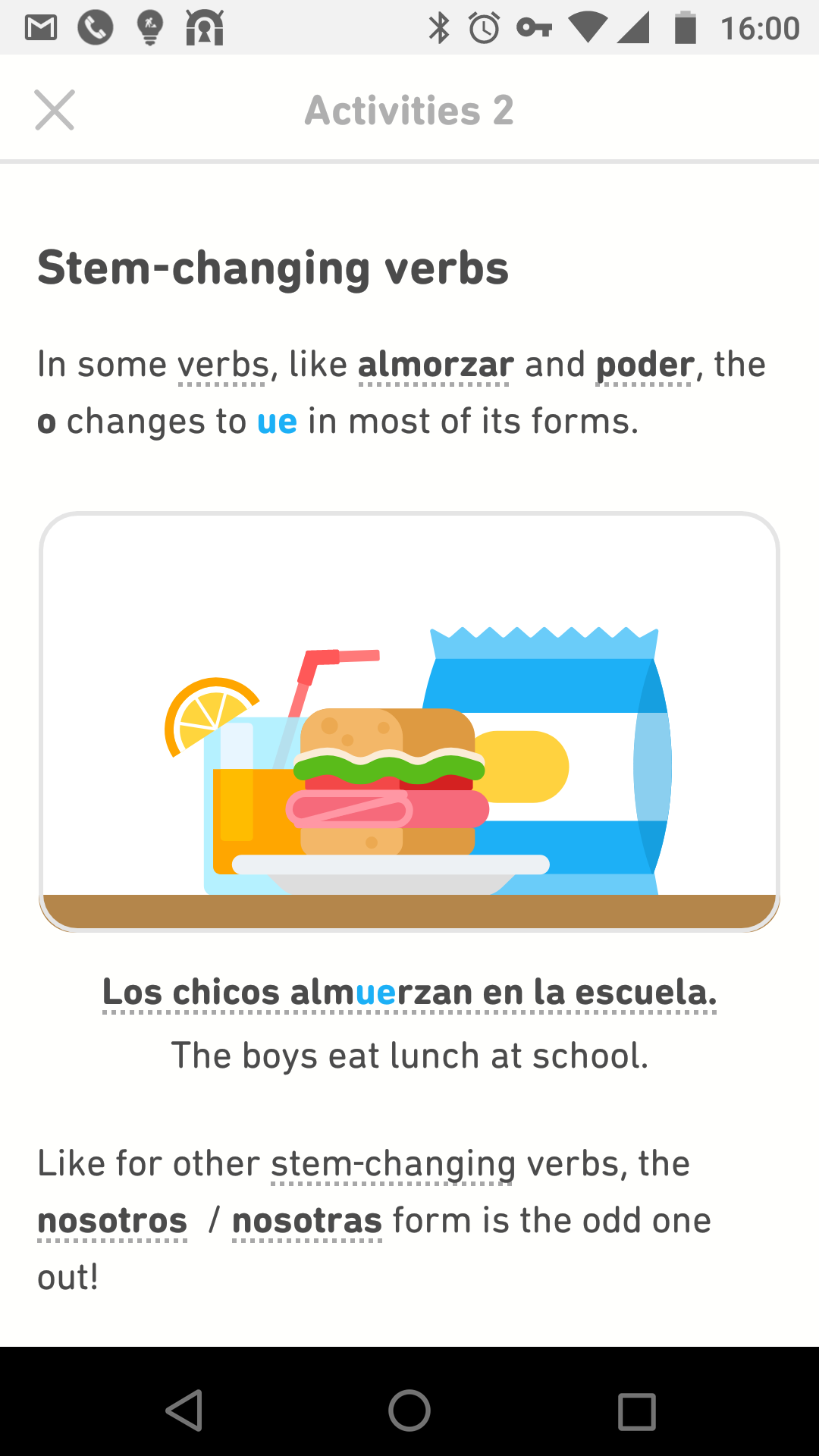
Re:Duolingo becomes first VC-funded $1B Pittsburgh tech startup by Andrew_nenakhov on Saturday December 07, 2019 @06:02AM (#21729615)
They do have theory but in the app as well. At least, on Android:

https://xmpp.redsolution.com/upload/4bddf4f264f5c6577f16551f...
Re:Duolingo becomes first VC-funded $1B Pittsburgh tech startup by felipemnoa on Friday December 06, 2019 @07:38PM (#21727599)
>>Is that enough? Definitely not. Not for me at least. They basically give you the 'hello world' of a language.

Maybe try something like this: https://www.conversifi.com

It allows you to practice with a native speaker in your target language.

Disclaimer: I'm friends with one of the founders

Re:Duolingo becomes first VC-funded $1B Pittsburgh tech startup by tasogare on Friday December 06, 2019 @11:42PM (#21728514)
Same opinion. Too bad my profs don’t let me apply my idea in a more "product" way and on the languages I care about because I have a few ideas to improve the situation (one being the one I research for my PhD). So, I’m doing it on my spare time but it takes longer than I want.
Re:Duolingo becomes first VC-funded $1B Pittsburgh tech startup by guelo on Friday December 06, 2019 @07:22PM (#21727501)
There are a lot more people that have the idea of learning a language than there are people that actually go through with learning a language.
Re:Duolingo becomes first VC-funded $1B Pittsburgh tech startup by billfruit on Saturday December 07, 2019 @07:55AM (#21730025)
May be, how about effectiveness of software like Rosetta Stone in learning new language?