We all have cars because cars are incredibly useful; Got 4 young kids and you need to get groceries for the week? You're not going to bicycle them to the store and all that food home again in the mountains. Live in the city and want to go hiking 20 miles away? You're not going to settle for 30MPH when you could be doing 70MPH to get there. The reasons for cars are endless. That's why we have them.
(BTW, I pretty much only bike in my city. But it's pretty obvious why people have cars.)
Seems like lots of responses from able-bodied individuals without kids, elderly parents or other dependants who are able to get around on scooters or bikes in any weather and have little tolerance for those who might not be able or willing to do the same.
I live in Orange County, Ca. and bike most places most days. My wife and I share a car and we walk many places. Interestingly, even getting to the Home Depot which is only 3.7 miles away takes 20 minutes, is a bit hair raising, and I can only get small items. My last job was about 6 miles away, took 40 minutes to bike and I only did it once because it was unsafe.
But I know we’re living a charmed life. My next door neighbor is recovering from cancer treatment. If he makes it to his physical therapy appointment, it’s a good day. I’m not going to tell him to “get better equipment” or that people bike in Amsterdam so he should to. Believe me he’d love to be biking again.
It doesn’t mean our cities cant move in a more walking/biking friendly direction. I’d love to have more safe places. But have some compassion for people who aren't as lucky as you.
Yes, you want to use a car in this case. But, in the life I imagine, I would rent a car. I dislike driving intensely, but I can see use-cases in which cars are necessary. However, Americans have been largely forced into car ownership, despite the expense and hassle of owning one. A reduction in car ownership coupled with more pedestrian-friendly community designs is more my goal than making cars extinct. I would like my household to go from two to one vehicle.
And its true that if you have to rent you don't go hiking often because the money ticks away even while you are parked outside the zone (which would be the case for hiking) so you are always stressed out about hurrying. Also you always have to decide, do I want to/can I spend 50 Euros today just to go hiking? Or you know you could use your own car. Yes it also costs money but its way less and more spread out.
That sounds like someone with very stupid money management. Unfortunately, this is probably the norm.
You're surely spending many hundreds of dollars/Euros per month to own and operate a private vehicle: loan, fuel, insurance, maintenance, repairs. If you go hiking every single weekend, that's 200 Euros (according to you), which still should be cheaper than owning a car. Most likely, you're not going to rent a car every weekend. So it should be pretty obvious that you'll come out way ahead if you sell your car and just rent a car for those occasional weekend hiking trips.
>I live in one of those european cities. ... We have public transport but its depressing and annoying and also expensive.
What city is that? The German cities I've visited had very inexpensive public transit, especially if you got multi-day (or longer) passes, which anyone living there probably would.
Rentals start at around 28eur/day, so if I rented one every weekend (saturday+sunday), that'd be 224 eur plus fuel. Hardly cheaper.
Of course I don't travel every weekend, but when I do, it's more likely to be friday+saturday+sunday, and I do make week-long trips (and longer) a few times a year so it balances out, more or less.
Owning a car means I don't worry about making reservations, fetching and returning the vehicle, etc. It's always near the door, and I can go on a whim if a sudden need comes up, like it did just today.
But it does mean you worry about parking, scheduled and unplanned repairs, car wash, etc.
I think there's still an untapped marker for on-demand car hire like Zipcar and similar.
What's "worth mentioning"? My bank gives me about 2% on savings; it's not huge but it's certainly enough to switch banks over. If you're not making any interest in a bank, you're at the wrong bank.
A future where you have an Uber-like app where you summon an autonomous car that takes you to your destination for a nominal fee then who needs to own a car?
People which have items in their car that cannot be taken into the places they have to go, such as workplaces. Many people might not have that problem, but it is a problem.
An extra hour or two doesn't make a lot of difference when you're already booking for a weekend. Of course if you get stuck on a mountain overnight or something then you'd have a penalty charge, but frankly that would be the least of your worries in that case (and it would still be a problem if you had your own car but were worried about e.g. missing a day of work).
Of course hiring a car for a weekend costs a couple of hundred quid, but realistically you're going to do that what, ten times a year at most? You'd end up paying more in fuel, insurance and deprecation on a private car.
> Looks like zipcar is even station bound which makes it worse. You have to get yourself and all the stuff to the station somehow and then take it back from there again when you are done.
The "station" is around the corner at most. Walk 5-10 minutes, collect the zipcar, drive it to your building and load up, and then the same in reverse when you get back.
Owning a cheap car is way less expensive than renting a ZipCar. My car's only cost beyond gas was insurance. And my insurance was cheaper than renting a ZipCar for one weekend.
Obviously it depends on the car you own, but ZipCar's here can certainly be more expensive and more inconvenient than owning.
When we visit Brooklyn we usually get free street parking.
Nice. The “at most” is an interesting rhetorical (and grossly dishonest) trick you used there.
This is often my end goal when I go hiking
>Note that I'm only asking about city travel, not intercity transportation.
I don't know why these conversations always seem to descend into talking about the suburbs. Urban environments can (and should) reduce car traffic inside them. Talk about leaving the city to go hiking and suburban living (designed specifically around personal car ownership) are not what we're talking about here.
It's good to encourage cities to find ways for residents to get around without cars, if only because it can increase social mobility by increasing options for people who can't afford one. But pretty much all of the evidence I've seen suggests that Americans very much choose to have a car once they can afford one, and that is very much rooted in the fact that they're phenomenally useful.
Yet, there is a significant portion of the US population that can not afford a car, and the next level to afford to maintain a car, or afford to adequately insure a car.
And yes, it hurts economic mobility https://www.nytimes.com/2013/07/22/business/in-climbing-inco...
Indeed, car ownership is a big part of most household budgets in the US. There's the initial cost (in the $25K to $35K range now), insurance, repairs & maintenance - cars are huge money sinks. So much capital tied up in cars. A few years back I estimated that there were 3000 cars in our tech company parking lot which represents $75Million in capital (at $25K each) that's sitting idle about 95% of the time. The combination of public transit, on-demand self-driving cars, better city design, telecommuting could allow us to redirect that capital more productively.
Why are you buying a new car? You can get a very decent car for $8K. And if you did buy a new one, you don't have repairs and maintenance expenses.
> The combination of public transit, on-demand self-driving cars, better city design, telecommuting could allow us to redirect that capital more productively.
Doubtful. Public transit usually takes 3 times as long, so you are wasting human time in exchange for capital (there's a reason people buy cars - it's not because they want to waste money). Self-driving cars will never happen, and city design can't help all that much.
From your list, only telecommuting can help, but only if you do it full time.
(Also your dollar estimate assumes all new cars, which is far from accurate.)
Denizens of the Greater Smoke Area today might care to cozy up 'round the fire with a tale of the Crookedest Railroad in the World.
http://www.friendsofmttam.org/railroad/crookedest-railroad.h...
This only work that way because that's how your life is structured, not that it is a law of nature.
If you live near a grocery store, you wouldn't have to buy enough grocery to last you a week. You can just buy what you need.
I saw traffic in Sagion, Vietnam. Believe me, cars stick out like sore thumb compared to motorcycles and bikes, and if everyone uses car, traffic would basically grind to a halt.
With the way we use cars in America, it's very inefficient.
https://www.brookings.edu/blog/the-avenue/2018/05/25/early-d...
I like living in the city. My wife and I did it with our daughter until she was 5. But the problem with American cities isn’t cars. It’s that they offer no solutions for parents who aren’t rich. (And almost everyone ends up becoming a parent at some point.) Schools, family centric activities, transportation, affordable housing. You need a million dollars to buy a house in a good school district in many major US cities (if one even exists). There’s not much in the way of other kids around. (Babies, maybe, but how often do you see 10 year olds in NYC that aren’t tourists?)
This post goes into more detail on why that narrative is most likely noise: http://cityobservatory.org/no-youth_exodus_signal-noise/
Edit: 27k is approximately 0.25% of all 25-34 year olds living in cities with pops over 500k (which is what WSJ reported on). Not an exodus at all and it's really a bit of a nonsense narrative that WSJ has been pushing hard.
Presuming we've sufficiently eliminated car traffic and the roads are safe for kids, it's also likely that at least one of those kids can bike themselves to the store with you.
Once they're older, kids can bike themselves or walk. Families also manage that.
If memory serves, she got a shout-out in this book: https://seattle.bibliocommons.com/item/show/2862141030
Funny enough, I saw a mother of 4 biking today in Boston. It was raining and 50F/10C outside. She had a bakfiets with 3 onboard and a kid pedaling behind her. I don't think they were going grocery shopping though.
Trolley carts.
https://www.homedepot.com/p/Easy-Wheels-Mini-Shopping-Cart-i...
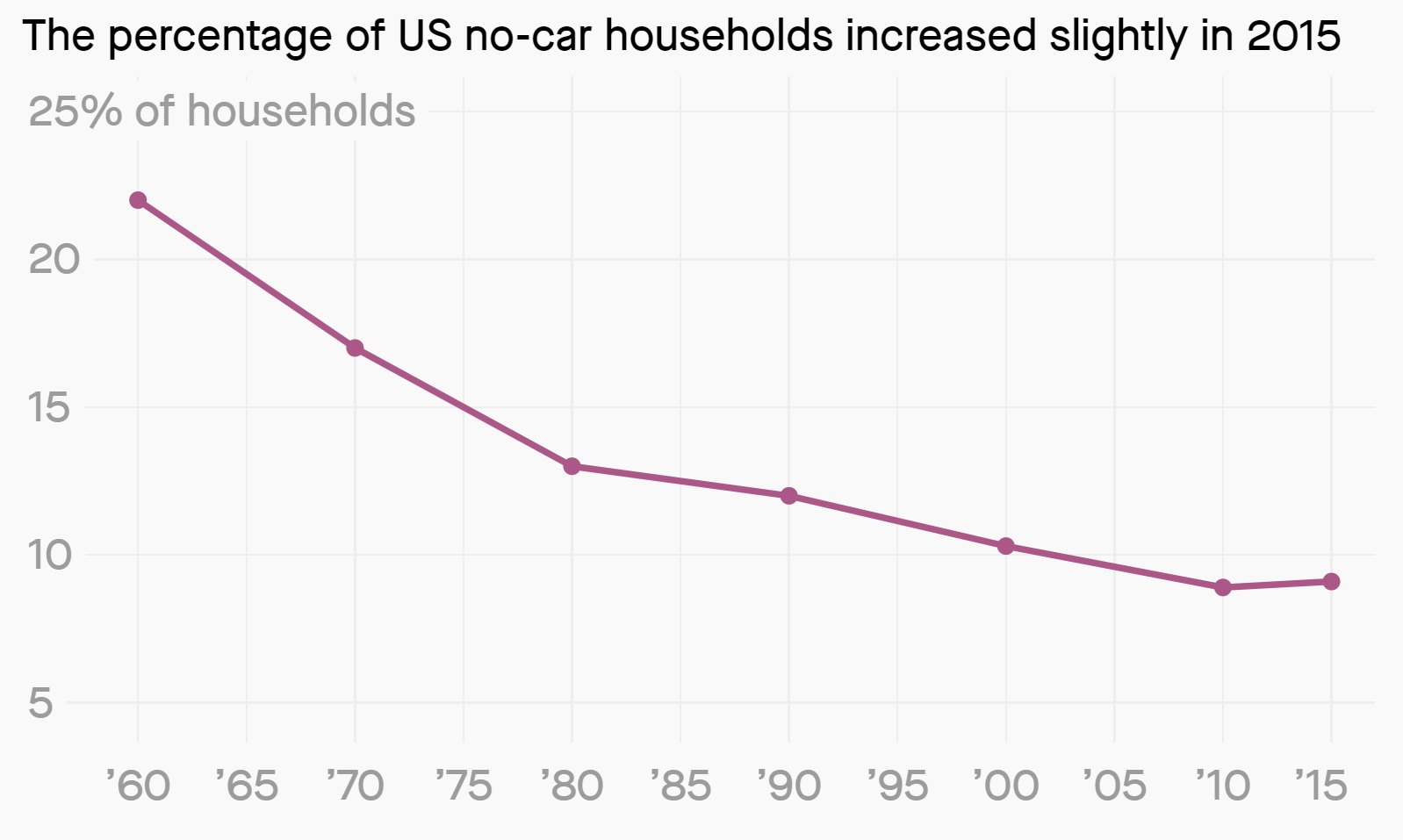
In the meantime, not having a vehicle for errands is real life for ~20% of the population, and if you add safely (maintained vehicle) or responsibly (insured, with a valid license, no warrants), this number quickly approaches 50% of the population.
https://www.nytimes.com/2013/07/22/business/in-climbing-inco...
And then you bring up hiking, which ~15% of the U.S. population participates in anyway (and it's at its height)
Most people living today don't, and never will have 4 young kids. We don't need to optimize the world for the most extreme outliers, at the expense of everyone else.
No reason trains can't solve this. When I lived in NYC there was plenty of hiking off the NJ transit. Popular hiking destinations here in the PNW have huge problems with traffic that would be helped greatly by building rail lines to them.
I think driverless cars are a great adapter / collector last mile technology for suburbs to go to the train station, but if somewhere has traffic problems now, it will have traffic problems with driverless cars too. After a certain point you need to put in trains.
[0] https://www.theurbanist.org/2016/05/26/the-supply-and-demand...
That's what has to change. Both the location of people, and the definition of "urban core".
And yeah, urban core will need to be redefined. Not everyone wants to live in a skyscraper. We need to strike a balance.
Good luck with that. People like living in the suburbs.
It's where I live and when self-driving cars are available I'll move further out of the city.
Not everybody lives in a city, and even people who do live in a city want to leave the city sometimes. I use my bike whenever I can, but we still own a car.
That said, the less you drive, the more interesting a driverless car might become: we won't be used to driving, so a self-driving car might be safer for us.
And the main reason I prefer to take the train over a car is that I can read in the train. With a driverless car, maybe I can read in the car (though car sickness is also an issue there).
Very much this. I've lived in London for nearly 20 years. I haven't driven in nearly 20 years. I've barely set foot in a car in nearly 20 years.
If I ever needed to drive I'd essentially have to learn all over again (ethically, anyway; not sure about the legal situation). A driverless option for those rare occasions would be great.
I believe the number one cause of death for Americans under the age of 30 is traffic accidents.[0] It's around 40,000 deaths per year (in the US alone).
Cars are getting safer, but humans aren't getting better drivers. Individuals humans will get better with experience, but experienced drivers cycle out and new drivers cycle in.
A 16-year-old doesn't get to inherit the experience of the 70-year-old they're replacing. A new self-driving car does inherit the experience of older self-driving cars. They also learn from each other in a way humans can't.
Human drivers also improve at a rate of O(1). Self-driving cars can share their experience perfectly, so they improve at a rate of O(n). I get a day of driving experience per day. Each one of a million self-driving cars on the road will acquire a million days of driving experience. They won't drive traffic accidents down to zero in a week, but in a few years, if we were to deploy them en masse, they could.
[0] Can't actually find CDC data about this anymore. "Accidents" is definitely still #1, but they no longer break out traffic accidents. I know in the past, that was #1. https://www.cdc.gov/nchs/data/dvs/LCWK1_2015.pdf
Traffic accidents are not included in the "accidental death" category, and haven't been for as long as I've been looking. From page 2 of the full report[0]:
"For example, Malignant neoplasms of the trachea, bronchus and lung (lung cancer) and Motor vehicle accidents are not rankable causes of death (see “Procedures for ranking causes of death”), although they can be identified using the standard mortality tabulation lists. If these causes were included in the current rankings, lung cancer would be placed among the 10 leading causes of death with a rank of 6th, whereas Motor vehicle accidents would rank 13th."
It's not even close to being #1, for any age group. More people die from suicide every year than from car accidents. Please also keep in mind that 1 out of every 6 traffic fatalities in the United States was a pedestrian.
[0]: https://www.cdc.gov/nchs/data/nvsr/nvsr68/nvsr68_06-508.pdf
Being #13 overall definitely doesn't preclude them from being #1 in younger age brackets. Most of the deaths from cancer and heart disease are the older age brackets ("Diseases of the heart" are 23% of overall deaths, but only 2-4% for each age rank among minors; ~6% in the 20s-30s). "Accidents (unintentional injuries)" is the #1 listed cause for every male and female age bracket until the 45–54 bracket (pp 19-22) (this precludes infants under 1). The question is what portion of those were traffic accidents.
If we assume traffic accidents at the same rate among all age groups, then we have 36,000/169,936[0] = ~20%. That drops it to around fifth place for most of the younger brackets. (Personally, I'd guess it's higher for at least the 15-19 age bracket, but that's just a guess at this point.)
So, okay, fine, traffic accidents is roughly sixth most common cause of death for kids in the US, and thirteenth for all ages. The original question was why we'd prefer that if the cost is the same. Even while my numbers were way off, it's still a big benefit.
> Please also keep in mind that 1 out of every 6 traffic fatalities in the United States was a pedestrian.
I'm assuming a significant portion of pedestrians traffic fatalities are drivers killing pedestrian, not pedestrians...I don't even know what to put as the alternative. Stepping in front of a bicycle?
My position is not that human-driven cars kill human drivers -- it's that human-driven cars kill lots of people. If drivers only ended up harming themselves, I'd be slightly less concerned about it.
[0] Just grabbing most recent number from https://en.wikipedia.org/wiki/Motor_vehicle_fatality_rate_in...
> Human drivers also improve at a rate of O(1). Self-driving cars can share their experience perfectly, so they improve at a rate of O(n). I get a day of driving experience per day. Each one of a million self-driving cars on the road will acquire a million days of driving experience. They won't drive traffic accidents down to zero in a week, but in a few years, if we were to deploy them en masse, they could.
This is all very nice, but if true, why are self-driving cars still unable to drive in snow, avoid crashing into trucks pulled over on the side of the road, or navigate a parking lot without nearly getting t-boned?
The rate of improvement might be O(N) (I strongly doubt it), but the problem may lie in the constant multiplier...
Have you seen people driving on the first snowfall of the year?
> or navigate a parking lot without nearly getting t-boned?
Driving in a parking lot is tough. Lots of pedestrians, lots of other cars, and way more people driving in reverse than you'd see in most scenarios.
Most of those people don't have winter tires.
> Driving in a parking lot is tough.
So when is the O(N) rate of growth going to get SDVs to the point of an attentive 16 year old?
You'd think that they'd drive extra cautiously in snow in that case.
> So when is the O(N) rate of growth going to get SDVs to the point of an attentive 16 year old?
Does it need to beat an attentive 16 year old or does it just need to beat a distracted early to mid 30s parent with a small child or two in the car? Self driving cars only need to be better than the average human to reduce overall accidents. Having said that, I'd probably be more likely to hop into a car driven by a random person than a self driving car that I know is only marginally better than an average human.
And it's possible that the number one cause of shortened lifespan for older Americans is also cars, by virtue of encouraging (perhaps enforcing, if they've sufficiently influenced your town's urban planning) a sedentary lifestyle, and all the health risks associated with one. I also wouldn't be surprised if they contribute to the USA's relatively high rate of mental health issues, by contributing to social isolation.
Self-driving cars won't help with those bits. If anything, they'll intensify them.
One common reason people give for not biking is that they're afraid someone driving a car will kill them. Self-driving cars should reduce that risk.
Of course, they also should make commuting by car cheaper and more relaxing/less of a waste of time, so you're likely correct, but there is that competing force that may increase cycling rates.
I'm not a machine learning expert, but I'm not convinced this assertion is well grounded. If you have two ML systems, I don't know of a simple, general, reliable way to transfer the "knowledge" stored in one to the other without disrupting the "knowledge" already within the other.
If you mean just copying the video feed, sure, but that's only one input variable. There's no guarantee of a linear relationship between hours of video feed and driving quality. Humans seem to hit an asymptotic lower bound in the collision probability even as they accumulate experience, and while that might not be true for self-driving cars, it isn't guaranteed a priori.
You're pretty much guaranteed that self-driving technology "skills" will collectively improve over time, at some positive rate, whereas we don't expect "Gen Z" to be more skilled drivers than previous generations.
This is all entirely skill-focused. We're not guaranteed that self-driving cars will actually get safer if we don't have the proper incentives to favor safety over speed or cost. Similrly, despite the stagnancy of human driving skill, I anticipate safety will improve with human drivers for non-skill-related reasons -- specifically, driver assistance technology, and a shift towards just getting a Lyft if you're impaired.
So absolutely we will have cars and trucks well after we're able to develop driverless versions of them.
(I think that's slightly wrong -- humans are probably O(log n) because large populations of humans invest in heuristics and teaching methods that enhance driver improvement rate, and for SDCs, the "lessons learned" between units are probably somewhat redundant, so it might scale as something like sqrt(n). But I don't see a problem with the O(n) usage.)
The semantics that GGP comment meant to convey are better represented by saying that autonomous cars' driving experience grows with Ω(n) (analogous to >=) or Ɵ(n) (analogous to =).
He went on to blow another red light before turning off onto a side street.
This kind of shit would never happen with a self driving car. The bar for self driving cars is incredibly low.
In fact, people could start accounting on other people's self driving cars being cautions and deliberately betting on their safety features. e.g If most people were driving a Tesla I could more safety run red lights since their other cars will stop for me automatically.
Unless we are going to make self-driving ONLY cars that is.
This is the dream.
EDIT: More specifically, I envision a world where to manually drive your car you have to past a MUCH more rigorous test than the current licensing process. Including background checks for infractions such as DUI, would ban / block you from obtaining a manual driving license.
You would of course retain your freedom to have a car that can drive itself.
A lot of 70 year olds should not be driving.
You need to give some serious readjustment to your mental image of “old people”. Perhaps the word you’re looking for is “disabled” or “differently-abled”, depending upon your preference. Some of those people, maybe disproportionately so, also happen to be old.
I’d type more, but this AARP member crashed his scooter on the way to work on Friday, and my shoulder’s still a little sore. Wear your helmets, mine cracked so that my skull wouldn’t.
Guess what, me, too! My anecdata are from a more active group, though. So we have differing views of the world, and that’s fine. I’ve never been overweight a day in my life, so I try to avoid general, “all ya need to do is...” It demonstrates a lack of empathy and a small world view.
But I would ask the same of others. Yes, there are people with limited mobility. I get that. But they’re still a minority, and does it need to be brought up every g-ddamned time the subject comes up that not everyone can ride a scooter? Most people can, can we talk about them for a minute before dive off into the edge cases?
We can talk about limited mobility options, no we will talk about them, just maybe later. But the reason we have cities over run with cars now is because way too many people who are otherwise capable think they can’t hobble more than a city block, and only under perfect conditions.
Yet that's what one sees in Copenhagen.
Anyway, young people biking more means that more older people will actually be able to bike, because exercise helps with increasing mobility as we age.
Add in doctors and other specialized labor which is important but thankfully rarer in need and have a larger "patient footprint".
That small towns are mostly dying is no accident or sinister conspiracy - they are victims of not being able to compete with scale barring some niches like say tourist towns.
The only implausible escape from cities as a situation involve not only teleportation but cheap teleportation which effectively scribbles over many spatial constraints.
There are definately downsides, but they can be solved. We have systems to collect and clean waste so that is no longer a problem. When cars can be mostly eliminated and the ones that are left will be autonomus, that’s the traffic and air pollution problem mostly solved.
Then we can also have more of untouched land for wildlife and our general pleasure.
I live in a rural area in Ohio. Any eligible land that isn't being tilled already gets converted to farm land. Plots are getting consolidated, treelines are getting leveled and burned to gain another couple acres of arable land.
I think if we all move to cities there will be some natural parks but most of it will be converted to ag and industry. If you get a couple million acres of privately held land, who knows what's happening in there.
Higher densities of people make many things more efficient, e.g. shared heating in apartment building, making mass transit viable, sharing resources like food and water. Climate change is forcing our hand on transitioning to a higher-efficiency society, but we would have to do it soon anyway because we are running out of oil. When you can't enjoy the energy density of fossil fuels, efficiency will start to matter a whole lot more. Our current mode where a single person might travel up to 50 or 100 miles every day, just to live their life, is a ridiculously inefficient way of spending your time on Earth.
Secondly, habitat loss is the single greatest cause of the mass extinction of species we are currently experiencing. Most of that is agriculture, but urban sprawl certainly plays a big part. If we want to enjoy, you know, other species existing, we should be looking for ways to reduce the amount of land we need to occupy as humans.
Also, a bonus: kids that grow up in walkable neighborhoods have been shown to have the highest levels of upward economic mobility. So really if you want to do right by your kids, you should be moving to a walkable area and reducing your car use.
For personal interactions, you have face-to-face talking and generally (in the context of clustering) access to many people with aligned interests to talk and interact with in person in real time.
Culturally, you have art installations, exhibitions, and all sorts of activities like musical concerts, theater, etc. that aren't exactly reproduced remotely.
In terms of work and hobbies, clusters can give access to tools, workshops, that might be too expensive to have at home. Say using a hackerspace/fab lab vs. having a complete electronics lab in your house or a laser cutter.
All of those should be more readily accessible (in terms of transportation time and cost) if you are well located within a large hub.
Of course, remote does have significant cost benefits in some respects (housing and supplies), and for some professions the benefits of cities aren't strictly necessary, but clustering and the physical world should not be underestimated or thought obsolete.
Sure I can work from anywhere, but businesses (especially leisure) tend to concentrate where people concentrate.
Just like when I went trekking. I asked our guide once, _where do we have to go for the trail to be less crowded?_
He named a few places. Then mentioned there were no stairs on the slopes of the mountains he just named. No hot water for showers in the lodges on the way. Much fewer places to stay to eat or sleep. And not as much choice on the menu.
Wether it's around the Annapurna or in the US, businesses and services develop and concentrate where there they can find more customers. People go where they can find the products, services and experiences they long for, and the people they care about.
as long as our food is on one specific location so will we.
If the trend of subsistence farming because more than that we might see a shift in urban areas.
I live in an completely unremarkably small city except for the fact that there is one big employer with a lot of money. The rents and house prices are only going up.
The discussion always seems to assume that you live in a dense central city or in Nowhereville USA. In reality, a huge number of people live in suburbs, exurbs, and less dense parts of the city.
There's no shortage of local shopping. And "downtown" is easily accessible for those times when someone wants to take advantage of the resources (like better restaurants and theater) that are mostly less available outside of the city proper.
In many countries such people use public transportation, but that's crowded and inconvenient for the richer folks who can afford cars.
Why do you think people still have cars in Amsterdam?
In Europe cycling distance to work within a city is as quick as driving. If you aren't quite fit enough you can get an electric bike (very popular amongst the elderly).
I didn't consider the suburbs in my question but in a small to medium sized city (<0.5m) I'd suggest the average commute would be ~8km. That takes ~25mins on a bicycle. Now project a better micromobility infrastructure and cycling looks much more attractive. All those school runs just vanish.
So you'd have to rich and fat to still be driving. ;)
[0] https://www.theguardian.com/world/2019/may/03/amsterdam-ban-...
Eventually, yes. That is the march of technology. Especially if Elon Musk's bet that it can be done using only cameras is right - then the hardware cost is the same as an iPhone. If LIDAR is also required, it will take longer for the prices to go down.
This year I bought a 2-year old used econobox car (63 horsepower of pure fury). It already came with 360 degree "top-down-view" parking cameras, stereo camera auto emergency braking, lane departure warning, green light departure warning. And it's a mild hybrid. Once the software is developed, it won't take more than a decade to start coming down in price.
I drove a rental Nissan Rogue a few weeks back while we were in DC and it had top-down camera, auto steer, adaptive cruise, heated everything, etc. And that is not exactly the most desirable car you can buy. The technology really has trickled all the way to the bottom, but some of it needs to trickle back up...
And don't forget lack of showers at workplaces. If there wasn't a shower available where I work I definitely wouldn't bike to work.
Obesity is one thing promoting modes of transportation other than driving is a hope to solve; where the developed world is showing highest rates ever and scientific studies showing that the chair of a car is unhealthy.
The good thing about the driverless cars is that they solve the parking problems in the cities. We can even add lanes or pavements by removing all parking spaces in the city centers.
Removing free rental of public space to park your private vehicle is something I _do_ endorse though!
Like Amsterdam and Copenhagen?
> The good thing about the driverless cars is that they solve the parking problems in the cities.
They solve the search for parking by humans. But if you want to get the cars out of the city while they aren't used, you practically double the traffic and emissions.
There are cites in the US with great weather, for example San Diego, Santa Barbara, all of Marine and Sonoma Counties in CA have great weather (sadly it is having wild fire problems right now). I agree that we could be biking in those places more.
The US as a whole has climate all over the place, from polar (N. Alaska) to tropical (S. Florida) to a desert. The coldest it has ever been in the Netherlands is -27 °C, but the continental US has gotten down to -57 °C (Alaska has reached -62 °C). The hottest it has ever been in Amsterdam is +41 °C while the US has reached +57 °C.
It's true that these are crazy extremes and we can't decide on public policy based solely on rare events, but there are big cities all over the US where it is too cold to bike. Consider:
Average Weather: days at or below temperature:
    City (population)   -18 °C    0 °C
    -----------------   ------   -----
    Amsterdam   (821 K)   none    none

    Minneapolis (422 K)    23      148
    Chicago    (2716 K)     7      122
    Denver      (620 K)     7      157
    Milwaukee   (595 K)     7      126
    Detroit     (673 K)     4      115
    Indianapolis(872 K)     4      104
    Rochester   (208 K)     4      129
    Buffalo     (259 K)     3      124
    Cleveland   (386 K)     3      104
    Hartford    (123 K)     3      125
Average Weather: days at or above 38 °C:
    City   (population)      38 °C
    -------------------      -----
    Amsterdam   (821 K)       none

    Phoenix       (1626 K)     107
    Las Vegas      (642 K)      70
    Riverside      (328 K)      24
    Dallas        (1341 K)      17
    Austin         (951 K)      16
    Sacramento     (502 K)      11
    Oklahoma City  (644 K)      11
    San Antonio   (1493 K)       8
    Salt Lake City (201 K)       5
    Houston       (2313 K)       4
    Kansas City    (489 K)       3
The entire west coast has weather at least as favorable to bike commuting as Amsterdam, yet the percentages of people commuting that way are still far lower than Amsterdam simply because the infrastructure isn't there.
But the big one is that the Netherlands has about half the population of Canada in an area the size of New Brunswick. Obviously they can afford better transport infrastructure than we can.
* Where I live, bike lanes become snow banks circa mid-January.
I grew up in Southwestern Ontario and we had days were school was cancelled due to cold, not snow. They were worried about frostbite on any exposed skin.
they solve the parking problems in the cities
By turning the general traffic lanes into de facto moving parking spaces?
I live in Seattle, rain sucks to ride in and most people don't have facilities to change or shower at work. That's a luxury not a standard.
It's all a moot point anyways because all this assumes everyone lives within biking distance of work and that work trucks/vans don't exist for a valid purpose.
They only solve them by doubling the traffic problems. I'm not a civil engineer so I'm not sure which problem is harder to solve, but this hardly seems like a free lunch.
So what? Can you only bike on sunny days? Get better gear.
Hell I motorcycle year round even when it drops below freezing. When it gets real crazy I just take the bus for a day or two.
Most people will not need to drive very often, so they would not buy a car at all. However everybody has situations where driving of some sort is the best option.
I don’t anticipate many people will ever buy a driverless car.
The whole concept of buying a car is kind of ridiculous. You pay for it then you continue paying for registration, insurance, maintenance, park, etc all while it sits idle 90% of the time.
Driverless cars allow you to be picked up at your front door and dropped off exactly at the spot wherever and whenever you want for a low fee per trip. And we’ll need about 1/10 the number of cars that we have today.
Since there isn't much savings possible in a shared car without losing the whole advantage of a car you may as well buy your own: the ability to leave your golf clubs in it is more than worth the extra costs.
Just because everyone's car is idle 90% of the time doesn't mean that we can replace the fleet with a driverless fleet that is 1/10th the size.
Thought experiment: Most of your clothes sit idle 90% of the time.
I have a cup full of pennies in my closet that sit idle all the time too and I don't care... cause they're pennies.
Similarly, the average car cost over $35,000 in 2018. That's a sizable expense for most people. Clothes in comparison, not so much.
Unless buying a fleet of vehicles over time produces better gains/results than other retirement/investment options (fossil fuel divestment or 401k replacements, plus having the convenience of immediate SDC access).
I think cars embody the classic american spirit of freedom and "wind in your hair" fleeting moments.
After gen-x, the cost of vehicles skyrocketed to parity with what modest accomodations used to cost, so the younger generations are writing their story with a much different frame of reference.
I enjoy the saying "In America,100 years is a long time and in Europe, 100 miles is a long distance".
Another model are shared cars, like dockless scooters and bikes. They are reasonably popular in the Netherlands for example. But they still require quite a bit of planning to ensure the car is available, and they are not always "in front of your door". Also you need to rent it for the entire time that you're away.
Irrespective, SDC will take some time. Like NLP, they work will within a constrained problem domain, but don't really generalise.
Human driver's only account for 50% - 55% of a cab's cost.
https://urbankchoze.blogspot.com/2014/08/what-taxis-can-tell...
https://www.quora.com/What-is-the-breakdown-of-where-taxi-fa...
Mind you I live in a rural area and spend a fair amount of time (1 day week) in areas with no or very poor mobile phone coverage so that might put me off!
I don't see why people who don't consider carpooling right now would order a driverless car that needs to pick up some other people before going where they want. So how would driverless cars reduce the number of cars on the road? Or to state it differently: why do we need driverless cars to get the average occupancy of cars on the road above 1?
We (as a society) are fully capable of building single-person cars. It's just the economics of car ownership incentivize having four to five seats and a lot of trunk space just in case you need it, even if you aren't using them 99% of the time.
That's likely to change if the cars are being run by a driverless car service. They'll already have the numbers to know how many single-person cars to maintain in the fleets as compared to five seaters. Fuel / electricity will be cheaper for smaller vehicles. If traffic does notably increase, tolls and congestion taxes will come more into play and be lower for smaller cars. Single person cars could split lanes (like motorcycles).
At that point, the economic incentives change, and we could see different outcomes.
Self driving also could allow better "microroutes" which don't take you out of the way like public transit. It wouldn't address the stranger adversion however.
Ironically in the worst case it may technically reduce the average occupancy even if the total utilization rises and thus number of cars on the road drops for the same demand.
It isn't as simple as "People don't do it now, why would they do it in the future?" There are many ways to make automated car sharing far more attractive to people than car pooling ever could.
It may seem like you can solve this by just picking up in the neighborhood. However there are not enough people in any given neighborhood to make that work. This morning exactly one person (car) passed me on my way to the bus stop - I don't know if this person would go the same direction as me or not: there isn't much opportunity for ride sharing within one neighborhood.
Transit has the same problems. It solves them by forcing people to walk to the stop/station. At least everybody feels like they are making progress. They also come on a schedule which means you can't leave when you want to.
But I'm also a young human who's in pretty good shape. My dad, who uses a walker and has other mobility issues, can't bike and can't walk distances. Buses and trains are options, but he'd have to use them for any distance travel + a wheelchair if he has to go more than a block... not easy.
When I was in Boston, I had the privilege of living in an expensive apartment in the middle of town. I could walk, bike, take a bus, etc. But if you can't afford to live downtown, you're once again restricted to buses and trains.
Of course, we should build up complementary transportation systems but a car-free future isn't going to happen and we shouldn't want it to happen. For many people and use cases, cars can't be beat.
Generally speaking, I don't see any future where people no longer drive, because the cost of not-driving is so exorbitantly expensive that very few people will ever be able to afford it. EVs are cheap, and get cheaper every day. Dense urban "car-free" housing is already unaffordable for almost everyone, and only gets more expensive every day as development continues.
Unless we get extremely lucky and the housing market crashes hard, the future will probably be one where it's cheaper to have buy 6 to 12 brand-new zero-emission EVs, than it will be to afford an urban car-free 2-bedroom condo in any top-20 city. Given Urbanists political goals (and the fact that Urbanists are winning their goals), I suspect public car commuting and VMT to grow every single year, for 80% of the low and/or middle class population.
In less dense areas the car shines above anything else. However in those dense areas where people have shown they want to live cars are too big and we need something else.
That's not really how construction works in the US. All construction generates higher prices than existed before (this is explicit intentional policy, at both the local, state, and federal level).
There is no such thing as new housing in the US that lowers property values, therefore there is no such thing as a new building that lowers "prices". No one does this (except perhaps, non-profits and such). And even if you wanted to anyway, no bank would ever finance it.
https://research.upjohn.org/cgi/viewcontent.cgi?article=1325...
> This suggests that new construction reduces demand and loosens the housing market in lowand middle-income areas, even in the short run.
The best time to build affordable housing is 20 years ago, the second best time is now.
When nearly everywhere people live is sufficiently urban to for it to not be economically insane to deploy good enough public transit to replace cars in all those areas.
So not in the lifetime of anyone discussing it here. Maybe never if predictions about population leveling off hold.
What does being male have to do with it?
I live in the city, as my question may have suggested, and my family can cycle and walk and take the tram and bus and train everywhere we need to go in the city.
Also, we do have a vehicle, it's a campervan. We don't need it to do the shopping because we're walking distance to some small stores and get deliveries of groceries and fresh, organic vegetables (yum).
The reference to the safety of scooters may require you to provide some evidence. The children are required by myself to wear a helmet and their health is better.
Other than Manhattan, everywhere else a majority of residents own cars (Even in Manhattan I think it’s like 40% or something own a car). Moreover, the last 70 years of migration have led to a common pattern of people living in the suburbs and commuting via car to their workplace - replacing that with micromobility feels like a threat to their way of life and they will fight it vigorously.
What we actually see happen is even small tweaks like the 14th street bus lane in NYC get tied up in court and fought via democratic processes, when they do succeed it’s after a lot of effort.
https://investorplace.com/wp-content/uploads/2019/04/Screens...
Walk? There is no place you can walk to from your house. Our strict zoning codes have carefully kept anyplace you might want to walk to farther from your house than walking distance. Even if we eliminated all codes today (ignoring all downsides) it will be many years before it makes much a difference.
Bike? Cities in the US are too large and spread out. You can get farther in a car than a bike. There is some opportunity, but not much because few people live within reasonable bike distance of work so they will have a car: once you have a car you may as well drive: you can fit more in the trunk than the bike racks, so it is easy to be lazy.
In addition, streets tend to wind around, you often spend far longer than desirable getting out of your neighborhood. This is only a few minutes by car, but on a bike it is a lot longer and you feel that when you spend a lot of time going the opposite direction of your destination because that is how the roads go. This is really hard to fix without knocking down houses. This same issue mean that transit cannot work, even if density is high enough (it typically is!) the winding roads mean the bus can't run fast enough to get people anywhere in a reasonable amount of time.
While you are at it, check the traffic deaths due to motor vehicles. Do it for urban environments, which is the original topic.
Oh, and the improvements in life expectancy for those who take regular exercise by, for instance, cycling to work. Better offset those. I suggest using micromorts.
Is that something that seems likely to happen?
But even assuming it does, I suppose the answer would be because you don't have to worry about finding parking for a taxi, or walking to wherever you parked last night. With a little forethought, you can step right out your door and into your waiting vehicle.
I grew up outside Palm Springs (so not just talking about the very rural part of the country, which is vast and still populated). It would have taken me almost an hour to bike to my high school from my house, but only took ~20 minutes in a car, and for two of the years, the route included dropping off two younger siblings. Skipping past the safety concerns, I think that two daily hour long bike rides is pretty unrealistic for kids under a certain age. This also ignores that, in high school, I literally didn't have a spare 1.5 hours with varsity sports, AP/IB classes, and all the other "necessary" extra-curricular stuff for college prep (which is a separate issue, but still exists).
"No longer driving at all" is really only for single and/or childless people, and mainly those living in a large city where the retailers and service providers you need to see in person are within a realistic biking range.
As you described, clearly there are good cases for driving. Cities are not one of them.
It doesn't take much to imagine a situation where the nearest emergency room is a mile away and she can still go on the bike's child seat. Or a taxi.
If you live in a city your car, even if you have one, is not necessarily the quickest way to get around.
Does this sound unlikely? Consider European cities like Copenhagen and Amsterdam which have encouraged cycling over the last two decades and all the other cities, like London and New York, that are embarking on ambitious transformations to create friendlier streets for people.
If you don't need to drive why would you buy a driverless car? Also, why would I prefer a driverless taxi if an electric car with a human driver costs no more?
Note that I'm only asking about city travel, not intercity transportation.