News for hackers. Stuff that matters.
Re:Have You Ever Tried to Sell a Diamond? (1982) by Synaesthesia on Wednesday August 28, 2019 @04:49PM (#20823831)
Have you ever read manufacturing consent?

Household products like soap and flour used to be generic and without brands. Brand names were invented to differentiate identical products. The entire history of marketing in the 20th century is appealing to people’s emotions with emotional oversimplifications. Their goal is to creat an uninformed, irrational consumer.

There was a huge campaign against man made global warming, and its worked, a significant amount of people believe its a hoax.

Many people thought Iraq was behind 9/11, or supported Al Queda.

Propaganda is all around us, and it works!

Re:Have You Ever Tried to Sell a Diamond? (1982) by SilasX on Wednesday August 28, 2019 @05:12PM (#20824016)
Wait, what? Branding is an important solution to the problem of validating product quality, as it attaches consequences to selling an inferior product, and thus saves on search costs.

Yes, it's possible to waste too much money on branding, but the existence of brands, which creates incentive for consistent quality and attributes of a product, is not a bad thing in itself, even for commodity goods like flour and soap.

IIRC, one of the old problems with general/convenience stores was having to ask around about which products are good, and branding has mostly solved that.

(To answer the obvious objection: yes, regulation is another way to ensure consistent quality, but that has its ups and downs, like being slow to catch up with changing consumer preferences.)

Re:Have You Ever Tried to Sell a Diamond? (1982) by jdietrich on Wednesday August 28, 2019 @07:33PM (#20825159)
Consumer brands pre-date the FDA. The earliest adverts for branded foods tended to emphasise purity and safety above any other merit of the product, at a time when adulteration was rife.

In the absence of other oversight, a brand name provided a degree of trust - advertising is a form of costly signalling, indicating that the advertiser is investing in their reputation and would have something to lose by selling a shoddy product. The brand of flour I've never heard of is far more likely to be padded out with gypsum or chalk than the brand of flour that has advertised in the newspaper every week for the last four years.

We're seeing the inverse trend today, with sites like Amazon being flooded with white-label products of unknown safety and quality. In many product categories, there just isn't a brand with widespread recognition, or the sheer number of off-brand products has drowned out the branded products. These white-label sellers have little or nothing to lose if they sell a shoddy or outright dangerous product - they just take down the product listing, put up a new listing and buy enough five star reviews to get the ball rolling again.
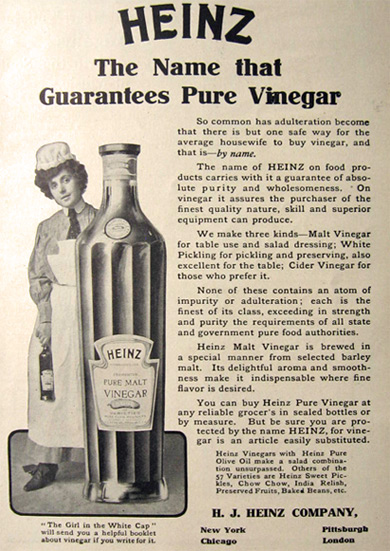
https://www.atticpaper.com/prodimages/081111small/heinz.jpg

Re:Have You Ever Tried to Sell a Diamond? (1982) by jngreenlee on Wednesday August 28, 2019 @11:38PM (#20826454)
No time right now to write more...but I have wondered what brands existed in say Roman era...Greek era...Persian era...etc...surely they did!
Re:Have You Ever Tried to Sell a Diamond? (1982) by sandworm101 on Thursday August 29, 2019 @12:32AM (#20826709)
"Silver hallmarks in the UK date back to the medieval period and the practice of applying them as a guarantee of the purity of the precious metal represents Britain’s oldest form of consumer protection."

https://www.antiquestradegazette.com/guides/information-guid...

The romans would have had guild marks on things like pottery, I just don't know of any online guides for them.

Re:Have You Ever Tried to Sell a Diamond? (1982) by jhanschoo on Thursday August 29, 2019 @02:48AM (#20827270)
You didn't have mass distribution on the scale you have today without middlemen, and so word-of-mouth and personal recommendations should have probably sufficed for most markets, as they do in some markets today (e.g. job and employment)
Re:Have You Ever Tried to Sell a Diamond? (1982) by elSidCampeador on Thursday August 29, 2019 @01:27AM (#20826902)
In all probability, people's names were their own brands, like they still are in small towns today.

I can imagine two Romans walking down the street, and one saying to the other "Oh our family has been buying meat from Spartacus' family for generations now, they're the best when it comes to that sort of stuff."

Re:Have You Ever Tried to Sell a Diamond? (1982) by DonHopkins on Thursday August 29, 2019 @05:51AM (#20828113)
Or place's names, like Champagne.
Re:Have You Ever Tried to Sell a Diamond? (1982) by ryanmercer on Thursday August 29, 2019 @09:26AM (#20829265)
I don't know about commercial brands but some gladiators were paid quite handsomely by sponsors[1], not unlike top-tier athletes today (actually, some arguably earned more than modern athletes[2])

[1] https://www.forbes.com/sites/drsarahbond/2016/08/10/how-athl...

[2] https://www.thevintagenews.com/2017/01/18/the-highest-paid-a...

Re:Have You Ever Tried to Sell a Diamond? (1982) by toomanybeersies on Thursday August 29, 2019 @02:27AM (#20827157)
Falernian wine would probably count as a "brand" of wine.

https://en.wikipedia.org/wiki/Falernian_wine

Re:Have You Ever Tried to Sell a Diamond? (1982) by dahfizz on Thursday August 29, 2019 @08:00AM (#20828694)
The baker down the street was the only "brand" of bread available, I suspect. Although personally knowing who is making the product fulfills a similar function to branding.
Re:Have You Ever Tried to Sell a Diamond? (1982) by AllegedAlec on Thursday August 29, 2019 @07:02AM (#20828394)
Re:Have You Ever Tried to Sell a Diamond? (1982) by kozak on Thursday August 29, 2019 @05:14AM (#20827944)
"None of these contains an atom of impurity or adulteration" (from the vintage Heinz ad) is quite a bold statement.
Re:Have You Ever Tried to Sell a Diamond? (1982) by DonHopkins on Thursday August 29, 2019 @05:49AM (#20828104)
Unfortunately they were homeopathically poisonous due to water memory.
Re:Have You Ever Tried to Sell a Diamond? (1982) by lotyrin on Wednesday August 28, 2019 @05:57PM (#20824444)
You absolutely can still grade commodities. A discerning distributor who has discerning retailers who have discerning consumers has plenty of incentives not to comingle inferior material into his shipments.

The fact that consumers aren't very discerning is exactly created by brands -- they have learned to discern based on identity instead of by quality, because brand recognition is less effort than material inspection.

Additionally, a brand certainly does not provide the attachment to consequence that you claim, once a brand has consumers' loyalty and a sizable market share it can adjust quality with relative impunity.

Re:Have You Ever Tried to Sell a Diamond? (1982) by merpnderp on Wednesday August 28, 2019 @06:29PM (#20824719)
Toilet paper. Buy the cheap stuff and compare to the high end brands. Worlds of difference.
Re:Have You Ever Tried to Sell a Diamond? (1982) by coldtea on Thursday August 29, 2019 @11:43AM (#20830497)
Less than the "price differential" difference. And artificially created - not because of real extra cost needed to make it better, but for market differentiation. So that the same manufacturer, under two brand names, can sell to the poor and the middle/upper class at different prices.
Re:Have You Ever Tried to Sell a Diamond? (1982) by lotyrin on Wednesday August 28, 2019 @07:29PM (#20825133)
What point does this make that addresses mine?

Of course there are different qualities of toilet paper. In a commodity-style market for toilet paper there would be competition on both price and on quality axes and there would likely be multiple points of equilibrium between quality and price.

Re:Have You Ever Tried to Sell a Diamond? (1982) by mlthoughts2018 on Wednesday August 28, 2019 @08:06PM (#20825388)
I think the point is that, in the opinion of many people, the basic, stupid strategy of walking to the toilet paper aisle and buying the first thing that matches something you saw on TV actually works in terms of getting a pretty OK objective quality instance of the product pretty much all the time pretty much anywhere you go, for a ton of different household products and commodities.

People choose to differentiate by superficial brand identity specifically because it creates the experience they want: reproducible access to consistently acceptable quality.

Re:Have You Ever Tried to Sell a Diamond? (1982) by TheOtherHobbes on Thursday August 29, 2019 @03:59AM (#20827629)
Which actually doesn't work when buying a car, because some premium car brands are notoriously unreliable, prone to basic manufacturing defects, expensive to run, and inefficient.

Their only selling point is a certain mid-market bling. No one making a rational decision would ever buy one.

But this is basic US MBA strategy. Cut corners on tangibles, replace them with hype and marketing bullshit targeted at a specific demographic, then leverage The Brand™ to charge the highest possible prices.

Use both formal traditional advertising and informal online astroturfing to maintain the illusion of value.

It's called marketing, but in reality it's industrial-scale behaviour modification.

Re:Have You Ever Tried to Sell a Diamond? (1982) by DonHopkins on Thursday August 29, 2019 @05:56AM (#20828127)
One of the great selling points of the low-end Yugo was that it had a defroster on the back windshield, to warm your hands while you pushed it.
Re:Have You Ever Tried to Sell a Diamond? (1982) by stef25 on Thursday August 29, 2019 @08:06AM (#20828728)
First heard that joke in the 80s, only it was for Lada
Re:Have You Ever Tried to Sell a Diamond? (1982) by jhanschoo on Thursday August 29, 2019 @02:51AM (#20827280)
> The fact that consumers aren't very discerning is exactly created by brands

But we use a lot of different manufactured goods in our daily lives today, many manufactured in ways that require expert knowledge to appraise. It's unreasonable to ask for the average person to be well-versed in them all.

Re:Have You Ever Tried to Sell a Diamond? (1982) by adrianN on Thursday August 29, 2019 @03:08AM (#20827376)
Being well-versed in the products they sell is the role the shopkeeper used to have.
Re:Have You Ever Tried to Sell a Diamond? (1982) by nine_k on Wednesday August 28, 2019 @09:16PM (#20825780)
Hey, a discerning distributor builds a brand around its being discerning. This may be entirely organic, because reputation accretes all by itself, through merely doing transactions with enough customers.
Re:Have You Ever Tried to Sell a Diamond? (1982) by fujiters on Thursday August 29, 2019 @04:09AM (#20827667)
Costco.
Re:Have You Ever Tried to Sell a Diamond? (1982) by jgmjgm on Wednesday August 28, 2019 @08:41PM (#20825586)
The point is that branding often has little relationship to quality. It does allow brands to charge higher rates for basically identical homogeneous products.

As a teenager I worked in a potato chip factory. We also made chips for competing brands. Often this amounted to changing the bags the chips were put into. These brands would then charge different prices for the identical product.

I once sat in on a lecture by a former CEO of a very successful grocery store chain. He noted that if you buy anything in a can you might as well buy the cheapest good because there were basically identical behind the label.

Choose almost any kind of product. Often times multiple brands are created by the same parent company to provide the illusion of competition. Sometimes there are differences in quality/features but sometimes not.

Re:Have You Ever Tried to Sell a Diamond? (1982) by toomanybeersies on Thursday August 29, 2019 @03:27AM (#20827481)
I've eaten a lot of cans of food in my day, and I can say with certainty that they are not all the same. That's not to say that the expensive brands are the best though.

Maybe it's different in the USA, but there's definitely a huge variation in quality across canned goods in Australia. Most cans under a dollar aren't worth buying in my experience.

They aren't all made in the same factory either, the cheaper cans tend to be made in Indonesia or other developing countries. I try and avoid food manufactured in developing countries, I've seen what their food safety standards are like, not to mention the pollution and heavy metal risk, or if it's even what it says on the can (even Europe isn't immune to this, see the Horse Meat Scandal). I have no particular reason to believe that my can of Tuna from Vietnam actually contains Tuna, or that it's free of mercury or lead.

A 50 cent can of baked beans or spaghetti doesn't taste anything like a proper Heinz can, the beans are usually fine but the sauce is atrocious. But there are brands that are cheaper than Heinz that are just as good (don't taste the same though).

Cheap cans of fruit are almost universally terrible. The fruit in the tins is terrible quality: underripe, overripe; too sweet, sour, or bitter. Bottom shelf tinned pineapple feels like I'm eating timber.

Vegetables tend to be fairly consistent, although the cheapest cans of tomatoes often contain added water or tomato juice.

Coconut milk/cream is worth paying for the premium brands, the budget brands are so watery. Pacific Island sourced coconut milk tends to be better, at least in my opinion.

Fish is a real mixed bag. Not just for taste, but for sustainability, human rights, and pollution. It's worth doing some research into what brands are best. Some of the more expensive brands are actually the worst.

Plain legumes (chickpeas, lentils, kidney beans etc.) are the only canned goods where the cheap brands seem to be the same quality as the premium brands.

Your statement [branding often has little relationship to quality] still stands though. You can get high quality, cheap packaged food, you just need to spend a bit of time looking for the right brands (which may involve trial and error). Going for the most well known or most expensive brand is definitely not the way to ensure you're getting the best quality food at a modest price.

Re:Have You Ever Tried to Sell a Diamond? (1982) by stef25 on Thursday August 29, 2019 @08:13AM (#20828767)
> Fish is a real mixed bag

Here in Brussels a few years ago, it was found that 1 in 3 kinds of fish that was served in restaurants did not match the type of fish on the menu.

150 restaurants were visited, 5 types of fish were ordered and 36 different types were served (lots of Pangasius). In 95% of cases, "red tuna" was actually white or some other kind of tuna.

Source (in Dutch) https://weekend.knack.be/lifestyle/culinair/een-op-drie-viss...

Re:Have You Ever Tried to Sell a Diamond? (1982) by pnutjam on Thursday August 29, 2019 @10:49AM (#20829969)
I used to work at Sysco foods and while I never attended one, the sales guys used to talk about "can cuttings" as a big sales tool.

Basically, they would cut open cans of other providers and cans of Sysco products to show how much more product vs liquid they provided, or maybe the quality... Not really sure.

Re:Have You Ever Tried to Sell a Diamond? (1982) by perl4ever on Thursday August 29, 2019 @08:35PM (#20834995)
You can debate endlessly the merits of different products in theory or in actual cases, but not that there are differences in quality. If multiple things are made on the same assembly line, don't you think they have dials they can adjust for different clients?

I remember buying a generic roll of aluminum foil once, because what could possibly go wrong with something that simple? Why should I pay the premium for a brand name? Well, it was not wrapped around the spool quite right. It wasn't completely worthless, but it reminded me that there is a huge amount of detail that needs to be gotten right even for products that occupy little if any space in your mental world when you don't work in the industry. And a factory can turn dials to make infinite variations for different clients, including quality control. I remember trying some generic cereal, and it was very similar to the branded equivalent, but there was something odd and gritty in it.

However, I think what leads to people being receptive to claims that it's all the same is the degradation of brand name quality - as soon as someone recognizes that brand equity exists, they can exploit it by cutting costs until people notice it. There's always going to be a lag that is profitable in the short term and information technology is making this more efficient, measurable, and tempting. My suspicion is that this is why white label goods are becoming more popular - it's not that brands are less useful in principle than they ever were, but everyone who owns a brand is succumbing to the temptation to strip mine it and this is making consumers become more cynical and devalue brands in general.

Re:Have You Ever Tried to Sell a Diamond? (1982) by sametmax on Thursday August 29, 2019 @08:57AM (#20829036)
> IIRC, one of the old problems with general/convenience stores was having to ask around about which products are good, and branding has mostly solved that.

I lived in Africa for a little time, so I had to learn to do that. As an introvert geek, it was painful.

But going back to France, what strikes me is how much more efficient eventually this solution is.

So many brands failed us: intel, oracle, facebook, etc. They haven't paid nearly close to half the price of how they misbehaved with their customers.

Brands don't allow me to build much trust.

Local sellers however ? Well, once I befriend local shop owner, I trust him or her to really tell me which products is worth what.

Re:Have You Ever Tried to Sell a Diamond? (1982) by empath75 on Wednesday August 28, 2019 @06:45PM (#20824828)
Even street drugs use branding, in the absence of advertising and regulation.
Re:Have You Ever Tried to Sell a Diamond? (1982) by toomanybeersies on Thursday August 29, 2019 @02:32AM (#20827191)
Pressed ecstasy pills are probably the best example of this. For instance, the old White Doves back in the 90's. People are reluctant to buy a press they haven't encountered before, and are more happy and willing to buy a familiar "brand" of pill.

Of course, once a particular press has a reputation for quality, the fake imitation presses come in, diluting the market and eventually destroying the brand's reputation.

Re:Have You Ever Tried to Sell a Diamond? (1982) by megaremote on Thursday August 29, 2019 @06:24AM (#20828246)
LSD printed on bits of paper with images on it predate that.
Re:Have You Ever Tried to Sell a Diamond? (1982) by stef25 on Thursday August 29, 2019 @08:15AM (#20828773)
Let's not forget marijuana strains
Re:Have You Ever Tried to Sell a Diamond? (1982) by Smithalicious on Wednesday August 28, 2019 @06:51PM (#20824871)
Imagine how much better drug use would be if dealers respected trademarks!
Re:Have You Ever Tried to Sell a Diamond? (1982) by russh on Wednesday August 28, 2019 @07:32PM (#20825149)
I learned about that from watching Stringer Bell in "The Wire".
Re:Have You Ever Tried to Sell a Diamond? (1982) by keiferski on Thursday August 29, 2019 @01:19AM (#20826875)
Lots of life lessons in The Wire :)

https://youtube.com/watch?v=KbbZc2pab9k

Re:Have You Ever Tried to Sell a Diamond? (1982) by goatinaboat on Thursday August 29, 2019 @08:27AM (#20828853)
Branding is an important solution to the problem of validating product quality

Yes and no. Any number of brands now is coasting on quality it’s not had in years, it’s made in the same factory in China as the “knock-off” version and just gets a different sticker on it.

Re:Have You Ever Tried to Sell a Diamond? (1982) by wmeredith on Thursday August 29, 2019 @11:21PM (#20835716)
This practice is called cashing out brand equity and it’s a calculated move to increase profit margins despite damage to the brand.

The key here is that the brand itself does lose its power in the process. It’s a self correcting problem.

Re:Have You Ever Tried to Sell a Diamond? (1982) by goatinaboat on Friday August 30, 2019 @01:26AM (#20836146)
Indeed but only after the consumer has been shafted. If only the reputational damage passed transparently to the actual owners and people started to say “I’m never buying anything owned by XYX Private Equity Firm”
Re:Have You Ever Tried to Sell a Diamond? (1982) by onion2k on Thursday August 29, 2019 @05:30AM (#20828037)
Branding is an important solution to the problem of validating product quality..

Often the only difference between a brand item and the generic version is the label. The contents are identical. Branding doesn't validate quality in that case.

Here in the UK Kellogs actually ran a campaign telling consumers "We don't make breakfast cereals for anyone else." The generic shop brands cereals started to get good enough that people thought Kellogs were making the cheaper stuff as well.

Re:Have You Ever Tried to Sell a Diamond? (1982) by GonzaloQuero on Thursday August 29, 2019 @06:07AM (#20828183)
I think "validating quality" here means "you always get the same expected quality", instead of "branded product A is better quality than unbranded product B", so I'd say it still applies.

In other words, unbranded cereal can, and most of the time is, better than shop brands, but that does not remove the fact that, when buying Kellogs in any shop you get exactly what you expected.

Re:Have You Ever Tried to Sell a Diamond? (1982) by coldtea on Thursday August 29, 2019 @11:39AM (#20830454)
>Wait, what? Branding is an important solution to the problem of validating product quality, as it attaches consequences to selling an inferior product, and thus saves on search costs.

For the products mentioned (soap, detergents, toothpaste, and tons of other stuff, etc) it was just an artificial way to differentiate the same thing, and make people pay for the brand name...

Re:Have You Ever Tried to Sell a Diamond? (1982) by Stratoscope on Thursday August 29, 2019 @12:47AM (#20826771)
> Brand names were invented to differentiate identical products. The entire history of marketing in the 20th century is appealing to people’s emotions with emotional oversimplifications. Their goal is to creat an uninformed, irrational consumer.

Gosh, that is so different from my own experience. Let me tell you about a brand I trust: Kirkland Signature Extra Virgin Toscano Olive Oil.

Anyone who knows olive oil knows that it can be one of the scammiest products there is. "Italian" on the label may only mean that it's bottled in Italy, blended from stale olive oil from all over Europe and the mideast. It may have off odors and flavors, but you won't know until you open it. And how old is it? Your guess is as good as mine.

This Toscano is the real deal, and it proudly lists the harvest date on the label. They don't have it all year round - when they run out you have to wait for the next harvest. So I have a few bottles of the October-December 2018 harvest in our "olive oil cellar" (a cool closet).

Another good one is Trader Joe's Greek Kalamata olive oil, which also lists the harvest date.

Both TJ's and Costco have lesser oils too; it's not just the store brand but the specific product brand that tells me I will be getting a quality olive oil.

I don't see what's wrong with that.

Re:Have You Ever Tried to Sell a Diamond? (1982) by magduf on Wednesday August 28, 2019 @07:26PM (#20825107)
>Brand names were invented to differentiate identical products.

Wrong. Brand names were around during Roman times. Roman pottery has been unearthed which shows brand names and logos. It isn't anything new.

Re:Have You Ever Tried to Sell a Diamond? (1982) by ilikehurdles on Wednesday August 28, 2019 @07:42PM (#20825228)
The sentence before the one you quoted refers to household items like flour and soap, not pottery.
Re:Have You Ever Tried to Sell a Diamond? (1982) by refurb on Wednesday August 28, 2019 @05:17PM (#20824061)
Brand names for soap and flour go back well over 100 years. And before they had names, they would have been associated with a store - “Jim’s mill has crappy flour”.
Re:Have You Ever Tried to Sell a Diamond? (1982) by ceejayoz on Wednesday August 28, 2019 @05:19PM (#20824076)
> Brand names for soap and flour go back well over 100 years.

I mean, that's the point, right? Each one's history stretches back at least 5-10k years.

Re:Have You Ever Tried to Sell a Diamond? (1982) by summerdown2 on Thursday August 29, 2019 @05:43AM (#20828088)
Brand names for household products came into their own not to differentiate identical products, but rather to differentiate identical-seeming products. I.e.. because of the scandals of adulteration in the Victorian age.

http://www.artisanfoodlaw.co.uk/history-of-food-law/19th-cen...

https://books.google.co.uk/books?id=U29jOkKqI2kC&pg=PA96&lpg...

Re:Have You Ever Tried to Sell a Diamond? (1982) by ryanmercer on Thursday August 29, 2019 @09:21AM (#20829223)
>There was a huge campaign against man made global warming, and its worked, a significant amount of people believe its a hoax.

Hell, the Southpark guys did and made fun of it for years... and now they're like "wait a minute, it is real, our bad"

>Over the last two episodes, Parker and Stone have attempted to correct the mistake they made over a decade ago, as the boys beg Gore to help them fight the destruction of ManBearPig. While in 2006's South Park climate change was some silly myth, now it's a very real horror that most people still choose to ignore.

.

>South Park has never been one to say it was wrong. It's a show that will gladly stand by its depictions of everything from suicide to terrorist attacks and the prophet Muhammad. So, to admit it was wrong about its take on climate change 12 years ago is a surprising sign of maturity.

https://www.esquire.com/entertainment/tv/a25127458/south-par...

Re:Have You Ever Tried to Sell a Diamond? (1982) by Spooky23 on Wednesday August 28, 2019 @07:04PM (#20824968)
Have you ever baked? There is a big difference between using a consistent brand like King Arthur flour and a generic brand.
Re:Have You Ever Tried to Sell a Diamond? (1982) by a_imho on Thursday August 29, 2019 @03:23AM (#20827463)
It works both ways though, to some degree. Once someone is aware that the cost of branded products factors in the massive spending on propaganda, the rational decision is to buy off brand.
Re:Have You Ever Tried to Sell a Diamond? (1982) by MarkMc on Thursday August 29, 2019 @05:13AM (#20827940)
Soap is far from identical - every soap has a different smell Wich is a major factor in consumer choice.
Re:Have You Ever Tried to Sell a Diamond? (1982) by sandworm101 on Thursday August 29, 2019 @12:27AM (#20826684)
>> Household products like soap and flour used to be generic and without brands. Brand names were invented to differentiate identical products.

And so people could choose to not buy bread/flour containing alum or chalk, both once common practice.

Re:Have You Ever Tried to Sell a Diamond? (1982) by dstroot on Wednesday August 28, 2019 @07:36PM (#20825182)
Found out recently my 77 year old mother (who spends a lot of time on Facebook) does not believe in global warming. I was completely shocked. She’s very religious and perhaps is targeted as a “low information” decision maker.
Re:Have You Ever Tried to Sell a Diamond? (1982) by C1sc0cat on Thursday August 29, 2019 @05:10AM (#20827926)
Branding in soap goes back hundreds of years
Re:Have You Ever Tried to Sell a Diamond? (1982) by enriquto on Wednesday August 28, 2019 @04:54PM (#20823873)
All the examples that you say are quite old. What huge propaganda campaign is going on underhandedly in 2019?
Re:Have You Ever Tried to Sell a Diamond? (1982) by jbattle on Wednesday August 28, 2019 @05:01PM (#20823928)
"It is normal for tech companies to hoover up behavioral data about us, to package it up, and to sell it on to others for whatever purposes they want"
Re:Have You Ever Tried to Sell a Diamond? (1982) by PhasmaFelis on Wednesday August 28, 2019 @11:27PM (#20826409)
They already mentioned the global-warming thing. "Global warming either isn't real or is completely natural, so we shouldn't try to fix it." It's been taking a beating recently, but they've only doubled down on it, and it's still got a lot of momentum.
Re:Have You Ever Tried to Sell a Diamond? (1982) by fnord77 on Wednesday August 28, 2019 @05:10PM (#20824001)
Just off the top of my head:

-Lots of relentless propaganda trying to differentiate and demonize political parties (liberals/democrats bad and hate america!) when in reality there's not much difference between mainstream elements of both parties outside of wedge issues.

-Lots of green-washing propaganda (consuming product X is good for the environment)

Re:Have You Ever Tried to Sell a Diamond? (1982) by whatshisface on Wednesday August 28, 2019 @05:25PM (#20824123)
Add "super foods" to that list, which vary in actual health value but are all heavily supported by their associated agricultural consortium.
Re:Have You Ever Tried to Sell a Diamond? (1982) by derefr on Wednesday August 28, 2019 @06:02PM (#20824493)
The former has been going on forever; the latter has been going on for at least as long as environmentalism itself.

Also, both of these are "industry trends", where I think what the parent is asking for are campaigns unique to a single company and a single advertising agency, but with far-reaching effects on public perception beyond that company's brand.

Re:Have You Ever Tried to Sell a Diamond? (1982) by Udik on Wednesday August 28, 2019 @07:39PM (#20825204)
Israel has been lobbying and campaigning relentlessly for the past few decades to obtain and maintain political support from the West.

The campaign has successfully instilled a few formulas in the public opinion- for example:

1) that Israel has a right to defend itself; (notice how subtly it shifts the issue from that of whether it is defending or attacking, to whether it has a right to defend itself from attacks).

2) that Israel's right to exist needs to be constantly reiterated. (Which implicitly suggests that it's possible the speaker doesn't recognize it- you don't ask somebody who criticizes France to declare it has a right to exist).

3) that the reason Israel is attacked is hatred and anti-Semitism. (And not, of course, that it is violation of international legality and human rights).

4) that there is no meaningful distinction between USA's objectives and Israel's. (While Israel and USA are separate countries and by nature have different objectives).

Some less official but widespread ideas are the negation of Palestinians existence (they are just Arabs) and a "might makes right" principle ("Palestinians have lost and should get over with it").

Re:Have You Ever Tried to Sell a Diamond? (1982) by KibbutzDalia on Thursday August 29, 2019 @12:00AM (#20826563)
Hey @dang — why do you allow these off topic rants?
Re:Have You Ever Tried to Sell a Diamond? (1982) by PhasmaFelis on Thursday August 29, 2019 @03:36PM (#20832838)
It looks like a direct answer to the grandparent question "What huge propaganda campaign is going on underhandedly in 2019?" You may think it's wrong, but I don't see how it's off topic.
Re:Have You Ever Tried to Sell a Diamond? (1982) by Consultant32452 on Wednesday August 28, 2019 @05:23PM (#20824111)
Russia collusion
Re:Have You Ever Tried to Sell a Diamond? (1982) by LanceH on Wednesday August 28, 2019 @05:52PM (#20824407)
Keto or anti-keto -- one of those.
Re:Have You Ever Tried to Sell a Diamond? (1982) by ericb on Wednesday August 28, 2019 @07:01PM (#20824952)
I tried really hard to find a profit motive as Keto was catching on a couple years ago, and I couldn't. Nobody was selling much. I'd lean toward anti-keto.
Re:Have You Ever Tried to Sell a Diamond? (1982) by magduf on Wednesday August 28, 2019 @07:29PM (#20825129)
Of course there's a profit motive for Keto: selling books, movies, and magazines. Haven't you seen all the magazines at Whole Foods pushing keto and paleo diets? Or the "experts" selling books pushing them?
Re:Have You Ever Tried to Sell a Diamond? (1982) by ericb on Wednesday August 28, 2019 @07:39PM (#20825202)
This was before all that. I couldn't even find a book. I found Keto by going through every diet subreddit and looking for which ones had the most before and after photos that were significant, and not sponsored by for-profit programs (like weight watchers).

Intermittent fasting seems similar at the moment. Promising results, and I can't find a sponsor. Sure, given any trend, people will find a way to make a profit. But the kernel of these seems fairly organic, unlike say, the "South Beach Diet."

Re:Have You Ever Tried to Sell a Diamond? (1982) by sjwright on Wednesday August 28, 2019 @09:17PM (#20825786)
There's also a profit motive to sell water, so maybe hydration is a scam too?

To ericb's point—there's a massive difference between a profit motive of selling optional advice versus selling the "product". Like many real diets, keto is little more than a subset of foods already available at the supermarket. It's not like someone was trying to flog a special powder or vitamin pills.

Re:Have You Ever Tried to Sell a Diamond? (1982) by magduf on Thursday August 29, 2019 @12:55PM (#20831302)
A book can easily cost as much as a special powder or vitamin pills. And yes, someone writing some pseudo-scientific book pushing "hydration" (in reality, over-hydration) is a scam artist too. I'd be very surprised if there aren't any such books out there.

I case you're wondering, this "hydration" thing basically is a scam too, just like keto. Fun fact: it's generally impossible to die of dehydration, unless you genuinely don't have access to freshwater. People will drink when they're thirsty. No athletes have ever died of it. However, a significant number of athletes have died of over-hydration (water poisoning). Just like keto, it's dangerous and unhealthy.

Re:Have You Ever Tried to Sell a Diamond? (1982) by sjwright on Friday August 30, 2019 @10:50PM (#20844360)
"Books aren't free" isn't a coherent criticism of an idea. Nobody is claiming exclusivity or special authority over the concept of diets which trigger human ketogenesis.

Your level of unqualified certainty about keto diets is amusing. I personally know a number of people who are sticking to that diet and they've all had their health objectively improve as a result. (Weight, body tone, lipoprotein subfractions.)

In one case, he had chronic fatigue that his GP (family doctor) couldn't resolve, nor two expert referrals who tried medications and special diets. The keto diet led to an effective cure (the key factor was narrowed to the consumption of sugar, even relatively small amounts) and when combined with other health marker improvements, now considers his keto diet as necessary for a tolerable existence.

So yeah, dangerous and unhealthy.

(And for the record I've no idea what "this hydration thing" is. When I cited hydration I wasn't talking about some special diet, only to the basic concept of not being dehydrated.)

Re:Have You Ever Tried to Sell a Diamond? (1982) by isostatic on Thursday August 29, 2019 @07:36AM (#20828552)
Brexit
Re:Have You Ever Tried to Sell a Diamond? (1982) by beamatronic on Wednesday August 28, 2019 @05:42PM (#20824297)
Are Snap-on branded tools “identical” to Harbor Freight “branded” tools? I mean a wrench is a wrench, right?
Re:Have You Ever Tried to Sell a Diamond? (1982) by StillBored on Wednesday August 28, 2019 @09:15PM (#20825775)
Heavily depends on the tool. There are a lot of youtube comparisons.

https://www.youtube.com/watch?v=bytkgeo9Q1g

There is still a ton of play in most the tools with moving parts. (AKA don't buy a drill press because there is a huge amount of play in the HF versions). The cheap home depot tools though are actually pretty good if you get the reasonable ones. AKA a good Ryobi 18V drill is just as good as the yellow or red ones that cost 2x-3x as much despite the "contractor grade".

https://www.youtube.com/watch?v=wTuiMcOXAwk

(there are a bunch of videos with people killing dewalt drills, batteries, etc. At least over the past few years their reputation doesn't appear to be deserved.)

Re:Have You Ever Tried to Sell a Diamond? (1982) by michaelmrose on Wednesday August 28, 2019 @11:09PM (#20826334)
Anecdotally cheaper brands of power tools seem to have a higher rate of return despite being mostly sold to consumers who are extremely likely to use tools in a less demanding fashion compared to contractors that who buy more expensive tools. This leads one to believe that the more expensive brands are better made and more durable and therefore worth the premium. If you time your purchases around frequent promotions you probably will pay less than 2x for the better quality tool and may well even save money in the long run.

Example if you pay 1.8x the cost for a tool that lasts 10 years vs 1x for 4 years of service you will actually have paid LESS not more.

One also notices that pro's tend to buy brand name tools rather than budget brands even when they are budget conscious in other ways.

Re:Have You Ever Tried to Sell a Diamond? (1982) by AnimalMuppet on Wednesday August 28, 2019 @06:28PM (#20824710)
Not if you're a professional mechanic intending to use it every day for 30 years. I believe that breakage resistance and level of wear and tear are not the same.
Re:Have You Ever Tried to Sell a Diamond? (1982) by Udik on Wednesday August 28, 2019 @06:47PM (#20824847)
And if they're not identical, do you really need the quality of the more expensive one (supposing it is in fact higher?)
Re:Have You Ever Tried to Sell a Diamond? (1982) by pgreenwood on Wednesday August 28, 2019 @07:22PM (#20825078)
There are large differences in wrench quality. Cheap wrenches have poor tolerances in the heads leading to burred nuts. Also there can are superior designs in some ring spanners to reduce burring. Ok if you only want to use a nut a few times, but if it's a machine you want to be servicable it's very impotant to use decent quality tools.
Re:Have You Ever Tried to Sell a Diamond? (1982) by magduf on Wednesday August 28, 2019 @07:27PM (#20825120)
Harbor Freight hand tools are surprisingly good these days.
Re:Have You Ever Tried to Sell a Diamond? (1982) by liability on Wednesday August 28, 2019 @06:09PM (#20824555)
I'd wager their wrenches are damn close to identical unless perhaps you're using a lengthy cheater.

(Machines more complex than a simple lever probably have more room to differentiate themselves.)

Re:Have You Ever Tried to Sell a Diamond? (1982) by tyingq on Wednesday August 28, 2019 @06:54PM (#20824895)
They aren't the same. At the very least, good wrenches are forged, shit ones are cast. Just for starters.
Re:Have You Ever Tried to Sell a Diamond? (1982) by criddell on Wednesday August 28, 2019 @08:30PM (#20825528)
Harbor Freight sells lots of drop forged wrenches:

https://www.harborfreight.com/8-piece-sae-offset-box-wrench-...

I wouldn't buy their stuff if my job depended on my tools, but for something I need twice a year at my house, no problem.

Re:Have You Ever Tried to Sell a Diamond? (1982) by liability on Thursday August 29, 2019 @12:41PM (#20831113)
My point was that you won't put enough force on either of them to discern a difference without a cheater bar. Maybe if it's a very small wrench.

I'd like to see you torque a 1" harbor freight wrench to the point of failure with your bare hands. I don't think you could do it even with your full body weight or something to push off of.

There are certainly cases where products differ enough in quality that there are pragmatic reasons to avoid some brands and prefer others. But I think standard wrenches are a poor example if you're trying to convey this point.

Re:Have You Ever Tried to Sell a Diamond? (1982) by tyingq on Friday August 30, 2019 @07:55AM (#20837672)
Sure. It's usually cheater bars that bend/break cast wrenches. Not common for around the house stuff, but very common for rusty bolts on cars, for a shade tree mechanic. Though the tolerances on cheap wrenches can certainly round off nuts even in around the house situations.