It's not a great idea to grind or sand Cadmium plated items, because it kicks the Cd into a fine dust that you will inhale and will be absorbed into your system.
The kind of mercury you hear about that is incredibly toxic and can absorb through your skin are actually mercury salts (ethyl mercury, methyl mercury, etc.) and aren’t as likely to be found.
He was originally in the business of repairing these machines and then discovered he could no longer buy these parts from the OEMs so he learned CAD and CNC and injection molding and started making them a few years ago. He has a 3D printer for prototyping, but he needs to injection mold part of the final product because there is no filament in the particular material that he needs. His business has transitioned from repair to manufacturing and now he mostly sells replacement parts to other repair shops.
I don't want to disturb his business by talking about it in detail, but the point is that I think there are and will be many opportunities around repair parts that manufacturers are unwilling to provide because they'd rather be selling new machines. Aside from the environmental impact, that's fine since there are many people who won't go the repair route, and then there's a secondary market for those who will make parts and repair the machines.
There is a solution to so many problems here (creating usually unavailable parts for machines/devices/products) but the problem is knowing which parts are in demand and currently have no supplier.
A maker would need to have an interest or hobby in such a device & discover a need for the item for it to come into fruition. But just think of how many general 3D printed parts could be printed as solutions for so many products out there that are going unmade.
I was not commenting on the quality of the work. BTE, saying the Chinese quality must be automatically shite is a ridiculous idea.
I could see someday having a github project for replacement parts, each one iterating and getting better an better -- far beyond the original.
Could even be something silly, like a plastic fuse extractor tool that people will pay $50 for if it looks OEM.
A company does sell a replacement, which he paid a fortune for, which had garbage tolerances and we spent weeks modifying it until it fit more or less well enough.
I suspect if you spent time on "classic car" forums you'd find owners of very specific models of cars searching for things you could make and sell for any markup, and every owner would buy one.
[1] Its the silver part in this photo, which the alternator mounts to and must be precisely centered https://rennlist.com/forums/attachments/993-forum/1236047d15...
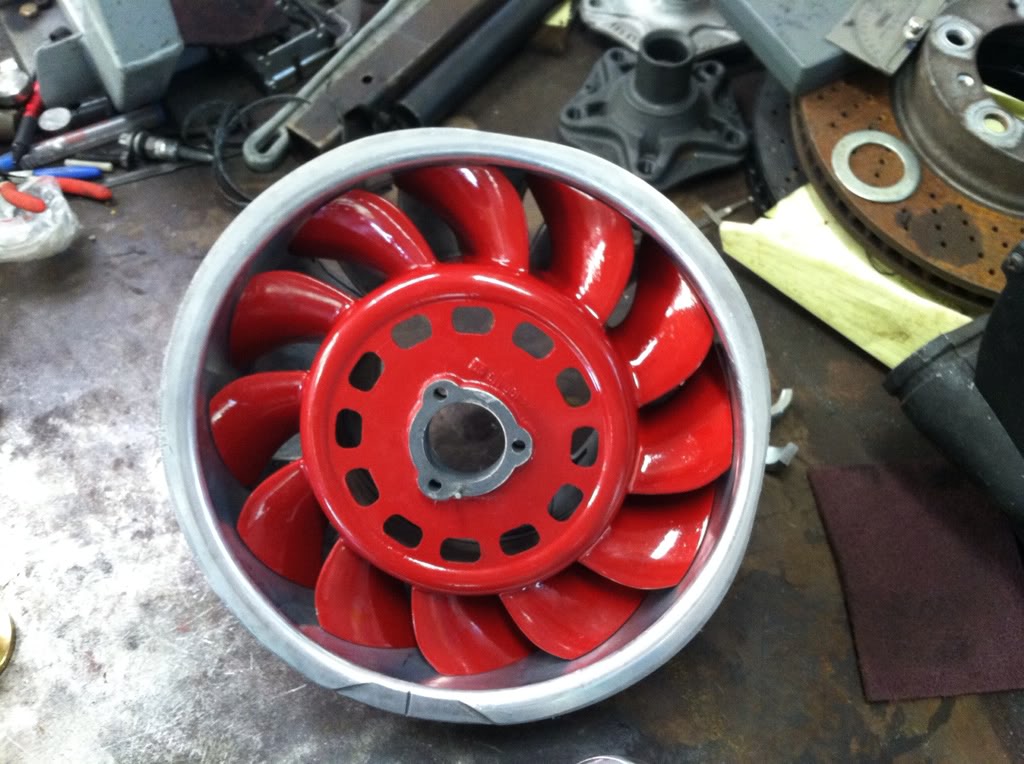
https://mercedesheritage.com/classic-mb-culture/mercedes-ben...
Even without that, I'm kind of surprised they sue. Are they patenting each part? Is there case law that covers this? Or is it just a case of bringing a suit to scare people I sto stopping? I wonder.
Edit: I actually looked into it a little more- it looks like the part is probably machined from casting given that there appear to be four stators which also locate the center mounting point. That's where the concentricity would be set; not by the casting, but by the machining of the center flange. So assuming that the fan's mounting points are within spec, I would say that your friend's part could just be chalked up to machining process that leaves something to be desired. This is actually a trickier part if machined from casting (without the appropriate tooling), but actually pretty simple (and wildly expensive) if machined from billet.
I used to order a lot of custom things from China. Took a lot of trial and error to find good suppliers. They only accept bank wire as payment, so they risk little other than repeat business if they choose to be sloppy.
I think from memory the inside of the circle (which was cast) was not perfectly round. From memory the original Porsche part was titanium, and this replacement was aluminum. But I might have that backwards.
What doesn't sit right with me is the fact that for a small run, the price of even an aluminum casting would absolutely motivate me to get it right the first time. At the level of volume that the guy would have to be operating at, I would be test-fitting every part to a car before sending it out the door.
I feel like the relative scarcity of air-cooled 911s coupled with the difficulty of machining the part correctly as a third party is why the part itself is so hard to come by. If a person were motivated, though, there is definitely another way to make a suitable replacement more cheaply and easily with a modified design. That's provided someone is okay with not having a completely factory 911.
Just take a quick look through your favourite forum for your car of choice and there's endless threads begging for some random old plastic part that can no longer be found.
Interior trim clips, centre console fascias, exterior body plugs (where tow hook goes, where roof racks go, etc), stereo surrounds, door handle surrounds, etc etc etc.
Depends on your pricing and margins. There's a huge number of parts that are available but ridiculously priced, often coming out an order of magnitude in excess of what seems reasonable.
Take for instance a kettle scale filter. OK you probably can't 3d print these, but for something so simple they're insanely priced - £5-£15 for a bit of plastic. A whole kettle with filter costs typically £15-£35. Dyson parts are even sillier.
e.g. https://www.amazon.co.uk/Genuine-Philips-Kettle-Filter-HD467...
There may be a far wider range of parts you could profit from than you may think. :)
This is def not viable from my view- at least not for parts that are this cheap already.
That's most of it left for promotion. Domestic appliances, large and small, regularly have small spare parts that attract 25 or 50% of the price of the entire item. Never used to.
That they're already doing well with small appliances in the niche of non-available parts says enough about pricing floor.
I've also considered creating some upgrades to the stock parts, but it's on my "some day I'll get around to it" list.
It's a neat business model: The person posts DIY repair videos on youtube, which drives traffic to his site. The strollers can easily cost $1000 new, and are often handed down / resold, so there is motivation to keep them running, and they have some weak spots which tend to break. The 3D printed replacement parts can be of superior quality to the original parts.
Want to team up on an a milk gallon jug attachment to pour cleanly?
I think sellers may be able to limit the materials to known working ones (each material has it's own requirements).
was it to save money? or for some unique design?
https://photos.google.com/share/AF1QipMECi57zKtD6arv_-sL83gp...
> is there any way to scan it from your phone and hear it?
It's not detailed enough for that, though you can tell the cadence and reliably guess at the number of words. If you know what we said, and only we do, then you can see it.
The storefront is through ShapeWays[1] and I use iFixit[2],[3] to drive the traffic. It passively makes enough to cover my own coffee needs forever. I spend about 20 minutes per month fielding questions. This all happened because my grinder failed and I could not get parts.
[1] https://www.shapeways.com/product/NASLAGCCP/breville-coffee-...
[2] https://www.ifixit.com/Guide/BCG800XL+Grinder+Jamming+due+to...
[3] https://www.ifixit.com/Guide/BCG600SIL+Dose+Control+Pro+Coff...