A very quick google search will show you that there is sizeable documentation out there on the learning curve for li-ion batteries.
See: https://www.solarchoice.net.au/wp-content/uploads/Solar-PV-l...
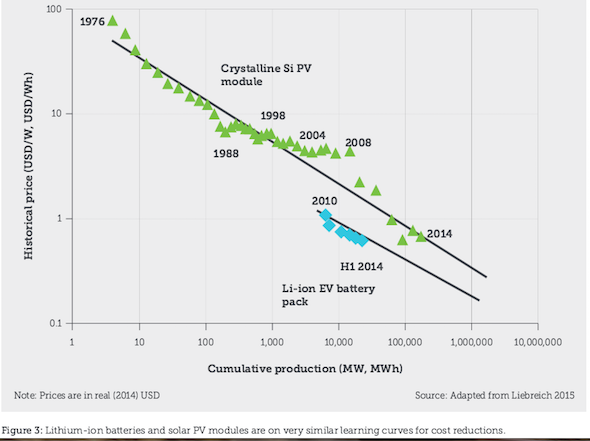
Additionally, while nuclear is definitely a good option for delivering clean, always on electricity - the reason nuclear power plants aren't being built is because whoever is financing it / coming up with the money has to deal with not only a 5-10 year construction lead time but also a 50 year operating period. Given the cost reductions of renewables, how do you price in the risk that your plant will become completely uneconomic at some point in that time period?
I should clarify that I'm not against solar as an important part of the energy mix, but it seems incredibly wasteful when we consider the sheer amount of material required in panels + storage to replicate the sustained output of a single fission plant, not all of which can be easily recycled. Solar hasn't historically been widespread enough for us to experience the issues associated with widespread end-of-lifing of components, but one look at the electronics industry and the waste it produces should tell us that it could be a massive problem we're kicking down the road. The sheer amount of material required to run the world on solar energy is staggering. Nuclear waste is comparatively a tiny and easily tractable problem by comparison - all the world's nuclear waste over a 50 year period could probably fit in a single underground site of sufficient volume.
There has been plenty of work done on smaller, safer fission reactor designs over the last 50 years, but the regulatory burden to get new designs approved & operational is extremely limiting. There's no way to do it without the support of government as things currently stand, and it's a pity - nuclear could provide 50%+ of the global energy mix emission-free with a relatively small footprint compared to solar, and certainly with far less in the way of materials input between plant construction & fissionable material (the latter producing 24,000,000 kWh from a single KG of U-235).
Nuclear is worse in every other way except space used, and Earth is huge.
I will never understand the fawning over a technology that has proven so lackluster under human control. (Nuclear is fantastic with rigid controls such that the US Navy implements, but this never happens is commercial fleets)
Australia will be at 100% renewables before the first nuclear generator would come online if you broke ground today. We should stop mourning nuclear and keep ramping renewables and battery production. The model is proven at scale.
This was already a little sad, but now that the economic case has turned decisively against nuclear power, with things going badly for basically every nuclear project and things going better than expected for most renewables it's becoming absurd.
Sorry, but you are the one making judgment calls and "enjoying being correct" here. I'm advocating for nuclear power, and I also understand the battle is mostly lost, so please don't act smug like this. Other than the economic case, there are massive hurdles on the way of a 100% renewables world, which I hope will be overcome, since that's obviously the way the world is going forward to now.
1. Producing large quantities of power
2. Continuously, for several decades
3. Hiding most of the costs until long after those responsible have become unaccountable
On top of that, while reliable and cheap renewables are “nearish future”, fusion tech is potentially not much less “nearish”, and would enable people to go back to living in Northern Europe, America, Asia, etc.
Note: I’m not trying to espouse or argue for a particular approach here; I’d trying to suggest some reasons why there might be so much (and such long-lived) “fawning over [nuclear] technology”. This is just some mildly educated guessing on my part.
Hence why the article describes one of the projects under consideration is a massive renewables concentration in northern Australia (the population of that area is a rounding error), with the goal of exporting to Asia via undersea cable.
https://www.quora.com/What-is-the-total-mass-and-volume-of-a...
Note also that this is mostly just considering high level waste (like, the actual spend fuel rods and reactor parts), and not all low- and intermediate-level waste, of which there is a lot more:
https://en.wikipedia.org/wiki/Radioactive_waste#Classificati...
If I follow your link, I read this: Over the past four decades, the entire industry has produced about 62,500 metric tons of used nuclear fuel. That's the high-level waste.
The rest of the comment goes on to explain that including all low- and intermediate-level waste, plus legacy waste from military activities, then it may reach the millions of cubic feet you're citing.
Low-level waste is not much more dangerous than the extra natural radiation you receive from a plane trip, so the real danger is high-level waste. And that can fit in a fraction of the space required for a single solar park.
https://nda.blog.gov.uk/2017/04/03/how-much-radioactive-wast...
This is really hard in the U.S. because the NRC is very unfriendly to R&D, but T.E. has already gotten through the hardest part of Canada's licensing process and expects to have the first IMSR running by 2025 or so. Moltex and Elysium also have MSR projects in Canada.
Nuclear naturally looks bad if you compare today's nuclear to the future of wind/solar/storage.
You're comparing vaporware to technologies with a proven track record.
A couple years ago I got to sit in a meeting between people from a dozen GenIV reactor startups and a former head of the NRC. The reactor people said their biggest problem was that the NRC required a near-complete design before they would even take a look. At that point they either said yes or no. If no then that was the end of it, you were out of business. If yes you still had only a paper reactor. Getting to that point required several hundred million dollars.
That's a very difficult sell to investors. They said just a more phased process would help a lot. The NRC person was unsympathetic, said it wasn't the NRC's job to help develop or promote nuclear technology, and was uninterested in climate change.
Canada has a more rational approach to R&D, while maintaining rigorous safety. That's why MSR companies are moving there, and why the first one, Terrestrial Energy, is making solid progress.
(And as a side note, molten salt reactors are a lot simpler than light water reactors, because they have safety advantages inherent to the physics of the fuel and coolant.)
I don't know. MSR's are certainly interesting, but they have downsides as well as upsides.
Some of the PWR SMR's like NuScale also sport passive safety features, which should make it simpler and safer. Being a PWR, it's still a high pressure design, of course, which MSR's avoid.
While MSR are very cool, in some ways they're pretty scary too. I mean, you're pumping around tonnes of super-radioactive goop. What if you have a leak? At least with a traditional design you have a couple of extra protective layers, with fuel being contained in solid pellets contained in tubes. And you have to be very careful with the chemistry of the fuel salt; IIRC one of the early MSR's (ARE?) had to be shutdown since they messed up their redox chemistry which lead to fissiles plating out on the heat exchangers. Eek!
There's the famous Rickover quote that anybody can design a paper reactor, but real reactors tend to be complicated, over budget, and over schedule.
Moltex Energy agrees with you on pumping fuel salt. They keep their liquid fuel in a fuel rod, open at the top, no pumping. All the rods are immersed in a pool of liquid salt coolant, which just sits there. Secondary coolant in pipes through through that.
(I didn't answer your previous points about the NRC process, but for the record, I completely agree with you.)
> Moltex Energy agrees with you on pumping fuel salt. They keep their liquid fuel in a fuel rod, open at the top, no pumping. All the rods are immersed in a pool of liquid salt coolant, which just sits there. Secondary coolant in pipes through through that.
Yes, Moltex is an interesting design. The main drawback, AFAICS, is that since the fuel concentration in the fuel salt is quite low compared to solid fuel designs, they have to use pretty enriched fuel. I think their current plans call for 40% Pu. And the breeding ratio is poor, around 0.5 according to a paper I skimmed through a while ago.
Yes, they also have the thermal design which I'm quite sure requires much lower enrichment, but AFAICT is more a concept than something they're actively developing. It makes sense of course to focus on one design at a time, unless they have infinite money.
One of the other fast spectrum MSR startups, Elysium, also proposes using spent fuel + maybe leftover military Pu for startup. The interesting thing about Elysium is that their design at least breeds, so they only need enriched fuel for starting up. They're saying that they can run up to 40 years before needing to reprocess the fuel, just by adding U238 online to the salt.
Sure. But at some point physics limits how far you can go. We had a good run for many decades with micro-electronics because it's possible to cram a huge number of transistors on a tiny microchip. For solar cells and batteries we're not that far away from fundamental physical limits.
So even though batteries look poised to replace gas for services like frequency control and some peak shaving, they're still orders of magnitude too expensive to allow us to completely run a grid on wind and solar, with no guarantee they will ever actually hit those price levels required.
However, for the last 20 or so years there were chants about the end of Moore's Law. Still appears to be going strong, "somehow".
My take on battery storage: several incremental developments coming down the pipeline on the anode and cathode side of li-ion batteries (improved chemistries, less cobalt, increased silicon %, new electrolyte mediums, etc). Combined with the "coming surge" of li-ion batteries and development for upcoming EV models with billions invested in new battery factories, it's hard to not see significant changes to the price within even a decades time.
Well, Moore's law has already slowed down quite a lot, and in the not too far future we won't be able to miniaturize further since atoms are only so small (e.g. lattice spacing of Si is, from memory so might be wrong, 0.54 nm).
Of course, there is hope for various non-Si based electronics; we'll see.
> My take on battery storage: several incremental developments coming down the pipeline on the anode and cathode side of li-ion batteries (improved chemistries, less cobalt, increased silicon %, new electrolyte mediums, etc). Combined with the "coming surge" of li-ion batteries and development for upcoming EV models with billions invested in new battery factories, it's hard to not see significant changes to the price within even a decades time.
To clarify, I didn't mean to say that we're at the end of the road for battery development today. Just that we cannot expect decades of exponential improvement like we have seen with microchips.
I don't think an order of magnitude improvement in price/kWh is out of the question (in terms of kWh/kg it probably is, though?). But two orders of magnitude? Color me skeptical.
I don't think an order of magnitude improvement in price/kWh is out of the question (in terms of kWh/kg it probably is, though?). But two orders of magnitude? Color me skeptical.
Wrt cars, I think batteries are not too far from being viable to replace most uses in cars, city buses etc. And that will be a massive, and welcome change, in our society.
For long-range ships, planes etc. I don't see batteries as viable. My guess would be, for a future decarbonized society, synthetic hydrocarbons for planes and ships; some ships might use hydrogen or nuclear reactors.
https://www.woodmac.com/press-releases/batteries-renewables-...
I do not understand how spending 2 billion on a plant and 50 billion in case of a major meltdown is better that putting 2 billion into covering the country in solar panels and batteries.
The reason, as many commenters have said, is the vested interest of powerful players.
And 2 billion may be very optimistic even. The current price tag estimate for the nuclear plant being built in Finland is almost 10 billion euros, and over 10 years late. It'll likely be the second most expensive building in the world.
For Finland specifically, I understand it is difficult to rely on solar. May be in a 100 years, when we can run a superconducting cable through Russia to more Southern places.
On the other hand, imagine a scale of disaster if Fukushima-style meltdown happens in Finland. Is it really worth it?
I don't know how or why it happened, but solar/wind has become the most prominent notion of sustainable power generation.
It isn't. Not by a long shot. We don't even have a workable way to recycle or decommission photovoltaic solar panels after their useful lifespan. Reflector based solar plants and wind plants are causing so much ecological damage that their initial designers and proponents are now advocating against their use. At the same time these plants are consuming huge amounts of land that must be cleared of native flora and fauna. The guys building the Ivanpah solar plant have been walking off their jobs because of the wildlife destruction they were causing[1].
Wind and solar are a feel-good distraction which fall an order of magnitude short of meeting our projected energy demands. I'm not fundamentally against these power sources, but ignoring their limitations and trying to scale them to tackle climate change is absurd.
Nuclear is literally the only path forward. Nuclear fusion preferably, but even nuclear fission with all its downsides is currently the lowest deaths per kWh and lowest ecological/climate impact per kWh power source that exists today. Nuclear is also the only power source where we can internalise the waste product and store it in an inert form instead of immediately inflicting it on the environment. It's an order of magnitude better than solar/wind on those metrics.
This is not a controversial fringe view. This is what pretty much everyone in the sector has converged on over the last decade. It just hasn't filtered down to become popular opinion for some reason.
[1] https://video.nationalgeographic.com/video/news/00000144-0a3...
I've lived in places with massive wind farms and the turbines don't take up very much space. Each one displaces a small amount of corn or soybeans, perhaps enough to feed a family of 4 when considering the small perimeter and dirt driving paths (stupid trade wars notwithstanding). And each turbine creates enough energy to power 200 homes or so, which to me is a great tradeoff.
I encourage everyone to watch the 3 minute, 11 second video linked that presumably supports the claim that wind energy is causing massive ecological damage. You'll find that wind energy isn't even discussed in the video, which is about a solar reflection plant that boils water to power a turbine. The project designers moved, according to the video, roughly 173 tortoises, to another location. And quoting the video, they found "no significant difference in the survival or mortality" of those tortoises.
The strongest statement against this clean energy plant was a claim that in the 1940s or 1950s, there were lots of tortoises in that area. Was the plant created in the 1950s? Did the plant cause the tortoises to die or go somewhere else? I don't know when the plant was created but I'm guessing it was recent, and if so, it would be dishonest to blame it for a change that sounds like it started in the 1950s.
I started supporting wind energy in 1992, and am a bigger supporter today.
I'm not against nuclear energy; I think we need more of it. That said, nuclear proponents will probably have better luck comparing nuclear to coal than by attacking clean renewable energy like wind and solar. Wind and solar are here, they're good, and they're part of the future.
If you want to read up on the impact of wind energy, let me google it for you.
https://en.wikipedia.org/wiki/Environmental_impact_of_wind_p...
https://www.wind-watch.org/pix/displayimage.php?pid=26&fulls...
http://batsandwind.org/research/post-construction-fatality-s...
https://www.nbcnews.com/mach/science/wind-energy-takes-toll-...
Each turbine requires the clearing of 5 acres of land around it. Each turbine 'powers 200 homes or so'. There are 128 million homes in the US. That's 640k turbines. That's 3.2m acres of land cleared of vegetation and wildlife just for turbines, nevermind access roads, energy storage, etc. Wind turbines currently supply 8% of US demand and at this scale they kill around 200k birds, 600k bats and ~10 people in maintenance accidents each year. Multiply those numbers by 12.5 to power all of US. Multiply those numbers again by 10 to power china. By 100 to power the world. Starting to get the sense of how absurd this idea is outside of small-scale feel-good wind farms that look past the ecological damage?
France is what the future of sustainable and renewable power looks like. It's mostly nuclear. https://en.wikipedia.org/wiki/Electricity_sector_in_France#/...

Wind and solar are simply inadequate to be compared to fossil fuels or nuclear for base load supply.
https://www.theverge.com/2017/5/13/15635240/texas-songbirds-...
Typical nuclear plant costs, when compared to wind power in France, do not include decommissing of the plant or the cost of cabling while it is for wind turbines.
Also accidents side effects are downplayed so much it's insulting. According to the french medias, the tchernobyl nuclear cloud never crossed the french border. Yet we know now that thyroid cancer near said border spiked during a decade, and it's impossible to sell nuclear energy to one of my best friend whose life has be shatered it.
So the first step to promote nuclear power would be to actually respect people.
I think you might have fallen for media bias. While the nuclear industry doesn't have anything resembling a flawless safety record, it's still orders of magnitude safer than all mainstream power sources which see no scrutiny due to the dilution of their impact.
Nuclear accidents are viewed as bad in the same way that airline crashes are viewed as bad, despite airlines being the safest mode of transport and safer than the car journey to the airport. They are extremely rare, and they impact >100 people when they happen so they're always newsworthy. Unlike the 4.6M people that die due to fossil fuel related air pollution worldwide at a steady state each year.
https://en.wikipedia.org/wiki/Energy_accidents
I'm not pro or anti nuclear. I'm just a random AU citizen following the gradient descent path towards a future that least fucks our children.
Telling the population the border is safe knowing it's not and then they get cancer is quite factual.
I'm not talking about potential risks, I'm talking about actual confirmed events and the way they have been handled. It's not speculation, it's history.
The problem here are not the victims. It's not the risk or the stats. It's respect.
E.g: I can read your comment calmly. My friends with his scar in the throat and his helicopter pilot career down the toilet ? He would insult you and you would lose any chance of convincing him and hence his social network about nuclear.
So yeah, the pro nuclear community has a serious communication problem.
It's not so clear cut. Thyroid cancer rates started increasing dramatically almost everywhere in the world in the mid 80's. Diagnosis rates in the US for example have tripled since 1980, in South Korea they have gone up 13x since 1993. Meanwhile the mortality rate has been completely flat. The most likely cause of this is increase in both screening and the sensitivity of testing [1]. There is also a current debate about if we should be screening / treating thyroid cancer the way we are, i.e. it seems like we're detecting a lot of innocuous thyroid cancers and then operating without need resulting in unnecessary life long complications for the person.
This is why there is a lot of research out there indicating that the vast majority of the increase in thyroid cancer diagnosis in areas like France is unrelated to Chernobyl.
This is the official story we had after tchernobyl:
https://www.bastamag.net/IMG/png/journal_televise_antenne2.p...

This is the reality we measured:
https://img.lemde.fr/2016/04/26/0/0/956/687/688/0/60/0/cb64c...

It is worst than this, of course, because some plants accumulate radioactivity and we ate them. No recommendation had been given to the general population at all.
The region with the most thyroid cancers in the 20 years following is the Isère, at the center east of this map.
Now let's say we end up calculating that the actual number of cancers is, let's say, 100 more in France because of the cloud. It would not be much, and would not be worth acting on it: the flu would be more dangerous.
That's not the problem.
The problem is the way we communicate on this.
Most people make decisions based on a hazy blur of random exposure to flashy stories, not anything remotely resembling rational adult thought. I don't know what the solution is to nuclear's PR and political problems, but I know that it isn't anything that requires a third grader's level of critical thinking ability.
Regarding Chernobyl, I'll just mention it was used both for power and weapons production, and lacked basic safety features including a containment dome.
Reminds me a bit of the observations by Michael Shellenberger who went from https://www.sfgate.com/opinion/openforum/article/It-s-the-oi... to https://quillette.com/2019/02/27/why-renewables-cant-save-th...
Like many other topics today, discussions around energy and renewables has become so ideologically driven that it's hard to find any actual decent discussions.
Temporarily storing the waste onsite forever isn’t a solution.
Fusion is a pipe dream, an absolute fantasy. Yes, we should still research it, but it’s still a fantasy. We can’t even sustain a positive energy fusion reaction let alone deploy it as an energy source.
Vitrified nuclear waste has caused a grand total of 0 deaths or incidents throughout its history. More people die due to solar plants each year than have died to vitrified nuclear waste in all time.
Gen 3, never mind gen 4 reactors are able to consume waste from older reactor designs and spit out relatively inert waste products. Gen 4 reactors generally don't produce the kind of active waste that needs cooling pools, and their waste can be immediately made inert.
The hot waste problem exists only because most plants operating today date back to cold war era designs and were intended to produce weapons grade nuclear material rather than the the cleanest kWh. Despite that, they're still cleaner than every other energy source we have today.
It is very much a solved problem.
How do you know? From what I learned, a big problem with spent fuel is radiotoxicity. How do we know that no amount of weakly radioactive, but pretty toxic because of that material made it to the environment? Are all those storage containers that safe?
Even if all that were to happen in the worst possible case scenario (as has happened at Lake Karachay in Russia where untreated nuclear waste leaked into the groundwater in large volumes), it's still a long shot from being as deadly as the fossil fuels we take as a given today. That sets the upper worst hypothetical imaginary case for vitrified nuclear waste if some super volcano erupts at the storage site and converts it back into a chemically active form.
You can buy kitchen plates and glasses made from uranium glass, and that stuff is relatively a bigger hazard than vitrified nuclear waste. So is the americium in your smoke alarm, so are the various nuclear materials used at your local hospital for radiography and radiology.
To really nail this point home: coal fired power plants release more radioactive waste into the environment that nuclear plants do. The trace uranium found in coal can't be combusted and makes its way out the chimney, and that is more than a nuclear plant releases including disposal [1].
[1] https://www.scientificamerican.com/article/coal-ash-is-more-...
Are the coal-produced concentrations of such waste equal or higher than with the nuclear power waste? Say, if somebody is particularly unlucky and digests that?
>We don't even have a workable way to recycle or decommission photovoltaic solar panels after their useful lifespan
Nor do we know how to recycle nuclear waste (since that's what you're comparing it to) At best we know how to store nuclear waste, but we'll only know if we've done a good job in thousands of years so I wouldn't bet on it. You also seem to forget how Uranium is mined in the first place, but mining is involved for solar panels so I'd say they probably compare equitably here.
There is however progress in recycling solar panels [1]
>Reflector based solar plants and wind plants are causing so much ecological damage that their initial designers and proponents are now advocating against their use
What damage are we taking about? The tortoise in the link you gave seem to have been displaced. Sure it's not the best, but I'm sure building a nuclear plant comes with its own side effects, such as warming of the surrounding water, increase in traffic and noise pollution for the local wildlife.
>The guys building the Ivanpah solar plant have been walking off their jobs because of the wildlife destruction they were causing
There's no mention of that in the link you posted
>Wind and solar are a feel-good distraction which fall an order of magnitude short of meeting our projected energy demands.
Wind and solar resources can provide an order of magnitude more than what we currently consume. [2]
>Nuclear is literally the only path forward
No it's not.
>Nuclear fusion preferably
Not anywhere near being production ready, though the day it is I'm happy to have a fusion boiled cup of tea, heck I'm happy to pay more taxes in order to fund research.
>It just hasn't filtered down to become popular opinion for some reason.
Maybe because it's not true?
[1] https://www.reuters.com/article/us-solar-recycling/europes-f... [2] https://www.pnas.org/content/106/27/10933
Why are you linking a study that just looks at the potential wind kinetic energy available for conversion? A study that ignores where the bulk of useful wind turbines would need to be built? That ignores the economics and ecological impact? I mean that study is pretty clear about what it's looking at, and it isn't at all what you're implying.
"We elected in this study to exclude forested, urban, permanently ice covered, and inland water regions"
Uhhhh. Cool, in more breaking news, theoretically if we cleared flora/fauna and covered 1/5 of each continent in solar panels we'd also exceed our energy demand!
Did you just google your premise and pick a paper that vaguely seemed like it agrees with your presupposition? Take the time to actually read it.
Sorry for ignoring the rest of your gish gallop. I'm sure you understand that it's hard to engage in serious debate with people who scan your entire post for a couple of uncited fragments and latch on to those one by one. If you held yourself to the same standard, your entire comment would need to be broken down line by line and attacked since you have cited nothing. Especially if you're ignoring commonly understood facts like the existence of a nuclear waste disposal cycle, or if you're citing completely unrelated papers without even checking them first.
Clueless environmentalists demonstating, skyrocketing costs for construction of new reactors, overregulation, fear of nuclear proliferation.
Nuclear is not the only path forward, there's also geothermal power where it's available. Nuclear can be nearly renewable if we reprocess and recycle nuclear "waste" and further burn it in fast breeder reactors. Unfortunately those are prohibitively expensive.
Modular nuclear reactors could also very useful and they're quite safe since they're derived from naval PWRs which have an excellent track record. So far only the Russians have two naval reactors on a barge called Akademik Lomonosov. The rest of them are in various stages of design or regulatory review. There's hope NuScale will be comercially available around 2025.
No shortage there.
Last week I just saw a bunch of kids camp out at our city hall to protest and demand the “New Green Deal” which proposed to eliminate plane travel and retrofit all buildings in the USA with renewable energy...
Good luck nuclear... uphill battle there.
> “The battery pipeline has grown exponentially,” Dixon says
> Other projects include the 4GW Walcha project in NSW, proposed by Energy Estate and Mirus Wind, which aims to combine huge amounts of wind, solar and storage for the biggest project proposed so far for the main grid.
Battery power has obviously been improving asymptotically towards zero (i. e. the inverse of power growing exponentially): https://www.google.com/search?q=costs+of+lithium+ion+batteri...
It's funny how the wider tech community has this obsession with nuclear technology. It's a sort of scientism, where the actual science has long moved on, but a certain group just clings to outdated ideas because they are still invested in a culture clash. It has gotten to the point where I think the potential danger of nuclear technology is actually appreciated, as a sort of sticking-it-to-the-environmentalists feature. Or it's a symptom of people growing up with science fiction culture prominently featuring nuclear power, unwilling to let their ideas of a glorious future go.
But the facts have simply moved on, and renewable energy is now winning on economic arguments alone. Thanks to actual scientists, and to a significant degree politicians (especially Germany) offering magnificently effective subsidies, solar, wind, and storage are now competitive even with coal. Nuclear power is big hairy dangerous technology some people somehow adore, but it's also prohibitively expensive.
In many ways, China's nuclear demonstrates the advantages of its authoritarian system; it can get some things done far better than democracies, willingness/permitting/policy being such non-concerns for their governmental system.
https://www.forbes.com/sites/jeffmcmahon/2018/10/02/4-ways-t...
Absent that, both approaches will probably develop naturally, as technology and political climate allows.
Countries that haven't started are lucky because every part of a nuclear power plant is incredibly difficult to get rid of.
Not in Australia it isn't. We have very large areas of geologically stable, sparsely populated land. Some of it is even already contaminated by nuclear tests in the 50s.
It didn't 'miss' its window — it was actively shut out by the green movement. One of the great ironies of climate change really.
Disagree. Ignorance has immense political power.
No you don't. You need storage, but it can be pumped hydro, hydrogen, ammonia, molten salts, and many other things.
Tesla would beg to differ. Their entire EV market is made possible by better, cheaper batteries, and that stems from the popularization of smaller, longer lasting, power sucking smartphones.
[1] https://www.bba.ca/project/north-american-lithium-mine-resta...
[2] https://www.reuters.com/article/us-panasonic-batteries/panas...
I saw a cool graph showing how much cell price would change if different material inputs price changed. Essentially, cobalt or lithium could double in price, and the cost of a battery pack for a car would only increase 5-10%. Can't find the exact graph, but this article has quite a lot of detailed info on battery price constituents. http://thedeepdive.ca/lithium-ion-battery-cells-cathodes-and...
edit: oo it actually has forecasts for cobalt production and demand showing demand for cobalt higher than supply by 2025. And forecasts that material costs are not likely to drop. And that manufacturers will work other angles of the price equation to get prices lower.
Nuclear power is generally pretty harmless. But when it fails, it has the potential to kill millions and render large parts of the country uninhabitable. That is danger.
I still think we should have gotten rid of coal before nuclear. But long-term, nuclear is not an acceptable power source.
According to Wikipedia's entries about France[2] and Germany[3] neither country is without accidents, albeit not Chernobyl or Fukushima-level incidents. The list of accidents involving Gen-II and Gen-III reactors is quite long[4], with USA leading (of course they have the highest number of reactors worldwide so it makes sense).
Please correct me if I'm wrong but as far as I can determine, a majority of operational reactors worldwide are still quite old (1965–1996) Gen-II designs with a smattering of Gen-III and most recently a handful of Gen-III+ upgrades, with most plans to upgrade being put off due to Fukushima.
The safest Gen-IV designs are planned to start construction earliest in 2030. I can't find any installations of Gen-III+ reactors anywhere in Europe, they seem to be spread across Asia with a small handful of US installations.
Also considering the reality of climate change and the resulting expectations of increasing frequency and strength of weather events, I would think another Fukushima-type event is not far away, especially factoring in the age and possible lack of preparation for such extreme weather events.
Also waste management is not a minor issue with no real solution other than "bury it underground and hope nobody digs it up by accident in the future".
[0]: https://news.ycombinator.com/item?id=19312154
[1]: https://www.researchgate.net/publication/260339436_An_Overvi...
[2]: https://en.wikipedia.org/wiki/Nuclear_power_in_France#Accide...
[3]: https://en.wikipedia.org/wiki/Nuclear_power_in_Germany#Accid...
[4]: https://en.wikipedia.org/wiki/List_of_nuclear_power_accident...
It's pretty common knowledge that battery capacity at the same prices goes up by 8% per year.
Also please note that in case France and Germany electrical grids frie because of a solar storm, cooling down the reactors will be impossibe once the emergency power generators run out of fuel.
Nuclear is too expensive.
> costs too much
because we haven't invested in any experimentation in most markets. The US has stopped building new reactors for decades. There's no reason why nuclear reactors can't be made to be cheaper.
> I think it's no longer great;
This needs a benchmark. Nothing is great in absolute. It's still great vs all the other energy productions methods. Solar need huge surfaces to produce large quantities of energy, and solar panels require very toxic materials for manufacture... nothing's perfect unfortunately.
For thorium, the wikipedia page lists 22 disadvantages: https://en.wikipedia.org/wiki/Liquid_fluoride_thorium_reacto.... It may well be the longest list of arguments against I've seen on Wikipedia, including, by the way, proliferation risks.
It's interesting how you say "has been dealt with" and then point to a technology that barely exists in reality. Thorium reactors have been promised as a solution since a long time, people have predicted that many of them will be built really soon. It hasn't happened.
No. In some ways they're much worse, in fact.
> Nothing is great in absolute. It's still great vs all the other energy productions methods. Solar need huge surfaces to produce large quantities of energy, and solar panels require very toxic materials for manufacture... nothing's perfect unfortunately.
Indeed, by many metrics (deaths per kWh, environmental footprint) nuclear is the best option we have.
The cells themselves are pretty inert, although CdTe (rarely used but once popular) is quite toxic. And of course none of this stuff radiates.
Nuclear has such a complex set of technologies and industry that needs to be developed and maintained. The buildings themselves take years to develop and construct.
Then there's the stigma around them etc etc.
Renewables just make more sense these days.
Though apparently radiation is not as bad for the flora and fauna as people are:
“Wildlife is thriving around Chernobyl since the people left”
https://www.newscientist.com/article/dn28281-wildlife-is-thr...
Also, deaths during construction tend to be workers who have signed up to the risk. That isn't OK, but it is a lot less bad than risk to random members of the public who have not consented. And it is a vast improvement on the deaths caused by fossil fuels.
Source?
Also it only functions as baseload - it's a great alternative to coal, but that's about it.
Not the case for the UK.
There the energy density per head of population is too high for renewables.
Good video by the late David Mackay on that point here.
You can also send power under water quite a ways cheaply. So, it’s hard to find a location which needs extreme power production density.
As to solar, clearly you have seen them on roofs which have no other real use.
They do, very much. And that is new batteries, not even taking into account all the used ones that will flood the market in a while.
Combining wind and solar dramatically changes the numbers, thus making a meaningless argument. They are so cleap you can balance the cost of overproduction and storage to end up with minimal storage. But in such an environment Nuclear is simply more expensive than either extra wind production or storage making it nearly useless.
See https://www.manhattancontrarian.com/blog/2019-3-14-how-much-... for a good overview
“storage for what could be many days — or even a month or more — of power.“
The only way you get that kind of assumption is to set production at exactly as much energy as you need over the year. If you produce extra power every day then you never need even 1 day of full storage. It’s true wind and solar does not always produce the same amount of power every day, they never produce zero. Thus, it’s a question of what you scale the system around minimum or average production over some time frame.
Run the numbers vs. assuming minimum production and some storage is a net gain. But, as Nuclear costs at a minimum twice as much and also needs redundancy, actual storage requirements are fairly low. Those numbers get worse if you need run Nuclear as less than full capacity.
Aim to have a surplus on the lowest output day of the year and you never need more than a few hours.
Further, the ideal amount of storage is heavily influenced by price and cost of production. The grid is a huge complex system and simple models don’t provide good answers.
Demand is very predictable. As for supply, the generation capacity of fossil or nuclear power plants is known ahead of time and can be managed to provide power in a predictable fashion. These plants don't randomly begin generating more power when the wind blows or when the clouds part or the sun rises and they don't randomly generate less power when the winds die or the clouds arrive or the sun sets.
You don't need storage mechanisms with this type of generating capacity. But if you try to shift significantly towards solar/wind to provide power you now have an unpredictable generating system. That can be mitigated to some extent by adjusting the output of the traditional plants but the more your generating capacity is moved towards the unpredictable renewables the harder it becomes to keep the balance.
Even if you manage to keep things balanced, you can't decommission the old plants because sometimes (dark windless nights), your renewables aren't going to generate any power and most or all of the power has to come from those plants you were trying to replace with the renewables.
The only way around this is to come up with some sort of storage mechanism that can react quickly to the varying supply of renewables to maintain a smooth/constant power supply. Which wouldn't necessarily be a problem except for the fact that we actually know how to build high-capacity cost-effective storage mechanisms.
Suppose, you want to supply an island with nuclear power. Lowest recorded useage at was 1GW of power and the peak recorded daytime use is 3.5KW of power. Average annual power useage was 2GW and peak daily useage was 2.4 GW.
You can buy nuclear power in 0.25 GW increments with 95% of the cost being there of the power is used or not.
Nuclear costs 149x per GW, Wind 45x, solar 40x average daily output. Nuclear needs to be offline 4 days out of the year for maintenance, wind and solar provide a minimum daily output of 40% their maximum.
Now, without lot of storage nuclear needs 3.5GW even if one plant is offline at a minimum but preferably some cushion if future needs are over 3.5GW. Thus we need 4GW of Nuclear for 596x to be safe. (Larger grids need less cushion, but still need to plan for multiple GW or Nuclear to be offline.)
Wind and solar need some storage, but even using the lowest values of 40% average output that’s 45 /.4 x 3.5GW = 400x.
Though if we had some storage we could also drop Nuclear to 2.4GW + safty factor to get closer to 400x. But remember we now produce 2.5x as much solar/wind on the average day for the numbers to get close, and we still need to use storage for nuclear. Further, those assumptions are unfair as in practice solar and wind minimums don’t occur on the same days as maximum power usage.
For a current example, the US loses money by exporting subsidized food. But, they would lose even more money by letting that food rot.
Countries that are truly interested in sustainable energy production should be building nuclear power plants. France & Germany will come to deeply regret their decisions to decommission old reactors and not build new ones, since nuclear is an incredibly safe source of baseline power.