Tether has printed $600 million worth of tokens since, so either: 1) Local Taiwanese have deposited $600 million to buy Bitcoins through domestic wires, OR 2) Tether is lying and printing tokens out of thin air.
Place your bets gentlemen.
People with real money would instead wire the funds to Gemini or ItBit or even a terribly managed company like Coinbase.
KISS
For context, I reported couple of bugs to MtGox back in the day, and even MtGox fixed them in under a month which is more than what I can say for Coinbase. I guess this is what happens when Coinbase speed-hired 100 people in one year with no proper team-building exercises.
Correction, there is no support. I have a bit of money permanently locked in a coinbase account because their support does not reply at all.
At some point I will just have to convert it all to BTC and send it elsewhere. Caveat Emptor.
On the account draining -- well, there's a latency in setting up new bank accounts there. So I'm surprised it's that easy to just yank money out.
Although I did notice there's no account verification. For example, on Vanguard or other platforms they do a small deposit of a few cents and ask you to verify the payment amounts, a process which has a latency of a day or two.
Are there any ways to make coinbase safer other than a very secure password?
It worked fine, but had to go into the bank in person with ID to get the funds approved.
Not sure what it'd be like if I moved $100ks.
$600 million bet — literally.
They don't need to do that on that many exchanges to have effective peg to USD. However they of course still need traditional bank accounts, and they need to trade the BTC on OTC markets or somewhere else.
Basically everything about the parent comment is factually incorrect. I'm not sure why it's so upvoted. I guess people just like scandal in the cryptocurrency world and would prefer to believe what comports with their preconceptions.
Even if BFX did not know this before they build their exchange, this most likely became clear from day 1. Tether is a great hedge against this (politics aside).
Could you address anything that you think is "factually incorrect"?
> The post I was responding to claimed Tether was specifically created to address Bitfinex's wire issues. That is false.
It does not claim that it was "specifically created for that", it claims that "Their solution" to the wire problems was "Tether". It does not state anything about why Tether was created in the first place.
> Secondly, there is plenty of reason to create something like Tether independently of any wire issues (specifically: to normalize prices between exchanges).
People will arb the effiencies away anyway, regardless of what tools the exchanges provide them. Besides tether a lot of people in Taiwan are arbing through the traditional banking system [0].
But you are right, it IS important that there are ways to flow money in and out. Which is exactly what Tether is for according to OP's argument.
[0] https://steemit.com/bitcoin/@kingscrown/living-in-thaiwan-yo...
Read the post, man, very first paragraph:
> Bitfinex was cut off from the US financial system, which makes it impossible for them to clear USD-denominated wires...Their solution: issue a cryptocurrency which is claimed to be 100% backed by USD and say that it is redeemable 1-to-1 for dollars... we just can't actually physically give you the dollars.
> People will arb the effiencies away anyway, regardless of what tools the exchanges provide them. Besides tether a lot of people in Taiwan are arbing through the traditional banking system [0].
That's true, except you probably have never tried to actually execute that kind of arbitrage before. I have, so let me tell you the problem tether solves: speed. If you do arbitrage through the banking system, you have to wait for wire transfers to clear. That can take days to weeks. That means you have to wait for the spreads to be large enough and stable enough to compensate you for the enormous risk of being exposed to the vicissitudes of the crypto markets during that time. And that's assuming you already have the accounts setup in the right countries. Tether makes all that instantaneous. That is an enormous benefit to arbitrageurs equalizing prices, and inter-exchange liquidity.
I've read it a few times now, still can't find where they say they specifically created tether (the system) for this exact purpose. Keep in mind that the issuance of tether is not the creation of the complete tether blockchain/system (they are issuing new tether around the clock).
> That's true, except you probably have never tried to actually execute that kind of arbitrage before. I have, so let me tell you the problem tether solves: speed.
You are right, I have never tried arbing through the banking system. I am doing small/mid scale arbing in cryptomarkets, however I stay away from anything that touches any bank / FIAT.
Though my point is that: yes arbing through banks is slow, inefficient and very dangerous. People will do it nonetheless because of the margins you can make. The exchange does not care how hard it is or how people do it, just that there is some guy somewhere (potentially flying around with suitcases of cash) who is doing it.
So yes I 100% agree with:
> That is an enormous benefit to arbitrageurs equalizing prices, and inter-exchange liquidity.
But bfx only cares about the latter, not really about the people doing it.
> Bitfinex was cut off from the US financial system, which makes it impossible for them to clear USD-denominated wires...Their solution: issue a cryptocurrency which is claimed to be 100% backed by USD
Right there. patios11 claims that Bitfinex's "solution" to their wire problems was issuing Tether. That is demonstrably false, because Tether predates Bitfinex's wire issues by more than a year.
> I, J.L. van der Velde, hereby declare as follows:
> 1. I am the Chief Executive Officer for iFinex Inc. (“iFinex”), BFXNA Inc. (“BFXNA”), BFXWW Inc. (“BFXWW”), and Tether Limited (“Tether”). I have personal knowledge of the facts set forth below, and if called and sworn as a witness, I could and would testify competently thereto.
> 2. iFinex, through its subsidiaries BFXNA and BFXWW, owns and operates a leading global Virtual Currency platform called Bitfinex.
Bitfinex is responsible for Tether.
patio11 is well respected in this community, so I guess the post is upvoted just because of the author. I personally respect patio11 on quite many topics as a very knowledgeable, but when it comes to Bitcoin and cryptocurrencies he seems to have some personal issue with them, which makes his posts on the topic not that objective.
If you have a substantive rebuttal to make, do that instead of engaging in passive aggressive character assassination. What you’re doing is probably satisfying, but it doesn’t convince anyone else that you’re correct who doesn’t already side with you, and it’s insidious in that it steers the course of the conversation away from an individual’s point and onto their identity.
When you have to choose between following a pre-bankrun rumour or following unsubstantiated pushback, follow the rumour. It costs you maybe 5% to get out vs 100% if you're wrong and banks / money holders compete on assuring people that there is less risk with their solution so if Tether can't provide assurance then that is their problem. Cut and run.
(Possible responses include both "the traditional financial system and fiat currency is actually pretty good" and "someone should run a reliable FDIC equivalent as a business for new exchanges and new coins".)
The only problem is that there's no way to know for sure whether an exchange is running on a fractional reserve or not.
Well, they've never proved it. Just a literal: "Hey, we promise we have the money."
So, can't really say; it's basically a Schrödinger's cat to everyone on the outside. We will only know when it booms — or busts.
Both are owned by iFinex LTD, and had the same CEO till earlier this year. Total amount they have lost comes out to $1 Billion.
How are you still claiming "They may not be"?
I also wish that "everybody I disagree with is a shill" meme stayed in 4chan and reddit, it's incompatible with reasonable discussion.
So, I did lose the time-value of that money (they didn't pay me interest on it), and I didn't get paid back in Bitcoin or Ethereum, which would have been more money, but i'm still very happy with how they handled it. I think it was the most reasonable and honest solution to the problem that they had available to them at the time.
> Don't accuse others of astroturfing or shillage. Email us and we'll look into it.
> Don't feed egregious comments by replying; flag them instead. When you flag something, please don't also comment that you did.
Reversing Tether tx does nothing to recover those Bitcoins.
Edit: found this: https://www.reddit.com/r/btc/comments/7e1840/the_30000000_us...
It seems like people did in fact notice the $30m being deposited on Bitfinex and being used to buy Bitcoin, all before it was known to be stolen. Difficult to confirm a thing like this, but I wouldn't bet against it.
http://article78againstnydfs.com/docs/317-cv-01882-BitfinexC...
And the company officers are currently actually bitfinex people?
Total coincidence.
Poloniex is owned by a guy named Tristan D'Agosta. He's a little bit less easy to track down, but does seem to be a real, known person with a real history and life.
I don't know how they each separate customer and operating funds, but i'm sure the Bittrex guys at least would probably be happy to tell you if you ask in their Slack channel, assuming they don't consider it a security risk.
Correct me if I'm wrong here, but this seems to be an argument for BTC/USD going up on Bitfinex -- but not necessarily elsewhere. Is the market failing to price in the fact that "USD on account at Bitfinex" has a value which is not identical to that of "USD in a regulated US bank account"?
If the price of Bitcoin has been inflated by 600 million USD that doesn't really exist, then when this unwinds it will be bad news for Bitcoin.
Where is the evidence the exchange itself is doing it?
Is this real trading activity, or is it people discovering that there's no feasible way to trade USD directly for the meme coin du jour?
Don't people who run arbitrage bots usually understand concepts like counterparty risk? Do they not realize that by moving money into Bitfinex they're potentially acquiring a large amount of assets which will end up being devalued?
I think there is a place for a 1:1 backed currency on the blockchain, but I'd rather see Governments actually print for example USD and AUD onto something like an ERC20 Ethereum token.
This would add real fiat to the blockchain which is important, as in the end all taxes are paid in fiat. (It would be nice to be able to go directly into AUD for all crypto currencies, rather than the mess I have now which is to use an intermediate crypto currency like Ethereum or Bitcoin to move in and out.)
Those extra transactional costs really screw with a lot of us.
Especially after the Bitfinex "hack". I won't touch them with a ten-foot pole, but for large scale money laundering, nothing fits the bill better.
You briefly mention that crypto-currencies are used for money laundering. Do you think that's what's driving btc price to insane levels? Or is it just good old euphoria?
For example ECB (european central bank) is issuing 60 billion euros new money each month, and buying bonds with it. That is half of the bitcoin market cap.
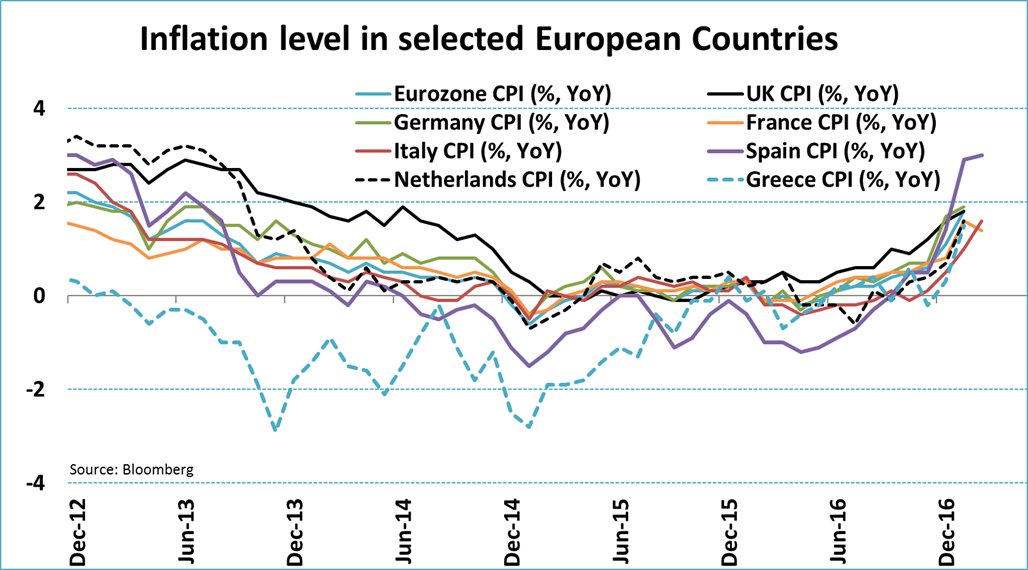
Yes, this drives bank savings account rates down to nothing, thus people are looking for better "investments".
I feel like I'm missing something here -- doesn't the first VC end up with more in tether than the right-pocket money?
Well, yeah. People don't just participate in schemes without getting "paid" for it.
Participating exchanges have to upgrade their omni/tether clients or they run the risk of accepting the unredeemable tethers for which their customers will hold them liable. Omni's design allows tether to track all the disavowed tethers so there's no risk of payout to addresses downstream of this one.
EDIT: it appears I was wrong!
This change was from 14 hours ago: https://github.com/tetherto/omnicore/pull/1
Couldn't you just try to find exchanges where Tether volume spiked around that time?
It was shut down by US authorities sometime in the Spring of 2013 as I recall. Tether is playing a similar inter-exchange roll today. At least now there is some kind of public ledger, but that may not be saying much.
To add to the excellent summary of patio11:
The other side of the coin is that more and more exchanges are using Tether (USDT) as the only thing pegged to the FIAT world in any way (value wise), not having to deal with actual dollars and banks makes the legal side of running an exchange a lot easier and cheaper. So a lot of exchanges are supporting USDT for a reason way bigger than simply providing a trading marketplace for them. Think about exchanges like Bittrex and Poloniex, which volume wise are huge and don't offer any real dollars or euros.
When you go to withdraw from Tethers it basically says "if you don't have more than $50k in claims, go away" [1]. Suffice it to say that most of their customers don't have that.
My guess is that Bitfinex, through a combination of wash trading and Tethers, have been pushing up the price of Bitcoin and they've basically been running a Ponzi scheme.
[0] https://tether.to/wp-content/uploads/2017/09/Final-Tether-Co... -- "This engagement does not comtemplate tests of accounting records or the performance of other procedures performed in an audit or attest engagement"
[1] https://cdn-images-1.medium.com/max/800/1*7BOwdYvUycjNFdUB2e...
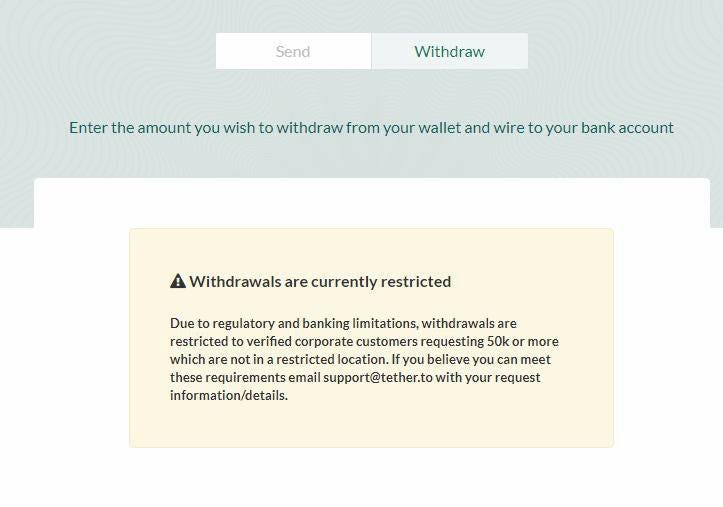
The requirement to redeem in large blocks doesn’t change that logic, and still ensures that the smaller trades happen at par.
This is not how most people redeem tether, they go to any of a wide range of exchanges (kraken, poloniex, bittrex, etc) and trade whatever amount (from a dollar or whatever the minimum trade amount is).
It is the definition of inflation: increased money supply. Except it's priced in $, which hasn't actually inflated. So if the bubble pops and the money is found to be fraudulent, then it equates to money supply shrinking. Artificial demand removed..
However I don't think it's obvious that this thing will implode, based on the information we have we can only speculate. Pointing to screenshots about being unable to withtdraw tethers is a red herring and has nothing to do with whether tether will implode.
1) Let users exchange USDT for USD no matter the denomination or status. If they can't do that, remove the thing that says "You always have 24/7 access to our balance" from the website marketing.
2) Release an official audit (that doesn't say "this is not an audit")
3) Explain the large amounts of Tethers being minted. If they are legitimate, who is pumping $100m into Tethers almost every 3 days? No need to be specific, but records would be nice.
4) Tell us who their banking partners are that are holding the USD.
5) Put their transparency page back up [0]. Bonus points if they actually keep the "Shareholder Equity" number negative in the interest of transparency, or explain why it might have gone negative.
[0] Compare: https://archive.is/6os3c https://wallet.tether.to/transparency
The fact that they haven't done any of these heavily imply to me that Bitfinex and Tethers are a sham operation.
This again, is related to their marketing and not actually to their solvency (red herring).
> Release an official audit (that doesn't say "this is not an audit")
Lack of proof !== proof of insolvency.
And for all the other ones:
They are not entitled to tell you everything. The fact that choose not to is in NO way proof that they are insolvent.
I 100% agree that based on your list one might choose not to trust them. Just don't go screaming "they've basically been running a Ponzi scheme" with the only proof being them not telling you what you want to know about their operations.
My bet is that exchanges are holding a lot of these, and they're a bit bought in to Bitfinex not falling over...
Insofar as market cap means anything, Bitcoin alone takes up about 56% of the sum of all cryptocurrencies listed on coinmarketcap.
They accept anonymous reports, and pay out whistleblower penalties in some circumstances.
I can't tell if Tether is a US company or not, but regardless, it's still worth reporting if y'all care to - that USD has to get into the country somehow, and it sure is interesting how it isn't being reported properly!
Generally, they know about it, but they have to work to build a case against these people?
This is the only thing that matters: no matter how many faults, and bugs, and breaches, and unauthorised transactions there are, people still flock to these poorly specified, even more poorly executed soap bubbles with no real-life uses.
This like the tenth time something like this happened this year (or just last month, I lost track). And still, somehow, there are (perceived) millions upon millions of dollars in these systems.
Certainly you won't believe it does without some strong verification right?
The short version: Mt. Gox stopped paying out USD-denominated claims, because (as was correctly perceived by many people) they were insolvent. They continued paying out BTC-denominated claims. The only way to get value out of Mt. Gox was to either go through yen (which the vast majority of customers couldn't do [0]) or buy Bitcoin and withdraw, which caused the price of Bitcoin to gallop upwards in late 2013.
[0] I got a number of interesting business propositions that year: https://twitter.com/patio11/status/423869016776933376
Didn't the price crash after the extreme rise? Or was this because the BTC was stolen and unrelated to the USD insolvency? Was the "good for BTC" tongue in cheek?
Similar thing could happen with people redeeming USDT for USD if they don't have enough to cover the already issued USDT.
Tether certainly has a connection to Finex but they are not its biggest client. Tether is being used by crypto-only exchanges mainly Bittrex and Poloniex to give people the possibility to trade coin/usd.
A possible explanation of Tether growth is simply that: Polo and Bittrex started using them. Is that shady and tries to avoid regulation by placing a crypto sign over a real dollar? Yes.
> If you don't believe Bitfinex's $600 million in liabilities are worth a copper shilling, the only option for getting your value out of Bitfinex is to swap your liability for Bitcoin, which drives up the price of Bitcoin at the margin.
Except that the price of bitcoin in finex has been lower than other exchanges in the last few weeks and only slightly higher now.
> I, J.L. van der Velde, hereby declare as follows:
> 1. I am the Chief Executive Officer for iFinex Inc. (“iFinex”), BFXNA Inc. (“BFXNA”), BFXWW Inc. (“BFXWW”), and Tether Limited (“Tether”). I have personal knowledge of the facts set forth below, and if called and sworn as a witness, I could and would testify competently thereto.
> 2. iFinex, through its subsidiaries BFXNA and BFXWW, owns and operates a leading global Virtual Currency platform called Bitfinex.
I don't know what else you need for a smoking gun. Tether and Bitfinex are the same thing.
This is false. In fact, every "USD" market on Bitfinex is actually a Tether market. It doesn't matter what the label on the ticker is, because USD cannot be deposited or withdrawn from Bitfinex, only Tether. Given that, Bitfinex is by far the biggest Tether market.
Whether they are holding a lot of USD₮ or not, I don't know. But since they cannot receive USD, by construction their USD holdings are limited.
[1] https://support.bitfinex.com/hc/en-us/articles/213919369-Wha...
There are others though not really at Tether's level. There is bitUSD on cryptocurrency called Bitshares.
> Is this good news for Bitcoin? Oh this is great news for Bitcoin.
Some more discussion on this topic here: https://news.ycombinator.com/item?id=15633852
To add to your post, there are some claims on the fact that it is not finex which has the highest volume rather Bittrex and Poloneix.
There is an interesting reason for that- there is no market for BTC/USDT on Bitfinex as far as I can tell: https://coinmarketcap.com/currencies/tether/#markets
Though I am unable to open the exchange link - https://www.bitfinex.com/t/USDT:USD
This means if I need my USDT to convert to BTC Finex is not the place. They are rather Poloneix and Bittrex which have an exchange for BTC/USDT. Hence people are going to those exchanges in droves, instead of finex.
The second interesting thing is as far as I can tell, finex seems to peg the USDT to $1 and invariably sell/buy at the same price. There is no free float. While others have a free float to BTC/USDT which means prices can be pushed higher there. So I will not be surprised if Bittrex/Poloneix had higher BTC prices.
That said, the chart of USDT is also interesting: https://coinmarketcap.com/currencies/tether/#charts
The peg was maintained for a long while before things seem to get hairy in April/May this year.
You have it backwards. There is no BTC/USD market on Bitfinex. Their "BTC/USD" market is a BTC/Tether market. They have simply labeled it wrong to mislead people. USD cannot be deposited or withdrawn from Bitfinex, only Tether, and that makes their "USD" market a Tether market no matter what the ticker says.
It's really a brilliant scam, but it's only a matter of time before Tether is shut down for enabling money laundering, and Bitfinex with it. Banning US citizens may buy them a little time but it won't last forever. Bitfinex will be the next BTC-e, only worse. Not only is their volume higher than BTC-e, they may bring down Bittrex and Poloniex with them.
1. USDT > USD. This is the benign version. This signifies increased demand for Tether itself. This happens when there are arbitrage opportunities between exchanges that can only be exploited quickly using Tether. This is the variety that is most common, and exactly what Tether was intended to be used for.
2. USDT < USD. This is bad. This means that people are willing to take a small haircut to not be holding Tether. This means that the market views Tether as risky in some way, possibly implying insolvency. This has happened a few times, but is less common.
Understanding this is essential to interpreting Tether, price divergences, and also the nominal divergence between prices on different exchanges.
From the looks of the chart here(if you need more clarity zoom from April to date): https://coinmarketcap.com/currencies/tether/#charts
It is you second but is less common, USDT < USD is what is happening more. Sure there are some spikes in the opposite direction.
1. The saw all the buzz about BFX and Tether and decided to pile the negative buzz all at once.
or
2. Let's tell them we got hacked and shift the attention their; plus they might feel bad for us.
They were good when they first started but then they got full of themselves and started implementing very odd and sketchy operations. Personally, I won't use them until they become verified: https://cryptonaire.com/digital-assets
Or any other altcoin available on Bitfinex.
That is some backward logic there.
If there was 600 mio. USD of fake money used to trade bitcoin, it would have driven the price of bitcoin up (and the price of USD down).
Now we get that thing in reverse.
The funny part is that Tethers came into being after Bitfinex was hacked, right, as a way to help them out? Sometimes we say after someone or a company makes a mistake they're less likely to do so again. In this case, "oops"?
No, Tether is completely unrelated and existed (or was in the process of being stood up) years prior. It just became widely used in 2017 after some exchanges (bitfinex being a big one) switched to it for USD for a variety of reasons.
There is a letter signed by iFinex CEO that he owns both Bitfinex and Tether: http://article78againstnydfs.com/docs/317-cv-01882-BitfinexC...
The first is what everyone can agree on is evil and the later is what we haven't agreed on (or not yet).
To quote from the page on malum in se; "The phrase is used to refer to conduct assessed as sinful or inherently wrong by nature, independent of regulations governing the conduct", which I don't think is a thing tbh.
Moving some money around without telling the government is only illegal because it's illegal.
To me, the difference is whether or not there is a victim. No victim, no wrongdoing.
If you knowingly helped a murderer dispose of a body, that’s wrong by nature right? Money laundering is the financial equivalent of that.
It's not necessarily disposing of a body, and punishing people for moving luggage around without asking questions is obviously absurd.
International airlines are a better analogy; should we just let people run weapons, drugs, even children in their luggage, with no mechanism for inspection?
If you don't tell the government you're moving resulting in taxes not being paid properly then you're damaging the government and by proxy, society. Atleast, that's what I think.
In cases where you're not tax avoiding, why does money laundering have to be a separate crime? It comes back to "Money laundering is just a cheat code for prosecutors to get easy points when they can't actually find real wrongdoing."
> The primary purpose of tethers is money laundering.
you don't back up this statement. The primary purpose of cryptocurrency isn't money laundering. CME is not a money launderer. the us vc aren't in the business of money laundering. What do they gain from buying tether ? How do they move their real usd to bitfinex ? Why does bitfinex even want US dollars ? How is bitfinex able to maitain the usdt/ btc rate appropriately ?
1) Bitfinex being the producer of tether? 2) Bitfinex being cut off from the US financial system? (According to their knowledge base, USD withdrawal is an option: https://support.bitfinex.com/hc/en-us/articles/213919309-How...)
1) Declaration 1&2 show that Bitfinex (through iFinex) share the same CEO (and they're the plaintiffs in this case)
2) The whole point of the case was Bitfinex fighting against being cut off by Wells Fargo.
http://article78againstnydfs.com/docs/317-cv-01882-BitfinexC...
Tethers is a sole-source cryptocurrency, pegged to the US dollar. Bitfinex produces it, though they're cagey (some would say outright lying at times) about the level of involvement.
The primary purpose of tethers is money laundering, even more so than cryptocurrency generally. Bitfinex was cut off from the US financial system, which makes it impossible for them to clear USD-denominated wires. Their clients have ~$400M of USD on deposit with Bitfinex. Their solution: issue a cryptocurrency which is claimed to be 100% backed by USD and say that it is redeemable 1-to-1 for dollars... we just can't actually physically give you the dollars.
Incredibly, this has worked so far. Bitfinex has issued approximately $600 million in tethers, all but $10 million or so in the last 6 months. They're usable on a handful of exchanges, for the purpose of buying BTC and other cryptocurrencies.
Tether claims that someone has stolen 5% or so of their $600 million tethers -- the digital claims, not the underlying dollars sitting at their totally-exists-we-promise bank account. They've made a technological change to the Omni client to disallow transactions on the stolen tokens, but there is no guarantee that they succeed in convincing all parties to use this.
The nightmare scenario for them is 1+ exchanges say "Well, actually, we rely on your money actually being money to list it here, so pick: we delist you or we don't, but we don't have any incentive to apply that patch." [0] The thief immediately exfiltrates to Bitcoin, and suddenly 30 million hot tethers are contaminating the money stream at the exchange, and they cannot be conveniently disambiguated from clean tethers, because money is fungible.
Hilarity then ensues, for values of hilarity which probably mean "bank run" on a bank which is structurally incapable of paying out most holders of money.
[0] Why does Bitfinex care whether their cryptocurrency is listed at other exchanges? Because they need to launder money to support their exchange business. Tethers are institutionalizing a sort of crypto-hawala (or crypto-Liberty Reserve), allowing the physical transfer of real money to happen at legal remoteness to the cryptocurrency exchange.
Bitfinex has an order book filled with something people want. A way to get access to that orderbook is to say "Bitfinex, I want some tether, how do you sell them to me if you can't accept a wire?" Bitfinex might say "Are you a trustworthy US VC? Spiffy. Move $20 million from your left hand pocket to your right hand pocket. The right hand pocket is now ours; here's $20 to $21 million in Tether, which are good for BTC at your favorite exchanges. At some time in the future, a trustworthy US VC other than yourself is going to ask you to buy some tether from them at par value. You will do that, and pay them from your right pocket. If a regulator asks you about this transaction, you bat your eyes and say 'Oh, sophisticated investors doing a cryptocurrency transaction, nothing to see here.'"
Post-script: Is this good news for Bitcoin? Oh this is great news for Bitcoin. If you don't believe Bitfinex's $600 million in liabilities are worth a copper shilling, the only option for getting your value out of Bitfinex is to swap your liability for Bitcoin, which drives up the price of Bitcoin at the margin.
This is exactly what happened in the final months of Mt. Gox.