In particular, this article was of interest to me simply because of how grand a claim it makes.
In general, grand claims are something to approach with skepticism, because of laws of probability number 35, which states that: "few complex non-linear phenomena have a beautifully simple explanation, and if a grand claim purports to be such an explanation, then it most likely is not such an explanation".
It is worth reading law 36 of probability as well: "the maker of a grand claim is more likely to be a 'journalist' or a PR department person, than a scientist".
How do the laws of probability hold up? Pretty darn well, I'd say.
Here's the abstract (by the way, eLife IS an open source journal, so the journalist had no excuse here):
> To form and maintain organized tissues, multicellular organisms orient their mitotic spindles relative to neighboring cells. A molecular complex scaffolded by the GK protein-interaction domain (GKPID) mediates spindle orientation in diverse animal taxa by linking microtubule motor proteins to a marker protein on the cell cortex localized by external cues. Here we illuminate how this complex evolved and commandeered control of spindle orientation from a more ancient mechanism. The complex was assembled through a series of molecular exploitation events, one of which – the evolution of GKPID’s capacity to bind the cortical marker protein – can be recapitulated by reintroducing a single historical substitution into the reconstructed ancestral GKPID. This change revealed and repurposed an ancient molecular surface that previously had a radically different function. We show how the physical simplicity of this binding interface enabled the evolution of a new protein function now essential to the biological complexity of many animals.
Key takeaways:
1) "A molecular complex scaffolded by the GK protein-interaction domain (GKPID) mediates spindle orientation in diverse animal taxa by linking microtubule motor proteins to a marker protein on the cell cortex localized by external cues"
Explanation: in this sentence, the scientists are carefully pointing out where the 'thing' (a protein domain) they are going to make a claim about fits into the biological picture. No, there isn't one superhero -- there's a carefully choreographed concert that their 'thing' is a part of.
2) "we illuminate how this complex evolved and commandeered control of spindle orientation from a more ancient mechanism"
Very cool. Simple statement. Interesting, but no grand claim.
3) "The complex was assembled through a series of molecular exploitation events, one of which – the evolution of GKPID’s capacity to bind the cortical marker protein – can be recapitulated by reintroducing a single historical substitution into the reconstructed ancestral GKPID."
Again, they reiterate how there was actually a bunch of things happening ("a series of molecular exploitation events"), ONE of which is the cool one they want to talk about.
4) "This change revealed and repurposed an ancient molecular surface that previously had a radically different function."
If you were wondering what's cool, this is what's cool.
5) In conclusion: "We show how the physical simplicity of this binding interface enabled the evolution of a new protein function now essential to the biological complexity of many animals."
Hmm...no grand claim finishing claim made regarding how this ONE thing changed EVERYTHING. Again, we are reminded of the whole picture: "so yeah guys, here's how this protein function, which is essential (because it's part of a super complex dance number) for so many living things, probably came about".
I'm going to go commission a gold filigree copy of the laws of probability.
Mind you, the scientists still can't entirely stop themselves from making somewhat grandiose claims:
“That’s a very different paradigm for thinking about diseases like cancer,” Prehoda said. “It could allow us to think about new ways to develop therapies by focusing on genes that are involved in this unicellular to multi-cellular process.”
A lesson to learn in software development too.
Luckily machine learning came along and has shown empirically that the solution is to increase the number of dimensions. Our tiny neural nets of the 90s also got stuck in local maxima. But when we could finally make huge and deep networks, the problem more or less disappeared.
I believe this is the real solution to the local maxima problem in evolution. Real evolution works with a massive number of parameters, which means exploration of the problem space doesn't get stuck in local maxima, just as it doesn't in Deep Learning. When the number of tweakable parameters outstrips the dimensionality of the problem space then there is always some angle pointing up out of the valleys.
This is a different, and I think more general way of expressing the typical counterargument which you explained. "There is always some angle pointing up" is a more general way of saying "just one mutation is usually enough to create a functional prototype".
Is there any compelling reason to believe evolution _doesn't_ get stuck in local optima? It's not my field, so may be missing something obvious, but I see no reason that evolution requires complete avoidance of local optima. Different species could be the result of being "pulled" towards to different local optima. Local optima could disrupt evolution but, over time, a single large enough mutation or large enough change in external environment will either push you out of that optima, or stop it from being an optima.
https://en.wikipedia.org/wiki/Cephalopod_eye
> In vertebrate eyes, the nerve fibers route before the retina, blocking some light and creating a blind spot where the fibers pass through the retina. In cephalopod eyes, the nerve fibers route behind the retina, and do not block light or disrupt the retina.
Ah yes, that's just what brilliant scientists like Mendel, Darwin, Fisher, Wright, Watson et al. were missing: Deep Learning! /s. The number of local optima grows exponentially in problem dimension, so increasing the dimension simply provides an even stronger guarantee that your optimizer will converge to one. Evolution, for its part, is definitely stuck in one, as evidenced by the fact that I cannot fly.
It is true there are more local minima, but they're generally pretty equivalent. In fact, in high dimensions, saddle points are a much bigger problem than local minima. [0] The fact that optimization works on these large, non-convex problems is kind of a marvel, and raises really interesting questions. (mostly "this shouldn't work this well unless there's some kind of regularity to these problems that makes them nicely behaved"). What this says about evolution I neither know nor care to speculate (above my pay grade).
[0] http://arxiv.org/abs/1406.2572
Yes, the backpropaganda can get annoying.
Forgive my potential ignorance, but it seems to me that there's a difference between the dimensionality of a problem and the dimensionality of a neural net working on the problem. Did you mean to imply that adding more dimensions to a neural net increases the number of local maxima for the problem?
> Evolution, for its part, is definitely stuck in one, as evidenced by the fact that I cannot fly.
Flying requires a large number of biological tweaks that are not necessarily good for every organism. For instance, lower bone density. When humans have this, we call it osteoporosis and it's generally a Bad Thing(tm).
Also, I could argue that evolution has done a better job than you give it credit for, considering that I don't know any other animal that can travel over land at sustained high speeds, fly at extreme altitude, swim to extreme depths, and burrow through mountains.
(honest question, because I probably didn't get the angle and problem space thing)
The question is about how a search works within old neural nets, vs. how a search works within new neural nets.
PS: Of course there are also software / algorithm changes, but often same problem 1,000,000,000x the processing power just works.
The answer to this proposition is that the fact we aren't aware of the evolutionary advantages which were obtained en route doesn't mean there weren't any.
The feathered wing is very complex and it won't fly until it has fully evolved, for example -- but as we learned quite recently, feathers evolved (and were an evolutionary advantage) because dinosaurs needed to stay warm. Birds can fly because a feather which is efficient at capturing air and keeping a giant lizard warm also turns out to be very efficient at pushing air and keeping a proto-avian aloft.
Your argument begs the question. It is the same as saying: "since evolution actually happened, these mutations must have conferred some evolutionary advantage".
The fact that we are not aware of any evolutionary advantage conferred by a change yields no information in either direction about the validity of the evolutionary theory.
http://smile.amazon.com/Why-Evolution-True-Jerry-Coyne/dp/01...
It summarizes the strongest evidence for evolution in several categories, including the fossil record; the evolution of various features like feathers, eyes, and wings; sings of path dependence that can only be explained by evolution, like the recurrent laryngeal nerve[0]; etc.
[0] https://en.wikipedia.org/wiki/Recurrent_laryngeal_nerve#Evid...
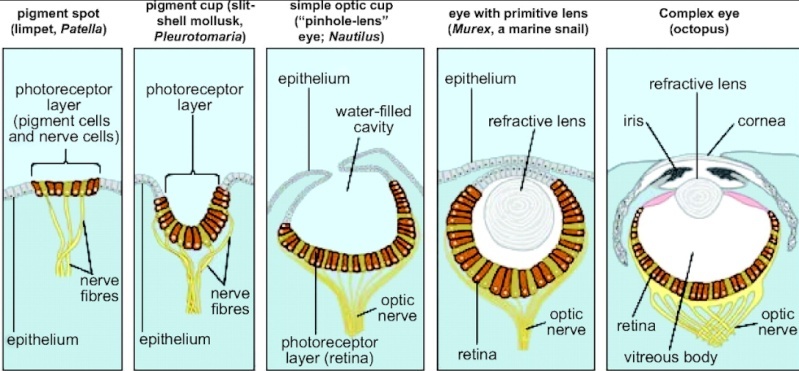

Eyes are an interesting example, because they are seemingly incredibly complex systems, yet eyes have evolved independently dozens of times. For example, octopuses and humans have equivalently complex eyes which have entirely different origins and have slight differences (for example, human eyes have a blind spot due to the nerve fibers being on top of instead of behind the light receptors).
Seeing how you go from nothing to spot to pinhole lens eye is the critical part.
Basically, they go through each of those stages, and shows what it would look like from the creatures point of view
In 2, light centered on the cup will fall on all the cells, but light from the side will be occluded by the edge of the cup and only fall on one side. Now you have a low-resolution camera, and can roughly tell which direction light is coming from.
In 3, light from any angle will only light up a small part of the cup's interior, allowing for greater precision--effectively, higher resolution.
Genes which do not confer any advantage are just as likely to spread as ones that do. Evolution doesn't select for advantages, it selects against disadvantages. Evolution is just an emergent property of death.
This is not true, the question isn't whether neutral changes can spread, but simply what percentage of molecular changes that spread are neutral. In fact I think that molecular evidence has shown pretty convincingly that on the genome scale most changes are neutral, vindicating the Neutral theory of evolution:
https://en.wikipedia.org/wiki/Neutral_theory_of_molecular_ev...
This is just false. Evolutionary theory requires no such thing and there's plenty evidence that each step towards the evolution of things like the eye provides marginal advantage to the organism even though it's not fully an eye.
Allow me to quote [topic: 'The missing steps to complexity', page-45]:
"In The Origin of Species Darwin made the point that that natural selection actually predicts that intermediates should be lost. In that context, it is not terribly surprising that there are no surviving intermediates between bacteria and eukaryotes [e.g. plants, humans]. What is more surprising, though, is that the same traits do not keep on arising, time and time again -- like eyes.
We do not see the historical steps in the evolution of eyes, but we do see an ecological spectrum. From a rudimentary light-sensitive spot on some early worm-like creature, eyes have arisen independently on scores of occasions. That is exactly what natural selection predicts. Each small step offers a small advantage in one particular environment, with the precise advantage depending on the precise environment. Morphologically distinct types of eye evolve in different environments, as divergent as the compound eyes of flies and mirror eyes of scallops,or as convergent as the camera eyes that are so similar in humans and octopuses. Every conceivable intermediate from pinholes to accommodating lenses, is found in one species or another. We even see miniature eyes, replete with a 'lens' and a 'retina', in some single-celled protists [e.g. amoeba]."
What do you think of it? Is it serious enough? Because I think there is an obvious flaw in it, the question: why are these mutations linked?
But the question remains: who put these genes near each other, so that something would evolve without being naturally selected just because its gene was near another gene?
What is the likeness of a gene near a gene that's "evolving" to be important somehow in the future of the evolution of that species?
You can insert supernatural interference into the process -- there's nothing but the principle of parsimony (Occam's razor) preventing that -- but you can't require it in order for things to work the way they apparently do/did work.
Genetic linkage is a fairly advanced concept. For example, this (great) introductory Yale course doesn't even mention it. http://oyc.yale.edu/ecology-and-evolutionary-biology/eeb-122...
Every gene is next to another gene. You are right, the scenario you are detailing is unlikely - correspondingly, it happens very rarely.
Complex things we don't understand often seem magical.
It may also be that the gene doesn't confer any specific advantage but a population bottleneck or isolation event can spread it nonetheless.
For the curious, look up _Would you baptize an extraterrestrial?_ by Guy Consolmagno SJ and Paul Mueller, which discusses this and other science-y subjects.
Evolution is a fact. There is no scientific debate about that. There are only some people who read the Bible as contradicting science, and who therefore attempt to cast doubt on science so as to defend their interpretation of the Bible.
You are correct that the Catholic Church is not one of those groups, and hasn't been for many years. The Church's official position is that God is the architect of evolution.
My current understanding is that the creation myths in Genesis are non-literal stories, intended to be taken in ancient Mesopotamian context, primarily describing that the cosmos is God's temple. (see https://en.wikipedia.org/wiki/Genesis_creation_narrative#Mes... )
My main problem at this point is that a central theme in the Bible as a whole is that death was caused by original sin, and wasn't originally part of God's creative plan. Obviously by the time mankind had evolved and sinned, death must have occurred, so I'm struggling to reconcile this one.
How do other Christians resolve this discrepancy?
As for creation myths, we have a document written several thousand years ago which says the universe began in a flash of light and developed through several stages of increasing complexity, which I think is pretty impressive given that it wasn't until the mid-20th-century that science established this is indeed the case.
Stages are named as days, and the "omnipotent" god even gets tired and has to rest (!) the whole day after 6 in which he makes the whole word, including the "firmament" to keep the water on the heaven from not raining down all the time.
Doesn't have sense.
http://www.mechon-mamre.org/p/pt/pt0101.htm
"ח וַיִּקְרָא אֱלֹהִים לָרָקִיעַ, שָׁמָיִם; וַיְהִי-עֶרֶב וַיְהִי-בֹקֶר, יוֹם
שֵׁנִי. {פ}
And God called the firmament Heaven. And there was evening and there was morning, a second day." (Genesis 1:8)
Which word of those is mistranslated?
Note that because of this and similar lines the Jews count the days for celebration (including Shabbat) to have a beginning at the evening (Shabbat starts on Friday evening).
If you mean "yō·wm" here are all the places where the word was used in the Bible:
Or the meaning got lost in translation.
Listen, if christian people (disclosure: I'm catholic) can rationalize genocide and enslavement of other people then rationalizing something like this should be easy.
It is possible for all the mutations to appear simultaneously as well. But again, the probability would be astronomically small.
I think it's more the case that things may spread if they don't have any disadvantage (like causing death).
In evolution theory things that do not have any evolutionary advantage neither spread or die off.
But in practice everything comes at a cost, so generally they will die off.
It cost calories to create feathers, so if not useful they will disappear.
That doesn't sound right at all. Look at the some of discussion of the 'Irreducible Complexity' examples. https://en.wikipedia.org/wiki/Irreducible_complexity#Stated_...
You can't introduce a complex organ out of the blue by flipping a single gene anymore than you can add HTTPS handling to your webapp by changing a single opcode in your binary. For that to work, the structural and operational information must have already been there in the organism.
But yeah one bit/mutation does not a feature make. Not without some prior stuff to latch on to, in my opinion.
Best i can tell, all that is needed for something to be carried forward is for it to not be a hindrance.
Thus, a proto-wing could very well linger for generations without going anywhere simply because it does not hinder the lineage's survival.
Never mind that the planet has not been the shape we see it in for the entire time.
Google how the eye evolved, it didn't just mutate it was a series of slow gradual mutations.
What you are suggesting goes against evolution theory (which is ok with proper evidence)
It's a mutation theory which is hard to find a lot of info on and I can't find the proper name of.
But it is considered incorrect.
However, it didn't.
There is a common objection?
All these Creationists have heard of evolution and have reasons not to believe it.
[1] http://www.gallup.com/poll/170822/believe-creationist-view-h...
He then argued that therefore Earth is not very old and evolution didn't have time to happen.
I was amazed...
You can pick and choose your religion, but you can't pick and choose with logic.
An argument from authority (My Holy Bible says that God exists!) is quite a bit less convincing than many lines of inquiry ending up at the same place.
The usual counterargument says that just one mutation is usually enough to create a functional prototype of a complex feature/organ (MVP, if you please). A series of mutations is not required.
This study provides yet another example backing this counterargument. One single mutation can change an unicellular entity and make it behave like a multi cellular organism. Intuitively, one would think this would take many mutations. However, intuition is wrong in this case, and in many others.