Over time the amount of energy wasted by bitcoin could become stupendously dumb. We could be using our spare processor cycles to fold proteins or aid in numerous other research, and yet we're using it to allow people to send bits of data to each other without a need for centralized trust.
Compare that to the centralized bank where you have a single centralized trusted source which allows transferring money from one person to another to take no more energy than a modest server and some backups -- far less than the power consumption of a single GPU miner.
The above problem also won't get better. Even after you're no longer mining for new coins, you must keep up the mining volume to protect existing coins and allow transactions to occur at all. I personally find the above to be a fundamental problem with the "proof of work" solution. Sure, on paper you've solved the General's problem, but the reality is that you're throwing massive amounts of energy out the window. Because of that, I think this proof's place should have been to remain on paper.
Even if scaled up to global usage, I very much doubt Bitcoin mining would be worse.
As computers get better, traditional applications, like databases, perform better and you can either serve more customers, use cheaper (and often more efficient hardware), or do nothing and use your outdated hardware.
With bitcoin, your enemy is not the performance of the raw work you are doing (you can hash better), but the fact that everyone else also has these increases. Because of that, the limiting factor is not performance, but cost, and so over time the average cost of the bitcoin network will not go down like the cost of centralized systems do.
Let's do a thought experiment: Let's imagine that instantly all computers get 100 times faster but it costs 10 times the energy to run these faster machines (not actually that unrealistic) and the cost becomes 10 times cheaper.
Traditional centralized banks can simply use a 10th of their existing hardware to have no energy-cost increase but a 10 times increase in customers they can serve. Sure, it's a bureaucracy, so it'll roll out slowly, but they're saving money too so maybe a little faster.
Bitcoin, everyone will simply buy 10 times as much hardware since it's cheaper and they want to get a bigger bit of the pie (mining reward) before everyone else manages to buy all their hardware. You now have an equilibrium in terms of equipment cost reached again, but suddenly the hash-rate is 1000 times more and the energy consumption is 100 times more.
The above might sound a little too theoretical, but if you look at the increase in hash rate and estimates for power usage of cpus, then gpus, and then asics, you'll see that in general power consumption for bitcoin constantly increases.
You're arguing that the existing cost of banks / the existing system is high because it's legacy. Your argument doesn't say "and it's constantly, and provably, going to waste more energy as hardware gets more cost-efficient". Even if you want to claim that banks are currently less efficient (which I doubt they are), I hope the above convinces you that bitcoin over time will constantly use more energy thus resulting in an obviously more wasteful result, while banks and other centralized systems can take advantage of improvements and thus become more cost and power efficient over time.
Not really. Eventually electricity will dominate mining costs, not hardware, and people will only invest in more efficient hardware, not cheaper hardware. The total cost of the electricity used in mining will never exceed the total value of the block rewards plus transaction fees, since miners would rather stop mining than mine unprofitably.
Whether the total electricity used increases or decreases over time depends on whether the increase in price of bitcoins outpaces the block reward halving every 4 years, or transaction fees become a significant source of miner income (https://en.bitcoin.it/wiki/Funding_network_security). A single bitcoin would need to be worth $1 million in 50 years to keep pace, for example.
But I think it's more likely we'll transition to better (cheaper, more secure) mining system before then anyway, which is entirely possible to do without having to redistribute bitcoins (it would essentially be a fork that the "economic majority" agrees with: https://en.bitcoin.it/wiki/Economic_majority)
If you have 300 BTC and you suspect someone else is almost able to mount a 51% attack and thus devalue all your BTC, it makes logical sense for you to put more money into mining, even more than you can gain from the combination of block rewards and electricity, to secure your existing investment. As you do that, others will be forced to as well to avoid you having too much power and to protect their BTC and so on....
That does not tell the whole story though, power usage per gigahash is a more accurate measure, because the higher the GH the more secure the network. From CPU, to GPU to ASIC the power use per gighash has fallen significantly.
If you really want to compare it to the banking sector then you need to include the full and real costs of that banking system, power alone is not the only cost. One bail out, as seen in the last few years, dwarfs the power cost of bitcoin. That is without considering the knock on effects of the banking meltdown on the overall economy.
And bitcoin can take advantage of improvements to reduce power consumption of ASICs (as there is no next step tech that will provide an increase in gigahash as ASICs did, so now it goes to refining the power usage. Additionally larger farms are looking at renewable alternatives and uses for the excess heat being produced. It is still a very young sector so there is a lot of working out to do, but it is being done.
There is no fiat energy.
On the converse the cost of the bailout is pegged to the price of money. Fiat lowers that cost via inflation. The surplus currency created by the bailout is reflected in low interest rates.
The key is that money is more fungible than energy. Buying energy and converting it into bitcoin is likely to be inefficient when the market reaches equilibrium. As a value store, nobody wants rubles when they try to cash out.
There's some efficient amount of money to spend on security, and markets will generally aim for that amount, even if they don't necessarily hit it exactly. In the version of Bitcoin where the mining reward is negligible and miners are mostly paid with transaction fees, it should happen there as well. But the mining reward is currently substantial, which greatly over-allocates resources to security.
Add that in to the fact that Bitcoin mining has huge externalities in many parts of the world, due to the fact that electricity is often produced by burning coal, and coal externalities are poorly accounted for, and you have a big problem. Or rather, you would have a big problem if Bitcoin were big enough to matter.
I would say the upper bound on the amount of energy someone will spend on BTC is roughly the cost of (prestige of mounting a 51% attack) + (BTC market cap of one individual). If people allocate resources to BTC efficiently then one rogue person will just mount an attack and take over the network for the combination of prestige and fortune. Any person with large BTC wealth will want to have more security to protect his investment appropriately, and your security against said attacks is buying more hashing power. The fact that over time hardware becomes cheaper just means it's a constant losing battle.
Other markets that allocate money to security I think can reach an efficient amount because the system they're protecting does not, as a core part of it, require you to have more processing power than your user's / people you transact with. The two security models are so drastically different I don't think a comparison can be made. Perhaps the closest comparison is password hashing where it's good practice to increase difficulty over time to slow down attacks, but with 2FA and lockouts after N attempts, you actually don't need to allocate significant resources there.
And changing over a course of 10 years (there's an incentive to constantly upgrade hardware anyway) is probably still way faster than the banking system would change on a global scale if it was running into a problem.
While this is a different story because hardware and the PoW algorithm is involved, Bitcoin has a story of "breaking" changes. There will be more with the increase of the block size, etc. So I doubt this would be aniticipated way before it made it's way into the protocol, so the affected parties could prepare as well.
Your thought experiment misses an important point: the cost of energy. AFAIK that's already dominating hardware costs for miners.
That means: since the cost of bitcoin mining will tend to scale up (or down) linearly with the total value of bitcoin, so will energy usage (barring changes in energy price). It will not keep going up when the bitcoin value has reached a plateau (for whatever reason).
Dollar price of electricity doesn't matter. You can't magically print out more coal by signing a document, nor you can clear your "kWh used" counter by going to war with someone else. We have something like 50 years to cut down on our energy use and switch to better sources if we want to have a technological civilization alive on this planet; setting up our economy to run on an exponentially-growing resource waster might not be the smartest idea now.
Physical security also scales well. The volume of secure space you have increases to the 3rd power with only an approximately 2nd order increase in the costs of creating it (your basic area/space tradeoff working for you in this case).
The argument that payroll doesn't scale is also absurd: who are all these Bitcoin entrepreneurs trying to run exchanges, if not payrolled staff?
Finally and most importantly: the difficulty factor of Bitcoin does not reduce the computational power required to mine it. It is the exact mechanism of the provably increasing cost: the difficulty goes up, so more and more power is required to preserve the status quo.
Any changes in energy cost are thus ignorable, since in a Bitcoin-only world they're constantly eaten up by changes in difficulty factor, whereas in the non-Bitcoin world they become real-wealth for everyone.
No. the difficulty goes up so more hashing power is required, whether this means more actual power usage will depend on the machines being used and their efficiency.
Except... The difficulty also goes down.
But don't let facts get in the way of your flaming argument...
A decline in hashing power can only happen from people looking at real energy consumption and saying "to hell with this". At which point the network compensates to keep hashing difficulty the same, but does not reduce energy consumption for any of the remaining participants.
But correspondingly, the mean difficulty does go up continuously - that's the fixed number of coins. So even when the block to block difficulty is adjusted, the net trend is less coins per unit hash, which means the marginal energy cost of the coins approaches infinity.
Miners optimise for USD$/kWh, not for coins/hash. The latter is entirely virtual and largely unrelated to the network power consumption.
which means the marginal energy cost of the coins approaches infinity
You seem to ignore that Miners, too, have to pay for their energy.
So, in your model, either the market price of the coins must also approach infinity, or the miners will just stop mining.
One of the first things you realize when you try to setup payment processing is that middlemen would not actually exist in the payment processing industry if it was an efficient market. But these companies do exist because the entire industry structure has developed to pass risk from credit card companies to intermediary businesses whose sole function is basically to manage risk and enforce policy compliance. It is a bit like if Google didn't give email addresses to individuals because it couldn't be bothered policing spam, so you got your email through a third party.
Anyway, even if we ignore the deadweight losses imposed on the economic system by all of the businesses which cannot get credit accounts (merchant accounts), the costs of supporting this credit-centric system are enormous. PCI compliance costs alone are staggering, and serve no purpose except to lower the risk held by credit card companies. And even with this, the inefficiency of central risk management is so great that VISA doesn't even bother to investigate fraudulent purchases of less than 500 USD. And why should they when costs can simply be pushed back to merchants and turned into a profit center by issuing chargebacks.
And this is where bitcoin gets interesting -- by inverting the risk structure and letting anyone accept payments without the need for a payment processor to issue credit, Bitcoin eliminates entire horizontal swathes of the payments industry, while placing competitive pressure on legacy payment providers. If the technology scales to the point you are concerned about, it will decimate the number of people required to be employed managing risk in everyday transactions.
Put more succinctly, you need to shift from thinking about the energy costs of bitcoin as a wasted ongoing expense and start considering them the price of eliminating an otherwise intractable trust problem in finance. It is like paying for a standing firefighting force. Expensive in one way, but a lot cheaper than the alternative.
Centralized systems could be more efficient if their incentives were in line with the incentives of the people they serve. But their incentives are not and they are not fair.
You are theorizing about something based on how it feels without really looking into the reality of it. Bitcoin mining is so many orders of magnitude smaller than even fragments of current financial infrastructure it would laughable to talk about, even if electricity usage was any sort of a major issue, which it is not.
... and exponentially worse as time goes on (by design).
Only for people who don't understand the design.
Google "bitcoin difficulty".
> Only for people who don't understand the design.
Personal attacks all the way because your pet golden hammer was attacked. Always the same result.
Neither is Bitcoin my pet golden hammer (I don't even know that metaphor), nor is my statement a personal attack.
It's merely pointing out that your claim is so fundamentally wrong that you can't have a good understanding of the design.
If you don't want to learn the protocol then maybe think about it this way: Energy consumption is not an exponential factor in bitcoin simply because miners have to pay for their energy, too. And the number of miners does not grow exponentially.
Your premise is wrong. Bitcoin has a mechanism called "difficulty". It's very much at the core of the protocol, google it and ponder how it affects your argument.
Furthermore, the current economics of mining have a fixed expiration date set to 2140, that's roughly when the last coin would be mined.
The protocol will need to be changed fundamentally long before that date. Since we don't know what that change will look like, we also don't know how it will affect the network's power consumption.
Any "thought experiments" that naively extrapolate from the current power consumption are as pointless as trying to guess your car's mileage based on its fuel consumption during ignition.
The protocol is still in the bootstrap phase. If it prevails then the bitcoin in 10 years will be very different from the bitcoin of today.
Bitcoin mining will always be a race on who can spend the most energy.
No. It is a race on who can spend their energy the most efficiently. (in terms of hashes per kWh).
That's why old mining methods (CPU miner, GPU miner...) are obsoleted by new ones (ASICs).
You can pump a Gigawatt into an old GPU mining rig and it will only cost you a lot of money.
Pump the same Gigawatt into a modern ASIC rig and it might make you money.
the hash rate doesn't grow on trees.
why the hell would you doubt it would be worse? it does 7 transactions per second.
http://www.forbes.com/sites/timworstall/2013/12/03/fascinati...
here's on estimate: Bitcoin Mining Uses $15 Million's Worth Of Electricity Every Day
Those stats assumed CPU/GPU and FPGA, not ASIC, miners.
For instance, the 5-to-500-gigahash-per-second rigs would have to be running at over 300k watts of electricity using those statistics. :)
So in reality, the network is much more efficient -- the high-end miners are using more than 100x less electricity (which would still be 3000 watts for high-end rigs per those numbers), and probably closer to 1000x less, than those estimates.
GH/s/w: 4.6 // http://www.coindesk.com/a-look-inside-kncminer/
watts to provite current hash rate: 300,000,000/4.6 = 65,217,391.30 w
kw to provide 1s: 65,217.39
an hour of that: 65,217.39*3600
234,782,604 kwh
10c per kwh => $23,478,260.4 per hour
24 hours => $563,478,249.60
my own figures are even more wacky so I would welcome some better statistics.
65,217kW is the energy usage. Providing that for an hour takes 65,217kWh - not multiplied by anything.
So that's $6,521 per hour, $156,521 per day.
ps it wasn't obvious at all, that's why i wrote "even more wacky" as mark of how solid i thought the figures were.
3600*7 = 25200 transactions for $6521.
they'd really want to see about increasing the block size.
Cost per transaction would go down drastically with increased usage.
I'm not really a fan of bitcoin, and wouldn't touch it myself, but I think it's an interesting experiment.
It's even worse than that because normal people at least have a decent idea of when their gold is secure. A non-techie just has to trust that the online bitcoin provider or author of the wallet is doing what he/she really says and in a secure fashion.
Hiding it at home seems risky because of burglaries.
I haven't found a solution yet, that's why I don't own any gold.
With bitcoin, at least I can spread the risk, like putting a part of the "secret" into a bank vault, hide part at home, at a friends house, whatever. The risk of a simultaneous burglary in two unrelated houses seems low.
You can also buy gold futures on the futures/commodity exchange which is a contract that specifies the other party has to deliver gold to you in the future. The risk is that the financial system collapses and the broker/clearing broker cannot uphold the contract anymore.
So it depends on your intention for buying gold, if it's to hedge against inflation or market crashes, buy a gold tracking security will be fine. If it's to be used as a doomsday currency, then I think you're better off hoarding canned tuna, vodka and guns; things that you can either barter with, or use to force other human beings to do your wish.
In general I agree. Only storing guns seems even more difficult than gold. I live in a country where it is not a normal thing, and statistics seem to point out that gun ownership increases risk of being shot. But in a doomsday scenario, I suppose having a gun would be a good idea :-/
Epic :)
You've got bigger issues at that point.
This, and plus the fact that in almost every country on Earth now, buying Gold needs an ID of some sort so that governments know exactly where to look for Gold the day they want to seize it. I think one of the last places where you can buy Gold anonymously is Switzerland.
EDIT: and you have to trust that the Gold you buy is real. There's always the risk it's gold plated tungsten or something.
I haven't bought a lot of gold, but I've never been asked for ID here in East Europe. Go to kiosk, buy coins with cash and that's it.
Same thing, how do you ensure the Gold is authentic ?
> jewelry stores
That is true, but you won't buy Gold at a good price in this way, there is a premium on jewelry versus gold coins in weight, for example.
For example recently in Greece the exact thing happened that people always worry about: home ownership was suddenly being heavily taxed, because those house owners have little way to hide their assets.
In general governments try to prevent the population from using alternative currencies (usually it is illegal). So if in an economic crisis gold would become too much of a live currency, countermeasures by the government seem very likely.
Anyway. Turning "hoarding" into a dirty word is one of the last signs an economy is about to tear itself to pieces, just before the baseball bats come out and shop windows start getting smashed. Stay classy though!
> That's a) impossible
Well, that's prima facie not true. It can indeed be possible for theft and violation of private property to be a net good for the economy as a whole.
Again, I stress, I have no idea about this case per se. It's an interesting thought experiment though, as to when the government taking something away from private citizens like that can be good on the whole for an economy.
If one safe deposit box full of gold is stolen, that portion of the gold is gone. If a safe deposit box containing 1/5th of a Shamir's Secret Sharing secret is stolen, the secret can't be reconstructed by the thief, but can be reconstructed by the owner if they still have access to 3 of the 5 pieces (for example).
It also seems weird to hide a piece of gold at a friends house. Now you expose them to the risk of burglary, as well as to the temptation (in a crisis).
Bitcoin keys are much easier to hide, too.
For the truly paranoid you could even generate your seed using coin flips or dice rolls... http://www.swansontec.com/bitcoin-dice.html
The benefits of bitcoin are outweight by having to secure your private key(s) yourself.
Put it in your teeth, facepalm, your teeth!
You have to trust the hardware (open source hardware/firmware will be an improvement), and verify addresses out of band (see https://medium.com/@octskyward/why-you-think-the-pki-sucks-b... for solutions), but otherwise you can safely use it on even a malware infested computer.
As a bonus, it can be protected by a pin (with firmware-enforced rate limits). And backups of the seed can be made in case the hardware wallet is stolen/lost/destroyed. They can even be split up using Shamir's Secret Sharing.
(Eventually mobile devices will be able to accomplish the same thing. You could imagine a more advanced version of Apple's "Secure Enclave" that presents the user with a UI (rendered by the Secure Enclave coprocessor) to authorize transactions)
Again, I don't see what the innovation here is, except the technical aspects (the blockchain as a distributed system is very clever).
If you go to a third world country, it's even less convenient to pay for stuff. For example, you can't get a hotel room last-minute with a credit card in Vietnam, where I checked, because they need to verify your ownership/control of your credit card with a pair of small debits, probably because of the fraud/chargeback situation.
Another example, you want to donate to Wikileaks from the US. Not so easy.
Sometimes you really want digital cash you can take and spend anywhere for any reason, and US credit cards or debit cards or other mainstream bank accounts can't do that.
(There still is the problem of needing to use much more secure computers/devices to manage your digital cash than consumers are accustomed to having and using today.)
[1] An opportunity made possible by the ability (created by Bitcoin) to profitably and efficiently collect micropayments in poor regions of the world
As far as cash, try collecting cash payments for your grid of micro-generators recharging cellphones in the Amazon, see how well that works out for you. Let me guess, you're gunna fly some drones in to pick up the payments...
>As far as cash, try collecting cash payments for your grid of micro-generators recharging cellphones in the Amazon, see how well that works out for you. Let me guess, you're gunna fly some drones in to pick up the payments...
Try removing your micro generator from the community after you've installed it when they stop paying your rent. See how that works out for you.
I'd collect the payments when I delivered the fuel btw.
Maybe the "entrepreneurs" will in fact "smell the opportunity" and move in and save the day, but for what? What's the gain? Why design critical infrastructure so that its survival is based on a hypothetical market scenario, when it can be done right in the first place?
But hell, we're dealing with incentive structures here, and people change those only when they're incentivized to do so. So maybe we really need to wait for Bitcoin or something similar to throw us back into XVII century (only dirtier) for people to realize that maybe, just maybe, they shouldn't have been treating feedback loops as benevolent deities.
You also have to give your name and address to the recipient bank to somehow prove you're not laundering money or funding terrorism.
The quick-transfer system is only available for certain transactions. Most payments still take a while, and anything that involves a paper cheque still takes at least a week.
As for money laundering and terrorism - it's been proven over and over that it's easier to get a bank account for both than it is to get a bank account as an average Joe.
Not a few banks are knowingly involved in illegal transactions of one kind or another. So giving Bitcoin a hard time for the same thing is hypocritical.
Banks are certainly going to be killed by a global digital currency sooner or later, but it's going to need some kind of independent OpenMoney initiative.
BC is not that initiative, because the creators seemed to believe that starting a digital goldrush was more important than creating a rock-solid and secure peer to peer infrastructure for all transactions.
I doubt banks will still be around fifty years from now. In an all-digital economy they're not just parasitic, they're irrelevant.
This problem is soluble (as sibling points out, it's been solved in the UK). Conversely Bitcoin always takes about half an hour to settle transfers, for fundamental design reasons. Bitcoin qua Bitcoin is never going to be an effective way to pay for your shopping, and if you're using "Bitcoin" via a Visa-like entity, the benefits over just using Visa are questionable.
> Another example, you want to donate to Wikileaks from the US. Not so easy.
I suspect for most people (that is, non-anarchists) that's actually an advantage. Bitcoin is the equivalent of paying in used notes; it inherently carries a whiff of, at minimum, tax avoidance or socially-disapproved earning sources, because the big places where Bitcoin is more useful than conventional currency are tax evasion and socially unpopular activity. Whereas someone paying with amex likely has a proper job.
Sure, but it doesn't matter what benefits Bitcoin offers to banks (although I do think you are overlooking a few). If banks ever were to support BTC denominated accounts, it would be because of consumer demand, not because Bitcoin is more efficient for them to store/transfer. So, what really matters is what benefits Bitcoin offers to consumers versus other currencies.
I'd say the two main benefits some people see in Bitcoin are: 1) it gives you the option to bypass the banking system when you want to or have to (e.g. if you have limited access to the banking system). Of course it's also possible with cash but a lot more inconvenient. 2) its predictable monetary supply.
I will give you that today, the price fluctuation and immature ecosystem makes USD and other national currencies a more viable choice for the average consumer.
In the best case scenario, Bitcoin will continue to experience unstable boom-bust cycles as prices will rise when people start hoarding their coins, then crash again when people dump their Bitcoin en masse once prices hit a high enough peak. This is great for speculators, terrible for everyone else.
In the worst case scenario, Bitcoin prices drop to $0 when everyone gives up using it. Which leads to the second problem: Bitcoin never really solved the chicken-and-egg problem. Not enough merchants accept Bitcoin for customers to bother with yet another currency, and not enough customers use bitcoins for merchants to deal with yet another currency. Services like Coinbase are merely abstractions over the USD - too few merchants deal solely in Bitcoin, and for good reason.
Pure bitcoins dealing will start getting adopted by the average folk first once the availability and ease of use problem is solved.
It may not be much of a currency at the moment since banks are attempting hard to prevent its use but the freedom it gives you outweighs the risk of it being stolen if you are not careful.
Bitcoin would hurt Visa and Master Card very badly if it were adopted since it obsoletes their entire business practice.
It would also be potentially beneficial for the user since if you could purchase things with bitcoin at your local store the owner wouldn't have to pay the bank or Visa a small fee to make a transaction. That saving could be passed along to you as a reduction in price.
Now if there were any decently run services out there that could secure the average users wallets the market would pick up very fast. The biggest problem bitcoin has at the moment is all the hackers stealing the bitcoins and giving it a bad reputation in the news.
>It would also be potentially beneficial for the user since if you could purchase things with bitcoin at your local store the owner wouldn't have to pay the bank or Visa a small fee to make a transaction.
I don't pay them when I make a purchase the store does. That saving could be passed along but it wouldn't be.
>The biggest problem bitcoin has at the moment is all the hackers stealing the bitcoins and giving it a bad reputation in the news.
The biggest problem bitcoin has at the moment is that it isn't really better than existing systems for 99% of the people in the world with money. And with that comes complexity, security risks and volatility.
If Bitcoin ever gets to a stage where it even looks like it has a chance to hurt Visa or Mastercards current business model then they will simply change their business model and use their massive current infrastructure and global network to become the biggest players in the new bitcoin market. I would be extremely surprised if Visa and Mastercard didn't have people wargaming these scenarios as we speak.
Now if there were any decently run services out there that could secure the average users wallets the market would pick up very fast.
A service provided by Visa or Mastercard perhaps...
How do I do a chargeback on a purchase paid for via Bitcoin?
1) You can choose your arbitrage provider independent of your payment channel (whereas with Visa/Mastercard you are locked into the arbitrage facility of the payment channel) -> splitting off a feature into a modular component -> more competition among providers -> better products.
2) The arbitrage provider only holds a m-of-n key to confirm your transaction, so they don't hold your funds, so they cannot steal them (directly, obviously they could collude with the intended recipient of the funds, but that's by and by).
3) You can set arbitrary values for how many m-of-n signatures you want and for checklocktime. So you can customise the arbitrage arrangement to suit the transaction far more than any offering from V/MC.
Finally, let's not forget that if you really are desperate to keep that classic chargeback commerce experience, there is nothing to stop V/MC rebuilding their system on top of BTC and offering the same package. The current "chargeback" system isn't really a "chargeback" anyway, it's more of a "failure to pay funds that your bank provider agreed to display as pending."
What's the problem?
Cases where they just don't want to refund you.
Cases where they are scammers/criminals.
Cases where your coins are stolen and spent at a store(the equivalent of having your card stolen to buy a tv at walmart).
Um, and with VISA they will just happily ignore you taking back what they consider their money and wish you a good day?
Cases where they just don't want to refund you.
Same as above?
Cases where they are scammers/criminals.
Why would you send money to those? Since you know there is no Chargeback mechanism wouldn't it be wise to demand product/service first or use an escrow service?
Cases where your coins are stolen and spent at a store(the equivalent of having your card stolen to buy a tv at walmart).
Oh, I think there we are getting to the point. You are mistaking Bitcoin for a credit card. Well... It is not.
It works very differently and if you treat it like "just another CC" you're in for quite a bad time.
VISA doesn't consider it their money. So ya they will do that. You not knowing that suggests a huge gap in your knowledge of how credit cards work/how charge backs work.
>Why would you send money to those? Since you know there is no Chargeback mechanism wouldn't it be wise to demand product/service first or use an escrow service?
How would I know? A company can seem fine and turn into a scam quickly. I could use an escrow service but then I'd have to arrange that for every purchase when currently I can have it handled for me automatically.
>Oh, I think there we are getting to the point. You are mistaking Bitcoin for a credit card. Well... It is not. It works very differently and if you treat it like "just another CC" you're in for quite a bad time.
I'm not confusing it at all. I was giving an example that closely maps to the security concern with a credit card.
So if you agree that Bitcoin is not a credit card then what relevance does an example have that maps to the security concerns of a credit card?
If you want to ignore that is fine with me. But there is still a lot of my comment left up there.
I'm not confusing it [Bitcoin vs CC] at all. I was giving an example that closely maps to the security concern with a credit card.
First you say you agree that Bitcoin and Credit Cards are not the same - and then you proceed to complain about problems that only occur if you treat Bitcoin like a Credit Card.
You said that you can not worry about charge backs because you can just ask for the money back. Problem solved.
I gave you a list of occasions where no you couldn't just ask for the money back. You have ignored this and focused on this irrelevant argument to avoid having to face the main discussion.
Just because you're avoiding looking at the problem doesn't mean it doesn't exist.
Since you know there is no Chargeback mechanism wouldn't it be wise to demand product/service first or use an escrow service?
What part of "Bitcoin is not a credit card, do not treat it like a credit card" is so hard to understand?
Yes, if you send coins to some address which might belong to a scammer then those coins might be lost. Duh.
You can now complain all day about Bitcoin not having a chargeback mechanism. Or you can just accept it as fact and refrain from sending your coins to random bitcoin addresses...
Someone said the Bitcoin obsoletes the entire business practice of Visa and MC. I pointed out chargebacks as something Visa and MC do that is not reasonably supported by Bitcoin, with the implication that chargeback support is a feature of Visa and MC that consumers find attractive, and hence Bitcoin does not obsolete credit cards.
So yes, you are right...Bitcoin is not a credit card. And that means those who want credit card features will continue using Visa and MC, and hence they are not going to be obsoleted by Bitcoin.
http://www.icanbarelydraw.com/comic/comics/2014-01-27-40-mil...
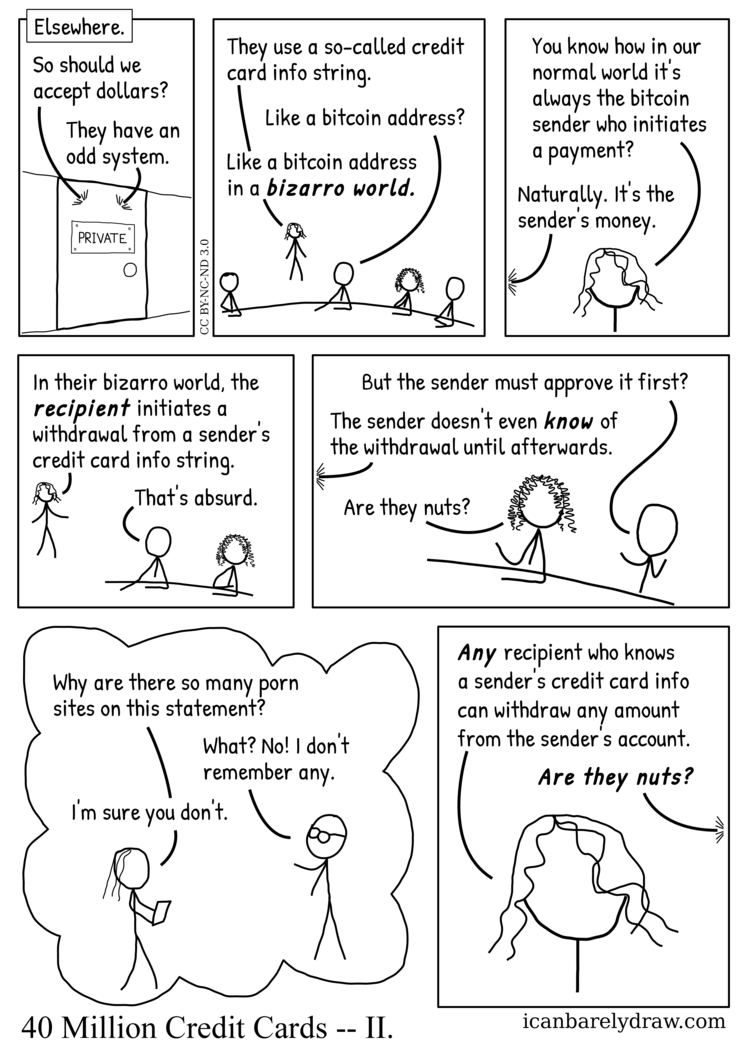
"How would I know? A company can seem fine and turn into a scam quickly. I could use an escrow service but then I'd have to arrange that for every purchase when currently I can have it handled for me automatically."
>You can now complain all day about Bitcoin not having a chargeback mechanism. Or you can just accept it as fact and refrain from sending your coins to random bitcoin addresses...
The point is though you either reimplement the security manually for each transaction or you only shop at a handful of companies and hope there isn't a mistake that they can't track on their side. Look at all the complaints about Tiger direct not refunding bitcoin payments early on for an example of a non-scamming company screwing people over not by maliciousness but by incompetence.
So yes. I could just hope I won't run into one of those problems while shopping or I could manually setup escrow for every purchase and hope the escrow solution I choose is legitimate. Or I could just keep using my credit card and not have to worry.
And people wonder why bitcoin isn't gaining traction?
It's starting to get hilarious...
Yes. If you want to use a credit card then please, by all means, use a credit card.
And in addition you may use Bitcoin in scenarios where it works well (e.g. to transfer money to people you know), for ecommerce through services like Bitpay, or just retain it as your favorite strawman... ;-)
Offloading the issue of converting it to something usable to them? This only makes sense if you already have a bunch of bitcoin and makes no sense for the receiver.
>for ecommerce through services like Bitpay
Which doesn't fix the charge back or scam problems. Scammers can use Bitpay too.
Have a nice day! :-)
It's also the electronic version of: Be able to move that gold around the globe near instantly, without a middleman, at almost zero cost. And some other quite neat things.
While these features may seem "anecdotical" for many people in the western world, there's also a large number of people in poorer countries for whom e.g. the fees on long distance transactions or not being able to get a bank account are a very real problems.
I think you're overestimating the impact of bitcoin on poor countries by several orders of magnitude. People who don't have access to a bank account now don't have a smartphone, and certainly not a computer either. And internet access is rare and expensive (most people have dumb phones, internet at home is a rarity, and most coffee places charge you for wifi).
On top of that the only way to buy bitcoin here (for now, at least) is to send money through western union to some guy on localbitcoins and of course, that's far from "almost zero cost" or "without a middleman".
I'm not trying to rain on your parade, but the reality is that it's still much, much easier and cheaper to get a bank account than bitcoin here (you can open a bank account in less than an hour, with a minimal deposit of 50$. That allows you to use ATMs and send money anywhere).
So I come back to my original point, adoption is margnial, at best. Especially in poor countries.
And wouldn't it be nice if Bitcoin changed that reality for the better, a little bit?
So I come back to my original point, adoption is margnial, at best. Especially in poor countries.
Which I never argued.
I merely pointed out that Bitcoin has some additional useful properties on top of being a very volatile electronic gold equivalent.
It would, for sure. But I'm not sure how - people need to become rich enough to afford smartphones/laptops and a reliable internet access first. That implies we'd have solved a big chuck of the other problems first :(
> Which I never argued.
You're right, sorry if my post was misleading. You just pointed out other advantages of bitcoin over gold (which are correct).
The biggest advantage of gold is that it's value is relatively stable and has been used as a valuable metal since ancient times.
That's quite the opposite of Bitcoin actually.
Bonus points for being honest about it (a rarity) :)
Well the value of the whole blockchain is over $2.5Bn, so it's more than anecdotal. http://coinmarketcap.com/
There is approximately 1.3 Trillion Dollars in paper/coin form, according to the Federal Reserve Bank of New York: http://www.newyorkfed.org/aboutthefed/fedpoint/fed01.html, and that's just USD.
So yeah, anecdotal.
b) you're comparing apples and oranges - the market cap for USD is not the total value of printed currency
c) btc transaction volume currently averages about $65M per day, which is $23.7B p.a - about 4x the size of the Apple App Store and about one-eighth of PayPal's $180B p.a and larger than all but the top 3-4 online payment providers
d) it is still very, very early days for btc. it's goal is to not replace PayPal, but to have these payment gateways build on top of it.
e) there are dozens of blockchain based applications currently in design, draft, development, beta test etc.
f) the current implementation of btc for payments is horrible yet despite that it has established itself as a viable payment backend with a non-insignificant portion of the market
g) comparing bitcoin with any fiat currency, let alone the worlds major reserve currency, is very flattering
The value of BTC speaks more about people prepared to jump into anything that seems to be the next fast way of making money than the long term viability of it.
For adoption, you'd want to look more at data like transaction numbers, transaction value, merchants accepting it and order statistics from retailers. There's not much data, though.
For example, in the stock market, if there are rumours of hostile take over, the price of the particular stock rises. Think about e.g. Yahoo/Microsoft acquisition rumours.
Bitcoin has or will have its niche, perhaps it will not be for your savings but sharing money with friends using a bitcoin wallet app is by far the most frictionless paying experience I ever had. I think you opinion is on the spot though... for now.
It would be more stable with more wide spread adoption, I'd guess if shops were to use it they'd en masse refuse to fluctuate/change prices every day, dampening the trade induced fluctuations.
inflation 2.3% [1]
my interest rate : 4.02% [2]
That's arguably the definition of money.
It's even worse than that because gold is palpable can be used to make things.
In Europe a 2013 law is now in effect which basically states no more bank bail-outs, from now on it will be bail-ins. In other words if a bank fails it will use its customer's deposits to cover its debt.
The US, EU and many other countries have deopsit insurance* schemes that limit risk to depositors. You may not get all your money back if you have large deposits, but for example in the EU you're generaly guaranteed to get at least the first 50,000 Euros.
There is no way not to be the potential victim of this, because bank customers do not have enough information to determine whether a bank is sound or not. Worse, soundness is dependent on what everyone else is doing; a bank can be fine one day then destroyed due to a bank run. Risk is hard to deaggregate in the mortgage business because house prices all move together.
You're onto something with "profits of risky loans are privatised while the losses are socialised", but bitcoin really isn't a good solution to that.
any benefit is on average far, far outweighed by the costs
A cost-benefit analysis with no numbers! Convincing!
Bullshit. Customer reviews, third party audits, history and reputation, secondary signals (quality of website, customer support, advertising, quality of investors). The list goes on [1] Your only limit is your imagination and your confidence in the intelligence of your species my friend. You've been tricked by the miserable current state of banking (a product of socialist intervention) into thinking that this is the way banks are and must be. You'd see how quickly things will change when a) banks live and die by their reputation b) anyone can build a bank from anywhere to service the world (enabled by Bitcoin.)
bitcoin really isn't a good solution to that.
Why not? Bitcoin supersedes political violence. No government can order more of it to be created at gunpoint. Therefore there is no way to enact "backdoor" taxes (inflation) to support inherently-broken schemes such as socialised deposit insurance. The only way is frontdoor taxation, which people are far better at measuring and disliking. The success of Bitcoin would cut off the last life support tube for dysfunctional government
[1] Yes, I know you'll have point by point reasons why each one of those techniques is somehow uniquely impossible to work with the 100% success rate uniquely required by this and all other regulated industries (health, inter-city transport et al), which for some reason work just fine in the industries which escape regulation (online commerce for instance) which for some reason are much more forgiving.
What if your bank is not a member of FDIC ?
It's sort of what the European Union has with those bail ins, deposits are guaranteed up to 100k but this comes from inside the bank, first from shareholders and creditors then larger accounts. Makes sense that the public should not have to pay for the failure of a private banking entity.
Then don't do business with that bank. The vast majority of banks and credit unions in the US offer insured accounts. If yours doesn't you should move your money elsewhere.
The FDIC insurance is $250k per insured-account-type per institution. That is, if I have a checking and a retirement account with one bank I'm insured for a total of up to $500k. Anything exceeding that needs to be in another account type or another bank to be insured. Most investment accounts aren't insured, but some brokerage accounts are (you'll get that info when you talk to your bank) but the investments themselves (naturally) are not, just the value of any non-invested cash.
The cost (in the US) is put upon the banks to pay for this insurance. It's just a federally created insurance agency. Barring a major collapse across many (most?) banks, it should have enough stored up over the years to cover the cost without requiring financing from the federal government. In theory, you can have private insurance (I believe these do exist) for your bank, but I'm not sure how common this is in the US.
Like most insurance schemes, the more participants the more affordable it is. It'd be a tough market for someone else to break into.
We despise existing solution thinking that we could and should disrupt everything. Tear down everything and build everything from scratch; Our way or the high way attitude.
Bitcoin definitely have some innovations here and regardless of what happen in the future, it's impact will be felt. It was a great experiment, probably the greatest social experiment of the 21st century. The best is that it's self contained and sandboxed. Allowing it too roam freely in unchartered water.
But the financial industry is not as un-innovative as we hope they are. To innovate means you have to experiments, to experiment mean there will be failures. Over the years we seen financial industry fail and fail again. In fact, the incentive to "innovate" is so high, you constantly see the cat and mouse game between the regulators and the industry players, and the revolving doors of the prison cells never really stop.
While the greed and failure of the financial industry has irked us and certainly bred a level of mistrust. Trust in the financial system is at the highest level in human history. You have to understand that they are no stranger to mistrust and throughout human history it is a recurring problem they have to solve over and over again.
The current floating currency and central banks structure which provides deposit insurance among many other things are the result of many iterations over thousands of years. This system run the global economy, it scale is unimaginable large in human scale. There's a lot to appreciates.
Sure there's room for improvements. Many people treats Bitcoin like it must replace the financial system but the problems it facing now is exactly what the financial system had solved. What I'm pretty sure is that Bitcoin's will definitely had an impact on the next iteration of the ever evolving financial system.
The Bitcoin community I have seen fails to recognized the important of trust in finance. Not just trust between computers, but trust between humans. Like the 90's and 00's software industry fails to recognize the important of simplicity and good user experience. The next Steve Jobs of the cryptocurrency is in my believe one who understand these ideas to heart.
There's a lot to celebrate about Bitcoin and what we had done, as I always like take a contrary position. Bitcoin is not a replacement of the existing financial system, it is, or will be if it haven't, part of the system. Thus, the rise and fall of its price is part and parcel. It's kinda exciting to see this great experiment in the running, although I'll dread experiencing it first hand.
As Bruce Lee once said, "In great attempts it is glorious even to fail." I wouldn't consider this a failure but it's definitely glorious.
Whatever shreds of interest your bank gives you will be way, way less than the inflation you're experiencing. In other words, your money's purchasing power keeps decreasing even if you're getting some interest on it, ie. you're losing your wealth.
Bitcoin doesn't experience inflation like that, so it should be a better store of value than your fiat currency. I said "should" because bitcoin has been in a speculative bubble, and just came down even more. Right now it's still just a speculative asset, but it could serve as a stable currency.
Your card is irrelevant.
Transaction fees are not extortion. They're a massive skimming operation inflicted on the masses, because the masses have no choice but to eat them. Thank your state-maintained bank cartel for that.
Bitcoin's sole value as a currency lies in its ease of use as a back-end for transactions. It's not a bad intermediary for transactions between people using different currencies, provided the third party transaction service has legal, fast, and cheap ways to convert to and from fiat in both countries. But then, it's not so much a currency as a transport layer with added uncertainty.
I've yet to see a compelling case for BTC as anything but TCP/IP for dollars or a wayback machine for anything you want. It's bad for savings, god-awful for investment, and useless for [legal] commerce.
You're talking about something different now. Namely the effects of all the speculation, and for example governments figuring out if Bitcoin poses enough of a threat to them that they need to make it illegal, and so on. Will they shut it down? Will they not? Will they first make some money with it, and then shut it down?
The point is that the wild fluctuations in Bitcoin's price you see are not proof that it's not a good store of value. It could well be, after stabilizing, if it ever does.
A good store of value is something that could serve as a good medium of exchange too, like gold for example. Gold was used as money for ages, exactly because its characteristics made it suitable for that. It can't be printed by pressing a button somewhere, it's divisible, durable, and so on.
Bitcoin has some of the same characteristics, and that's why it might well become a widely used medium of exchange. I bet something like it will.
Central banks are not actually helping you. If you have a sound currency, it can't be printed, and central banks can't meddle with it.
You see, printing a currency devalues it. If the pool of currency in circulation grows faster than the pool of wealth it can be exchanged for, then the currency loses some of its value relative to the wealth available.
>> Bitcoin's sole value as a currency lies in its ease of use as a back-end for transactions.
Fiat currencies' sole value lies in the fact that governments force us to pay taxes in them. Otherwise we'd all be using a sound currency instead, because it would be in our self-interest to do so.
But in a long-term sense—an imagined future where all the speculative value has gone out of Bitcoin and it is now just "worth what it is worth"—it would make a fairly good store of value, in exactly the same way gold would if we knew exactly how much of it there was to mine out of the earth, if some property of the (never-changing) extraction process meant that it was only able to be mined out at an exactly inverse-exponential rate, and if it were very easy to handle the resulting gold in 0.00000000001g pieces.
Similarly, talking about imagined futures is not a convincing way to defend a currency as a store of value. If you have to posit that your money will still be there iff A, B, and C are true, then you're not going to park your money in that particular stall.
What I'm saying is that there's no reason to assume that you won't see Bitcoin's value stabilize e.g. ten years from now, and Bitcoin become a useful store of value from that point forward.
Or, to put it another way, just because the Bitcoin that exists today is a bad store of value, doesn't mean that "Bitcoin is a bad store of value" is an immutable fact about Bitcoin. It could just be a fact about today.
My card is very relevant.
If someone steals it, they can use it but it doesn't impact me in any way except having to wait for the new card to come.
If someone steals my bitcoins, it means they have a copy of my private key, and there is nothing I can do about it. Zich. Nada.
Transaction fees pay for this insurance (among other things, but still).
Unfortunately this is no longer the case in Europe with cards activated under 'Verified by Visa' ( and presumably the Mastercard equivalent ).
If an VbV card is used and passes authentication then it is assumed that the cardholder authorised the transaction and they are liable.
...and that's how you get a bank.
I don't think the benefits of bitcoin outweight having to maintain (multiple) private key's security.
For the really secure wallet you program two (or more) cards with the same key in case one of them is lost or craps itself (then throw away the private key). They are protected by a PIN code so they brick themselves after 3 subsequent wrong tries. If you lose one of the cards then you get two new cards, program them with identical private keys (clearly it is different than the previous one) then transfer all of your money to the new wallet.
It's really hard to be your own bank, but it is possible. The beauty of bitcoin that you don't have to trust any third party, but it's really hard manage properly.
I would be surprised if anybody used this scheme, I don't have any bitcoins either. If I jump into the bitcoin business I'm sure I will adopt this scheme.
Bitcoin inflation is at 10% per year right now not even considering the dropping price.
Not a lot of that going around the developed world at this point in time, though, is there?
It costs a certain (very high!) amount of real electricity to process a block. This plus an incentive has to be paid to miners. Miners have to pay for their electricity in real local currency. Therefore for every transaction block processed either someone "buys in" ~$10 worth of bitcoin or the outstanding value of all bitcoin drops by that amount.
No interest rate, and you have to secure it yourself? No thanks. My "big bad bank" guarantees me at least a small interest in saving money, and if my card is stolen, I get a new one in 24 hours and all transactions are cancelled. I'm happy to pay some transaction fees ("extortion!") to get that kind of insurance.
Bitcoin is the electronic version of "let's buy a lot of gold and stash it somewhere".
EDIT: Burn karma, burn. Ah well.