I'm guessing once the technology is widespread, we'll see almost total elimination of rear-end accidents on the freeway - the technology really is quite amazing.
How many milliseconds does it take the 5 Series to notice what's going on and start applying the brakes?
[1] If you are a) early 20's, b) male, c) responding to a audio cue, and d) doing exactly one thing on the cue (as opposed to making even a very simple decision based on the cue), you can get down to 150ms.
Are they just tapping the brakes because the road is bending---some people always do---or are they slamming on the brakes because there's a traffic incident that you can't yet see? You're 200-millisecond reaction needs to be completely different in these two cases, but you just can't immediately tell the difference.
Both for people and for automatic cars, judging deceleration is a harder problem than just reacting to a red light going on, but the sensors on automatic cars should give them a big advantage.
Sure, if they're not looking down at the radio or at the accident on the other side of the freeway.
I recall from looking into this stuff a bit that a good reaction time from "oh shit" to "brakes are applied" is around 750ms. Accounting for people who aren't fully on top of their game (distracted, tired, injured, old, etc.), road designers assume more like 1.5-2s delay for applying brakes. And even that will be optimistic in some cases, as many car crashes demonstrate.
Adding some sort of auto brake feature adds another layer of safety (presuming that the ratio of 'saves' to added risk is very high with this tech.)
I think a recent one in the news was 20+ cars. If just one of those cars had autobrake and safe following distance this could have been halved or quartered and wouldn't have blocked a highway for a few hours.
I would like to know just how fast these cars can react. I'm betting they could be actually slowing the car before a human is even aware something is wrong, but I would like to have some numbers to cite.
We can increase the efficiency of reactionary driving as much as we want with computers, but for me, you just can't beat defensive driving.
Just curious, How well do these systems handle potential rear threats as well? How would it handle tailgaters? Some tailgaters are more aggressive than others. Some just need a friendly reminder that you do not appreciate the tailgating by a nice easy slow down, or a slight tapping of the breaks. Others -- such as the guy in F250 super duty with 30 inch tires and a lift kit, you might just want to go ahead and move over when you see them coming.
Saying everyone should just drive defensively isn't a solution. The evidence for that is the fact that that's what we currently try to tell everyone to do, and it's still a problem that people drive poorly.
Saying everyone should just drive defensively is most definitely not a solution.
We need better enforcement? We try to do that by writing laws and issuing tickets. And, again, poor driving is still a problem.
How about we FORCE people to drive defensively? That sure sounds like what automated driving is trying to do.
Probably about as much as the average driver. Hell, a lot of drivers on the road don't even notice a turn signal and get pissed that they're stuck behind a turning car in the lane.
What I worry, is that these systems will (of course) have bugs, and they are mechanical systems, so they will also physically fail - and, they will cause some deaths (cars are dangerous - 36,000 fatalities/year) - - but if for every one of those bug/physical failure deaths, you have 10 where the automated-system avoided an accident - that's a pretty big net savings in human lives.
And, software/hardware systems are only going to get better - that's certainly not the case for human drivers. Indeed, with cell phones, regardless of whether they are hands-free, there is research to show we are becoming less capable drivers than we were 30 years ago.
We know that a fingerprint is a bad password.It can't be changed, you leave copies everywhere, authentication is based on an approximation, etc. Strong, frequently changed passwords would be much better. But is it significantly better than the security on most people's phones: a 4 digit passcode, or none at all.
Tradeoffs are different between computers and humans. Defensive driving is about trying to stay within an envelope where you can safely respond to whatever happens. A computer system will have a different envelope, so it won't need to do the same stuff.
To make a terrible analogy, a human pilot flying by eye needs to eventually make a decision to land at an alternate airport when his primary is fogged in. Is a computer smart enough to make that judgment call? Well, if the computer is equipped with a zero-zero landing system and can safely land in the fog, who cares?
Your question about rear threats is intriguing. The proper response is a lot less clear there, I think. Do you speed up? Slow down? Change lanes? Squirt them with washer fluid? Drop some caltrops from your rear bumper?
You need to be both looking at the road with cameras and profiling it with LIDAR. (Or terahertz radar, once that gets going.) It's not enough to just sense the car ahead. You need to be able to detect potholes, ice patches, junk on the highway, small animals, and similar problems. We could detect and avoid potholes back in 2005. Since we were doing off-road driving, that was a normal driving event.
The reason for a high-view LIDAR is that you want to see the pavement surface ahead from a reasonably useful angle and get a 3D profile of the road ahead. Google uses the Velodyne spinning-cone LIDAR scanner, which is a lot of LIDAR units built into one rotating mechanism. That's a research tool. There are other LIDAR devices more suited to mass production. Advanced Scientific Concepts has a nice eye-safe LIDAR which can operate in full sunlight. It costs about $100K, but that's because it's made by hand for DoD and space applications. The technology is all solid state, not inherently that expensive, and needs to be made into a volume product. (Somebody really needs to get on that. In 2004, I took a venture capitalist down to Santa Barbara to meet that crowd, but there was no mass market in sight back then. Now there is.)
You can only profile the road out to a limited distance, regardless of the sensor, because you're looking at the road from an oblique angle. Under good conditions, though, you can out-drive the range at which you can profile the road. That was Sebastian Thrun's contribution, and won the DARPA Grand Challenge. The idea is that if the LIDARs say the near road is good, and the cameras say the far road looks like the near road, you can assume the far road is like the near road and go fast. If the far road looks funny, you have to slow down and get a good look at the road profile with the LIDARs.
Automatic driving systems have to do all this. "Driver assistance" systems don't. Hence the "deadly valley".
That's just to deal with roads and static obstacles. Then comes dealing with traffic.
Humans proved that for current level driving two not particularly high-resolution cameras are sufficient. Seems like pushing in this direction will remove this expensive component?
You get to use worse hardware, but you need several order magnitude better software.
I expect that, after the first wave of clumsy LIDARing self-driving cars, all the car companies (Google especially) will be collecting exactly training data from the cars' sensors to build exactly this kind of model. In fact, I wouldn't be surprised if that was what the Google car was really about, in the same way Google Voice is really about collecting speech training data.
The best part of this kind of training data is that it all comes pre-annotated with appropriate reinforcements: even if the image-recognition sensors aren't hooked up to anything, they're coupled to the input stream from the other car sensors and the driver's actions. So you would get training data like
- "saw [image of stopsign], other heuristically-programmed system decided car should stop, driver confirmed stop."
- "saw [image of kitten standing in the road], other heuristically-programmed system decided car should continue, driver overrode and stopped car."
Etc. Aggregating all these reports from many self-driving cars, you could build an excellent image-to-appropriate-reaction classifier.
In a driving situation, the worst-case scenario is everybody dies.
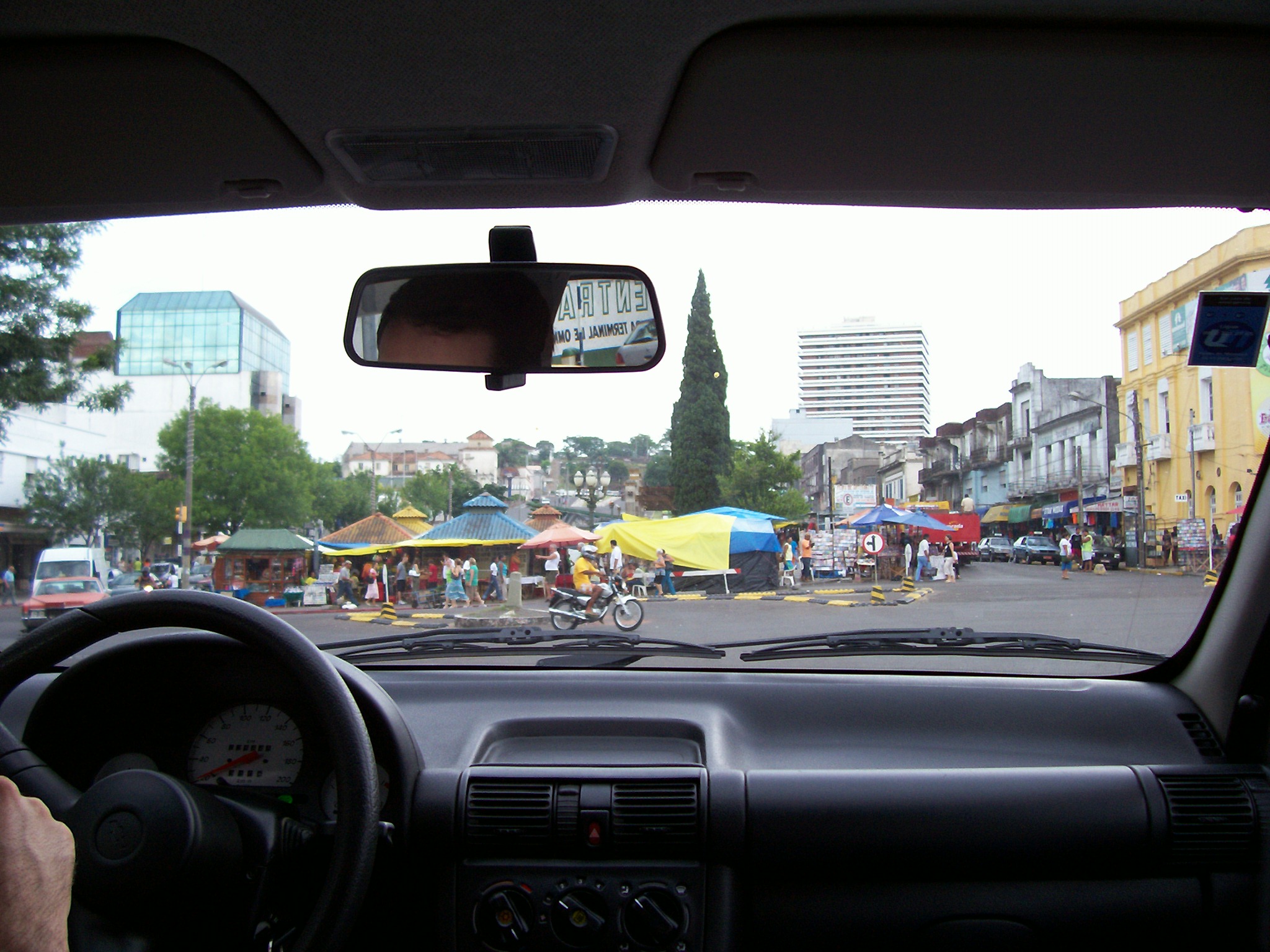
The human eye can instantly recognize the available driving paths, the motorcyclist ahead, and project where people will walk. Software would have to parse out where the open roads are, how far that motorcyclist is and whether he can clear the intersection before the car reaches it, and what that sign on the right-hand side is—using the same information, but it has to parse it first whereas we do that almost instantly. It's a totally different game.
Edit: a better solution would be to observe the behaviour of other drivers; if there is someone driving ahead of you, you can assume that the road between you and them is OK; if there's noone ahead of you, you need to drive slower and be more careful (that's how I drive at night). Once there's a critical mass of cars with cameras, cars could communicate road conditions automatically.
I would be frightened to trust the data coming from a random car in front of me. Inferring road condition from another car behavior sounds reasonable, using data supplied from it, not so much.
However, if the car three cars in front of you just broadcast "I'm doing an emergency stop right now", that's really valuable data. The human in your car won't know anything is wrong for at least a second. The human driver behind you would know about it before the human driver in front of you.
Until some asshat implements a button that sends this message for "lulz", though that would probably constitute a crime under existing law.
A computer-driven car, though, wouldn't (shouldn't) just immediately slam on the brakes because of that signal. It would tighten seat belts and start slowing down, but it also would want to avoid getting rammed by the car behind it. It can make very accurate estimates about its stopping distance and use all of it.
That's just my theory on it.
The simple answer is that we don't know how to do it with stereo vision alone yet. Getting range reliably is hard, and your brain uses lots of tricks to do it.
The second answer is that we need better-than-human performance if this is to take off. So using human-type sensing might not be good enough anyway.
Lots of researchers are pushing on vision-based driving, though.
Though, with many self-driving cars perhaps the sensors on each could share info, thereby mapping a larger (if not, endless) area.
My prediction: "crashdummy" will eclipse "heartbleed" and "shellshock"!
Tesla is talking about automatically putting their car into a garage. That's a good application; it's slow, and you can have sensors all around the car to avoid hitting anything. A more general system that can put a car into a big parking garage or lot is quite possible. Cooperating parking garages might have some additional bar-code markers and maybe a data link for open space info.
The whole airport car-rental thing could be done automatically, using slow-speed automatic driving to bring the car up to a pickup point at the terminal, just as the renter gets there. That may be one way this gets deployed. (I proposed that around 2003, but after 9/11, the idea of autonomous vehicles in an airport seemed politically hopeless.)
Those are some ways this might be deployed. Everyone has obsessed on automatic freeway driving since the 1950s, but that may not be the killer app.
It is one thing to anticipate threats, but when the road is under snow how do computers make that intuitive leap people can?
http://en.wikipedia.org/wiki/Air_France_Flight_447#Final_rep...
"the crew lacked practical training in manually handling the aircraft both at high altitude and in the event of anomalies of speed indication; the two co-pilots' task sharing was weakened both by incomprehension of the situation at the time of autopilot disconnection, and by poor management of the "startle effect", leaving them in an emotionally charged situation;"
A great deal of the required operations for autodriving are offloaded or irrelevant in autopiloting. I know we were talking about an isolated case of the unexpected failure of an automated piloting system, but if we consider all of these additional complexities in typical road driving * millions more cars with barely-trained operators, it's reasonable to suppose that those types of problems would occur much more frequently with autodrivers than autopilots.
First, one of the pilots held the stick back all the way down to the water even though the airplane was clearly stalled. This is completely inexcusable. The automotive equivalent would be holding the accelerator pedal to the floor while aiming at a brick wall. Even worse, the guy who did this was a qualified glider pilot, and glider pilots should have extreme familiarity with stalls and stall recovery since so much of a glider's flight time is spent close to stall.
Second, the control system of the plane handled conflicting inputs from the two pilots by averaging them together. There was no indication to the pilots that they were fighting each other. Positive exchange of control of the aircraft is another really basic thing about flying, even more basic than putting the nose down in a stall. This setup made it far too easy for the pilots to be unaware of who was really flying the plane. If the control sticks moved together, it would have been obvious to the other pilot what was going on.
One could put some blame on the autopilot in causing the one pilot to forget the basics of stall recovery, but it seems to me that the real fault was in not training for it sufficiently, since that's not something you do in normal flight in an airliner anyway.
Keep in mind every car out there is currently built with a feature where you can accelerate to a lethal speed, then press a small button, and the car continues to travel at that lethal speed until the car runs out of gas, hits a brick wall, or the driver consciously disengages it. We call it cruise control.
If all we are doing is adding automatic braking and lane following to cruise control, I don't see how it can be anything other than better.
Because in the real world, people won't exercise exactly the same level of situational awareness, such that the autopilot only adds a safety mechanism. In the real world, it will replace a certain amount of driver attention. And the question is, is it always superior to human attention?
It's probably net superior, but I bet it will cause a couple of high profile accidents that a careful human could have avoided, and then people (or the government) will be scared of it.
The more valuable question is this:
Does it perform better than humans in the most frequently occurring situations that lead to incidents, are those situations a large enough fraction of all incidents such that the number of overall incidents drop significantly, and will that drop be greater than the increase in frequency of less predictable situations.
If the above turns out to be the case, then there will be fewer accidents despite less aware drivers.
edit: case in point
Or I could refuse to accept the premise internet points are important and realize that downvotes aren't a reliable indication of post quality.
I'm certainly not going to be bullied by companies in to being quiet because they might take away some of my internet points.
Please RT.
Your anecdote is insufficient to support this claim. One example does not make this a common practice.
The admins explained it that the Microsoft news triggers the flamewar prevention they built, and it happens almost every time. Microsoft articles need admins to explicitly allow them on the front page, or they're gone in minutes.
Lane assist kinda, sorta works (I can choose if the car will actively try to stay in the lane and/or if it's going to alarm me by vibrating the steering wheel when I cross over into another lane). It's limited to the Autobahn though and really more often then not just doesn't recognizes the lanes. IF it does, it has the kind of protection you describe. Unfortunately that makes it even less useful. On a really straight road I cannot turn it on, because it's going to beep at me after 1-2 seconds. You need to drive (I exaggerate, but the idea's true) like in a Hollywood movie from the 60s (or the Simpsons intro), turning the wheel left and right for no reason.
(The ACC in this car is crap as well, but .. let's leave it with lane assist for now)
I am extremely skeptical that this system can work, in general, any time soon. Even in a Tesla.
Infiniti has a commercial out now that I see frequently while streaming TV that shows someone who should not be on the road but is enabled by the driver assist features.
Maybe one mandatory feature of driver assist should be that if the car intervenes more than 2 times in 10 minutes its next step should be to find a safe place to pull over and stop.
And can you imagine the liability implications? "My spouse had an asthma attack/allergic reaction/severe cut in the of middle of the night and my car stopped me from driving them to the hospital. They died before the ambulance reached the house."
It would be a huge pain if you are on a long drive and your car decides you need a nap! But it would save lives, possibly mine. Personal transport is a convenience. Personal safety is paramount.
I think the MVP for an automatic driving system—presuming we don't just get the AI version out soon enough—would be your suggestion (stopping the car when it can't handle a situation), plus passing control of the vehicle to the moral equivalent of OnStar. There'd be call-centres full of people remotely driving drunk/sleeping people's cars for them using the vehicle's instrumentation+the driver's pre-programmed route. Like a taxi service where your own car is the taxi.
Following from that, I wonder what bar Driving has, and as such, what distribution of "Controllers" we'd need to be safely within that, and if that would allow it to be viable.
I fully realize that the difference between virtual racing games and real live humans in hunks of metal is massive. I'm just saying that work on dealing with latency in situations which are more predictable and have larger margins for error than high precision operations have been worked on ever since QuakeWorld.
The real problem, I think, would be making sure the (presumably cellular) connection to the car doesn't drop or suffer from latency spikes. If the car companies teamed up with the cell companies, there'd probably be big pushes to put 4G or WiMax microcells on every power-pole running down streets and highways, and even more in cities, to ensure cars remain online.
So? None of these manufacturers have a carbon-friendly drive train. The fact that Tesla added a software feature "late in the game" is no 'bonus' to the already-contenders. Actually, lets see Mercedes' obstacle-avoidance compete with the SpaceX/Tesla crowd. I'm willing to suffer the down-votes until such a point is reached that we all, conscientiously, acknowledge the docking maneuvers allowed by a SpaceX/Tesla co-operation. In the meantime I'd like to point out to you: software features as an "also-ran" is not really a dilemma.
Tesla seems to want a system that is more complex. Things like "have the car come meet you from where it was parked", lane _crossing_ (let alone lane keep assist), and eventually on-off ramp driving. All with live updates rather than going into the dealer.
What makes this offering (potentially) different is the ambitious intended use of the system, something which would make even a Daimler-Benz lawyer cringe.
These features have never once appealed to me and I can't imagine using them even if I had them. I find it very hard to square the "American Love of Driving" and the cultural connotations that driving has in the US with systems that relegate the driver to a passenger ...
Maybe for stop and go rush hour driving ... but beyond that, I don't see the appeal.
I think this pretty well sums up why most people hate it: http://www.qwantz.com/index.php?comic=2587
The pay isn't always great, humans require sleep, and freight needs to be delivered. I am still amazed trains are piloted but they are and that is far simpler to automate than trucks.
Once trucking becomes automated you will have trucks delivering at all times to warehouses, scheduling around traffic patters. Whereas humans are not necessarily best at driving at night, vision and physiological reasons, computers could drive at hours when traffic is always the lightest.
I can imagine that not being default behaviour because it doesn't match driving norms, but perhaps it would be better?
Two airline pilots fell asleep while cruising over Hawaii last February, flying past their destination toward open ocean for 18 minutes before waking up and returning for a safe landing, federal accident investigators revealed Tuesday.
Ref: http://abcnews.go.com/Travel/story?id=5042619
A packed passenger jet heading to the UK was left flying on autopilot when both pilots fell asleep at the controls, it emerged last night.
Ref: http://www.dailymail.co.uk/news/article-2432847/Both-pilots-...
This sounds to me like the "technology right now is crossing a distinct line into doom" fallacy. It seems like the same could have been said when automobiles started being operated by average folks rather than professional chauffeurs, when the synchromesh was invented, automatic transmissions, antilock brakes, cruise control, adaptive cruise control, and so on.
There was a good article discussing this recently on here, a quick search should find it for more details.
So, I agree with the parent that semi-auto pilot like features are probably quite risky when intervention is required. At least current generations, but I think we can also make better designs that address these concerns.
We've seen airplane crashes because of pilots' misunderstanding of or ignoring autopilot features. But have we seen air travel become more dangerous on net because of autopilot features? I highly doubt it.
That's good enough for about 99% of freeway driving. The last 1% is a problem, which is why none of the big car companies call it automatic driving. Most of them put in systems to insure the driver keeps paying attention, such as insisting on hands on the wheel in auto mode.
We're approaching the "deadly valley" - automatic driving that's almost good enough that the driver can stop paying attention. On the far side of the "deadly valley" is full-auto driving, including automatic handling of unusual and emergency situations, which is where Google and CMU/Cadillac are headed.
The minimum safe level is probably a system that can get the vehicle stopped autonomously when it's headed into a situation it can't handle. Beeping the driver to take over is not going to work in practice. As soon as hands-off driving is available, people will use it when tired, drunk, or texting.