The notion of going to college was virtually inconceivable to me and I was pretty sure I'd end up out in a field or a factory someplace. For a while I did odd manual labor jobs, sanding decks, cleaning gutters, digging drainage trenches, that sort of thing. My parents were simply unable to pay for any amount of college for me and I was barely making enough money to cover the gas and meals to get to and from and work at the various job sites. Coming out of that kind of environment, with no hope of ever getting to college, I didn't even bother taking the SATs in high school and barely graduated at all, nobody hiring farm work cares about your GPA.
Through a friend I managed to land a low-end tech job, but it provided me with just enough to pay for community college with lots of financial aid (I couldn't take loans because I wasn't sure if I could even pay them back).
Eventually, just because I was currently in college in a desirable field, I landed a paid internship that paid 3x what I was then currently making. I graduated, transferred to the local state school, converted the internship into a part-time job that paid even more.
At the local state school, I didn't make enough to pay for college and live, so I qualified for a number of grants which provided 100% of my tuition (I still had to pay for books and various other fees). Today the grants are about the same amount of money, but the state school fees back then were about 1/3 less than they are today thanks to generous subsidies, so I definitely benefited from that subsidy program. I couldn't have gone to my final two years of my undergrad in today's environment.
Because I was nearing the end of my undergrad, I was able to land another, higher paying internship with a performance-based conversion to full-time employment. When I graduated college, I converted to full-time and immediately doubled my income and started on a long and interesting career path.
Eventually I went back to grad school and got a Masters, which has again accelerated my career development.
So did I experience social mobility from cheap education fees? Absolutely. I think the most important thing is that had I not gone to college and ended up in dead-end farm work, the amount of taxes I would have payed back into the state would have been a tiny tiny fraction of what I've paid back since then. I've easily bought back the subsidies and grants used for my education several times over just in the tax difference that I've paid personally, and the additional economic benefits I'm able to provide working in my field far outstrip even that. For example, I've been able to hire people from out of state and out of the country and bring them into my state where they're now paying taxes back into the system.
It seems like such a virtuous cycle that I can't imagine why at least the levels of subsidies that I enjoyed haven't been maintained. It seems like such an obvious investment.
Most of the rest of my family, having never gone to university at all don't quite understand what it's all about, but know enough to have some envy/confusion over the economic opportunities it creates. Basically my Mom thinks it's "nice".
One of my siblings ended up with an Associates in a vocational field and has worked steadily in that field, and another ended up with a business undergrad, but now works in a different field. They do get why schooling is important and understand how it benefits them.
I have a cousin who's gotten sick of the low-pay dead end job life and has been asking me for advice on how to get into and through college and turn it into an upwardly mobile career. He's also coming from a poor rural family environment and is pretty desperate to get out. But the new high cost of schooling (especially at his local state schools) is making it very hard for him to get his education moving forward.
From the guys who hired me into my internships and helped me afford school and payed me enough to get by, to some nameless group of politicians who passed the laws that helped subsidize my schooling and put in place the grants that made it all possible.
Without all of those people coming into play at just the right time and in just the right sequence, I'd be hardworking, just in an entirely different life and at a greatly reduced standard of living.
Btw. tuition fees were 500€ and you paid about 280€ for the University every 6 months.
While I've the great chance to ask the right person, would you mind telling me how a German student with a masters degree in Computer Science is seen in the USA. I mean what common prejudices do exist, are the prejudices in favor or against one. No worries, I'm very open minded about that =) I am at my late 20's and have been thinking that it would be a great decision to move to the USA. Would you recommend moving to the USA and if so, which state and city should I migrate to?
What would I earn there without work experience other than as IT-freelancer? And would that be by other americans as a lot or normal pay? I heard that the health system is very expensive over there. Is there a reasonable number of salary that I'd have to earn to not have to worry about that kind of problems? This question might sound weird, but in Germany you only pay 80€/monthly into the state-issued health-insurance and that easily covers most of the regular stuff. By that I mean to say that you don't worry about getting broke, if you have to get an operation.
1) He would then be able to upgrade his family's from the poor class to the upper-middle-class". But you didn't. Why?
In my case at least, there were complicated family problems. One of the difficulties with "making it" when everybody you grew up with didn't, is that they all start wanting you to help them. It may not just be money, but often the emotional and psychological problems that having no money brings with it. The short version is, after a few very difficult years I finally realized that what was happening is that they wanted me to live their life and make it work out for them, but I had to live my life and they had to live there's and for a number of years I kept myself (and later my wife) away from my family because of the negative influence they created.
Fortunately, for my parents, over the many years this all happened, they managed to get a bit better at business, eventually sell it and semi-retire. One nice thing about living in a poor area is that you don't need much to retire on!
2) I mean what common prejudices do exist, are the prejudices in favor or against one.
Germans are generally viewed very favorably in the U.S. There's a small fantasy around "German engineering" among most people and the perception that Germans are very intelligent. There's some small lingering feelings about WW2 that's hard to describe, it's not really a bad feeling about Germans, but an arrogant one amongst Americans. However, many Americans have German heritage and are very proud of it. Even if they demonstrate in sometimes silly ways.
As for German schooling and C.S. perception. I think that most Americans honestly don't know how to evaluate it, but assume German C.S. education is as good as American C.S. education (at least among public school education). I don't think any German school in particular is very well known here. Most American will probably believe it's very good since we believe German engineering disciplines in general are very good.
Because of Geography (we really only border two countries, and those are very far away from where most population centers are) and size (Germany is about the same size as New Mexico or Montana), Americans have a very insulated and often ignorant view of the world and foreigners. Sometimes that can be beneficial, sometimes that can be bad for you, but expect that most Americans will know almost nothing about Germany outside of beer, some stereotypes and WW2. If you've never spent much time here, prepare yourself for lots of culture shock. Also, the U.S. is so big that regional areas really do matter, even if everybody looks and talks kind of similar, local attitudes and ideas can be very different.
3) Would you recommend moving to the USA and if so, which state and city should I migrate to?
My wife is an immigrant and I can say that immigrating to the U.S. is not as easy as you might think! Basically you either have to be the immediate family member (child, parent, spouse) of a Citizen or Permanent Resident, or be brought in on an H-1B Visa to do it. Where you end up might have more in relation to those factors than any others.
If you try to come in to do business under a VISA (or the VISA free program we have with Germany) you may be doing something illegal and it can cause all kinds of problems. Being a free-lancer in the U.S. under those conditions can be very legally complicated. http://germany.usembassy.gov/visa/vwp/
If you have a choice, I would avoid Washington D.C. While there's a huge technology industry there, most of the work is for the government and requires citizenship. NYC and the San Francisco area have plentiful jobs, but are very expensive places to live, especially on a starter salary. Secondary cities like Seattle, Boston or Portland might be better as they're looking for people, and the cost of living is much better. I would do lots of job searches and see where there are lots of jobs so you can find an area with a robust job ecosystem.
Be aware, that many states are "at will" hiring states. Meaning they can fire you and you can quit for any reason at all, with no notice. It's not as scary as it sounds in practice, but if that concerns you you might want to research it a bit more.
4) What would I earn there without work experience other than as IT-freelancer? And would that be by other americans as a lot or normal pay?
In theory, even on an H-1B visa, you should earn the same as your peers. But some places will try to take advantage of your situation and underpay you a bit. As to what you salary should be, there's a very helpful website you can use for your research. www.glassdoor.com People anonymously post their job titles, interview experiences and salaries there so you can get an idea what the range should be.
Salary is very nonstandard though, you can find jobs paying as low as $30,000 for entry level and some paying as high as $100,000, depends on location, education, etc. You can live very comfortably in most of the U.S. for $85,000-$100,000, but realistically for a new person in industry you should expect $40,000-$65,000 in most places working as a software developer.
Here is a good chart http://www1.salary.com/Programmer-I-Salary.html
5) I heard that the health system is very expensive over there. Is there a reasonable number of salary that I'd have to earn to not have to worry about that kind of problems?
It is very expensive, especially if you don't have insurance. It's also complicated and confusing. Insurance is starting to be required for everybody and is usually provided by employers for full-time employees. Typically you will pay part of your monthly insurance and the company will pay part of it. For your portion it should run around $100-200/monthly and there's some various out of pocket expenses when you use it. Depending on your insurance, it may not even cover everything and you'll have to pay the difference. Even then, if you have to get a routine operation of some kind (appendix, etc.), it might be cheaper to fly back to Germany and have it done. For small regular doctor things, it's not too bad. Service levels are generally low despite the expense, but the care level is relatively high.
However, it's possible to find the best, most exotic, bleeding edge, medical care, some kind of bizarre new surgery or piece of diagnostic equipment that nobody else in the world has, it'll be available (at a very high price) in the U.S. So if you really need something that severe, and can convince your insurance company to cover it, it might be best to do it here.
One of the problems is that even the doctors can't really tell you how much something will cost. They can try to make it cheaper for you in some ways, but there's a negotiation phase between the insurance company and the medical provider that you don't get to participate in that determines the final bill (and what portion is paid for by insurance).
It's honestly a terrible situation and seems really stupid if you're coming from just about any where in Europe.
Finally) It might be more useful to think of the U.S. as a very tightly integrated EU/Eurozone/Shengen Zone with a more powerful central government and weaker state governments than Europe. It's one country, but the rules and laws are a bit different in every state and each state has it's own central and local governments. So for you, it might be more useful for you to think of each U.S. state as a different country, but they all basically share immigration laws and currency.
(You think I'm exaggerating, but I've had a couple of friends from the US — the urban US! — tell me they want to visit me here in Buenos Aires because they've always wanted to visit the Amazon. They didn't realize they're closer to it than I am.)
Consider this. Bane might be from, say, Nebraska. Nebraska is 7000 km from Norway, which is a country of five million people. Germany is 7000 km from Luanda, Angola, a city of five million people, and from Ningxia, China, a province of six million people. How much do you know about education policy and health care in Luanda and in Ningxia? Have you often considered moving to either of them?
Now, consider that you, as a German, are dramatically more international-minded than even an average USAmerican, let alone a rural USAmerican none of whose grandparents went to college, or probably even finished high school. So it's really unlikely that anyone in Bane's life ever suggested that he move to Norway or even Germany, at least before he got into grad school in the US.
I don't think there is much in the way of prejudice for or against Germans in the US right now. A master's degree in CS are a slight negative that you can probably overcome: academics will assume you gave up and quit a Ph.D. program halfway through, while non-academics who work in programming will think you're probably an impractical academic type. But both groups will probably pay more attention to you than to your credentials, except of course that there are academic jobs you really do need a doctorate for.
I haven't lived in the US since 2006 so I'm not up to date on your other questions.
I think he's discussing a German doing this. It might be a German-to-English translation issue. (I reread it a couple times before I figured out he was talking about himself).
Your points about American international mindedness are absolutely correct though.
Well, not quite. You're in Argentina which borders Brazil. While Brazil is a huge country you are definitely still closer to the Amazon area than somebody in the US.
(I've travelled in Brazil and the Amazon and am fully aware how big it is and how long it takes to get from S to N!)
Graduated Highschool - 1995
Graduated Undergrad - 2003 (not a typo, I was usually the oldest student in class)
Graduated Grad - 2010 (also not a typo, I went back after some career time to figure out what I wanted to do)
Fast forward 15 years, I worked in a research lab and in 2009 I paid more than $12000 in income tax alone. I also created more employment by spending the money I earned. The government got a great return on its investment and it can now fund the education of more people -- a virtuous cycle.
Almost half my class was in a similar situation and most of them are doing good.
Now I am not saying that the British system is the ideal (pros and cons) but I can certainly provide some more anecdotal evidence of many people who study for free (in the Czech Republic) and are basically wasting the system resources (both in terms of taking up spaces in classes and having the tax status of a student). But possibly even better argument for tuition is the level of funding for universities. It certainly seems greater in tuition based systems (I know the US and UK one) vs government sponsored one (like the Czech one).
In the UK system there is no risk. You only have to pay back the loan (form the government) when you are earning over a certain amount per year. It is taken directly from your salary like other taxes. If you never earn enough money you never have to pay it back. If you choose to live and work abroad you don't have to pay either.
I've long thought that framing it as a graduate tax would be much less discouraging to potential students.
You have to pay your loan regardless of whether you have a job or not, or whatever your financial condition is. Exceptions can be made (you go through a loan handler, so it's whatever they say) but overall it's a risk. It's just a risk that pays off for most people.
That UK system sounds pretty wonderful.
Again, not in the UK. Students here are given two loans. One to cover tuition and a separate one for cost of living. It's not much but it's enough for a student to get by.
That's more of an anecdotal evidence of a shitty public university system. I don't know how it works in the Czech Republic other than from your comment, but in Slovenia, it's extremely wasteful, even though it doesn't need to be.
The primary issue is that students have awesome tax and other financial benefits. First, you don't pay tax for (I'm not completely sure, but lets say) more than the minimum wage as a student. Then, you get subsidized food (lunch coupons), free healthcare (as long as one of your parents is employed) and lots of benefits with private companies (I had a bank card that allowed me free withdrawals anywhere in the EU, even in a different currency). Personally, I don't see an issue with free healthcare (I think it should be free for everyone, as it is in the UK), but tax breaks and lunches are a unnecessary benefit.
This issue is exploited by "perpetual students" - basically, there is no incentive, nor requirement, that you finish your studies "in time". The only limit is that you can have the student status until you're 26 years old, so many people stretch their studies beyond what's necessary and work for private businesses, gaining experience and not being taxed, for several years before they complete the last exams and graduate. (Then they complain that they can't get a job, because all the businesses prefer to hire students, because they're cheaper).
If education was free, but you were required to finish on time and there were no tax benefits of being a student, the system would waste much less money. To reduce the cost even more, the government could automatically give you a "nominal loan" that was automatically canceled when you finish your study, so only people who study and don't finish would have to pay, and you'd also have to pay for any additional years you need (e.g. if you fail a year).
Watch out; independently of being an effective idea or not, this would create a strong incentive for extensive corruption.
I have a bachelor's degree in Computer Science, which is really the minimum degree I would have chosen to get a job in my present field. However, probably at least 50% of the classes I took to get that degree were a complete waste of my time.
"Trade schools" in my view have a reputation for not having enough depth in the field for which they are targeted (at least, in the United States). The perception when I graduated was that a CS degree was way better than any "tech school" degree -- if you wanted to get a job, that is.
I would have loved to have gone to a school that offered a very deep Computer Science program that was targeted just at Computer Science. I didn't need or want English, Philosophy, Sociology, and all of the other worthless classes that I was forced to take to fulfill the requirements. Math classes make sense, those have useful applications in my chosen field.
And I don't have a problem with anyone that wants to take those kind of classes either. It's just that I had a specific goal in mind when I enrolled, and the results could have been so much more satisfying if the curriculum had been better targeted.
If I were starting over today (with all the resources available on the internet, etc) I would consider not going to college at all. It has become prohibitively expensive in the United States, and from what I understand things have not really changed much (and if they have it is probably for the worse). There are a ton of very high-quality resources for learning available online (many of which I wish I had more time to use). I am not at all discounting the value of well-designed classes in a school setting. However, I do think that people tend to underestimate how much a self-driven person can learn on their own.
Also, I would be far more likely to plan to be self-employed (if I were starting today) that I would have been when I was entering college. At that time, I just wouldn't have considered it. Today I'm sure that I could make that happen.
We held up 'having a bachelors degree' as a requirement for getting a job, no matter what the job is. It's a way of narrowing the applicant pool.
And it completely distorted the purpose of university.
IMHO, everyone who qualifies academically should have the opportunity to - free of charge - go to university. It raises the level of cultural discourse.
On the other hand, trade schools are completely stigmatized in this country - and many of them are simply scams that don't do a very good job at training you at all (see: ECPI).
Post-secondary education in the USA is completely ass backwards, with conflicting priorities, an upside down profit motive, and a cultural perception of either being absolutely necessary or absolutely lib'rul and evil intellectualism that's-a destroyin' amurka.
That's mostly a thing of the past and almost only applicable to human medicine anymore.
Today universities are free to set their own admission standards and procedures, and while school grades play a big role in it, you have realistic chances to get in based on some other measure of merit. Or even luck in a lottery.
maybe measure the shape of their head too, save time and send them straight to jail if they have criminal phrenology
http://www.gsb.stanford.edu/programs/mba/financial-aid/cost-...
Yale cost of attendance for undergrad is $63,250 per year.
What if the loan repayments were a percentage of your salary, rather than a fixed rate? I wonder why these types of loans aren't offered...
For government subsidized university places (read - most places for Australian students) - tuition amounts were capped at specific levels. These could be deferred by All students on a loan - that charges CPI (Inflation) as it's interest rate. Repayment kicks in once the student earns a certain level - and goes up as a % depending on their income.
Thank you for asking for data to inform our discussion here. Yes. There are a number of scholars of the economics of education who work full-time researching this issue. You are correct that university admission generally takes in young people from more prosperous families all over the world--because young people from such families don't have to enter the labor force immediately after completing compulsory schooling to support themselves or to support other family members.
The best evidence from international studies suggests the policy announced by Germany is not the best policy for ensuring access to higher education. An Organisation for Economic Cooperation and Development (OECD) international study reports, "Student financial support systems that offer loans with income-contingent repayment to all students combined with means-tested grants can be an effective way to promote access and equity while sharing the costs of higher education between the state and students."[1] Reading this study will provide more background information.
My recollection of the international research studies I have read is that the best mix of quality of higher education and access to higher education by students of all economic backgrounds is to have a mixed system (nonsystem) of higher education in a country, with some public universities with very heavy tax subsidies so that list price is low (but admission is hard to gain), some private universities that accept students with more money (or more willingness to take out loans on the idea that investing in higher education has return on investment), and some privately funded scholarships specific to students rather than specific to what institutions the students enroll in. Examples of countries with such nonsystems that produce a lot of access to higher education of good quality for a lot of students include the United States (where black people, who are often poor, attend college at a higher rate than French people in France do, as I recall reading), and more recently Japan (which now also has such a mixed nonsystem, parallel to its national universities), and Taiwan. I have also read the Norway and other Nordic countries do well in providing a lot of access to reasonably good higher education, with perhaps a different mix of providers.
A 2013 article from the Times Higher Education Supplement[2] has an interesting discussion of international trends in financing higher education.
[1] http://www.oecd.org/education/skills-beyond-school/49729932....
[2] http://www.timeshighereducation.co.uk/features/a-different-w...
First, the German economy is dependent on a skilled labor force. As a result, Germany subsidizes tertiary education across the board, not just college. That's not only to keep college accessible for the poor, but to encourage young people to get a solid, credentialed education.
Second, the usual expectation in Germany is that you'll finish university with a graduate degree. In fact, until recently (per the Bologna Process) there weren't even undergraduate degrees in Germany (as they provided less depth than a graduate degree and less practical experience compared to vocational training). The industry is generally interested in an MS over a BS, and having to pay for your tuition may force students to take a break after their Bachelor's degree to earn some money.
Third, there's the German attitude towards personal debt and loans (which is that they don't particularly like either). I think the German banking system isn't really set up do handle big personal loans outside of mortgages and car loans.
That's not true. The report you linked to is trying to "strike the right balance between keeping student charges reasonable and finding sufficient funding for their higher education systems." The goal is to simply reduce government spending on education by transferring costs to individuals.
[1] "OECD research suggests that student financial support systems that provide both loans with income-contingent repayments and means-tested grants not only promote access and equity at the front end of higher education, but also lead to better outcomes for students at the back end."
http://www.oecd.org/education/skills-beyond-school/49729932....
However, as far as education is concerned, it would be wrong to blame universities. The German school system is very stratified, "locking in" a child's destiny at a young age. Via parents who understand this and fight tooth and nail to get their child into the highest tier of the school system, it leads to high correlation between parents' and children's academic achievements.
I would say that is lower compared to Scandinavian countries but generally high.
From Wikipedia:
http://upload.wikimedia.org/wikipedia/commons/thumb/6/6c/Soc...

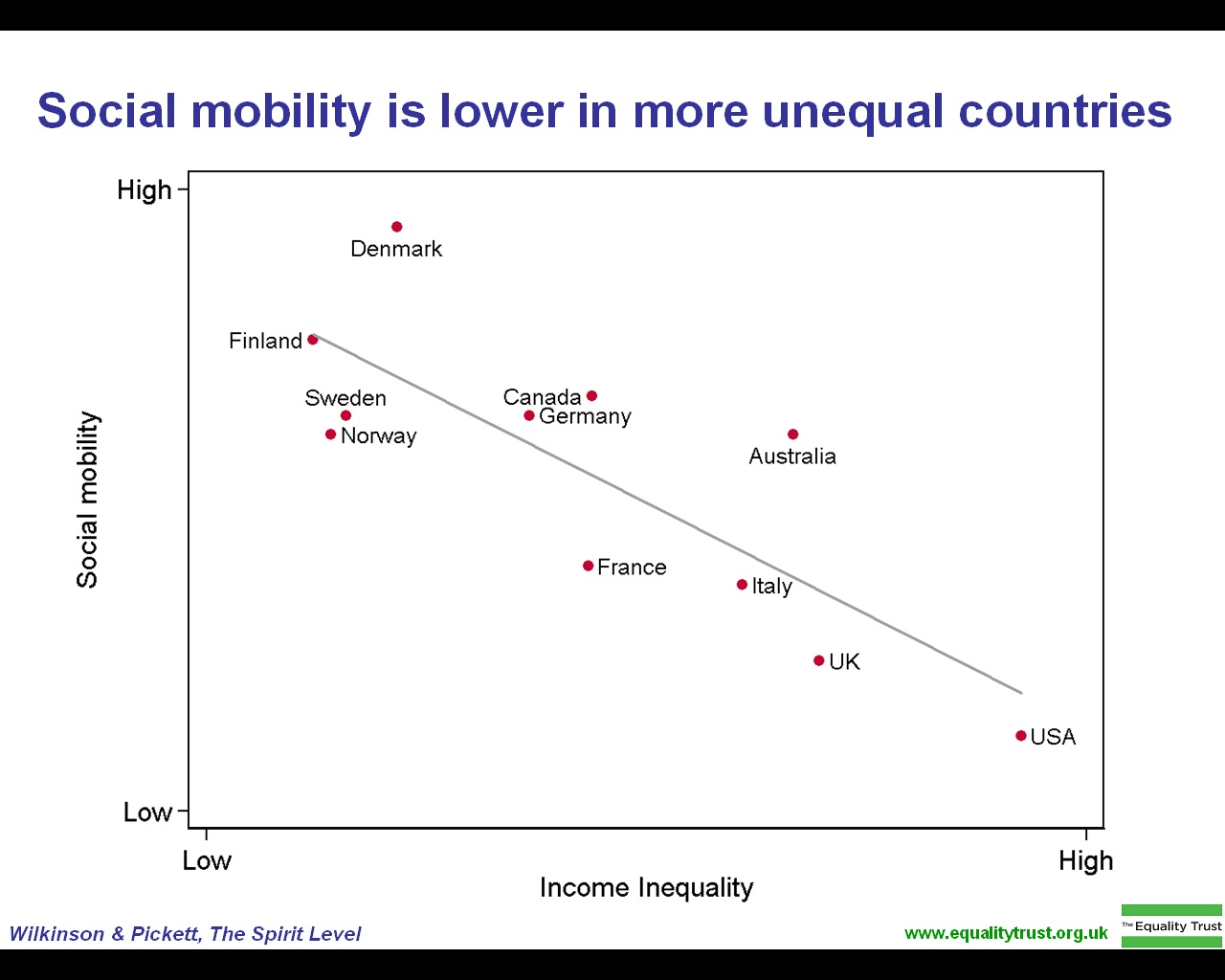
What the German education system recognizes is this: not everyone needs to go to university. There are lots of other satisfying career paths.
Nobody is giving slack to kids who did not managed to get to college. They are expected to be mature. I'm pretty sure college students are as capable as them.
My point is that there is always a way to advance if you have the brains and the drive to do it. In addition to that you can easily receive financial support from the German state if your family is unable to pay for your desired education. I don't think the system can do much more as it already offers all the opportunities you could hope for.
So this then leads to the question of why social mobility is still low despite all of this. Possibly it has more to do with the people's general mindset. Parents with academic degrees are likely going to push their children in the same direction. Parents without a degree, on the other hand, may very well tell their children that an apprenticeship has served them just fine and that there is no need to get an academic degree. This, I think, is the big difference. In the US there is this idea of advancing and making more of yourself (even if that has become more difficult, but that's not the point here) while German society is much more static. I think this is the real reason for low social mobility that people are simply not that driven to chance their circumstances and not even free education and financial support can change that.
Your argument seems to be that since there are some people have moved between social tiers, anyone can move between social tiers if they choose the right strategy.
This is a plain fallacy.
http://www.theguardian.com/news/datablog/2012/may/22/social-...
  Social mobility is the movement of individuals, families,
  households, or other categories of people within or
  between social strata in a society. It is a change in
  social status relative to others' social location within a
  given society.
Combined with funding based only on the number of students provided by the govt. the quality in education possibly doesn't differ enough to provide any effect on social mobility.
Not saying they are worse than the german system, but certainly not better.
What I'd like to read more about is research on progressive fee systems (e.g. based on family income) and the consequences on admissions and subsequent performance.
[1] e.g. http://onlinelibrary.wiley.com/doi/10.1111/1468-0297.00075/a...
That is the argument used to introduce the fees. Once they are introduced, poor person chance to get into university gets even lower. Expensive University basically constitutes huge advantage for kids of the rich, it makes competition for well paid jobs lower.
Moreover, rich in Germany pay more in taxes, so they really pay more.
More to the point, does it increase participation of poor people in the best universities and the best (as reflected in higher salaries) degree programmes?
The Italian experience is that free universities were (are) routinely oversubscribed. They opened loads of new universities in poorer areas, and still were eventually forced to introduce limits with entrance exams. The most in-demand institutions eventually reintroduced fees, although much lower than UK or US rates (we are talking 100/200 euro per month, tops). So I'd say the answer is yes.
In fact, Italy has now the opposite problem: there are too many graduates and not enough jobs, so highly-educated people (especially from poorer backgrounds, i.e. lacking long-standing social connections) are now moving abroad in very high numbers.
How many graduates in Political Sciences and Literature are there ?
How many job openings that require this specific knowledge ?
Most of my collegues graduating with me in Electronics were working in Italy within weeks/months of graduation.
But I generally agree that being available to everybody the degree in Italy is somewhat devalued.
I'm not saying degrees are "devalued" (European opportunities abound, after all, and most Italian graduates are actually very smart), but it illustrates that making education (almost) free will always result in growing numbers of graduates from all backgrounds. This is a good thing overall IMHO, but should be expected and planned for.
Correlation does not imply causation. In Spain, jobs that did not require a university degree were paying really well before the crisis, so many people were joining the labor force at a young age instead of going to university. From my observations, this was specially prevalent among people that came from less educated families. Suppose that at the same time university fees were going up (I'm not sure about this). In that scenario, if you looked at the data, you could wrongly conclude that rising tuition fees were discouraging people with less educated backgrounds from attending university.
In Germany, tuition is almost non-existent (usually some fees of maybe 150€/semester, although a few years back there was a phase of actual student fees of - still laughable - 500€/semester), and if your parents don't make much money, or if you have many siblings, you can even get a half-credit/half-scholarship from the government (AFAIK even without interest, called "Bafög"), so especially for poor kids it's as easy as nowhere else in the world to go study. In smaller towns you can also get a student dorm room for under 200€, and overall living (esp. groceries) in Germany is quite cheap.
Yet Germany has a very low number of working-class students, for whatever reasons. Usually I think it's the parents' influence (but don't ask me why).
We also now have student credit now, in case you don't qualify for Bafög money, but unlike consumer credit which has become quite common, student credit doesn't seem to find many friends. People don't want to go borrow 10-30k for a college degree, but they'll happily finance their 25k cars or their 300k+ condos/houses.
I think there are two reasons:
1. Three-tiered school system: German children are separated after the fourth grade and go to three different schools (Hauptschule, Realschule, Gymnasium) and only if Gymnasium graduates can go to universities. In theory this should happen depending on their academic abilities, but in practice it depends on the ability of your parents to support you in school and their interest in your academic career, too. Parents who went to the Hauptschule may think that this is the best way for their child, too.
2. For many jobs you don't need a degree or better you cannot even get a college degree. Nurses, craftsmen and many more professions are trained in vocational schools (which are counted as secondary education in OECD studies). While a US nurse attends a college (as far as I know) and therefore is counted as tertiary educated.
The early separation isn't the greatest thing (although there have also been people switching, or a friend of mine who changed from Gymnasium to Realschule and after 10th grade when Realschule finished he continued on the Gym and actually got his Abitur), but I actually think it helps because different students can learn at different levels and speeds.
Your criticism stands, though, and more recent attempts to reform the school system have introduced "Gesamtschulen", where all students learn together in one school, but pick different courses at different levels. The results are mixed (not as easy as black+white), but AFAIK not that bad.
Finnish students get allowance from the government for the duration of their studies (max ~60 months) and get government backed cheap loans which they start paying back after their studies.
My own experience is that there are people from very varying backgrounds in the Finnish universities.
Thought experiment: American students also get government backed cheap loans. Further, since these government-backed cheap loans are often used to cover cost of living as well as tuition, they are a de-facto allowance from the government (albeit one you need to pay back after you are graduated). And yet the american education system seems to have a bunch of dysfunctions that the Finnish one does not.
There has to be other differences that cause this, it can't be the presence of cheap loans. The conventional wisdom in America is that cheap loans incentivize universities to raise tuition, because they know the money is still coming in. Why does this effect not take place in Finland?
When the government is directly covering the cost of education, they are the ones bargaining with educational institutions. If the institution tries to bump prices, the government can pull funding for that institution and basically eliminate their revenue. As such, the institutions and government are required to negotiate much more rationally.
The question should not be "what is different between the systems?" but "what, if anything, is similar?".
If the university finances are decoupled from student ability to pay, then loan availability doesn't distort the education institutions, but instead mainly affects the lifestyle of students and their families.
You still need to live. The maximum loans don't appear to take in to account the cost of rent and food/transportation. When+where I went to Uni there were no fees and there was a loan system but the loan didn't cover living expenses at all, IIRC it didn't even cover my rent (which was as high at the time as London rents; London students had a higher loan rate however to accommodate the high rent). Without relatively well off parents I couldn't have attended the high-class institution that I did.
The usual answer is to have a part time job - but with lectures starting at 9am every day, finishing labs by about 6pm some days and evenings spent at the library the only time for a job was weekends, which would mean no sport and/or no social life.
Anyway, I digress, the UK model seems only really good in theory. Many, many people appear to be at "university" only to avoid work or having been convinced that they "need a Uni education to function as part of society" by political parties who seemingly only wanted to reduce the unemployment figures. Perhaps that's a little too cynical but I think there's much truth in it too.
>In this case it doesn't seem fair to tax people who are poor to pay for something that is mainly of benefit to the rich. //
Educated workers benefit society. They often pay larger tax bills but they also fill roles in fields like medicine, education, engineering, and such that serve society. We need educated people to work and bolster our economy if we want to live in the way we've become accustomed to. We don't have to pay but we'd be foolish IMO not to. Like begrudging doctors their high pay when we as a society en masse appear not to blink at paying footballers, bankers, pop-stars and such many order of magnitude more [I know the economics aren't so simple]. The UK is looking to immigration to solve the crisis of lack of skilled workers and at the same time placing financial blocks in front of those that might be able to be home-grown to fill those positions in the future. Maybe that's not a bad thing but it seems like one, not least because of the skills drain we place on other countries.
While the idea of removing costs sounds good there are just so many negatives. Means testing should still be done, raise the bar so that the truly well off are the only ones paying and not the lower income levels. The second "means" testing would be, is their object an effective degree. I see no reason to pay for someone's hobby, paying for a degree to benefit society is another.
which redirects my thinking too, its free if your going to be a teacher, public defender, or similar, provided you complete the course and server for a set number of years, no less than ten.
There are more destructive forms of welfare than academic credentialism. Its an interesting idea to think about... if you can't get a job, go to school for free collecting degrees and certifications until you get a job.
I've checked the numbers and in terms of accounting overhead and criminal justice system overhead it is somewhat cheaper, even with hyperinflated .edu costs, to send a kid to school than to jail. Even if only 1 in 3 kids gets caught and enters the criminal justice system (we do approach that ratio with some minorities) the numbers still work out that its cheaper to send all 3 of them to a community college than sending just 1 to prison.
A well educated society is essential to an effective and efficient democracy and I would argue beneficial to culture and quality of life overall.
The US is actually a very good example for what happens, if a significant part of your population is not well educated.
Even if it's "free," there are opportunity costs for spending years and years of your life in school. Rich families can afford these years with no problem. But the worst parts of a credentialism race fall on those at the bottom who can't spend a decade in school or can't hack the classroom material.
Instead they need to focus on provide the required education to get those who are economically disadvantaged into a higher and sustainable income level.
Regardless, we should not be in the business of paying for people to be students, especially those who can easily pay for it and for those who have no real goal in mind other than to be a student. Society is not at the point where we can simply employ people to learn who put it to no use.
The only result of sending unprepared people college, will be making college less safe and destroying quality of education for kids who are prepared for college.
http://www.washingtonpost.com/blogs/wonkblog/wp/2014/09/30/w...
Consider, a doctor might make more money but the value of the lives they save is greater than their income. So, it's really a question of how much should the state subsidize education.
Anyway, the direct costs of education might be paid for by the state. But, the opportunity costs are paid for by the students who could be working and getting paid vs going to school. So, even at 100% tuition reimbursement students still cover a significant fraction of the cost of a collage degree.
http://www.huffingtonpost.com/2009/04/08/how-much-does-smoki...
http://www.babycenter.com/0_how-smoking-during-pregnancy-aff...
The Dutch school system uses what you're suggesting actually; the government offers scholarships to all students, which is effectively a (low-interest) loan; if you finish your education, that loan or part thereof (depending on whether you took an extra loan, it's complicated) is forfeited, i.e. you don't have to pay it back. The remainder can be paid off in monthly terms, but the amount you have to pay off is determined based on how much money you earn.
If you are unable to get a good enough job to pay back that loan, it's forfeited after 15 or 25 years (I think it used to be 15 and they upped it recently).
It's kinda complicated though, and they had some heavy cuts in the system a while ago due to the economy - which IMHO is a huge shame, since a lot of students won't choose a higher education now, causing university studies to only be in reach of the rich once again.
If you have two people who earn the same amount of money and one receives a service (university education) and the other does not. Does it make sense to split the costs of that service if the one who received it can afford to pay on their own?
Personally, I'd be happy to subsidize it in that way. The overall cost to me is low and the overall benefit to society is quite high.
It seems to me that most of the resistance comes from this "I had to do it, so you should too" mindset and it's really not beneficial to anyone. As Retic mentioned, this isn't a zero-sum game and thinking about it like it is doesn't help anyone.
A better use of your example would be to point out that both of those people may have been able to pay for a third person that couldn't have afforded it otherwise. The fact that one of them could have is irrelevant.
If student loan repayments are capped at X% of income and you do not believe that getting a university degree will raise your earnings by at least X% then it probably is not in your best interest to attend university. The same math applies regardless of how much money you have before you start university.
I was unaware that the role of university was to take your salary from X to X+Delta. What if you are a better citizen, a nurse (earning less than a secretary, but contributing more), a street artist? What if you earned more as a construction worker, but instead studied science and work part time as a scientist and part time doing community work?
The salary and taxes are not the only measure of your contribution to society and of the positive effect of university.
The current Scottish Government has been widely criticised by opponents for using cuts in the College budgets to fund their free tuition policy for Universities.
As colleges and universities are, sadly, still stratified by class in the UK this could have a detrimental on effect for social mobility in Scotland.
http://www.bbc.co.uk/news/uk-scotland-scotland-politics-2387...
They suggest that those who require to use college to gain entrance to university and those who cannot afford to be supported through four years of higher education (grants and loans being unable to cover living costs) are left out (along with young people who simply want to learn a trade) in favour of those that can afford it.
I, however, was very careful to not bring personal politics into this ;-)
Even the uneducated tend to be better off in a country with a high education average than in a country where everybody is on their level. I'd rather be an illiterate in the Sweden, Switzerland or the USA (to take a few samples from all over the spectrum between welfare and market) than in any of the many countries that never succeeded in building a true culture of education.
You may question the causality of this (does education cause wealth or does wealth cause education?) but i doubt that it would even be possible to bootstrap high education with a market-only approach even under the most beneficial circumstances otherwise. I'm no expert in the history of American education institutions, but i'd be surprised if they were not founded with intentions more along the lines of the greater good of the colony or whatever local scope the founders were thinking of, than along the lines of offering even better opportunities for the rich. At the time, most of the truly rich were probably quite happy sending their offspring back to England anyway.
On one hand it seems obvious that if you reduce costs of attending university you remove a barrier that would prevent economically disadvantaged people from attending.
But on the other hand, university students, especially those at the best universities disproportionately come from better economic backgrounds and this seems to be true everywhere. In this case it doesn't seem fair to tax people who are poor to pay for something that is mainly of benefit to the rich.
In the UK we have a student loan system where students do not have to pay back loans unless they earn over a threshold amount, so in theory there is nothing to prevent a poor person going to university regardless of how high the fees are.