I would say that is lower compared to Scandinavian countries but generally high.
From Wikipedia:
http://upload.wikimedia.org/wikipedia/commons/thumb/6/6c/Soc...

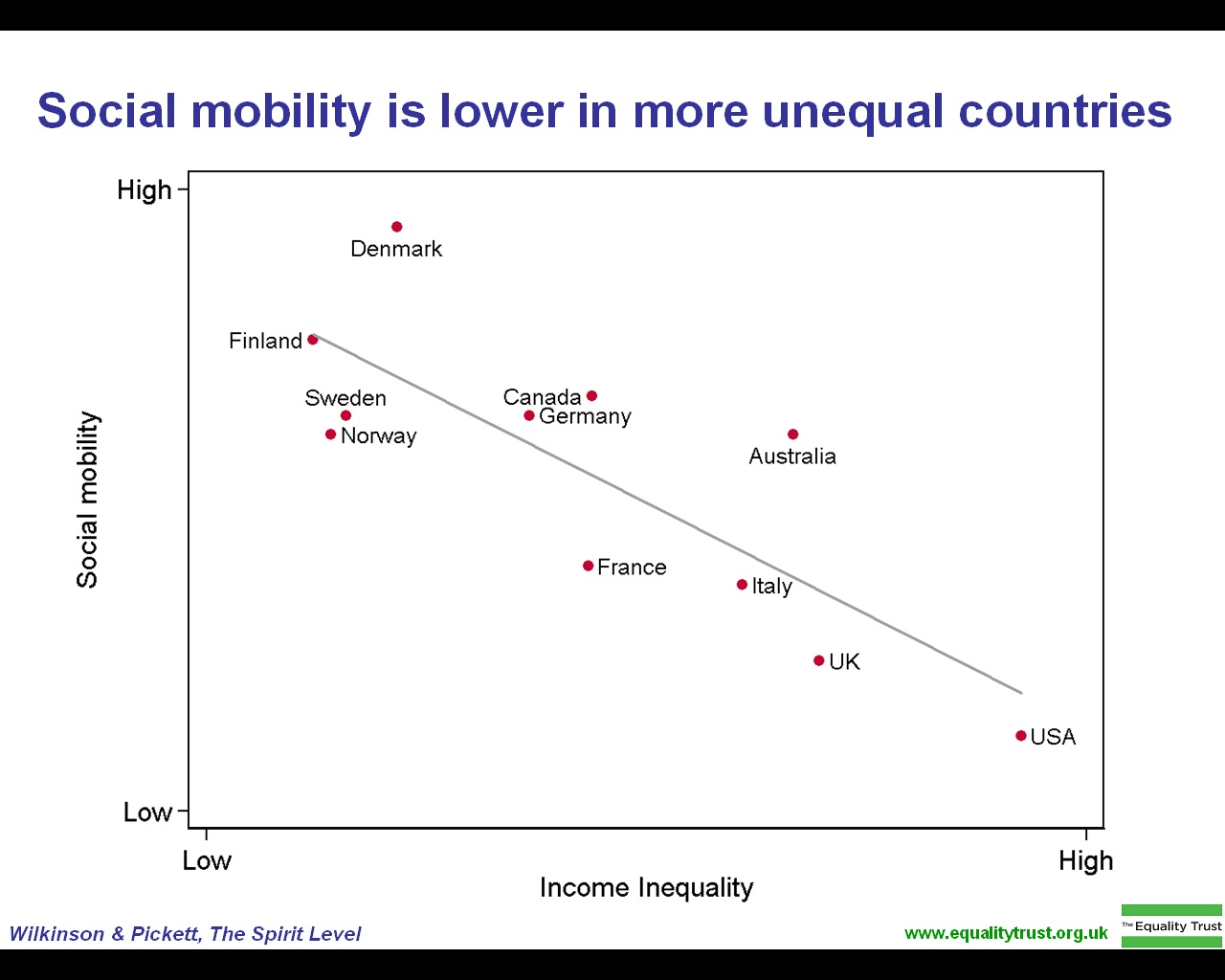
What the German education system recognizes is this: not everyone needs to go to university. There are lots of other satisfying career paths.
Nobody is giving slack to kids who did not managed to get to college. They are expected to be mature. I'm pretty sure college students are as capable as them.
My point is that there is always a way to advance if you have the brains and the drive to do it. In addition to that you can easily receive financial support from the German state if your family is unable to pay for your desired education. I don't think the system can do much more as it already offers all the opportunities you could hope for.
So this then leads to the question of why social mobility is still low despite all of this. Possibly it has more to do with the people's general mindset. Parents with academic degrees are likely going to push their children in the same direction. Parents without a degree, on the other hand, may very well tell their children that an apprenticeship has served them just fine and that there is no need to get an academic degree. This, I think, is the big difference. In the US there is this idea of advancing and making more of yourself (even if that has become more difficult, but that's not the point here) while German society is much more static. I think this is the real reason for low social mobility that people are simply not that driven to chance their circumstances and not even free education and financial support can change that.
Your argument seems to be that since there are some people have moved between social tiers, anyone can move between social tiers if they choose the right strategy.
This is a plain fallacy.
http://www.theguardian.com/news/datablog/2012/may/22/social-...
  Social mobility is the movement of individuals, families,
  households, or other categories of people within or
  between social strata in a society. It is a change in
  social status relative to others' social location within a
  given society.
Combined with funding based only on the number of students provided by the govt. the quality in education possibly doesn't differ enough to provide any effect on social mobility.
Not saying they are worse than the german system, but certainly not better.
However, as far as education is concerned, it would be wrong to blame universities. The German school system is very stratified, "locking in" a child's destiny at a young age. Via parents who understand this and fight tooth and nail to get their child into the highest tier of the school system, it leads to high correlation between parents' and children's academic achievements.