I think the mayor win for coding was reasoning. That's why such a small model can match GPT-4.1 in coding, but I suspect that GPT-4.1 still wins in general world knowledge due to bigger size.
Encyclopedic knowledge matters relatively little in perspective, given the expectable future developments: even the more knowledgeable of us will use that knowledge for reasoning and intuition (and we will have absorbed the intellectual keys during our training), but under our professional hat we should in theory be ready to go "I stand corrected" and "more precisely" with the actual data at hand.
I.e.: for the encyclopedic knowledge needed, the /understander/ will have a RAG subsystem and a corpus of knowledge to inquire upon processing queries.
(Corroboration: we can't delirate, and neither can the machine...)
And to improve reliability, if the machine can check, it will have to check. "Costly" cannot be an excuse.
Model doesn't know what it doesn't know.
Said abilities - intellectual strength - are immensely more important than notions. The relation between network size and intellectual strength, vs network size and notions (original topic in this branch), is presumably not yet that clear. Intelligent models may not necessarily be embedded with explicit information of everything, though they will have to have ways to reach that upon contingent necessity (to solve specific problems). Like us.
For example, you if you instruct a model to create decoder for some data type users will upload to your website. The intelligent model without notions will retrieve information about that data type and build a working decoder, but it might miss from context that users uploading to a website means untrusted input and thus won't even try to gather information about what it needs to be done to securely handle such uploaded data.
Or if you give it a task to translate text to a language it didn't encounter during training. You can provide it with grammar rules and a dictionary for information retrieval, but I guess it won't perform as well as inteligent model that already has some fundamental notions of that language and only needs a dictionary to expand its vocabulary.
Gpt-4.1 only knows a lot of patterns, but doesn't have reasoning intelligence that would help it properly use that knowledge. So, a small reasoning model can easily beat it in a lot of tasks. The question is how will, 14 months from now, new small reasoning models compare to current big reasoning models.
How much information needs to be embedded is not yet clear, but currently, bigger reasoning models are still better at complex tasks than small reasoning models. Either sweet spot of embedded notions is higher that what current small models have or information retrieval ability needs to improve.
Thank you for giving me hope!
For 16GB laptops, Qwen 3.5 9B is the undisputed champ.
Gemma 4 31B is the top dog at small model coding, but is dense so it needs ~48GB unified RAM for full context. If you want decent coding on a laptop you need a lot of RAM. But this shouldn't be surprising, dev machines have always needed lots of resources.
> For 16GB laptops, Qwen 3.5 9B is the undisputed champ.
Thanks
For smaller ones like my native Latvian, the output could be confused for good translation from across the room, the words do look like Latvian words. But the quality is Google translate circa 20 years ago, tops.
It could probably do a decent enough translation to English, if all you need is to get the gist of text. But for smaller European language outputs, nothing comes close to Gemini.
I'm not doing translations, rather querying Hebrew text with a Hebrew prompt.
(not recommendation, I've not used it .. yet)
Which is unsurprising in the AI space.
You get a wall of text showing you various random fine-tuned models by random people, and that is basically it.
Actual sane default requirements like "just give me the normal AI labs", "please filter for dense only" and "I want this exact context size at this quant" are not part of the tool, apparently. Neither is "compare these quants for me for the same model".
Or maybe it's just hidden enough that I did not find them before I've stopped caring.
Conway's law is at it again.
(Honestly I think Apple's "AI push" could do worse than just focus on a curated model library, a couple of Apple-standard Gemini distillations, an OS-level model manager and some sort of tweak of their containers system to do what Docker's sbx does. They could demystify a lot of this shit.)
Creative writing is not my focus, so this is only secondhand information. r/LocalLlama tends to focus more on the technical side; if you want more creative side check out r/SillyTavern as well (but type of info does bleed over between them).
Qwen models are always good. The 35B A3 model is a MoE model which means it has higher performance in RAM constrained environments compared to the 27B dense model (which is better at coding).
I don't have experience to rate it's Hebrew or Greek performance but apparently it's not bad.
Which quant of Gemma? For coding Qwen seems to be pretty far ahead, but generally Gemma seems to have a "vaster" set of knowledge, but armed with a search tool it doesn't really matter, and Qwen 3.6 been really great for all sorts of tool calling. I mostly do programming and related things though, fwiw.
> I was going off of peoples' opinions on reddit
It's extremely astroturfed all over the place, especially the larger subreddits, and especially the one related to a specific animal in a specific location. It's sad, as early on it was a great resource, but now it's mostly paid posts and a race to the bottom, with lots of piling, and all the knowledgeable people I used to recognize are nowhere to be found.
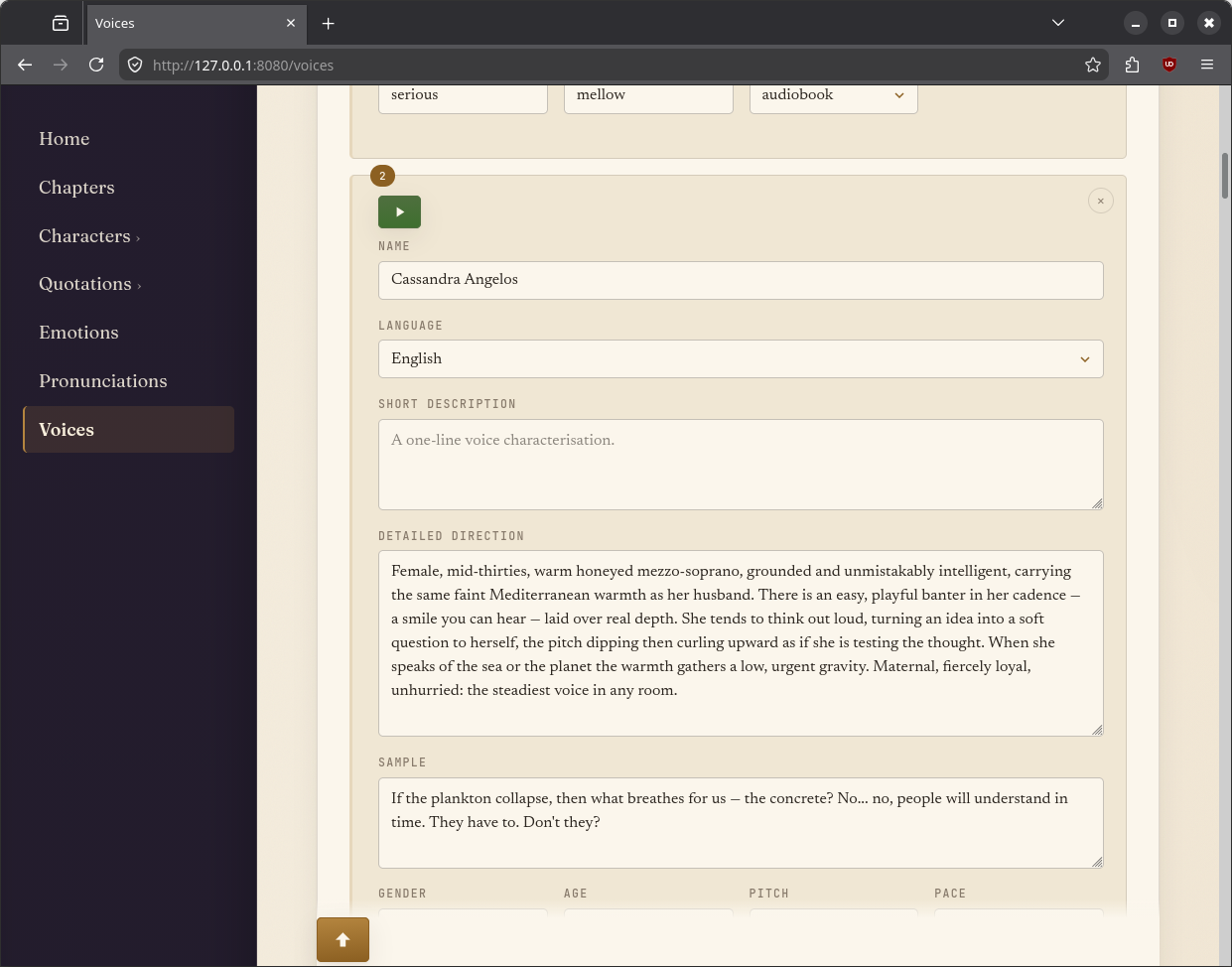
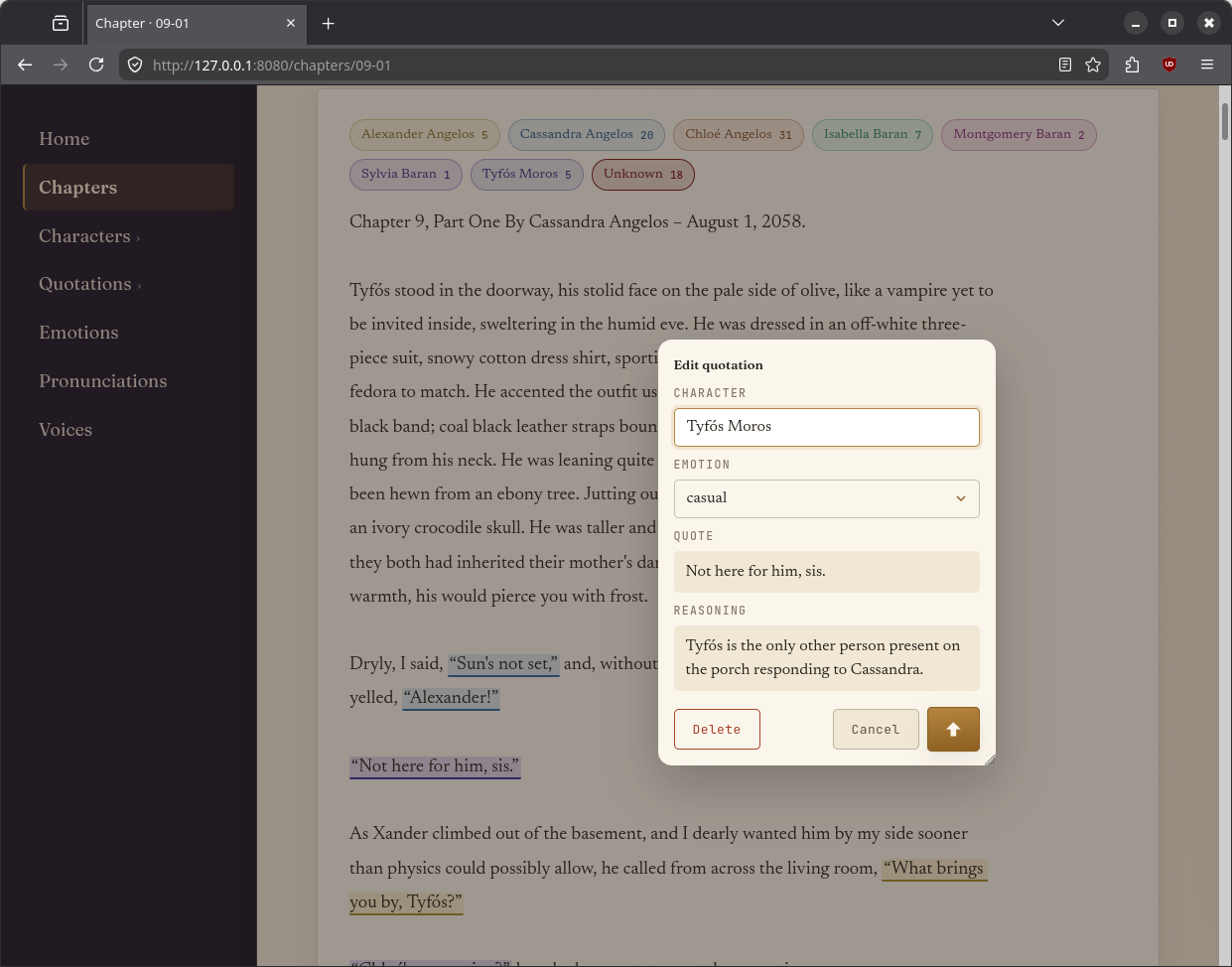
Screens:
* https://i.ibb.co/TBBV5nJk/kl-01.png (voice design)
* https://i.ibb.co/nNvvKDyV/kl-02.png (quotation attributions)
I don't have unified RAM tho and offloading to CPU is dog slow, which is why I'm interested in 7b-12b models.
Why do people with modern laptops have such little amounts of ram?
I’m a system administrator and I can do my job with no issues at 16GB. Most days 8GB would likely be enough, since I’m just using and abusing other systems anyway.
Java devs at my last job were still running 16GB in 2020. Admittedly that was a while ago. Still not a decade.
Close some Chrome tabs?
Fine if work's paying, but for personal devices (that might have been purchased before local models got good), people have what they have.
Probably doesn't matter these days with all-day batterys, but now the demand-supply curve is lopsided.
It's right there in the middle benchmark bar "LiveCode Bench" 72%.
you can run qwen 3.6 35BA3B on a 12-16GB vram gpu and ot works pretty well.
https://www.youtube.com/watch?v=8F_5pdcD3HY&t=1s
even the 27B in some quants can fit.
https://www.reddit.com/r/LocalLLaMA/comments/1tkmgwj/qwen27b...
qwen IMO is far better for coding, esp agentic coding when combined with something like Pi, it comes probably close enough to Sonnet for a lot of use cases.
Gemma family is better for almost all other tasks you'd use a local llm for.
I had horrible luck with Gemma 4 12B with a variety of coding harnesses - but as usual Qwen 3.5 9B did OK.
EDIT: CORRECTION: I pulled a fresh copy of Gemma 4 12B and inference code and the tool use problems in my test harnesses are fixed. Gemma 4 12B is slow on my 16B MacBook Air, put produces OK results.
(Though it is gaslighting me about PHP anonymous functions.)
I would not use it to write code (the MoE 26B writes really good PHP), but it appears to have absolutely good enough knowledge to write implementation plans, and I think that could be useful in a sort of agentic coding tutorial environment.
I test these models with simple things. My favourite mini test is asking an AI to write a "last login" tracker facility for wordpress with a sortable admin column, which is trivial code — only a few lines -- but touches on a reasonably deep bit of the WP API. If you ask it to prompt you with clarifying questions, those questions are quite revealing.
It can write the code. Not tested it but I am sure it works. It's not as elegant.
It is not as good at understanding nuanced instructions as either the 26B or the sparse Qwen 3.6. There are concise things you can say in a prompt to Qwen 3.6 that have it draw logical conclusions that fully impress me.
I am more impressed by it than I expected. I reckon this would be quite useful in a tutorial tool.
(I say this as a sort of qualified cynic; I think much of the AI circus is a farce. But if these things are to ever be useful for teaching without making people dependent on some cloud "intelligence tap", this is progress)
That speed for token output indicates to me that it somehow is using hybrid mode and involving cpu+system ram somehow. That ~5tk/s is about the ram bandwidth of DDR4 RAM versus that size model at 4bit. Any consumer GPU with 12 GB like a nvidia rtx 2080 or rtx 3060 should be doing 20+ tk/s with llama.cpp and CUDA backend.
I should play a bit more with llama.cpp options and see what bappened there. Thanks!
Up until this point, I've found the cost/value to unequivocally favor using a cloud subscription, but I would be lying if I didn't worry that one day OpenAI is going to increase the price for my subscription by 5-10x. I rely on these tools enough that if there is a real viable local option, I'm going to take it.
Not really. There's a reason the announcement didn't include ANY benchmark (!) and didn't mention EXACTLY what is the memory bandwidth. It's going to be dog-slow unusable for large models, as tok/sec is basically bandwidth divided by active weights. Rumoured 300GB/s / 30GB active weights (decent model) = 10 tokens per second, which is really slow
The Nvidia boxes have only slightly more memory bandwidth, so I wouldn't expect them to be notably faster. At least not enough to make it useful interactively at that scale.
Even batched usage needs to be fast enough to deliver results in a reasonable time. Overnight runs are useful, 24 hour runs are...less so.
Anyway, most of the time people are talking about interactive use, and there's currently an upper bound on how large a model can be for local hosting on a reasonable budget (i.e. not a crazy amount more expensive than what a high end developer desktop or laptop costs). The sweet spot is probably currently the big Qwen 3.6 or Gemma 4 models, which are in the ~60GB range for 8-bit quantization plus a large context.
The dense model is almost usable, but feels really sluggish, even with MTP. I think it's about 12-15 tokens/second on the Strix Halo. Slow enough to where I'd rather pay to use a cloud model.
I might try the 6-bit version of the dense model to see how it behaves, though. Maybe it'll retain its bug hunting abilities while making it fast enough to use interactively and not take all day for benchmark runs.
the value of local models is allowing normal people to access AI without needing to subscribe to cloud services. this is esp imp for the rest of the world where even a 12GB gpu is extremely expensive.
there is no real viable local option that will come even close to Sonnet/Gemini Flash or the cheaper chinese models. Even if your pc costs <$2k you are never going to recoup the hw costs, and the results will be far worse.
As a work tool, this is reasonably priced. You can save a bit of money by opting for a non-laptop form factor.
I'm looking forward to the fallout when the data center bubble bursts. There's a good possibility we'll see a glut of hardware, either on the used market or from manufacturers that no longer have massive orders from OpenAI and the like.
Can you instruct it to use a lsp?
I had this with Gemini: in the middle of a C++ program it once said RParen instead of using )
It was easy to fix of course, but it makes you question what is going on inside its head.
The result is decent, but it had a few bizzare/trivial syntax errors I had to fix manually: it would do an extra closing bracket or paren a few times, and wanted to separate function definitions with comma. Not sure what that was about, but otherwise the output run just fine.
So, with those qualifiers, I think it's a decent local coding model. It roughly compares with GPT-4.1 (!!), released 14 months ago, on the output: https://senko.net/vibecode-bench/2025/minesweeper-gpt-4.1.ht... (actually I'd call it better, but those syntax errors...)
I ran the quantized version (4-bit GGUF) on my consumer-grade card with 12G of VRAM and got 5t/s for output. Not for interactive use for coding, but fairly capable model.
To me, it's fascinating how much progress we got in over a year. GPT-4.1 was considered an extremely capable coding model. Now we got something with 12B of params performing roughly the same (in this specific benchmark, disclaimers, etc).
Lists of various models I tested: https://senko.net/vibecode-bench/