That framing doesn't do him and the team justice. There is (or better, was) a 3.5h long story about NVIDIA GPUs finding their ways illegaly from the US to China, which got taken down by a malicious DMCA claim from Bloomberg. It is quite interesting to watch (Can be found archive.org).
GN is one of the last pro-consumer outlets, that keep on digging and shaking the tree big companys are sitting on.
He's essentially a low quality tabloid.
Not everywhere:
https://archive.org/details/the-nvidia-ai-gpu-black-market-i...
00:00:00 - The NVIDIA AI GPU Black Market
00:06:06 - WE NEED YOUR HELP
00:07:41 - A BIG ADVENTURE
00:10:10 - Ignored by the US
00:11:46 - BACKGROUND: Why They're Banned
00:16:04 - TIMELINE
00:21:32 - H20 15 Percent Revenue Share with the US
00:26:01 - Calculating BANNED GPUs
00:29:31 - OUR INFORMANTS
00:31:47 - THE SMUGGLING PIPELINE
00:33:39 - PART 1: HONG KONG Demand Drivers
00:43:14 - PART 1: How Do Suppliers Get the GPUs?
00:48:18 - PART 1: GPU Rich and GPU Poor
00:56:19 - PART 1: DATACENTER with Banned GPUs, AMD, Intel
01:06:19 - PART 1: Chinese Military, Huawei GPUs
01:09:48 - PART 1: How China Circumvents the Ban
01:19:30 - PART 1: GPU MARKET in Hong Kong
01:32:39 - WIRING MONEY TO CHINA
01:36:29 - PART 2: CHINA Smuggling Process
01:43:26 - PART 3: SHENZHEN's GPU MIDDLEMEN
01:50:22 - PART 3: AMD and INTEL GPUs Unwanted
01:56:34 - PART 4: THE GPU FENCE
02:06:01 - PART 4: FINDING the GPUs
02:15:12 - PART 4: THE FIXER IC Supplier
02:21:12 - PART 5: GPU WAREHOUSE
02:27:17 - PART 6: CHOP SHOP and REPAIR
02:34:52 - PART 6: BUILD a Custom AI GPU
02:56:33 - PART 7: FACTORY
03:01:01 - PART 8: TAIWAN and SINGAPORE Intermediaries
03:02:06 - PART 9: SMUGGLER
03:05:11 - LEGALITY of Buying and Selling
03:08:05 - CORRUPTION: NVIDIA and Governments
03:26:51 - SIGNOFF
But yes, once they reedit and republish themselves (or manage some sort of appeal and republish as-is) then of course linking to that (and a smaller cut of the parts they've had to change because Bloomberg were litigious arseholes, if only to highlight that their copyright claim here is somewhat ridiculous) would be much better.
Personally, I found the length of the quotes from politicians kind of tedious, but I sure wouldn’t want them to capitulate to Bloomberg after this.
They made six figures from merch sales on that investigation. Not much, but more than Youtube ads.
Ask Beyonce.

You guess the result.
GN is unique in paying for silicon-level analysis of failures.
der8auer also contributes a lot to these stories.
I tend to wait for all 3 of their analyses, because each adds a different "hard-won" perspective.
In general PC enthusiasts have always treat it these corporations bit like sports teams.
He never really got over the stuff with Linus and doubled down on stupid things. I think they both have a great place in the tech scene and LTT's videos of recent have been a lot better quality and researched then yesteryear.
This was Gordon's style, and Steve is continuing it. He has the courage to hit Bloomberg offices with a cameraman, so I don't think his words ring hollow.
We need that kind of in your face, no punches held back type of reporting when compared to "measured professionals".
> We use a Noctua cooling solution for both systems. For the 1st system, we mounted the heat sink centred. For the 2nd system, we followed Noctua's advice of mounting things offset towards what they claim to be the hotter side of the CPU. Below is a picture of the 2nd system without the heat sink which shows that offset. Note the brackets and their pins, those pins are where the heat sink's pressure gets centred. Also note how the thermal paste has been squeezed away from that part, but is quite thick towards the left.
> But note that the 1st failure happened with a more centred heat sink. We only made the off-centre mounting for the 2nd system as to minimise the risk of a repeated system failure.
I didn't write the article, I was just commenting because other users seemed to miss information that was written in it.
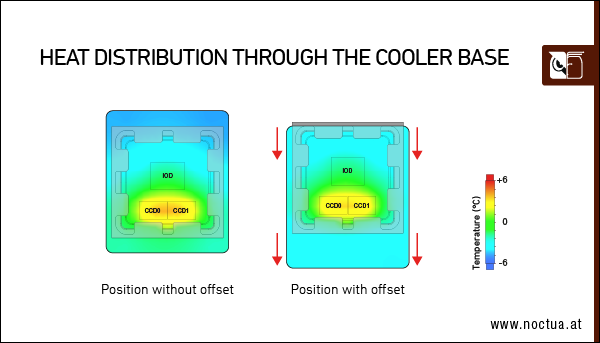
The picture with the thermal paste shows that paste was squeezed out from the entire perimeter of the CPU, so the cooler is making contact with the whole CPU. The paste is squeezed thinner near the lower side of the CPU because that's where the mounting pins are located, meaning that's where the mounting pressure is the strongest. The impression left by the thermal paste matches the diagram on Noctua's site ( https://noctua.at/pub/media/wysiwyg/offset/heat_cooler_base_... ).
Noctua lists the NH-U9S cooler as being compatible with the 9950X, and claims it has "medium turbo/overclocking headroom", see https://ncc.noctua.at/cpus/model/AMD-Ryzen-9-9950X-1831 . I'm not sure how they come up with their compatibility ratings, but I generally trust Noctua knows what they're doing when it comes to CPU cooling.
It's also important to note that the author only tried the offset mount after they had a CPU die when the cooler was mounted centered on the CPU.
Overall, I think it's unlikely that these failures can be blamed on poor cooling.
Probably there's less paste remaining on the south end of the CPU because that's where the mounting force is greatest.
If anything, there's too much paste remaining on the center/north end of the CPU. Paste exists simply to bridge the roughness of the two metal surfaces, too much paste is a bad sign.
My guess is that the MB was oriented vertically and that big heavy heat sink with the large lever arm pulled it away from the center and north side of the CPU.
IMO, the CPU is still responsible for managing its power usage to live a long life. The only effect of an imperfect thermal solution ought to be proportionally reduced performance.
AMD is somewhat worse than Intel as their DDR5 memory bus is very "twitchy" making it hard to get the highest DDR5 timings, especially with multiple DIMMs per channel.
I got 2x32GB sticks of RAM with the plan to throw in another two sticks later. I had no idea that was now a bad plan. I wish manufacturers would have just put 2 DIMM slots on motherboards as a “warning.”
Despite this, the overtemperature protection of the CPUs should have protected the CPUs and prevent any kind of damage like this.
Besides the system that varies continuously the clock frequency to keep the CPU within the current and power consumption limits, there is a second protection that stops temporarily the clock when a temperature threshold is exceeded. However, the internal temperature sensors of the CPUs are not accurate, so the over-temperature protection may begin to act only at a temperature that is already too high.
So these failures appear to have been caused by a combination of not using the appropriate coolers for a 200 W CPU, combined with the fact that AMD advertises a 200-W CPU as an 170-W CPU, fooling naive customers into believing that smaller coolers are acceptable, and with either some kind of malfunction of the over-temperature protection in these CPUs or with a degradation problem that happens even within the nominal temperature range, but at its upper end.
Noctua's CPU compatibility page lists the NH-U9s as "medium turbo/overclocking headroom" for the 9950X [0]. I don't think it's fair to suggest their cooler choice is the problem here.
On the same page linked by you, Noctua explains that the green check mark means that with that cooler the CPU can run all-core intensive tasks, exactly like those used by the gmplib developers, only at the base clock, which is 4.3 GHz for 9950X, with turbo disabled in BIOS.
Only then the CPU might dissipate its nominal TDP of 170 W, instead of the 200 W that it dissipates with turbo enabled.
With "best turbo headroom", you can be certain that the CPU can run all-core intensive tasks with turbo enabled. Even if you do no overclocking, but you run all-core intensive tasks with turbo enabled, this is the kind of cooler that you need.
Noctua does not define what "medium headroom" means, but presumably it means that you can run with turbo enabled all-core tasks that have medium intensity, not maximum intensity.
There is no doubt that it is a mistake to choose such a cooler when you intend to run intensive multi-threaded computations. A better cooler, but not much bigger, like NH-U12A, has an almost double cooling capacity.
That said, there is also no doubt that AMD is guilty of at least having some bugs in their firmware or in failing to provide adequate documentation for the motherboard manufacturers that adapt the AMD firmware for their MBs.
> Modern CPUs measure their temperature and clock down if they get too hot, don't they?
Yes. It's rather complex now and it involves the motherboard vendor's firmware. When (not if) they get that wrong CPUs burn up. You're going to need some expertise to analyze this.